COM and NET Component Services 1st Edition Juval Löwy
COM and NET Component Services 1st Edition Juval Löwy
COM and NET Component Services 1st Edition Juval Löwy
COM and NET Component Services 1st Edition Juval Löwy
COM and NET Component Services 1st Edition Juval Löwy
1.
COM and NETComponent Services 1st Edition Juval
Löwy download
https://ebookname.com/product/com-and-net-component-services-1st-
edition-juval-lowy/
Get Instant Ebook Downloads – Browse at https://ebookname.com
2.
Instant digital products(PDF, ePub, MOBI) available
Download now and explore formats that suit you...
QuickTime for NET and COM Developers 1st Edition John
Cromie
https://ebookname.com/product/quicktime-for-net-and-com-
developers-1st-edition-john-cromie/
Programming WCF Services Mastering WCF and the Azure
AppFabric Service Bus Third Edition Juval Lowy
https://ebookname.com/product/programming-wcf-services-mastering-
wcf-and-the-azure-appfabric-service-bus-third-edition-juval-lowy/
Application Architecture for NET Designing Applications
and Services 1st Edition Microsoft Corporation
https://ebookname.com/product/application-architecture-for-net-
designing-applications-and-services-1st-edition-microsoft-
corporation/
Entrepreneurial Economics Bright Ideas from the Dismal
Science 1st Edition Alexander Tabarrok
https://ebookname.com/product/entrepreneurial-economics-bright-
ideas-from-the-dismal-science-1st-edition-alexander-tabarrok/
3.
The Big BackBook Tips Tricks for Therapists
Illustrated Edition Jane Johnson
https://ebookname.com/product/the-big-back-book-tips-tricks-for-
therapists-illustrated-edition-jane-johnson/
The Oxford Handbook of Comparative Evolutionary
Psychology 1st Edition Jennifer Vonk
https://ebookname.com/product/the-oxford-handbook-of-comparative-
evolutionary-psychology-1st-edition-jennifer-vonk/
Hacking Exposed Computer Forensics 2nd Edition Michael
Bass
https://ebookname.com/product/hacking-exposed-computer-
forensics-2nd-edition-michael-bass/
A Farm Through Time The History of a Farm from Medieval
Times to the Present Day 1st Edition Angela Wilkes
https://ebookname.com/product/a-farm-through-time-the-history-of-
a-farm-from-medieval-times-to-the-present-day-1st-edition-angela-
wilkes/
Madame Sadayakko The Geisha Who Bewitched the West
Lesley Downer
https://ebookname.com/product/madame-sadayakko-the-geisha-who-
bewitched-the-west-lesley-downer/
4.
Karachi Ordered Disorderand the Struggle for the City
2014 1st Edition Laurent Gayer
https://ebookname.com/product/karachi-ordered-disorder-and-the-
struggle-for-the-city-2014-1st-edition-laurent-gayer/
6.
2
COM and .NETComponent Services
Dedication
Foreword
Preface
Scope of This Book
Some Assum ptions About the Reader
Definitions and Text Conventions
Other COM+ Books and References
How to Contact Us
Acknowledgm ents
1. COM+ Component Services
1.1 COM+ Component Services
1.2 The Component Services Explorer
1.3 Hello COM+
1.4 COM+ Configured Components
1.5 Applications, DLLs, and Com ponents
1.6 Configuring COM+ Applications
1.7 Debugging COM+ Applications
1.8 Deploying COM+ Applications
1.9 Summary
2. COM+ Context
2.1 Encapsulation via Marshaling in COM
2.2 Encapsulation via I nterception in COM+
2.3 The Context Object
2.4 The Call Object
2.5 Cross-Context Manual Marshaling
2.6 Summary
3. COM+ I nstance Management
3.1 Client Types
3.2 I nstance Managem ent and Scaling
3.3 Object Pooling
3.4 Just-in-Tim e Activation
3.5 Combining JITA with Object Pooling
3.6 Object Constructor String
3.7 COM+ I nstance Managem ent Pitfalls
4. COM+ Transactions
4.1 Transaction Basics
4.2 Transaction Properties
4.3 Transaction Scenarios
4.4 COM+ Transactions Architecture
4.5 Configuring Transactions
4.6 Voting on a Transaction
4.7 Transactional Object Life Cycle
4.8 Designing Transactional Components
4.9 Nontransactional Clients
4.10 Transactions and Object Pooling
4.11 Compensating Transactions
4.12 Transaction Execution Tim e
7.
3
4.13 Tracing Transactions
4.14I n-Doubt Transactions
4.15 Transaction Statistics
4.16 COM+ Transactions Pitfalls
5. COM+ Concurrency Model
5.1 Object-Oriented Programm ing and Multiple Threads
5.2 Apartm ents: The Classic COM Solution
5.3 Activities: The COM+ I nnovation
5.4 COM+ Configuration Settings
5.5 Activities and JITA
5.6 Activities and Transactions
5.7 Tracing Activities
5.8 The Neutral Threaded Apartm ent
5.9 Summary
6. Program m ing the COM+ Catalog
6.1 Why Program the Catalog?
6.2 The Catalog Programming Model
6.3 Catalog Structure
6.4 I nteracting with the Catalog
6.5 Features of COMAdminCatalog
6.6 The COM+ Catalog and Transactions
6.7 Summary
7. COM+ Security
7.1 The Need for Security
7.2 Basic Security Terms
7.3 Role-Based Security
7.4 Securing a Server Application
7.5 Securing a Library Application
7.6 Program matic Role-Based Security
7.7 Security Boundaries
7.8 Advanced COM+ Security
7.9 COM+ Security Pitfalls
7.10 Summary
8. COM+ Queued Components
8.1 Major Benefits of Queued Components
8.2 Queued Components Architecture
8.3 Component Services Explorer Configuration
8.4 I nvoking Queued Components on the Client Side
8.5 Designing Queued Component I nterfaces
8.6 Receiving Output from a Queued Component
8.7 Queued Component Error Handling
8.8 Queued Components and Transactions
8.9 Synchronous Versus Asynchronous Components
8.10 Queued Components Security
8.11 Queued Components Pitfalls
8.12 Summary
9. COM+ Event Service
9.1 Classic COM Events
9.2 COM+ Event Model
9.3 The Event Class
9.4 Subscription Types
9.5 Delivering Events
8.
4
9.6 Event Filtering
9.7Distributed COM+ Events
9.8 Asynchronous Events
9.9 COM+ Events and Transactions
9.10 COM+ Events and Security
9.11 COM+ Events Limitation
9.12 Summary
10. .NET Serviced Components
10.1 Developing Serviced Components
10.2 .NET Assemblies and COM+ Applications
10.3 Registering Assem blies
10.4 Configuring Serviced Components
10.5 Application Activation Type
10.6 The Description Attribute
10.7 Accessing the COM+ Context
10.8 COM+ Context Attributes
10.9 COM+ Object Pooling
10.10 COM+ Just-in-Tim e Activation
10.11 COM+ Constructor String
10.12 COM+ Transactions
10.13 COM+ Synchronization
10.14 Program ming the COM+ Catalog
10.15 COM+ Security
10.16 COM+ Queued Components
10.17 COM+ Loosely Coupled Events
10.18 Sum mary
A. The COM+ Logbook
A.1 Logbook Requirements
A.2 Log File Example
A.3 Using the Logbook
A.4 Configuring the Logbook
A.5 How Does the Logbook Work?
A.6 Summary
B. COM+ 1.5
B.1 I mproved User I nterface Usability
B.2 Legacy Applications and Com ponents
B.3 Disabling Applications and Components
B.4 Pausing Applications
B.5 Service Activation Type
B.6 I mproved Queuing Support
B.7 Application Pooling and Recycling
B.8 Application Dump
B.9 Application Partitioning
B.10 Aliasing Components
B.11 Configurable Transaction Isolation Level
B.12 I mproved Context Activation Setting
B.13 Private Components
B.14 Web Services in COM+ 1.5
B.15 Summ ary
C. Introduction to .NET
C.1 .NET Programm ing Languages
C.2 Packaging .NET Components: Assemblies
C.3 Developing .NET Components
9.
5
C.4 Writing .NETClient-Side Code
C.5 .NET as a Component Technology
C.6 Com posing Assemblies
Colophon
7
Forew ord
I firstran into COM+ back in 1996. In those days, I was working as
a Common Object Request Broker Architecture (CORBA) consultant
and was fresh out of IBM, where I had been heavily involved in
IBM’s original CORBA implementation.
CORBA was the first of the architectures that we might describe
today as Distributed Component architectures, which set the stage
for both COM/ DCOM in the Microsoft space and RMI/ IIOP in the Java
space.
Back then, I was interested in a particularly knotty problem related
to distributed component architectures. Systems built with such
architectures had a characteristic performance pattern. They could
handle large numbers of transactions, as long as those transactions
originated from a small number of clients. So, for example, 5,000
transactions per minute divided between 5 clients worked fine. But
when those same 5,000 transactions per minute were split among
1,000 clients, each processing 5 transactions per minute, the
systems choked.
This was odd, I thought. Why should 5 clients, each processing
1,000 transactions per minute, be fundamentally different than
1,000 clients, each processing 5 transactions per minute? What is
the difference between the first 5,000 transactions per minute and
the second?
Distributed component architectures, as they existed in 1996,
dictated a one-to-one relationship between clients and component
instances. The business logic of such architectures is in the
component instances. And it is the business logic that makes
transactional requests of transactional resources, such as the
database. In order to make transactional requests, the component
instances require expensive resources, such as database
connections. We run out of steam (i.e., transactional throughput)
when one of two things happen: we overload the system with
transactional requests or we run out of resources (e.g., database
connections).
Clearly, going from 5 clients, each making 1,000 transactional
requests per minute, to 1,000 clients, each making 5 transactional
requests per minute, has no overall impact on the transactional
throughput. Therefore, the reason why our distributed component
systems must be dying is that we are running out of resources.
So the answer to getting lots of clients on a distributed component
architecture is not going to come from increased capability of the
back-end transactional resources (e.g., databases). It will have to
come from something else-something that allows resource sharing.
This, then, is the problem I worked on back in 1996. How do you
12.
8
get several clientsto share resources in a distributed component
architecture?
The solution to this problem came from an unexpected source. I
was asked to write a book on COM and DCOM. I knew very little
about COM and DCOM back then. As I looked over the COM/ DCOM
white papers on the Microsoft web site, I quickly recognized it as a
typical distributed component architecture and predicted the same
throughput problems I had seen in other distributed component
systems.
As I browsed through the white papers, I noticed an obscure beta
product called Microsoft Transaction Server (MTS). At first, I
dismissed MTS as an API used to manage distributed transactions.
But as I read more about MTS, I realized that it had little to do with
transactions. Instead, it attacked a much more interesting problem:
how to share resources among clients. In a nutshell, MTS addressed
the very problem that had so vexed the existing distributed
component systems-how to support a large number of low-
transaction generating clients!
I did eventually write that book, as well as many articles on the
importance of the ideas introduced by MTS. Many of these articles
appeared in my ObjectWatch newsletter (available at
www.objectwatch.com), a newsletter that has, over time, become
influential in its space.
Back in 1996, I predicted that MTS would be a historically important
product-one that would redefine approaches to scalability in
distributed component systems. In fact, that prediction has come
true. Today, every infrastructure designed to support high
scalability in distributed component systems is based directly on the
ideas, algorithms, and principals first introduced by MTS in 1996.
Enterprise JavaBeans, for example, the Java scalability
infrastructure, is almost a direct copy of MTS.
But what does this have to do with COM+ , you may ask. It turns
out that COM+ and MTS are one and the same. Microsoft, never
known for its marketing savvy, decided to wait until customers
finally got used to the name MTS (itself a misleading name), and
then it pulled a fast one-it switched the name! And not just any
name, but one that would be as confusing as possible! So they
renamed MTS as COM+ . Naturally, customers assumed that COM+
was the next release of COM. In fact, COM+ was the next release of
MTS.
Now Microsoft has announced .NET. Once again, the brilliant
Microsoft marketing organization has left many customers confused.
Is COM+ now dead? Far from it—.NET is a series of interesting new
features, none of which replace COM+ . COM+ is still the scalable
infrastructure that supports resource sharing and deals with the
myriad of issues (such as security and transaction boundary
13.
9
management) that areso closely related to resource sharing and so
crucial to distributed applications.
So whether you are rushing into Microsoft’s new .NET technology
platform or taking a wait and see attitude, if you need to put a lot of
clients around your system, you need to understand COM+ .
Therefore, this book is very timely. COM+ is going to be with us for
a long time. Its name may change again, just to confuse the
innocent; but the ideas, algorithms, and principals will not. COM+ ,
under whatever name, is here to stay!
Roger Sessions,
CEO, ObjectWatch, Inc.
Publisher, ObjectWatch newsletter (www.objectwatch.com)
Author, COM+ and the Battle for the Middle Tier
Austin, Texas
14.
10
Preface
This book discussesCOM+ component services. Each service is
covered in its own chapter, and each chapter discusses a similar
range of issues: the problem the service addresses, possible
solutions to that problem, an in-depth description of the COM+
solution, tradeoffs, design, and implementation guidelines, tips, and
known pitfalls. I have tried to provide useful design information and
lessons I learned while applying COM+ . I also describe COM+ helper
classes and utilities I developed that will enhance your productivity
significantly. (The COM+ Events helper objects and the COM+
Logbook are prime examples.) This book focuses on the "how to"—
that is, it provides practical information. You should read the
chapters in order, since most chapters rely on information discussed
in the preceding chapters. The book also aims to explain COM+ step
by step. A software engineer already familiar with COM who wants
to know what COM+ is and how to use it can read this book and
start developing COM+ applications immediately.
Scope of This Book
Here is a brief summary of the chapters and appendixes in this
book:
• Chapter 1 introduces the Component Services Explorer and
basic COM+ terminology. This chapter deliberately holds your
hand as you develop your first "Hello World" COM+
component. Subsequent chapters do much less handholding
and assume you are familiar with the COM+ environment. If
you already have experience with basic COM+ development,
feel free to skip this chapter.
• Chapter 2 demystifies the COM+ context by presenting it as
the key mechanism for providing component services using
call interception. Generally, you need not be concerned with
contexts at all. However, the COM+ context underlies the way
COM+ services are implemented.
• Chapter 3 describes two scalability-enabling mechanisms that
COM+ provides for a modern enterprise application: object
pooling and Just-in-Time Activation (JITA). The discussion of
instance management, and especially JITA, is independent of
transactions. Early COM+ documentation and books tended to
couple instance management and transactions. However, I
found that not only can you use instance management
independently of transactions, but it is easier to explain it that
15.
11
way. Besides explaininghow to best use object pooling and
JITA, Chapter 3 describes other activation and instance
management COM+ services such as the constructor string.
• Chapter 4 explains the difficult, yet common, problems that
transactions address, and provides you with a distilled
overview of transaction processing and the transaction
programming model. The difficult part of writing this chapter
was finding a way to convey the right amount of transaction
processing theory. I want to help you understand and accept
the resulting programming model, but not bury you in the
details of theory and COM+ plumbing. This chapter focuses on
COM+ transaction architecture and the resulting design
considerations you have to be aware of.
• Chapter 5 first explains the need in the component world for a
concurrency model and the limitations of the classic COM
solution. It then describes how the COM+ solution, activities,
improves deficiencies of apartments.
• Chapter 6 shows how to access component and application
configuration information programmatically using the COM+
Catalog interfaces and objects. Programmatic access is
required when using some advanced COM+ services and to
automate setup and development tasks. This chapter provides
you with comprehensive catalog structure diagrams, plenty of
sample code, and a handy utility.
• Chapter 7 explains how to secure a modern application using
the rich and powerful (yet easy to use) security infrastructure
provided by COM+ . This chapter defines basic security
concepts and shows you how to design security into your
application from the ground up. You can design this security
by using COM+ declarative security via the Component
Services Explorer and by using advanced programmatic
security.
• Chapter 8 explains what COM+ queued components are and
how to use them to develop asynchronous, potentially
disconnected applications and components. In addition to
showing you how to configure queued components, this
chapter addresses required changes to the programming
model. If you have ever had to develop an asynchronous
method invocation option for your components, you will love
COM+ queued components.
• Chapter 9 covers COM+ loosely coupled events, why there is
a need for such a service, and how the service ties into other
COM+ services described in earlier chapters (such as
transactions, security, and queued components). Many people
consider COM+ events their favorite service. If you have had
to confront COM connection points, you will appreciate COM+
Events.
16.
12
• Chapter 10shows how .NET components can take advantage
of the component services described in the previous chapters.
If you are not familiar with .NET, I suggest you read Appendix
C first—it contains an introduction to .NET and C# . Chapter
10 repeats in C# m any of the C+ + or VB 6.0 code samples
found in earlier chapters, showing you how to implement
them in .NET.
• Appendix A helps you develop a useful and important utility—
a flight recorder that logs method calls, errors, and events in
your application. Logging is an essential part of every
application and is especially important in an enterprise
environment. The logbook is also an excellent example of the
synergies arrived at by combining multiple COM+ services. It
is also a good representation of the design approaches you
may consider when combining services.
• Appendix B describes the changes, improvements, and
enhancements introduced to COM+ in the next release of
Windows, Windows XP. Instead of writing the book as if
Windows XP were available now (as of this writing it is only in
beta), I chose to write the book for the developer who has to
deliver applications today, using Windows 2000. When you
start using Windows XP, all you need to do is read Appendix
B—it contains the additional information you need.
• Appendix C describes the essential elements of the .NET
framework, such as the runtime, assemblies, and how to
develop .NET components. The appendix allows a reader who
is not familiar with .NET to follow Chapter 10.
Som e Assum ptions About the Reader
I assume that you are an experienced COM developer who feels
comfortable with COM basics such as interfaces, CoClasses, and
apartments. This book is about COM+ component services, not the
component technology used to develop a COM/ DCOM or .NET
component. You can still read the book without this experience, but
you will benefit more by having COM under your belt. I assume you
develop your components mostly in C+ + and ATL and that you
write occasional, simple client code in Visual Basic. I also use trivial
C# in Chapter 10 to demonstrate how .NET takes advantage of
COM+ services, but you don'
t need to know C# to read that
chapter. A .NET developer should also find this book useful: read
and understand the services in Chapter 1 through Chapter 9, and
then use Chapter 10 as a reference guide for the syntax of .NET
attributes.
17.
13
Definitions and TextConventions
The following definitions and conventions apply throughout this
book:
• A component is an implementation of a set of interfaces. A
component is what you mark in your IDL file (or type library)
with CoClass or a class in C# .
• An object is an instance of a component. You can create
objects by calling CoCreateInstance( ) in C+ + , specifying
the class ID (the type) of the object you want to create. If you
use Visual Basic 6.0, you can create objects using new or
CreateObject( ). A C# client uses new to create a new
instance of a component.
• I use the following terms in the book: CoCreating refers to
calling CoCreateInstance() in C+ + , or new or
CreateObject( ) in Visual Basic. Querying an object for an
interface refers to calling IUnknown::QueryInterface( ) on
the object. Releasing an object refers to calling
IUnknown::Release( ) on the object.
• The graphical notations in Figure P-1 are used in almost every
design diagram in the book. The "lollipop" denotes an
interface, and a method call on an interface is represented by
an arrow beginning with a full circle.
Figure P-1. I nterface and m ethod call graphical notations
• Error handling in the code samples is rudimentary. The code
samples serve to demonstrate a design or a technical point,
and cluttering them with too much error handing would miss
the point. In a production environment, you should verify the
returned HRESULT of every COM call, catch and handle
exceptions in C# , and assert every assumption.
I use the following font conventions in this book:
• Italic is used for new terms, citations, online links, filenames,
directories, and pathnames.
• Constant width is used to indicate command-line computer
output and code examples, as well as classes, constants,
functions, interfaces, methods, variables, and flow-controlled
statements.
18.
14
• Constant-width boldis used for code emphasis and user
input.
• Constant-width italic is used to indicate replaceable
elements in code statements.
This icon indicates a note or tip.
This icon indicates a warning.
Other COM+ Books and References
This book describes how to use COM+ component services in your
application. It focuses on how to apply the technology, how to avoid
specific pitfalls, and design guidelines. If you want to know more
about COM+ in general and the nature of component technology, I
recommend the following two books that helped me a great deal in
my attempt to grasp COM+ .
COM+ and the Battle for the Middle Tier by Roger Sessions (John
Wiley & Sons, 2000) is hands down the best "why" COM+ book. It
explains in detail, with excellent examples and in plain language,
the need for software components and component services. For
example, instead of the page or two this book includes on the
motivation for using transactions, Sessions devotes two fascinating
chapters to the topic. The book goes on to compare existing
component technologies (such as COM, CORBA, and Java) and their
corresponding suites of component services. It also contains a few
case studies from real-life systems that use COM+ . Roger Sessions
also has a unique way of eloquently naming things— providing the
most appropriate term, which is often not the name Microsoft uses.
Whenever it makes sense, this book uses Sessions'terminology,
such as "instance management" instead of the Microsoft term
"activation."
Understanding COM+ by David S. Platt (Microsoft Press, 1999) is
probably the best "what" COM+ book. The book describes the
services available by COM+ and provides sidebar summaries for the
busy reader. It is one of the first COM+ books, and Platt worked on
it closely with the COM+ team.
I also used the MSDN Library extensively, especially the
"Component Services" section, while writing this book. Although the
information in this library tends to be terse, the overall structure is
good. Use this book to learn how to apply COM+ productively and
19.
15
effectively, and usethe MSDN Library as a reference for technical
details and a source for additional information.
How to Contact Us
We have tested and verified the information in this book to the best
of our ability, but you may find that features have changed (or even
that we have made mistakes!). Please address comments and
questions concerning this book to the publisher:
O’Reilly & Associates, Inc.
101 Morris Street
Sebastopol, CA 95472
(800) 998-9938 (in the United States or Canada)
(707) 829-0515 (international/ local)
(707) 829-0104 (fax)
The web site for the book lists examples, errata, and plans for
future editions. You can access this page at:
http: / / www.oreilly.com/ catalog/ comdotnetsvs
To ask technical questions or comment on this book, send email to:
bookquestions@oreilly.com
Or to me directly:
juval.lowy@componentware.net
For more information about our books, conferences, software,
resource centers, and the O’Reilly Network, see our web site:
http: / / www.oreilly.com
Acknow ledgm ents
A book is by no means the product of just the author’s work. It is
the result of many events and individuals, like links in a chain. I
cannot possibly name everyone, ranging from my parents to my
friends. I am especially grateful for my two friends and colleagues,
Marcus Pelletier and Chris W. Rea. Marcus worked with me on large
COM+ projects, and together we confronted the unknown. Marcus’s
thoroughness and technical expertise is a model for every
programmer. Chris’s comments and insight into a reader’s mind
have contributed greatly to this book’s accuracy, integrity, and flow.
I wish to thank Yasser Shohoud for verifying my approach to
transaction processing and sharing with me his own, Richard Grimes
for reviewing the book, and Roger Sessions for writing the
Foreword. Thanks also to Johnny Blumenstock for providing me with
a place to write. Finally, this book would not be possible without my
20.
16
wife, Dana, whoseconstant support and encouragement made this
book a reality. Thank you, Dana.
21.
17
Chapter 1. COM+Com ponent Services
By now, most developers of large-scale enterprise applications are
convinced of the benefits of component-oriented development. They
have discovered that by breaking a large system down into smaller
units, they can write code that is easier to reuse on other projects,
easier to distribute across multiple computers, and easier to
maintain. As long as these components adhere to a binary standard
that defines how they communicate with one another, they can be
invoked as needed at runtime and discarded when they have
finished their work. This type of application is also particularly
suited to the Web, where clients request services of remote
applications and then, once satisfied, move on to other tasks.
For nearly a decade, the Microsoft Com ponent Object Model (COM)
has been the standard for components that run on Windows
machines, including Windows 9x and Me clients and Windows NT
and 2000 servers. The COM model is well documented by the
Microsoft Component Object Model Specification. Tools such as
Visual C+ + and Visual Basic make it easy to create COM
components, and scores of books, training classes, and articles are
available to teach programmers how to use them. Many features of
the Windows operating system are now implemented as COM
components, and many companies have invested heavily in COM-
based systems of their own.
In July 2000, Microsoft announced a radically new component model
as part of its .NET development platform, suddenly calling into
question the viability of existing COM applications. .NET components
bear little resemblance to legacy COM components and are not
backwards compatible. They can be made to interoperate with COM
components but do not do so naturally.
When it comes to the services and tools programmers use to build
enterprise-scale .NET applications, however, one facility continues
to provide the necessary runtime infrastructure and services: COM+
component services. These services have been available on
Windows 2000 since its release, but they will gain greater
importance in the months ahead. As it turns out, they offer a bridge
between traditional COM and .NET applications, making your
understanding and mastery of them as important now as it has ever
been.
In this chapter, we provide a quick overview of the COM+ suite of
component services and then introduce you to the Component
Services Explorer, your primary tool for building and managing both
COM and .NET enterprise applications. You will also create, debug,
and deploy a simple COM+ "Hello World" application, using a
traditional COM component and learning about COM+ application
types and configured components as you do so.
22.
18
1 .1 COM+Com ponent Services
Components need runtime services to work. The original COM
runtime supported components located on the same machine,
typically a desktop PC. As the focus of Windows development
shifted from standalone PCs to networked systems, Microsoft found
it necessary to add additional services (see The Evolution of COM+
Services). First, they added support for distributed applications, or
applications whose components are located on more than one
machine (sometimes referred to as "COM on a wire"). Later,
Microsoft added new services to support enterprise applications,
whose complexity and scale placed new demands on the resources
of a system and required an entirely new level of support. These
trends were only exacerbated by the move to web-based
applications aimed at huge numbers of customers connected over
the public Internet.
Collectively, the services that support COM and .NET component-
based applications are known as the COM+ component services, or
simply as COM+ .
The Evolution of COM+ Services
COM solved a number of problems facing early component
developers by providing a binary standard for components,
defining a communication interface, and providing a way to
link components dynamically. COM freed developers from
having to deal with "plumbing" and connectivity issues,
allowing them to concentrate on designing components.
By the mid-1990s, however, it was clear that Windows
developers needed additional services to support distributed
and transaction-oriented applications. Distributed COM
(DCOM) was released in 1995, a specification and service
used to distribute components across different machines and
invoke them remotely. Then, Microsoft released the Microsoft
Transaction Server (MTS) in 1998, which provided
component developers with new services for transaction
management, declarative role-based security, instance
activation management, component deployment and
installation, and an administration tool for managing
component configurations.
There was more to MTS than just new services. MTS
represented a programming model in which the component
developer simply declared (using the MTS administrative
tool) which services a component required, and left it to MTS
to provide an appropriate runtime environment. Developers
23.
19
could now spendeven less effort on low-level service
plumbing (such as interacting with transaction processing
monitors or managing the life cycle of an object), and more
on the business logic the customer paid for. Yet, MTS had its
limitations. Foremost was the fact that MTS was built on top
of conventional COM/ DCOM. The underlying operating
system and COM itself were unaware that MTS even existed.
MTS resorted to esoteric hacks and kludges to provide its
services, and MTS could not provide its services to every
COM object (multithreaded apartment objects were
excluded). Some services, such as object pooling, were
either not possible or unavailable.
The development of a new version of the Windows NT
operating system (initially called NT 5.0 and later renamed
Windows 2000), gave Microsoft an opportunity to correct the
deficiencies of MTS and DCOM by fusing them into a new
comprehensive component services suite. Microsoft added
yet more services, including object pooling, queued
components, and events, and made the package a part of
the core Windows operating system. The new suite of
services was named COM+ 1.0, the subject of this book. The
next version of COM+ , COM+ 1.5, is scheduled for release
with Windows XP in Q4 2001 and is described in Appendix B.
The COM+ acronym is an overloaded and often misused
term. Today it is used informally to refer to both the latest
version of the COM component specification and the
component services available on the latest versions of
Windows. In this book, we use the term COM+ to refer to the
COM+ component services. When we speak of COM+
components, we refer to COM components configured to run
under those services. However, as you will see, a COM+
application may consist of either COM or .NET components
(see COM+ : The Migration Path to .NET).
Here is a quick summary of the most important services provided
by COM+ :
Administration
Tools and services that enable programmers and
administrators to configure and manage components and
component-based applications. The most important tool is the
Microsoft Management Console Component Services Explorer.
COM+ also provides a standard location, the COM+ Catalog,
for storing configuration information. The Component Services
Explorer is explained in the following section. The COM+
Catalog is described in Chapter 6.
Just-in-Time Activation (JITA)
24.
20
Services that instantiatecomponents when they are called
and discard them when their work is done. JITA is explained
in Chapter 3.
Object pooling
Services that allow instances of frequently used, but
expensive, resources, such as database connections, to be
maintained in a pool for use by numerous clients. Object
pooling can improve the performance and responsiveness of a
distributed application dramatically. It is explained in Chapter
3.
Transactions
Services that allow operations carried out by distributed
components and resources such as databases to be treated as
a single operation. Transaction management is a requirement
of most commercial systems. COM+ Transaction services are
discussed in Chapter 4.
Synchronization
Services for controlling concurrent access to objects. These
services are explained in Chapter 5.
Security
Services for authenticating clients and controlling access to an
application. COM+ supports role-based security, which is
explained in Chapter 7.
Queued components
Services that allow components to communicate through
asynchronous messaging, a feature that makes possible
loosely coupled applications or even disconnected
applications. Queued components are discussed in Chapter 8.
Events
Services that allow components to inform one another of
significant events, such as changes in data or system state.
COM+ supports a publish-subscribe model of event
notification, which is described in Chapter 9.
To summarize, COM+ is about component services and has almost
nothing to do with the way a component is developed. The .NET
framework allows you to develop binary components more easily
than does COM, but it continues to rely on component services
available through COM+ . The manner in which .NET and COM
components are configured to use these services, however, is not
the same. Currently, most Windows enterprise developers are
developing applications based on the existing COM standard using
Visual Basic 6 and Visual C+ + 6 with ATL. For this reason, this book
uses COM examples to demonstrate COM+ . However, these same
services are available to .NET components as well. Chapter 10
shows you how to use them.
COM+ 1.0 is an integral part of Windows 2000 and requires no
special installation. Some COM+ features are available only when
25.
21
both the clientand server are running on Windows 2000 machines,
but COM+ clients can usually run on Windows 9.x and Windows NT
machines as well.
COM+ : The Migration Path to .NET
.NET is Microsoft’s next-generation component technology
and application development platform. (For a quick overview
of the .NET platform, see Appendix C.) However, adopting a
radically new technology such as .NET is never an easy
endeavor for companies and developers. Most have made a
considerable investment in an existing, often COM-based,
code base and the developer skills needed to maintain it.
Unless companies have a compelling reason to move to .NET
or a reasonable migration path, they postpone or avoid
making the change.
However, because COM and .NET components can coexist in
the same COM+ application, companies can continue to build
COM components today, adding .NET serviced components to
their applications at a later time when the advantages of
doing so are more compelling. This is a migration strategy
worth your consideration.
When Windows XP is released in Q4 2001, it will include a new
version of COM+ component services, COM+ 1.5. This new version
improves COM+ 1.0 usability and addresses some of the pitfalls of
using COM+ 1.0 on Windows 2000, as described in this book. COM+
1.5 also adds new features to existing services and lays the
foundation for integration with .NET web services. Appendix B
summarizes the forthcoming changes.
1 .2 The Com ponent Services Explorer
COM+ components and applications are managed through the
Component Services Explorer (formerly known as the COM+
Explorer).The Component Services Explorer is a Microsoft
Management Console snap-in and is available on every Windows
2000 machine.
To fire up the Component Services Explorer, go to the Start menu
and select Settings Control Panel. When the Control Panel window
appears, select the Administrative Tools directory and then select
the Component Services application.
The first thing you should do after locating the Component Services
Explorer is create a shortcut to it on your desktop. As a developer,
you need easy access to the Component Services Explorer, your
main gateway into COM+ (see Figure 1-1). You can use the
Component Services Explorer to create and configure COM+
26.
22
applications, import andconfigure COM or .NET components, export
and deploy your applications, and administer your local machine.
You can even administer COM+ on other machines on the network,
provided you have administrative privileges on those machines.
A COM+ application is a logical group of COM+ components.
Components usually share an application if they depend on one
another to accomplish their tasks and when all the components
require the same application level configuration, as with security or
activation policy. Components in the same application are often
developed by the same team, and are meant to be deployed
together.
You can see all the COM+ applications installed on your machine by
opening the Component Services Explorer and expanding the
Computers folder in the Tree window: Computers My Computer
COM+ Applications. Every icon in the COM+ Applications folder
represents a COM+ application. Each COM+ application contains
COM+ components. Components must be explicitly imported into
the Component Services Explorer to take advantage of COM+
services.
The Component Services Explorer offers a hierarchical approach to
managing COM+ services and configurations: a computer contains
applications, and an application contains components. A component
has interfaces, and an interface has methods. Each item in the
hierarchy has its own configurable properties. Note that the
hierarchy allows you to view the parameters of any method listed in
the hierarchy.
Figure 1-1. The Com ponent Services Explorer
1 .3 Hello COM+
The best way to become acquainted with the Component Services
Explorer and basic COM+ terminology is to do a trivial example.
This section walks you through the COM+ equivalent of the
27.
23
canonical "Hello World"program. You will build a COM+ application
containing a COM component that displays a message box saying
"Hello COM+ ".
When developing your "Hello COM+ " application, follow these steps:
1. Create a classic COM component. All COM+ components start
their life as classic COM components, developed with such
tools as ATL, MFC, or Visual Basic 6.0.
2. Create a new COM+ application to host the component.
3. Add the component to the application.
4. Write a client and test the component.
The rest of this chapter uses this "Hello COM+ " example to
demonstrate various COM+ features and capabilities. The example
is also available as part of the source files provided with this book
(see the Preface for information on how to access these files).
1.3 .1 Building a COM Com ponent
We will use ATL 7.0 to generate a classic COM component, although
you can also do it in Visual Basic 6.0 with almost the same ease.
Start a new ATL project in Visual Studio.NET and name it Hello. For
simplicity, do not use Attributed project (deselect Attributed in the
ATL Project Wizard under Application Settings). Also, do not select
COM+ 1.0 support. This selection adds a few interfaces explained in
subsequent chapters that are not relevant to this example. Bring up
the Add Class dialog ATL and select the Simple ATL Object item.
This step should bring up the ATL Simple Object Wizard dialog (see
Figure 1-2). Type the following entries, in order:
1. In the Short Name field, enter Message .
2. In the CoClass field, enter Hello .
Your completed dialog should look like Figure 1-2. There is no need
to access the Options selection in the dialog (just use the defaults).
Click OK when you’re done.
Figure 1-2. Use the ATL object w izard to generate a sim ple COM object
28.
24
Right-click the IMessageinterface icon in the Class View, and select
Add and then Add Method... from the pop-up context menu. This
step brings up the Add Method Wizard. Enter ShowMessage as the
method name and click OK.
After following these steps, the ATL Object Wizard will generate a
new interface definition in the project IDL file, and the new method
wizard will add a method to that interface. Verify that the interface
definition in the IDL file looks like this:
[
//various IDL attributes
]
interface IMessage : IDispatch
{
[id(1), helpstring("method ShowMessage")] HRESULT
ShowMessage( );
};
Also make sure that the IDL file contains a type library section with
the CoClass definition:
[
//you will have a different CLSID here:
uuid(C530E78E-9EE4-47D3-86CC-3B4EE39CBD26),
helpstring("Message Class")
]
coclass Hello
{
[default] interface IMessage;
};
Next, go to the message.cpp file and implement the ShowMessage( )
method of the CMessage class:
STDMETHODIMP CMessage::ShowMessage( )
{
29.
25
::MessageBox(::GetActiveWindow( ),"Hello COM+","First
COM+Application",MB_OK);
return S_OK;
}
You can now compile and build the DLL. Every COM+ component
must reside in a DLL, and that DLL must contain a type library
embedded in it as a resource. ATL will compile and build the DLL for
you and add a reference to the type library in the project resource
file, the hello.rc file. COM+ does not require you to register your
component, although the ATL build process will register it for you.
As you will see later, COM+ maintains its own components
registration and configuration repository.
1.3 .2 Creating a COM+ Application
Open the Component Services Explorer and expand My Computer
COM+ Applications folder. Right-click the COM+ Applications
folder and select New Application from the pop-up context menu.
This step brings up the Application Install Wizard. Click Next on the
first wizard screen.
In the next wizard screen, select the Create an Empty Application
option in the next wizard screen. Now the wizard will let you specify
the new application name and its application type, which can be
either a library or a server type (see Figure 1-3). Enter Hello COM+
for the application name, and change the application type from the
default Server application to Library application. A library
application indicates that the components in the application will be
loaded directly in the process of their clients (like a classic COM in-
proc server). A server application indicates that the components will
run in their own process (similar to a classic COM local server). You
can always change the application name and its activation type later
with the Component Services Explorer. Click Next and Finish in the
last wizard screen. You have just created your first COM+
application.
Figure 1 -3 . Nam ing your new COM+ application and configuring it to be a
library or a server application
whispering so many,so very many things into her ears, that—but 'tis
no business of ours, and we had better stick to our story.
"What's to be done now with these two fellows here?" said Von
Schwanthal, who probably felt the evening air getting too damp for
his taste. "Shall we take them into the house, or shall we carry them
to the settlement with us?"
"Well leave them here," said Wolfgang; "what's the use of dragging
them about any further? Either we will pronounce judgment upon
them ourselves to-morrow, which, at all events would be the shorter
course, or we will take them, bound, in the boat, to Memphis, so
that they may be punished there."
"That will certainly be best," said Pastor Hehrmann, "for, may
Heaven preserve us from executing the law ourselves, as I have
heard is sometimes practised here in America! We will not dye our
hands in human blood."
"Am I dreaming?" said Helldorf, who had stopped to listen as soon
as he heard Wolfgang's voice, advancing towards the latter, and
availing himself of the uncertain light of the moon. "Isn't that—by all
that's wonderful!—Wolfgang!"
"Helldorf!" the other exclaimed, embracing his friend, and pressing
him to his breast—"Helldorf, God bless you, my dear fellow—
Helldorf!" and with that word, the name of a man with whom he had
in past times shared joy and sorrow—the remembrance came upon
him suddenly of all that he had lost, of all that he had suffered, and
he cast himself in dumb and scarce bearable agony on the shoulder
of his friend.
"Friends! I have a hundred dollars in gold upon me," Dr. Normann
now suddenly whispered to the two men who kept watch over him;
"they are yours if you will cut through the cord, and turn away your
head for a moment."
32.
"Hit him overthe head, Hans, if he opens his mouth again," said
Schmidt, growling a hearty curse to himself into the bargain. "Does
the blackguard think to bribe us, too? Wait, you dog!"
Under any other circumstances it is probable that Normann would
have been deterred by this not over-encouraging answer, but the
sound of the voices of the two men, Wolfgang and Helldorf, filled his
soul with horror, and he dreaded the worst.
"I have five hundred dollars with me," he whispered again, as he
endeavoured to raise himself; "my men, I'll make you rich, only
loosen my bands, and give me a minute's start. Five hundred dollars,
I say, do you hear?—five hundred dollars!"
"Shall I give him a tap?" asked the Alsatian, and raised the heavy
iron-shod stick, which in starting he had seized in haste as the most
convenient weapon of offence and defence.
"It won't do any harm," Schmidt considered, growling, "for he has
already richly deserved——"
The Alsatian did not wait for the conclusion of his comrade's
sentence, but gave the bound criminal such a hard and well meant
cut across the shoulders, that the latter yelled with pain and rage.
"Hallo! what's up there?" Von Schwanthal now cried, as he levelled
his gun, and quickly advanced. "Is he trying to get away?"
"He's offering a bribe again," said Schmidt, laughing, "and the
Alsatian has forbidden him rather feelingly."
"Aha! he would like to be off," said Von Schwanthal, "I dare say. His
is a desperate case. I wouldn't be in his shoes for the best bearskin
in the world. But I think it would be better for us to take those
worthies in-doors. In the first place they can be easier guarded
there, and besides it's getting very unpleasant out here. Mr.
Wolfgang, I dare say, has got a little bread and meat—you
understand!"
33.
"Aha! you arehungry," said the party alluded to, with a smile; "well,
we shall manage to find something. But here comes Scipio, with fire,
I see. That's right of you, old fellow; throw the burning logs down
here; we are not going to stay out here all night, it is true, but they
may light us for the moment."
He took, at the same time, a burning pine-torch out of the old
negro's hand, and stepped up to the place where the malefactors
were guarded.
"So this gentleman, here, wanted to bribe our watchmen, eh?" said
Wolfgang, while he passed the flaming light towards the pale face of
the doctor. "That, I suppose, is your much-praised Dr. Normann.
Confusion!" he suddenly cried out, interrupting himself, and starting
back in surprise, as though he had trodden on a snake—"Wæhler!
Dr. Wæhler! Then there is a retributive providence even in this
world. Villain, thy hour has come! Mary! Mary! here is revenge!" And
before any of the astonished spectators, who surrounded him, could
interfere—yes, even before the pale sinner himself had any notion of
what was in store for him—Wolfgang, driven by the sight of the
hated one to the wildest and most unbridled rage, swung the heavy
brand which he carried in his hand, and dashed it down with all his
might upon the malefactor, who uttered a loud scream of dread and
horror. The sparks flew far around, and the flame was extinguished
—but again the glimmering club was raised and threatened
destruction to him who had now fallen back unconscious; it was
Pastor Hehrmann who saved him. He seized the enraged man's arm
with all his strength, and begged and entreated of him to stay, and
not to stain his soul with murder.
"Murder!" said Wolfgang, musingly. "Murder!" he re-echoed as if in a
dream. "Yes, yes, it would be murder—yet that villain, has he not
deserved death a thousand-fold at my hands? Was he not the cause
that we were obliged to leave the home we had founded in a
beautiful country, and that my wife now—killed by fever and grief—
lies in the cold earth? But you are right," he continued, after a short
pause, whilst the smoking torch fell from his hand—"you are right; I
34.
will not stainmyself with the blood of this villain—he shall be handed
over to the hangman, to whom he belongs."
"Hold there—hold fast!" cried Schmidt, as he made a spring, and
missing his footing, pulled down the Alsatian who stood beside him,
to the ground, too.
"Back!" cried Von Schwanthal, at the same time, as he opposed
himself to the dark form of the fugitive mulatto, who was just about
to fly past him into the thicket.
But perceiving the German levelling at him, and fearing the fowling-
piece, which stopped his only outlet in that direction, more, he
turned back and attacked young Siebert, who was taken by surprise,
tore the gun out of his hand, and then sprung with it, with a
tremendous leap, right into the stream, whose waters met over him
again.
"Wait a bit, you scoundrel!" said Von Schwanthal, as he sprang to
the edge of the bank, and raised the gun to his cheek—"wait, you
scoundrel! only show your black woolly head again, and I'll let fly at
you, so that——"
"Let him go," Werner begged, as he pushed the barrel, which was
already aimed, aside—"we are all so happy, this evening. Human
blood, spilt by our hands, would put us out. He will not escape his
fate."
"You are right, I will willingly leave him; however, you've saved his
life, that's certain, else by this time he would have been on the high
road to the infernal regions. But, if he really does go to the devil,
we've got the head and chief rogue, and he must pay the penalty for
both this time. Wait a bit, my little doctor, we'll make you swallow
something which shall be more bitter than your own pills."
But the doctor did not hear a word of all these friendly addresses,
for, stupified by the blow, he continued to lie there rigid and
35.
unconscious, or elsepretended to be so, and was carried by his
sentinels into the house.
The mulatto, who had made such good use of the moment when
they were all occupied with the doctor, and was now joyously
dividing the flood with sturdy arms, struck out towards the opposite
shore. Von Schwanthal could, for a long time, trace the light stripe
which the swimmer left behind him in the water. He certainly
appeared to have escaped from the hands of mortal avengers; but a
greater one watched him; Nemesis stretched forth her iron grasp
towards him—he had met his fate.
There are few who can plough their way across the mighty father of
the waters—the Mississippi; the current is too strong; a thousand
whirlpools exhaust the swimmer, although they may not be powerful
enough to suck him down. The Mulatto stemmed the flood with
powerful chest, and had already reached the middle of the river; he
then turned on his back to rest, and now began again to labour with
redoubled exertion.
But this it was which proved fatal to him; he had, from the very first,
to escape the still-dreaded shot, over-exerted himself, and now,
when fear lest he should not reach the saving shore came to be
superadded, it operated cripplingly upon him. His breathing became
more laboured, his movements quicker, but also fainter, and it was
only the sight of the shore, which constantly advanced more and
more near, which yet maintained his spirit. He had now attained the
dark line that mirrored the tree tops in the water, yet still the land
receded about two hundred yards more.
"Courage!" he faintly gasped, whilst he clenched his teeth as if in
grim defiance—"courage! yonder—but a few yards off, life and
freedom smile!—courage!" With a strength which he could only
borrow from despair, he divided the waters. He had but a few yards
more to swim before he could grasp the over-hanging willows of the
shore. "Ha! how strong the current rolls along on this side!" He could
scarcely support himself above the whirling flood.
36.
"Help!" he cried:Turner must be on this side, and would hear him.
"Help!" In vain—twice, already, had he stretched out his hand to a
projecting branch, twice had the current's speed sucked him away
from under it. Now, again, a saving branch stretched out towards
him—with a last exertion of strength, he threw himself upwards and
towards it; he clutched the rocking branch which projected far into
the river. But, oh! unfortunate wretch, it gave way! it was but a
floating reed which had settled there, and that broke in the grasp.
The mulatto sank—the waves curled and gurgled above him. He yet
clutched the treacherous reed in his hand, and bore it with him into
the deep. But there—yet again—as if in the battle of struggling and
wrestling life with the silent deep, the dark figure reappeared from
its watery grave; yet again it turned its wild defying look up to the
bright, silent, friendly moon, that quietly and holily poured down her
peaceful light, as well on the passion-torn sons of man, as on the
cold, slumbering, earth, and the silver-gleaming stream. Yet again, a
wild, blasphemous curse bubbled from the ashen lips of the mulatto,
and the convulsed body sank for ever into the unceasingly further-
rolling flood, as though nature would no longer suffer that hideous
distorted mask to abide further in the wondrous harmony of her
forms.
Their caution awakened by the flight of the mulatto, the Germans
watched their remaining prisoner with the greater attention and
care, and the whole of them now retired to Wolfgang's dwelling,
partly to pass the remainder of the night there, partly to maintain a
fire, beside which the remaining pursuers, whom they also expected
to arrive shortly, might warm and refresh themselves. However,
hardly had Wolfgang completed the arrangements for the
convenience of his guests, before, to the surprise of all, he led out
his horse again, and told the men that he was about to ride back to
the settlement that very night, to communicate the happy tidings of
the result of their hunt to Madame Hehrmann, and relieve her mind,
for that the anxiety of the mother for her daughters so shamefully
carried off, must be boundless.
37.
Pastor Hehrmann atfirst tried to prevent him, but as he probably
was alarmed for his poor wife himself, unless she should shortly
receive good tidings concerning her daughters, he ultimately offered
himself as a companion, and, notwithstanding Wolfgang positively
declined this at first, and affirmed that the pastor stood almost as
much in need of rest and care as his daughters, and that they must
at all events have a protector, yet the father was not deterred by
that.
"I leave them to the care of their noble-minded preservers," he said,
grasping Werner's hand; "and to-morrow follow us as quickly as you
can—we shall await you impatiently."
Louisa was unwilling to part with her father, but surrounded by so
many friends, no further danger could threaten them, and to send
tidings of their safety was the very thing she had ardently wished.
The two horsemen, therefore, departed, and the remaining men
divided themselves into two watches, to relieve one another, so as
not to be overpowered by sleep. Werner, however, was excluded
from these, for it now came out that he had been wounded by Von
Schwanthal's shot, and was very weak from loss of blood. The
wound, it is true, proved by no means dangerous, yet it called for
rest. Von Schwanthal, when he first heard of it, was inconsolable,
begged the young man's pardon a thousand times, offered to keep
watch himself all night, then abused the doctor and his base
accomplices again, and at last, proposed to permit their prisoner,
who probably knew some little of surgery, at all events, to use his
hands so far as to dress the wounded limb—the upper part of the
right arm. Werner had, meanwhile, found a much dearer and better
doctor, than him whom Von Schwanthal proposed—Bertha. Scarcely
had she heard that the young man was wounded—wounded on her
account—before she quickly, and with a strength which one would
not have supposed her capable of, tore off the linen kerchief which
she wore lightly tied round her neck, and begged—how could
Werner resist such a request?—to be allowed to examine, and bind
up the wounded limb. Her sister lent a helping hand, and Werner
38.
was ordered, notwithstandingall his opposition, to lie down and rest
himself, so that he might not catch cold, and the wound, which then
was not serious, be aggravated by inflammation. But he would not
agree to this on any condition—not even upon the persevering
request of the pretty girls; his place, he said, was beside the fire half
the night, but the other half with the watch, to preserve those from
harm whom he had been so fortunate as to save.
Accordingly, it was so done; the men relieved each other regularly,
although nothing suspicious further occurred, and, Normann was too
securely guarded to escape. It was not till the sun rose on the
following morning, in all his splendour and majesty, that they broke
up to depart, and to follow the tracks of the horsemen who had
ridden on before.
The only remaining horse was now applied to the use of the two
young ladies, and Bertha, with Louisa mounted behind her, sat as
firmly in the saddle as though she had been used to romp about on
horseback from infancy. But Werner walked by her side, and held the
bridle of the spirited horse, as it stamped along, or she might not
have mustered courage to do so. Normann was compelled to
accompany the party with his hands tied behind his back, and with
Von Schwanthal marching close after him; while the little negro was
dispatched to the nearest town, to fetch the sheriff, in order to
deliver up the criminal into his hands. Scipio, on the other hand, who
had offered himself as their conductor, was to keep up a good fire at
the mouth of the Halchee, to collect the scattered settlers, who, it
was conjectured, had missed their way, and bivouacked in the
woods. Helldorf assured them that he was able readily to find the
road from the horse and wagon tracks.
Sure enough, the remaining pursuers of the kidnappers, although
they had not exactly lost themselves, yet had so entangled
themselves in thickets and briers, that they found it impossible to
get on after darkness had set in. Now they tumbled into a ditch,
then stumbled over a branch or a root, and tore their hands and
faces in a most melancholy manner. In all their troubles, they had
39.
kept closer andcloser together, in order by their mutual vicinity to
keep off, in part at least, the uncomfortable feeling which seized
upon them, however brave they might be, when they gazed into the
surrounding darkness, whence now and then, wild, strange, and
sometimes fearful cries of animals resounded and filled them with
terror. By the next morning's light, however, they followed the course
of the Halchee, which brought them to the shores of the Mississippi,
where the trusty black received them, and gave them tidings of all
that had occurred.
The luggage of the three friends had been meanwhile got into
Wolfgang's house, and Scipio, who had first of all refreshed his
guests with meat and drink, conducted them, following the old
wagon tracks, as Helldorf had done, back to the settlement, where
the poor little tailor took to his bed at once, and, in consequence of
the unusual exertion, had a regular bone-shaking attack of the cold
fever, or ague.
40.
CHAPTER X.
THE MIGRATION.
Wemust now pass over a period of nearly a year, and I will merely
relate, in few words, what took place in the settlement and its
neighbourhood in the interim.
The sheriff, accompanied by two constables, had taken away Dr.
Normann to the county town, but the settlers found themselves, in
consequence, involved in infinite trouble, for almost every one of
those who had taken part in the pursuit and capture of that
scoundrel was summoned to give evidence upon oath, before the
court; even Bertha and Louisa had to go there, and Wolfgang
subsequently often expressed his opinion that it would have been
better to have allowed him to pursue the course which he had
wished to take, and then there would have been no occasion for all
this trouble; Pastor Hehrmann, on the other hand, declared that he
willingly submitted to it all, for that his conscience could not now
accuse him of shedding, or of being party to the shedding of human
blood.
Dr. Normann, or Wæhler, as his name was discovered to be at the
trial, was found guilty by the jury, and sentenced to ten years'
imprisonment in the House of Correction; it is true, that he
subsequently appealed to the court of the United States, but without
obtaining a more favourable result, and in the early part of the
following year, he was delivered over in irons to the penitentiary of
the state.
But how did it fare with the settlers, now that they had arrived in the
foreign, but much-wished-for country? Alas, ill enough! At first,
Helldorf and Schwarz had taken the greatest pains to induce them to
migrate to a healthier district, and that without further loss of time,
41.
but the goodfolks would only profit by experience, and would first
pass through every successive stage of expectation deceived and
hope destroyed; without which practical lessons, Germans seldom
follow advice. As Helldorf and Schwarz, therefore, soon discovered
that further persuasion was not merely useless, but would even tend
to confirm the obstinate people in their stupid resolution, they gave
up preaching of colours to the blind, who could not see or
comprehend them. Werner, on the other hand, brought into nearer
contact with the Hehrmanns, and emboldened by his adventures and
good fortune, sued for the little hand of the dear, blushing Bertha,
and the parents gave their cheerful and willing assent, on condition
that he should settle among them, and, like themselves, become a
farmer. Mindful, however, of the warnings of his friends, and
unwilling, besides, to cultivate a spot where the inexperienced
Germans had been banished by the fraud of a fellow-countryman, he
begged them to grant him a year's delay till he should have founded
a little home for himself, when he would fetch bride and parents
together, and would, with willing heart, work hard, in order to have
all the dear ones beside him.
Pastor Hehrmann, at that time, it is true, shook his head, and replied
very gravely, that he had, once for all, given his word to the
association, faithfully to stay beside them so long as they required
him, and he should be the last to go from so important and self-
imposed a duty. Helldorf, however, gave his opinion, with a laugh,
that if there were nothing else to detain him beside that, Pastor
Hehrmann would, no doubt, be a free and independent man, in the
following year, and would willingly accompany his son-in-law to a
healthier climate, and pleasanter neighbourhood; he, moreover,
would warrant, that within a year, Werner should have made a
beginning on a sufficient little property; and he longed not a little
himself for the time when he should become a neighbour of the
families of Hehrmann and Werner.
Accordingly, matters remained thus for the present; Werner, after a
stay of about three weeks, cleared out,—accompanied by Schwarz
42.
and Helldorf, andeven by Wolfgang, the latter of whom, however,
only intended to view the country, and to return to the Mississippi,
for the present,—across to the southern part of Missouri, and there
the three settled themselves on the woody banks of the Big Black
River.
They had worked and toiled there during three months or so, and
with the little capital which they possessed, and warned by the
experience of Helldorf and Schwarz, they had really performed
wonders, when one day, Werner got hold of that sealed letter of
introduction, which was directed to a distant relative of his own,
settled but a few miles from where they were living. Werner would
hitherto, on no account, seek him out, but now that his own
circumstances looked rather more prosperous, the wish occurred to
him to make the acquaintance of the old man, of whom his uncle
had formerly often spoken to him.
Dr. Wisslock resided, although he had but little intercourse with the
neighbourhood, on the high road leading from St. Louis to Arkansas,
and was reputed, as Werner had learnt from some of his neighbours,
not only to be the possessor of a very considerable farm, and much
property, but also, although very eccentric, to be a very good-
hearted man.
It was a Sunday, when Werner determined to look him up, and with
the letter in his pocket, he reached, just before dinner-time, the neat
and well-kept fence of the fields of Indian corn, between which, a
straight, broad road led to the homestead. Werner followed this, and
arrived before the house, threw his horse's bridle over a rack erected
there for the purpose, and after tapping twice at the door without
receiving an answer, stepped into the house, and from thence
walked into a room, the door of which stood ajar. Here he found
himself at once in the presence of his relative, Dr. Wisslock,
introduced himself briefly and pithily, and handed him the letter.
"Hem!" said the old man, when he had hastily skimmed through it
—"hem? What has the young gentleman learnt, that he comes
43.
dropping, as fromthe clouds into the back woods in this way?—
educated at a university—eh?"
Werner answered affirmatively.
"And now, all at once, wants to become a farmer?"
"A farmer's life has been described to me," replied the other, "by
several friends, as most suitable for a German."
"Oh, ah! Yes, I dare say!" growled Dr. Wisslock, nodding his head,
significantly; "I dare say, picturesque landscape—hanging woods and
rocks—creepers and wild vines—bleating herds, and bear's flesh—
the usual dream. You'll find out your mistake."
"I scarcely think so," said Werner, smiling; "what I have hitherto
seen of the country, pleases me much."
"You'll think differently when you come to handle the axe and the
plough," grumbled the old fellow, by no means more agreeably
disposed by this reply. "Here, in the woods, there is no getting on
without work, nor without right-down hard work either; we can't buy
little niggers and blackamoors, directly. Do you intend to settle?"
"It's already done," replied Werner, rather shortly, for the reception
of the old man began to displease him.
"Already done?" he asked, surprised, as he stopped a pinch of snuff
midway to his nose. "Already done! why, how long has the young
gentleman been in America, then?" and he opened the letter again,
and looked at its date.
"Almost a year, and for the last half-year I have been your
neighbour, though rather a distant one."
"Oh, the deuce!" exclaimed the old man, and a peculiar kind of
movement played round the corners of his mouth, "the deuce! Then
you're perhaps actually one of the three young Germans who have
made such a good start on the Black River?"
44.
Werner nodded hishead silently.
"Very glad to make your acquaintance," continued the old man,
becoming very friendly, and even hearty all at once,—"have heard
nothing but good report of all of you, and was shortly coming to see
you. But be seated, I beg, be seated. So you've carried the
introduction about in your pocket for half a year! Hem! why didn't
you come to me at once?
"I had brought introductions to New York and Philadelphia," replied
Werner, "and seeing their result, or rather finding that they had no
result, and, as I now feel well enough, could have had none, I laid
by the rest of the letters in my box, and indeed shouldn't have
delivered this had it not been sealed, and had I not wished besides
to make your acquaintance."
"Hem—hem!" interjected the old man, and one could read in his
looks how pleased he was with the firm, manly behaviour of the
young man—"hem—hem! very reasonable that—must dine with me
first—afterwards I'll take a ride over with you to the Black River—can
sleep there, I suppose—eh? Should like to see your housekeeping
there—hem—hem!—three bachelors—eh? Heaven have mercy upon
us!—there is but one here, and even with him things are bad
enough."
The old man chatted away for a long time in his peculiar, but good-
tempered style, and actually trotted over to the "Three Mens' Farm,"
(as it was called in the vicinity, from the three proprietors,) that
same evening.
But Dr. Wisslock was not the man to let the matter drop there. If
Werner had brought the letter to him at first, and so, if not directly,
still to a certain extent indirectly, challenged him to assist him, he
might perhaps have met him with the usual American saying, "Help
thyself!" But here was quite a different case—the young man did not
want him; he had proved that he did not want him, and was only
come there to make his acquaintance—that sounded quite
45.
differently. Besides, Wernerknew nothing of a clause which was
appended to the letter, and which his old uncle had not read to him
with the rest.
The Doctor, as he was briefly styled in all the country round, now
took a very particular interest in the plans of the three young
people, whom he liked more and more upon further acquaintance.
He inquired about one thing and the other, and made himself
intimately acquainted with all, and not only helped them with
excellent advice, but also subsequently, cheerfully, and with good
will, by act and deed. Meanwhile, he had ascertained all the
particulars, as well concerning the joint-stock settlement, as of
Werner's love, and the worthy family of the Hehrmanns. But from
that moment forward, he urged and urged Werner to go across and
fetch the Hehrmanns out of the swamps, and put them in train to
become acquainted with the real life in the west, that they might not
in those poisonous swamps imbibe a distaste for the noble woods.
But Werner knew but too well that Hehrmann would never desert
the settlement so long as the colony had existence, however few the
members might be of which it might consist.
Besides, he had firmly resolved not to return to the Halchee until he
should be in a position to earn his livelihood, and subsist
independently; such was, however, not yet the case, and full six
months more elapsed before he had erected a little dwelling on his
own land, and had procured all kinds of necessary implements. But
when that was done the old man left him no more peace, and he
and Helldorf, who volunteered as his companion, set out one fresh
sunny morning in Autumn, after nearly a year's absence, to visit his
sweetheart, and, with the parents' blessing, to fetch her home to his
quiet cheerful house.
Mounted on hardy ponies, the two friends trotted freshly and merrily
along through the autumnal forest canopy, and although the
wondrous splendour of colour of the foliage, and the thousand
various tints of the fading leaves, now and then riveted their eyes,
distracting the gaze to and fro, and although they could hardly
46.
sufficiently admire theconstantly fresh beauties which were
presenting themselves, still they did not, on that account, stay the
course of their horses, and after a difficult ride through the
Mississippi swamps, which, although then dry, were yet overgrown
with rank vegetation, reached the broad stream, took advantage of a
ferry kept up near the southern boundary of Kentucky, to be set
across, and now kept along the eastern shore, and at the foot of the
hills as far as Jackson, in order to avoid the low land, and not to be
further detained by the difficulties of the ground.
It was not until the fourth day that they entered upon the narrow
bridle path which the settlers, under Wolfgang's guidance, had in
former times marked out to the little town, by cutting blazes, or
large pieces of bark from the trees standing on this line. But the
road, even when they came quite into the vicinity of the settlement,
seemed not to have been used for a long time past; the blazes were
grown over, and the yellow leaves of Autumn covered, undisturbed,
the slightest trace even of a path. Helldorf smiled quietly to himself,
and after they had ridden silently for some time, merely observed—
"The young colony seems to keep itself pretty independent; at all
events, it does not seem to keep up much intercourse with the
interior of the country."
"Helldorf," said Werner, giving, at the same time, his own beast the
spurs, and pushing on beside his friend as a somewhat more open
space allowed of their riding abreast; "Helldorf, it seems to me as
though the young colony stood in no further connexion at all. I see
no cattle anywhere, nor, indeed, any traces of any having ever
pastured here; no axe is to be heard, no—but, hold!—what was
that? That sounded like one, at least; then, after all, I may have
been mistaken."
The men halted for a moment to listen, and then heard distinctly
enough the distant, regular strokes of an axe. The sound came from
the quarter where the settlement lay, and as they now knew that
they were near their destination, they cantered cheerfully along
47.
through thorn andthicket, no longer following the blazed trees, but
the guidance of their own hearing, into the woods.
"It still looks rather rural round the town of Hoffnung," said Helldorf,
as he was obliged to leap his nag over a great tree stem which lay
crosswise in his way. Werner made no reply, but raised himself in the
stirrups, and tried to get a view of the clearing, which began to be
discernible through the lighter bush.
But, good Heaven! how deserted, how forsaken, did that place look!
Where was the bustle and activity of a cheerful, industrious band of
settlers, who must be intent on carrying the stores of harvest to
meet the approaching winter? Where was the realization of those
hopes which so many had nursed and revelled in, whereby a glad
provision was to be made for them, and their children after them?
Alas, they had all passed away!—those plans and fancies, those bold
castles in the air, those notions of public spirit and friendship.
Discord and ill will had sown their seeds even in that secluded colony
of the Mississippi swamp, or rather the seed which had been long
sown had sprung up, and ripened its evil crop, and those
expectations which had filled the hearts of the better sort with
cheerful confidence, and for which they had quitted their native land
and everything dear, had there dissolved away into an evil, painful
dream, and yonder stood the ruins, cold and bleak, staring towards
Heaven, as though they would testify to the hateful, evil disposition
of mankind.
"Good Heaven! what has happened here?" said Werner, as he drew
in his horse's reins in alarm—"where are all the people gone who
formerly animated this place?"
"Why, where should they be?" said Helldorf, shrugging his shoulders;
"dispersed in all quarters, as I foretold you. That does not surprise
me much; but that Pastor Hehrmann should not have let us know a
word of his having left the place—that does seem extraordinary."
48.
"There's some oneback yonder, chopping," said Werner; "his back is
towards us; now he turns this way. By all that's holy, that's
Hehrmann!—may I never see paradise if I did not recognise the
face! But how pale he looks!"
"Hehrmann, and alone here!" replied Helldorf, thoughtfully. "Well, we
will leave the horses behind awhile, for they won't be able to make
their way through this wild chaos of young shoots and old stumps;
we can then soon convince ourselves whether you are right. I hope,
at least, that it may be so; but let us advance—this uncertainty is
dreadful."
The man, who had hitherto been chopping at a long stem, now
lifted, with evident difficulty, a heavy log which he had cut off, on to
his shoulder, and stepped with it towards the house; there, outside
the door, he put it down, and a young lad, who came running from
another corner of the clearing, helped him to carry in the load.
Helldorf and Werner hurried forward without exchanging another
word, and in a few minutes were in front of the door, which was
opened from within.
Hehrmann, who, with the assistance of Charles, the former glazier's
apprentice, had just placed the heavy back-log on the fire, stood
with his back towards them, but on his wife and daughters uttering
a cry of surprise, on seeing those who had approached, he turned
quickly round towards the door, and that with no presentiment of
any good. But who shall describe his joyful astonishment, when he
recognised the dear and long-wished for forms of those worthy men,
for whose friendly voices he had so often longed? Who can paint his
feelings when he grasped Werner and Helldorf's hands, and with a
hearty, although certainly rather tremulous voice, bade them a
joyful, sincere "Welcome?"
And what said Bertha to this meeting? Oh, my dear reader, thou art
not to know everything; thou must rest satisfied with being told that
Werner had been a full hour in the house, and since he was first
49.
welcomed by Bertha,and yet, as if in absence of mind, kept her little
hand lying warmly and firmly in his. Hast thou ever thus held a being
that was dear—very dear to thee? Then thou knowest what it
means, and if thou hast not—then, poor reader, then, any
explanations or description which I might give would not assist thee.
But how poor Werner's heart bled, when he learnt, as he now by
degrees did, the whole story of the sufferings of the young colony.
The prophecies with which those who meant them well had warned
them, had been but too soon fulfilled. Quarrels and discord broke
out first when the people discovered that they could not, as they
had actually supposed, become rich and independent in half a year,
and the majority would no longer work, as they declared that they
had no occasion to labour so hard for their own livelihood, and that
they were not disposed to toil for others of the "Gentry."
Becher had then, first of all, withdrawn himself from the affair, and
given up what he termed a hopeless business; Siebert, junior, had
followed him, and immediately afterwards the elder one had also
disappeared, and that, as Hehrmann, Herbold, and Von Schwanthal
could not conceal from the rest of the settlers, with a pretty
considerable portion of the common funds. Pastor Hehrmann had
then had great sacrifices to make, and gave up the greater part of
his already much diminished property to pacify those who made the
loudest complaints, and to stave off the ruin of all his hopes, which
else would have taken place at once. But what hurt him more than
all was the ungrateful conduct of those whom he had most obliged,
whom he had most actively supported. People who, without means
of their own, had been hitherto supported from the common stock of
the society, showed themselves the most discontented; the most
embittered quarrels and disputes followed the distaste for work, and
although the better men among them, and Hehrmann as the
foremost of these, gave way, and again and again endeavoured to
restore a good understanding—although representations and even
prayers were wasted upon the disturbers, it was in vain. "We are all
equal here," was the eternal answer; "and if I'm to toil and moil
50.
here, I shouldlike to know what for," said the stupid fellows, who
either could not, or would not see, that by such bad faith they not
only destroyed the society, but also brought the greatest evils upon
themselves, as they now went off without knowing the language,
without money, and without friends, into a strange country, and had
to toil and plague themselves for yet stranger people, and that,
perhaps, for six or seven dollars a month, and without receiving
either thanks or a friendly word in return. Von Schwanthal had left
later, in order to see Arkansas; for an American, who had passed
through, had told him so much of the shooting in Arkansas, that he
could no longer resist the newly awakened and mighty love of
hunting any longer. He embarked himself and his baggage, after
having formally taken leave of the colony, for Little Rock, and
intended, as he had told Pastor Hehrmann at parting, to lead a
regular hunter's life in the new state.
Becher had gone to New Orleans, and the rest gradually dispersed
to all quarters of the compass. Hehrmann saw them, one after
another, take their leave, or even forsake the place without leave-
taking; but when he was left almost alone, and wished himself to
seek a better, healthier home, when his last friend had disappeared
with Wolfgang, who had cleared out for Missouri as late as seven
months since, he found, to his alarm, that he no longer possessed
the means. He had given away everything—sacrificed all, in order
that he might not see his favourite plan, the union of Germans in, a
fraternal society, founder. He had, when they learnt from Buffalo that
the things left behind there were gone, and could not be traced, and
the landlord pretended to know nothing about anything of the kind—
when subsequently link after link of the chain fell away, when those
forsook him on whom he had calculated most—even when ridicule or
contemptuous laughter met his ear, he had never hesitated. "We are
melted down to a few," he used to say to those few, "but we can yet
prove that people who religiously are in earnest in the good cause,
can carry it through in spite of the greatest difficulties."
51.
But he soondiscovered that those who continued with him were, for
the most part, merely compelled to do so, because they did not
possess a single dollar wherewith to pay their passage anywhere
else, and gladly seized upon the first opportunity which offered,
without troubling themselves much as to what became of Pastor
Hehrmann and his family, whom they left alone in the swamps.
One only continued with them honestly and faithfully—one only
never forgot how well, how kindly he had been taken by the hand by
this family, when he himself stood alone and friendless. This was
Charles, the former glazier's apprentice, and richly did he requite all
the benefits he had received, especially during the past summer,
when Pastor Hehrmann, himself, was confined to his bed for weeks,
by fever. Oh, how often, how ardently had they longed for Werner to
come back—that he might keep his word, and seek them again in
their now disconsolate solitude! Alas! the mother had already begun
to doubt, and had said—
"You'll see, my child; he has acted like the rest of them; he has gone
off, far, far away, and no longer thinks of those, formerly his so dear
friends, whom he has left behind."
"Or, perhaps, lies ill and helpless himself among strangers," worthy
Hehrmann would then usually interrupt her, for still he never could
make up his mind to think ill of any one, unless, as, alas! had latterly
often been the case, he was compelled to do so, against his will.
Bertha would on such occasions stealthily press her father's hand,
and wipe a tear from her eye, for still she did not doubt her lover's
word; but the idea that he might be ill and suffering, might stand in
need of her help, that alone it was which pained her, and which,
however much she might strive against it, oppressed her with
melancholy.
Louisa, too, who had, by this time, grown up to full, blooming
womanhood, had latterly become strikingly sad and melancholy, and
had even, when the conversation turned upon Werner and his
52.
friends, several timesleft the room, and afterwards returned, with
eyes dimmed and red with crying.
Such was the posture of affairs at the "Hoffnung," or "Hope," as they
had (with so little presentiment of the result) named the town,
which, indeed, was destined to remain a hope, merely. But Werner
and Helldorf now sat down beside Hehrmann, who in this one year
seemed to have added ten to his age, and spoke to him of courage
and comfort.
"You cannot stay here any longer," said Helldorf, at last. "Wolfgang,
too, has particularly commissioned us to bring you away, at all
events. We have capital land, in Missouri, and although not
adequately furnished, still have such conveniences as a farmer in the
woods needs. A farm lies ready for you: you can begin to work, and
till it, at once; cattle there are also; so that with what yet remains
here——"
"Oh, my good Mr. Helldorf!" said Hehrmann, shrugging his
shoulders, "it would certainly be difficult to begin with what remains
here. Not a single head remains—not even a single horse, to
perform the most needful work. The people have left me nothing,
and what cows and pigs we had, were all eaten half-a-year ago. I
would gladly have bought a cow again, in order to have milk for my
family, at least—but, in the first place, I could not spare time to
leave the farm so long, and then I doubted whether the price might
not be beyond my means. Our ready money has, perhaps through
our own fault, very much dwindled down."
"Hem!" said Helldorf, reflectively, not wishing to let it be seen how
much all that he heard pained him; "hem—then matters are indeed
come to extremity. But, my dear Mr. Hehrmann, don't let that trouble
you; you have purchased experience dearly, it is true, but yet,
perhaps, not too dearly; you are all still healthy, you know; consider
how it fared with poor Wolfgang. No; from henceforward, I trust a
better life is in store for you. You will come with us—won't you?"
53.
"Gladly, to ahealthier climate," replied he. "I have done all that God
or man can require of me, and now I owe it to my family to lead
them hence; in order to do so, I certainly stand much in need of
your help, but, if I keep my health, be assured that you will not have
obliged one who will be ungrateful."
"Enough, enough!" said Helldorf, smiling; "who knows how soon we
may not hold you to your word."
"But what is to become of Charles?" asked Madame Hehrmann—"we
cannot leave the poor boy here all alone."
"No, certainly not," said Werner; "he shall go with us, and if he has a
liking for farming, shall found a home for himself; so far as it is in
our power to help him, he may rely upon us. That he has kept with
you so honestly and faithfully deserves not only our warmest thanks,
but also some return, and he shall never find us behindhand."
The preparations for removal were soon made; the little which the
settlers had left Pastor Hehrmann, and which was really worth
carriage, such as the clothes and linen of the family (of which,
however, very much had been carried off) was got together. But the
little family-council, which was called for the purpose, really did not
know how that little was to be transported as far as the Mississippi,
as the horses could not possibly carry all, and the road was too long
to make more than one journey. At this juncture, Helldorf made a
suggestion which was immediately accepted, and quickly put into
execution—namely, to form a light raft on the then swollen Halchee,
to cover it with the boards which roofed the house, and upon this to
float down their whole stock. They had no occasion to chop trees for
this purpose, but took a small log-hut rudely erected for storing
Indian corn, but which, as no Indian corn had been yet raised, had
never been used, carried the short and not very heavy stems to the
rivulet, tied them together with such ropes as yet remained, and
soon found that the new construction answered its purpose
admirably.
54.
The things werethen made fast upon it, and Helldorf and Charles
undertook to steer it down stream. Werner and Hehrmann were to
lead the little caravan towards the Mississippi, for which the two
saddles were by ingenious contrivances turned into side saddles.
One of these was occupied by Madame Hehrmann, and Bertha and
Louisa occupied the other by turns.
Helldorf had wished, at first, to take the women with him upon the
raft, upon which they certainly might have performed the journey
very smoothly. And the otherwise so bashful Louisa had been quite
ready to throw aside all fear, and to confide herself to the care of the
new captain of the raft, as he called himself in joke; but Madame
Hehrmann feared to trust herself to so fragile a conveyance, and the
land journey consequently received the preference.
They reached the stream without any accident, and were there
compelled to avail themselves of Wolfgang's almost ruinous hut, to
avoid an approaching storm, and to await the arrival of a steamer,
going up stream. Fortunately, the latter happened first. It was the
Marmion, a dreadfully slow boat, which crept along the shore like a
snail, but, on that very account, landed anywhere whenever a signal
was made to take in passengers or goods. She was bound for
Cincinnati, and they availed themselves of her as far as Benton, in
Missouri, landed there, hired a large carrier's wagon, to the teamster
of which they entrusted their whole luggage, bought some more
horses, and then prosecuted their journey quickly, and without
further hindrance.
They thus reached a spot, within about a mile of their future abode,
where speculative heads had, in earlier times, planned a town which
did not answer, and was abandoned. An old Yankee lived by himself
upon the spot, and had planted the clearing, destined for public
buildings, with Indian corn.
Here, to Werner's astonishment, Dr. Wisslock came to meet them,
saluted the company very politely, and then, as opportunity
occurred, appeared to have much and important business to discuss
55.
with Helldorf. Thelatter had not left Louisa's side during the whole
ride from Benton, and must have had a great many very interesting
things to tell her, for the two had often, out of mere absence of
mind, lagged several hundred yards in the rear, and could only be
brought up with the main body by repeated shouts and signals.
Werner could not imagine what, in the name of wonder, could have
induced Dr. Wisslock to ride thus far to meet them, and then to carry
on this conversation aside, which surely could have very well kept till
the end of their journey. But he did not remain long in the dark as to
the object of this mysterious conduct, for Helldorf suddenly
advanced toward the Hehrmann family, who were encamped under a
wide spreading hickory, and proposed—Werner's astonishment may
be conceived—formally for Louisa's hand!
"And in order that you, dear father," he turned to him, "may no
longer stand alone in the world—in order that you may not be
forsaken by your children also, as others have forsaken you, come
and live with me, on my farm, and we will conduct our farming
together, so that it shall be a pleasure to us both, and so that you
may look forward with courage and confidence to an old age,
cheerful and free from care."
"I protest against that," exclaimed Werner, without leaving any one
else time to speak. "I have priority—you come with me and Bertha;
or, if you won't do that—at least, live alternately with each, so that
each of your children may enjoy your society."
"Hallo there, young gentleman!" said Dr. Wisslock, who had by this
time approached, and taken hold of Werner's arm. "First of all, that
young lady yonder, who has suddenly turned so red, has got a word
to say, and then we two have also a crow to pick together."
"We two?" said Werner, astonished.
"Yes, we two," continued the old man, without losing his gravity,
whilst Louisa, as if dyed in crimson, hid her blushing face in her
mother's bosom, and at last, when Helldorf again and again pressed
56.
her, merely reachedhim her little hand without looking at him or
changing her posture.
"But, my dear doctor, what, in the first place, have you to say to
me?"
"That I'll explain directly to the young gentleman. Does he suppose
that he brings me a letter, in which my cousin—but that would be a
secondary matter—no, the best friend of my youth—charges me, by
all that I hold dear, to care for him as for a son!"
"But, my good——"
"Hear me out!—to care for him as for a son, I say. Does the young
gentleman suppose that I have so quickly forgotten all that I owe his
old uncle? and that is all I possess. No, indeed! In order, however,
that I may, in discharging a portion of my obligation, yet derive a
benefit from it, I have planned the thing in this way:—The young
gentleman marries Pastor Hehrmann's elder daughter, and goes to
live on my farm, which he——"
"Doctor——"
"Hear me out, I say!—which he uses and works as though it were
his own. But the old doctor, with whom ploughing and chopping
have not exactly agreed for the last two years, must be fed and
nursed until his end, in return for which he engages besides to find
the young gentleman and his family in medicine and medical
attendance during any illnesses which may occur—without the use of
calomel—and gratis. When I happen to die, of course he inherits
what I have scraped together here; but it is to be hoped that he will
have quite enough to do with me, and can very well afford to leave
his wife's parents to their other son, whom, by-the-bye, he may
always take as a pattern for himself. So now the young gentleman
may speak—is he content?"
"Dear doctor—your goodness—you—you heap benefits upon me
which—I really don't know—Bertha——"
57.
"Well, of course,that's understood," the doctor quickly interrupted
him; "you must first ask your bride whether she will undertake the
arduous office of sick nurse to an old man like me—she of course
has the principal voice in the matter, for hers will be the greatest
burthen and trouble. Well, miss," he said, turning with gravity to the
charming girl, "Do you say 'Yes' or 'No,' to the bargain?"
Bertha, with agitated feelings, seized the old man's hand, and
assured him, that she would always be a good, faithful daughter to
him. This so pleased the doctor, that he first looked kindly and
fixedly in her bright eyes, and then, all at once, without further
warning, took hold of her head, and gave her a hearty kiss.
Is there any need of further description of these happy people?
Hardly—Love and Friendship made to them their rude home in the
woods a paradise, and the old doctor, who had been already
vegetating there for many long years past, forsaken and alone,
completely revived, in the midst of them, to a new and almost-
forgotten existence.
What became of the other settlers remained for the most part
unknown. Von Schwanthal had gone to Arkansas, as already
mentioned; the elder Siebert was subsequently met by Becher in
New Orleans, but he was not destined long to enjoy the fruits of his
breach of trust; he died of yellow fever, and was robbed, by a
mulatto woman, who had waited on him during his brief sickness, of
everything which he called his, and, by reason of total absence of
funds, was earthed away with a thousand others whom "Yellow
Jack" had swept off about the same time, in the Potter's field, in a
wet, swampy soil. The brewer made his way to Cincinnati, and was
quite hearty, when the shoemaker subsequently met him there;
Herbold, too, started a distillery, somewhere in Ohio state, and
Schmidt was, after a lapse of some years, reported to have been
seen in Illinois. The poor tailor fared, perhaps, the most strangely;
he was very lucky at first, went to Little Rock, got work there, and
earned so much money that he was enabled to begin business on
his own account, in a small way; but then bad times came, money
58.
got scarce, andsaving had to be practised, to which rule of conduct,
Meier, who, by this time, had begun to play the dandy a little, would,
on no account, conform. The natural consequence did not fail to
ensue: he got into debt, and accepted an offer of marriage from a
rather elderly lady, on condition that she should pay his debts; this
was done, and Meier was now to become a happy husband. But not
wishing to carry the joke to that length, he endeavoured to escape
southward, on a steamer which happened to be there at the time,
but was discovered, and, on that very day, united in the holy bands
of matrimony to his forgiving bride.
Next year, they learnt that Dr. Normann, or Wæhler—perhaps even
that was not his real name—had been transferred to the Penitentiary
of the State; but of Turner, no further trace was ever found, save
that Pastor Hehrmann affirmed at a subsequent period that he had
seen him at St. Louis, whither he had gone on business; he had too
quickly disappeared again, however, for the former to make himself
certain of the fact. Nor did any one know the name there.
But what cared the happy ones about these scoundrels? They left
them to their own shame and dishonour, and to the contempt of all
good and honest men; whilst they themselves toiled and laboured
on, in their allotted, although narrow sphere of life, according to the
best of their ability, and the "Three Men's Farm," as the settlement
still continued to be called—when Schwarz, too, afterwards sought
unto himself, from among the daughters of the land, a dear little
wife—was soon reputed to be one of the best in the United States.
THE END.
T. C. Savill, Printer, 4, Chandos-street, Covent-garden.
59.
*** END OFTHE PROJECT GUTENBERG EBOOK THE WANDERINGS
AND FORTUNES OF SOME GERMAN EMIGRANTS ***
Updated editions will replace the previous one—the old editions will
be renamed.
Creating the works from print editions not protected by U.S.
copyright law means that no one owns a United States copyright in
these works, so the Foundation (and you!) can copy and distribute it
in the United States without permission and without paying
copyright royalties. Special rules, set forth in the General Terms of
Use part of this license, apply to copying and distributing Project
Gutenberg™ electronic works to protect the PROJECT GUTENBERG™
concept and trademark. Project Gutenberg is a registered trademark,
and may not be used if you charge for an eBook, except by following
the terms of the trademark license, including paying royalties for use
of the Project Gutenberg trademark. If you do not charge anything
for copies of this eBook, complying with the trademark license is
very easy. You may use this eBook for nearly any purpose such as
creation of derivative works, reports, performances and research.
Project Gutenberg eBooks may be modified and printed and given
away—you may do practically ANYTHING in the United States with
eBooks not protected by U.S. copyright law. Redistribution is subject
to the trademark license, especially commercial redistribution.
START: FULL LICENSE
PLEASE READ THISBEFORE YOU DISTRIBUTE OR USE THIS WORK
To protect the Project Gutenberg™ mission of promoting the free
distribution of electronic works, by using or distributing this work (or
any other work associated in any way with the phrase “Project
Gutenberg”), you agree to comply with all the terms of the Full
Project Gutenberg™ License available with this file or online at
www.gutenberg.org/license.
Section 1. General Terms of Use and
Redistributing Project Gutenberg™
electronic works
1.A. By reading or using any part of this Project Gutenberg™
electronic work, you indicate that you have read, understand, agree
to and accept all the terms of this license and intellectual property
(trademark/copyright) agreement. If you do not agree to abide by all
the terms of this agreement, you must cease using and return or
destroy all copies of Project Gutenberg™ electronic works in your
possession. If you paid a fee for obtaining a copy of or access to a
Project Gutenberg™ electronic work and you do not agree to be
bound by the terms of this agreement, you may obtain a refund
from the person or entity to whom you paid the fee as set forth in
paragraph 1.E.8.
1.B. “Project Gutenberg” is a registered trademark. It may only be
used on or associated in any way with an electronic work by people
who agree to be bound by the terms of this agreement. There are a
few things that you can do with most Project Gutenberg™ electronic
works even without complying with the full terms of this agreement.
See paragraph 1.C below. There are a lot of things you can do with
Project Gutenberg™ electronic works if you follow the terms of this
agreement and help preserve free future access to Project
Gutenberg™ electronic works. See paragraph 1.E below.
62.
1.C. The ProjectGutenberg Literary Archive Foundation (“the
Foundation” or PGLAF), owns a compilation copyright in the
collection of Project Gutenberg™ electronic works. Nearly all the
individual works in the collection are in the public domain in the
United States. If an individual work is unprotected by copyright law
in the United States and you are located in the United States, we do
not claim a right to prevent you from copying, distributing,
performing, displaying or creating derivative works based on the
work as long as all references to Project Gutenberg are removed. Of
course, we hope that you will support the Project Gutenberg™
mission of promoting free access to electronic works by freely
sharing Project Gutenberg™ works in compliance with the terms of
this agreement for keeping the Project Gutenberg™ name associated
with the work. You can easily comply with the terms of this
agreement by keeping this work in the same format with its attached
full Project Gutenberg™ License when you share it without charge
with others.
1.D. The copyright laws of the place where you are located also
govern what you can do with this work. Copyright laws in most
countries are in a constant state of change. If you are outside the
United States, check the laws of your country in addition to the
terms of this agreement before downloading, copying, displaying,
performing, distributing or creating derivative works based on this
work or any other Project Gutenberg™ work. The Foundation makes
no representations concerning the copyright status of any work in
any country other than the United States.
1.E. Unless you have removed all references to Project Gutenberg:
1.E.1. The following sentence, with active links to, or other
immediate access to, the full Project Gutenberg™ License must
appear prominently whenever any copy of a Project Gutenberg™
work (any work on which the phrase “Project Gutenberg” appears,
or with which the phrase “Project Gutenberg” is associated) is
accessed, displayed, performed, viewed, copied or distributed:
63.
Welcome to ourwebsite – the ideal destination for book lovers and
knowledge seekers. With a mission to inspire endlessly, we offer a
vast collection of books, ranging from classic literary works to
specialized publications, self-development books, and children's
literature. Each book is a new journey of discovery, expanding
knowledge and enriching the soul of the reade
Our website is not just a platform for buying books, but a bridge
connecting readers to the timeless values of culture and wisdom. With
an elegant, user-friendly interface and an intelligent search system,
we are committed to providing a quick and convenient shopping
experience. Additionally, our special promotions and home delivery
services ensure that you save time and fully enjoy the joy of reading.
Let us accompany you on the journey of exploring knowledge and
personal growth!
ebookname.com

















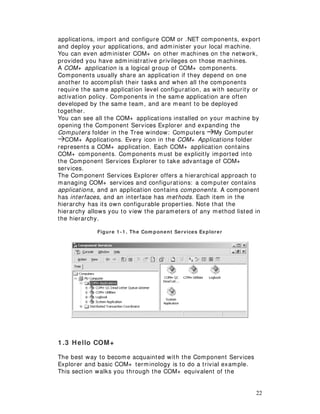
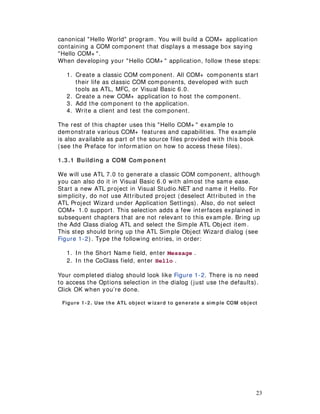
![24
Right-click the IMessage interface icon in the Class View, and select
Add and then Add Method... from the pop-up context menu. This
step brings up the Add Method Wizard. Enter ShowMessage as the
method name and click OK.
After following these steps, the ATL Object Wizard will generate a
new interface definition in the project IDL file, and the new method
wizard will add a method to that interface. Verify that the interface
definition in the IDL file looks like this:
[
//various IDL attributes
]
interface IMessage : IDispatch
{
[id(1), helpstring("method ShowMessage")] HRESULT
ShowMessage( );
};
Also make sure that the IDL file contains a type library section with
the CoClass definition:
[
//you will have a different CLSID here:
uuid(C530E78E-9EE4-47D3-86CC-3B4EE39CBD26),
helpstring("Message Class")
]
coclass Hello
{
[default] interface IMessage;
};
Next, go to the message.cpp file and implement the ShowMessage( )
method of the CMessage class:
STDMETHODIMP CMessage::ShowMessage( )
{](https://image.slidesharecdn.com/22360-250512111453-3c2456e8/85/COM-and-NET-Component-Services-1st-Edition-Juval-Lowy-28-320.jpg)