Creating and Consuming Web Services in Visual Basic First Edition Seely S.
Creating and Consuming Web Services in Visual Basic First Edition Seely S.
Creating and Consuming Web Services in Visual Basic First Edition Seely S.
Creating and Consuming Web Services in Visual Basic First Edition Seely S.
Creating and Consuming Web Services in Visual Basic First Edition Seely S.
1.
Visit https://ebookultra.com todownload the full version and
explore more ebooks
Creating and Consuming Web Services in Visual
Basic First Edition Seely S.
_____ Click the link below to download _____
https://ebookultra.com/download/creating-and-consuming-
web-services-in-visual-basic-first-edition-seely-s/
Explore and download more ebooks at ebookultra.com
2.
Here are somesuggested products you might be interested in.
Click the link to download
Programming the Web with Visual Basic NET 1st Edition Lynn
Torkelson
https://ebookultra.com/download/programming-the-web-with-visual-basic-
net-1st-edition-lynn-torkelson/
Visual Development for Web and Mobile Games First Edition
Chris Carman
https://ebookultra.com/download/visual-development-for-web-and-mobile-
games-first-edition-chris-carman/
Visual Basic 2008 Programmer s Reference Rod Stephens
https://ebookultra.com/download/visual-basic-2008-programmer-s-
reference-rod-stephens/
Photojournalism and Today s News Creating Visual Reality
1st Edition Loup Langton
https://ebookultra.com/download/photojournalism-and-today-s-news-
creating-visual-reality-1st-edition-loup-langton/
3.
Visual Basic NETA Beginner s Guide Herbert Schildt
https://ebookultra.com/download/visual-basic-net-a-beginner-s-guide-
herbert-schildt/
Programming in Visual Basic 2010 The Very Beginner s Guide
1st Edition Mckeown
https://ebookultra.com/download/programming-in-visual-basic-2010-the-
very-beginner-s-guide-1st-edition-mckeown/
Microsoft Visual Basic 2010 for Windows Web and Office
Applications Complete Shelly Cashman 1st Edition Gary B.
Shelly
https://ebookultra.com/download/microsoft-visual-basic-2010-for-
windows-web-and-office-applications-complete-shelly-cashman-1st-
edition-gary-b-shelly/
Visual Basic 2005 a Developer s Notebook 1st Edition
Matthew Macdonald
https://ebookultra.com/download/visual-basic-2005-a-developer-s-
notebook-1st-edition-matthew-macdonald/
XML and Web Services Unleashed 1st Edition Ron Schmelzer
https://ebookultra.com/download/xml-and-web-services-unleashed-1st-
edition-ron-schmelzer/
5.
Creating and ConsumingWeb Services in Visual Basic
First Edition Seely S. Digital Instant Download
Author(s): Seely S., Smith E. A., Schaffer D.
ISBN(s): 9780130907639, 0130907634
Edition: First Edition
File Details: PDF, 4.75 MB
Year: 2002
Language: english
Trademarks
All terms mentionedin this book that are known to be trademarks or service marks have
been appropriately capitalized. Addison-Wesley Professional cannot attest to the accuracy
of this information. Use of a term in this book should not be regarded as affecting the
validity of any trademark or service mark.
Warning and Disclaimer
Every effort has been made to make this book as complete and as accurate as possible,
but no warranty or fitness is implied. The information provided is on an "as is" basis. The
authors and the publisher shall have neither liability nor responsibility to any person or
entity with respect to any loss or damages arising from the information contained in this
book or from the use of the programs accompanying it.
Credits
Acquisitions Editor
Sondra Scott
Development Editor
Laurie McGuire
Managing Editor
Charlotte Clapp
Project Editors
Tony Reitz
Linda Seifert
Copy Editor
Pat Kinyon
Indexer
Eric Schroeder
9.
Proofreader
Andrea Dugan
Technical Editors
KenCox
Jawahar Puvvala
Team Coordinator
Lynne Williams
Media Developer
Dan Scherf
Interior Designer
Gary Adair
Dedication
To Jean. Thanks for always believing in me.
—Scott
For Lauren and Jodi
—Eric
To my wife, Oshrat, for all her support and patience, and to our daughter, Zoe Amit, who
was born during the writing of this book.
—Deon
10.
Foreword
Looking back atthe last 30 years of human-computer interaction, a number of key
milestones stand out prominently: the shift from the mainframe computing to the PC, the
introduction of the graphical user interface, the move from 16- to 32-bit processors, and
most recently, the pervasiveness of the Internet and the Web. Each of these landmarks
represents a fundamental turning point in the relationship between human and machine.
They also served to address some of the most pressing industry challenges of the time,
from providing a viable platform for consumer-based computing to satisfying the need
for richer, graphical user interaction to enabling ubiquitous application deployment and
access.
Now, as businesses seek to address the ongoing fundamental challenges of software
integration, a new technology called XML Web services is promising to once again
fundamentally transform and enhance the way consumers and businesses interact with
computers. The core concept behind these Web services is relatively
straightforward[md]components that are accessible using standardized Internet
protocols. Yet their potential to affect the industry is both far-reaching and profound.
Similar to computing revolutions of the past, XML Web services represents a new
paradigm around which the entire computing industry is converging. Partners and
competitors alike are quickly recognizing the value of XML Web services as a universal
component architecture[md]one that spans programming languages, networks, and
even platforms.
But why this sudden move to a new software integration paradigm when technologies
such as DCOM and CORBA already exist? Although they provide a viable option for
integration of systems residing in a uniform corporate Intranet, they lack the capability to
adapt to the loosely coupled, heterogeneous environment of the Internet. As this
became evident to more and more businesses that required integration not only within
the firewall, but also with diverse business partners and customers, it became clear that
the path to success lay not in tightly-coupled, proprietary systems, but in the adoption of
integration technologies based on open standards. This is the fundamental differentiator
and the key to the success of Web services.
For developers, Web services present a nearly limitless world of new opportunities.
Because of the fundamental issues they address, Web services are pertinent to the
entire spectrum of today's software, from rich Windows applications, to thin-client Web
11.
applications to theemerging market of mobile device software. For Visual Basic
developers, Web services represent a new era in component creation and reuse. From
day one, Visual Basic developers have been avid consumers of preexisting
components. With XML Web services, the ability to consume components is vastly
expanded to the Internet, across firewalls and even to other operating systems. And
with Visual Basic .NET, the ability to call this remote functionality is as easy as setting a
reference to an existing COM component in VB 6.0. Building XML Web services in
Visual Basic .NET is just as effortless. In fact, if you've ever written a class in Visual
Basic 6, you're well on your way to creating Web services that can be deployed locally,
on your corporate Intranet, or on the Internet itself.
In Creating and Consuming Web Services in Visual Basic, the authors cover the basics
of XML Web service construction and consumption as well as numerous advanced
topics associated with Web-service development. Their practical approach to describing
the concepts of Web services will have you up and running in the first chapter. From
there, you'll discover and implement Web services that address pertinent issues of
security, state management, and asynchronous calls as well as the ever-important
bottom line: how Visual Basic .NET and XML Web services can save your business
money, promote integration with business partners and customers, and reduce your
project's time to market.
As we enter a new era in component development and reuse, Visual Basic .NET and
XML Web services empower us as VB developers to continue to be on the cutting edge
of application development. And with this book, you've already taken the first step to
understanding and implementing these crucial components that will take our Visual
Basic applications to the next level.
Ari Bixhorn
Product Manager
Visual Basic .NET
Microsoft Corporation
12.
About the Authors
ScottSeely works for Microsoft. He is a member of the MSDN Architectural Samples team
bringing you content in the form of the Favorites Web Service and Web Service How-To (if
the content was on interop with other toolkits, Scott probably wrote it) and as coauthor of
the "At Your Service" Voices column on msdn.microsoft.com. He has authored two other
books for Prentice Hall-PTR: Windows Shell Programming and SOAP: Cross Platform Web
Service Development Using XML. When not thinking about Web Services, Scott likes to go
hiking or on bike rides with his family.
Eric A. Smith works as an independent consultant, author, and trainer in the Indianapolis
area. He is also the owner of Northstar Computer Systems (www.northcomp.com), a value-
added reseller and Web hosting company. His company was one of the first to offer
commercial .NET hosting services to its clients. Eric has written or contributed to 12 books
covering Microsoft technologies, including ASP.NET at Work: 10 Enterprise Projects
(Wiley). He can be reached at eric@northcomp.com.
Deon Schaffer has been developing with Visual Basic and other Microsoft technologies for
more than seven years. For several years now, Deon's focus has been on designing and
developing Windows DNA applications. Recently, he has concentrated specifically on
Microsoft's .NET initiative.
Deon has a Bachelor's degree in Industrial Engineering with a major in Information Systems
Engineering from the Ben-Gurion University in Be'er Sheva, Israel. He is also a Microsoft
Certified Solutions Developer(MCSD). Deon is a senior consultant at Information Strategies
in Washington, DC. He can be reached at Deon_Schaffer@hotmail.com.
About the Technical Editors
Ken Cox is a technical writer and Web developer in Toronto. A Microsoft Most Valuable
Professional (MVP), Ken is a frequent contributor to computer books and magazines
dealing with Microsoft technologies, especially ASP.NET. Before turning his interests to
computers and things high-tech, Ken had a successful career as a broadcast journalist in
Toronto and Quebec City. Contact Ken at kjopc@hotmail.com.
Jawahar Puvvala currently works as a senior developer. He has a great deal of experience
in Microsoft and Java technology and has designed and developed several enterprise level
systems. J.P. has two Master's degrees (Hong Kong University of Science and Technology
and Florida Institute of Technology) and holds MCSD, MCSE, and MCDBA certifications.
He has published several conference and journal papers.
13.
Acknowledgments
I have tostart out by thanking my wife, Jean, and my children for their patience while
Daddy wrote another book. I don't think that they were ready for this so soon.
Fortunately, this is a team effort, and I had help from some great coauthors. Because of
them, I don't feel quite so burned out this time around.
I would like to thank Tim Moore at Prentice Hall for giving me an excuse to learn about
SOAP, starting with his little note back in December of 1999 saying "So, what do you
think?". By getting really involved with the protocol, I have had an opportunity to meet
many great people (you know who you are) and do great things (working at Microsoft
ROCKS!).
I'd like to thank Kent Sharkey and Michael Edwards for talking me into going to
Microsoft to help shape how people use XML Web Services (the broader term
describing SOAP and its related technologies). By working there, I've had an
opportunity to work and cooperate with others active in shaping where Web Services
are taking us. This includes folks outside Microsoft. I really feel that this is a community
effort and that it is working very well.
Thanks to Kenn Scribner and Mark Stiver for introducing me to the good folks at Sams
Publishing. I told the Sams people that I never want to write a book on my own again
(I've done so twice already), but that I would gladly be part of a larger team. They said
"cool" and provided a good opportunity to help out within a few weeks of my opening my
mouth. In case you are curious why I am thanking Sams Publishing in a book published
by Addison-Wesley, some of the team working on the book was reorganized into
Addison-Wesley from Sams early in 2002. Many of their titles went with them, including
this one. As a result, the team has never changed, just the name of the imprint.
While reviewing the Scribner and Stiver book, Applied SOAP: Implementing .NET XML
Web Services, I got to work with Laurie McGuire. I was excited to hear that Laurie would be
the development editor on this text as well. Laurie never leaves me waiting for material and
is patient when I slip delivery by a day or two. Finally, I want to thank Linda Engelman for
passing my name to Sondra Scott. Sondra really believed in this book and thought it should
be written. I hope she is happy about what we all created. I know that I am.
—Scott
First of all, I give God the glory for giving me the strength to get this book done. My wife
and daughter were understanding, as usual, with Daddy having to lock himself in his
office every so often. Sondra Scott and Laurie McGuire were understanding and helpful
14.
in getting themanuscript into shape. Scott Seely provided good guidance on the
chapters that I contributed. Thanks to all!
—Eric
15.
Introduction
Applications of WebServices
What You Will Need
Who Is This Book For?
Part I. The Basics
Chapter 1. Create Your First Web Service
The "Hello World" Operation
Other Files in the Project
Passing Complex Types
Returning Arrays of Simple Types
Returning Arrays of Structures
Summary
Chapter 2. Consuming Your First Web Service
Attaching a Web Reference
Command-Line Interface Applications
Graphical User Interface (GUI) Applications
Web Applications
Web Services Calling Other Web Services
Summary
Chapter 3. SOAP, WSDL, and UDDI Explained
SOAP
WSDL
UDDI
Summary
Chapter 4. Shaping the WSDL, XML, and SOAP Message
Shaping the WSDL File
Creating a Custom SOAP Extension
Creating a Server Based on a WSDL File
Using Visual Studio to Register Your SOAP Endpoint in UDDI
Summary
16.
Chapter 5. TroubleshootingWeb Services/Consumers
Viewing SOAP Message Exchanges
Debugging a Web Service at the Server
Debugging a Web Service Remotely
Debugging Web Services Under Load
Items to Include in Your Test Plan
A Simple Example
Summary
Part II. Going Deeper
Chapter 6. Security Issues with Web Services
Equipment Deployment
Authenticating Users
Guarding Data
Tracking User Activity
Summary
Chapter 7. Looking at the "Abilities"
Availability
Scalability
Manageability
Performance
Summary
Chapter 8. Asynchronous Web Services
Synchronous Versus Asynchronous Calls
Design Pattern for Asynchronous Method Calls
Calling a Web Service Asynchronously
Server to Server Asynchronous Communications
Summary
Chapter 9. Stateful Services
Benefits of Maintaining State: Performance and Scalability
17.
Maintaining State withthe Session Object
Maintaining State with the Application Object
Maintaining State with the Cache Object
Custom State Management
Summary
Chapter 10. Microsoft SOAP SDK
Using the SOAP Toolkit on the Server
Using the SOAP Toolkit on the Client
Summary
Chapter 11. Converting Legacy Applications to Web Services
Adding Web Service Support to COM+ Applications
Reusing an Existing COM Object Within a Web Service
Migrating from Visual Basic 6 to Visual Basic .NET
Summary
Part III. Solving Real-World Problems
Chapter 12. Business to Business XML Web Services
Choosing the Right Technology
Designing the Web Service
Building Elise's Emporium
Summary
Chapter 13. Business to Customer XML Web Services
Designing the Database
Designing the Application
Referencing the External Web Service
Creating the List Window
Adding the List Window Code
Designing the Stock Editing Window
Summary
Chapter 14. Platform Integration
18.
Assembling the Tools
Buildingthe Web Services
Building the Mobile Application
Summary
Chapter 15. Portals
Designing the Database
Configuring the Application
Adding the Business Objects
Creating the Web User Controls
Building the Web Pages
Summary
Chapter 16. Profiting From Your Web Services
Creating Services that Fill a Need
Decreasing Business Costs
Revenue Models
Marketing the Web Service
Summary
Appendix A. Additional Resources
XML General
General .NET Information
General Web Service Information
SOAP/XML Protocol
Remoting
UDDI
WSDL
Transactions
Tools
Security
ebXML
Sample Web Service
Introduction
One of themore confusing items about Web Services regards defining exactly what and
why they are. Let's begin with why they exist.
Web Services exist to make it easier to integrate applications. Existing technologies include
Java RMI, CORBA, and DCOM. All of these technologies work over networked
environments and allow for application integration. This application integration is possible if
all the components are reachable over a LAN. However, when going out to the public
Internet, these networked applications start to break down. Another problem is that none of
these technologies work well for cross platform, cross language integration. Often, working
with one of these technologies ties you to a particular language, operating system, or toolkit
that must be uniform across the solution. In today's world, the odds of having all systems
being written in the same language or using the same operating system and
interconnection libraries is fairly small. Add to this a desire to connect these applications
across large distances using the Internet and you will find that almost all of these
technologies come up short. The necessity of addressing these shortcomings gave birth to
Web Services. So, what are they?
A Web Service is a programmatic interface that is accessible via the Internet. As such, it
must rely on standardized protocols. You may be aware of the various technologies
surrounding Web Services. SOAP (an abbreviation that does not really mean anything
anymore), Web Services Description Language (WSDL), and Universal Description
Discovery and Integration (UDDI) are just a few of the technologies that are a part of Web
Services. To make Internet accessibility a reality, SOAP v1.1 and v1.2 rely on existing,
widely deployed technologies. The de facto minimum requirements for Web Service
interaction state that the platform, whether client or server, must understand the following
standards:
• Hypertext Transfer Protocol (HTTP)
• Transmission Control Protocol/Internet Protocol (TCP/IP)
• eXtensible Markup Language (XML)
• XML Schema Definition (XSD)
Due to the wide adoption of the Internet and XML, it is extremely difficult to find an
operating system or programming language that does not have some support for these
standards. Because the interest in Web Services is building to a fever pitch, vendors and
individuals are rallying to make additional Web Service–specific tools available. While not a
silver bullet for interoperability woes, talking to other languages and platforms just got a lot
easier to do.
21.
For many people,the promise of interoperability drew them into learning more about Web
Services. As a Visual Basic developer, this promise may have caused you to buy this book.
One question probably remains: How real is this promise of interoperability? For any two
implementations to work together, they typically have to agree on two items: what the
WSDL for a particular interface looks like and how to represent the SOAP message for any
given operation in XML. To this end, the many serious development teams and individuals
are working together to make sure they all agree.
At XMethods, http://www.xmethods.com/ilab, you can see a list of all the participants. This
page also describes what it means to pass or fail the set of tests, as well as the tests
themselves. If an implementation is not a part of this effort, you should steer clear of it. Yes,
the Microsoft implementations are active in this process.
Applications of Web Services
Before going too far into this book, you should understand some of the reasons for using a
Web Service:
Interface between languages where a binary interface does not exist or is inappropriate to
use— For example, you may want a Perl script to be able to talk to a Visual Basic interface.
Interface in between systems— For example, you may want to make a business application
on a mainframe accessible to boxes scattered throughout the business.
You need to allow a wide, unknown array of clients to access your application— This is a
common requirement in larger applications assembled using "best of breed" components.
You are exposing the functionality as a service for a fee— In this case, instead of inventing
your own protocol, use what Web Services provide to you. Examples include stock trading
services and access to research databases, among other things.
When creating a Web Service, make sure that the various APIs are stateless. If you must
maintain a pseudo-state, that state information should be obtainable from data passed in
the SOAP messages. For example, a Web Service may require that users be validated. To
do so, they log in and receive an authentication token. Other Web Service calls will require
that the token appear somewhere within the SOAP message. With this, you have state (the
user is "logged in") and this state is maintained over transient connections. Maintaining
state this way helps with scalability and will be covered in Chapter 6, "Security Issues with
Web Services."
What You Will Need
22.
While you couldrun most of these examples using the free Microsoft .NET Framework
SDK, you will get the greatest benefit and productivity by using Visual Studio .NET. This
book assumes that the reader has Visual Studio .NET installed. This book will still be
valuable to users with only the SDK, but many things will be harder to do.
You should also have a copy of the Microsoft SOAP Toolkit v2 installed on your machine.
Yes, install this even if all you do is program .NET applications. The toolkit comes with an
application called MSSOAPT.EXE. This application allows you to review the SOAP
messages going between the SOAP endpoints.
The machine that you are developing on must have Internet Information Server (IIS)
installed. Without it, you will not be able to run the examples in the book or develop Web
Services on your local machine. This is only available on Windows NT 4.0, Windows
2000, and Windows XP. The good news is that all versions of these operating systems
can host IIS. On the Professional versions of XP and 2000, you need to explicitly install
IIS. You can do this through the Add/Remove Programs Control Panel applet. Refer to
your Windows documentation for instructions. NT 4.0 Workstation can host IIS 4.0. This
is available through the Windows NT 4.0 Option Pack.
Finally, it would help to have a good book on Visual Basic .NET handy. Learn Visual Basic
.NET in 21 Days by Kent Sharkey and Duncan MacKenzie is one text that would work
nicely. Their book serves as an overview of the language.
Who Is This Book For?
Because Web Service development with Visual Basic will attract Internet-savvy developers,
Visual Basic application developers, and hobbyists, a wide range of people will be picking
up this text and reading it. You do not necessarily need a lot of experience with the latest
version of Visual Basic. That said, you should know that the language has changed a bit
and has become more flexible. If you have not made yourself familiar with the changes, you
should plan on updating your knowledge on Visual Basic .NET specifics along with this
book.
You probably bought this book for one of two reasons:
• You want to learn how to write code that uses Web Services just to keep up to
date.
• You just found out that you need to expose your application to outside
applications and you need to learn this stuff as fast as possible.
With these goals in mind, this book is organized into the following parts:
23.
Part I: TheBasics— Part I gets you programming right away. Almost everyone should, at a
minimum, skim all of Part I before proceeding through other chapters.
Keep in mind that the examples presented in Chapters 1, "Create Your First Web
Service," and 2, "Consuming Your First Web Service," are appropriate for only
one reason—they teach the concepts without burying you in special techniques.
You would never offer these to internal applications or external partners, but they
are very useful for getting you started learning the basics of Web Services. In
subsequent chapters, you will tackle practical and realistic examples.
Part II: Going Deeper— Part II covers some of the more advanced Web Service topics. In it,
we examine securing a Web Service and tradeoffs you can make to maximize the
scalability, reliability, and manageability of a Web Service. With some of the Web Services,
you will have a need to maintain some kind of state in between Web Service calls. Different
techniques for maintaining that state are useful depending on the circumstances. This
section closes out with a look at Web Service enabling existing applications written using
Visual Studio 6.0 and the Microsoft Web Services Toolkit.
Part III: Solving Real-World Problems— Part III examines the uses of Web Services in real
world situations. Web Services can be used to enable integration between business
partners and customers. Within your own business, you can use Web Services to tie your
heterogeneous computing environment together. The section closes out with a look at how
this investment in Web Services can help improve your business's bottom line.
Now, let's jump right in and learn how to write Web Services!
24.
Part I: TheBasics
This section allows you to jump right in by creating and using a very simple Web Service.
Then, you'll take a look at features such as SOAP, WSDL, UDDI, how they work and how
you can take advantage of them through the XML and Web Service-specific attributes in
.NET. You conclude your study of the basics by learning how to find and fix any bugs in the
Web Services you create and consume.
IN THIS PART
1 Create Your First Web Service
2 Consuming Your First Web Service
3 SOAP, WSDL, and UDDI Explained
4 Using Attributes to Shape WSDL and XML
5 Troubleshooting Web Services/Consumers
25.
Chapter 1. CreateYour First Web Service
IN THIS CHAPTER
• The "Hello World" Operation
• Other Files in the Project
• Passing Complex Types
• Returning Arrays of Simple Types
• Returning Arrays of Structures
If you have never written a Visual Basic .NET Web Service before, you are in the right
place. You may be under the impression that Web Services are hard to write and deploy.
With many toolkits, that impression is 100% correct. Fortunately, .NET was designed with
Web Services in mind, making their coding and deployment an easy task. As someone who
has used several of the more popular toolkits out there, I can honestly say that .NET is by
far the easiest to use.
In this chapter, we are going to develop a Web Service that exposes a set of operations
that demonstrate what .NET can do for you without you knowing a thing about what is going
on under the covers. The demonstration will showcase the following items:
• A "Hello World" operation that shows the basics
• Returning a simple structure
• Returning an array of simple data types
• Returning an array of complex data types
The reason we are focusing on returning the items instead of passing them as arguments is
simple—.NET will allow me to show you the results of the operations through Internet
Explorer. To do so, all I have to do is make sure that none of the operations takes a
complex type as an argument. In Chapter 2, "Consuming Your Web Service," we will look at
how easy it is to write a client for this Web Service.
Let's dig in!
The "Hello World" Operation
Before you get the idea that "Hello World" is just a silly little example, consider that "Hello
World" can do a great job diagnosing some basic problems. If a machine has an endpoint
that returns a simple string when called correctly, programs using that code can perform
simple tests to see if they can connect to the server.
26.
The good newsfor us is that the wizards inside Visual Basic .NET will write this operation
for us. To get there, we need to go through the Visual Studio IDE and create a new project.
To do so, perform the following steps:
Open up Visual Studio .NET.
Select File, New Project.
Select the following items in the New Project dialog ( (as shown in Figure 1.1):
o Project Types: Visual Basic Projects
o Templates: ASP.NET Web Service
o Name: Chapter1
o Location: http://localhost
Figure 1.1. Creating a Visual Basic .NET Web Service project.
Click OK.
At this point, the IDE will create the Web Application on your local machine and generate
the files needed for your Web Service. A skeleton class for a Web Service will be created
as well. This class is always named Service1. Few people actually want a class named like
this. To get a class with a meaningful name, you have two options—rename everything or
27.
delete Service1.asmx fromthe project and create a new class with a better name. Deleting
the existing class has the added advantage that you will not miss some tiny detail. To
delete Service1.asmx from the project, simply right-click the filename and select Delete.
When the IDE warns you that the file will be permanently deleted, press OK. Now, let's add
a new, better-named class to the project.
In the IDE, select Project, Add Web Service.
In the Add New Item dialog, name the Web Service FirstService.asmx (see Figure
1.2).
Figure 1.2. Adding a Visual Basic .NET Web Service Class.
Click Open.
You should now be looking at a screen similar to the one shown in Figure 1.3. From here,
click the text Click Here to Switch to Code View. The wizard generated the sample in Listing
1.1 just for you.
28.
Figure 1.3. IDEimmediately after adding a new .NET Web Service Class.
Listing 1.1 Wizard-Generated Code for Web Service
Public Class FirstService
Inherits System.Web.Services.WebService
#Region " Web Services Designer Generated Code "
Public Sub New()
MyBase.New()
'This call is required by the Web Services Designer.
InitializeComponent()
'Add your own initialization code after the
InitializeComponent() call
End Sub
'Required by the Web Services Designer
Private components As System.ComponentModel.Container
29.
'NOTE: The followingprocedure is required by the Web Services
Designer
'It can be modified using the Web Services Designer.
'Do not modify it using the code editor.
<System.Diagnostics.DebuggerStepThrough()> _
Private Sub InitializeComponent()
components = New System.ComponentModel.Container()
End Sub
Protected Overloads Overrides Sub Dispose(ByVal disposing As
Boolean)
'CODEGEN: This procedure is required by the Web Services
Designer
'Do not modify it using the code editor.
End Sub
#End Region
' WEB SERVICE EXAMPLE
' The HelloWorld() example service returns the string Hello
World.
' To build, uncomment the following lines then save and build
the project.
' To test this web service, ensure that the .asmx file is the
start page
' and press F5.
'
'<WebMethod()> Public Function HelloWorld() As String
' HelloWorld = "Hello World"
'End Function
End Class
To enable the HelloWorld function, simply uncomment three lines of code.
<WebMethod()> Public Function HelloWorld() As String
HelloWorld = "Hello World"
End Function
30.
If you havenot used Visual Basic .NET before, the statement before the keyword Public
may look a bit odd. The value in angle brackets (< >) is an attribute. The languages
shipping with .NET all allow for the use of attributes before class declarations, member
variables, or methods. The attributes are specific to the data immediately following them.
Instead of creating extra executable code, attributes provide metadata for the functions.
When the Common Language Runtime (CLR) encounters that metadata, it may execute
code or generate some other behavior. We will cover the attributes specific to Web
Services in Chapter 4, "Using Attributes to Shape WSDL and XML."
When the CLR sees the attribute <WebMethod()> when loading a class through an .asmx
file, it knows to expose the method as a part of a Web Service. Web Services themselves
only need to derive from the base class System.Web.Services.WebService to be able
to access the ASP.NET Session and Application objects. You could just as easily not derive
from System.Web.Services.WebService and still have a fully functional Web Service.
To build the project, go to the Build menu and select the Build option. To see if everything
worked, open Internet Explorer and navigate to
http://localhost/Chapter1/FirstService.asmx. After doing this, you should be
presented with the screen shown in Figure 1.4. The page contains a warning that we will
explore shortly.
Figure 1.4. What ASP.NET presents for a .asmx page.
To get the screen shown in Figure 1.4 and any other links we might follow from this page,
we had to do no work. Instead, ASP.NET generates the pages for us by using the .NET
reflection APIs. We will cover how this all works in Chapter 4. Just know that .NET makes
your life very easy.
31.
On the generatedpage, you will see a link to the HelloWorld operation. If you follow that
link, you will be presented with a page that allows you to call the function and that outlines
how to call the function using SOAP, HTTP/GET, and HTTP/POST. You see the general
format of the message exchange—what to send and what to expect in return. This is
another helpful piece of documentation that ASP.NET writes for you (see Figure 1.5). This
page also allows you to call the Web Service by clicking the Invoke button.
Figure 1.5. Documentation ASP.NET generates for a Web method.
When you press Invoke, Internet Explorer will not use SOAP to call the underlying function.
Instead, it will call the Web Service using HTTP GET.
The actual exchange will look like the following:
Request:
GET /Chapter1/FirstService.asmx/HelloWorld? HTTP/1.1
Host: localhost
Response:
HTTP/1.1 200 OK
Content-Type: text/xml; charset=utf-8
Content-Length: length
<?xml version="1.0" encoding="utf-8"?>
<string xmlns="http://tempuri.org/">string</string>
32.
Clicking Invoke, weget the following response:
<?xml version="1.0" encoding="utf-8"?>
<string xmlns="http://tempuri.org/">Hello World</string>
For most of this book, we will only work with SOAP requests and responses. A SOAP
Request/Response typically has this format:
<Envelope>
<Header></Header>
<Body>[interesting stuff here]</Body>
</Envelope>
But, Web Services can exist outside of the SOAP protocol. You can also send XML in a
regular HTTP GET or POST request and return raw XML from that same request. When
you do this, you are using Web Services in their simplest forms. To create the fancier, more
powerful messages, only SOAP will work.
You will see a lot of messages in this chapter and the next. The idea is for you to become
comfortable reading the messages. Outside of some special properties of the SOAP
Envelope, your messages will be primarily Body content. That content is regular XML and
only loosely related to SOAP. This book assumes you are already familiar with XML and
that is why we start out with the simplest Web Service messages possible: HTTP
GET/POST.
Other Files in the Project
Before we run headlong into the remaining examples, let's take a moment and see what
other files got included in the project and where they sit on your hard drive. Looking at the
Solution Explorer pane in Figure 1.3, you see the following files in your project:
AssemblyInfo.vb Contains version information related to the Visual Basic project.
[Project Name].vsdisco Contains the dynamic discovery information for this Web
Service. The ASP.NET runtime uses this to discover and list all the Web Services hosted
on a particular machine.
Global.asax Use this class to add handlers called by the ASP Application and
Session objects. Web Services must derive from System.Web.Services.WebService
to get access to these objects.
33.
Web.config Configuration informationrelated to the Web application. You can use this file
to specify database connection strings, security settings, globalization settings, and other
application-specific items.
By the time you are done reading this book, you will see the importance of Web.config
because we will use it frequently. .NET uses config files extensively. These files are meant
to replace static Registry settings. As an added bonus, they allow you to specify data that
influences program behavior in an easy-to-use format. You can experiment with security,
change databases, or edit application-specific settings without rebuilding the program. For
example, let's say that we wanted to change the default string that our HelloWorld
returned. To do this, we would open up Web.config and add the following section as a
child element of the configuration root element:
<appSettings>
<add key="ReturnString" value="I love config files!" />
</appSettings>
You should know that the elements not in quotes must appear as is. The add element has
two attributes—key and value. When accessing application settings, you access them by
key to get the associated value. Each key must be unique. After this XML is entered into
Web.config, modify HelloWorld to read the ReturnString value from the
configuration file.
<WebMethod()> Public Function HelloWorld() As String
HelloWorld = System.Configuration.ConfigurationSettings. _
AppSettings.Get("ReturnString")
End Function
Now, when you invoke HelloWorld via the ASP.NET–generated interface, it returns the
following:
<?xml version="1.0" encoding="utf-8"?>
<string xmlns="http://tempuri.org/">I love config files!</string>
And yes, if you change the value attribute while the program is running, the program will get
the new data the next time it goes to look. In the Web.config file, you will spend more
time modifying appSettings than doing anything else. The first time you go into
Web.config, the appSettings element does not exist. After you add it, if you need
additional key/value pairs stored, just add them to the one appSettings element. For
example, to add another element, the appSettings section would expand as follows:
<appSettings>
34.
<add key="ReturnString" value="Ilove config files!" />
<add key="AnotherKey" value="Another Value" />
</appSettings>
Let's continue the example by having it handle a class object.
Passing Complex Types
ASP.NET makes it exceptionally easy to pass complex types as Web Service arguments
and return values. If the complex type is passed as a method argument, ASP.NET will only
be able to support SOAP messaging. This is because no definition exists to describe how to
pass complex types as arguments via HTTP/GET or HTTP/POST. You can return complex
types via these methods. So that we can see the immediate results of our coding via
Internet Explorer, we will return the type.
Many people who learn of this functionality are often surprised to find out that when a value
is passed via a Web Service, only the publicly visible fields are serialized. The receiver of
the object has no access to any methods that the object may expose. Instead, the recipient
of the object must already know what to do with the object when it is received. If you need
to pass objects with methods intact, do not use Web Services. The Common Language
Runtime (CLR) within .NET provides mechanisms when object identity and object value
must be preserved. Web Services can only preserve the public object values.
To keep things simple, we will create a class called Person. Person will contain a Name
object and a date for the person's birthday. Listing 1.2 shows a pair of classes that form a
complex type. Name contains three strings and is itself a complex type. Person makes it a
little more interesting for serialization because it must also serialize a Name inside.
Listing 1.2 Source for Name and Person Objects
Public Class Name
Public First As String
Public Middle As String
Public Last As String
End Class
Public Class Person
Public theName As Name
Public birthDay As Date
Public Sub New()
35.
theName = NewName()
End Sub
End Class
So far, so good. Now, we need to add a Web Method to the FirstExample object that
returns a Person, as shown in the following code:
<WebMethod()> Public Function GetPerson() As Person
GetPerson = New Person()
GetPerson.birthDay = System.DateTime.Parse("April 5, 1972")
GetPerson.theName.First = "Scott"
GetPerson.theName.Middle = "Christopher"
GetPerson.theName.Last = "Seely"
End Function
To test things out, we navigate over to
http://localhost/Chapter1/FirstService.asmx and click GetPerson. Here, we
see that the request and response via Internet Explorer will be fairly plain:
Request:
GET /Chapter1/FirstService.asmx/GetPerson? HTTP/1.1
Host: localhost
Response:
HTTP/1.1 200 OK
Content-Type: text/xml; charset=utf-8
Content-Length: length
<?xml version="1.0" encoding="utf-8"?>
<Person xmlns="http://tempuri.org/">
<theName>
<First>string</First>
<Middle>string</Middle>
<Last>string</Last>
</theName>
<birthDay>dateTime</birthDay>
</Person>
When we invoke the method, the Web Service responds as expected with the following:
36.
<?xml version="1.0" encoding="utf-8"?>
<Personxmlns:xsi="http://www.w3.org/2001/XMLSchema-instance"
xmlns:xsd="http://www.w3.org/2001/XMLSchema"
xmlns="http://tempuri.org/">
<theName>
<First>Scott</First>
<Middle>Christopher</Middle>
<Last>Seely</Last>
</theName>
<birthDay>1972-04-05T00:00:00.0000000-07:00</birthDay>
</Person>
As you can see, the Person element came across with two sub-elements—theName and
birthDay. The amazing part here is that no object-specific code had to be written to write
it out as XML.
Returning Arrays of Simple Types
ASP.NET treats arrays of simple types as a list of items. Like everything we have seen so
far, developers have little to think about other than stating that an array is being passed in
or returned. To demonstrate the power here, we will write a Web Method in Listing 1.3 that
returns an array of random numbers. As arguments, it will take the number of items to be
returned as well as the smallest and largest permissible values to be returned.
Listing 1.3 Source for the FirstService.GetRandomNumbers Function
<WebMethod()> Public Function GetRandomNumbers( _
ByVal arraySize As Long, ByVal min As Long, _
ByVal max As Long) As Long()
Dim retval(arraySize - 1) As Long
Dim rnd As New System.Random()
Dim index As Long
For index = 0 To retval.Length - 1
retval(index) = rnd.Next(min, max)
Next
GetRandomNumbers = retval
End Function
37.
The code createsan array of size arraySize and a random number generator. Using the
random number generator, the code loops through all the elements assigning them different
values, and then returns those values to the caller. The Next function takes two values and
returns a random number within that range. The return value from this function will be as
small as the minimum value but never as large as the maximum. In mathematical terms,
Next returns a value in the range (min, max). When testing this function from Internet
Explorer, we will continue to use HTTP/GET. The message exchange will look something
like the following:
Request:
GET /Chapter1/FirstService.asmx/GetRandomNumbers?
arraySize=string&min=string&max=string HTTP/1.1
Host: localhost
Response:
HTTP/1.1 200 OK
Content-Type: text/xml; charset=utf-8
Content-Length: length
<?xml version="1.0" encoding="utf-8"?>
<ArrayOfLong xmlns="http://tempuri.org/">
<long>long</long>
<long>long</long>
</ArrayOfLong>
To get five values between –1000 and 1000, I would fill in the generated form as shown in
Figure 1.6. The outgoing request is then formatted within the URL as
http://localhost/Chapter1/FirstService.asmx/GetRandomNumbers?arrayS
ize=5&min=-1000&max=1000. This request returns the XML shown in Listing 1.4.
38.
Figure 1.6. Usingthe ASP.NET–generated Web page to call GetRandomNumbers.
Listing 1.4 Returned XML for call to GetRandomNumber
<?xml version="1.0" encoding="utf-8"?>
<ArrayOfLong
xmlns:xsi="http://www.w3.org/2001/XMLSchema-instance"
xmlns:xsd="http://www.w3.org/2001/XMLSchema"
xmlns="http://tempuri.org/">
<long>-593</long>
<long>203</long>
<long>-158</long>
<long>799</long>
<long>20</long>
<long>-930</long>
</ArrayOfLong>
Simple arrays get passed around all the time. It may be a list of temperatures, dates,
strings, or something else. Arrays of structured data are equally common.
Returning Arrays of Structures
39.
Many times, applicationsneed to return arrays of structured data. Frequently, this data is
stored in a database or on a device and needs to be transmitted en masse. For example,
when requesting the details of a purchase order, it makes sense to return the lines and
delineate the parts of the line. A line item might contain the following details:
• Part number
• Part name
• Part description
• Quantity ordered
• Price per part
As we saw with the GetPerson example, a bit of structured data can contain other
structures. Likewise, arrays can appear anywhere within the data. Arrays are very powerful
and are often quite handy. Fortunately, .NET handles these well too. To keep things simple,
we will not introduce any new classes for this example (see Listing 1.5). Instead, we will
take an example that returns an array of names. This example will return a list of all the
authors (contributing authors included) involved with this book.
Listing 1.5 Source for the FirstService.GetAuthorNames Function
<WebMethod()> Public Function GetAuthorNames() As Name()
Dim firstNames() As String = {"Scott", "Michael", "Jeffrey",
"Deon"}
Dim lastNames() As String = {"Seely", "Carnell", "Huntsman",
"Schaffer"}
' Array will be dimensioned 0 to firstNames.Length - 1. The
' assumption here is that firstNames.Length == lastNames.Length
Dim retval(firstNames.Length - 1) As Name
Dim index As Long
' Instantiate the four names
For index = 0 To retval.Length - 1
retval(index) = New Name()
retval(index).First = firstNames(index)
retval(index).Middle = ""
retval(index).Last = lastNames(index)
Next
GetAuthorNames = retval
End Function
40.
To make thingsvery simple, all the first names are stored in one array and the last names
in another. Then, as the code loops through initializing the individual array elements, it also
sets the values for the Name.First, Name.Middle, and Name.Last. Again, we will test
this Web Method using the HTTP/GET interface. The message exchange will look like the
following:
Request:
GET /Chapter1/FirstService.asmx/GetAuthorNames? HTTP/1.1
Host: localhost
Response:
<?xml version="1.0" encoding="utf-8"?>
<ArrayOfName xmlns="http://tempuri.org/">
<Name>
<First>string</First>
<Middle>string</Middle>
<Last>string</Last>
</Name>
<Name>
<First>string</First>
<Middle>string</Middle>
<Last>string</Last>
</Name>
</ArrayOfName>
When choosing the Invoke button on the generated Web page, the names are returned with
the following XML:
<?xml version="1.0" encoding="utf-8"?>
<ArrayOfName
xmlns:xsi="http://www.w3.org/2001/XMLSchema-instance"
xmlns:xsd="http://www.w3.org/2001/XMLSchema"
xmlns="http://tempuri.org/">
<Name>
<First>Scott</First>
<Middle />
<Last>Seely</Last>
</Name>
41.
<Name>
<First>Michael</First>
<Middle />
<Last>Carnell</Last>
</Name>
<Name>
<First>Jeffrey</First>
<Middle />
<Last>Huntsman</Last>
</Name>
<Name>
<First>Deon</First>
<Middle/>
<Last>Schaffer</Last>
</Name>
</ArrayOfName>
Once again, the serialization is done without any effort on the developer's part.
Summary
Visual Basic, working together with the .NET runtime, gives developers the ability to easily
create Web Services with little or no knowledge of XML, SOAP, or the underlying
machinery. Because you will rarely have to concern yourself with the particulars, you can
concentrate on developing good, solid code. You can easily pass around simple and
complex types, as well as arrays.
In this chapter, we tested the various functions by using the HTTP/GET interface. Web
Services can typically be accessed via HTTP/GET, HTTP/POST, and SOAP. The rest of the
book will concentrate on talking to Web Services using SOAP. The messages are slightly
different from what we showed here. We will look at the SOAP messages being exchanged
between the client and server. As a Web Service programmer, you will find it helpful to
become very familiar with what these messages look like. Chapter 3, "SOAP, WSDL, and
UDDI Explained," will cover the SOAP protocol in detail.
42.
Chapter 2. ConsumingYour First Web Service
IN THIS CHAPTER
• Attaching a Web Reference
• Command-Line Interface Applications
• Graphical User Interface (GUI) Applications
• Web Applications
• Web Services Calling Other Web Services
In the previous chapter, we created a Web Service that showed the variety of things you
could do. The next thing we need to cover is consuming that Web Service. It might have
many different types of clients. Anything that can talk to a Web Service might come calling.
The following are just a few examples of the entities that might call your Web Service:
• Command-line interface (CLI) applications
• Graphical user interface (GUI) applications
• Web applications
• Other Web Services
When using Visual Basic .NET, the code you write to talk to a Web Service does not vary
based on the client type. To emphasize that point, we will build a simple example for each
of the four different Web Service clients just mentioned. Each example will only access one
of the methods the Web Service exposes. To test your understanding of the subject matter,
I encourage you to work along with the examples. After you complete the chapter, modify
the individual example applications to access Web Methods not used by that example.
We will begin by looking at how you attach a Web reference. Regardless of application
type, you always attach a Web reference the same way.
Attaching a Web Reference
Visual Studio .NET has a special name for the machinery that hooks up a Web Service
client to the server—Web reference. A Web reference consists of the WSDL (Web Services
Description Language) and any related disco files. It also includes the automatically
generated code that the client uses to call the Web Service. We call this generated code
the proxy.
NOTE
What is a disco file? It's a term for the Web Service discovery files. A given Web Service
application may have multiple Web Services running within the same .NET binary. The
43.
disco file enumeratesthe services available within that binary by listing the paths to the
WSDL files. Within .NET, that typically maps to a listing of all the .asmx files in the directory
with the string "?WSDL" appended to the end of the filename.
When we hook up a Web Service, we can do so two ways—through command-line tools or
through the Visual Studio IDE. In this text, we will concentrate on using the Visual Studio
IDE. If you want to use the command-line tool WSDL.EXE, please refer to the Framework
SDK documentation.
So that you can follow along with these instructions, create a simple Visual Basic
application in the Visual Studio IDE. The application type does not matter much, but to keep
things simple, I recommend creating a Console Application. Let's attach to the Chapter1
Web Service using the IDE by following these steps:
Select Project, Add Web Reference.
In the Add Web Reference dialog, go to the Address combo box and type
http://localhost/Chapter1/chapter1.vsdisco (see Figure 2.1).
Figure 2.1. Adding a Web reference through the Visual Studio .NET IDE.
Click Add Reference.
44.
NOTE
Besides using theIDE, there are other ways to add references to Web Services. When you
first open the Add Web Reference dialog, the opening screen (shown in Figure 2.2) shows
that you have the option to view Web references that reside on the Local Web Server.
Figure 2.2. The startup view of the Add Web Reference dialog.
You can also add a Web reference by browsing straight to the WSDL file of the Web
Service. To get the WSDL file for the Chapter1 Web Service, the URL would be
http://localhost/Chapter1/FirstService.asmx?WSDL. In this case, you would
still click Add reference to create the proxy.
At this point, the Web reference has been added to the project and is contained in the
localhost namespace. . When the IDE creates the proxy, the IDE automatically places
the proxy in a separate namespace. The namespace comes from the start of the URL that
helped grab the namespace in the first place. If you do not like the IDE chosen namespace,
you can easily change the namespace. Just go to the Solution Explorer pane within the
IDE, navigate to the Web references node, and right-click the Web reference you want to
change. In our case, we right-click on the node underneath the Web Reference named
localhost and select Rename from the pop-up menu (see Figure 2.3). Rename
localhost to something slightly more meaningful: Chapter1.
45.
Figure 2.3. Manipulatingthe namespace associated with a Web reference.
Now that this has been completed, we can also look at doing some other interesting things.
In Chapter 1, "Create Your First Web Service," I indicated that the application configuration
file would be something with which you should get very familiar. We are going to continue
our education by looking at how we can get our Web Service to read the endpoint URL from
the configuration file.
In the IDE, go to the Solution Explorer pane and click the Chapter1 node underneath the
Web References node. In the Properties pane, you should see the list of properties for the
Web reference (see Figure 2.4). One of the properties is URL Behavior. This item can be
static or dynamic. Static behavior means that the URL never changes and is stored in the
proxy object base on the endpoint listed in the WSDL file. If the endpoint changes and you
want to avoid rebuilding the application every time the Web Service does move, you can tell
the application to look for the endpoint URL in the application configuration file by setting
the URL Behavior to Dynamic. Under the covers, what is happening?
46.
Figure 2.4. Changingthe URL Behavior property related to a Web reference.
To answer that question, we need to look at the proxy that the IDE generates for us. That
proxy is located in a subdirectory of the main project. On my machine, this is located in My
DocumentsVisual Studio ProjectsChapter2CLIWeb
ReferencesChapter1FirstService.vb. When the URL Behavior property is set to
Static, the constructor of the proxy looks like the following:
<System.Diagnostics.DebuggerStepThroughAttribute()> _
Public Sub New()
MyBase.New()
Me.Url = "http://localhost/Chapter1/FirstService.asmx"
End Sub
When the URL Behavior property is set to Dynamic, the constructor of the proxy changes to
the code shown in Listing 2.1.
Listing 2.1 Proxy Constructor with URL Behavior Set to Dynamic
<System.Diagnostics.DebuggerStepThroughAttribute()> _
Public Sub New()
MyBase.New()
Dim urlSetting As String = _
System.Configuration.ConfigurationSettings.AppSettings( _
47.
"Chapter2CLI.Chapter1.FirstService")
If (Not (urlSetting)Is Nothing) Then
Me.Url = String.Concat(urlSetting, "")
Else
Me.Url = "http://localhost/Chapter1/FirstService.asmx"
End If
End Sub
As you can see, the code for the Dynamic URL behavior is a little different. The Dynamic
lookup still defaults to the URL listed in the WSDL file. For reference, Listing 2.2 shows the
service section of the FirstService.asmx?WSDL file.
Listing 2.2 Service declaration From the FirstService.asmx?WSDL Listing
<service name="FirstService">
<port name="FirstServiceSoap" binding="s0:FirstServiceSoap">
<soap:address
location="http://localhost/Chapter1/FirstService.asmx" />
</port>
<port name="FirstServiceHttpGet"
binding="s0:FirstServiceHttpGet">
<http:address
location="http://localhost/Chapter1/FirstService.asmx" />
</port>
<port name="FirstServiceHttpPost"
binding="s0:FirstServiceHttpPost">
<http:address
location="http://localhost/Chapter1/FirstService.asmx" />
</port>
</service>
The proxy is a SOAP proxy, so it references the port named FirstServiceSoap and
getting the endpoint from the soap:address element. The dynamic setting allows me to
change this up a bit and access the Web Service using a URL defined in the application
configuration file in an appSetting key named
Chapter2CLI.Chapter1.FirstService. Because I used the IDE, this key has already
been placed in the app.config file. I can change this URL to hit my local machine by its
name, scottnb, instead of by localhost. The appSettings section now looks like the
following:
48.
<appSettings>
<add key="Chapter2CLI.Chapter1.FirstService"
value="http://scottnb/Chapter1/FirstService.asmx"/>
</appSettings>
Command-Line InterfaceApplications
The simplest user interface is the command-line application. It uses the console for its input
and output. While not visually appealing, it often provides a fast and simple way to
accomplish tasks. For our CLI application, we will have it call the HelloWorld Web
Method and print the results. As you will recall, HelloWorld was modified in Chapter 1 to
read its value from the Web.config file associated with the Web Service.
The first things we need to do are open up Visual Studio and create a new project. In Visual
Studio, you will see CLI applications called console applications. Perform the following
steps to create the console application:
Select File, Project, New Project.
Select the following items in the New Project dialog:
Project Type: Visual Basic Projects
Templates: Console Application
Name: Chapter2CLI
Figure 2.5 shows what the dialog should look like.
49.
Figure 2.5. Settingup the Chapter2CLI application.
At this point, you have a skeleton for a console application. The IDE should have an
opened file called Module1.vb. Our next task is to hook in the Chapter1 Web Service. To
do this, add a Web reference to http://localhost/Chapter1/Chapter1.vsdisco
and rename the namespace from localhost to Chapter1.
Your next step is to edit the Main subroutine. It will call HelloWorld, print the result to the
console, and then exit. The edited code looks as follows:
Sub Main()
Dim svc As New Chapter1.FirstService()
System.Console.WriteLine(svc.HelloWorld())
End Sub
It does not get any easier than this. Figure 2.6 shows the output of this application.
50.
Figure 2.6. RunningChapter2CLI.
I also promised you that we would look at the SOAP message exchange that occurs under
the covers. The following is the request and response that occurred for our CLI application:
Request:
<?xml version="1.0" encoding="utf-8"?>
<soap:Envelope
xmlns:soap="http://schemas.xmlsoap.org/soap/envelope/"
xmlns:xsi="http://www.w3.org/2001/XMLSchema-instance"
xmlns:xsd="http://www.w3.org/2001/XMLSchema">
<soap:Body>
<HelloWorld xmlns="http://tempuri.org/" />
</soap:Body>
</soap:Envelope>
Response:
<?xml version="1.0" encoding="utf-8"?>
<soap:Envelope
xmlns:soap="http://schemas.xmlsoap.org/soap/envelope/"
xmlns:xsi="http://www.w3.org/2001/XMLSchema-instance"
xmlns:xsd="http://www.w3.org/2001/XMLSchema">
<soap:Body>
<HelloWorldResponse xmlns="http://tempuri.org/">
<HelloWorldResult>I love config files!</HelloWorldResult>
</HelloWorldResponse>
</soap:Body>
tes de soleilsont con- l'homme trop petit pour
damnées, l'endosser.
Une bouiteille de vin,
Un verre d'eau,
Deux paires de lunettes,
Une douzaine de chemises,
Beaucoup de peine,
Un peu de beurre.
mais je marie demain mais les lampes bleues
l'ombre de mes pieds à d'un ciel de juillet sont
celle de mon père. les filles de mes filles.
Plusieurs enfants font un vieillard.
et la satisfaction d'un vieillard
je me promènerai + je me promène +
je me promenais + je me suis promené
Je vis
J'ai vécu comme toi
Déclaration[*]
POIDS PUBLIC, rencontre d'un homme et d'un
homme, d'une femme et d'un homme.
Les voyous inspirateurs sont ailleurs.
53.
Ils ont abandonnéun homme, encore ne tient-il
qu'à un fil.
Au point de vue santé: absent, sur l'oreiller
creux: présent, dans la maison: paresseux et
dans la rue: perdu pour tout le monde,
POUR L'OR DES RUES,
POUR les regards en l'air POUR ce qui n'existe
plus.
[*] Toutes les variétés du mot intérêt, si
agréables ou désagréables qu'elles soient,
naissent en même temps.
Le mien,
Gala, c'est dire est à toi.
AIR NOIR
VIEILLIR
BERGER
FINS
LES NÉCESSITÉSDE LA VIE ET LES CONSÉQUENCES DES
RÊVES
LES NÉCESSITÉS DE LA VIE
Vrai
Les autres
Les fleurs
Définitions
La paresse
Conséquences des rêves
LES CONSEQUENCES DES RÊVES
Quelques poètes sont sortis.
En trois mots langage clair.
Rendez-vous. n'importe où.
Public.
Chez soi.
Seul, l'unique.
S'ils n'étaient pas morts.
Ami? Non ou Poème-Éluard.
Sans musique.
Jour de tout.
L'espace.
Le grand jour.
Force.
Cette question.
Malice.
Les noms: Chéri-Bibi, Gaston Leroux.
56.
Baigneuse du clairau sombre.
Cachée.
L'héroïne.
Comédienne.
L'inévitable.
Berceuse.
Le joueur.
Le roi.
L'argyl'ardeur.
L'aube.
Premier tourment.
Vrai.
Dernier tourment.
Un ami.
Julot.
Amour.
Définition.
Un mot dur--N° 58.
Montre avec décors.
Plis.
Faites parler.
L'ami.
Meilleur.
Meilleur jour.
Simples remarques.
Plusieurs enfants font un vieillard.
Déclaration.
57.
*** END OFTHE PROJECT GUTENBERG EBOOK LES NÉCESSITÉS
DE LA VIE ET LES CONSÉQUENCES DES RÊVES, PRÉCÉDÉ
D'EXEMPLES ***
Updated editions will replace the previous one—the old editions will
be renamed.
Creating the works from print editions not protected by U.S.
copyright law means that no one owns a United States copyright in
these works, so the Foundation (and you!) can copy and distribute it
in the United States without permission and without paying
copyright royalties. Special rules, set forth in the General Terms of
Use part of this license, apply to copying and distributing Project
Gutenberg™ electronic works to protect the PROJECT GUTENBERG™
concept and trademark. Project Gutenberg is a registered trademark,
and may not be used if you charge for an eBook, except by following
the terms of the trademark license, including paying royalties for use
of the Project Gutenberg trademark. If you do not charge anything
for copies of this eBook, complying with the trademark license is
very easy. You may use this eBook for nearly any purpose such as
creation of derivative works, reports, performances and research.
Project Gutenberg eBooks may be modified and printed and given
away—you may do practically ANYTHING in the United States with
eBooks not protected by U.S. copyright law. Redistribution is subject
to the trademark license, especially commercial redistribution.
START: FULL LICENSE
PLEASE READ THISBEFORE YOU DISTRIBUTE OR USE THIS WORK
To protect the Project Gutenberg™ mission of promoting the free
distribution of electronic works, by using or distributing this work (or
any other work associated in any way with the phrase “Project
Gutenberg”), you agree to comply with all the terms of the Full
Project Gutenberg™ License available with this file or online at
www.gutenberg.org/license.
Section 1. General Terms of Use and
Redistributing Project Gutenberg™
electronic works
1.A. By reading or using any part of this Project Gutenberg™
electronic work, you indicate that you have read, understand, agree
to and accept all the terms of this license and intellectual property
(trademark/copyright) agreement. If you do not agree to abide by all
the terms of this agreement, you must cease using and return or
destroy all copies of Project Gutenberg™ electronic works in your
possession. If you paid a fee for obtaining a copy of or access to a
Project Gutenberg™ electronic work and you do not agree to be
bound by the terms of this agreement, you may obtain a refund
from the person or entity to whom you paid the fee as set forth in
paragraph 1.E.8.
1.B. “Project Gutenberg” is a registered trademark. It may only be
used on or associated in any way with an electronic work by people
who agree to be bound by the terms of this agreement. There are a
few things that you can do with most Project Gutenberg™ electronic
works even without complying with the full terms of this agreement.
See paragraph 1.C below. There are a lot of things you can do with
Project Gutenberg™ electronic works if you follow the terms of this
agreement and help preserve free future access to Project
Gutenberg™ electronic works. See paragraph 1.E below.
60.
1.C. The ProjectGutenberg Literary Archive Foundation (“the
Foundation” or PGLAF), owns a compilation copyright in the
collection of Project Gutenberg™ electronic works. Nearly all the
individual works in the collection are in the public domain in the
United States. If an individual work is unprotected by copyright law
in the United States and you are located in the United States, we do
not claim a right to prevent you from copying, distributing,
performing, displaying or creating derivative works based on the
work as long as all references to Project Gutenberg are removed. Of
course, we hope that you will support the Project Gutenberg™
mission of promoting free access to electronic works by freely
sharing Project Gutenberg™ works in compliance with the terms of
this agreement for keeping the Project Gutenberg™ name associated
with the work. You can easily comply with the terms of this
agreement by keeping this work in the same format with its attached
full Project Gutenberg™ License when you share it without charge
with others.
1.D. The copyright laws of the place where you are located also
govern what you can do with this work. Copyright laws in most
countries are in a constant state of change. If you are outside the
United States, check the laws of your country in addition to the
terms of this agreement before downloading, copying, displaying,
performing, distributing or creating derivative works based on this
work or any other Project Gutenberg™ work. The Foundation makes
no representations concerning the copyright status of any work in
any country other than the United States.
1.E. Unless you have removed all references to Project Gutenberg:
1.E.1. The following sentence, with active links to, or other
immediate access to, the full Project Gutenberg™ License must
appear prominently whenever any copy of a Project Gutenberg™
work (any work on which the phrase “Project Gutenberg” appears,
or with which the phrase “Project Gutenberg” is associated) is
accessed, displayed, performed, viewed, copied or distributed:
61.
This eBook isfor the use of anyone anywhere in the United
States and most other parts of the world at no cost and with
almost no restrictions whatsoever. You may copy it, give it away
or re-use it under the terms of the Project Gutenberg License
included with this eBook or online at www.gutenberg.org. If you
are not located in the United States, you will have to check the
laws of the country where you are located before using this
eBook.
1.E.2. If an individual Project Gutenberg™ electronic work is derived
from texts not protected by U.S. copyright law (does not contain a
notice indicating that it is posted with permission of the copyright
holder), the work can be copied and distributed to anyone in the
United States without paying any fees or charges. If you are
redistributing or providing access to a work with the phrase “Project
Gutenberg” associated with or appearing on the work, you must
comply either with the requirements of paragraphs 1.E.1 through
1.E.7 or obtain permission for the use of the work and the Project
Gutenberg™ trademark as set forth in paragraphs 1.E.8 or 1.E.9.
1.E.3. If an individual Project Gutenberg™ electronic work is posted
with the permission of the copyright holder, your use and distribution
must comply with both paragraphs 1.E.1 through 1.E.7 and any
additional terms imposed by the copyright holder. Additional terms
will be linked to the Project Gutenberg™ License for all works posted
with the permission of the copyright holder found at the beginning
of this work.
1.E.4. Do not unlink or detach or remove the full Project
Gutenberg™ License terms from this work, or any files containing a
part of this work or any other work associated with Project
Gutenberg™.
1.E.5. Do not copy, display, perform, distribute or redistribute this
electronic work, or any part of this electronic work, without
prominently displaying the sentence set forth in paragraph 1.E.1
62.
with active linksor immediate access to the full terms of the Project
Gutenberg™ License.
1.E.6. You may convert to and distribute this work in any binary,
compressed, marked up, nonproprietary or proprietary form,
including any word processing or hypertext form. However, if you
provide access to or distribute copies of a Project Gutenberg™ work
in a format other than “Plain Vanilla ASCII” or other format used in
the official version posted on the official Project Gutenberg™ website
(www.gutenberg.org), you must, at no additional cost, fee or
expense to the user, provide a copy, a means of exporting a copy, or
a means of obtaining a copy upon request, of the work in its original
“Plain Vanilla ASCII” or other form. Any alternate format must
include the full Project Gutenberg™ License as specified in
paragraph 1.E.1.
1.E.7. Do not charge a fee for access to, viewing, displaying,
performing, copying or distributing any Project Gutenberg™ works
unless you comply with paragraph 1.E.8 or 1.E.9.
1.E.8. You may charge a reasonable fee for copies of or providing
access to or distributing Project Gutenberg™ electronic works
provided that:
• You pay a royalty fee of 20% of the gross profits you derive
from the use of Project Gutenberg™ works calculated using the
method you already use to calculate your applicable taxes. The
fee is owed to the owner of the Project Gutenberg™ trademark,
but he has agreed to donate royalties under this paragraph to
the Project Gutenberg Literary Archive Foundation. Royalty
payments must be paid within 60 days following each date on
which you prepare (or are legally required to prepare) your
periodic tax returns. Royalty payments should be clearly marked
as such and sent to the Project Gutenberg Literary Archive
Foundation at the address specified in Section 4, “Information
63.
about donations tothe Project Gutenberg Literary Archive
Foundation.”
• You provide a full refund of any money paid by a user who
notifies you in writing (or by e-mail) within 30 days of receipt
that s/he does not agree to the terms of the full Project
Gutenberg™ License. You must require such a user to return or
destroy all copies of the works possessed in a physical medium
and discontinue all use of and all access to other copies of
Project Gutenberg™ works.
• You provide, in accordance with paragraph 1.F.3, a full refund of
any money paid for a work or a replacement copy, if a defect in
the electronic work is discovered and reported to you within 90
days of receipt of the work.
• You comply with all other terms of this agreement for free
distribution of Project Gutenberg™ works.
1.E.9. If you wish to charge a fee or distribute a Project Gutenberg™
electronic work or group of works on different terms than are set
forth in this agreement, you must obtain permission in writing from
the Project Gutenberg Literary Archive Foundation, the manager of
the Project Gutenberg™ trademark. Contact the Foundation as set
forth in Section 3 below.
1.F.
1.F.1. Project Gutenberg volunteers and employees expend
considerable effort to identify, do copyright research on, transcribe
and proofread works not protected by U.S. copyright law in creating
the Project Gutenberg™ collection. Despite these efforts, Project
Gutenberg™ electronic works, and the medium on which they may
be stored, may contain “Defects,” such as, but not limited to,
incomplete, inaccurate or corrupt data, transcription errors, a
copyright or other intellectual property infringement, a defective or
64.
damaged disk orother medium, a computer virus, or computer
codes that damage or cannot be read by your equipment.
1.F.2. LIMITED WARRANTY, DISCLAIMER OF DAMAGES - Except for
the “Right of Replacement or Refund” described in paragraph 1.F.3,
the Project Gutenberg Literary Archive Foundation, the owner of the
Project Gutenberg™ trademark, and any other party distributing a
Project Gutenberg™ electronic work under this agreement, disclaim
all liability to you for damages, costs and expenses, including legal
fees. YOU AGREE THAT YOU HAVE NO REMEDIES FOR
NEGLIGENCE, STRICT LIABILITY, BREACH OF WARRANTY OR
BREACH OF CONTRACT EXCEPT THOSE PROVIDED IN PARAGRAPH
1.F.3. YOU AGREE THAT THE FOUNDATION, THE TRADEMARK
OWNER, AND ANY DISTRIBUTOR UNDER THIS AGREEMENT WILL
NOT BE LIABLE TO YOU FOR ACTUAL, DIRECT, INDIRECT,
CONSEQUENTIAL, PUNITIVE OR INCIDENTAL DAMAGES EVEN IF
YOU GIVE NOTICE OF THE POSSIBILITY OF SUCH DAMAGE.
1.F.3. LIMITED RIGHT OF REPLACEMENT OR REFUND - If you
discover a defect in this electronic work within 90 days of receiving
it, you can receive a refund of the money (if any) you paid for it by
sending a written explanation to the person you received the work
from. If you received the work on a physical medium, you must
return the medium with your written explanation. The person or
entity that provided you with the defective work may elect to provide
a replacement copy in lieu of a refund. If you received the work
electronically, the person or entity providing it to you may choose to
give you a second opportunity to receive the work electronically in
lieu of a refund. If the second copy is also defective, you may
demand a refund in writing without further opportunities to fix the
problem.
1.F.4. Except for the limited right of replacement or refund set forth
in paragraph 1.F.3, this work is provided to you ‘AS-IS’, WITH NO
OTHER WARRANTIES OF ANY KIND, EXPRESS OR IMPLIED,
65.
INCLUDING BUT NOTLIMITED TO WARRANTIES OF
MERCHANTABILITY OR FITNESS FOR ANY PURPOSE.
1.F.5. Some states do not allow disclaimers of certain implied
warranties or the exclusion or limitation of certain types of damages.
If any disclaimer or limitation set forth in this agreement violates the
law of the state applicable to this agreement, the agreement shall be
interpreted to make the maximum disclaimer or limitation permitted
by the applicable state law. The invalidity or unenforceability of any
provision of this agreement shall not void the remaining provisions.
1.F.6. INDEMNITY - You agree to indemnify and hold the Foundation,
the trademark owner, any agent or employee of the Foundation,
anyone providing copies of Project Gutenberg™ electronic works in
accordance with this agreement, and any volunteers associated with
the production, promotion and distribution of Project Gutenberg™
electronic works, harmless from all liability, costs and expenses,
including legal fees, that arise directly or indirectly from any of the
following which you do or cause to occur: (a) distribution of this or
any Project Gutenberg™ work, (b) alteration, modification, or
additions or deletions to any Project Gutenberg™ work, and (c) any
Defect you cause.
Section 2. Information about the Mission
of Project Gutenberg™
Project Gutenberg™ is synonymous with the free distribution of
electronic works in formats readable by the widest variety of
computers including obsolete, old, middle-aged and new computers.
It exists because of the efforts of hundreds of volunteers and
donations from people in all walks of life.
Volunteers and financial support to provide volunteers with the
assistance they need are critical to reaching Project Gutenberg™’s
goals and ensuring that the Project Gutenberg™ collection will
66.
remain freely availablefor generations to come. In 2001, the Project
Gutenberg Literary Archive Foundation was created to provide a
secure and permanent future for Project Gutenberg™ and future
generations. To learn more about the Project Gutenberg Literary
Archive Foundation and how your efforts and donations can help,
see Sections 3 and 4 and the Foundation information page at
www.gutenberg.org.
Section 3. Information about the Project
Gutenberg Literary Archive Foundation
The Project Gutenberg Literary Archive Foundation is a non-profit
501(c)(3) educational corporation organized under the laws of the
state of Mississippi and granted tax exempt status by the Internal
Revenue Service. The Foundation’s EIN or federal tax identification
number is 64-6221541. Contributions to the Project Gutenberg
Literary Archive Foundation are tax deductible to the full extent
permitted by U.S. federal laws and your state’s laws.
The Foundation’s business office is located at 809 North 1500 West,
Salt Lake City, UT 84116, (801) 596-1887. Email contact links and up
to date contact information can be found at the Foundation’s website
and official page at www.gutenberg.org/contact
Section 4. Information about Donations to
the Project Gutenberg Literary Archive
Foundation
Project Gutenberg™ depends upon and cannot survive without
widespread public support and donations to carry out its mission of
increasing the number of public domain and licensed works that can
be freely distributed in machine-readable form accessible by the
widest array of equipment including outdated equipment. Many
67.
small donations ($1to $5,000) are particularly important to
maintaining tax exempt status with the IRS.
The Foundation is committed to complying with the laws regulating
charities and charitable donations in all 50 states of the United
States. Compliance requirements are not uniform and it takes a
considerable effort, much paperwork and many fees to meet and
keep up with these requirements. We do not solicit donations in
locations where we have not received written confirmation of
compliance. To SEND DONATIONS or determine the status of
compliance for any particular state visit www.gutenberg.org/donate.
While we cannot and do not solicit contributions from states where
we have not met the solicitation requirements, we know of no
prohibition against accepting unsolicited donations from donors in
such states who approach us with offers to donate.
International donations are gratefully accepted, but we cannot make
any statements concerning tax treatment of donations received from
outside the United States. U.S. laws alone swamp our small staff.
Please check the Project Gutenberg web pages for current donation
methods and addresses. Donations are accepted in a number of
other ways including checks, online payments and credit card
donations. To donate, please visit: www.gutenberg.org/donate.
Section 5. General Information About
Project Gutenberg™ electronic works
Professor Michael S. Hart was the originator of the Project
Gutenberg™ concept of a library of electronic works that could be
freely shared with anyone. For forty years, he produced and
distributed Project Gutenberg™ eBooks with only a loose network of
volunteer support.
68.
Project Gutenberg™ eBooksare often created from several printed
editions, all of which are confirmed as not protected by copyright in
the U.S. unless a copyright notice is included. Thus, we do not
necessarily keep eBooks in compliance with any particular paper
edition.
Most people start at our website which has the main PG search
facility: www.gutenberg.org.
This website includes information about Project Gutenberg™,
including how to make donations to the Project Gutenberg Literary
Archive Foundation, how to help produce our new eBooks, and how
to subscribe to our email newsletter to hear about new eBooks.
69.
Welcome to ourwebsite – the ideal destination for book lovers and
knowledge seekers. With a mission to inspire endlessly, we offer a
vast collection of books, ranging from classic literary works to
specialized publications, self-development books, and children's
literature. Each book is a new journey of discovery, expanding
knowledge and enriching the soul of the reade
Our website is not just a platform for buying books, but a bridge
connecting readers to the timeless values of culture and wisdom. With
an elegant, user-friendly interface and an intelligent search system,
we are committed to providing a quick and convenient shopping
experience. Additionally, our special promotions and home delivery
services ensure that you save time and fully enjoy the joy of reading.
Let us accompany you on the journey of exploring knowledge and
personal growth!
ebookultra.com
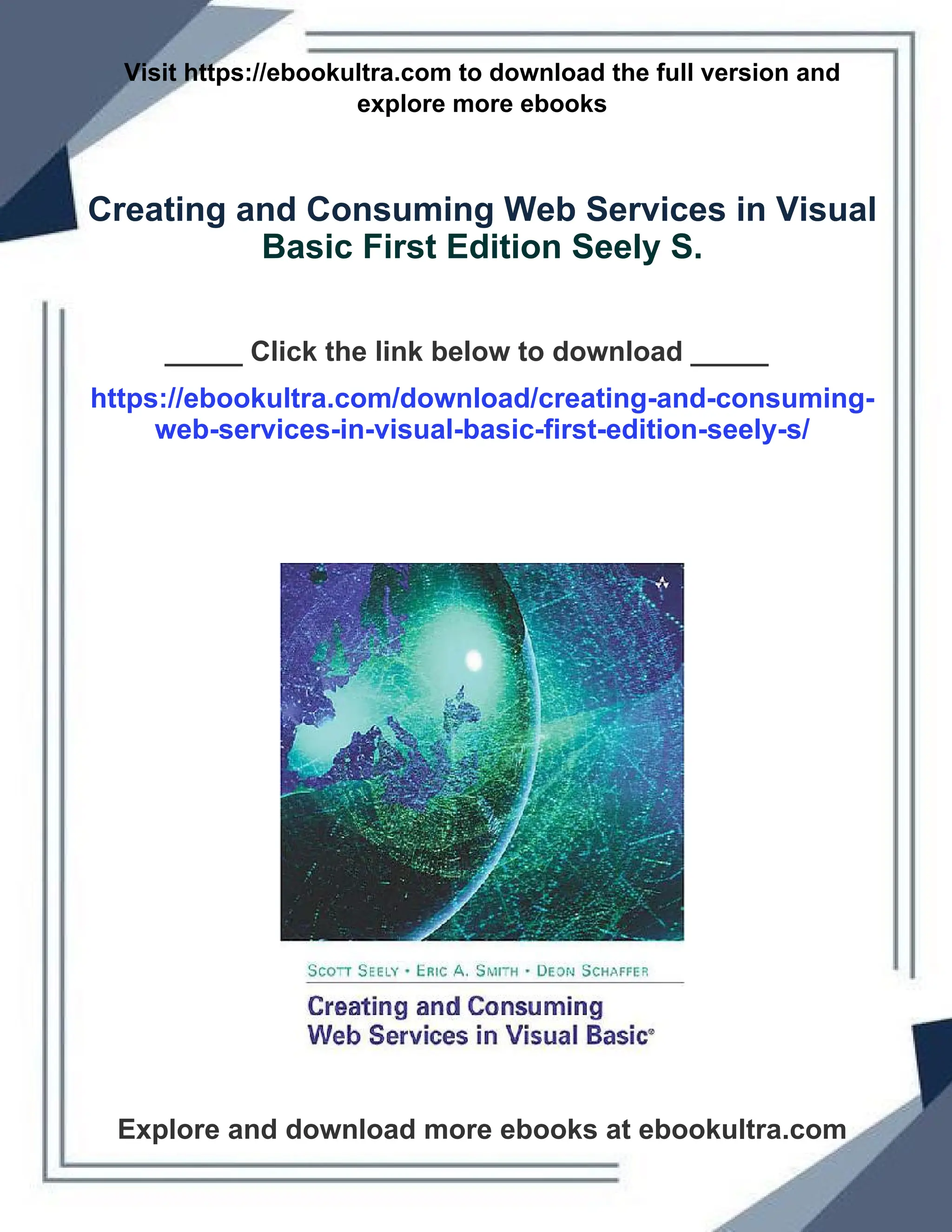
![Foreword
Looking back at the last 30 years of human-computer interaction, a number of key
milestones stand out prominently: the shift from the mainframe computing to the PC, the
introduction of the graphical user interface, the move from 16- to 32-bit processors, and
most recently, the pervasiveness of the Internet and the Web. Each of these landmarks
represents a fundamental turning point in the relationship between human and machine.
They also served to address some of the most pressing industry challenges of the time,
from providing a viable platform for consumer-based computing to satisfying the need
for richer, graphical user interaction to enabling ubiquitous application deployment and
access.
Now, as businesses seek to address the ongoing fundamental challenges of software
integration, a new technology called XML Web services is promising to once again
fundamentally transform and enhance the way consumers and businesses interact with
computers. The core concept behind these Web services is relatively
straightforward[md]components that are accessible using standardized Internet
protocols. Yet their potential to affect the industry is both far-reaching and profound.
Similar to computing revolutions of the past, XML Web services represents a new
paradigm around which the entire computing industry is converging. Partners and
competitors alike are quickly recognizing the value of XML Web services as a universal
component architecture[md]one that spans programming languages, networks, and
even platforms.
But why this sudden move to a new software integration paradigm when technologies
such as DCOM and CORBA already exist? Although they provide a viable option for
integration of systems residing in a uniform corporate Intranet, they lack the capability to
adapt to the loosely coupled, heterogeneous environment of the Internet. As this
became evident to more and more businesses that required integration not only within
the firewall, but also with diverse business partners and customers, it became clear that
the path to success lay not in tightly-coupled, proprietary systems, but in the adoption of
integration technologies based on open standards. This is the fundamental differentiator
and the key to the success of Web services.
For developers, Web services present a nearly limitless world of new opportunities.
Because of the fundamental issues they address, Web services are pertinent to the
entire spectrum of today's software, from rich Windows applications, to thin-client Web](https://image.slidesharecdn.com/56076-250228235214-cfeb7682/75/Creating-and-Consuming-Web-Services-in-Visual-Basic-First-Edition-Seely-S-10-2048.jpg)
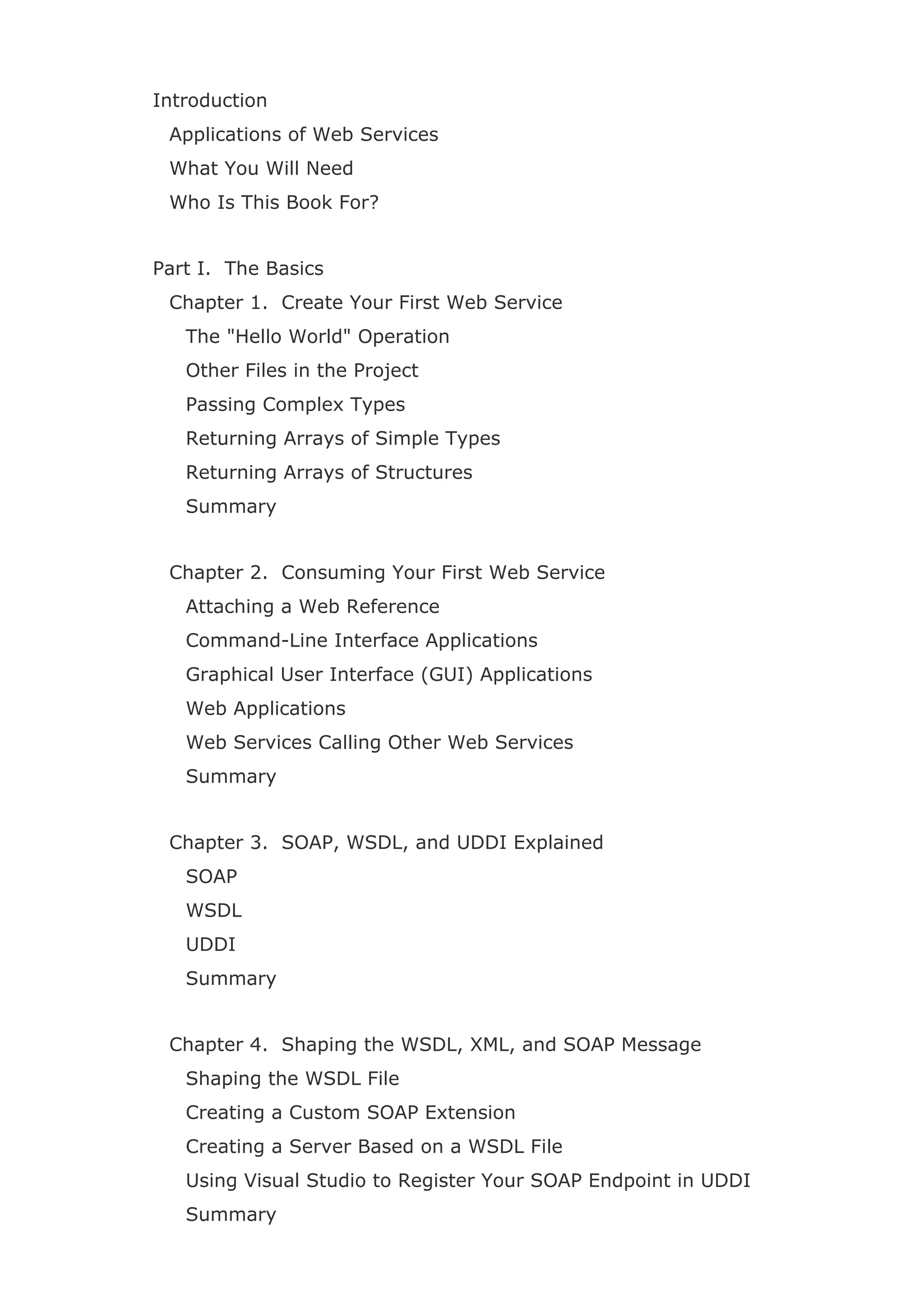
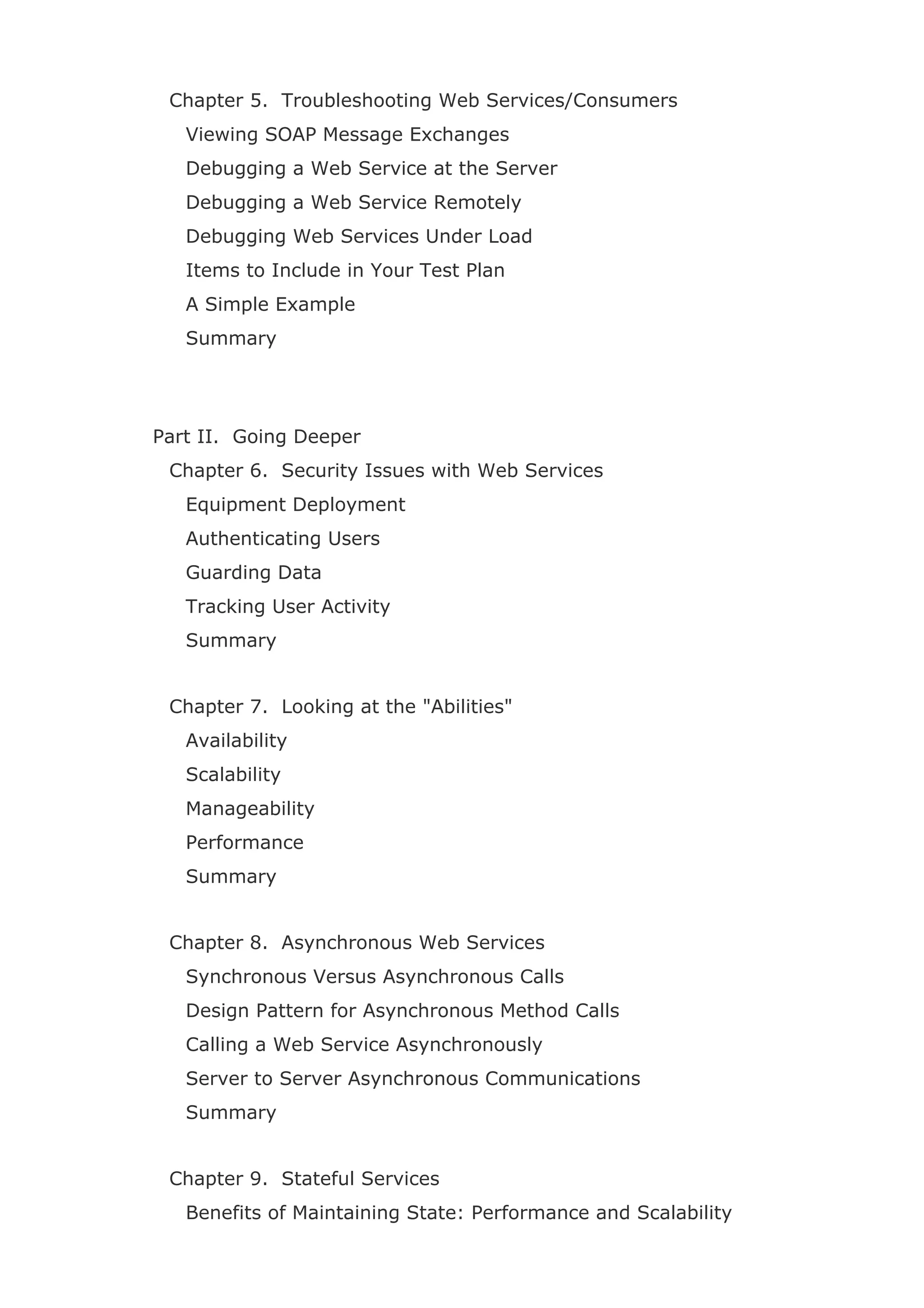
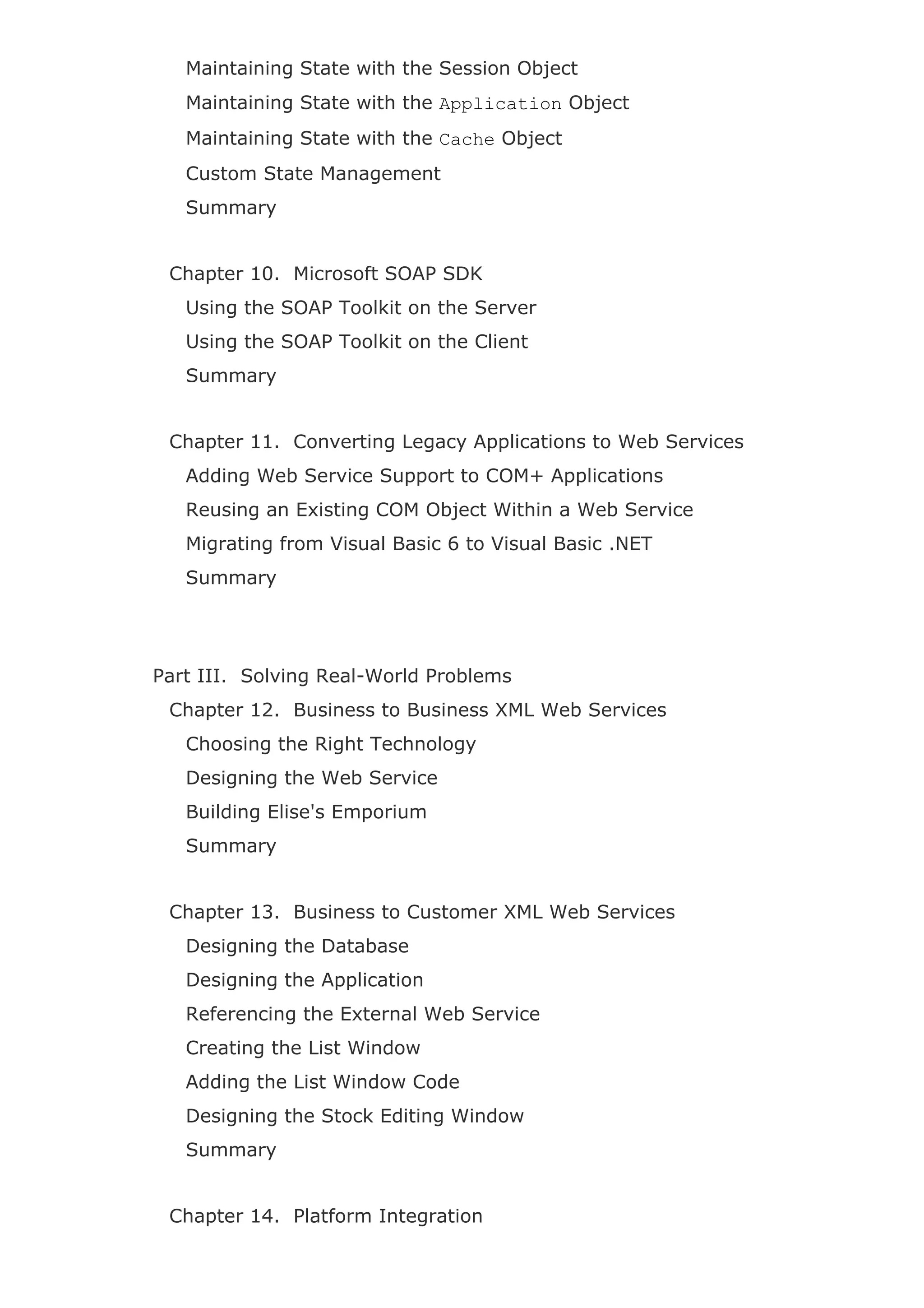
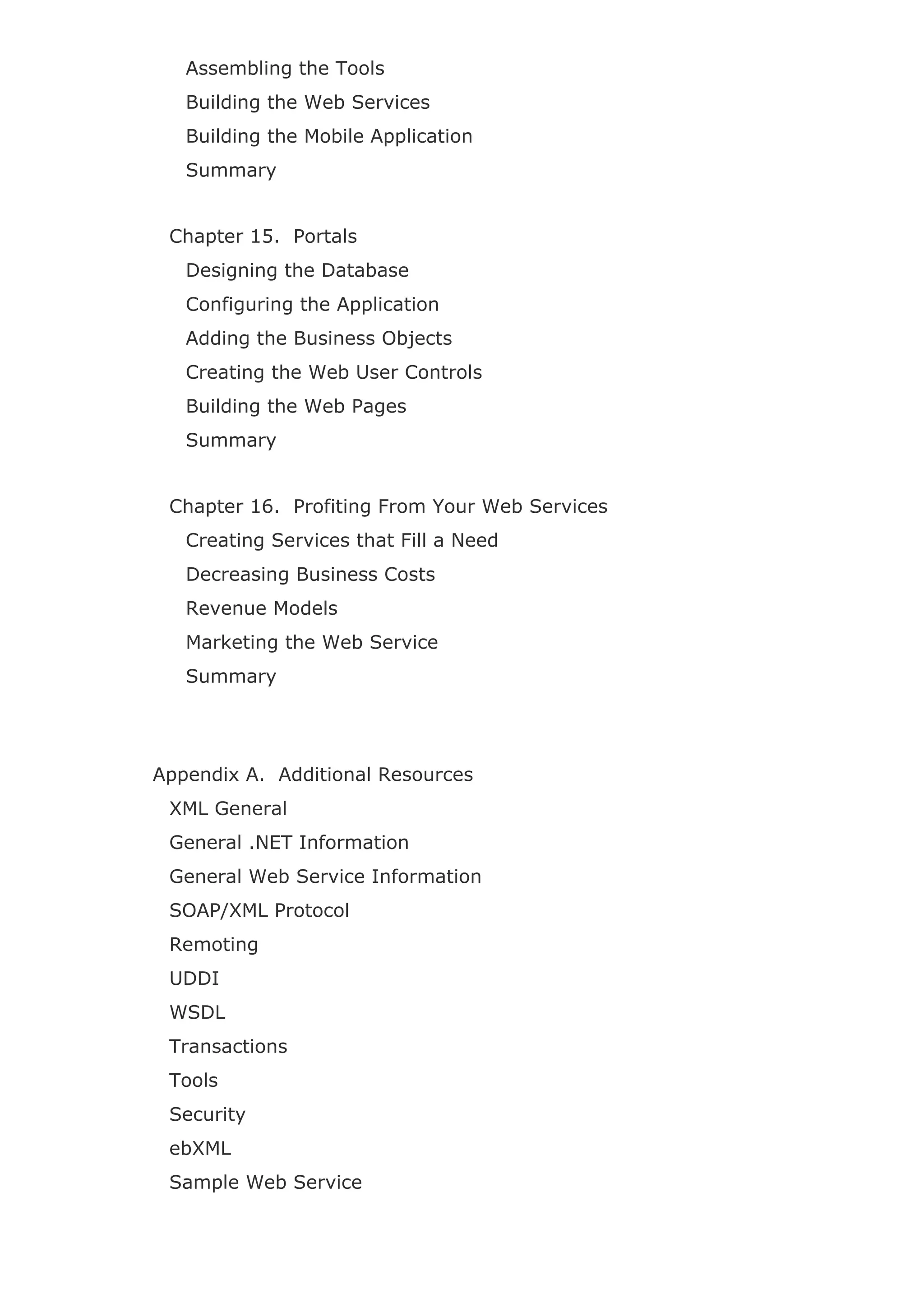
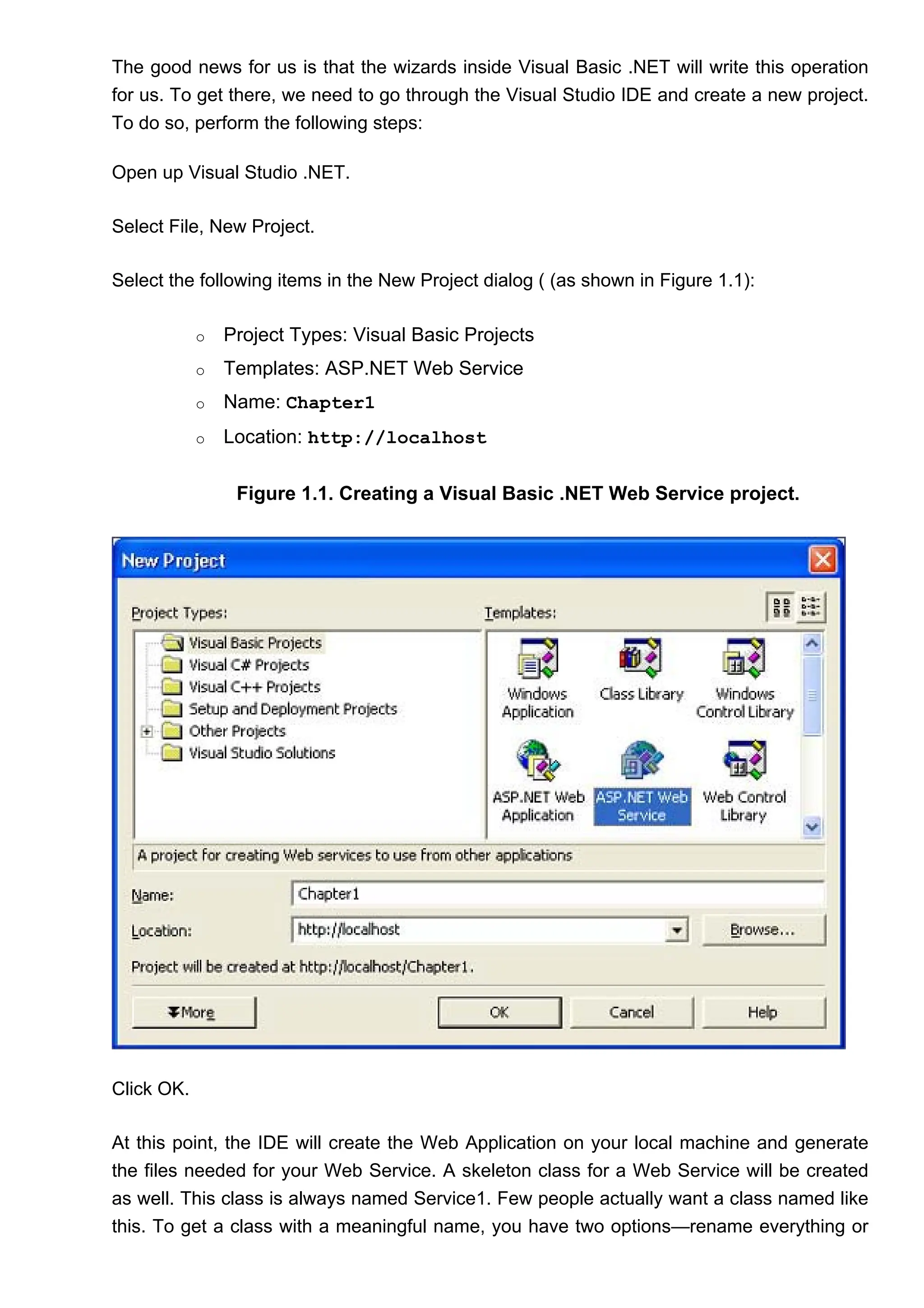
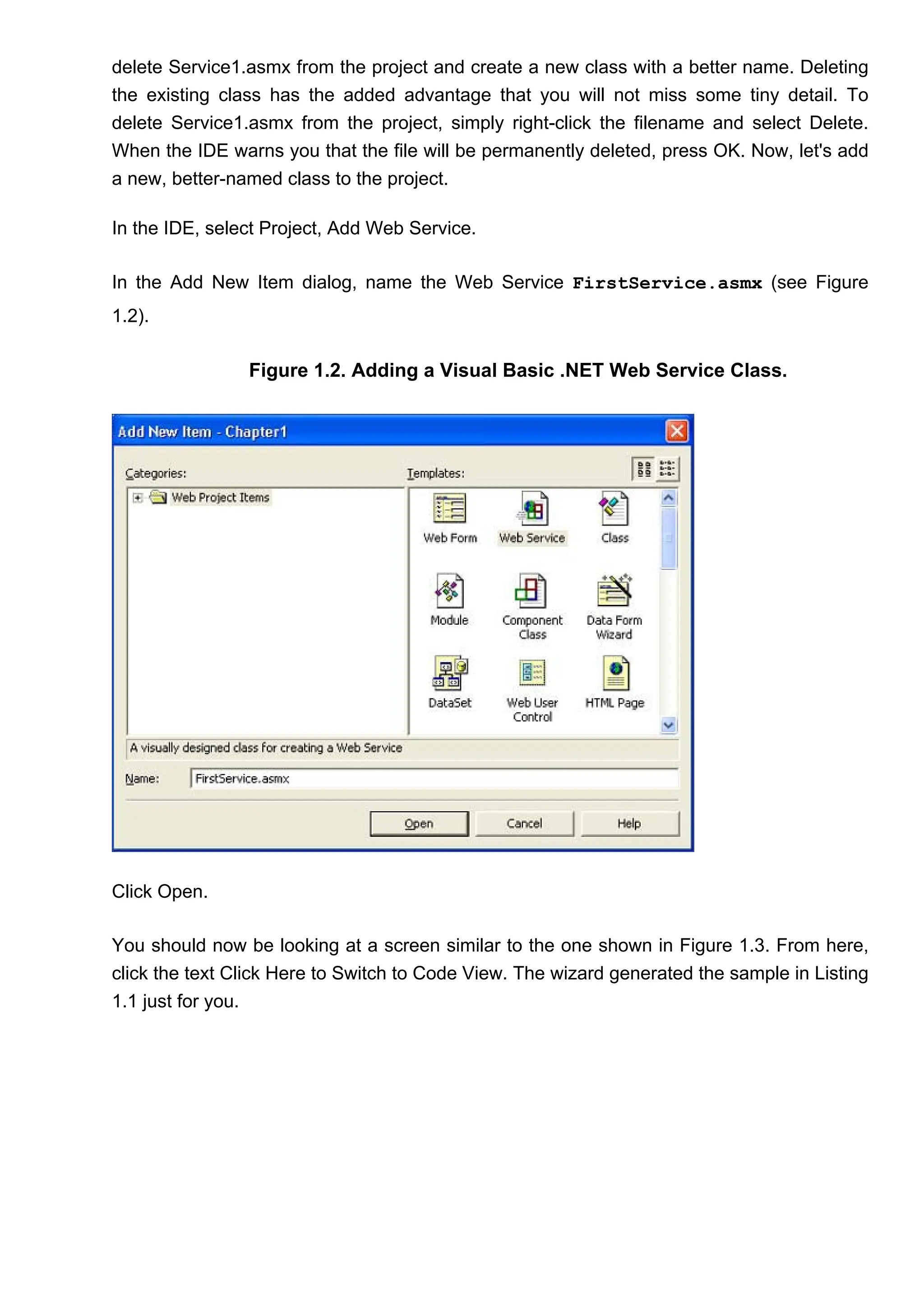
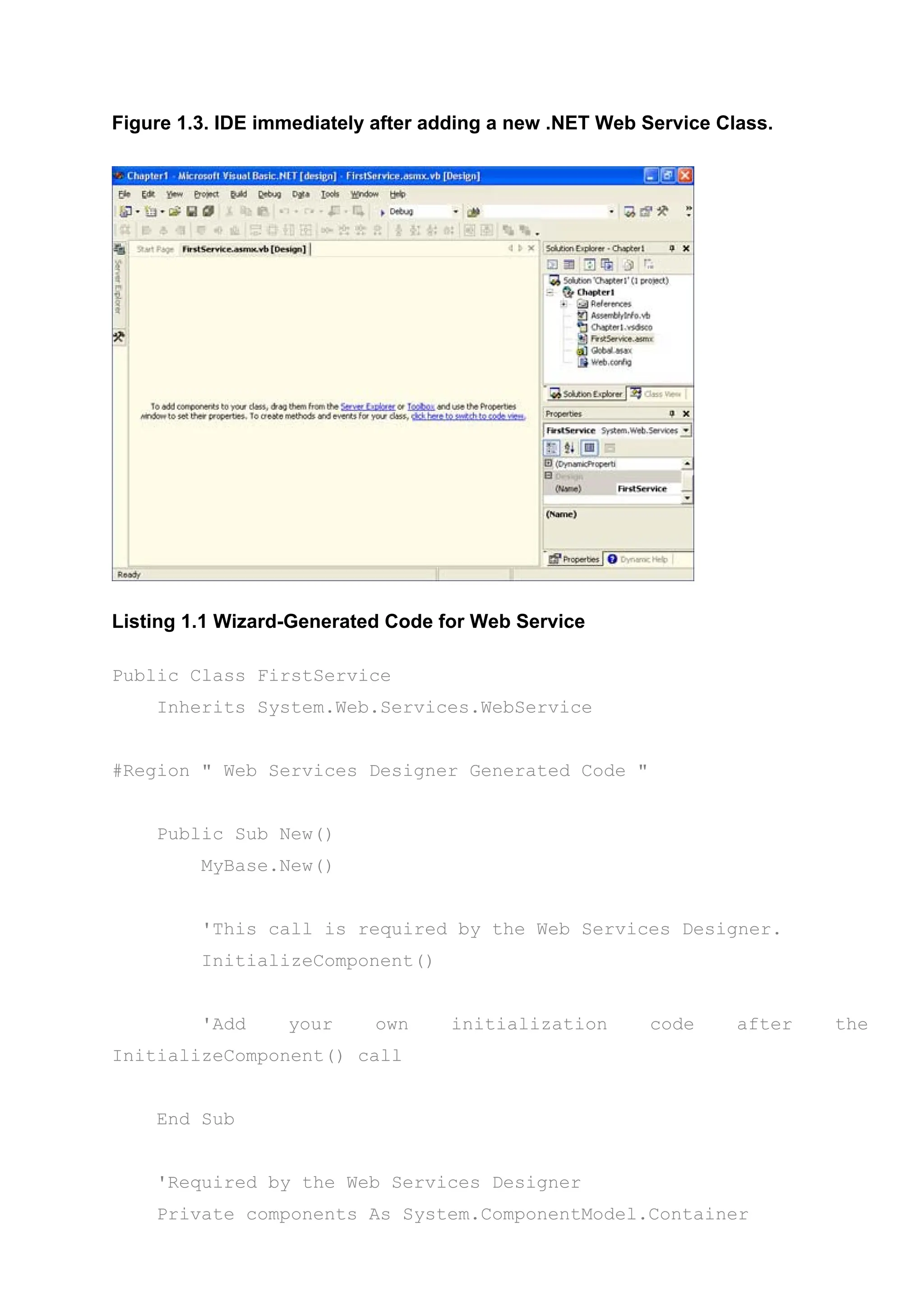
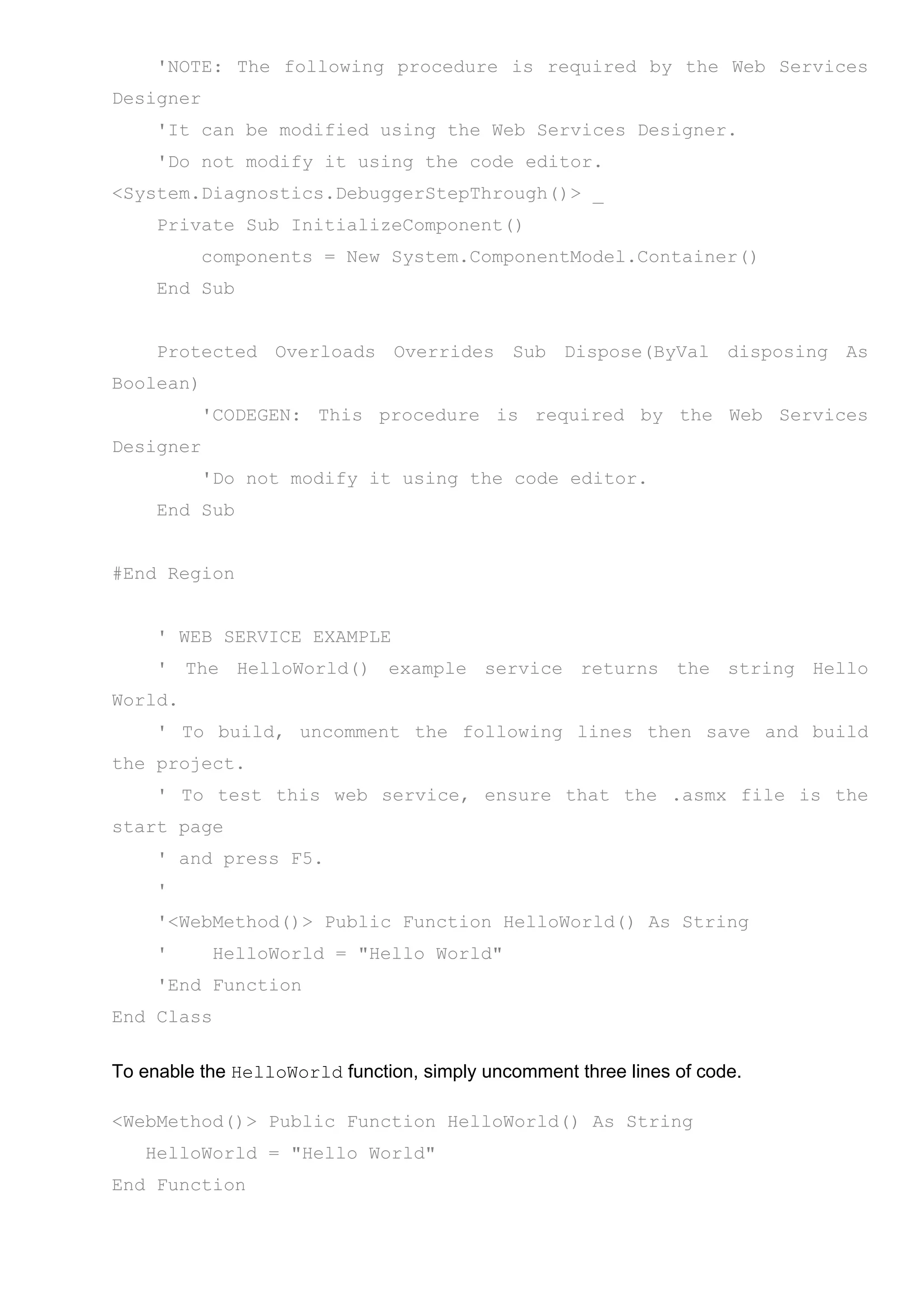
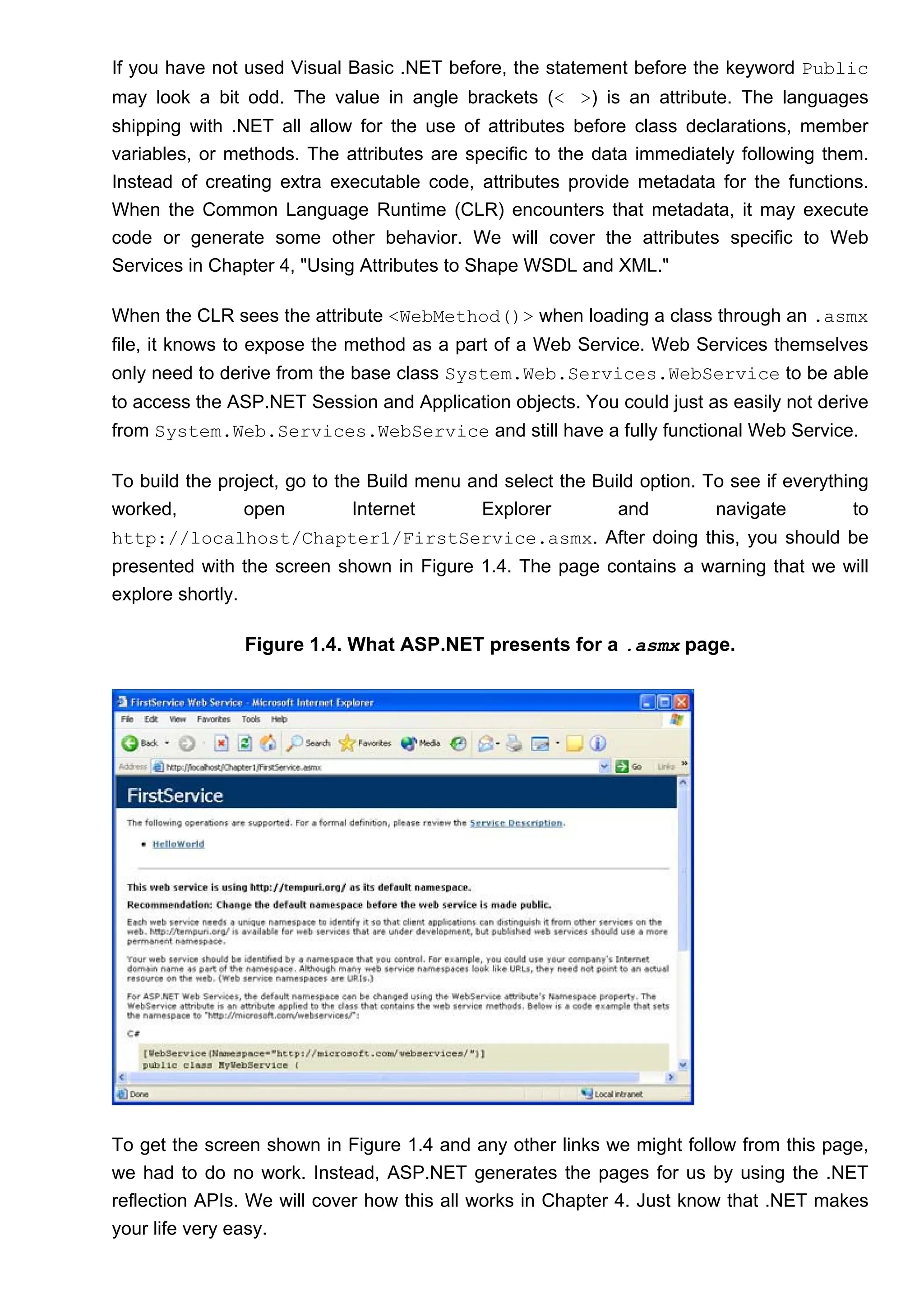
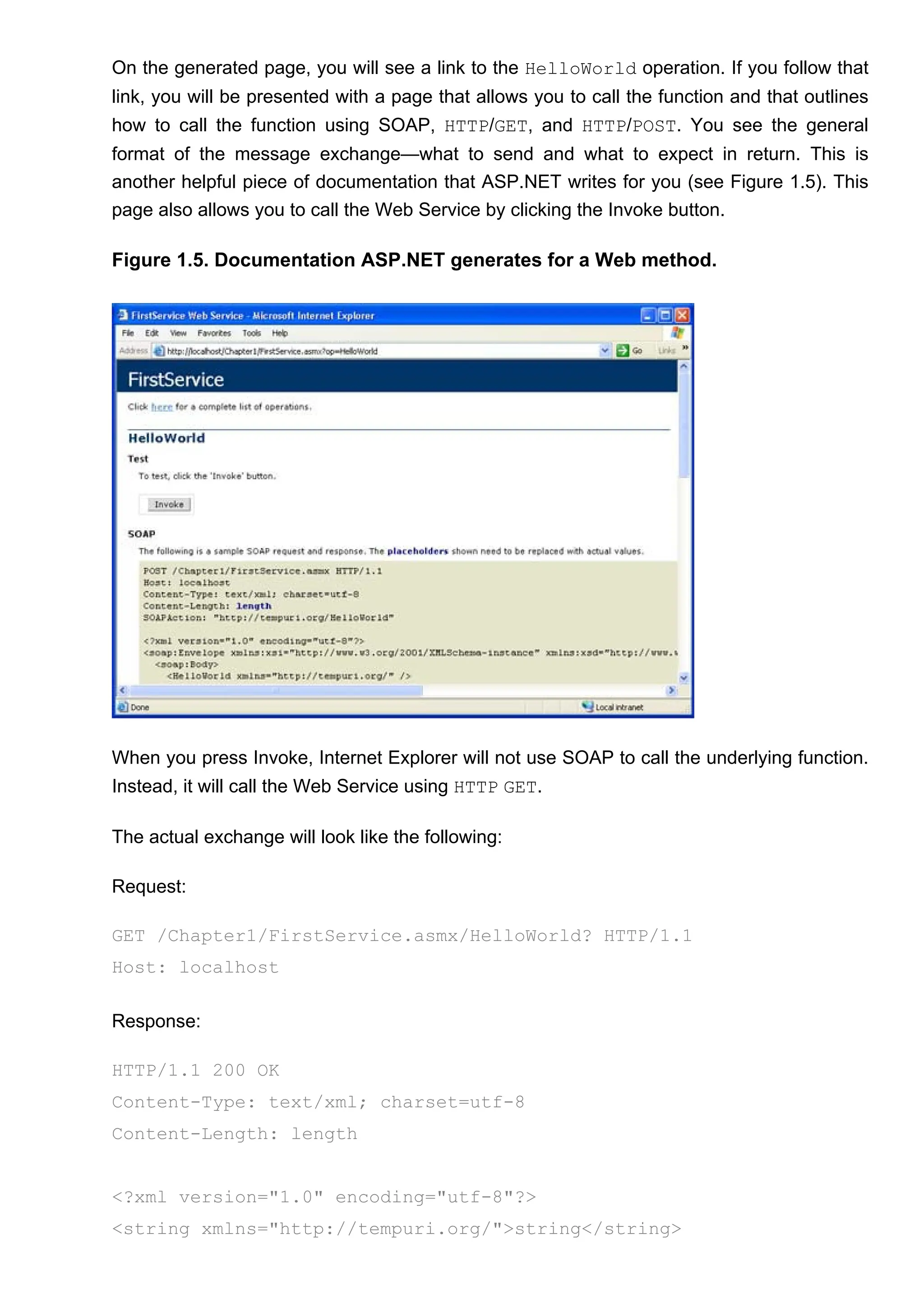
![Clicking Invoke, we get the following response:
<?xml version="1.0" encoding="utf-8"?>
<string xmlns="http://tempuri.org/">Hello World</string>
For most of this book, we will only work with SOAP requests and responses. A SOAP
Request/Response typically has this format:
<Envelope>
<Header></Header>
<Body>[interesting stuff here]</Body>
</Envelope>
But, Web Services can exist outside of the SOAP protocol. You can also send XML in a
regular HTTP GET or POST request and return raw XML from that same request. When
you do this, you are using Web Services in their simplest forms. To create the fancier, more
powerful messages, only SOAP will work.
You will see a lot of messages in this chapter and the next. The idea is for you to become
comfortable reading the messages. Outside of some special properties of the SOAP
Envelope, your messages will be primarily Body content. That content is regular XML and
only loosely related to SOAP. This book assumes you are already familiar with XML and
that is why we start out with the simplest Web Service messages possible: HTTP
GET/POST.
Other Files in the Project
Before we run headlong into the remaining examples, let's take a moment and see what
other files got included in the project and where they sit on your hard drive. Looking at the
Solution Explorer pane in Figure 1.3, you see the following files in your project:
AssemblyInfo.vb Contains version information related to the Visual Basic project.
[Project Name].vsdisco Contains the dynamic discovery information for this Web
Service. The ASP.NET runtime uses this to discover and list all the Web Services hosted
on a particular machine.
Global.asax Use this class to add handlers called by the ASP Application and
Session objects. Web Services must derive from System.Web.Services.WebService
to get access to these objects.](https://image.slidesharecdn.com/56076-250228235214-cfeb7682/75/Creating-and-Consuming-Web-Services-in-Visual-Basic-First-Edition-Seely-S-32-2048.jpg)
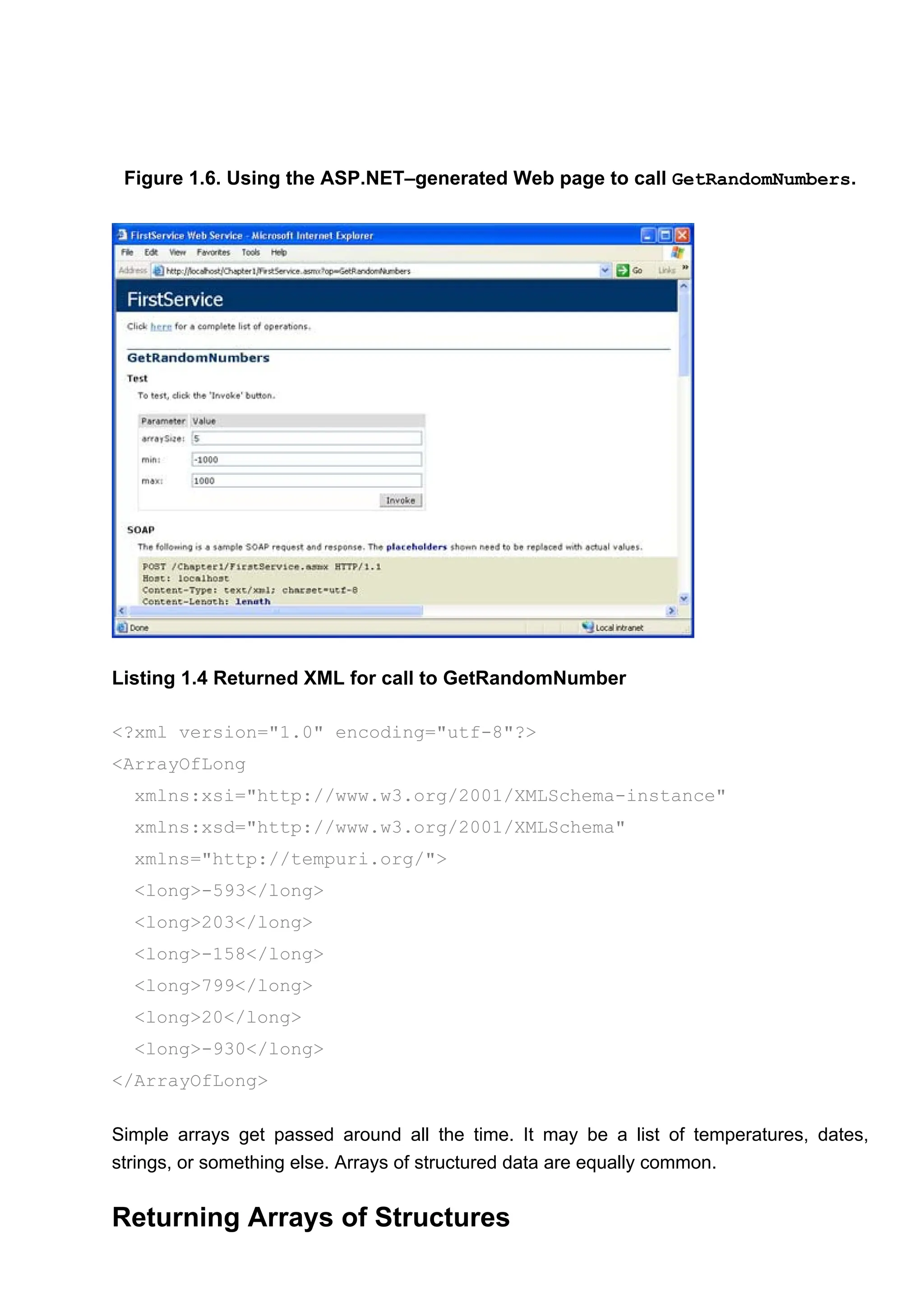
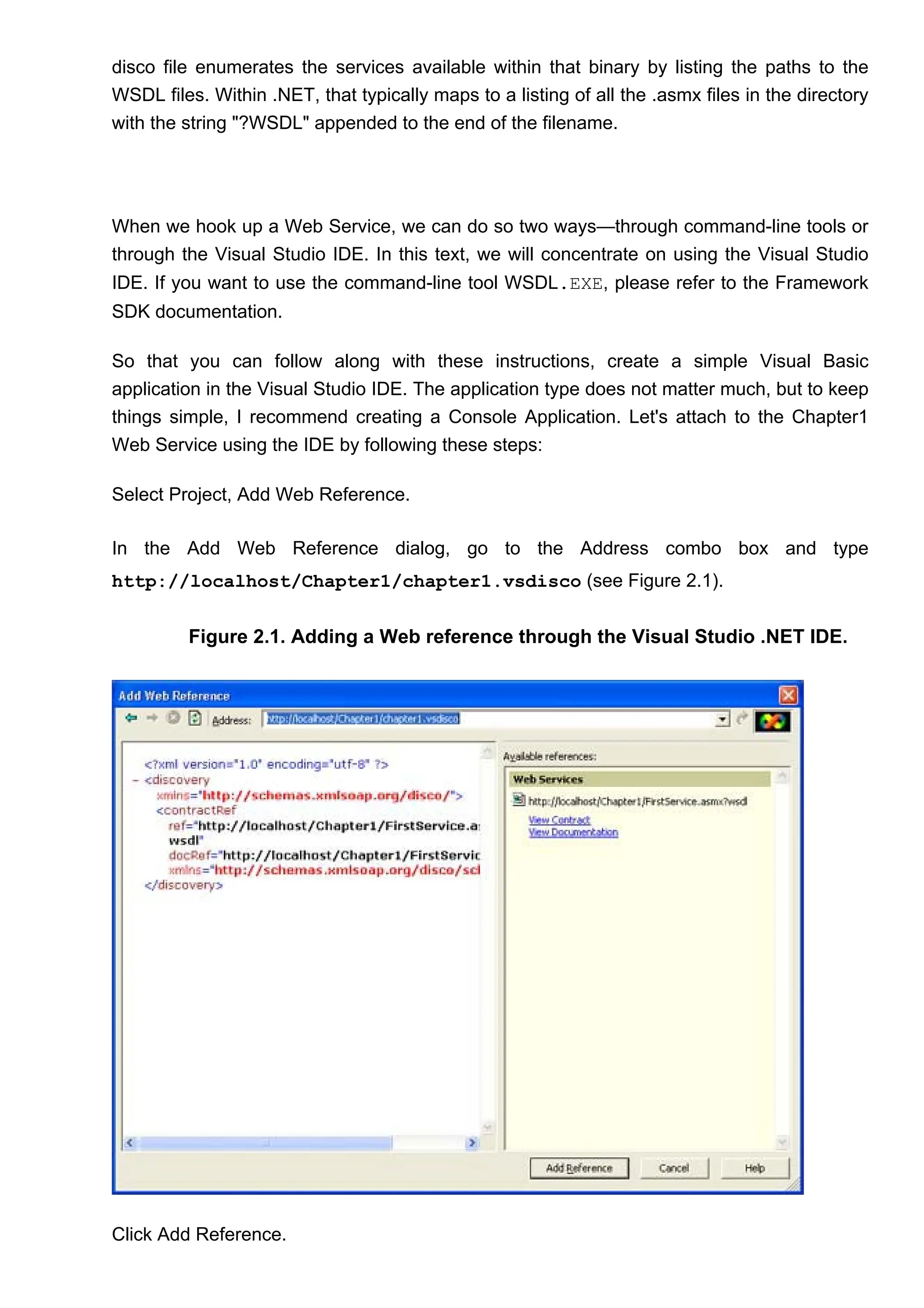
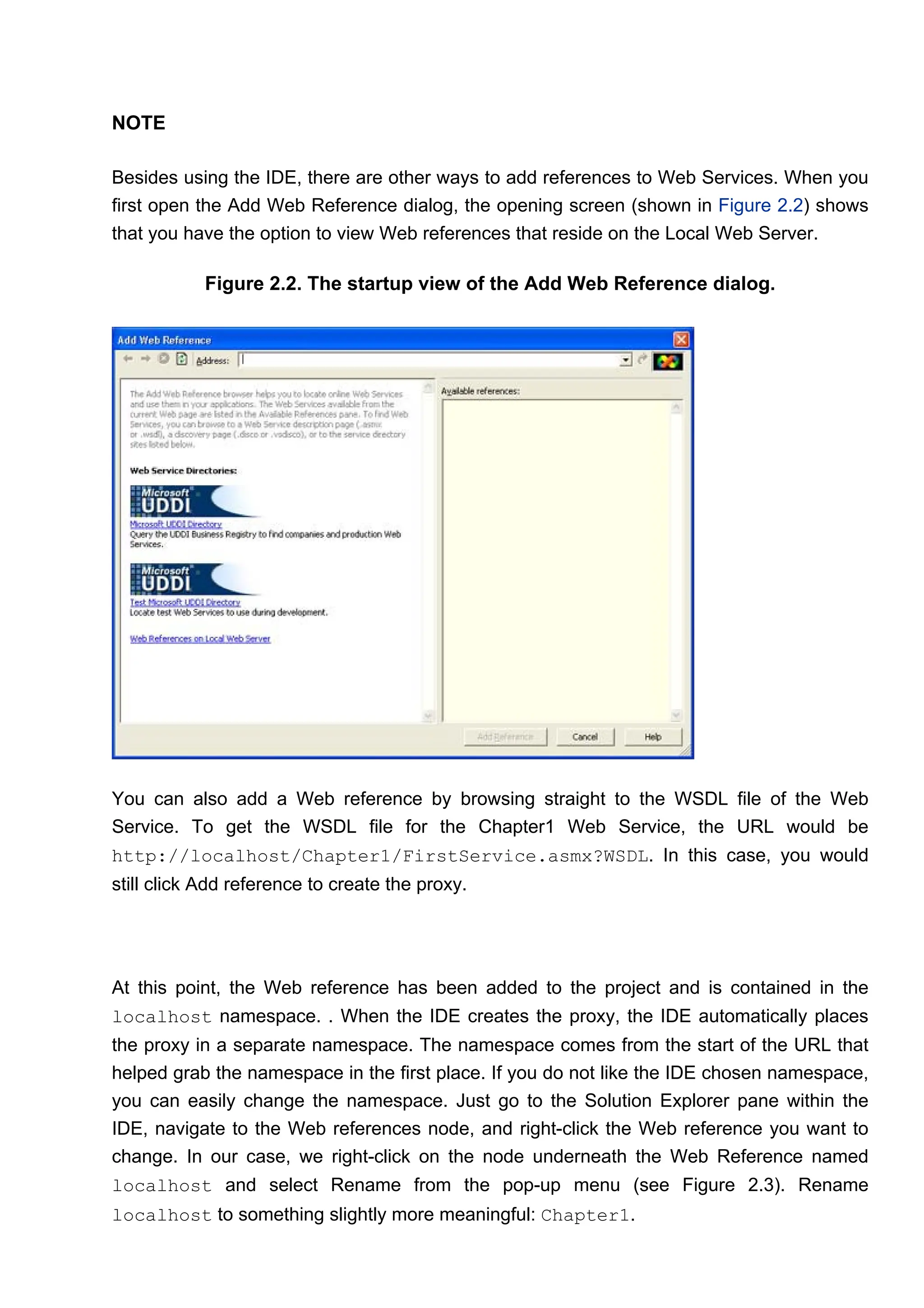
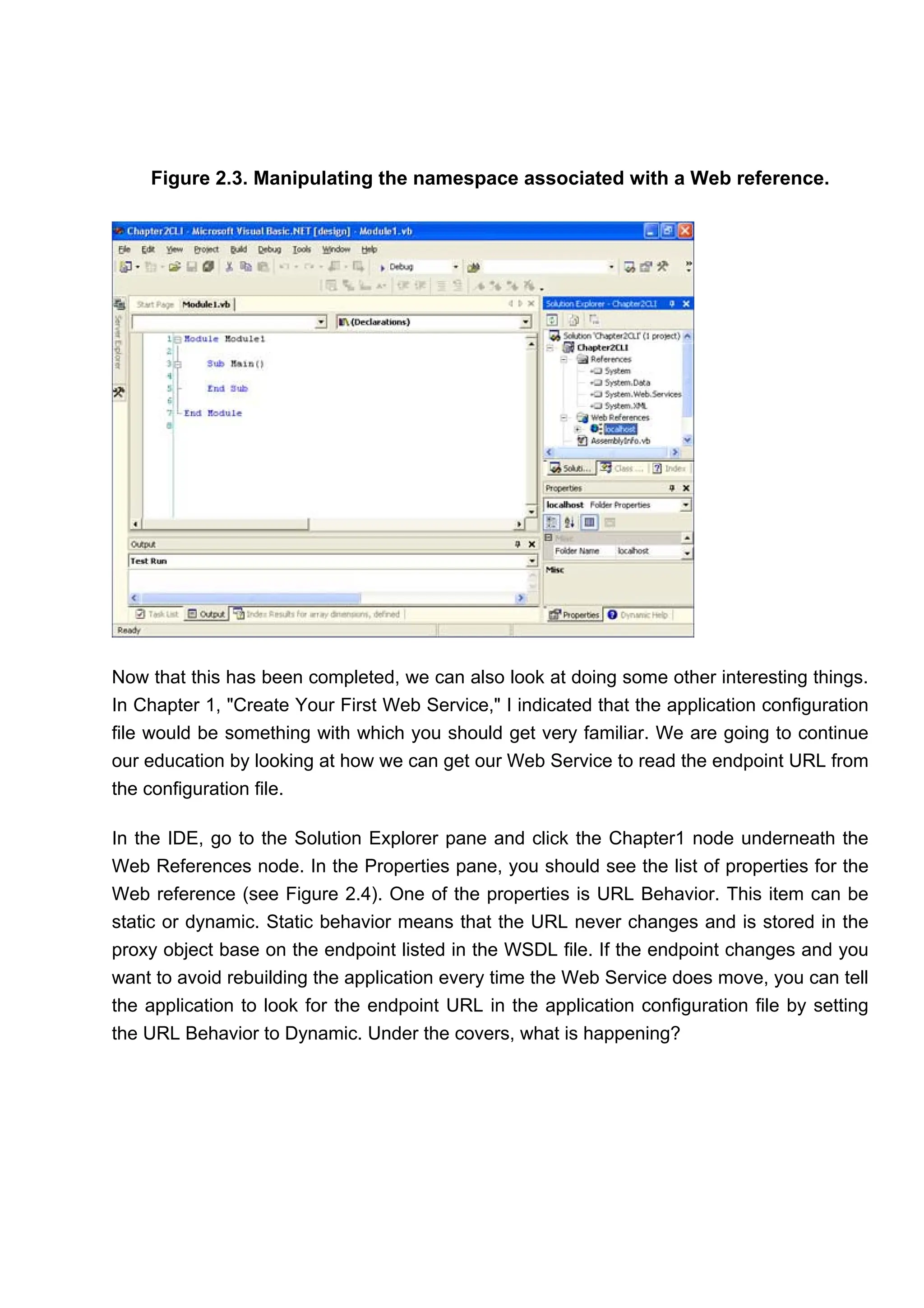
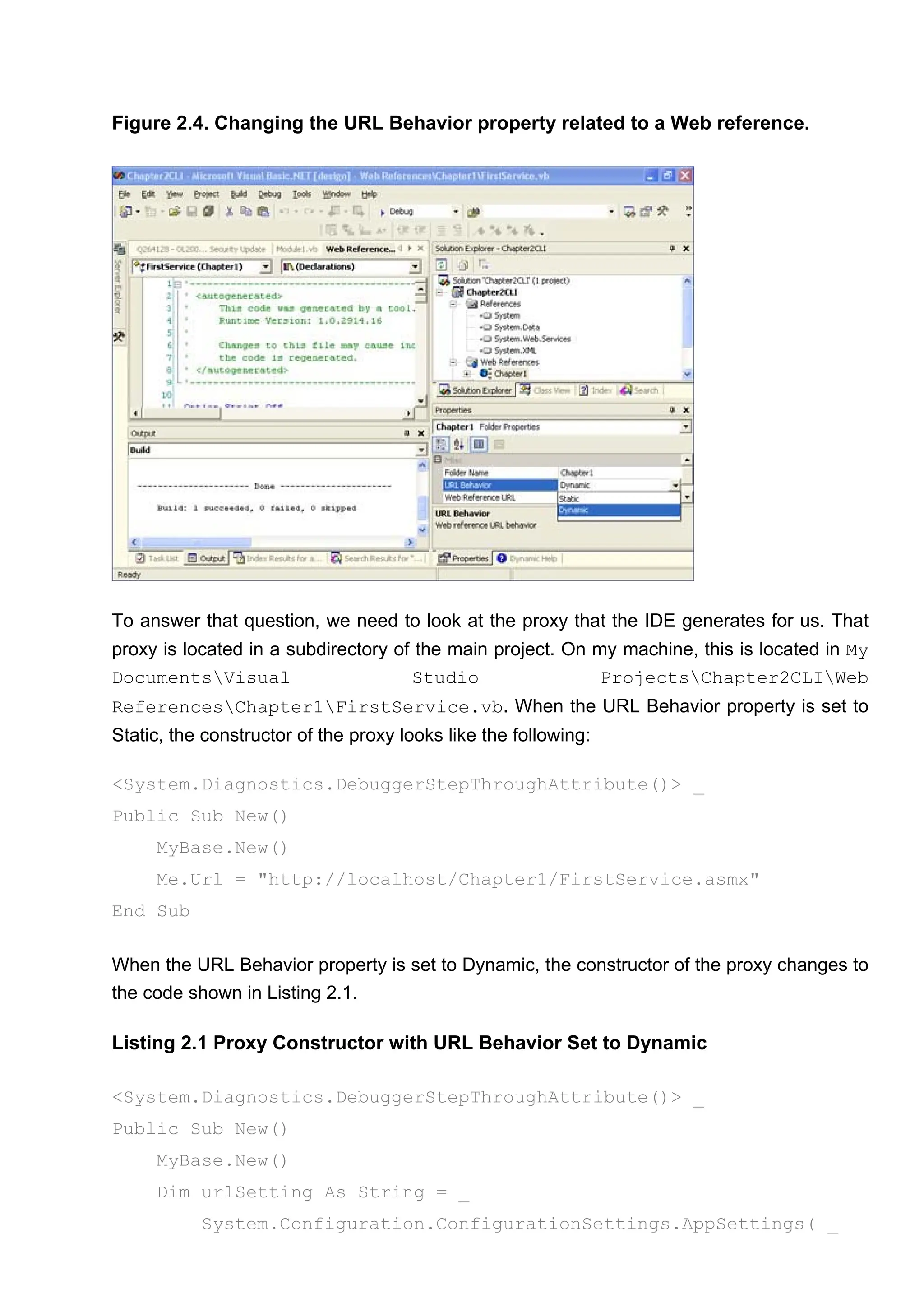
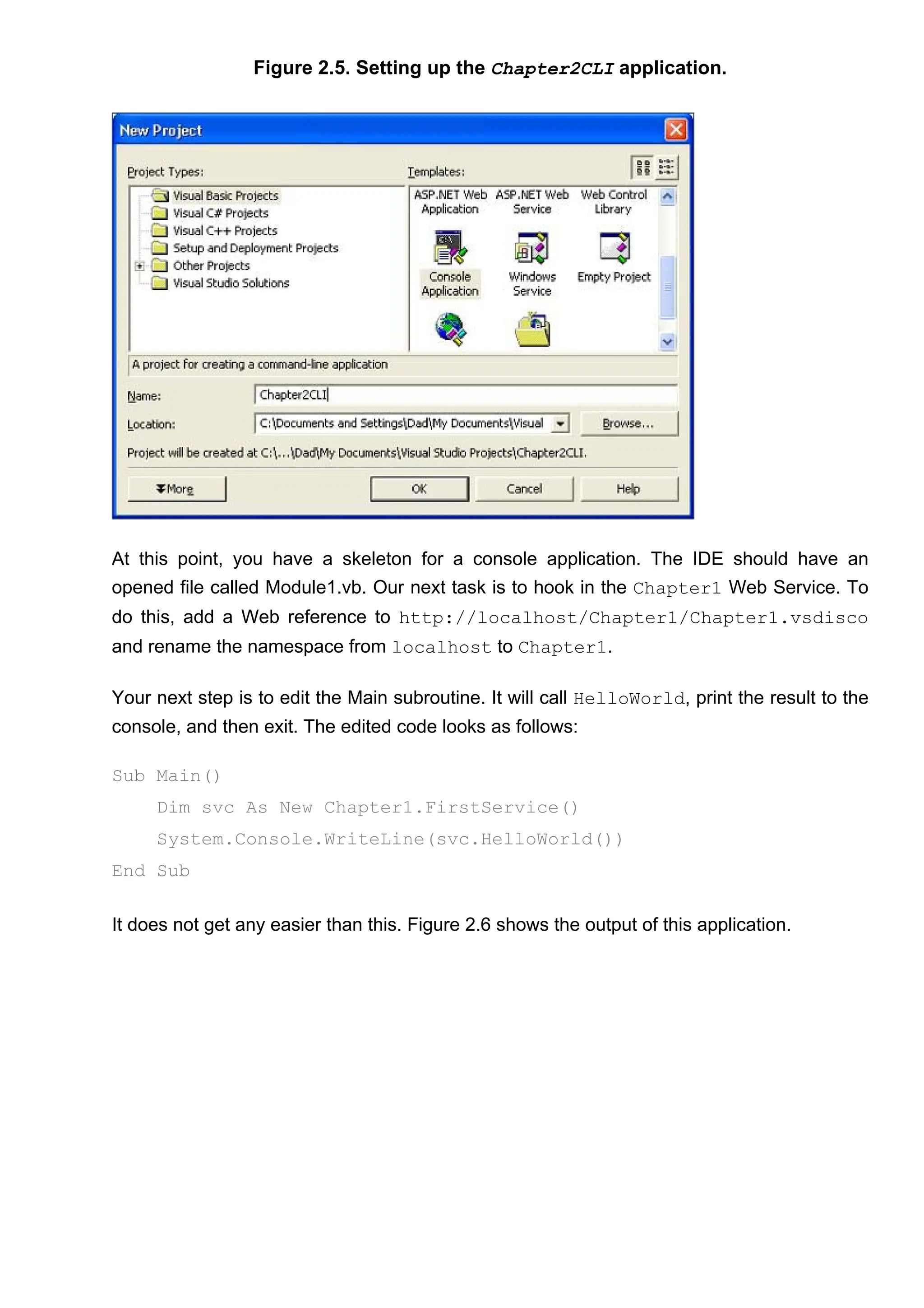
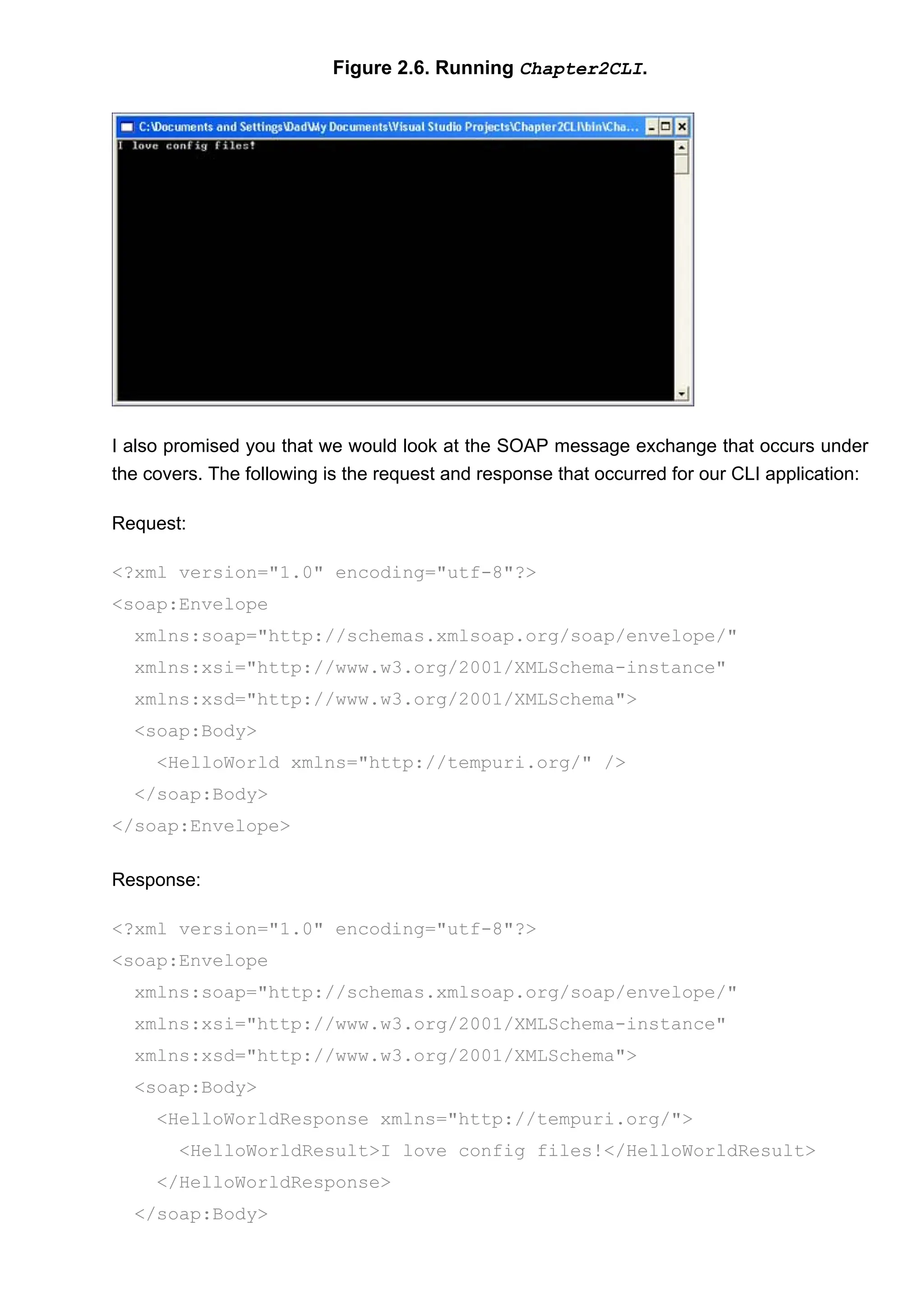
![tes de soleil sont con- l'homme trop petit pour
damnées, l'endosser.
Une bouiteille de vin,
Un verre d'eau,
Deux paires de lunettes,
Une douzaine de chemises,
Beaucoup de peine,
Un peu de beurre.
mais je marie demain mais les lampes bleues
l'ombre de mes pieds à d'un ciel de juillet sont
celle de mon père. les filles de mes filles.
Plusieurs enfants font un vieillard.
et la satisfaction d'un vieillard
je me promènerai + je me promène +
je me promenais + je me suis promené
Je vis
J'ai vécu comme toi
Déclaration[*]
POIDS PUBLIC, rencontre d'un homme et d'un
homme, d'une femme et d'un homme.
Les voyous inspirateurs sont ailleurs.](https://image.slidesharecdn.com/56076-250228235214-cfeb7682/75/Creating-and-Consuming-Web-Services-in-Visual-Basic-First-Edition-Seely-S-52-2048.jpg)
![Ils ont abandonné un homme, encore ne tient-il
qu'à un fil.
Au point de vue santé: absent, sur l'oreiller
creux: présent, dans la maison: paresseux et
dans la rue: perdu pour tout le monde,
POUR L'OR DES RUES,
POUR les regards en l'air POUR ce qui n'existe
plus.
[*] Toutes les variétés du mot intérêt, si
agréables ou désagréables qu'elles soient,
naissent en même temps.
Le mien,
Gala, c'est dire est à toi.](https://image.slidesharecdn.com/56076-250228235214-cfeb7682/75/Creating-and-Consuming-Web-Services-in-Visual-Basic-First-Edition-Seely-S-53-2048.jpg)