Origins of American
    Government

   The Colonial Period
English Heritage
• Limited Government
  – Power of the ruler is
    limited and not
    absolute.
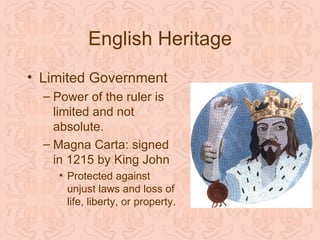
  – Magna Carta: signed
    in 1215 by King John
    • Protected against
      unjust laws and loss of
      life, liberty, or property.
English Heritage
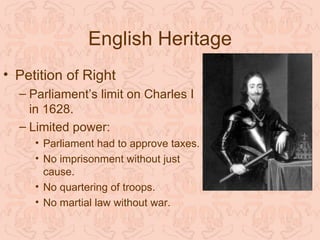
• Petition of Right
  – Parliament’s limit on Charles I
    in 1628.
  – Limited power:
     • Parliament had to approve taxes.
     • No imprisonment without just
       cause.
     • No quartering of troops.
     • No martial law without war.
English Heritage

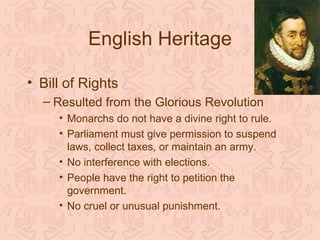
• Bill of Rights
  – Resulted from the Glorious Revolution
     • Monarchs do not have a divine right to rule.
     • Parliament must give permission to suspend
       laws, collect taxes, or maintain an army.
     • No interference with elections.
     • People have the right to petition the
       government.
     • No cruel or unusual punishment.
English Heritage
• Representative Government
  – Government in which people elect delegates to
    make laws and conduct government.
    • 2 chambers to Parliament:
       – House of Lords: nobility
       – House of Commons: elected businessmen and merchants from
         middle class.
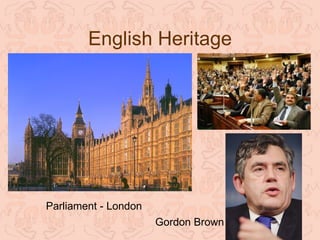
English Heritage


Parliament - London
                      Gordon Brown
English Heritage
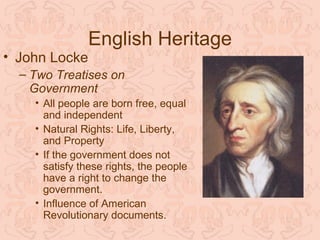
• John Locke
  – Two Treatises on
    Government
    • All people are born free, equal
      and independent
    • Natural Rights: Life, Liberty,
      and Property
    • If the government does not
      satisfy these rights, the people
      have a right to change the
      government.
    • Influence of American
      Revolutionary documents.
Colonial Governments
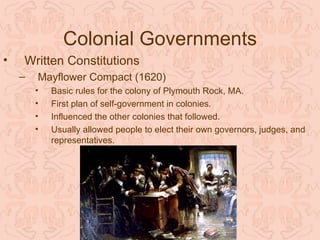
•   Written Constitutions
    –   Mayflower Compact (1620)
        •   Basic rules for the colony of Plymouth Rock, MA.
        •   First plan of self-government in colonies.
        •   Influenced the other colonies that followed.
        •   Usually allowed people to elect their own governors, judges, and
            representatives.
Colonial Governments

• Colonial Legislatures
  – Virginia House of Burgesses (1619)
     • First representative government in the colonies
     • Showed that Americans could manage their
       own affairs.
     • Requirement to vote was to own property; not
       an issue in America.
Colonial Governments
• Separation of Powers
  – Division of the power of government
    • Still must answer to the King; but considerable self-
      government
    • Three branches
       – Legislative
       – Executive
       – Judicial

Colonial government

  • 1.
    Origins of American Government The Colonial Period
  • 2.
    English Heritage • LimitedGovernment – Power of the ruler is limited and not absolute. – Magna Carta: signed in 1215 by King John • Protected against unjust laws and loss of life, liberty, or property.
  • 3.
    English Heritage • Petitionof Right – Parliament’s limit on Charles I in 1628. – Limited power: • Parliament had to approve taxes. • No imprisonment without just cause. • No quartering of troops. • No martial law without war.
  • 4.
    English Heritage • Billof Rights – Resulted from the Glorious Revolution • Monarchs do not have a divine right to rule. • Parliament must give permission to suspend laws, collect taxes, or maintain an army. • No interference with elections. • People have the right to petition the government. • No cruel or unusual punishment.
  • 5.
    English Heritage • RepresentativeGovernment – Government in which people elect delegates to make laws and conduct government. • 2 chambers to Parliament: – House of Lords: nobility – House of Commons: elected businessmen and merchants from middle class.
  • 6.
    English Heritage Parliament -London Gordon Brown
  • 7.
    English Heritage • JohnLocke – Two Treatises on Government • All people are born free, equal and independent • Natural Rights: Life, Liberty, and Property • If the government does not satisfy these rights, the people have a right to change the government. • Influence of American Revolutionary documents.
  • 8.
    Colonial Governments • Written Constitutions – Mayflower Compact (1620) • Basic rules for the colony of Plymouth Rock, MA. • First plan of self-government in colonies. • Influenced the other colonies that followed. • Usually allowed people to elect their own governors, judges, and representatives.
  • 9.
    Colonial Governments • ColonialLegislatures – Virginia House of Burgesses (1619) • First representative government in the colonies • Showed that Americans could manage their own affairs. • Requirement to vote was to own property; not an issue in America.
  • 10.
    Colonial Governments • Separationof Powers – Division of the power of government • Still must answer to the King; but considerable self- government • Three branches – Legislative – Executive – Judicial