COGNITIVE APPROACH
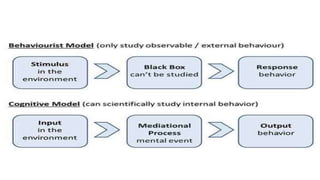
Behaviourism
S R
Behaviourists aren’t
interested in what happens in
between S and R. They don’t
think you need to know.
Social learning theory
S R
O
Social Learning Theorists say that things take place within
the organism that mediate between S and R.
You do need to know about the person’s mental processes.
Cognitive approach
S R
IP
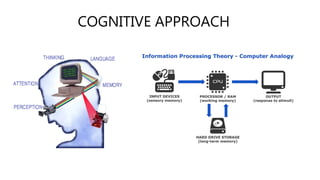
Cognitive psychologists extend this idea and say that our
behaviour is determined by the way we process information (PI)
taken in from our environment.
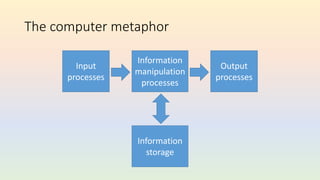
The computer metaphor
Input
processes
Information
manipulation
processes
Output
processes
Information
storage
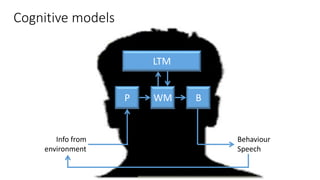
Cognitive models
•Cognitive psychologists use the results of their
research to develop models of how people
process information
•They infer mental processes from comparisons
between the information (input) a person
receives and the behaviour (output) they
produce
What is happening inside the black box?
?
What is happening inside the black box?
?
What is happening inside the black box?
?
1. Takes in a
shape.
2. Counts the
vertices.
3. Adds one to this
number.
4. Outputs a
shape with the
new number of
vertices.
What does this information processor do?
This may not be what is actually happening in the black
box, but it allows us to account for how the box
translates input into output. It is a useful model.
1. Takes in a
shape.
2. Counts the
vertices.
3. Adds one to this
number.
4. Outputs a
shape with the
new number of
vertices.
What will the output be?
Our model allows us to predict how the information
processor will behave. It is still not necessary for us to
know what’s actually happening in the box.
1. Takes in a
shape.
2. Counts the
vertices.
3. Adds one to this
number.
4. Outputs a
shape with the
new number of
vertices.
Cognitive models
Info from
environment
Behaviour
Speech
LTM
WM
P B
Score the questionnaires with a classmate
I’m like this It depends on
the situation
I’m like this
Serious Light-hearted
Lenient Firm
Sceptical Trusting
On a 7-point scale place
a number here that
represents a
dispositional view of
behaviour
On a 7-point scale
place a number here
that represents a
situational view of
behaviour
7-point scale:
1 = Somewhat like me
7 = A lot like me
Now do the same on
the “He/She is like
this” questionnaire
Biases
• Our observations of other people often contain biases that we don’t
notice.
•When it’s us we blame the situation
•When it’s someone else we blame them
Biases
• If we assume that the student was just a rude/arrogant/obnoxious
person, how might we act towards her next time we met?
• How might our actions be different if we made a situational
attribution (e.g. She had just received some bad news)?
• Why does it matter?
You are about to see a photograph. You have 5 seconds to decide what’s happening
Q. Why might it be important for a psychologist to be aware of their biases?
What did you see?
Get him!!!
Critical psychological thinking
•We all make assumptions about other people
and these assumptions are often biased. If we
remain unaware of our assumptions and biases
we are in danger of drawing mistaken
conclusions.
A B
What are the differences
between these chairs?
The differences you
pointed out are your
schema’s for those
chairs.
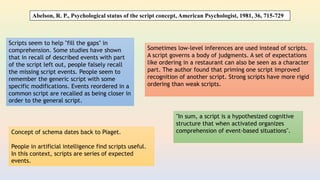
Abelson, R. P., Psychological status of the script concept, American Psychologist, 1981, 36, 715-729
Concept of schema dates back to Piaget.
People in artificial intelligence find scripts useful.
In this context, scripts are series of expected
events.
Sometimes low-level inferences are used instead of scripts.
A script governs a body of judgments. A set of expectations
like ordering in a restaurant can also be seen as a character
part. The author found that priming one script improved
recognition of another script. Strong scripts have more rigid
ordering than weak scripts.
"In sum, a script is a hypothesized cognitive
structure that when activated organizes
comprehension of event-based situations".
Scripts seem to help "fill the gaps" in
comprehension. Some studies have shown
that in recall of described events with part
of the script left out, people falsely recall
the missing script events. People seem to
remember the generic script with some
specific modifications. Events reordered in a
common script are recalled as being closer in
order to the general script.
COGNITIVE.pptx

COGNITIVE.pptx

  • 1.
  • 3.
    Behaviourism S R Behaviourists aren’t interestedin what happens in between S and R. They don’t think you need to know.
  • 4.
    Social learning theory SR O Social Learning Theorists say that things take place within the organism that mediate between S and R. You do need to know about the person’s mental processes.
  • 5.
    Cognitive approach S R IP Cognitivepsychologists extend this idea and say that our behaviour is determined by the way we process information (PI) taken in from our environment.
  • 7.
  • 8.
    Cognitive models •Cognitive psychologistsuse the results of their research to develop models of how people process information •They infer mental processes from comparisons between the information (input) a person receives and the behaviour (output) they produce
  • 9.
    What is happeninginside the black box? ?
  • 10.
    What is happeninginside the black box? ?
  • 11.
    What is happeninginside the black box? ?
  • 12.
    1. Takes ina shape. 2. Counts the vertices. 3. Adds one to this number. 4. Outputs a shape with the new number of vertices. What does this information processor do?
  • 13.
    What does thisinformation processor do? This may not be what is actually happening in the black box, but it allows us to account for how the box translates input into output. It is a useful model. 1. Takes in a shape. 2. Counts the vertices. 3. Adds one to this number. 4. Outputs a shape with the new number of vertices.
  • 14.
    What will theoutput be? Our model allows us to predict how the information processor will behave. It is still not necessary for us to know what’s actually happening in the box. 1. Takes in a shape. 2. Counts the vertices. 3. Adds one to this number. 4. Outputs a shape with the new number of vertices.
  • 15.
  • 16.
    Score the questionnaireswith a classmate I’m like this It depends on the situation I’m like this Serious Light-hearted Lenient Firm Sceptical Trusting On a 7-point scale place a number here that represents a dispositional view of behaviour On a 7-point scale place a number here that represents a situational view of behaviour 7-point scale: 1 = Somewhat like me 7 = A lot like me Now do the same on the “He/She is like this” questionnaire
  • 17.
    Biases • Our observationsof other people often contain biases that we don’t notice. •When it’s us we blame the situation •When it’s someone else we blame them
  • 18.
    Biases • If weassume that the student was just a rude/arrogant/obnoxious person, how might we act towards her next time we met? • How might our actions be different if we made a situational attribution (e.g. She had just received some bad news)? • Why does it matter? You are about to see a photograph. You have 5 seconds to decide what’s happening Q. Why might it be important for a psychologist to be aware of their biases?
  • 19.
    What did yousee? Get him!!!
  • 20.
    Critical psychological thinking •Weall make assumptions about other people and these assumptions are often biased. If we remain unaware of our assumptions and biases we are in danger of drawing mistaken conclusions.
  • 21.
    A B What arethe differences between these chairs? The differences you pointed out are your schema’s for those chairs.
  • 22.
    Abelson, R. P.,Psychological status of the script concept, American Psychologist, 1981, 36, 715-729 Concept of schema dates back to Piaget. People in artificial intelligence find scripts useful. In this context, scripts are series of expected events. Sometimes low-level inferences are used instead of scripts. A script governs a body of judgments. A set of expectations like ordering in a restaurant can also be seen as a character part. The author found that priming one script improved recognition of another script. Strong scripts have more rigid ordering than weak scripts. "In sum, a script is a hypothesized cognitive structure that when activated organizes comprehension of event-based situations". Scripts seem to help "fill the gaps" in comprehension. Some studies have shown that in recall of described events with part of the script left out, people falsely recall the missing script events. People seem to remember the generic script with some specific modifications. Events reordered in a common script are recalled as being closer in order to the general script.