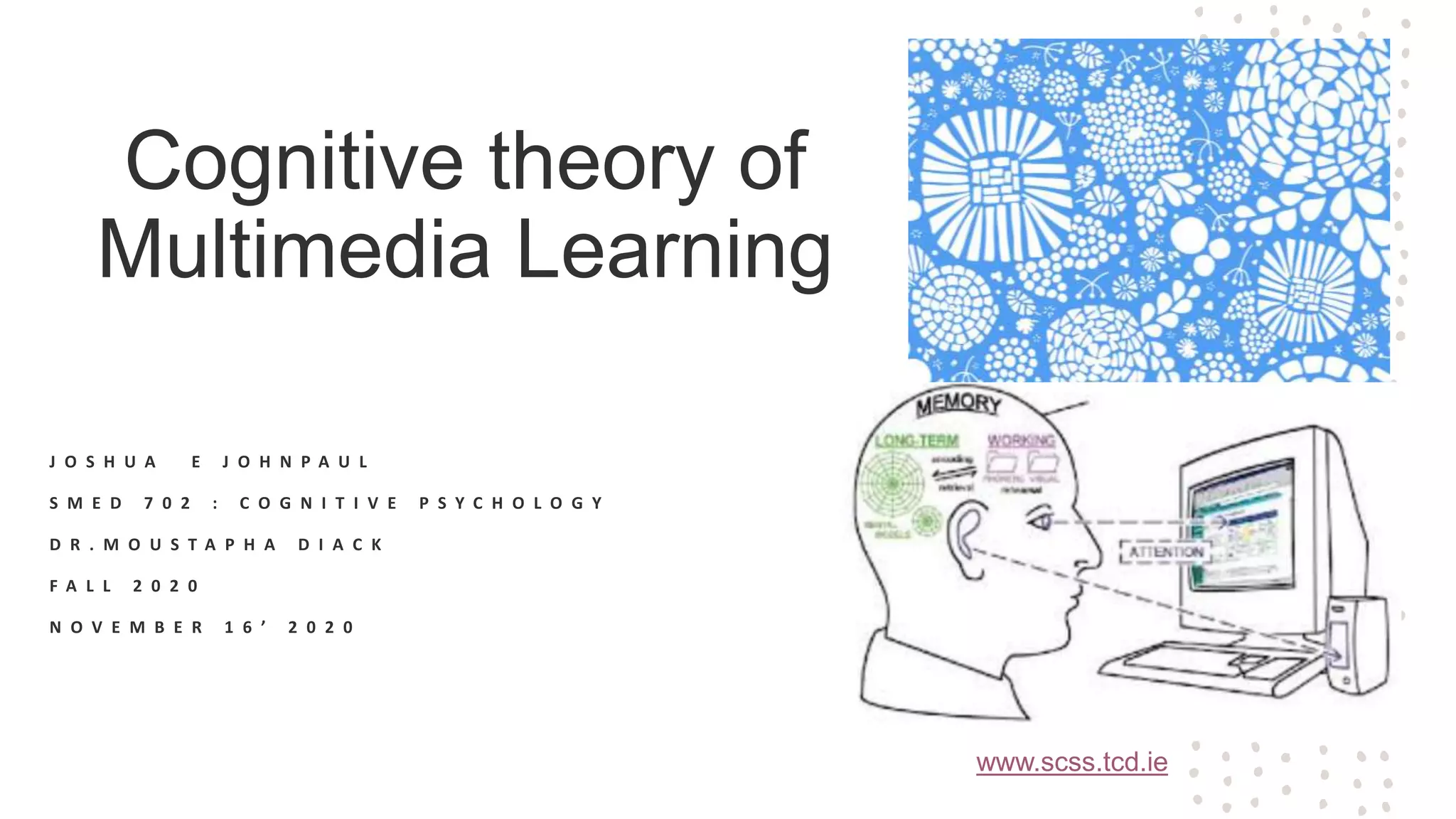
Cognitive theory of
Multimedia Learning
J O S H U A E J O H N P A U L
S M E D 7 0 2 : C O G N I T I V E P S Y C H O L O G Y
D R . M O U S T A P H A D I A C K
F A L L 2 0 2 0
N O V E M B E R 1 6 ’ 2 0 2 0
www.scss.tcd.ie
The Cognitve
Theory of
Multimedia
Learning
- Meaningful
connections between
words and pictures
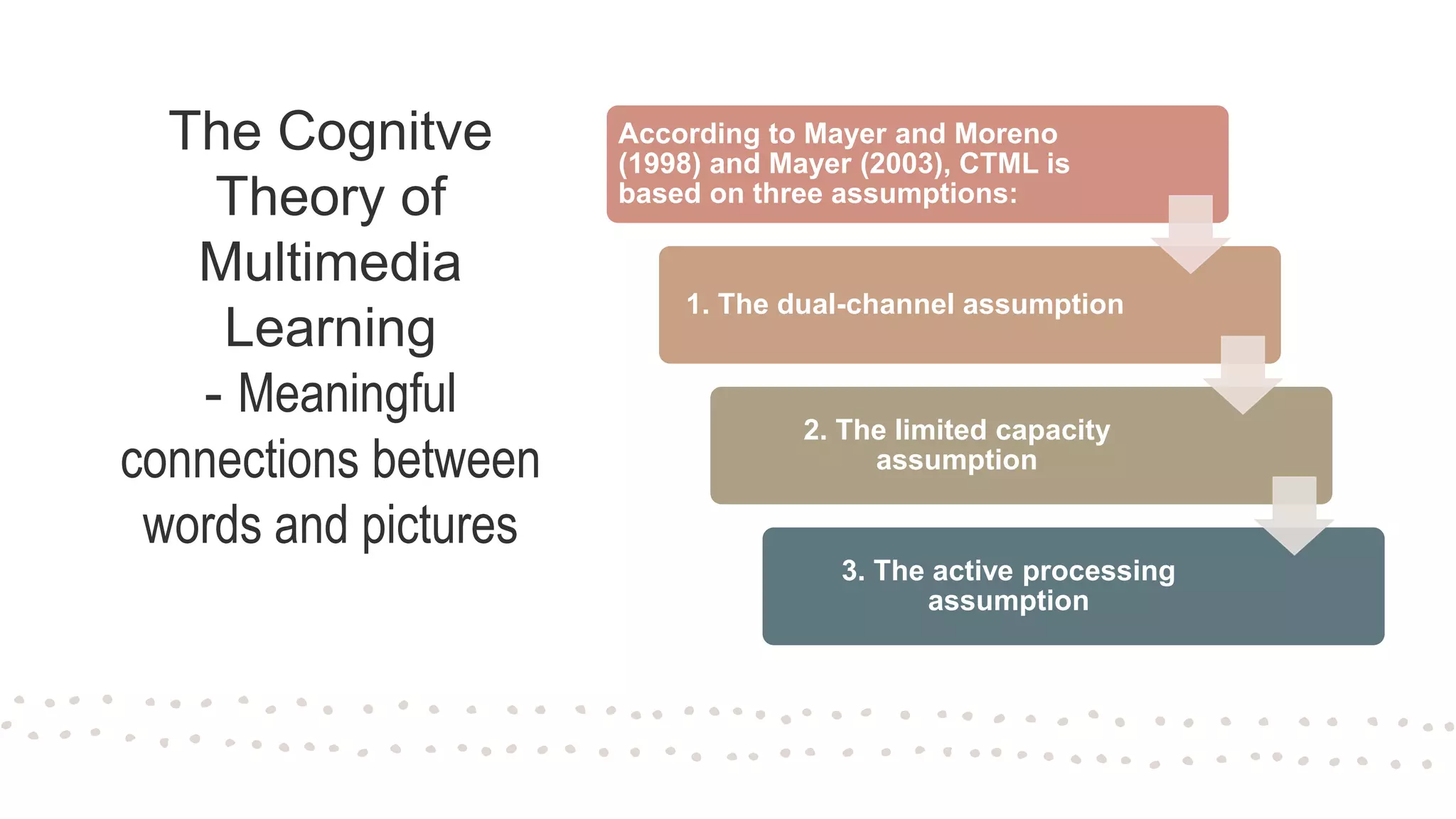
According to Mayer and Moreno
(1998) and Mayer (2003), CTML is
based on three assumptions:
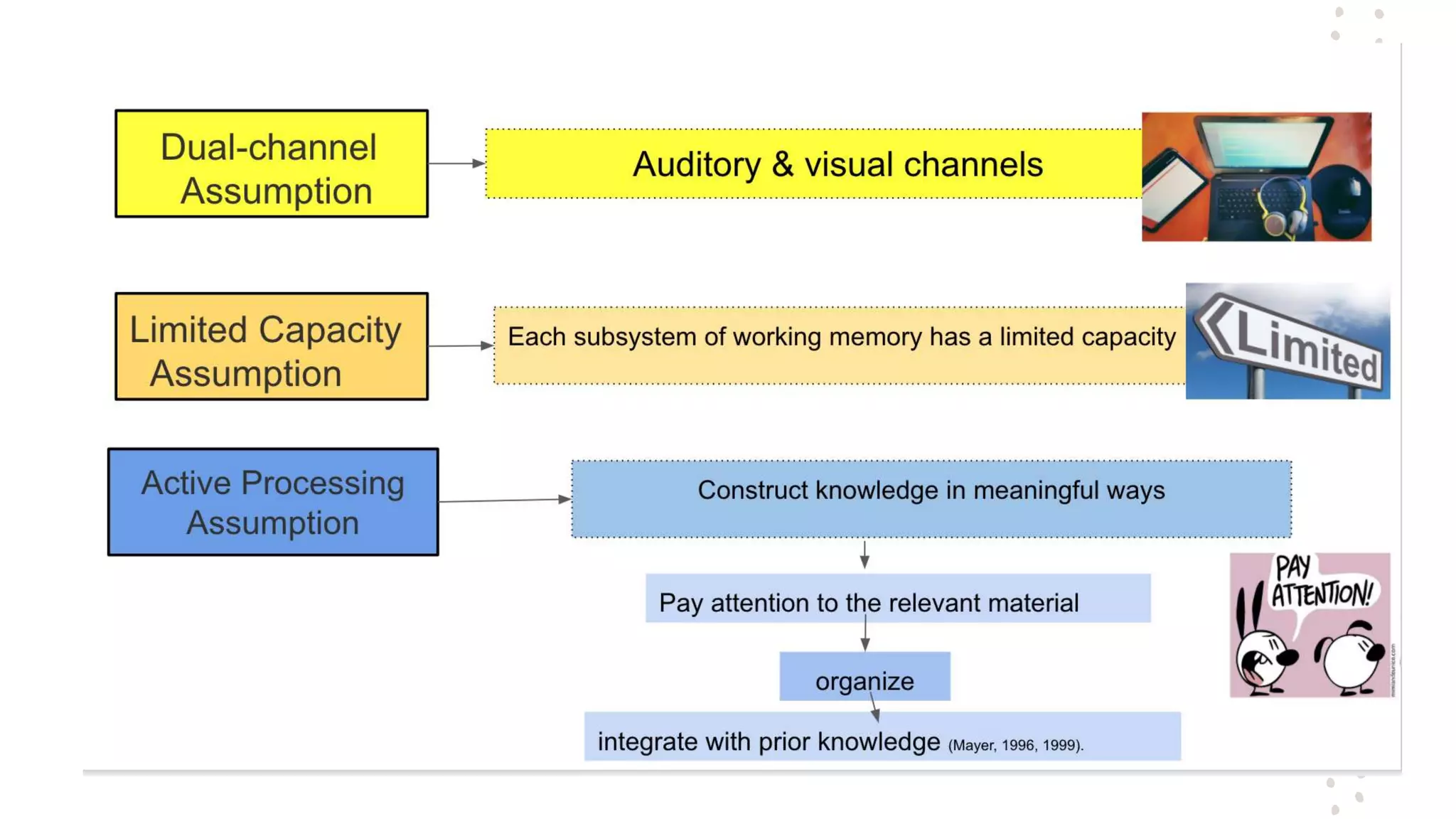
1. The dual-channel assumption
2. The limited capacity
assumption
3. The active processing
assumption
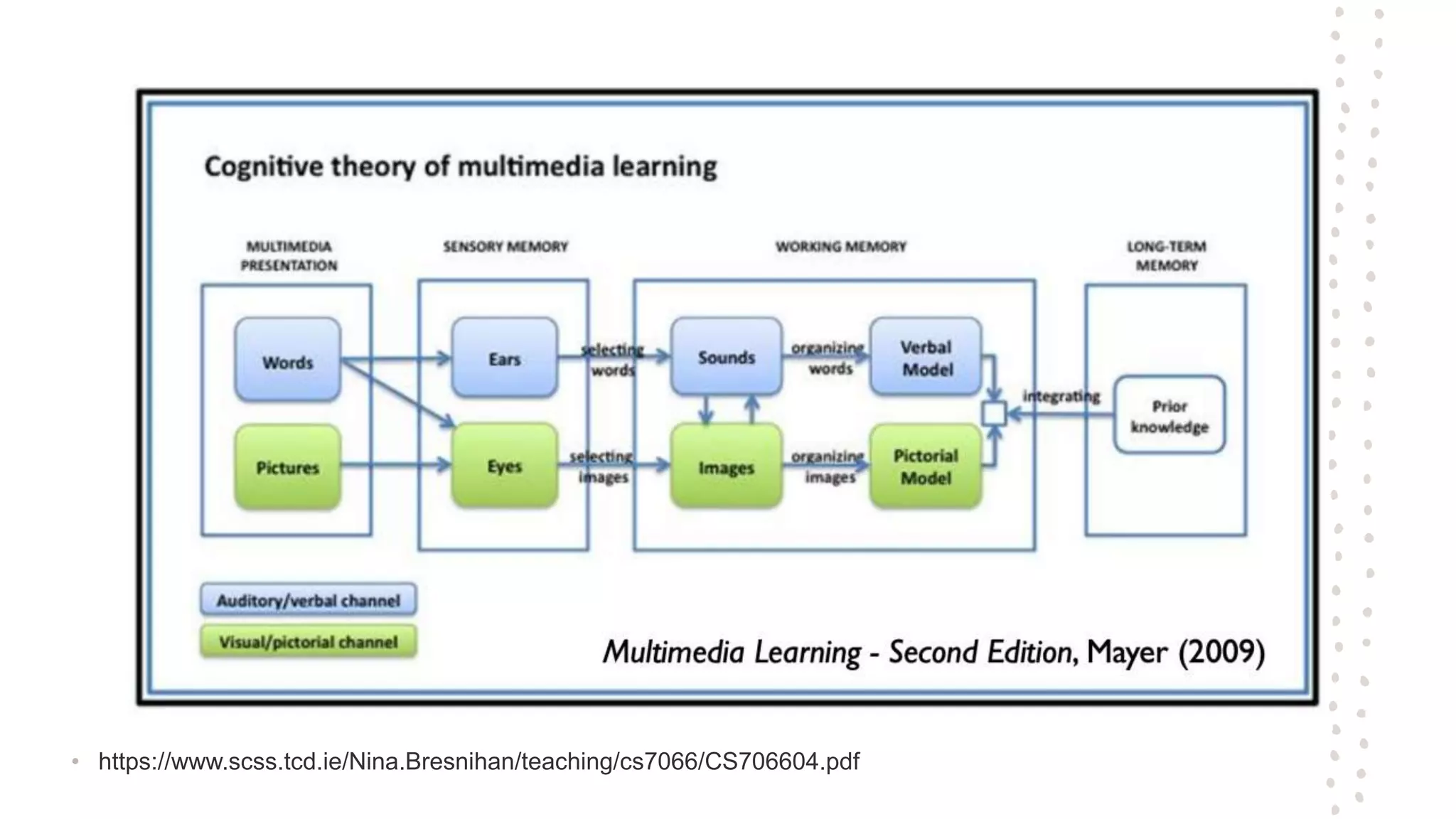
• https://www.scss.tcd.ie/Nina.Bresnihan/teaching/cs7066/CS706604.pdf
12 Multimedia Instructional Principles
• Coherence Principle
• Signaling Principle
• Redundancy Principle
• Spatial Contiguity Principle
• Temporal Contiguity Principle
• Segmenting Principle
• Pre‐training Principle
• Modality Principle
• Multimedia Principle
• Personalization Principle
• Voice Principle
• Image Principle
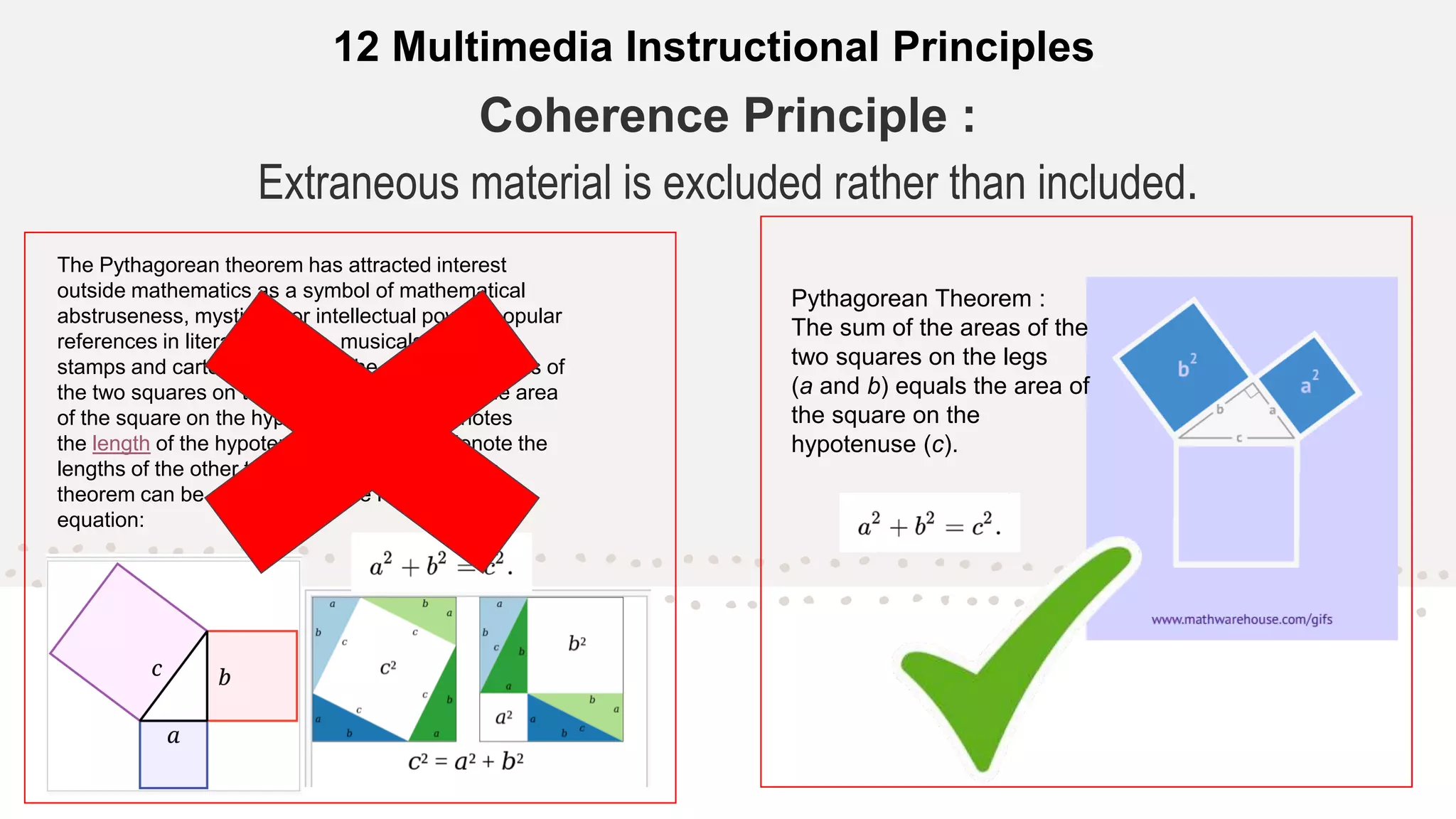
Coherence Principle :
Extraneous material is excluded rather than included.
12 Multimedia Instructional Principles
The Pythagorean theorem has attracted interest
outside mathematics as a symbol of mathematical
abstruseness, mystique, or intellectual power; popular
references in literature, plays, musicals, songs,
stamps and cartoons abound. The sum of the areas of
the two squares on the legs (a and b) equals the area
of the square on the hypotenuse (c). If c denotes
the length of the hypotenuse and a and b denote the
lengths of the other two sides, the Pythagorean
theorem can be expressed as the Pythagorean
equation:
Pythagorean Theorem :
The sum of the areas of the
two squares on the legs
(a and b) equals the area of
the square on the
hypotenuse (c).
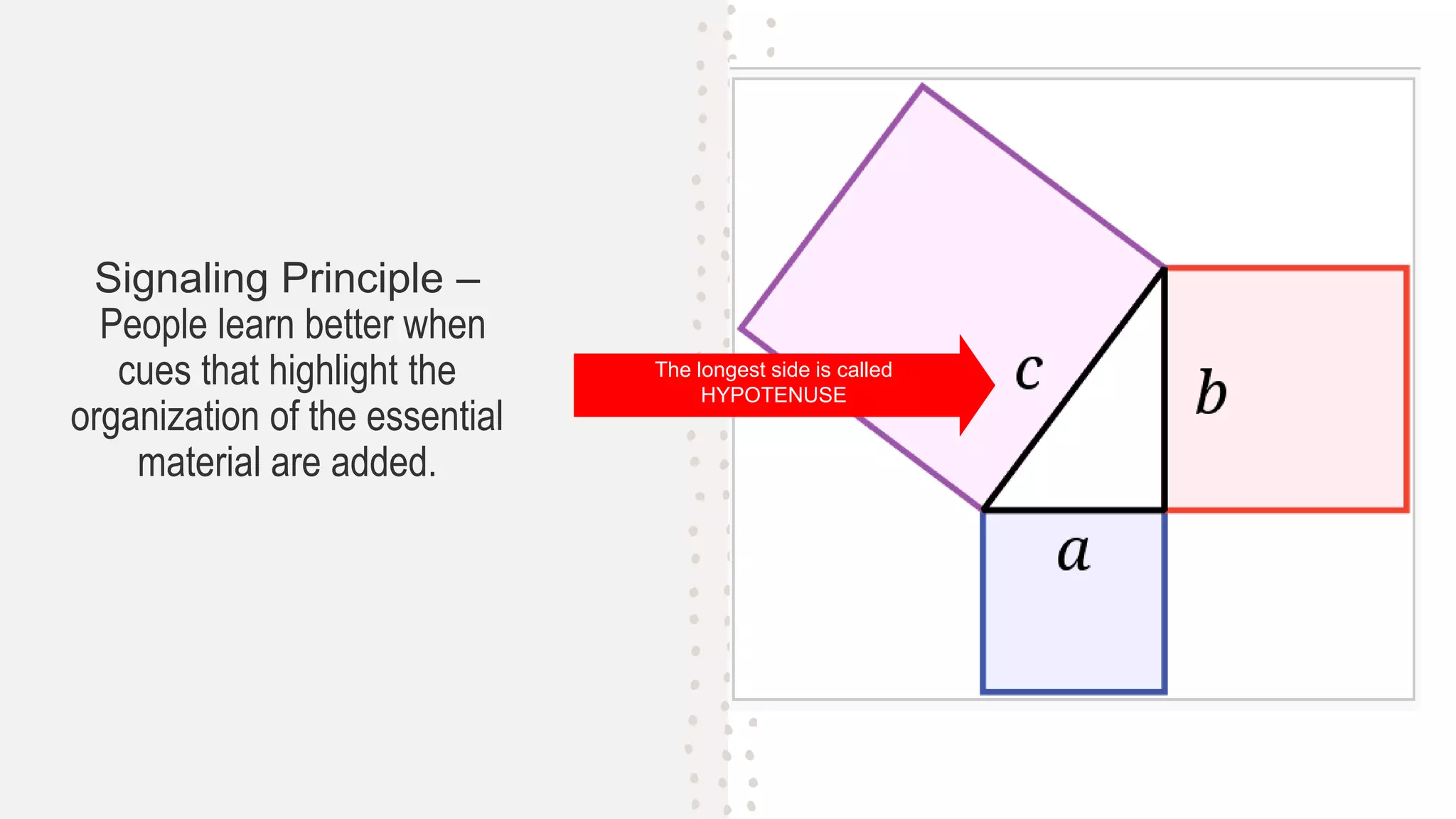
Signaling Principle –
People learn better when
cues that highlight the
organization of the essential
material are added.
The longest side is called
HYPOTENUSE
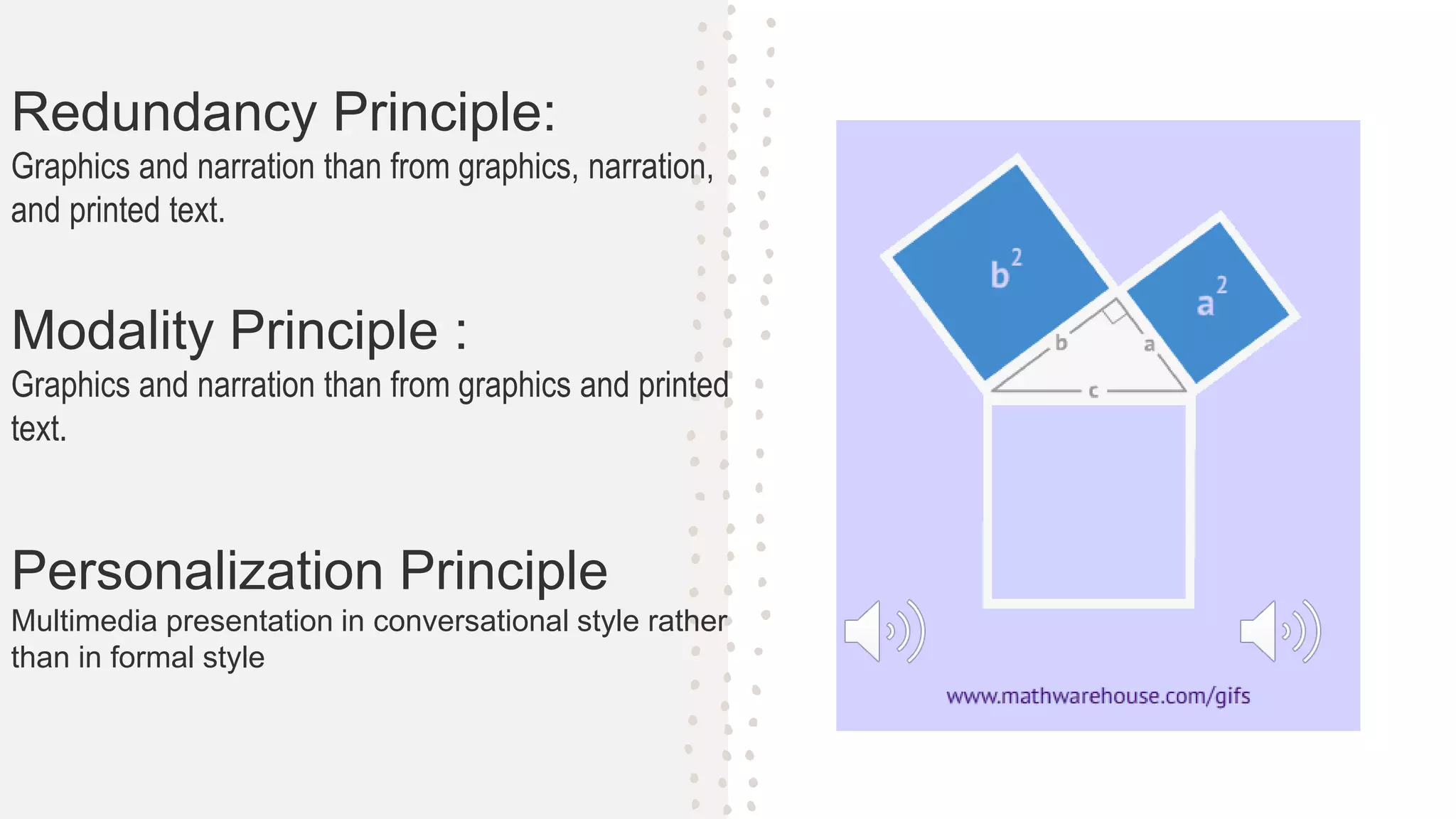
Redundancy Principle:
Graphics and narration than from graphics, narration,
and printed text.
Modality Principle :
Graphics and narration than from graphics and printed
text.
Personalization Principle
Multimedia presentation in conversational style rather
than in formal style
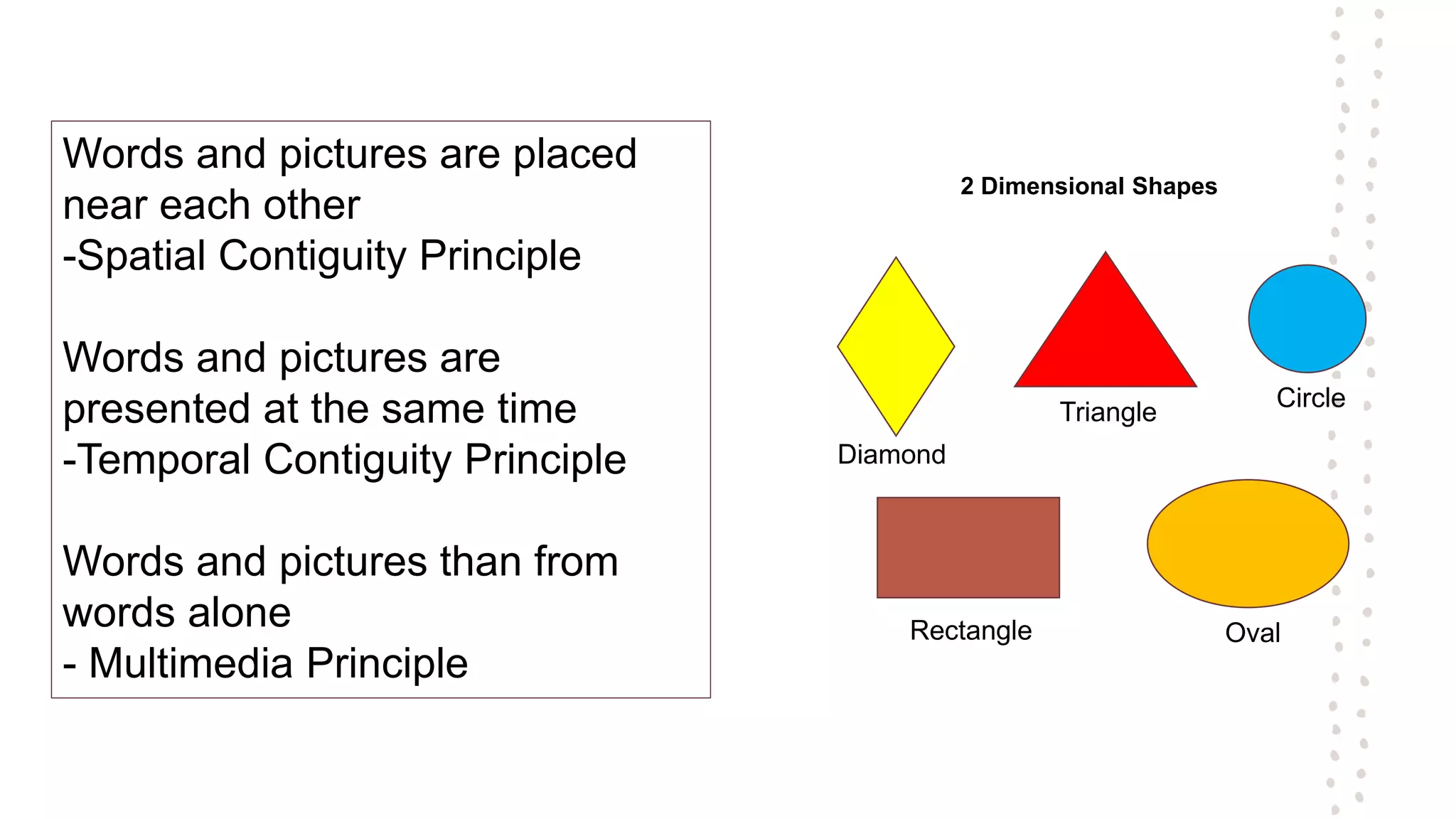
Words and pictures are placed
near each other
-Spatial Contiguity Principle
Words and pictures are
presented at the same time
-Temporal Contiguity Principle
Words and pictures than from
words alone
- Multimedia Principle
2 Dimensional Shapes
Diamond
Triangle
Circle
Rectangle Oval
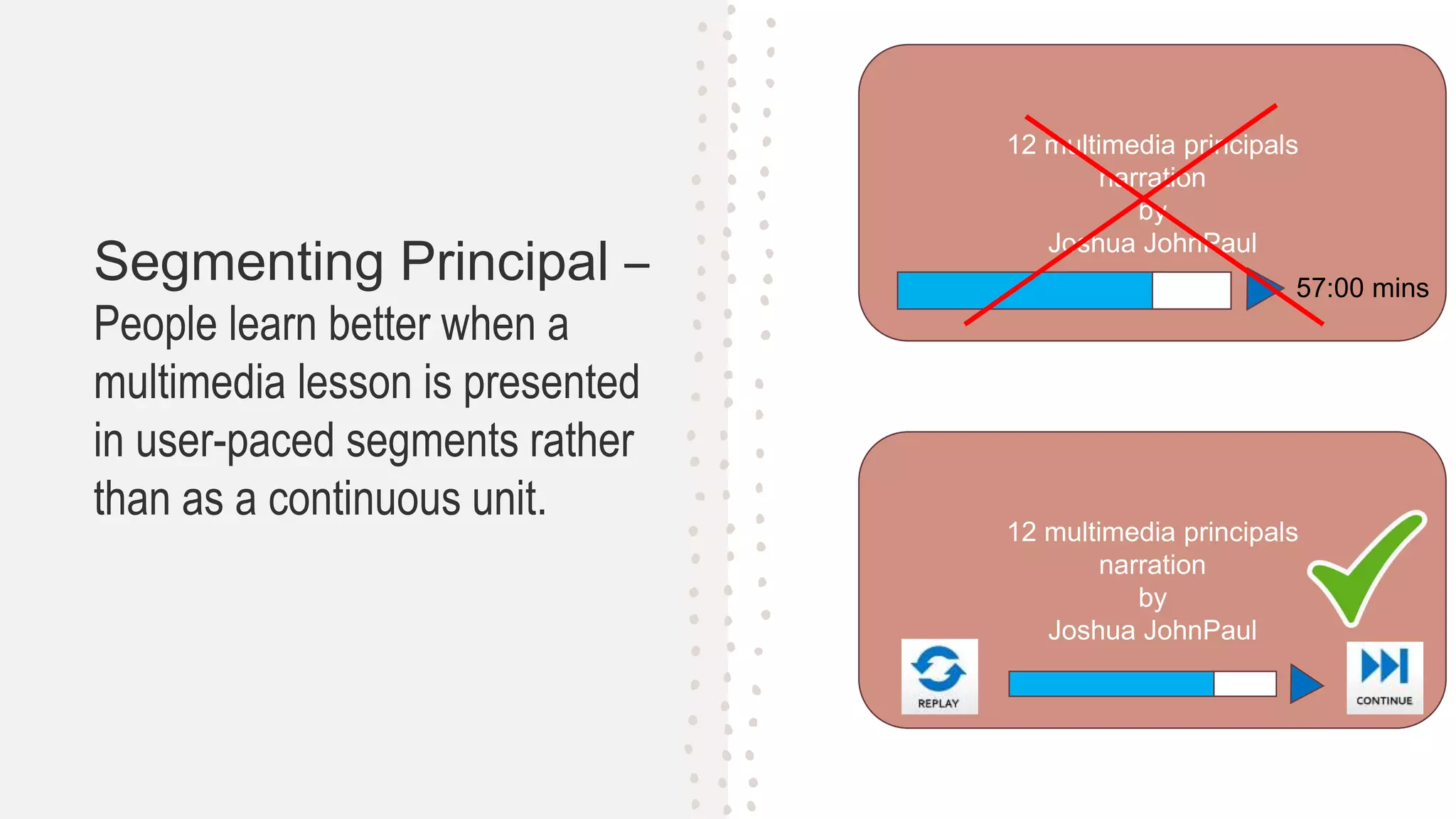
Segmenting Principal –
People learn better when a
multimedia lesson is presented
in user-paced segments rather
than as a continuous unit.
12 multimedia principals
narration
by
Joshua JohnPaul
57:00 mins
12 multimedia principals
narration
by
Joshua JohnPaul
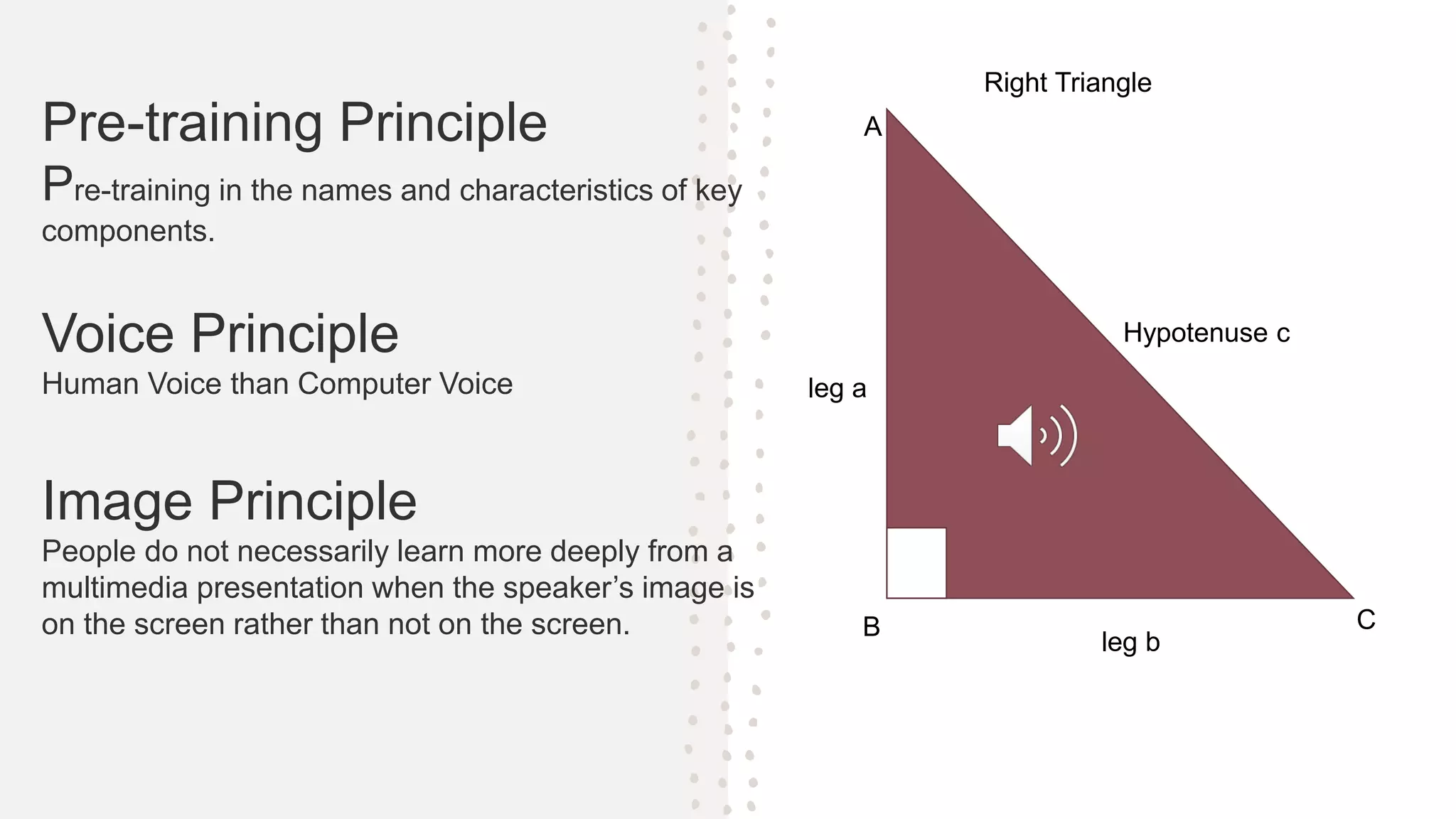
Pre-training Principle
Pre-training in the names and characteristics of key
components.
Voice Principle
Human Voice than Computer Voice
Image Principle
People do not necessarily learn more deeply from a
multimedia presentation when the speaker’s image is
on the screen rather than not on the screen.
Hypotenuse c
leg a
leg b
Right Triangle
A
B C
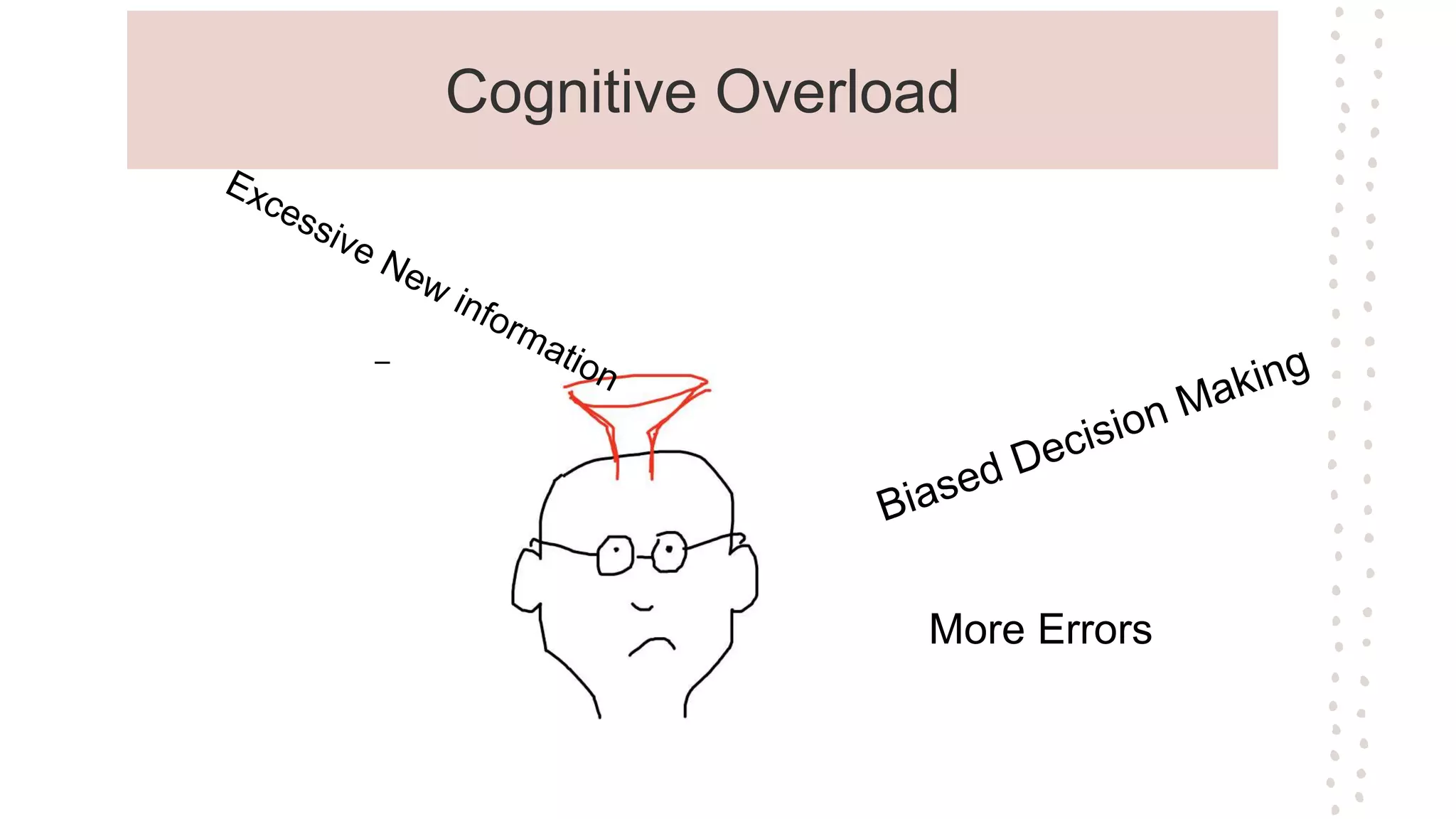
Cognitive Overload
–
More Errors
References :
• https://www.scss.tcd.ie/Nina.Bresnihan/teaching/cs7066/CS706604.pdf
• www.scss.tcd.ie
• https://en.wikipedia.org/wiki/Pythagorean_theorem
• www.mathwarehouse.com/gifs
• https://www.researchgate.net/figure/Effects-of-cognitive-overload_fig1_262147339

Cognitive theory in multimedia learning

  • 1.
    Cognitive theory of MultimediaLearning J O S H U A E J O H N P A U L S M E D 7 0 2 : C O G N I T I V E P S Y C H O L O G Y D R . M O U S T A P H A D I A C K F A L L 2 0 2 0 N O V E M B E R 1 6 ’ 2 0 2 0 www.scss.tcd.ie
  • 2.
    The Cognitve Theory of Multimedia Learning -Meaningful connections between words and pictures According to Mayer and Moreno (1998) and Mayer (2003), CTML is based on three assumptions: 1. The dual-channel assumption 2. The limited capacity assumption 3. The active processing assumption
  • 3.
  • 5.
    12 Multimedia InstructionalPrinciples • Coherence Principle • Signaling Principle • Redundancy Principle • Spatial Contiguity Principle • Temporal Contiguity Principle • Segmenting Principle • Pre‐training Principle • Modality Principle • Multimedia Principle • Personalization Principle • Voice Principle • Image Principle
  • 6.
    Coherence Principle : Extraneousmaterial is excluded rather than included. 12 Multimedia Instructional Principles The Pythagorean theorem has attracted interest outside mathematics as a symbol of mathematical abstruseness, mystique, or intellectual power; popular references in literature, plays, musicals, songs, stamps and cartoons abound. The sum of the areas of the two squares on the legs (a and b) equals the area of the square on the hypotenuse (c). If c denotes the length of the hypotenuse and a and b denote the lengths of the other two sides, the Pythagorean theorem can be expressed as the Pythagorean equation: Pythagorean Theorem : The sum of the areas of the two squares on the legs (a and b) equals the area of the square on the hypotenuse (c).
  • 7.
    Signaling Principle – Peoplelearn better when cues that highlight the organization of the essential material are added. The longest side is called HYPOTENUSE
  • 8.
    Redundancy Principle: Graphics andnarration than from graphics, narration, and printed text. Modality Principle : Graphics and narration than from graphics and printed text. Personalization Principle Multimedia presentation in conversational style rather than in formal style
  • 9.
    Words and picturesare placed near each other -Spatial Contiguity Principle Words and pictures are presented at the same time -Temporal Contiguity Principle Words and pictures than from words alone - Multimedia Principle 2 Dimensional Shapes Diamond Triangle Circle Rectangle Oval
  • 10.
    Segmenting Principal – Peoplelearn better when a multimedia lesson is presented in user-paced segments rather than as a continuous unit. 12 multimedia principals narration by Joshua JohnPaul 57:00 mins 12 multimedia principals narration by Joshua JohnPaul
  • 11.
    Pre-training Principle Pre-training inthe names and characteristics of key components. Voice Principle Human Voice than Computer Voice Image Principle People do not necessarily learn more deeply from a multimedia presentation when the speaker’s image is on the screen rather than not on the screen. Hypotenuse c leg a leg b Right Triangle A B C
  • 12.
  • 13.
    References : • https://www.scss.tcd.ie/Nina.Bresnihan/teaching/cs7066/CS706604.pdf •www.scss.tcd.ie • https://en.wikipedia.org/wiki/Pythagorean_theorem • www.mathwarehouse.com/gifs • https://www.researchgate.net/figure/Effects-of-cognitive-overload_fig1_262147339

Editor's Notes

  • #7 https://en.wikipedia.org/wiki/Pythagorean_theorem www.mathwarehouse.com/gifs