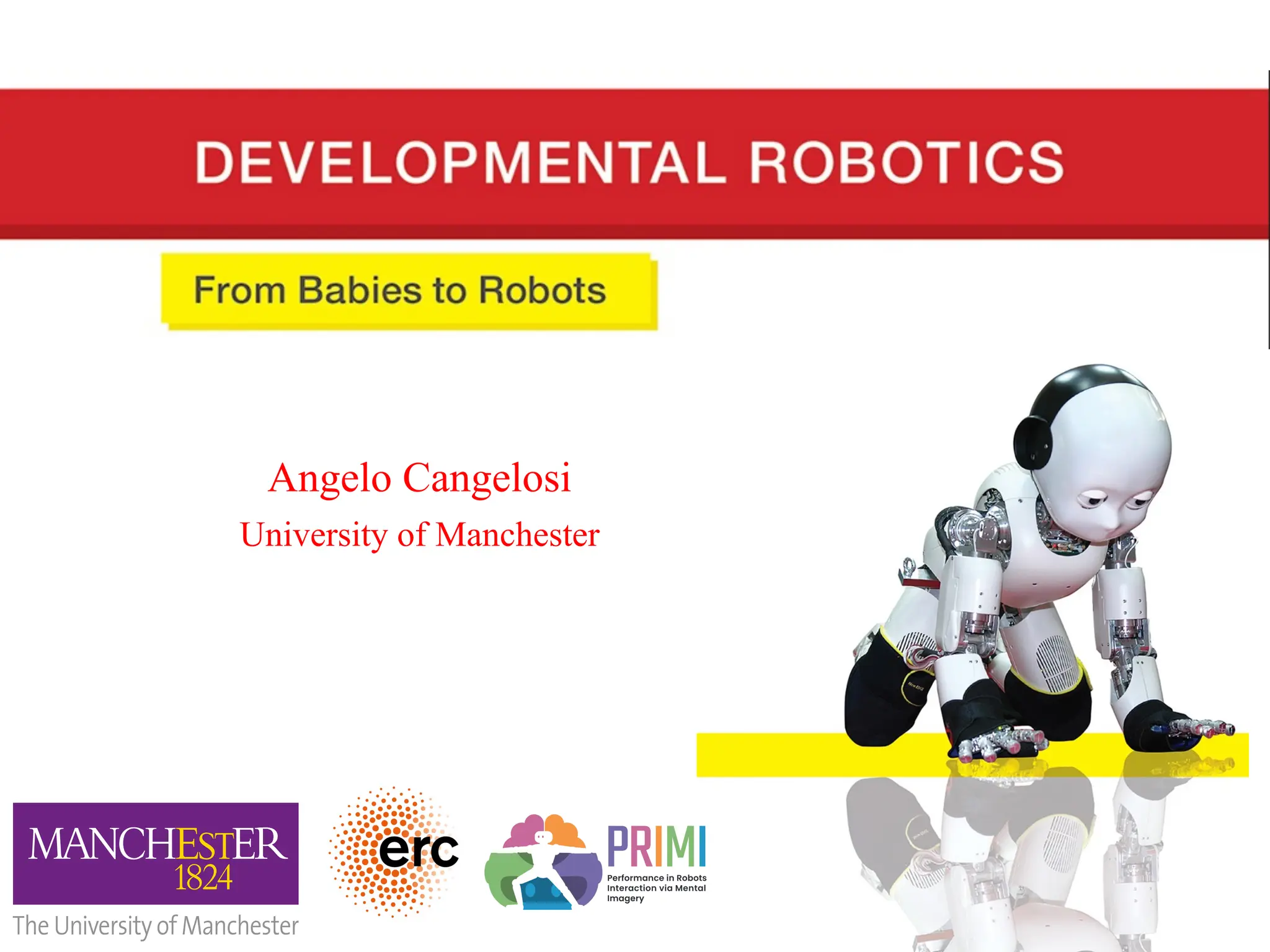
Angelo Cangelosi
University of Manchester
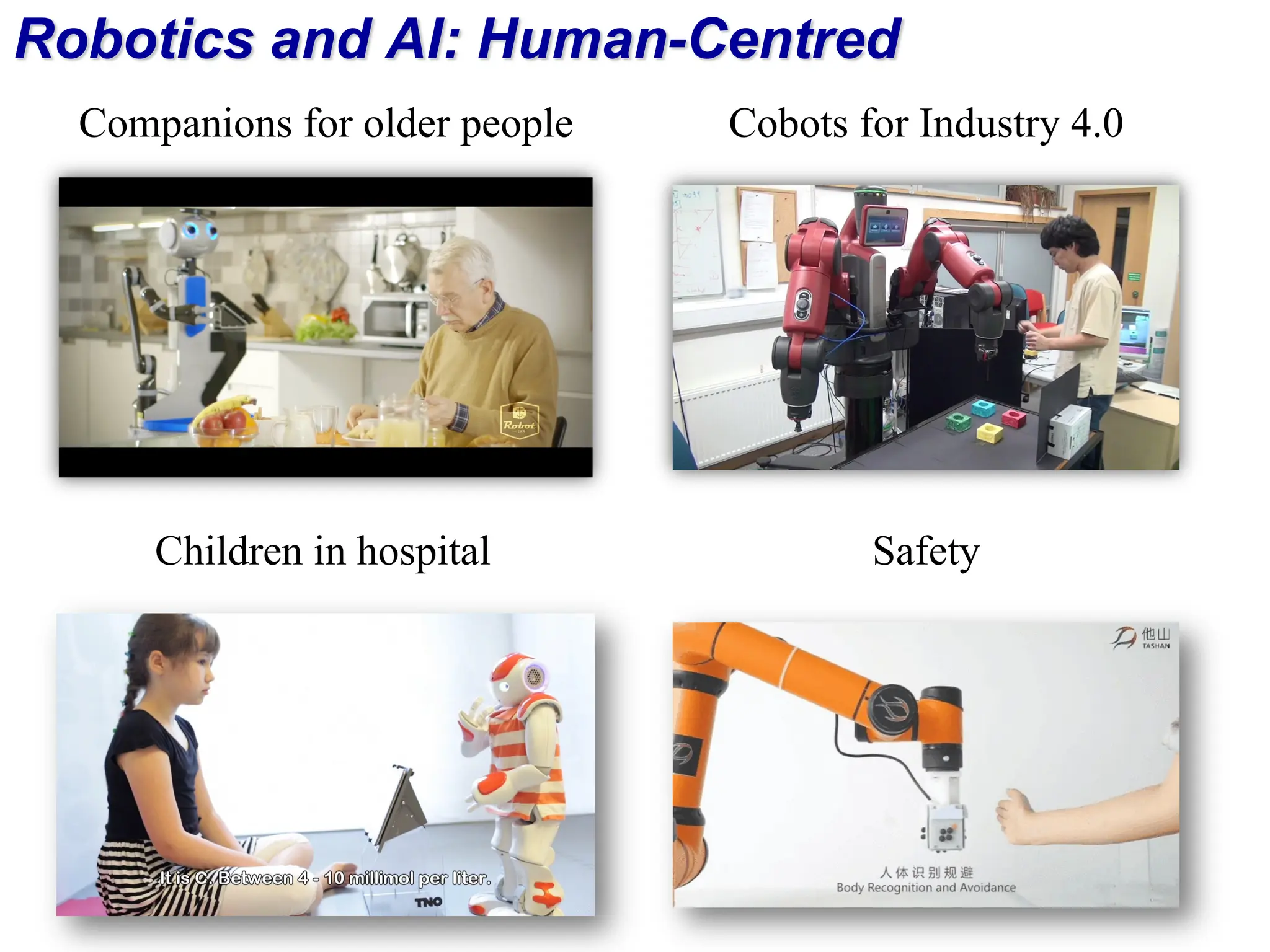
Robotics and AI: Human-Centred
Companions for older people Cobots for Industry 4.0
Children in hospital Safety
What are the mechanisms and constraints
(biases, cues)
supporting cognitive development?
How is embodiment involved in
language acquisition?
The “Body as Cognitive Hub” Hypothesis
(Smith 2010; Morse et al. 2011)
Gavagai
Quine (1960)
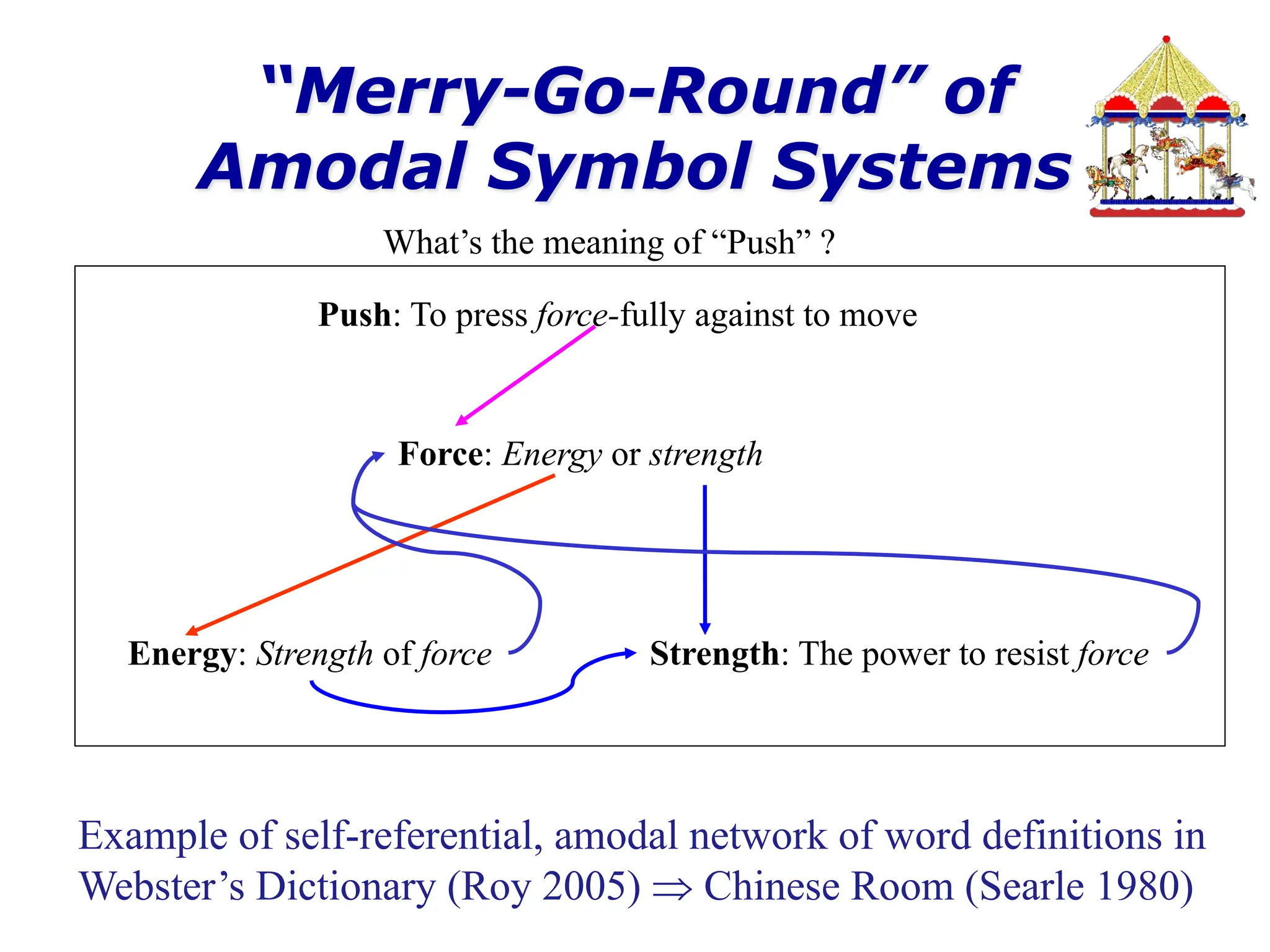
“Merry-Go-Round” of
Amodal Symbol Systems
Example of self-referential, amodal network of word definitions in
Webster’s Dictionary (Roy 2005) Þ Chinese Room (Searle 1980)
Force: Energy or strength
Energy: Strength of force Strength: The power to resist force
Push: To press force-fully against to move
What’s the meaning of “Push” ?
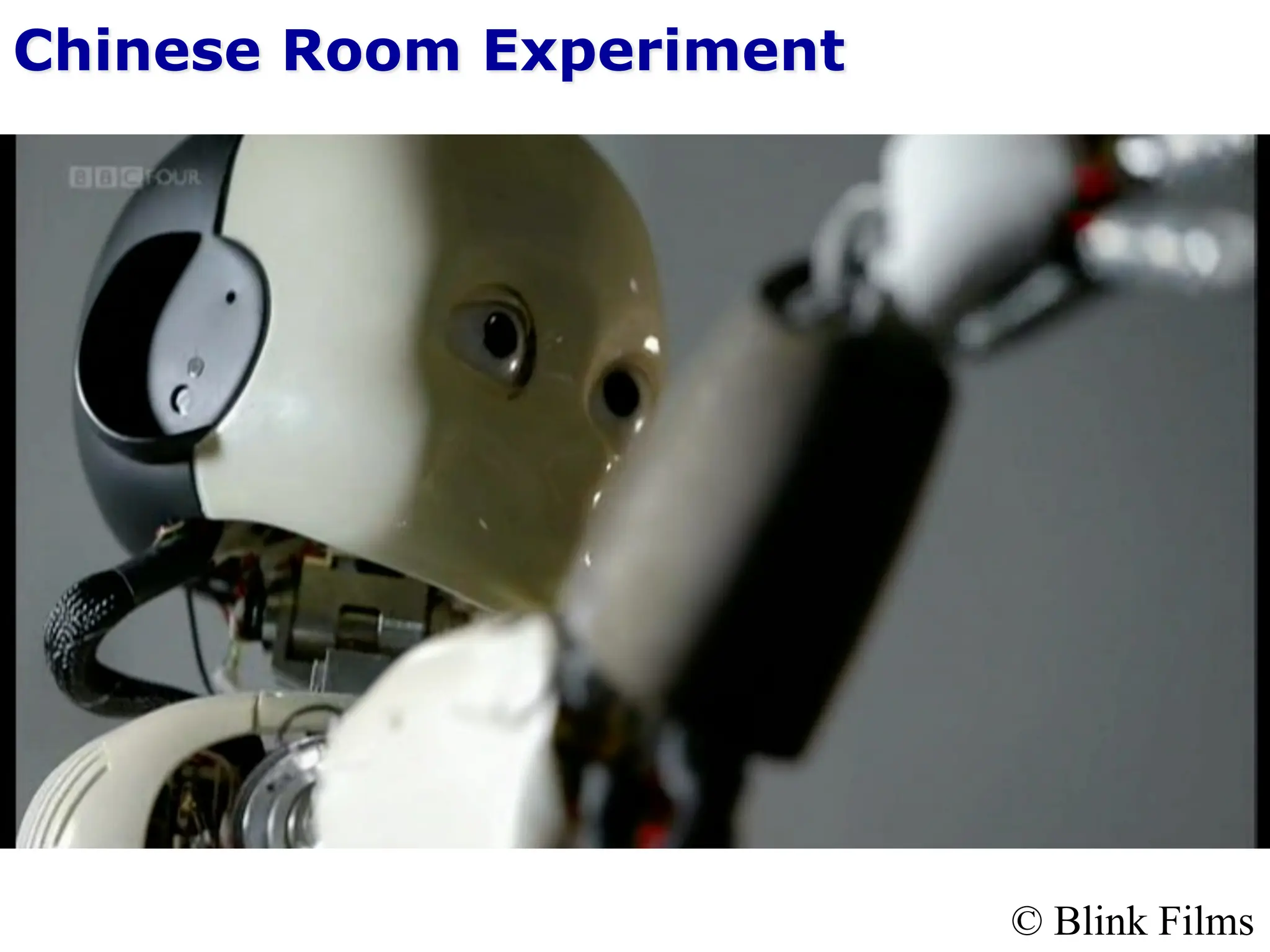
Chinese Room Experiment
© Blink Films
Chinese Room Experiment
© Blink Films
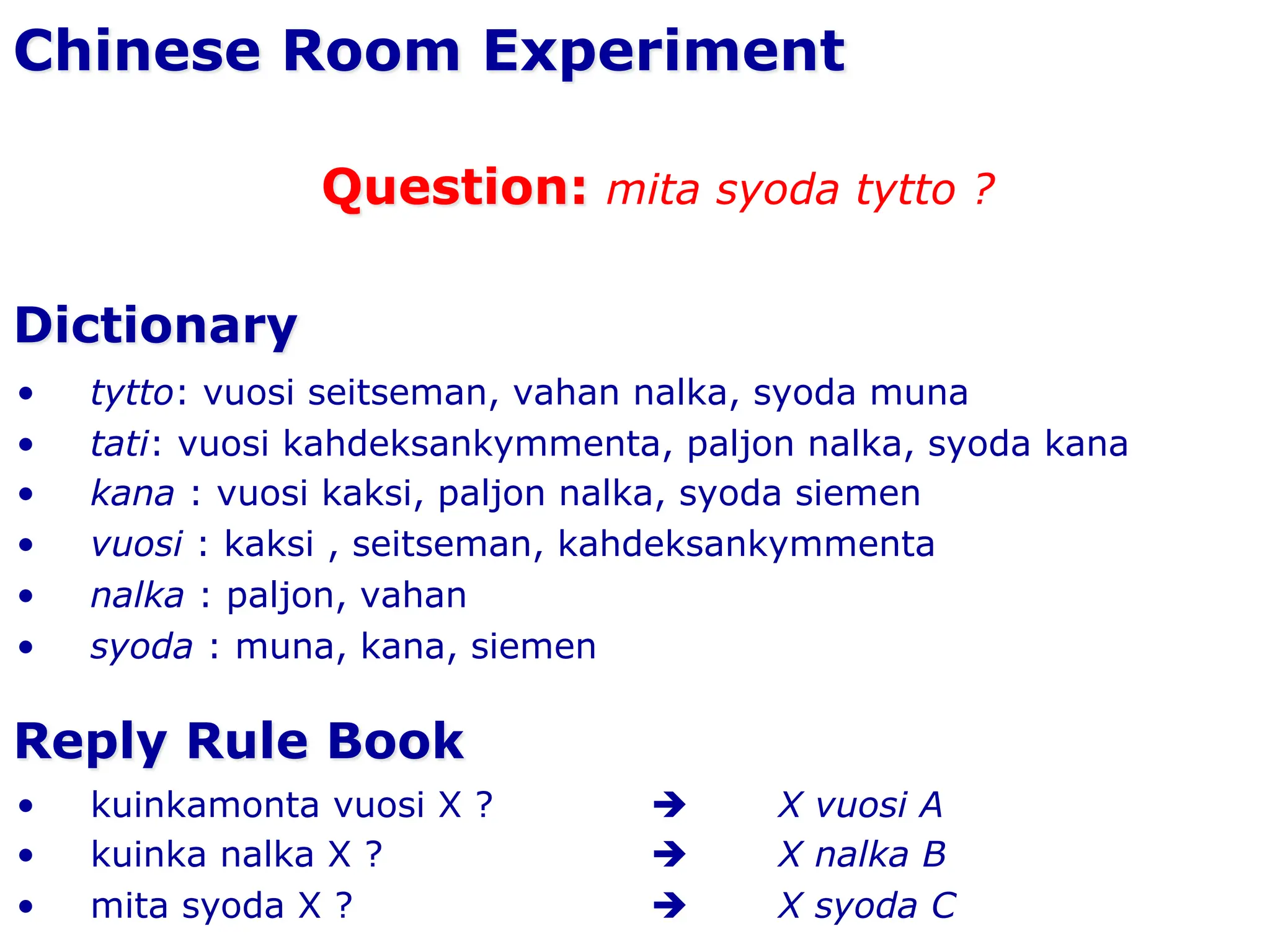
Question: mita syoda tytto ?
• tytto: vuosi seitseman, vahan nalka, syoda muna
• tati: vuosi kahdeksankymmenta, paljon nalka, syoda kana
• kana : vuosi kaksi, paljon nalka, syoda siemen
• vuosi : kaksi , seitseman, kahdeksankymmenta
• nalka : paljon, vahan
• syoda : muna, kana, siemen
Dictionary
• kuinkamonta vuosi X ? è X vuosi A
• kuinka nalka X ? è X nalka B
• mita syoda X ? è X syoda C
Reply Rule Book
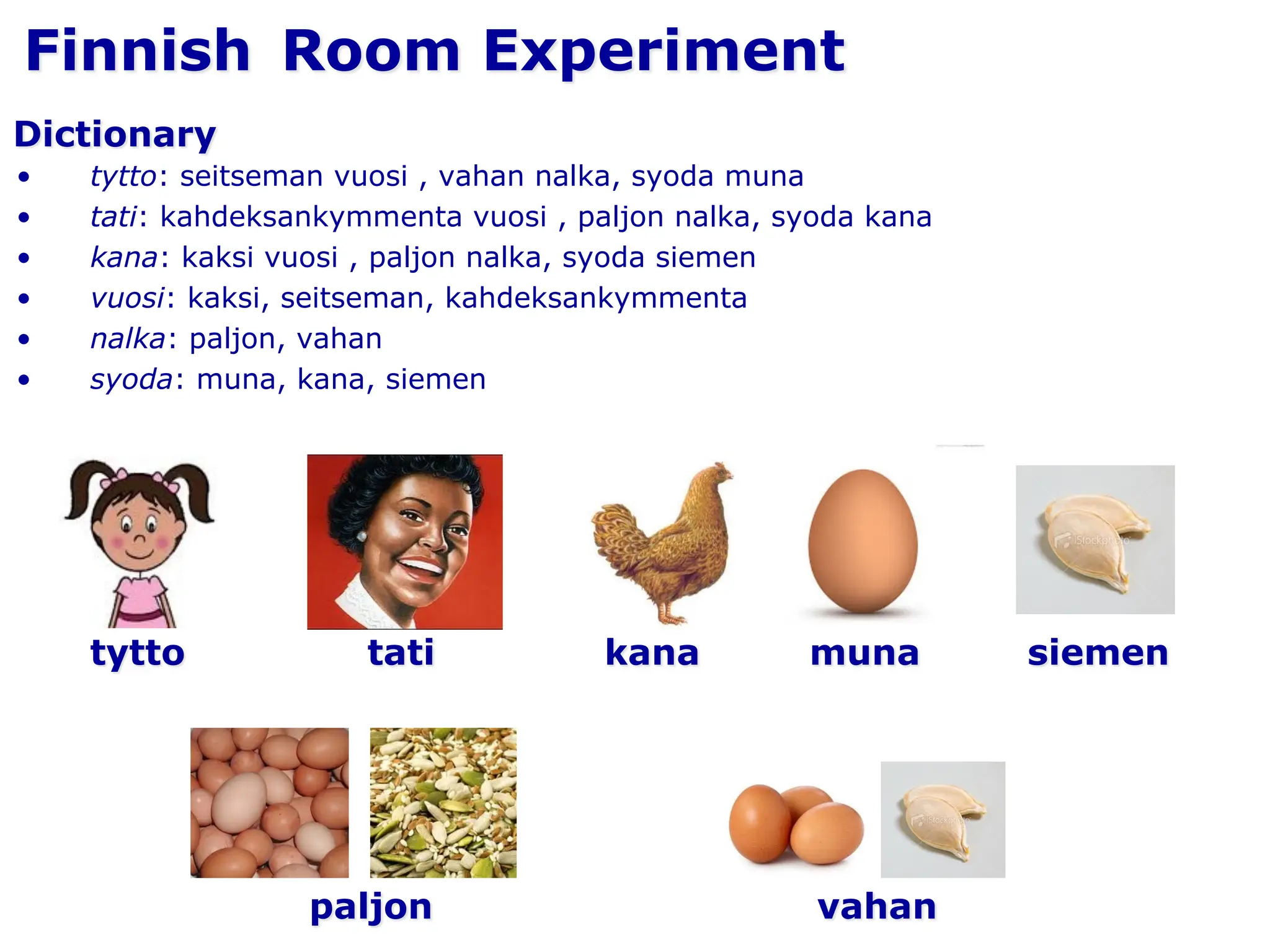
Chinese Room Experiment
tytto tati kana muna siemen
Dictionary
• tytto: seitseman vuosi , vahan nalka, syoda muna
• tati: kahdeksankymmenta vuosi , paljon nalka, syoda kana
• kana: kaksi vuosi , paljon nalka, syoda siemen
• vuosi: kaksi, seitseman, kahdeksankymmenta
• nalka: paljon, vahan
• syoda: muna, kana, siemen
Chinese Room Experiment
Finnish
paljon vahan
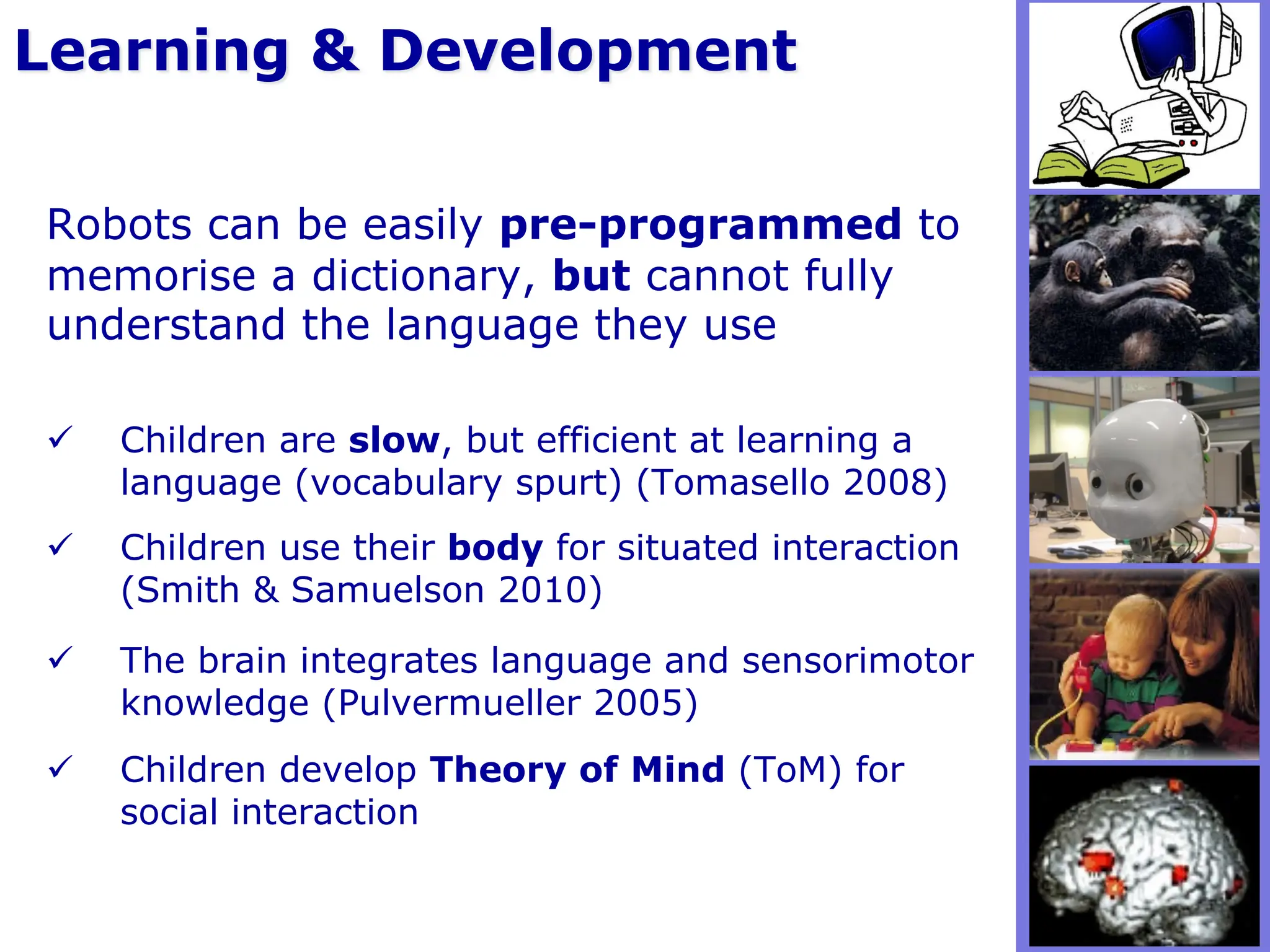
ü Children are slow, but efficient at learning a
language (vocabulary spurt) (Tomasello 2008)
ü Children use their body for situated interaction
(Smith & Samuelson 2010)
ü The brain integrates language and sensorimotor
knowledge (Pulvermueller 2005)
ü Children develop Theory of Mind (ToM) for
social interaction
Learning & Development
Robots can be easily pre-programmed to
memorise a dictionary, but cannot fully
understand the language they use
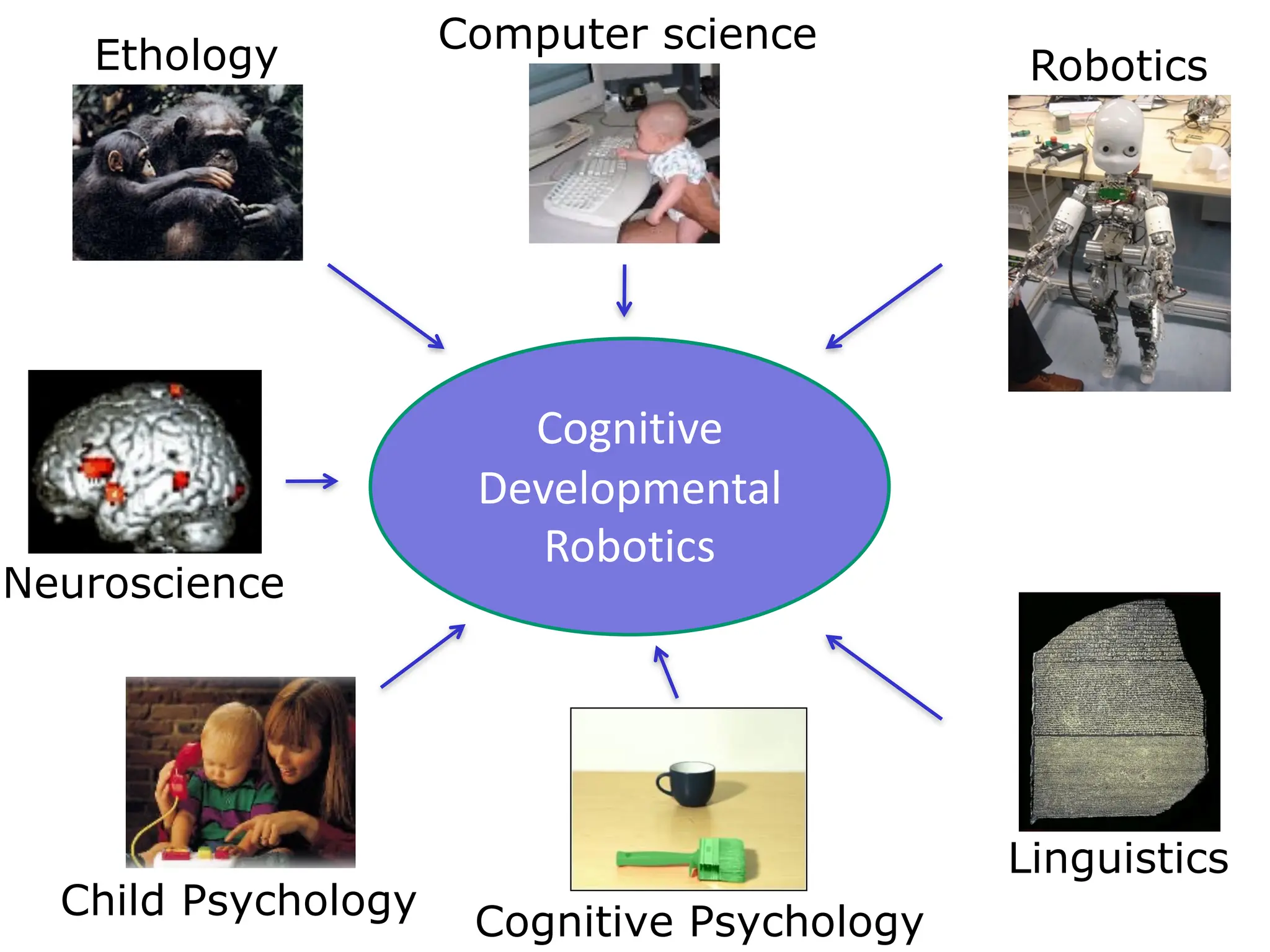
Cognitive
Developmental
Robotics
Child Psychology
Linguistics
Ethology Robotics
Neuroscience
Cognitive Psychology
Computer science
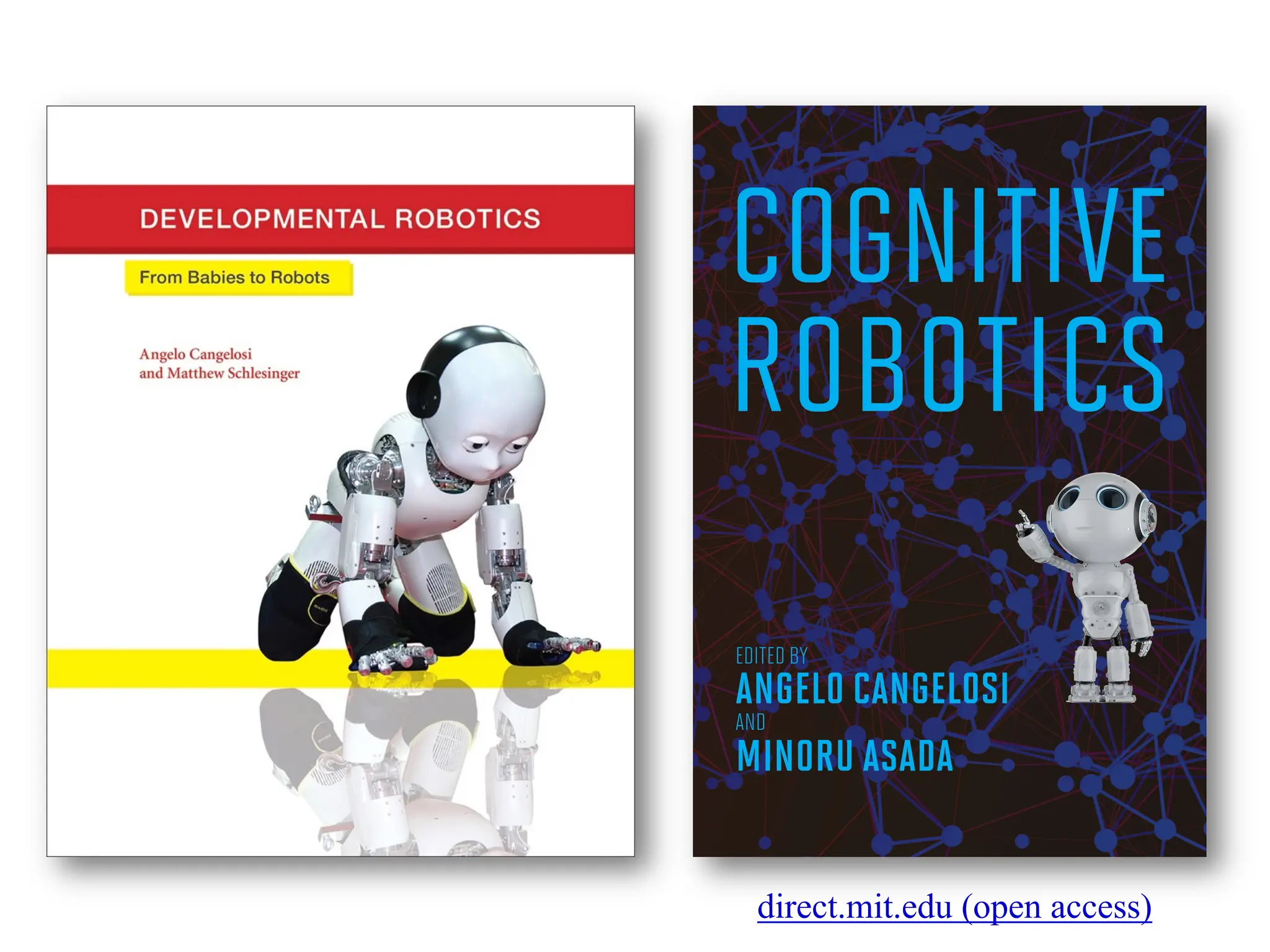
direct.mit.edu (open access)
Embodied Language Learning
Developmental Robotics
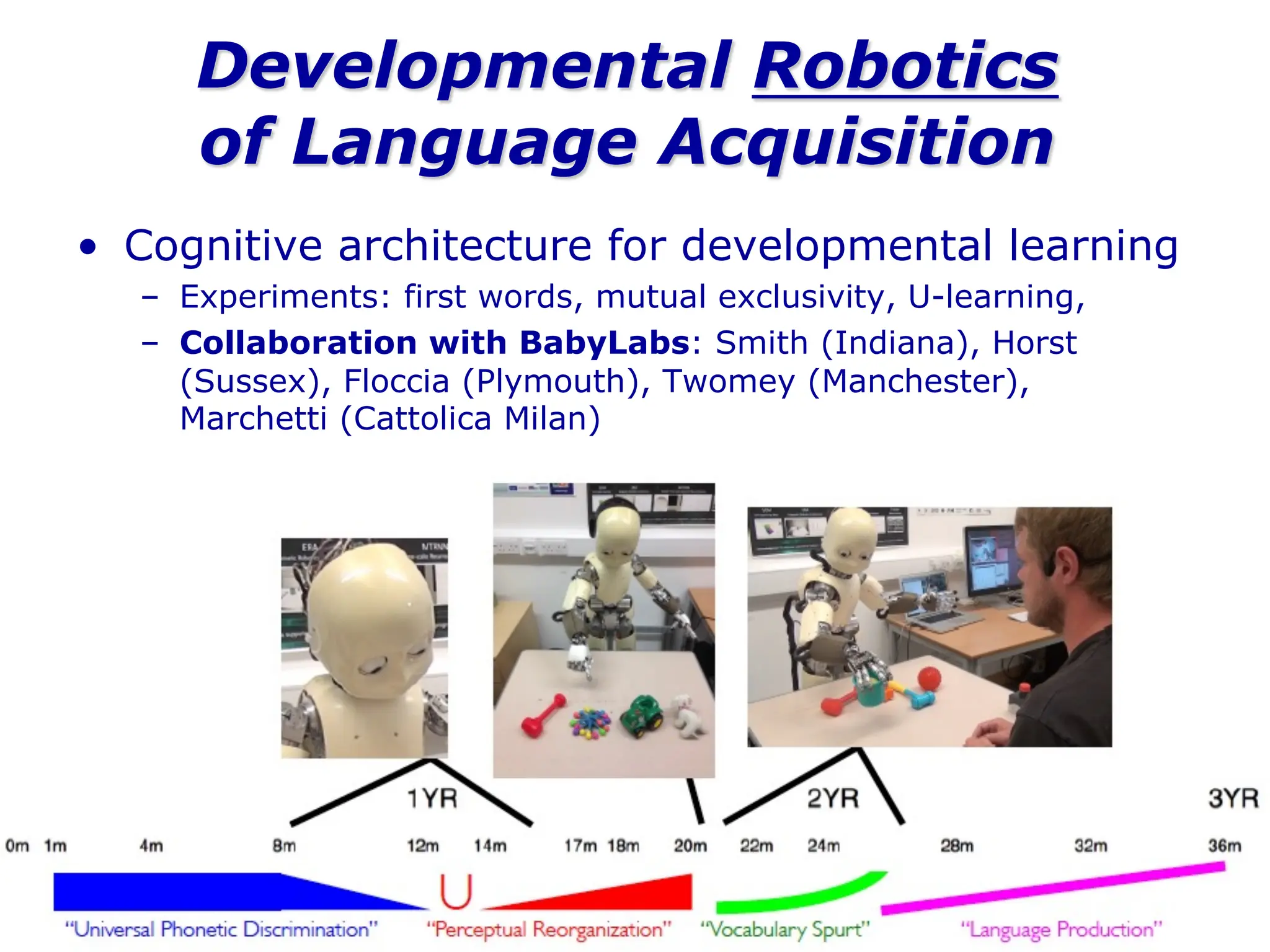
of Language Acquisition
• Cognitive architecture for developmental learning
– Experiments: first words, mutual exclusivity, U-learning,
– Collaboration with BabyLabs: Smith (Indiana), Horst
(Sussex), Floccia (Plymouth), Twomey (Manchester),
Marchetti (Cattolica Milan)
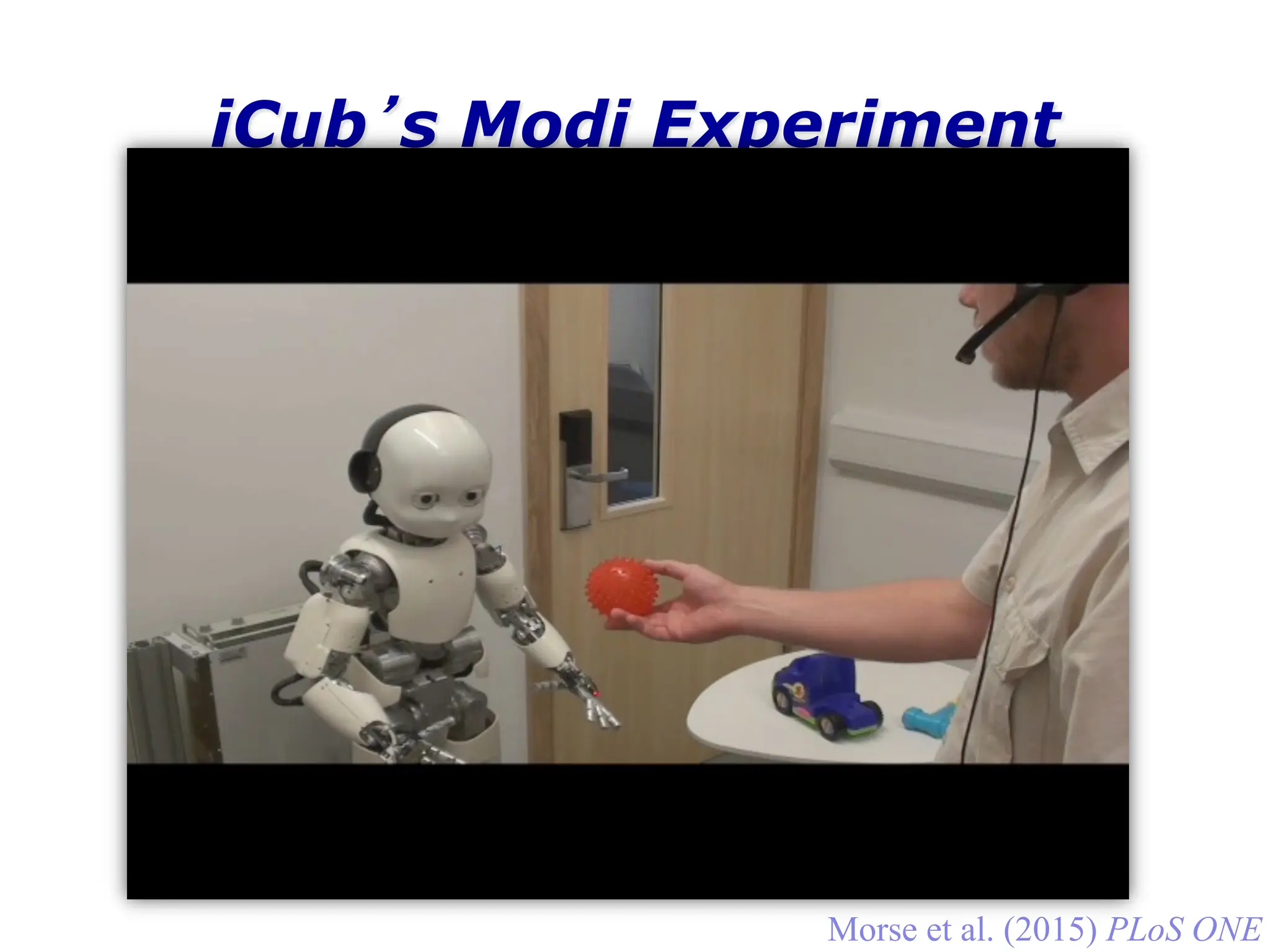
iCub’s Modi Experiment
Morse et al. (2015) PLoS ONE
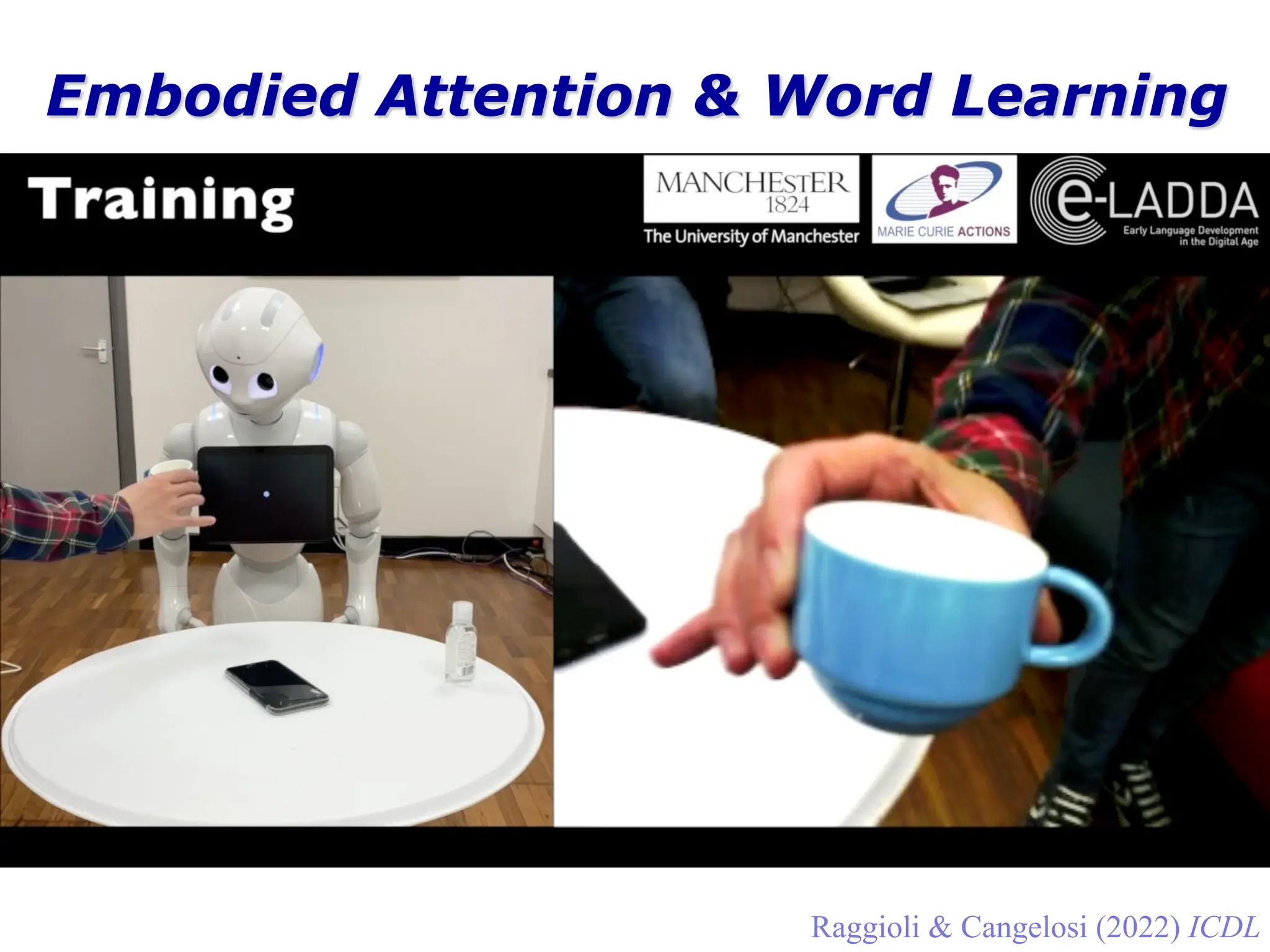
Embodied Attention & Word Learning
Raggioli & Cangelosi (2022) ICDL
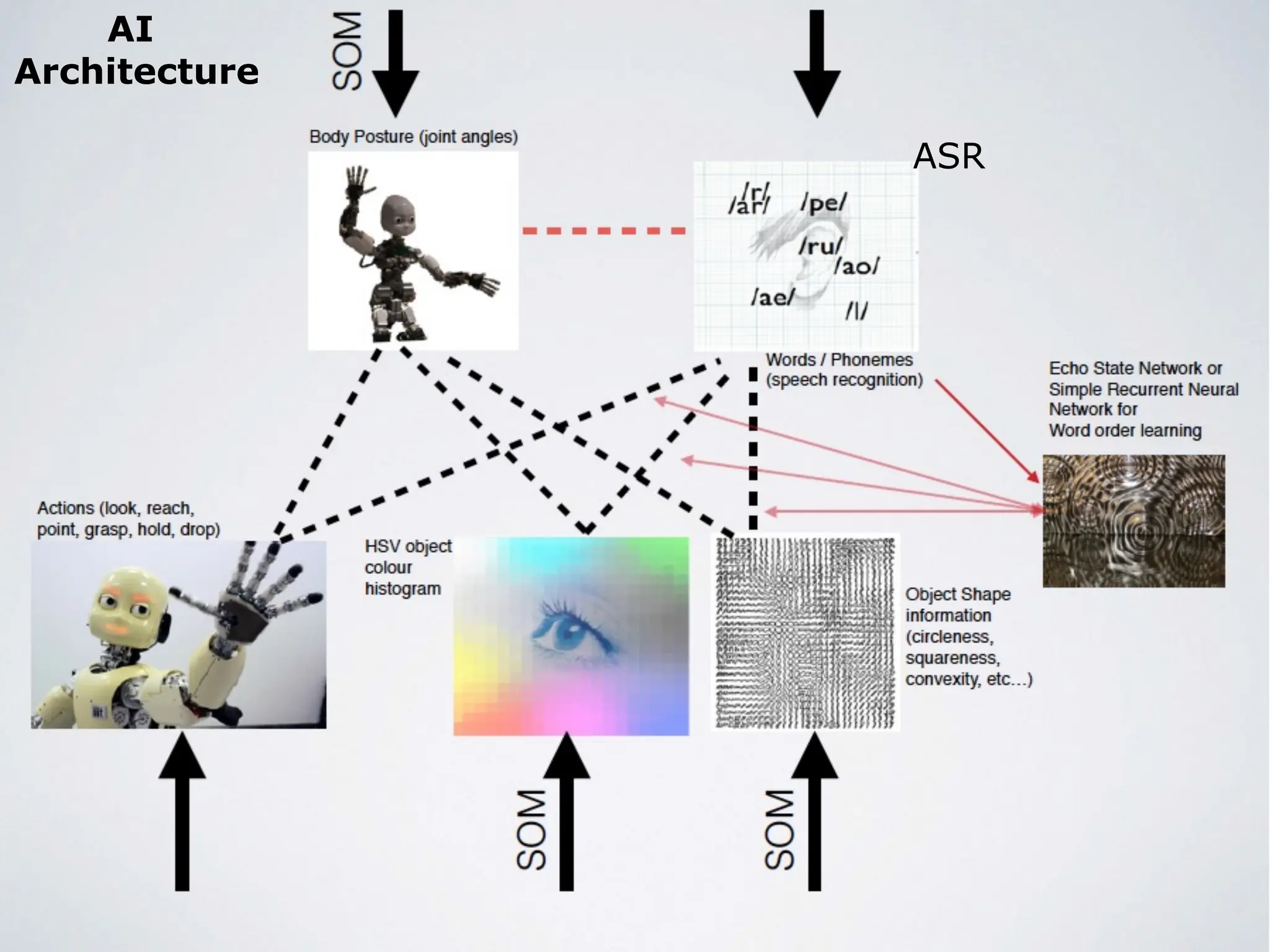
Epigenetic Robotics Architecture
AI
Architecture
ASR
Towards Learning
Abstract Words
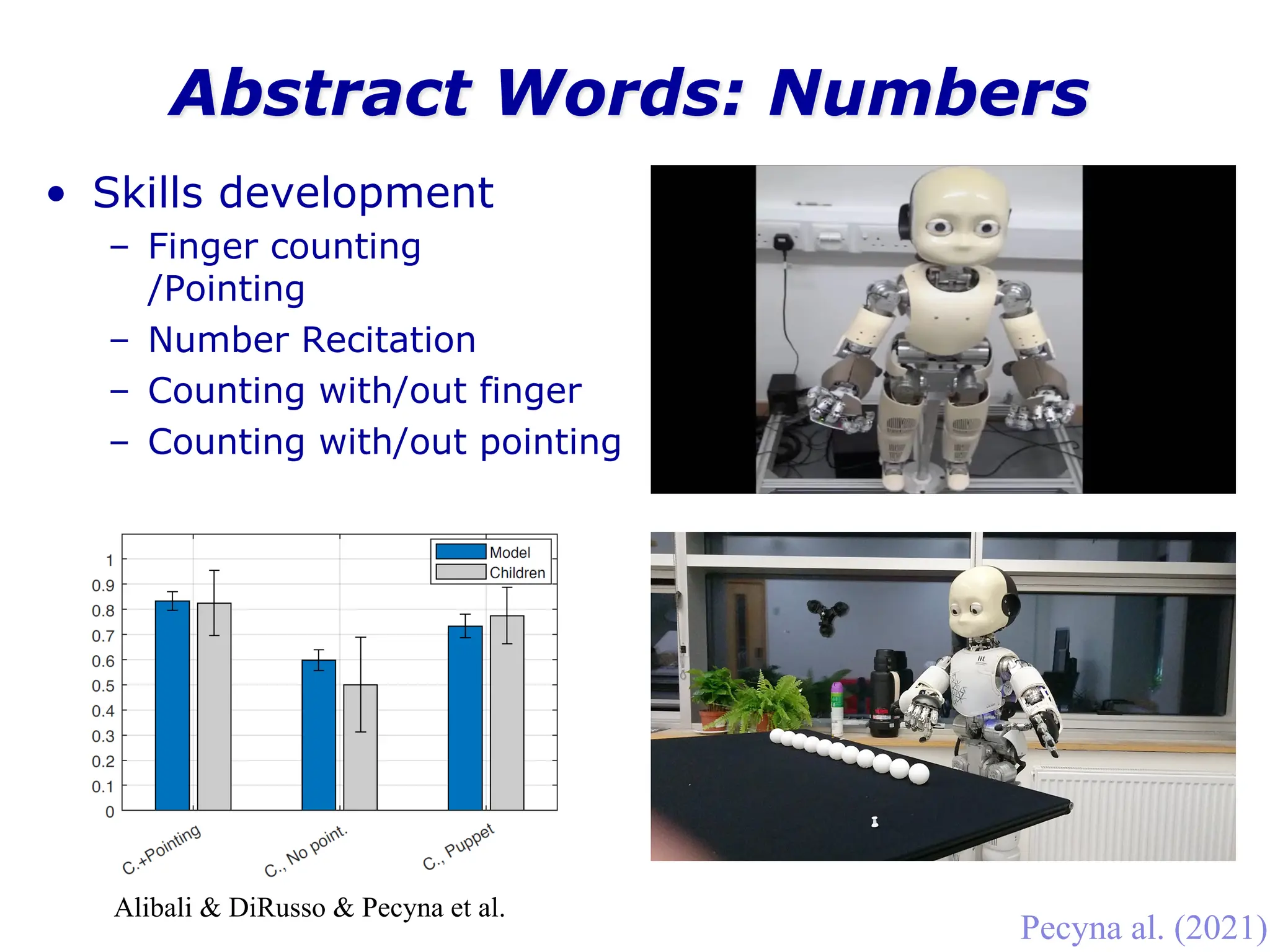
Abstract Words: Numbers
• Skills development
– Finger counting
/Pointing
– Number Recitation
– Counting with/out finger
– Counting with/out pointing
Pecyna al. (2021)
Alibali & DiRusso & Pecyna et al.
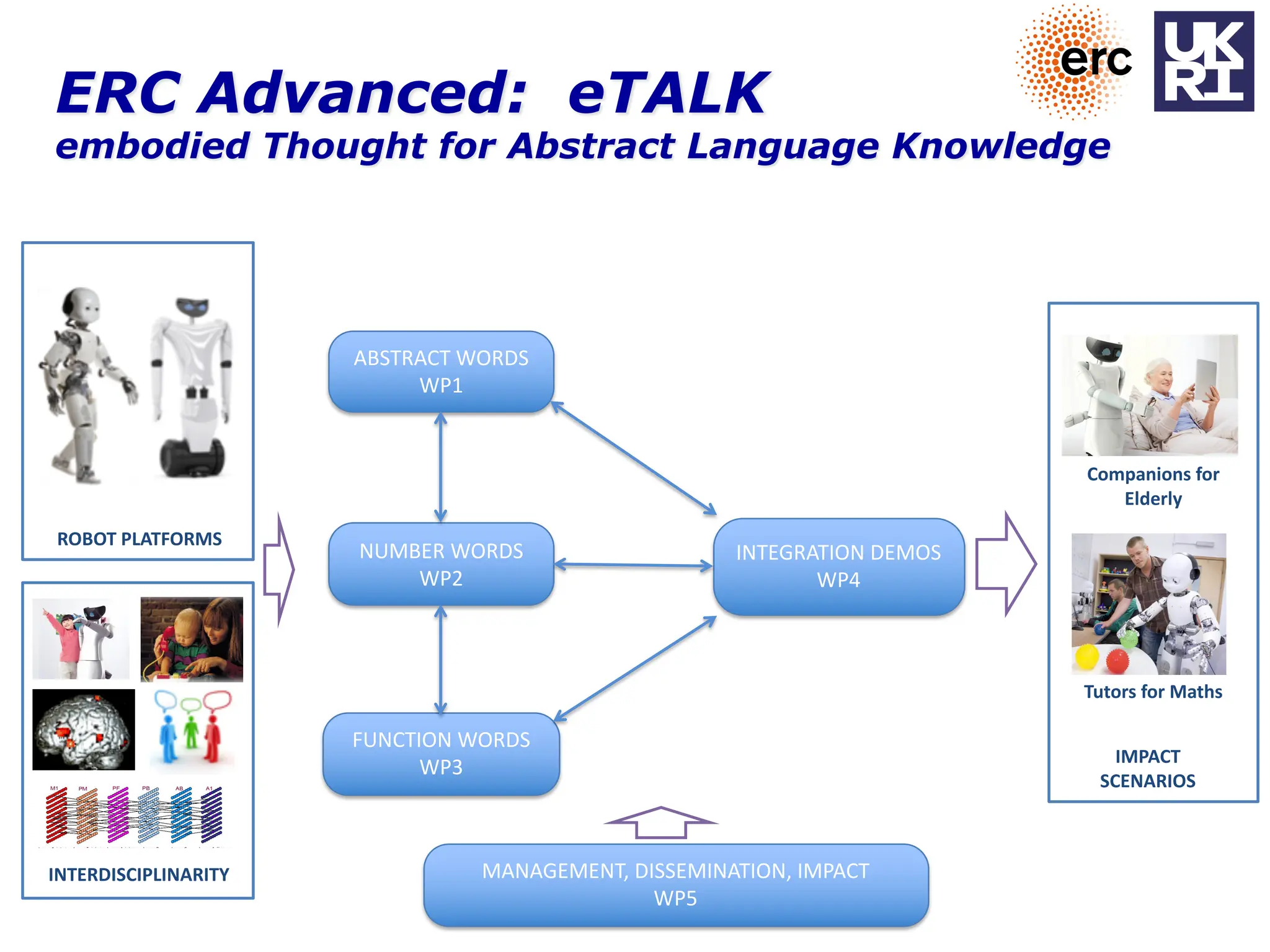
ERC Advanced: eTALK
embodied Thought for Abstract Language Knowledge
TRAINING PILLARS
INTEGRATION DEMOS
WP4
MANAGEMENT, DISSEMINATION, IMPACT
WP5
FUNCTION WORDS
WP3
ABSTRACT WORDS
WP1
NUMBER WORDS
WP2
IMPACT
SCENARIOS
INTERDISCIPLINARITY
ROBOT PLATFORMS
Tutors for Maths
Companions for
Elderly
Trust in Human-Robot Interaction
Towards a Theory of Mind
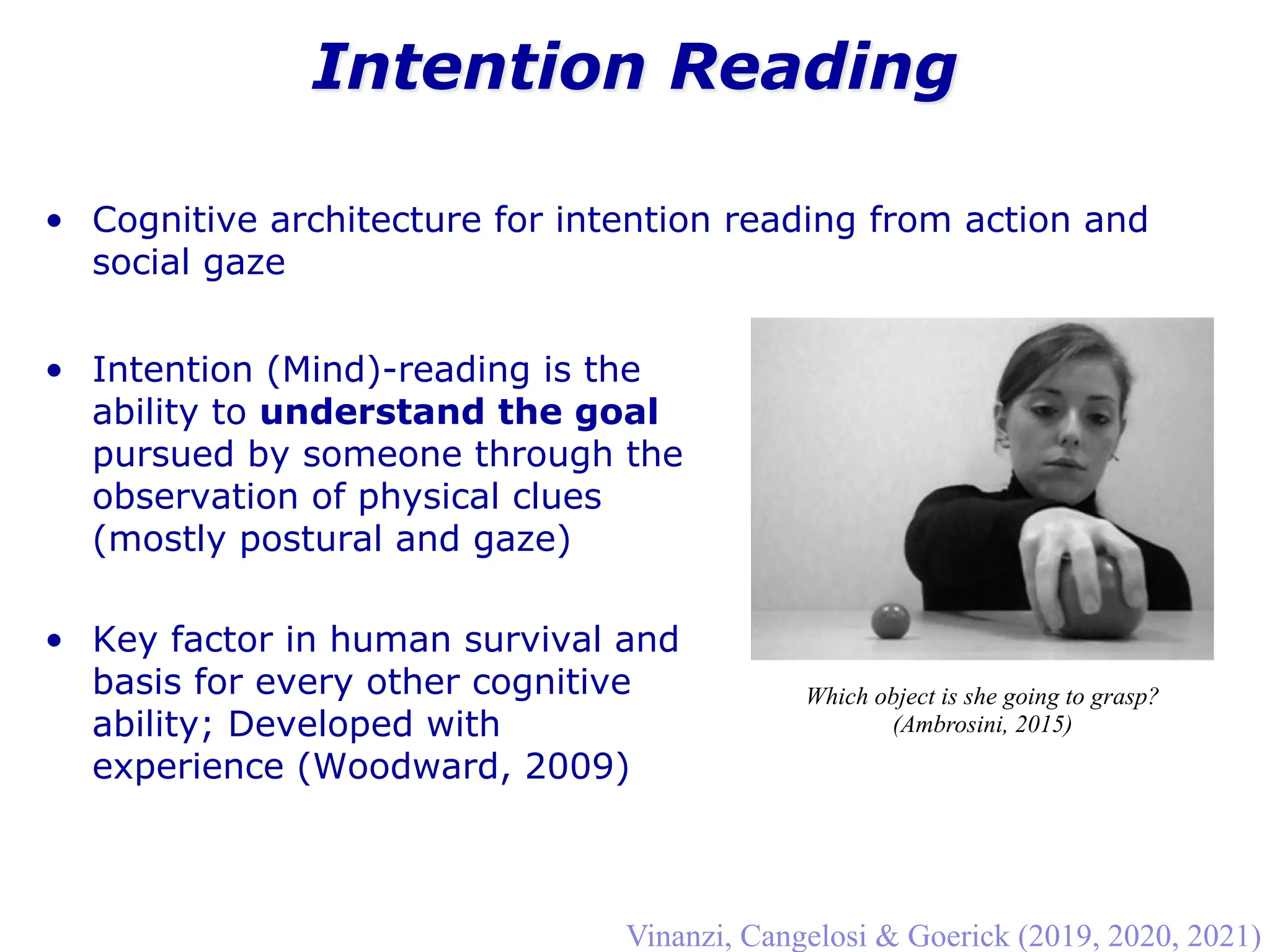
Intention Reading
Vinanzi, Cangelosi & Goerick (2019, 2020, 2021)
• Cognitive architecture for intention reading from action and
social gaze
Which object is she going to grasp?
(Ambrosini, 2015)
• Intention (Mind)-reading is the
ability to understand the goal
pursued by someone through the
observation of physical clues
(mostly postural and gaze)
• Key factor in human survival and
basis for every other cognitive
ability; Developed with
experience (Woodward, 2009)
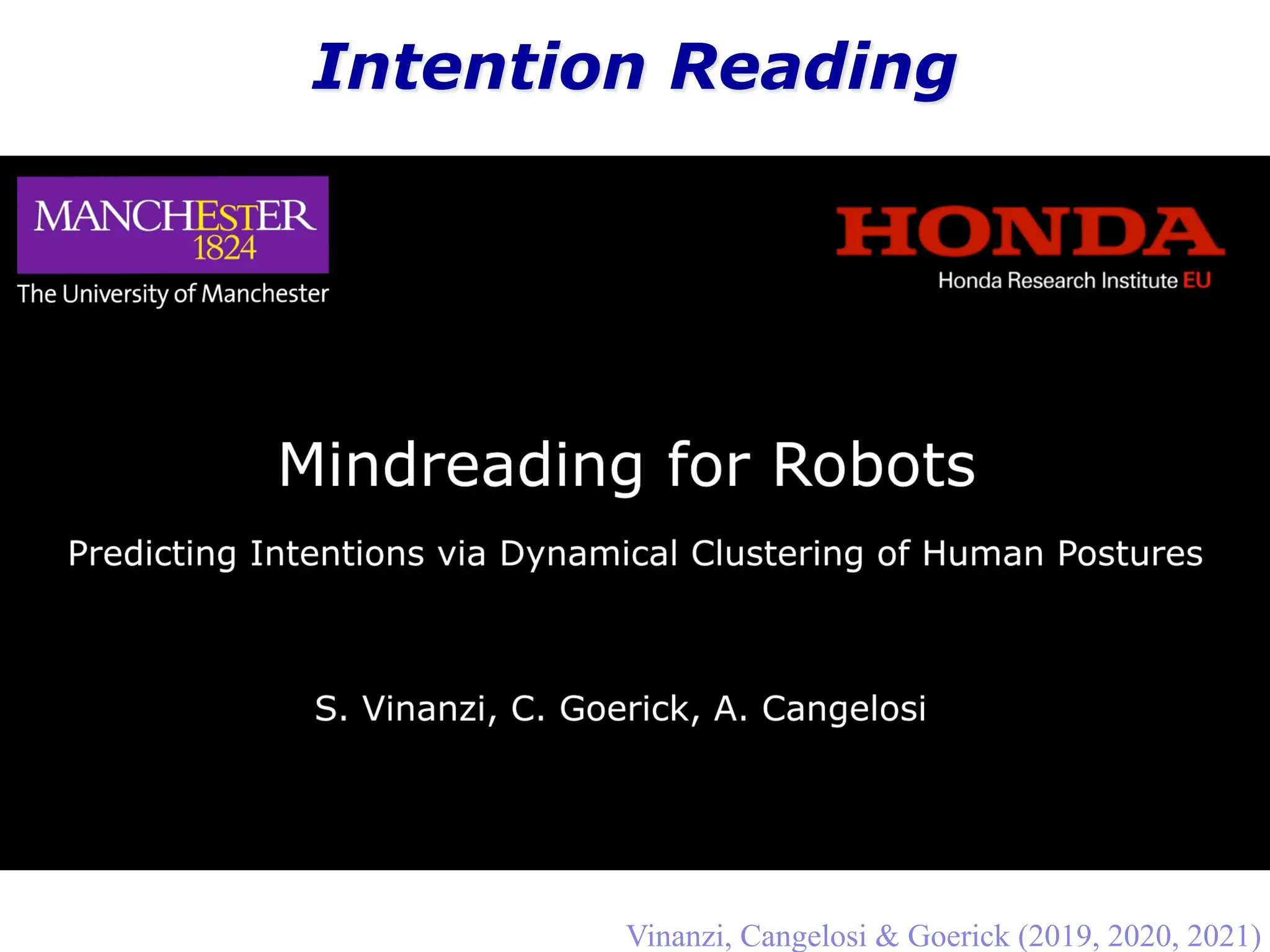
Intention Reading
Vinanzi, Cangelosi & Goerick (2019, 2020, 2021)
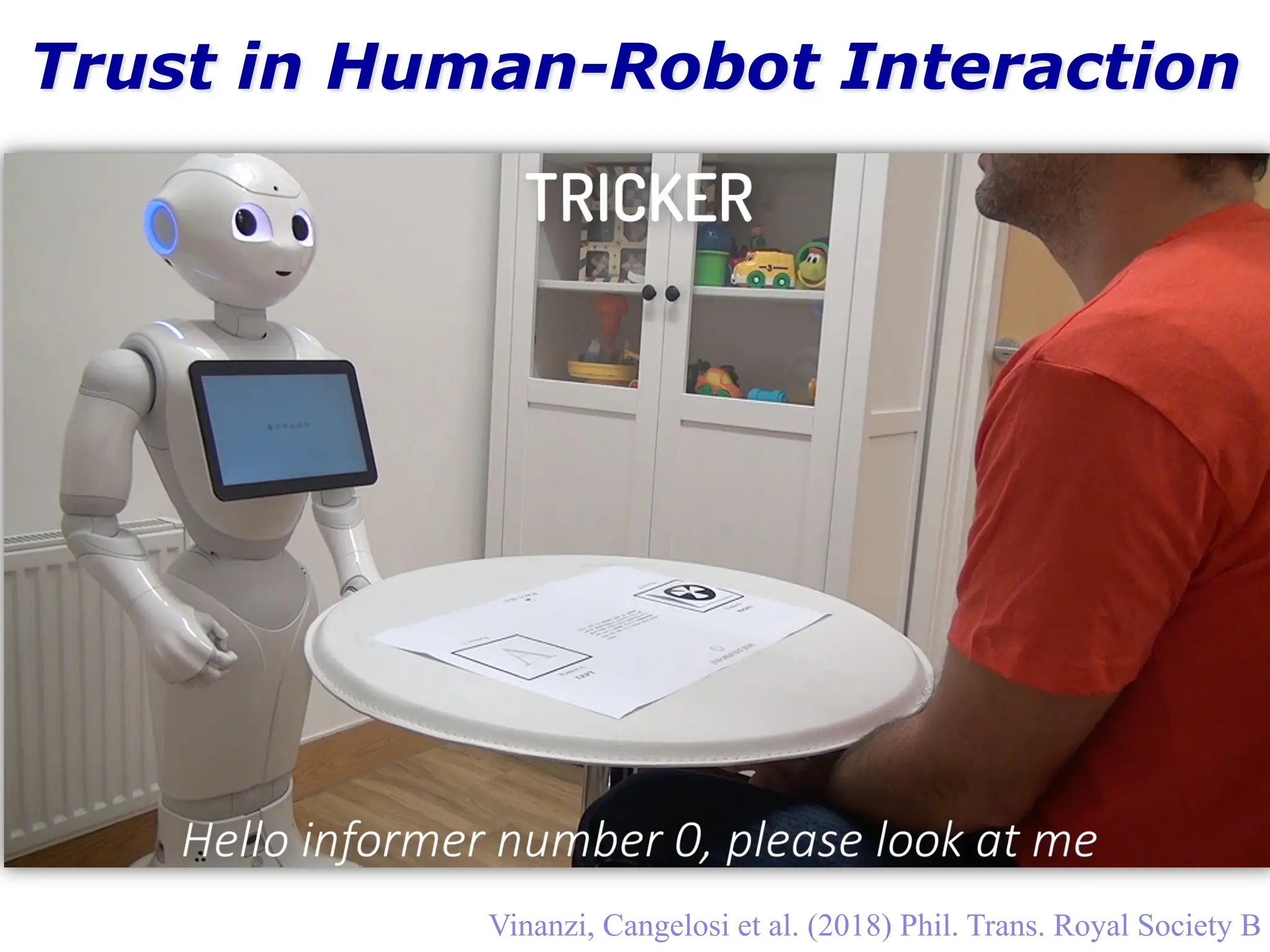
Trust in Human-Robot Interaction
Vinanzi, Cangelosi et al. (2018) Phil. Trans. Royal Society B
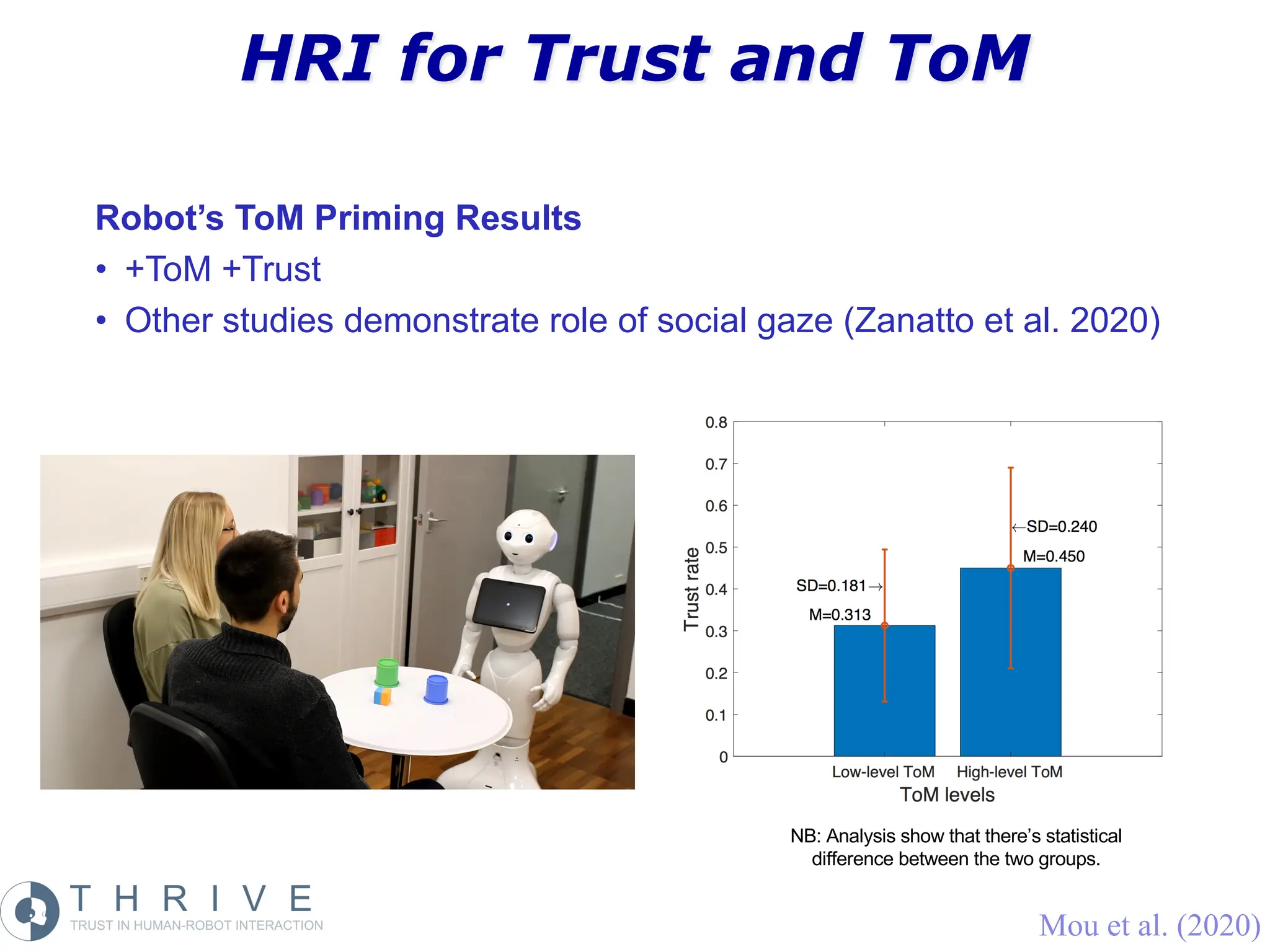
HRI for Trust and ToM
NB: Analysis show that there’s statistical
difference between the two groups.
Robot’s ToM Priming Results
• +ToM +Trust
• Other studies demonstrate role of social gaze (Zanatto et al. 2020)
Mou et al. (2020)
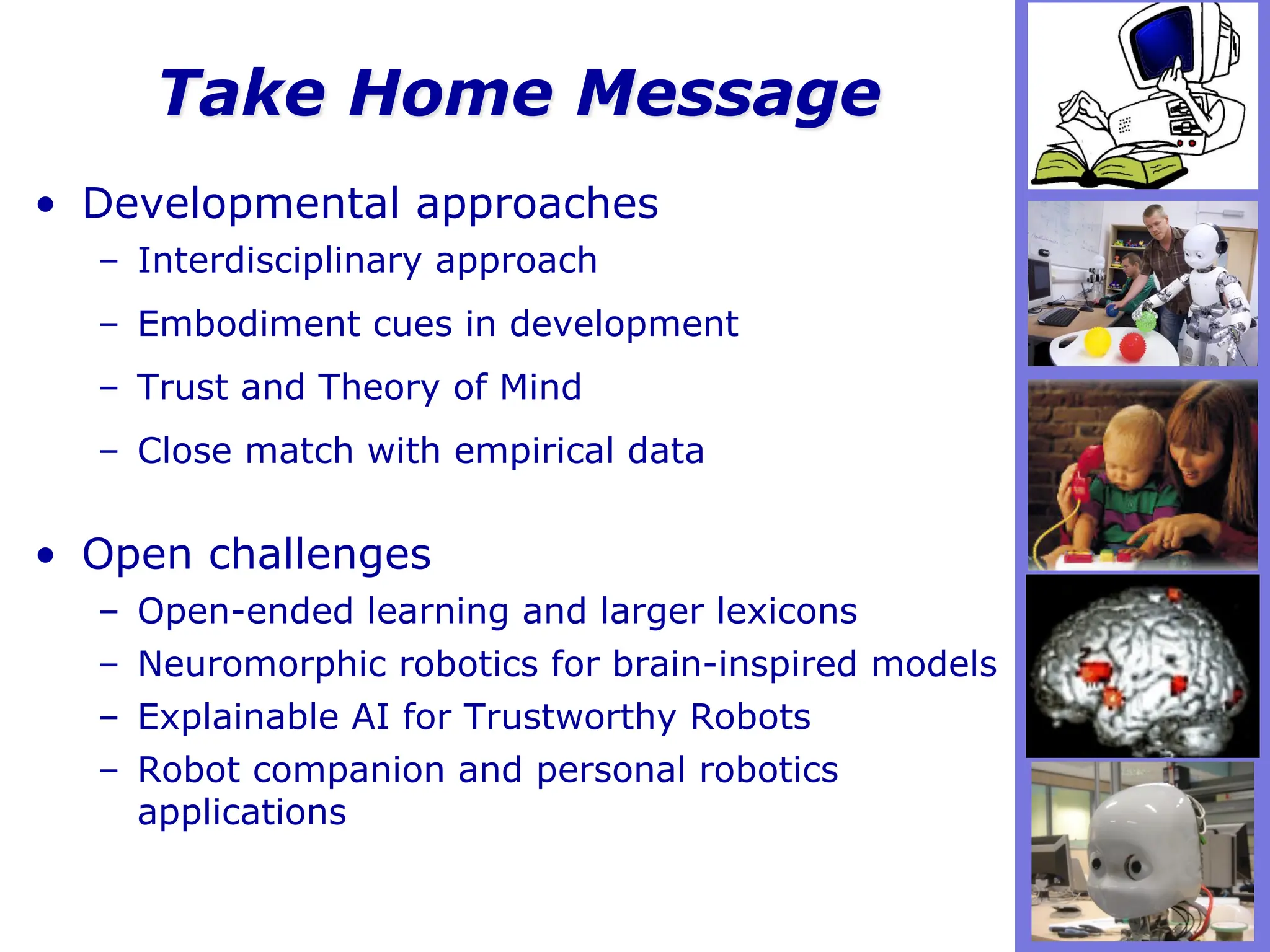
Take Home Message
• Developmental approaches
– Interdisciplinary approach
– Embodiment cues in development
– Trust and Theory of Mind
– Close match with empirical data
• Open challenges
– Open-ended learning and larger lexicons
– Neuromorphic robotics for brain-inspired models
– Explainable AI for Trustworthy Robots
– Robot companion and personal robotics
applications

Cognitive Robotics: from Babies to Robots and AI

  • 1.
  • 2.
    Robotics and AI:Human-Centred Companions for older people Cobots for Industry 4.0 Children in hospital Safety
  • 3.
    What are themechanisms and constraints (biases, cues) supporting cognitive development? How is embodiment involved in language acquisition? The “Body as Cognitive Hub” Hypothesis (Smith 2010; Morse et al. 2011) Gavagai Quine (1960)
  • 4.
    “Merry-Go-Round” of Amodal SymbolSystems Example of self-referential, amodal network of word definitions in Webster’s Dictionary (Roy 2005) Þ Chinese Room (Searle 1980) Force: Energy or strength Energy: Strength of force Strength: The power to resist force Push: To press force-fully against to move What’s the meaning of “Push” ?
  • 5.
  • 6.
  • 7.
    Question: mita syodatytto ? • tytto: vuosi seitseman, vahan nalka, syoda muna • tati: vuosi kahdeksankymmenta, paljon nalka, syoda kana • kana : vuosi kaksi, paljon nalka, syoda siemen • vuosi : kaksi , seitseman, kahdeksankymmenta • nalka : paljon, vahan • syoda : muna, kana, siemen Dictionary • kuinkamonta vuosi X ? è X vuosi A • kuinka nalka X ? è X nalka B • mita syoda X ? è X syoda C Reply Rule Book Chinese Room Experiment
  • 8.
    tytto tati kanamuna siemen Dictionary • tytto: seitseman vuosi , vahan nalka, syoda muna • tati: kahdeksankymmenta vuosi , paljon nalka, syoda kana • kana: kaksi vuosi , paljon nalka, syoda siemen • vuosi: kaksi, seitseman, kahdeksankymmenta • nalka: paljon, vahan • syoda: muna, kana, siemen Chinese Room Experiment Finnish paljon vahan
  • 9.
    ü Children areslow, but efficient at learning a language (vocabulary spurt) (Tomasello 2008) ü Children use their body for situated interaction (Smith & Samuelson 2010) ü The brain integrates language and sensorimotor knowledge (Pulvermueller 2005) ü Children develop Theory of Mind (ToM) for social interaction Learning & Development Robots can be easily pre-programmed to memorise a dictionary, but cannot fully understand the language they use
  • 10.
  • 11.
  • 12.
  • 13.
    Developmental Robotics of LanguageAcquisition • Cognitive architecture for developmental learning – Experiments: first words, mutual exclusivity, U-learning, – Collaboration with BabyLabs: Smith (Indiana), Horst (Sussex), Floccia (Plymouth), Twomey (Manchester), Marchetti (Cattolica Milan)
  • 14.
    iCub’s Modi Experiment Morseet al. (2015) PLoS ONE
  • 15.
    Embodied Attention &Word Learning Raggioli & Cangelosi (2022) ICDL
  • 16.
  • 17.
  • 19.
    Abstract Words: Numbers •Skills development – Finger counting /Pointing – Number Recitation – Counting with/out finger – Counting with/out pointing Pecyna al. (2021) Alibali & DiRusso & Pecyna et al.
  • 20.
    ERC Advanced: eTALK embodiedThought for Abstract Language Knowledge TRAINING PILLARS INTEGRATION DEMOS WP4 MANAGEMENT, DISSEMINATION, IMPACT WP5 FUNCTION WORDS WP3 ABSTRACT WORDS WP1 NUMBER WORDS WP2 IMPACT SCENARIOS INTERDISCIPLINARITY ROBOT PLATFORMS Tutors for Maths Companions for Elderly
  • 21.
    Trust in Human-RobotInteraction Towards a Theory of Mind
  • 22.
    Intention Reading Vinanzi, Cangelosi& Goerick (2019, 2020, 2021) • Cognitive architecture for intention reading from action and social gaze Which object is she going to grasp? (Ambrosini, 2015) • Intention (Mind)-reading is the ability to understand the goal pursued by someone through the observation of physical clues (mostly postural and gaze) • Key factor in human survival and basis for every other cognitive ability; Developed with experience (Woodward, 2009)
  • 23.
    Intention Reading Vinanzi, Cangelosi& Goerick (2019, 2020, 2021)
  • 24.
    Trust in Human-RobotInteraction Vinanzi, Cangelosi et al. (2018) Phil. Trans. Royal Society B
  • 25.
    HRI for Trustand ToM NB: Analysis show that there’s statistical difference between the two groups. Robot’s ToM Priming Results • +ToM +Trust • Other studies demonstrate role of social gaze (Zanatto et al. 2020) Mou et al. (2020)
  • 26.
    Take Home Message •Developmental approaches – Interdisciplinary approach – Embodiment cues in development – Trust and Theory of Mind – Close match with empirical data • Open challenges – Open-ended learning and larger lexicons – Neuromorphic robotics for brain-inspired models – Explainable AI for Trustworthy Robots – Robot companion and personal robotics applications