Cognitive Development
Cognitive Development
JeanPiaget
Jean Piaget
Poet Noah Perry once asked “ Who knows the
thought of the child?”
- Biologist
- Genetic Epistemologist
- Swiss Psychologist
1896 - 1980
2.
According to him,what distinguishes
human being from animal is………
Our ability to do abstract symbolic
reasoning.
His children Lucienne, Laurent and Jaqueline
who serve as subject in studying cognitive
development
3.
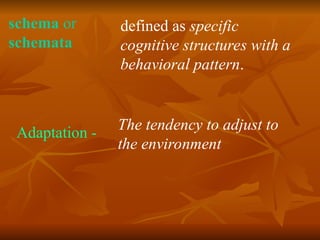
Adaptation -
The tendencyto adjust to
the environment
schema or
schemata
defined as specific
cognitive structures with a
behavioral pattern.
4.
Assimilation
refers to thetaking in of new
information.
Accommodation refers to the taking in of
new information by
restructuring the old
schema.
2 Subprocesses of Adaptation
5.
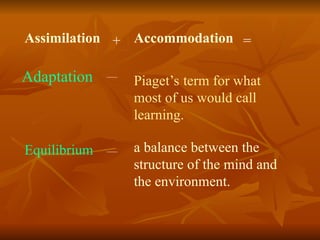
Assimilation Accommodation
+ =
Adaptation
abalance between the
structure of the mind and
the environment.
Equilibrium
Piaget’s term for what
most of us would call
learning.
6.
Stages of CognitiveDevelopment
Stages of Cognitive Development
Sensorimotor
Pre- operational
Concrete
operational
Formal
Operational
(Birth – 2 years)
(2 – 7 years old)
(7-11 years old)
(11 – adulthood)
7.
Stages of CognitiveDevelopment
Stages of Cognitive Development
Sensorimotor stage Birth to 2 years old
Object Permanence Refers to the recognition that the
object continue to exist even though
they are not directly sensed.
Egocentrism Centers on self and not concerned
with others opinion
Senses What is immediately sense from the
environment becomes knowledge
8.
According to Piaget,this
child is in the sensorimotor
period and primarily
explores the world with
senses rather than through
mental operations.
9.
Preoperational Stage -2 years old to 7 years old
Egocentric
Realism The ability to accept the difference of the
real world.
Irreversibility Unable to reverse thinking
Collective Monologue Talk to toys, with imaginary
friends, tell wild stories
10.
Concrete Operations -7 years old to 11 years old
Law of
Conservation
refers to the idea that a quantity
remains the same despite
changes in appearance
Formal Operational -11- adulthood
Perspective thought/ relativism
Awareness of different point of view rather than
single thought
Metacognition
Internal dialogue
Ability to examine one’s own mental processes
Self correction in solving problem
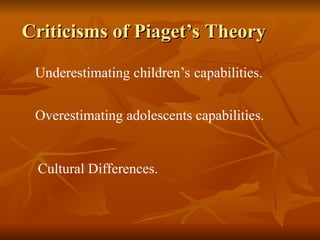
Criticisms of Piaget’sTheory
Criticisms of Piaget’s Theory
Underestimating children’s capabilities.
Overestimating adolescents capabilities.
Cultural Differences.