Cognitive Business
Where digital business
meets digital intelligence
August 3, 2016
Ravesh Lala
Vice President,
Watson Solutions
2 The Cognitive Business Narrative / 05.18.2016
The digital
explosion of
content is
impossible for
humans to make
sense out of it all
The digital explosion of content
makes it impossible for humans
to make sense of it all
Humans
excel at
DILEMMAS
COMPASSION
DREAMING
ABSTRACTION
IMAGINATION
MORALS
GENERALIZATION
Cognitive Systems
excel atCOMMON SENSE (but with many biases)
NATURAL LANGUAGE
LOCATING KNOWLEDGE
PATTERN IDENTIFICATION
MACHINE LEARNING
ELIMINATING BIASES
PROVIDING ENDLESS CAPACITY
Cognitive systems are creating a new partnership between
humans and technology
How are cognitive businesses different?
Are not programmed
but pose hypotheses based
on data patterns and
probability
Can see, use and
operationalize
virtually all data
Can understand, reason,
learn and interact with
humans naturally
4
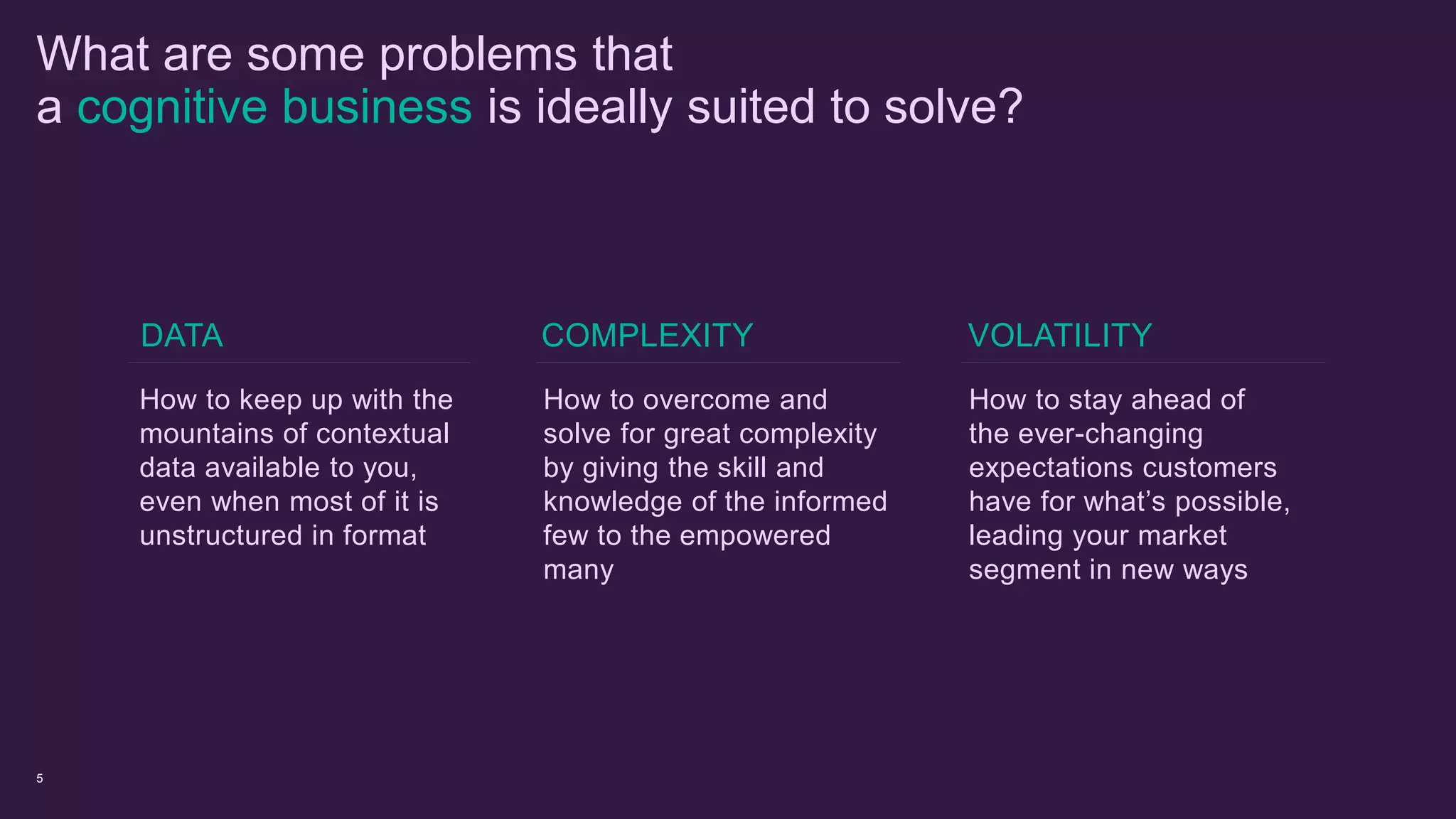
DATA
How to keep up with the
mountains of contextual
data available to you,
even when most of it is
unstructured in format
What are some problems that
a cognitive business is ideally suited to solve?
COMPLEXITY
How to overcome and
solve for great complexity
by giving the skill and
knowledge of the informed
few to the empowered
many
VOLATILITY
How to stay ahead of
the ever-changing
expectations customers
have for what’s possible,
leading your market
segment in new ways
5
A cognitive business has systems that can
enhance digital intelligence exponentially.
REASON
They can reason, grasp
underlying concepts,
form hypotheses, and
infer and extract ideas.
UNDERSTAND
Cognitive systems
understand imagery,
language and other
unstructured data
like humans do.
LEARN
With each data point,
interaction and outcome,
they develop and
sharpen expertise, so
they never stop learning.
INTERACT
With abilities to see,
talk and hear, cognitive
systems interact with
humans in a natural way.
6
Structured and active Unstructured and dark
Data that’s coming
• Customer records
• Transactional systems
• Predictive models
• Institutional expertise
• Operational systems
• News
• Events
• Social media
• Weather
• Geospatial information
• Internet of Things (IoT)
• Sensory data
• Images
• Video
Data outside your firewallData you possess ++
Cognitive businesses can access
and use all types of data.
7
8/23/2016
Key elements to defining a cognitive strategy
1. Establish a vision
• How would work get done in partnership
between humans and smart machines
• Are you too focused on how work gets done
today
2. Focus on value
• What will it take to unlock key value drivers
from unstructured data in your organization
• How can you blend immediate value from
solving comparatively easy problems with big
payoffs from hardest challenges
2. Test your data
• Do you have data that is clean and machine
readable
• What weak signals can smart machines detect
with your data that you cannot8
Becoming a cognitive business
requires a thoughtful strategy.
3. Frame your journey
• What is your target portfolio of use cases and
how do the use cases evolve as smart
machines learn about your data
4. Execute cognitive pilot and scale
• How to develop a 30/60/90 day plan for the first
uses cases including data selection and system
training
• How to engage users and drive adoption
• How to scale vertically (same use case) and
horizontally (new adjacent use cases)
• How to leverage cognitive technologies and
drive process automation
9
Identify a
problem
to solve.
Cast a vision.
Champion a
new culture.
Assess progress
towards your
desired outcome.
Measure
specific values.
Ensure your
process
is working – iterate
as needed..
Assess data
requirements
from internal and
external sources.
Collect, ingest,
curate, annotate
and build out
taxonomies and
ontologies.
Execute a
staged roll-out
based on a
simple starter-
prototype
Instrument for
metrics and KPIs.
Prepare people
for new ways of
collaborating
with
technology.
Adapt
processes,
content and
roles as
needed.
Periodically
update
functionality and
training with new
content based on
learnings
To summarize
1
Develop your
cognitive
strategy
6
Measure
outcomes
3
Apply
cognitive
technology
4
Engage your
organization
5
Enhance cognitive
capabilities based
on learning
2
Evaluate and
curate data
10
Thank you

Cognitive Business: Where digital business meets digital intelligence

  • 1.
    Cognitive Business Where digitalbusiness meets digital intelligence August 3, 2016 Ravesh Lala Vice President, Watson Solutions
  • 2.
    2 The CognitiveBusiness Narrative / 05.18.2016 The digital explosion of content is impossible for humans to make sense out of it all The digital explosion of content makes it impossible for humans to make sense of it all
  • 3.
    Humans excel at DILEMMAS COMPASSION DREAMING ABSTRACTION IMAGINATION MORALS GENERALIZATION Cognitive Systems excelatCOMMON SENSE (but with many biases) NATURAL LANGUAGE LOCATING KNOWLEDGE PATTERN IDENTIFICATION MACHINE LEARNING ELIMINATING BIASES PROVIDING ENDLESS CAPACITY Cognitive systems are creating a new partnership between humans and technology
  • 4.
    How are cognitivebusinesses different? Are not programmed but pose hypotheses based on data patterns and probability Can see, use and operationalize virtually all data Can understand, reason, learn and interact with humans naturally 4
  • 5.
    DATA How to keepup with the mountains of contextual data available to you, even when most of it is unstructured in format What are some problems that a cognitive business is ideally suited to solve? COMPLEXITY How to overcome and solve for great complexity by giving the skill and knowledge of the informed few to the empowered many VOLATILITY How to stay ahead of the ever-changing expectations customers have for what’s possible, leading your market segment in new ways 5
  • 6.
    A cognitive businesshas systems that can enhance digital intelligence exponentially. REASON They can reason, grasp underlying concepts, form hypotheses, and infer and extract ideas. UNDERSTAND Cognitive systems understand imagery, language and other unstructured data like humans do. LEARN With each data point, interaction and outcome, they develop and sharpen expertise, so they never stop learning. INTERACT With abilities to see, talk and hear, cognitive systems interact with humans in a natural way. 6
  • 7.
    Structured and activeUnstructured and dark Data that’s coming • Customer records • Transactional systems • Predictive models • Institutional expertise • Operational systems • News • Events • Social media • Weather • Geospatial information • Internet of Things (IoT) • Sensory data • Images • Video Data outside your firewallData you possess ++ Cognitive businesses can access and use all types of data. 7
  • 8.
    8/23/2016 Key elements todefining a cognitive strategy 1. Establish a vision • How would work get done in partnership between humans and smart machines • Are you too focused on how work gets done today 2. Focus on value • What will it take to unlock key value drivers from unstructured data in your organization • How can you blend immediate value from solving comparatively easy problems with big payoffs from hardest challenges 2. Test your data • Do you have data that is clean and machine readable • What weak signals can smart machines detect with your data that you cannot8 Becoming a cognitive business requires a thoughtful strategy. 3. Frame your journey • What is your target portfolio of use cases and how do the use cases evolve as smart machines learn about your data 4. Execute cognitive pilot and scale • How to develop a 30/60/90 day plan for the first uses cases including data selection and system training • How to engage users and drive adoption • How to scale vertically (same use case) and horizontally (new adjacent use cases) • How to leverage cognitive technologies and drive process automation
  • 9.
    9 Identify a problem to solve. Casta vision. Champion a new culture. Assess progress towards your desired outcome. Measure specific values. Ensure your process is working – iterate as needed.. Assess data requirements from internal and external sources. Collect, ingest, curate, annotate and build out taxonomies and ontologies. Execute a staged roll-out based on a simple starter- prototype Instrument for metrics and KPIs. Prepare people for new ways of collaborating with technology. Adapt processes, content and roles as needed. Periodically update functionality and training with new content based on learnings To summarize 1 Develop your cognitive strategy 6 Measure outcomes 3 Apply cognitive technology 4 Engage your organization 5 Enhance cognitive capabilities based on learning 2 Evaluate and curate data
  • 10.

Editor's Notes

  • #4 Humans are inherently capable of a set of skills that help us learn, discover and make decisions: We can apply common sense, morals, and reason through dilemmas; we can dream up new ideas and make generalizations when essential clues and pieces of information are missing. But we’re restricted by the time it takes to learn, process, and absorb new information and limited by the unconscious biases we all possess that influence the decisions we make. Cognitive systems, like Watson, are systems that:   Understand: They understand data – structured and unstructured, text-based or sensory – in context and meaning, at astonishing speeds and volumes. In fact, Watson reads 800 million pages per second.   With one client, Watson initially ingested 80 million documents and incrementally adds 30,000 additional documents every day.   Reason: They have the ability to form hypotheses, make considered arguments, and prioritize recommendations to help humans make better decisions.   Learn: They ingest and accumulate data and insight from every interaction, continuously. And they’re trained, not programmed, by experts who enhance, scale, and accelerate their expertise, and therefore get better over time. They never stop learning. It’s the difference between the strategies we used as children to solve mathematical problems, and the strategies we developed when we got into advanced strategies like geometry, algebra and calculus.   And working together with systems like Watson, we can achieve the kinds of outcomes that would never have been possible otherwise:   For instance, a Baylor Medical School retrospective study focused on a particular protein, called p53 -- a protein that inhibits tumor growth in cancer patients. Holding constant all the research and insights that had been done prior to 2003, and testing Watson's capabilities against it, Watson was able to extract from the over 23M Medline articles it read, a 100% of the known proteins that affect p53. It compressed what had been a decade of research to a matter of weeks. Watson was also able to identify the 7 new proteins that have been discovered since 2003 as well as 6 new phosphates that appear to impact p53, all of which are now being investigated. But this is just one example; oil pipeline analysts are using Watson to trim years off of production timelines; SwissRe -- one of the world’s largest reinsurance companies -- is using Watson to reimagine the practice of insurance underwriting.
  • #5 HOW ARE COGNITIVE SYSTEMS DIFFERENT?   The key reason cognitive businesses operate with an entirely different set of advantages is because they are using cognitive systems. Their abilities to get to data expand and deepen exponentially. They have programmed and probabilistic computing, giving them analysis plus hypotheses. They can interact with their business systems more naturally, more directly.
  • #6 WHAT ARE SOME PROBLEMS THAT A COGNITIVE BUSINESS IS IDEALLY SUITED TO SOLVE?   You are staring at mountains of unstructured data, and you believe the valuable insights are there. (Data can be both a cognitive problem and the fuel for a cognitive solution.) Your ability to solve complex issues for your customers, patients or constituents is limited by how many experts you have with the exact skills and knowledge required to unravel it. You have not cracked the code in meeting customer expectations for engagement, but competitors have—or they’re changing the rules altogether.
  • #7 A COGNITIVE BUSINESS HAS SYSTEMS THAT CAN ENHANCE DIGITAL INTELLIGENCE EXPONENTIALLY.   Key to attaining a richer digital intelligence are cognitive systems. With analytics, we get key insights from data, but with cognitive systems, we can turn those key insights into knowledge. Traditional computing is programmed (rules-based, logic-driven, dependent on organized information), but cognitive systems are probabilistic (they learn systematically, they are not dependent on rules, they handle disparate and varied data). Cognitive systems can understand unstructured information such as the imagery, natural language and sounds in books, emails, tweets, journals, blogs, images, sound and videos. They unlock meaning because they can reason through it, giving us new contexts to weigh and consider. Cognitive systems also learn continually, honing our own expertise so we can immediately take more informed actions. And they interact with us and with our customers, dissolving barriers between humans and machine, fueling unique, essential user experiences.
  • #8 COGNITIVE BUSINESSES CAN ACCESS AND USE VIRTUALLY ALL TYPES OF DATA.   With the right cognitive solutions, your business systems will understand data—structured and unstructured, text-based or sensory—in context and meaning, at astonishing speeds and volumes. IBM Watson software reads 800 million pages per second, for example. With one client, Watson technology initially ingested 80 million documents and is incrementally adding 30,000 additional documents every day. So in what intersections of what deep or wide data pools is your differentiated insight hiding?
  • #9 Prototype delivers significant value (e.g. major auto manufacturer used prototype insights to trigger a safety product recall)
  • #10    [A detailed look at how IBM helps clients build a sustainable cognitive strategy, tuned for their business and industry] Whether you are building an app or trying to transform your organization, think about these six steps