Cognitive Behavioral Therapy (CBT) Case Formulation Activity
Student
School of Behavior Sciences, Liberty University
Author Note
Student
I have no known conflict of interest to disclose.
Correspondence concerning this article should be addressed to
Student
Email: [email protected]
Abstract
This paper consists of a teaching activity that incorporates
higher order thinking skills (HOTS) associated with the
revisions of Bloom’s taxonomy made by Anderson and
Krathwohl. The teaching activity revolves around the
development process of a Cognitive Behavioral Therapy (CBT)
case formulation. Additionally, the active learning strategies
implemented within this lesson’s activity are as follows: (1)
group work that revolve around a provided case analysis, (2)
discussion techniques that involve penetrating questions, and
(3) think-pair-share.
2
CBT CASE FORMULATION ACTIVITY 2
Keywords: teaching activity, learning activity, Bloom’s
taxonomy, Cognitive Behavioral Therapy, CBT, case
formulation, active learning strategies, case analysis,
discussions, think-pair-share
Cognitive Behavioral Therapy (CBT) Case Formulation Activity
Every person in this world learns through their
experiences. In general, experiences affect people’s thoughts
and actions, and sometimes they can provide meaning to an
individual’s life. Consequently, when people are placed in
situations where they have to learn new things, these insights
should be of value to them. In relation to this notion, Merriam
et al. (2007) clearly stated that “learners must connect what
they have learned from current experiences to those in the past
as well as see possible future implications” (p. 162). This
connection of learning must also be placed within an
educational setting where adults are the students. Therefore,
this paper focuses on how incorporating higher order thinking
skills (HOTS) to a lesson activity in a graduate course is
essential for adults to learn with meaningful insights.
Svinicki and McKeachie (2014) stated that in order for adult
students to sharpen their thought process, they need to develop
habits of reflection. These habits of reflections are based off
experiences, successes and failures, plans and purposes, along
with choices and consequences (Svinicki & McKeachie, 2014,
p. 318). Consequently, when adult students develop these
habits, their ability to engage in learning activities within a
classroom setting can result to positive and meaningful learning
outcomes relative to HOTS. Furthermore, this paper explores
the development of a graduate level teaching activity that
consists of learning objectives pertaining to two highest levels
of thought from Bloom’s taxonomy.
Process of Development for a Learning Activity
Just like any educational setting, the first day is usually
when the teacher or instructor sets the tone to establish the
classroom’s environment. This is also when the teacher or
instructor goes over his or her expectations of student
performances that are dependent upon the level of education
that he or she is assigned to teach. However, in a college
classroom environment, Brookfield (2013) expressed how
teachers should exercise authority by communicating with their
students in a clear and transparent way (p. 25). So, for a
graduate level of education, the first day of class is usually
when the instructor goes over his or her syllabus that contains
information about the course’s content, student learning
objectives, course calendar, student tasks or assignments, etc.
Therefore, this results to adult students having an idea of the
direction that the course will take, along with what is clearly
expected of them from their instructor.
Course Preparation for Teachers
Before the first day of a graduate level class, Svinicki and
McKeachie (2014) explained how the initial step for instructors
to take is to prepare student learning goals that are expressed by
the course objectives (p. 6). The reason for this is because when
teachers or instructors write their student learning goals down,
it assists them in clearly describing what the expected student
learning outcomes are within the course. Consequently, these
goals will also help teachers or instructors determine what they
need to do for the course (Svinicki & McKeachie, 2014).
Teacher Groundwork
As the graduate course progresses within its term, teaching
techniques should have been implemented by the teacher or
instructor. Once students experience these teaching techniques,
they familiarize themselves with possible future steps in which
their instructor plans on taking. However, before an instructor
can move the class forward, he or she must design a sequence of
exercises that enables him or her to judge when students are
prepared to move on within the course (Brookfield, 2013, p.
37). So, for the learning activity within this paper, the teacher
must ensure that students are provided with the necessary
resources such as assigned textbook readings and online
resources relative to the course’s content. These resources will
prepare the students for the anticipated learning activity that
will be described in the upcoming sections of this paper.
The Teaching Activity
The topic of this paper’s teaching activity focuses on students
developing a Cognitive Behavioral Therapy (CBT) case
formulation for a couple who is seeking therapy. Of course,
prior to this activity, students already have background
knowledge about CBT through their previous reading
assignments and provided resources from the instructor. So,
once students are ready to move forward with the course’s
content, the teaching activity will take the direction of a
problem-based learning approach. Svinicki and McKeachie
(2014) explained how this approach enables the instructor to
provide students with a snippet of a selected scenario and some
material that students can use to solve a given issue (p. 207).
Therefore, the selected scenario for this activity is based off a
case study of a couple seeking therapy. It should take at least
five minutes for the class to read this case study provided by
Dr. Michael Regev, a registered marriage and family therapist:
John and Susan have been married for 7 years. They have two
children, aged 5 and 3. John is a computer technician and Susan
has been a homemaker since the birth of their first child. They
live in a nice neighbourhood in one of the suburbs of a big city
in Canada.
John and Susan were introduced to each other in college. They
fell in love immediately and after dating for about four months,
moved in together. They got married a year later. John liked
Susan’s openness and sensitivity. He used to describe her as a
“free spirit”, someone who could do the wildest thing on a
whim. He loved her spontaneity and genuineness. Susan
admired John’s brain and the way he made her laugh. She felt
safe with him and believed he was very dependable. In the
beginning of their relationship they got along really well and
were very happy.
The first time they both started feeling that the relationship was
not working well was after the birth of their first child.
Initially, both wanted to have a baby and both were thrilled
when their first daughter, Charlotte, was born. However, in the
months following the birth they started arguing a lot about
small things. Soon after, they started blaming one another for
various things. Susan blamed John for not taking on a fair share
of the baby’s care and house chores, and John blamed Susan for
criticizing him and for always nagging him about “stupid little
things”. Things had gotten so bad that they started thinking
about separating. However, they still wanted to give it a try and
in an attempt to mend things, they went away on a holiday, only
to discover a couple of weeks after their return that Susan was
pregnant again. At first they were both overwhelmed by the
news, but then they talked it through and agreed that it had
probably been a sign that they should stick together and raise
their family. The next few months went fairly well. Susan felt
that John was taking care of her and making sure she was
comfortable and safe. Susan was mostly in a good mood and
tried to minimize her requests from John. Things were looking
up.
However, shortly after the birth of their son, Sean, they started
fighting again. The tension in the house was getting worse every
day. They were both very tired and drained. Susan was feeling
overwhelmed with taking care of two children and she felt
abandoned by John. She started begging him to come home
early, or not to go to work at all. For his part, John was working
more hours than ever. He often missed dinner and when he did
not, he would often say he was exhausted and go to bed
immediately after dinner. The bitterness and anger in the
relationship grew more and more until John told Susan one day
that he had rented an apartment, and was moving out. Susan was
devastated. Even though she was very unhappy in the
relationship, she did not expect that John would leave her. She
was desperate and begged him to reconsider. They came to
therapy as a “last resort”. (Regev, n.d.)
This case study will serve as information that was acquired
through the couple’s intake process prior to their initial session.
However, before students engage in the activity, the instructor
will present an Extended Case Formulation Worksheet guide
created by Ackerman (2020) and was obtained from the Positive
Psychology website. The instructor will explain to the students
how Ackerman (2020) created this guide with instructions on
how to complete its Part A and Part B. This explanation should
take no more than five minutes of class time. Additionally, for
the sake of instructional guidance, the whole class will
complete Part A together through a class discussion. This
particular task should take no more than 20 minutes.
Afterwards, the teaching activity can finally take place where
students experience two highest levels of thought processes.
Critical Thought Levels of the Teaching Activity
In a college setting, depending on the course level,
Svinicki and McKeachie (2014) indicated that learning goals
“can be pitched at several different depths of complexity” (p.
10). However, in terms of this paper’s teaching activity, these
depths of complexity reflect the levels of objectives within the
revision of Bloom’s taxonomy made by Anderson and
Krathwohl (Svinicki & McKeachie, 2014). Therefore, this
paper’s teaching activity require students to use various types
of HOTS to analyze and evaluate.
Analyze
The first highest level of thought within this paper’s
teaching activity is to analyze or “subdivide content into
meaningful parts and relate the parts” by differentiating,
organizing, or attributing (Svinicki & McKeachie, 2014, p.
311). The learning objective for this level of thought is as
follows: As a group, given Part B of the CBT case formulation
guide, students will be able to categorize information provided
by the case study of a couple seeking therapy through
collaboration. What this means is that the whole class will be
broken up into three groups. Within their assigned group, the
activity requires students to participate in collaborating with
each other to fulfill this learning objective.
With the use of the Extended Case Formulation Worksheet
provided by Ackerman (2020), students are guided throughout
their collaboration process in categorizing the information
needed to complete Part B. Consequently, this activity
implements the use of discussion. Svinicki and McKeachie
(2014) suggested that one stimulation for discussion can start
with questions (p. 42). So, prior to breaking the class up into
three groups, the instructor should ask the following penetrating
question to initiate the activity’s discussion portion: How does
John and Susan’s automatic thoughts of their relationship
problem differ from one another? Afterwards, students can
begin go partake in the learning activity as a group taking no
more than 25 minutes.
The Effect of Group Work Learning Activity
Throughout this learning activity, students can build on
presented ideas together as a group. However, as students
collaborate in order to categorize information within the
provided case study, their perspectives towards the issue can be
similar or different. Svinicki and McKeachie (2014) discussed
how this type of situation can be positively guided through a
cooperative discussion method (p. 53). Therefore, in the event
that student perspectives differ during the case discussion, they
can take turns in understanding each other’s point of view.
When this occurs, students are still analyzing content by
relating these newly presented ideas towards their own
perceptions of the case study. Additionally, these differences
allow students to gain a better understanding of how analyzing
ideas, apart from their own, can positively impact their thought
process.
At this course level, students are expected to have grasp
the main concept of applying the CBT approach to the provided
case study. However, the most significant student impact of
learning during this activity lies within the information that has
been gathered through each group’s collaboration process. Once
students analyze their group’s obtained information from the
case study, they are able to categorize them onto Part B of the
case formulation worksheet guide. When this is done, students
gain a better understanding of why a CBT case formulation is
crucial to the development of a treatment process of a couple
seeking therapy. Furthermore, this then entails that the learning
objective for this highest level of thought, analyze, has been
fulfilled.
Evaluate
The second highest level of thought within this paper’s
teaching activity is to evaluate or come “to a conclusion about
something based on standards/criteria” by checking, critiquing,
or judging (Svinicki & McKeachie, 2014, p. 311). The learning
objective for this level of thought is as follows: Through
presentations, followed by a think-pair-share activity, students
will be able to compare similarities and differences among the
answers provided within Part B of the CBT case formulation
guide with others. What this means is that each group is
required to present Part B of their completed CBT case
formulation worksheet and it should take at least 20 minutes of
class time.
Based on the activity’s criteria of having students present
what their group came up with, it exposes information that
could either be similar or different from another group’s
conclusion. This process enables students, in all three groups, to
prepare for the anticipated discussion that will allow them to
compare their answers to another. However, before the
discussion begins, the instructor should ask students to reflect
on the following questions:
1. Among all three group’s presentations for Part B of the case
formulation guide, was there any type of information provided
that differed from the answers that your group came up?
2. Relative to the CBT approach, which information seemed
most common among all three group’s presentation that will
significantly impact the creation of John and Susan’s treatment
plan?
Students should be given at least two minutes to reflect on these
questions so that they are able to share their thoughts through
the active learning strategy of think-pair-share.
Think-Pair-Share
Once students gather their thoughts, they can begin to engage in
a discussion with a neighboring seated individual. Svinicki and
McKeachie (2014) expressed how the active learning strategy of
think-pair-share does not take much of class time (p. 196).
Therefore, this activity should take at least five minutes.
Svinicki and McKeachie (2014) also pointed out that through
the think-pair-share activity, students begin to engage in a
discussion by comparing their responses. If a disagreement
occurs, students can go through the process of trying to
compromise how to please both sides. However, during this
process, it is the teacher’s job to listen and guide students when
needed so that they can become problem solvers (Svinicki &
McKeachie, 2014). Once this activity is completed, before
student are dismissed, the teacher can request for them to write
a short reflection. This reflection can be about how this learning
activity impacted the way students understood the content that
has been learned. These student reflections can be briefly
explored during the beginning of the next class session.
Conclusion
This paper’s teaching activity concludes that students learn
better when they interact with each other. This notion is
supported by Svinicki and McKeachie (2014) as they stated that
one of the “best methods of gaining clearer, long-lasting
understanding” is by having someone else explain the topic to
another (p. 201). Additionall y, through this process, students
are also able to activate critical thought levels that are
associated with the revision of Bloom’s taxonomy created by
Anderson and Krathwohl. The ultimate goal of this teaching
activity is to incorporate various HOTS so that adult students
can experience the process of learning the course content in a
valuable way.
References
Ackerman, C. E. (2020). Extended case formulation worksheet.
Positive Psychology.
https://positivepsychology.com/wp-
content/uploads/2020/09/Extended-Case-Formulation-
Worksheet.pdf
Brookfield, S. D. (2013). Powerful techniques for teaching
adults. John Wiley & Sons,
Inc.
Merriam, S. B., Caffarella, R. S., & Baumgartner, L. M. (2007).
Learning in adulthood:
A comprehensive guide (3rd ed.). John Wiley & Sons, Inc.
Regev, M. (n.d.). Couples counseling – case example. Dr.
Regev.
https://drregev.com/counselling/couples-therapy/case-example/
Svinicki, M., McKeachie, W. (2014, 14th or later edition).
McKeachie's teaching tips:
Strategies, research, and theory for college and university
teachers. Cengage Learning.
1
The ABCDs of Writing Instructional Objectives
The ABCD method of writing objectives is an excellent way to
structure instructional objectives. In this
method, "A" is for audience, "B" is for behavior, "C" for
conditions and "D" is for degree of mastery needed.
Example: -"Given a sentence written in the past or present
tense, the student will be able to re-write the
sentence in future tense with no errors in tense or tense
contradiction (i.e., I will see her yesterday.)."
The key here is to use verbs that indicate a clearly observable
and measurable action. Appropriate action verbs
for the cognitive, affective, and psychomotor domains are listed
below.
Bloom's Taxonomy of the Cognitive Domain
Bloom's taxonomy of cognitive learning, originated by
Benjamin Bloom and collaborators in the 1950's,
describes several categories of cognitive learning.
ORIGINAL BLOOM COGNITIVE TAXONOMY
Category Description
Knowledge Ability to recall previously learned material.
Comprehension Ability to grasp meaning, explain, restate ideas.
Application Ability to use learned material in new situations.
Analysis Ability to separate material into component parts and
show relationships between parts.
Synthesis
Ability to put together the separate ideas to form new whole,
establish
new relationships.
Evaluation Ability to judge the worth of material against stated
criteria.
This taxonomy was revised in 2001 by Anderson and Krathwohl
to change the category names from nouns to
verbs, and to switch the Evaluation and Synthesis levels in the
hierarchy.
REVISED ANDERSON AND KRATHWOHL COGNITIVE
TAXONOMY
Category Description
Remember Ability to recall previously learned material.
Understand Ability to grasp meaning, explain, restate ideas.
Apply Ability to use learned material in new situations.
Analyze Ability to separate material into component parts and
show relationships between parts.
Evaluate Ability to judge the worth of material against stated
criteria.
Create Ability to put together the separate ideas to form new
whole, establish new relationships.
Many people also call the analysis, synthesis/create, and
evaluation categories “problem solving.”
From:
http://www.personal.psu.edu/bxb11/Objectives/ActionVerbsfor
Objectives.pdf
2
ACTION VERBS APPROPRIATE FOR EACH LEVEL OF
BLOOM’S/ANDERSON
& KRATHWOHL’S TAXONOMY
(Cognitive Domain)
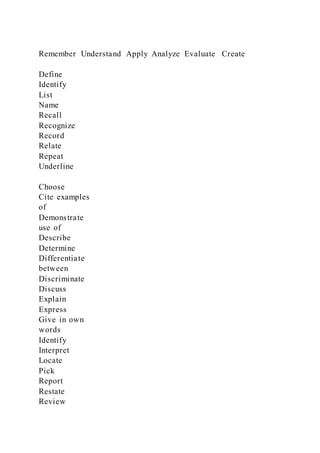
Remember Understand Apply Analyze Evaluate Create
Define
Identify
List
Name
Recall
Recognize
Record
Relate
Repeat
Underline
Choose
Cite examples
of
Demonstrate
use of
Describe
Determine
Differentiate
between
Discriminate
Discuss
Explain
Express
Give in own
words
Identify
Interpret
Locate
Pick
Report
Restate
Review
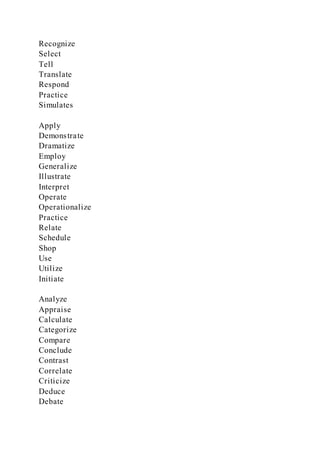
Recognize
Select
Tell
Translate
Respond
Practice
Simulates
Apply
Demonstrate
Dramatize
Employ
Generalize
Illustrate
Interpret
Operate
Operationalize
Practice
Relate
Schedule
Shop
Use
Utilize
Initiate
Analyze
Appraise
Calculate
Categorize
Compare
Conclude
Contrast
Correlate
Criticize
Deduce
Debate
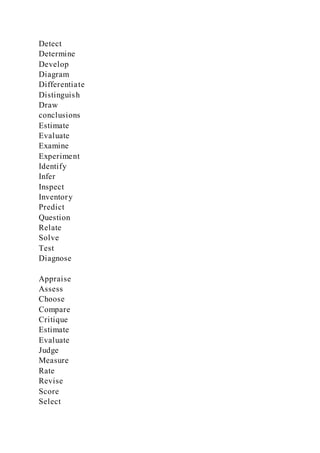
Detect
Determine
Develop
Diagram
Differentiate
Distinguish
Draw
conclusions
Estimate
Evaluate
Examine
Experiment
Identify
Infer
Inspect
Inventory
Predict
Question
Relate
Solve
Test
Diagnose
Appraise
Assess
Choose
Compare
Critique
Estimate
Evaluate
Judge
Measure
Rate
Revise
Score
Select
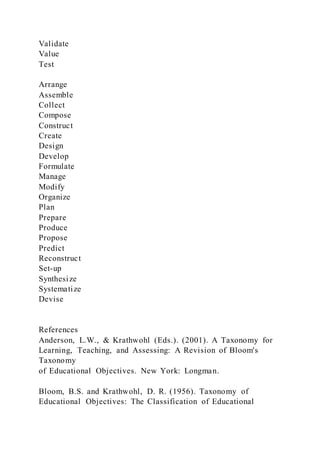
Validate
Value
Test
Arrange
Assemble
Collect
Compose
Construct
Create
Design
Develop
Formulate
Manage
Modify
Organize
Plan
Prepare
Produce
Propose
Predict
Reconstruct
Set-up
Synthesize
Systematize
Devise
References
Anderson, L.W., & Krathwohl (Eds.). (2001). A Taxonomy for
Learning, Teaching, and Assessing: A Revision of Bloom's
Taxonomy
of Educational Objectives. New York: Longman.
Bloom, B.S. and Krathwohl, D. R. (1956). Taxonomy of
Educational Objectives: The Classification of Educational
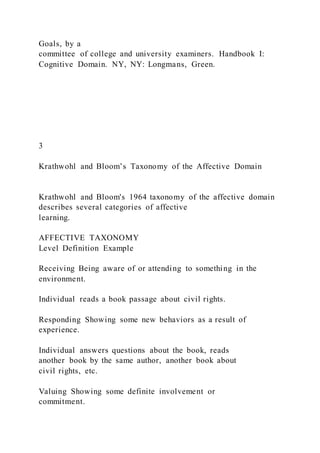
Goals, by a
committee of college and university examiners. Handbook I:
Cognitive Domain. NY, NY: Longmans, Green.
3
Krathwohl and Bloom’s Taxonomy of the Affective Domain
Krathwohl and Bloom's 1964 taxonomy of the affective domain
describes several categories of affective
learning.
AFFECTIVE TAXONOMY
Level Definition Example
Receiving Being aware of or attending to something in the
environment.
Individual reads a book passage about civil rights.
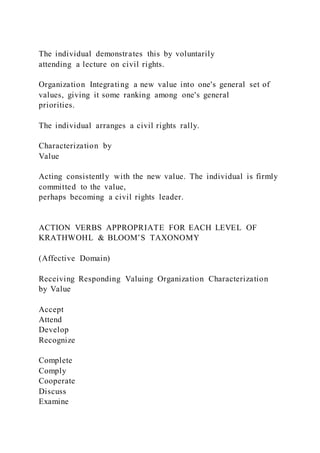
Responding Showing some new behaviors as a result of
experience.
Individual answers questions about the book, reads
another book by the same author, another book about
civil rights, etc.
Valuing Showing some definite involvement or
commitment.
The individual demonstrates this by voluntarily
attending a lecture on civil rights.
Organization Integrating a new value into one's general set of
values, giving it some ranking among one's general
priorities.
The individual arranges a civil rights rally.
Characterization by
Value
Acting consistently with the new value. The individual is firmly
committed to the value,
perhaps becoming a civil rights leader.
ACTION VERBS APPROPRIATE FOR EACH LEVEL OF
KRATHWOHL & BLOOM’S TAXONOMY
(Affective Domain)
Receiving Responding Valuing Organization Characterization
by Value
Accept
Attend
Develop
Recognize
Complete
Comply
Cooperate
Discuss
Examine
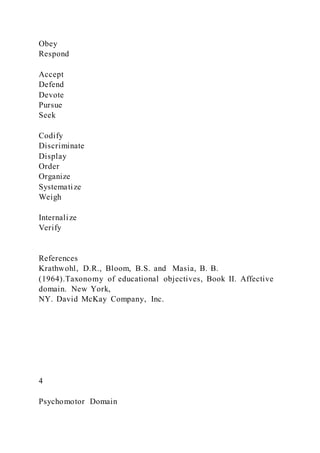
Obey
Respond
Accept
Defend
Devote
Pursue
Seek
Codify
Discriminate
Display
Order
Organize
Systematize
Weigh
Internalize
Verify
References
Krathwohl, D.R., Bloom, B.S. and Masia, B. B.
(1964).Taxonomy of educational objectives, Book II. Affective
domain. New York,
NY. David McKay Company, Inc.
4
Psychomotor Domain
The following is a synthesis of the taxonomies of Simpson
(1972), Dave (1970), and Harrow (1972).
PSYCHOMOTOR TAXONOMY
Level Definition Example
Observing Active mental attending of a physical event. The
learner watches a more experienced person. Other
mental activity, such as reading may be a pert of the
observation process.
Imitating Attempted copying of a physical behavior. The first
steps in learning a skill. The learner is
observed and given direction and feedback on
performance. Movement is not automatic or smooth.
Practicing Trying a specific physical activity over and over. The
skill is repeated over and over. The entire sequence
is performed repeatedly. Movement is moving towards
becoming automatic and smooth.
Adapting Fine tuning. Making minor adjustments in the
physical activity in order to perfect it.
The skill is perfected. A mentor or a coach is often
needed to provide an outside perspective on how to
improve or adjust as needed for the situation.
ACTION VERBS APPROPRIATE FOR
THE PSYCHOMOTOR TAXONOMY
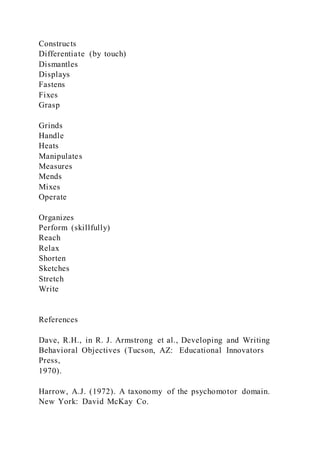
Bend
Calibrates
Constructs
Differentiate (by touch)
Dismantles
Displays
Fastens
Fixes
Grasp
Grinds
Handle
Heats
Manipulates
Measures
Mends
Mixes
Operate
Organizes
Perform (skillfully)
Reach
Relax
Shorten
Sketches
Stretch
Write
References
Dave, R.H., in R. J. Armstrong et al., Developing and Writing
Behavioral Objectives (Tucson, AZ: Educational Innovators
Press,
1970).
Harrow, A.J. (1972). A taxonomy of the psychomotor domain.
New York: David McKay Co.
Simpson, E. (1972). The classification of educational objectives
in the psychomotor domain: The psychomotor domain. Vol. 3.
Washington, DC: Gryphon House.
Brett Bixler
Attribution-NonCommercial-ShareAlike
CC BY-NC-SA
EDCO 725
Higher Order Thinking Skills Grading Rubric
Criteria
Levels of Achievement
Content
Advanced
Proficient
Developing
Below Expectations
Not present
Content
81 to 88 Points
Superbly includes assignment parameters with adequate support
from class content.
74 to 80 Points
Adequately includes assignment parameters with adequate
support from class content.
67 to 73 Points
Includes most assignment parameters with some support from
class content. Depth of content is marginal at the doctoral level
of study.
1 to 66 Points
Assignment demonstrated deficits at the doctoral level of study
0 points
Not Present
Structure
Advanced
Proficient
Developing
Below Expectations
Not present
Writing, Formatting, and Citation
34 to 37 Points
Student writing is exceptionally clear, persuasive and error free.
Ideas are fully supported and correctly cited using current APA
formatting.
31 to 33 Points
Ideas are adequately presented; sentences are correctly
constructed, and paragraphs are organized consistently with
doctoral level writing.
Writing is largely free of grammar, punctuation, and other
writing errors.
Contains any appropriate citations and APA formatting.
28 to 30 Points
Student’s writing deviates from the requirements in the
“proficient” column in several ways.
1 to 27 Points
Student’s writing deviates from the requirements in the
“proficient” column in numerous ways.
0 points
Not Present
Skip to Main Content
OnlineResidentialAthleticsAlumniParents
EducationLiberty UniversityLiberty University OnlineSchool of
DivinitySchool of LawOsteopathic MedicineResident Undergrad
AdmissionsLiberty Online AcademyResident Graduate
AdmissionsLiberty Christian AcademyWillmington School of
the BibleMilitary Affairs
AthleticsLiberty FlamesFlames FootballFlames Basketball -
MenFlames Basketball - WomenClub SportsCampus
RecreationIntramural Sports
EventsCollege For A
WeekendCommencementConcertsHomecomingOnline Student
LifeScaremare
MediaLiberty JournalLiberty NewsThe Journey FM90.9 The
LightLiberty ChampionSelah YearbookStreaming MediaCampus
MapsLUVotesYou Are Using an Outdated Browser
Some enhanced features will not work with your current web
browser. Use a modern browser for a better and more secure
experience.
Need Assistance? More Information. HelpDesk: (866) 447-
2869.See Your Choices
×
Tanya Williams
L30557637Edit ProfileChange PasswordSign Out
Tab for direct access to your apps or press enter then tab to
access apps and set favorites.
Announcements
LU AlertPlanned Banner and JAMS Upgrade(4/24-4/25)BuyLU
Scheduled Downtime (4/9 - 4/11)Wireless Network Connection
Issues (4/2)Mac OSX VPN Issue (4/1)Beware the Latest
Phishing Scams (3/19)
LU Official AnnouncementFlags at Half-StaffScheduled Power
Outage (5/22)View the Spring 2021 Final Exam Schedule
Show More
StudentsIT Jobs That Pay For Your SchoolingJFL Easter
HoursLU 245 One-Five Express Easter HoursShare, Create, and
Collaborate with the Collab HubDropbox is Now Available for
Students! All users must re-connect to Liberty Wi-Fi
Campus Events4/17 - Drive-In Movie: Jurassic Park4/13 - Open
Mic4/24 - Yard Sale4/6 - Job FairSA Workshop Series4/9 -
Rhett Walker feat. Madison Laine Coker5/1 - John Mark
McMillan feat. John Mark PantanamyLUNew myLUAlumni
ChaptersACAlumni ChaptersAlumni ReferralARAlumni
ReferralASISTApply, register, view transcripts and grades,
check Financial Aid, complete Financial Check-In, update
contact information and choose housing and dining
options.BlackboardYour online classroom - view assignments,
syllabus and grades, access discussion boards and instructor
profiles.Campus RecCRCampus RecCanvasCAccess to
CanvasCFAWCCFAWCourse RegistrationRegister for
coursesEmailAnytime/anywhere access to your Liberty email
account via web browser.Financial Check-inAccess to FCI -
prod Flames PassAccess to Flames Pass infoIT
HelpDeskTechnical help on campus or by phone for issues such
as connectivity, e-mail, printing, applications and telephony,
get educational discounts on hardware and software.IT
MarketplaceLiberty University now offers one convenient
source to help you get the technology that you need for your
education: The IT Marketplace! Jump Forwardaccess to jump
forwardLibraryAccess thousands of books, journals and
periodicals on campus or online - take advantage of student
computers, lounges, study rooms, a cafe and vending
machines.Master App PortalMAMaster App
PortalMyCoursesMAccess to CanvasOfficesO60 offices,
providing academic, administrative, technical and spiritual
support.On Demand RidesODAccess to Quick RidesOnline
Student LifeOSOnline Student LifePharos Print DetailAccess to
your Pharos account.RecyclingRAccess to RecyclingSpeak
Up!SUAccess Speak Up!Spiritual LifeSLSpiritual LifeStudent
ActivitiesSAStudent ActivitesStudent ChecklistSCTrack your
progress on the new Student ChecklistTicketsAthletics and
Concert Tickets TravelTTravel!You need to have JavaScript
enabled in order to access this site.
Dashboard
Dashboard
EDCO725_D01_202120
Read: Active learning Strategies to Promote Critical
Thinking
Skip To Content
Dashboard
Account
Dashboard
Courses
Calendar
Inbox
History
Resources
Close
Higher Order Thinking Skills Question Templates
Recall
Note: Any question becomes a recall
question if the answer has already
been explicitly provided to the student
in class or in the text.
When did ________ take place?
List the ________ .
Define the term ________.
What is a ________?
Who did ________?
Name ________.
Analysis
How does ________ work?
Sort these ________ .
Use the table to determine ________ .
Use the graph to determine ________ .
Graph ________ .
What caused ________ ?
What is another possible cause of ________ ?
Outline the ________ .
Based on the written description, draw a
diagram.
Draw your own map of ________ without
tracing or copying.
Use the map to determine ________ .
In what sequence did ________ happen?
Break ________ down into its component
parts.
Give an example of ________ .
What literary form is being used?
What technique is being used?
What information is needed?
Is the information relevant?
Into what groups can you organize these?
Draw a picture that illustrates what's described
in the story ________ .
What does ________ symbolize?
Find examples of [a literary device] in your
readings.
Analyze the ________ in ________ .
Classify these ________ according to
________ .
Separate the ________ from the ________ .
Translate ________ .
Analyze how ________ .
Explain how ________ works.
What was the author's point of view?
How did the author convey ________ ?
What words does the author use to paint an
image of ________ in your mind?
How were ________ used to ________ ?
What kind of a ________ is this?
Which one doesn't belong in this group?
What is the function of ________ ?
What is the purpose of ________ ?
What is the relationship between ________
and ________ ?
What is the pattern?
Use manipulatives to illustrate a concept.
Build a model of ________ .
Measure ________ .
Comparison
How is ________ like ________ ?
How are ________ and ________ different?
Compare the ________ before and after
________ .
Compare the character ________ at the
beginning of the story and at the end.
Distinguish between ________ and
________ .
Compare ________ with ________ .
On what dimensions might you compare
________ and ________ ?
Which one is the biggest/oldest/tallest?
Inference
Hypothesize what will happen if ________ .
Predict what will happen if ________ .
Apply the rule to ________ .
Solve the problem ________ .
Predict how the story ________ will end.
What is the main idea of the story ________ ?
What is the overall theme of ________ ?
What is the moral of the story?
Develop of plan to ________ .
Propose and describe an invention that fills
some need.
Write a research paper on ________ .
Based on your readings, what can you
conclude about ________ ?
What was the author's point of view?
Solve a logic puzzle.
What if ________ ?
What rule applies here?
What generalization can you make from this
information?
Create a ________ .
Design a ________ .
Propose a solution to the problem of _______
.
Evaluation
Was ________ worth the costs? Explain your
answer.
Was the argument convincing? What makes
you think so?
Did ________ behave appropriately? Why?
What would you have done in this situation?
Why?
Write a critique of ________ .
Was this experiment well designed? Defend
your answer.
Judge which is the best solution to the
problem of ________ ? Why do you think so?
How well are the conclusions supported by the
data/ facts/evidence? Explain.
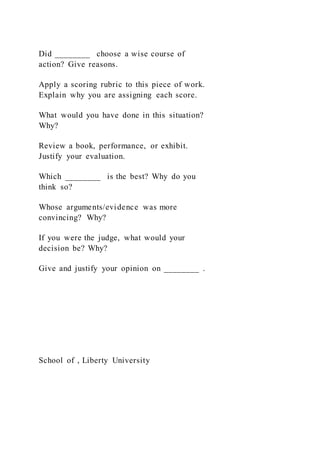
Did ________ choose a wise course of
action? Give reasons.
Apply a scoring rubric to this piece of work.
Explain why you are assigning each score.
What would you have done in this situation?
Why?
Review a book, performance, or exhibit.
Justify your evaluation.
Which ________ is the best? Why do you
think so?
Whose arguments/evidence was more
convincing? Why?
If you were the judge, what would your
decision be? Why?
Give and justify your opinion on ________ .
School of , Liberty University
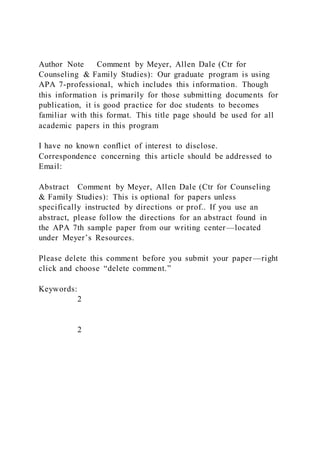
Author Note Comment by Meyer, Allen Dale (Ctr for
Counseling & Family Studies): Our graduate program is using
APA 7-professional, which includes this information. Though
this information is primarily for those submitting documents for
publication, it is good practice for doc students to becomes
familiar with this format. This title page should be used for all
academic papers in this program
I have no known conflict of interest to disclose.
Correspondence concerning this article should be addressed to
Email:
Abstract Comment by Meyer, Allen Dale (Ctr for Counseling
& Family Studies): This is optional for papers unless
specifically instructed by directions or prof.. If you use an
abstract, please follow the directions for an abstract found in
the APA 7th sample paper from our writing center—located
under Meyer’s Resources.
Please delete this comment before you submit your paper—right
click and choose “delete comment.”
Keywords:
2
2
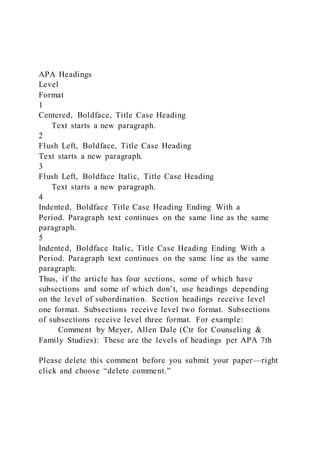
APA Headings
Level
Format
1
Centered, Boldface, Title Case Heading
Text starts a new paragraph.
2
Flush Left, Boldface, Title Case Heading
Text starts a new paragraph.
3
Flush Left, Boldface Italic, Title Case Heading
Text starts a new paragraph.
4
Indented, Boldface Title Case Heading Ending With a
Period. Paragraph text continues on the same line as the same
paragraph.
5
Indented, Boldface Italic, Title Case Heading Ending With a
Period. Paragraph text continues on the same line as the same
paragraph.
Thus, if the article has four sections, some of which have
subsections and some of which don’t, use headings depending
on the level of subordination. Section headings receive level
one format. Subsections receive level two format. Subsections
of subsections receive level three format. For example:
Comment by Meyer, Allen Dale (Ctr for Counseling &
Family Studies): These are the levels of headings per APA 7th
Please delete this comment before you submit your paper—right
click and choose “delete comment.”
References
Svinicki, M., McKeachie, W. (2014, 14th or later edition).
McKeachie's teaching tips:
Strategies, research, and theory for college and university
teachers. Cengage Learning.

Cognitive Behavioral Therapy (CBT) Case Formulation Activi

  • 1.
    Cognitive Behavioral Therapy(CBT) Case Formulation Activity Student School of Behavior Sciences, Liberty University Author Note Student I have no known conflict of interest to disclose. Correspondence concerning this article should be addressed to Student Email: [email protected] Abstract This paper consists of a teaching activity that incorporates higher order thinking skills (HOTS) associated with the revisions of Bloom’s taxonomy made by Anderson and Krathwohl. The teaching activity revolves around the development process of a Cognitive Behavioral Therapy (CBT) case formulation. Additionally, the active learning strategies implemented within this lesson’s activity are as follows: (1) group work that revolve around a provided case analysis, (2) discussion techniques that involve penetrating questions, and (3) think-pair-share. 2 CBT CASE FORMULATION ACTIVITY 2
  • 2.
    Keywords: teaching activity,learning activity, Bloom’s taxonomy, Cognitive Behavioral Therapy, CBT, case formulation, active learning strategies, case analysis, discussions, think-pair-share Cognitive Behavioral Therapy (CBT) Case Formulation Activity Every person in this world learns through their experiences. In general, experiences affect people’s thoughts and actions, and sometimes they can provide meaning to an individual’s life. Consequently, when people are placed in situations where they have to learn new things, these insights should be of value to them. In relation to this notion, Merriam et al. (2007) clearly stated that “learners must connect what they have learned from current experiences to those in the past as well as see possible future implications” (p. 162). This connection of learning must also be placed within an educational setting where adults are the students. Therefore, this paper focuses on how incorporating higher order thinking skills (HOTS) to a lesson activity in a graduate course is essential for adults to learn with meaningful insights. Svinicki and McKeachie (2014) stated that in order for adult students to sharpen their thought process, they need to develop habits of reflection. These habits of reflections are based off experiences, successes and failures, plans and purposes, along with choices and consequences (Svinicki & McKeachie, 2014, p. 318). Consequently, when adult students develop these habits, their ability to engage in learning activities within a classroom setting can result to positive and meaningful learning outcomes relative to HOTS. Furthermore, this paper explores the development of a graduate level teaching activity that consists of learning objectives pertaining to two highest levels
  • 3.
    of thought fromBloom’s taxonomy. Process of Development for a Learning Activity Just like any educational setting, the first day is usually when the teacher or instructor sets the tone to establish the classroom’s environment. This is also when the teacher or instructor goes over his or her expectations of student performances that are dependent upon the level of education that he or she is assigned to teach. However, in a college classroom environment, Brookfield (2013) expressed how teachers should exercise authority by communicating with their students in a clear and transparent way (p. 25). So, for a graduate level of education, the first day of class is usually when the instructor goes over his or her syllabus that contains information about the course’s content, student learning objectives, course calendar, student tasks or assignments, etc. Therefore, this results to adult students having an idea of the direction that the course will take, along with what is clearly expected of them from their instructor. Course Preparation for Teachers Before the first day of a graduate level class, Svinicki and McKeachie (2014) explained how the initial step for instructors to take is to prepare student learning goals that are expressed by the course objectives (p. 6). The reason for this is because when teachers or instructors write their student learning goals down, it assists them in clearly describing what the expected student learning outcomes are within the course. Consequently, these goals will also help teachers or instructors determine what they need to do for the course (Svinicki & McKeachie, 2014). Teacher Groundwork As the graduate course progresses within its term, teaching techniques should have been implemented by the teacher or instructor. Once students experience these teaching techniques, they familiarize themselves with possible future steps in which their instructor plans on taking. However, before an instructor can move the class forward, he or she must design a sequence of exercises that enables him or her to judge when students are
  • 4.
    prepared to moveon within the course (Brookfield, 2013, p. 37). So, for the learning activity within this paper, the teacher must ensure that students are provided with the necessary resources such as assigned textbook readings and online resources relative to the course’s content. These resources will prepare the students for the anticipated learning activity that will be described in the upcoming sections of this paper. The Teaching Activity The topic of this paper’s teaching activity focuses on students developing a Cognitive Behavioral Therapy (CBT) case formulation for a couple who is seeking therapy. Of course, prior to this activity, students already have background knowledge about CBT through their previous reading assignments and provided resources from the instructor. So, once students are ready to move forward with the course’s content, the teaching activity will take the direction of a problem-based learning approach. Svinicki and McKeachie (2014) explained how this approach enables the instructor to provide students with a snippet of a selected scenario and some material that students can use to solve a given issue (p. 207). Therefore, the selected scenario for this activity is based off a case study of a couple seeking therapy. It should take at least five minutes for the class to read this case study provided by Dr. Michael Regev, a registered marriage and family therapist: John and Susan have been married for 7 years. They have two children, aged 5 and 3. John is a computer technician and Susan has been a homemaker since the birth of their first child. They live in a nice neighbourhood in one of the suburbs of a big city in Canada. John and Susan were introduced to each other in college. They fell in love immediately and after dating for about four months, moved in together. They got married a year later. John liked Susan’s openness and sensitivity. He used to describe her as a “free spirit”, someone who could do the wildest thing on a whim. He loved her spontaneity and genuineness. Susan admired John’s brain and the way he made her laugh. She felt
  • 5.
    safe with himand believed he was very dependable. In the beginning of their relationship they got along really well and were very happy. The first time they both started feeling that the relationship was not working well was after the birth of their first child. Initially, both wanted to have a baby and both were thrilled when their first daughter, Charlotte, was born. However, in the months following the birth they started arguing a lot about small things. Soon after, they started blaming one another for various things. Susan blamed John for not taking on a fair share of the baby’s care and house chores, and John blamed Susan for criticizing him and for always nagging him about “stupid little things”. Things had gotten so bad that they started thinking about separating. However, they still wanted to give it a try and in an attempt to mend things, they went away on a holiday, only to discover a couple of weeks after their return that Susan was pregnant again. At first they were both overwhelmed by the news, but then they talked it through and agreed that it had probably been a sign that they should stick together and raise their family. The next few months went fairly well. Susan felt that John was taking care of her and making sure she was comfortable and safe. Susan was mostly in a good mood and tried to minimize her requests from John. Things were looking up. However, shortly after the birth of their son, Sean, they started fighting again. The tension in the house was getting worse every day. They were both very tired and drained. Susan was feeling overwhelmed with taking care of two children and she felt abandoned by John. She started begging him to come home early, or not to go to work at all. For his part, John was working more hours than ever. He often missed dinner and when he did not, he would often say he was exhausted and go to bed immediately after dinner. The bitterness and anger in the relationship grew more and more until John told Susan one day that he had rented an apartment, and was moving out. Susan was devastated. Even though she was very unhappy in the
  • 6.
    relationship, she didnot expect that John would leave her. She was desperate and begged him to reconsider. They came to therapy as a “last resort”. (Regev, n.d.) This case study will serve as information that was acquired through the couple’s intake process prior to their initial session. However, before students engage in the activity, the instructor will present an Extended Case Formulation Worksheet guide created by Ackerman (2020) and was obtained from the Positive Psychology website. The instructor will explain to the students how Ackerman (2020) created this guide with instructions on how to complete its Part A and Part B. This explanation should take no more than five minutes of class time. Additionally, for the sake of instructional guidance, the whole class will complete Part A together through a class discussion. This particular task should take no more than 20 minutes. Afterwards, the teaching activity can finally take place where students experience two highest levels of thought processes. Critical Thought Levels of the Teaching Activity In a college setting, depending on the course level, Svinicki and McKeachie (2014) indicated that learning goals “can be pitched at several different depths of complexity” (p. 10). However, in terms of this paper’s teaching activity, these depths of complexity reflect the levels of objectives within the revision of Bloom’s taxonomy made by Anderson and Krathwohl (Svinicki & McKeachie, 2014). Therefore, this paper’s teaching activity require students to use various types of HOTS to analyze and evaluate. Analyze The first highest level of thought within this paper’s teaching activity is to analyze or “subdivide content into meaningful parts and relate the parts” by differentiating, organizing, or attributing (Svinicki & McKeachie, 2014, p. 311). The learning objective for this level of thought is as follows: As a group, given Part B of the CBT case formulation guide, students will be able to categorize information provided by the case study of a couple seeking therapy through
  • 7.
    collaboration. What thismeans is that the whole class will be broken up into three groups. Within their assigned group, the activity requires students to participate in collaborating with each other to fulfill this learning objective. With the use of the Extended Case Formulation Worksheet provided by Ackerman (2020), students are guided throughout their collaboration process in categorizing the information needed to complete Part B. Consequently, this activity implements the use of discussion. Svinicki and McKeachie (2014) suggested that one stimulation for discussion can start with questions (p. 42). So, prior to breaking the class up into three groups, the instructor should ask the following penetrating question to initiate the activity’s discussion portion: How does John and Susan’s automatic thoughts of their relationship problem differ from one another? Afterwards, students can begin go partake in the learning activity as a group taking no more than 25 minutes. The Effect of Group Work Learning Activity Throughout this learning activity, students can build on presented ideas together as a group. However, as students collaborate in order to categorize information within the provided case study, their perspectives towards the issue can be similar or different. Svinicki and McKeachie (2014) discussed how this type of situation can be positively guided through a cooperative discussion method (p. 53). Therefore, in the event that student perspectives differ during the case discussion, they can take turns in understanding each other’s point of view. When this occurs, students are still analyzing content by relating these newly presented ideas towards their own perceptions of the case study. Additionally, these differences allow students to gain a better understanding of how analyzing ideas, apart from their own, can positively impact their thought process. At this course level, students are expected to have grasp the main concept of applying the CBT approach to the provided case study. However, the most significant student impact of
  • 8.
    learning during thisactivity lies within the information that has been gathered through each group’s collaboration process. Once students analyze their group’s obtained information from the case study, they are able to categorize them onto Part B of the case formulation worksheet guide. When this is done, students gain a better understanding of why a CBT case formulation is crucial to the development of a treatment process of a couple seeking therapy. Furthermore, this then entails that the learning objective for this highest level of thought, analyze, has been fulfilled. Evaluate The second highest level of thought within this paper’s teaching activity is to evaluate or come “to a conclusion about something based on standards/criteria” by checking, critiquing, or judging (Svinicki & McKeachie, 2014, p. 311). The learning objective for this level of thought is as follows: Through presentations, followed by a think-pair-share activity, students will be able to compare similarities and differences among the answers provided within Part B of the CBT case formulation guide with others. What this means is that each group is required to present Part B of their completed CBT case formulation worksheet and it should take at least 20 minutes of class time. Based on the activity’s criteria of having students present what their group came up with, it exposes information that could either be similar or different from another group’s conclusion. This process enables students, in all three groups, to prepare for the anticipated discussion that will allow them to compare their answers to another. However, before the discussion begins, the instructor should ask students to reflect on the following questions: 1. Among all three group’s presentations for Part B of the case formulation guide, was there any type of information provided that differed from the answers that your group came up? 2. Relative to the CBT approach, which information seemed most common among all three group’s presentation that will
  • 9.
    significantly impact thecreation of John and Susan’s treatment plan? Students should be given at least two minutes to reflect on these questions so that they are able to share their thoughts through the active learning strategy of think-pair-share. Think-Pair-Share Once students gather their thoughts, they can begin to engage in a discussion with a neighboring seated individual. Svinicki and McKeachie (2014) expressed how the active learning strategy of think-pair-share does not take much of class time (p. 196). Therefore, this activity should take at least five minutes. Svinicki and McKeachie (2014) also pointed out that through the think-pair-share activity, students begin to engage in a discussion by comparing their responses. If a disagreement occurs, students can go through the process of trying to compromise how to please both sides. However, during this process, it is the teacher’s job to listen and guide students when needed so that they can become problem solvers (Svinicki & McKeachie, 2014). Once this activity is completed, before student are dismissed, the teacher can request for them to write a short reflection. This reflection can be about how this learning activity impacted the way students understood the content that has been learned. These student reflections can be briefly explored during the beginning of the next class session. Conclusion This paper’s teaching activity concludes that students learn better when they interact with each other. This notion is supported by Svinicki and McKeachie (2014) as they stated that one of the “best methods of gaining clearer, long-lasting understanding” is by having someone else explain the topic to another (p. 201). Additionall y, through this process, students are also able to activate critical thought levels that are associated with the revision of Bloom’s taxonomy created by Anderson and Krathwohl. The ultimate goal of this teaching activity is to incorporate various HOTS so that adult students can experience the process of learning the course content in a
  • 10.
    valuable way. References Ackerman, C.E. (2020). Extended case formulation worksheet. Positive Psychology. https://positivepsychology.com/wp- content/uploads/2020/09/Extended-Case-Formulation- Worksheet.pdf Brookfield, S. D. (2013). Powerful techniques for teaching adults. John Wiley & Sons, Inc. Merriam, S. B., Caffarella, R. S., & Baumgartner, L. M. (2007). Learning in adulthood: A comprehensive guide (3rd ed.). John Wiley & Sons, Inc. Regev, M. (n.d.). Couples counseling – case example. Dr. Regev. https://drregev.com/counselling/couples-therapy/case-example/ Svinicki, M., McKeachie, W. (2014, 14th or later edition). McKeachie's teaching tips: Strategies, research, and theory for college and university teachers. Cengage Learning. 1 The ABCDs of Writing Instructional Objectives The ABCD method of writing objectives is an excellent way to structure instructional objectives. In this method, "A" is for audience, "B" is for behavior, "C" for conditions and "D" is for degree of mastery needed. Example: -"Given a sentence written in the past or present tense, the student will be able to re-write the
  • 11.
    sentence in futuretense with no errors in tense or tense contradiction (i.e., I will see her yesterday.)." The key here is to use verbs that indicate a clearly observable and measurable action. Appropriate action verbs for the cognitive, affective, and psychomotor domains are listed below. Bloom's Taxonomy of the Cognitive Domain Bloom's taxonomy of cognitive learning, originated by Benjamin Bloom and collaborators in the 1950's, describes several categories of cognitive learning. ORIGINAL BLOOM COGNITIVE TAXONOMY Category Description Knowledge Ability to recall previously learned material. Comprehension Ability to grasp meaning, explain, restate ideas. Application Ability to use learned material in new situations. Analysis Ability to separate material into component parts and show relationships between parts. Synthesis Ability to put together the separate ideas to form new whole, establish new relationships. Evaluation Ability to judge the worth of material against stated criteria. This taxonomy was revised in 2001 by Anderson and Krathwohl to change the category names from nouns to verbs, and to switch the Evaluation and Synthesis levels in the hierarchy.
  • 12.
    REVISED ANDERSON ANDKRATHWOHL COGNITIVE TAXONOMY Category Description Remember Ability to recall previously learned material. Understand Ability to grasp meaning, explain, restate ideas. Apply Ability to use learned material in new situations. Analyze Ability to separate material into component parts and show relationships between parts. Evaluate Ability to judge the worth of material against stated criteria. Create Ability to put together the separate ideas to form new whole, establish new relationships. Many people also call the analysis, synthesis/create, and evaluation categories “problem solving.” From: http://www.personal.psu.edu/bxb11/Objectives/ActionVerbsfor Objectives.pdf 2 ACTION VERBS APPROPRIATE FOR EACH LEVEL OF BLOOM’S/ANDERSON & KRATHWOHL’S TAXONOMY (Cognitive Domain)
  • 13.
    Remember Understand ApplyAnalyze Evaluate Create Define Identify List Name Recall Recognize Record Relate Repeat Underline Choose Cite examples of Demonstrate use of Describe Determine Differentiate between Discriminate Discuss Explain Express Give in own words Identify Interpret Locate Pick Report Restate Review
  • 14.
  • 15.
  • 16.
    Validate Value Test Arrange Assemble Collect Compose Construct Create Design Develop Formulate Manage Modify Organize Plan Prepare Produce Propose Predict Reconstruct Set-up Synthesize Systematize Devise References Anderson, L.W., &Krathwohl (Eds.). (2001). A Taxonomy for Learning, Teaching, and Assessing: A Revision of Bloom's Taxonomy of Educational Objectives. New York: Longman. Bloom, B.S. and Krathwohl, D. R. (1956). Taxonomy of Educational Objectives: The Classification of Educational
  • 17.
    Goals, by a committeeof college and university examiners. Handbook I: Cognitive Domain. NY, NY: Longmans, Green. 3 Krathwohl and Bloom’s Taxonomy of the Affective Domain Krathwohl and Bloom's 1964 taxonomy of the affective domain describes several categories of affective learning. AFFECTIVE TAXONOMY Level Definition Example Receiving Being aware of or attending to something in the environment. Individual reads a book passage about civil rights. Responding Showing some new behaviors as a result of experience. Individual answers questions about the book, reads another book by the same author, another book about civil rights, etc. Valuing Showing some definite involvement or commitment.
  • 18.
    The individual demonstratesthis by voluntarily attending a lecture on civil rights. Organization Integrating a new value into one's general set of values, giving it some ranking among one's general priorities. The individual arranges a civil rights rally. Characterization by Value Acting consistently with the new value. The individual is firmly committed to the value, perhaps becoming a civil rights leader. ACTION VERBS APPROPRIATE FOR EACH LEVEL OF KRATHWOHL & BLOOM’S TAXONOMY (Affective Domain) Receiving Responding Valuing Organization Characterization by Value Accept Attend Develop Recognize Complete Comply Cooperate Discuss Examine
  • 19.
    Obey Respond Accept Defend Devote Pursue Seek Codify Discriminate Display Order Organize Systematize Weigh Internalize Verify References Krathwohl, D.R., Bloom,B.S. and Masia, B. B. (1964).Taxonomy of educational objectives, Book II. Affective domain. New York, NY. David McKay Company, Inc. 4 Psychomotor Domain
  • 20.
    The following isa synthesis of the taxonomies of Simpson (1972), Dave (1970), and Harrow (1972). PSYCHOMOTOR TAXONOMY Level Definition Example Observing Active mental attending of a physical event. The learner watches a more experienced person. Other mental activity, such as reading may be a pert of the observation process. Imitating Attempted copying of a physical behavior. The first steps in learning a skill. The learner is observed and given direction and feedback on performance. Movement is not automatic or smooth. Practicing Trying a specific physical activity over and over. The skill is repeated over and over. The entire sequence is performed repeatedly. Movement is moving towards becoming automatic and smooth. Adapting Fine tuning. Making minor adjustments in the physical activity in order to perfect it. The skill is perfected. A mentor or a coach is often needed to provide an outside perspective on how to improve or adjust as needed for the situation. ACTION VERBS APPROPRIATE FOR THE PSYCHOMOTOR TAXONOMY Bend Calibrates
  • 21.
    Constructs Differentiate (by touch) Dismantles Displays Fastens Fixes Grasp Grinds Handle Heats Manipulates Measures Mends Mixes Operate Organizes Perform(skillfully) Reach Relax Shorten Sketches Stretch Write References Dave, R.H., in R. J. Armstrong et al., Developing and Writing Behavioral Objectives (Tucson, AZ: Educational Innovators Press, 1970). Harrow, A.J. (1972). A taxonomy of the psychomotor domain. New York: David McKay Co.
  • 22.
    Simpson, E. (1972).The classification of educational objectives in the psychomotor domain: The psychomotor domain. Vol. 3. Washington, DC: Gryphon House. Brett Bixler Attribution-NonCommercial-ShareAlike CC BY-NC-SA EDCO 725 Higher Order Thinking Skills Grading Rubric Criteria Levels of Achievement Content Advanced Proficient Developing Below Expectations Not present Content 81 to 88 Points Superbly includes assignment parameters with adequate support from class content. 74 to 80 Points Adequately includes assignment parameters with adequate support from class content. 67 to 73 Points Includes most assignment parameters with some support from class content. Depth of content is marginal at the doctoral level
  • 23.
    of study. 1 to66 Points Assignment demonstrated deficits at the doctoral level of study 0 points Not Present Structure Advanced Proficient Developing Below Expectations Not present Writing, Formatting, and Citation 34 to 37 Points Student writing is exceptionally clear, persuasive and error free. Ideas are fully supported and correctly cited using current APA formatting. 31 to 33 Points Ideas are adequately presented; sentences are correctly constructed, and paragraphs are organized consistently with doctoral level writing. Writing is largely free of grammar, punctuation, and other writing errors. Contains any appropriate citations and APA formatting. 28 to 30 Points Student’s writing deviates from the requirements in the “proficient” column in several ways. 1 to 27 Points Student’s writing deviates from the requirements in the “proficient” column in numerous ways. 0 points Not Present Skip to Main Content OnlineResidentialAthleticsAlumniParents
  • 24.
    EducationLiberty UniversityLiberty UniversityOnlineSchool of DivinitySchool of LawOsteopathic MedicineResident Undergrad AdmissionsLiberty Online AcademyResident Graduate AdmissionsLiberty Christian AcademyWillmington School of the BibleMilitary Affairs AthleticsLiberty FlamesFlames FootballFlames Basketball - MenFlames Basketball - WomenClub SportsCampus RecreationIntramural Sports EventsCollege For A WeekendCommencementConcertsHomecomingOnline Student LifeScaremare MediaLiberty JournalLiberty NewsThe Journey FM90.9 The LightLiberty ChampionSelah YearbookStreaming MediaCampus MapsLUVotesYou Are Using an Outdated Browser Some enhanced features will not work with your current web browser. Use a modern browser for a better and more secure experience. Need Assistance? More Information. HelpDesk: (866) 447- 2869.See Your Choices × Tanya Williams L30557637Edit ProfileChange PasswordSign Out Tab for direct access to your apps or press enter then tab to access apps and set favorites. Announcements LU AlertPlanned Banner and JAMS Upgrade(4/24-4/25)BuyLU Scheduled Downtime (4/9 - 4/11)Wireless Network Connection Issues (4/2)Mac OSX VPN Issue (4/1)Beware the Latest
  • 25.
    Phishing Scams (3/19) LUOfficial AnnouncementFlags at Half-StaffScheduled Power Outage (5/22)View the Spring 2021 Final Exam Schedule Show More StudentsIT Jobs That Pay For Your SchoolingJFL Easter HoursLU 245 One-Five Express Easter HoursShare, Create, and Collaborate with the Collab HubDropbox is Now Available for Students! All users must re-connect to Liberty Wi-Fi Campus Events4/17 - Drive-In Movie: Jurassic Park4/13 - Open Mic4/24 - Yard Sale4/6 - Job FairSA Workshop Series4/9 - Rhett Walker feat. Madison Laine Coker5/1 - John Mark McMillan feat. John Mark PantanamyLUNew myLUAlumni ChaptersACAlumni ChaptersAlumni ReferralARAlumni ReferralASISTApply, register, view transcripts and grades, check Financial Aid, complete Financial Check-In, update contact information and choose housing and dining options.BlackboardYour online classroom - view assignments, syllabus and grades, access discussion boards and instructor profiles.Campus RecCRCampus RecCanvasCAccess to CanvasCFAWCCFAWCourse RegistrationRegister for coursesEmailAnytime/anywhere access to your Liberty email account via web browser.Financial Check-inAccess to FCI - prod Flames PassAccess to Flames Pass infoIT HelpDeskTechnical help on campus or by phone for issues such as connectivity, e-mail, printing, applications and telephony, get educational discounts on hardware and software.IT MarketplaceLiberty University now offers one convenient source to help you get the technology that you need for your education: The IT Marketplace! Jump Forwardaccess to jump forwardLibraryAccess thousands of books, journals and periodicals on campus or online - take advantage of student computers, lounges, study rooms, a cafe and vending
  • 26.
    machines.Master App PortalMAMasterApp PortalMyCoursesMAccess to CanvasOfficesO60 offices, providing academic, administrative, technical and spiritual support.On Demand RidesODAccess to Quick RidesOnline Student LifeOSOnline Student LifePharos Print DetailAccess to your Pharos account.RecyclingRAccess to RecyclingSpeak Up!SUAccess Speak Up!Spiritual LifeSLSpiritual LifeStudent ActivitiesSAStudent ActivitesStudent ChecklistSCTrack your progress on the new Student ChecklistTicketsAthletics and Concert Tickets TravelTTravel!You need to have JavaScript enabled in order to access this site. Dashboard Dashboard EDCO725_D01_202120 Read: Active learning Strategies to Promote Critical Thinking
  • 27.
  • 28.
  • 29.
    Resources Close Higher Order ThinkingSkills Question Templates Recall Note: Any question becomes a recall question if the answer has already been explicitly provided to the student in class or in the text. When did ________ take place? List the ________ . Define the term ________. What is a ________? Who did ________? Name ________. Analysis How does ________ work? Sort these ________ . Use the table to determine ________ .
  • 30.
    Use the graphto determine ________ . Graph ________ . What caused ________ ? What is another possible cause of ________ ? Outline the ________ . Based on the written description, draw a diagram. Draw your own map of ________ without tracing or copying. Use the map to determine ________ . In what sequence did ________ happen? Break ________ down into its component parts. Give an example of ________ . What literary form is being used? What technique is being used? What information is needed? Is the information relevant? Into what groups can you organize these?
  • 31.
    Draw a picturethat illustrates what's described in the story ________ . What does ________ symbolize? Find examples of [a literary device] in your readings. Analyze the ________ in ________ . Classify these ________ according to ________ . Separate the ________ from the ________ . Translate ________ . Analyze how ________ . Explain how ________ works. What was the author's point of view? How did the author convey ________ ? What words does the author use to paint an image of ________ in your mind? How were ________ used to ________ ? What kind of a ________ is this? Which one doesn't belong in this group? What is the function of ________ ?
  • 32.
    What is thepurpose of ________ ? What is the relationship between ________ and ________ ? What is the pattern? Use manipulatives to illustrate a concept. Build a model of ________ . Measure ________ . Comparison How is ________ like ________ ? How are ________ and ________ different? Compare the ________ before and after ________ . Compare the character ________ at the beginning of the story and at the end. Distinguish between ________ and ________ . Compare ________ with ________ . On what dimensions might you compare ________ and ________ ? Which one is the biggest/oldest/tallest?
  • 33.
    Inference Hypothesize what willhappen if ________ . Predict what will happen if ________ . Apply the rule to ________ . Solve the problem ________ . Predict how the story ________ will end. What is the main idea of the story ________ ? What is the overall theme of ________ ? What is the moral of the story? Develop of plan to ________ . Propose and describe an invention that fills some need. Write a research paper on ________ . Based on your readings, what can you conclude about ________ ? What was the author's point of view? Solve a logic puzzle. What if ________ ? What rule applies here?
  • 34.
    What generalization canyou make from this information? Create a ________ . Design a ________ . Propose a solution to the problem of _______ . Evaluation Was ________ worth the costs? Explain your answer. Was the argument convincing? What makes you think so? Did ________ behave appropriately? Why? What would you have done in this situation? Why? Write a critique of ________ . Was this experiment well designed? Defend your answer. Judge which is the best solution to the problem of ________ ? Why do you think so? How well are the conclusions supported by the data/ facts/evidence? Explain.
  • 35.
    Did ________ choosea wise course of action? Give reasons. Apply a scoring rubric to this piece of work. Explain why you are assigning each score. What would you have done in this situation? Why? Review a book, performance, or exhibit. Justify your evaluation. Which ________ is the best? Why do you think so? Whose arguments/evidence was more convincing? Why? If you were the judge, what would your decision be? Why? Give and justify your opinion on ________ . School of , Liberty University
  • 36.
    Author Note Commentby Meyer, Allen Dale (Ctr for Counseling & Family Studies): Our graduate program is using APA 7-professional, which includes this information. Though this information is primarily for those submitting documents for publication, it is good practice for doc students to becomes familiar with this format. This title page should be used for all academic papers in this program I have no known conflict of interest to disclose. Correspondence concerning this article should be addressed to Email: Abstract Comment by Meyer, Allen Dale (Ctr for Counseling & Family Studies): This is optional for papers unless specifically instructed by directions or prof.. If you use an abstract, please follow the directions for an abstract found in the APA 7th sample paper from our writing center—located under Meyer’s Resources. Please delete this comment before you submit your paper—right click and choose “delete comment.” Keywords: 2 2
  • 37.
    APA Headings Level Format 1 Centered, Boldface,Title Case Heading Text starts a new paragraph. 2 Flush Left, Boldface, Title Case Heading Text starts a new paragraph. 3 Flush Left, Boldface Italic, Title Case Heading Text starts a new paragraph. 4 Indented, Boldface Title Case Heading Ending With a Period. Paragraph text continues on the same line as the same paragraph. 5 Indented, Boldface Italic, Title Case Heading Ending With a Period. Paragraph text continues on the same line as the same paragraph. Thus, if the article has four sections, some of which have subsections and some of which don’t, use headings depending on the level of subordination. Section headings receive level one format. Subsections receive level two format. Subsections of subsections receive level three format. For example: Comment by Meyer, Allen Dale (Ctr for Counseling & Family Studies): These are the levels of headings per APA 7th Please delete this comment before you submit your paper—right click and choose “delete comment.”
  • 38.
    References Svinicki, M., McKeachie,W. (2014, 14th or later edition). McKeachie's teaching tips: Strategies, research, and theory for college and university teachers. Cengage Learning.