Cognitive behavioral
approach
Application No :c64f4b51e78811e98e604b277ecc527d
User name: Ekta_08
Email id: singhekta7425@gmail.com
Name: Ekta Singh
M.A part 2nd
Cognitive behavioral approach is another form
of short term treatment where client are taught
to overcome addiction to alcohal.
It is very popular and extremed affective
therapy.
A common promise of congnitive theories is
that how people think largely, determine how
they behave and feel.
Assumption of cognitive therapy:-
Cognitive therapy teaches you how to identify the thought that
underlying your feeling.
If then provides are simple way to determine if those thoughts
are realistic.
If a thought is not realistic you can then replace in with a more
realistic one based on what you know from hard data.
Changing your cognition the way the one look at something
changes how you feel.
Aron Beck's cognitive therapy:-
This theory was proposed by Aron Beck's to firmly
beliefs that cognitive errors and depressive cognitive
traid are responsible for cognitive distortion and mental
health problem.
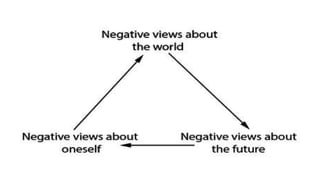
Cognitive traid are:-
1) thinking negatively about oneself.
2) thinking negatively about world.
3) thinking negatively about future.
Beck's focuses on importance of modifying
thoughts in the treatment of mental disorder for
him their are 6 congnitive distortion to which the
counsellor should attunee
1) arbitrary inferences
2) selective abstraction
3) catastrophizing
4) dicotomus all or nothing
5) emotional reasoning
6) overgeneralization
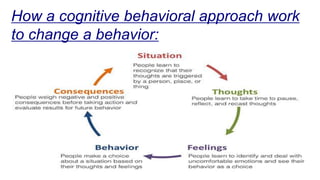
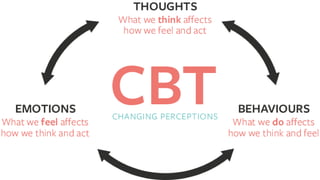
How a cognitive behavioral approach work
to change a behavior:
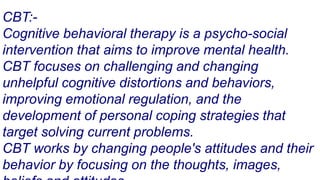
CBT:-
Cognitive behavioral therapy is a psycho-social
intervention that aims to improve mental health.
CBT focuses on challenging and changing
unhelpful cognitive distortions and behaviors,
improving emotional regulation, and the
development of personal coping strategies that
target solving current problems.
CBT works by changing people's attitudes and their
behavior by focusing on the thoughts, images,
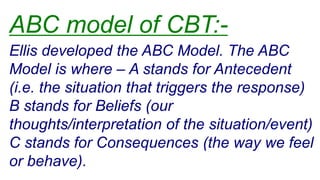
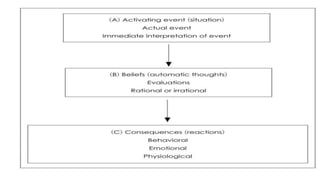
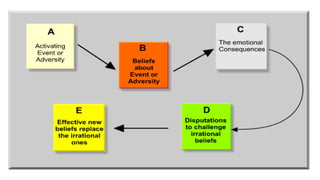
Ellis developed the ABC Model. The ABC
Model is where – A stands for Antecedent
(i.e. the situation that triggers the response)
B stands for Beliefs (our
thoughts/interpretation of the situation/event)
C stands for Consequences (the way we feel
or behave).
ABC model of CBT:-
REBT:-
Rational emotive behavior therapy,
also known as REBT, is a type of
cognitive-behavioral therapy
developed by psychologist Albert
Ellis. REBT is focused on helping
clients change irrational beliefs.
Emotionally healthy human beings develop
an acceptance of reality, even when reality
is highly unfortunate and unpleasant.
REBT therapists strive to help their clients
develop three types of acceptance: (1)
unconditional self-acceptance; (2)
unconditional other-acceptance; and (3)
unconditional life-acceptance.
CBT is usually focused on individuals working
on what Dr. Albert Ellis called, the “inelegant”
solution whereas REBT is mostly focused on
individual's working on the “elegant” solution.
These are but two keys examples of the
differences between Rational Emotive Behavior
Therapy and Cognitive Behavior Therapy.
Difference between CBT and REBT
Another key difference between Rational Emotive
Behavior Therapy and Cognitive Behavior Therapy is
the forcefulness modeled by the therapist in
challenging negative beliefs and the encouragement
of the client to similarly practice very forceful and
passionate disputing of the negative beliefs.
In CBT, the therapist asks questions like how do you
know you won’t fit it or be liked?
In REBT, the client would be asked, “So let’s suppose
that you did go out and you didn’t fit in that well and
no one liked you.
THANK YOU!!

Cognitive behavioral approach

  • 1.
    Cognitive behavioral approach Application No:c64f4b51e78811e98e604b277ecc527d User name: Ekta_08 Email id: singhekta7425@gmail.com Name: Ekta Singh M.A part 2nd
  • 2.
    Cognitive behavioral approachis another form of short term treatment where client are taught to overcome addiction to alcohal. It is very popular and extremed affective therapy. A common promise of congnitive theories is that how people think largely, determine how they behave and feel.
  • 3.
    Assumption of cognitivetherapy:- Cognitive therapy teaches you how to identify the thought that underlying your feeling. If then provides are simple way to determine if those thoughts are realistic. If a thought is not realistic you can then replace in with a more realistic one based on what you know from hard data. Changing your cognition the way the one look at something changes how you feel.
  • 4.
    Aron Beck's cognitivetherapy:- This theory was proposed by Aron Beck's to firmly beliefs that cognitive errors and depressive cognitive traid are responsible for cognitive distortion and mental health problem. Cognitive traid are:- 1) thinking negatively about oneself. 2) thinking negatively about world. 3) thinking negatively about future.
  • 6.
    Beck's focuses onimportance of modifying thoughts in the treatment of mental disorder for him their are 6 congnitive distortion to which the counsellor should attunee 1) arbitrary inferences 2) selective abstraction 3) catastrophizing 4) dicotomus all or nothing 5) emotional reasoning 6) overgeneralization
  • 7.
    How a cognitivebehavioral approach work to change a behavior:
  • 8.
    CBT:- Cognitive behavioral therapyis a psycho-social intervention that aims to improve mental health. CBT focuses on challenging and changing unhelpful cognitive distortions and behaviors, improving emotional regulation, and the development of personal coping strategies that target solving current problems. CBT works by changing people's attitudes and their behavior by focusing on the thoughts, images,
  • 10.
    Ellis developed theABC Model. The ABC Model is where – A stands for Antecedent (i.e. the situation that triggers the response) B stands for Beliefs (our thoughts/interpretation of the situation/event) C stands for Consequences (the way we feel or behave). ABC model of CBT:-
  • 12.
    REBT:- Rational emotive behaviortherapy, also known as REBT, is a type of cognitive-behavioral therapy developed by psychologist Albert Ellis. REBT is focused on helping clients change irrational beliefs.
  • 13.
    Emotionally healthy humanbeings develop an acceptance of reality, even when reality is highly unfortunate and unpleasant. REBT therapists strive to help their clients develop three types of acceptance: (1) unconditional self-acceptance; (2) unconditional other-acceptance; and (3) unconditional life-acceptance.
  • 15.
    CBT is usuallyfocused on individuals working on what Dr. Albert Ellis called, the “inelegant” solution whereas REBT is mostly focused on individual's working on the “elegant” solution. These are but two keys examples of the differences between Rational Emotive Behavior Therapy and Cognitive Behavior Therapy. Difference between CBT and REBT
  • 16.
    Another key differencebetween Rational Emotive Behavior Therapy and Cognitive Behavior Therapy is the forcefulness modeled by the therapist in challenging negative beliefs and the encouragement of the client to similarly practice very forceful and passionate disputing of the negative beliefs. In CBT, the therapist asks questions like how do you know you won’t fit it or be liked? In REBT, the client would be asked, “So let’s suppose that you did go out and you didn’t fit in that well and no one liked you.
  • 17.