Requirements Delivery –
Using Examples
About Us
Bharti Rupani
@bhartir24
brupani@enterprise-knowledge.com
https://www.linkedin.com/in/bhartir
Wyn Van Devanter
@wynv
wyn.vandevanter@excella.com
https://www.linkedin.com/in/wyntuition
http://www.slideshare.net/wynvandevanter
Terminology
• Specification by Example
• Executable Specifications
• Automated Acceptance Tests (AAT)
• Behavior Driven Development (BDD)
• Acceptance Test Driven Development
(ATDD)
• Testable Requirements
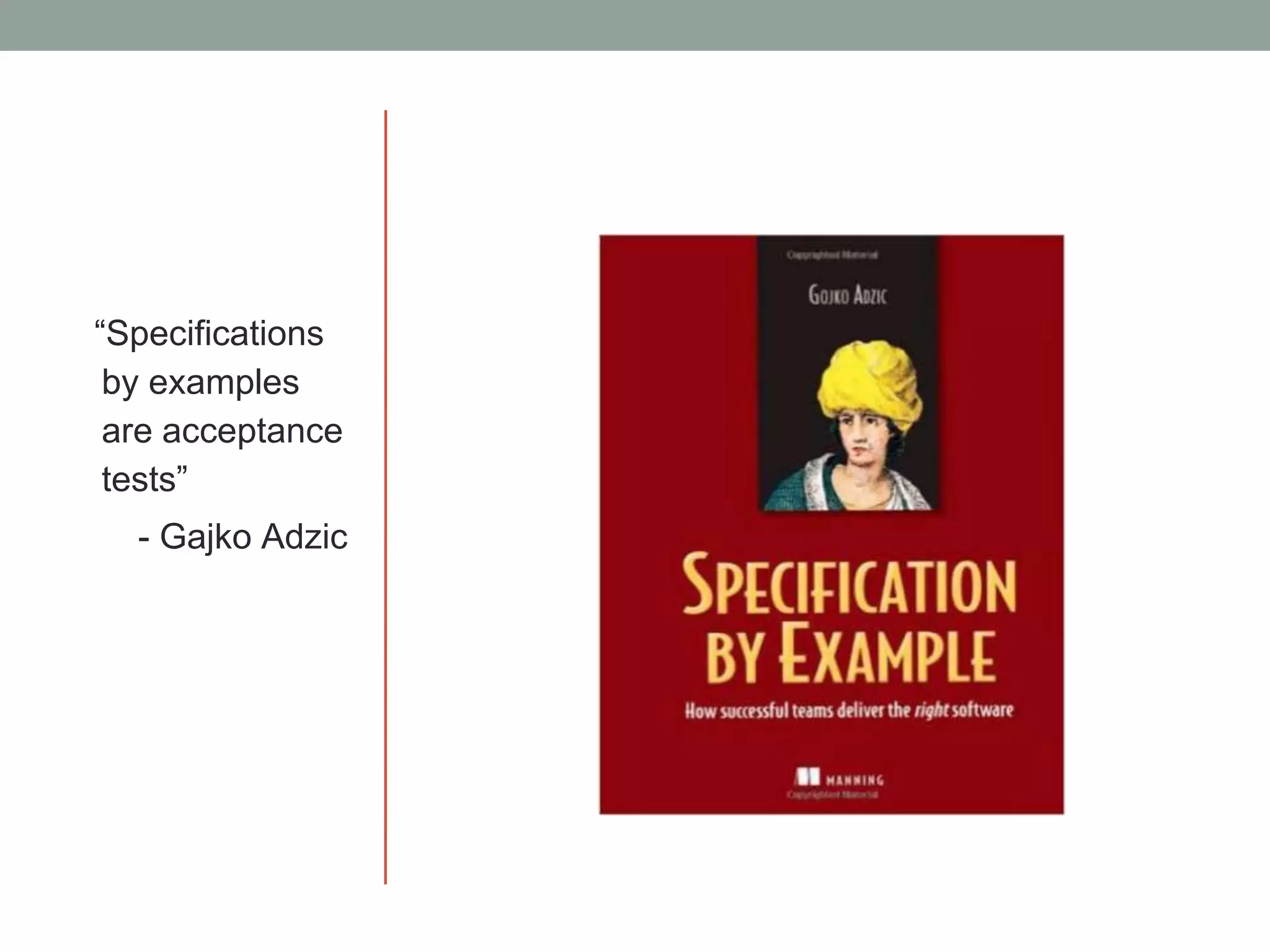
“Specifications
by examples
are acceptance
tests”
- Gajko Adzic
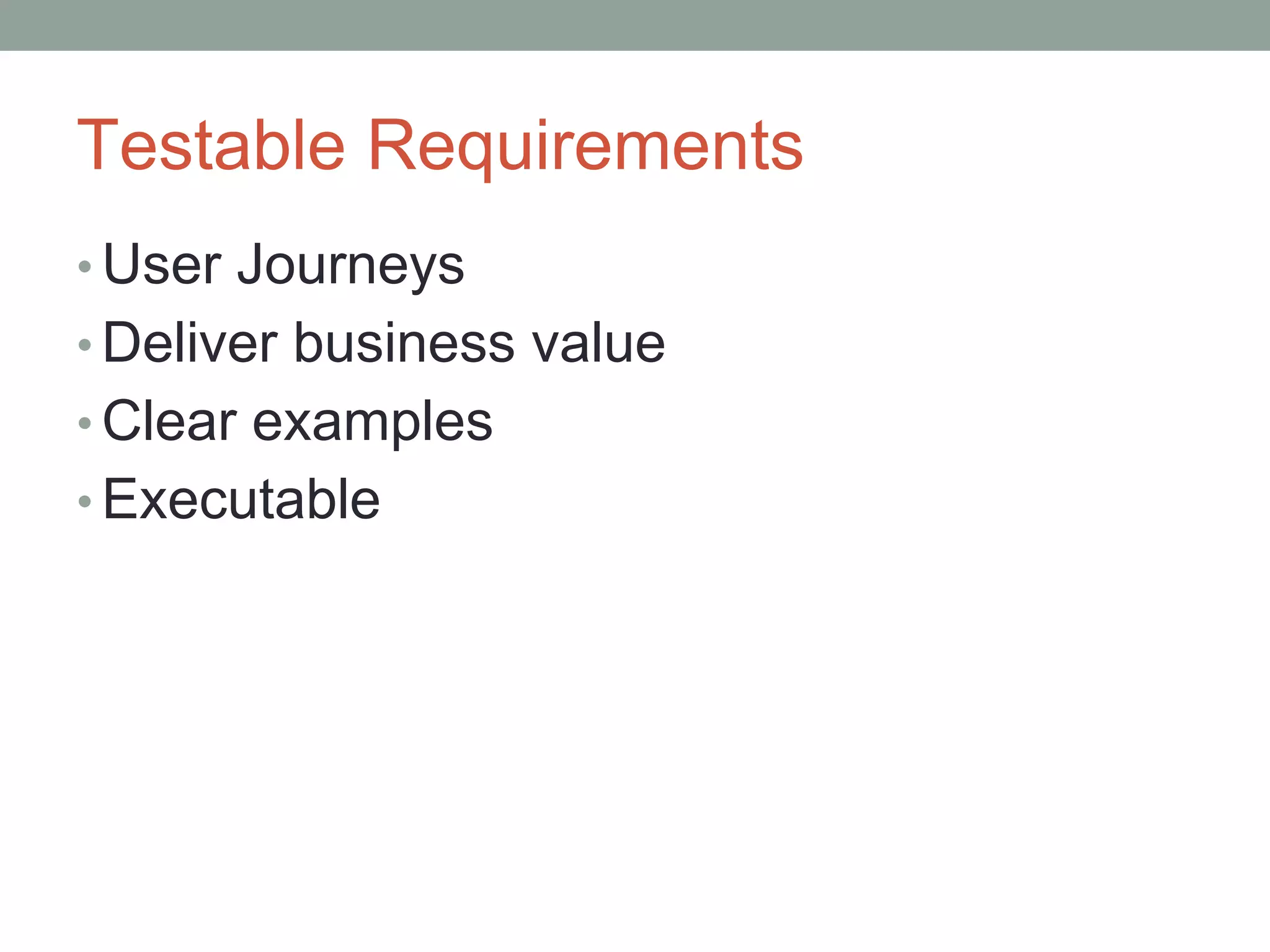
Testable Requirements
• User Journeys
• Deliver business value
• Clear examples
• Executable
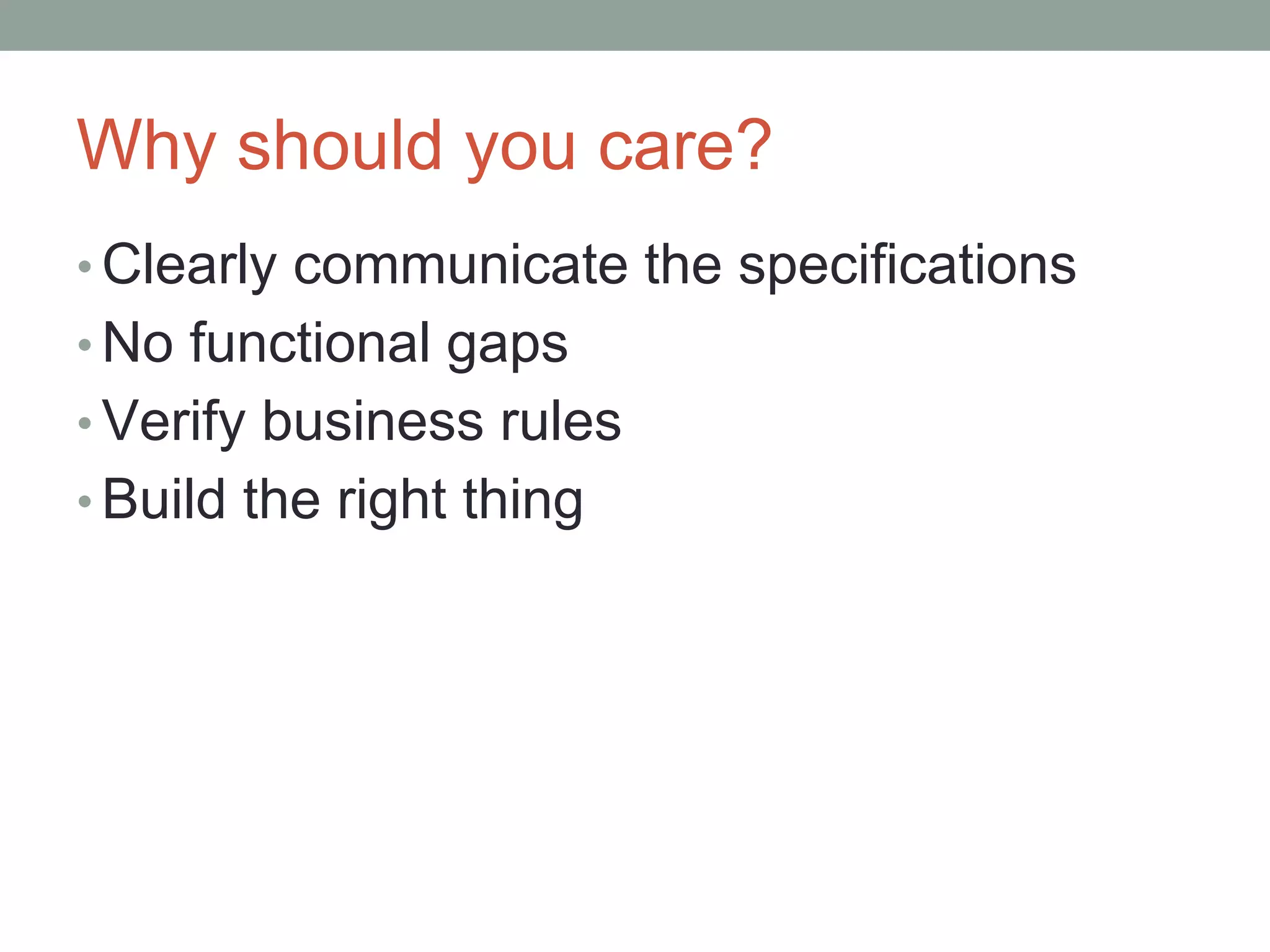
Why should you care?
• Clearly communicate the specifications
• No functional gaps
• Verify business rules
• Build the right thing
6
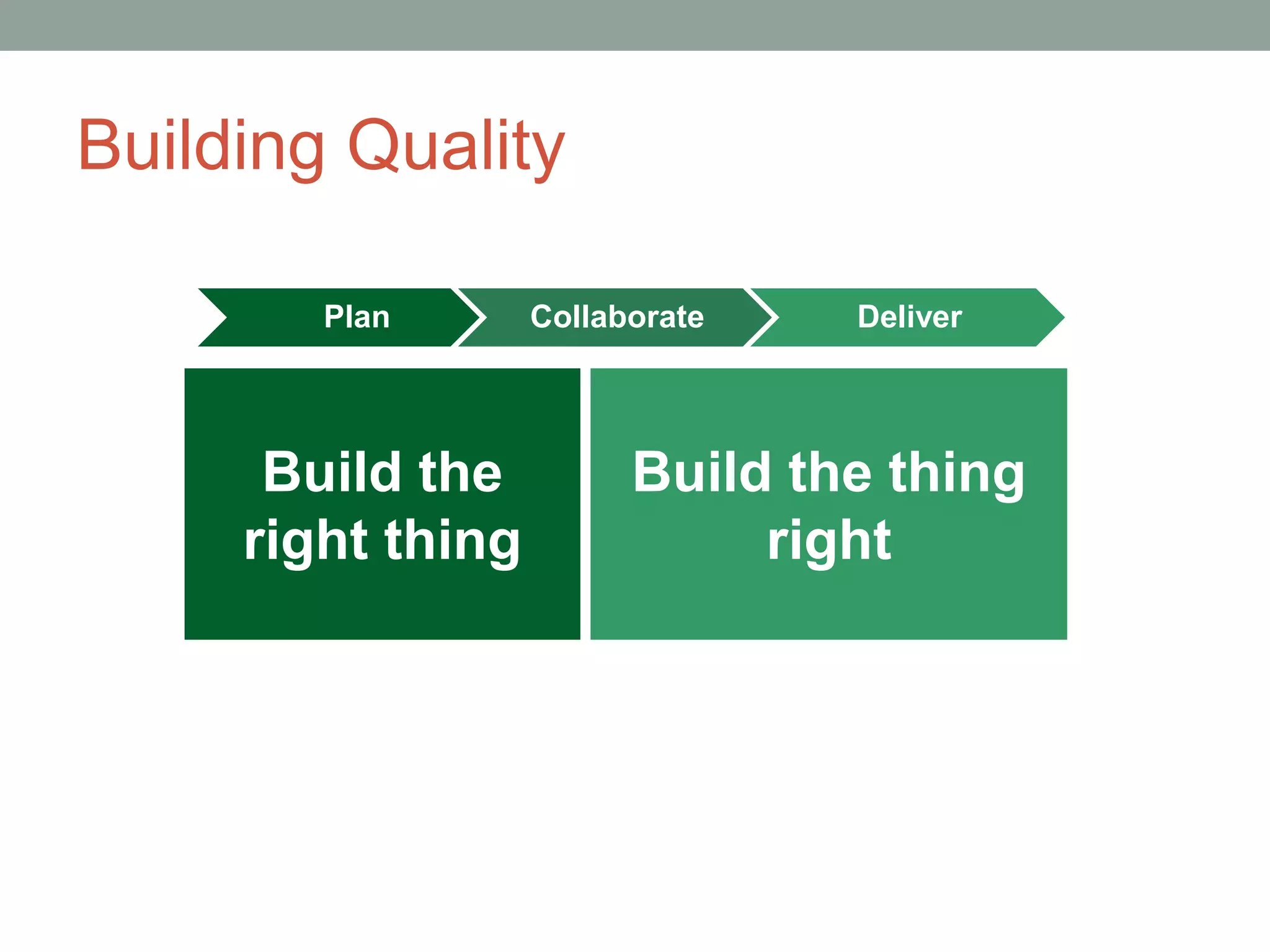
Building Quality
Plan Collaborate Deliver
Build the
right thing
Build the thing
right
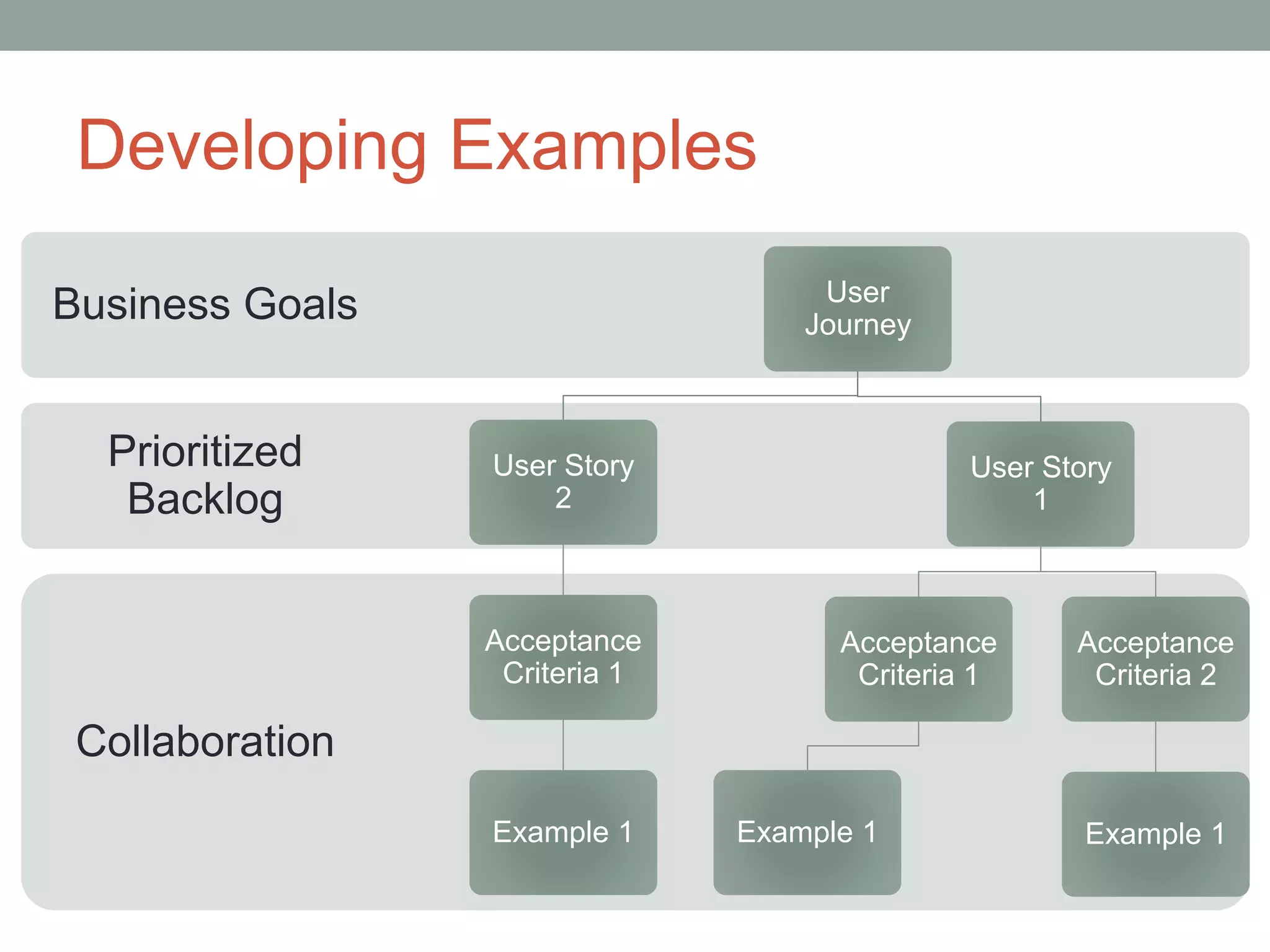
Developing Examples
Collaboration
Prioritized
Backlog
Business Goals User
Journey
User Story
2
Acceptance
Criteria 1
Example 1
User Story
1
Acceptance
Criteria 1
Example 1
Acceptance
Criteria 2
Example 1
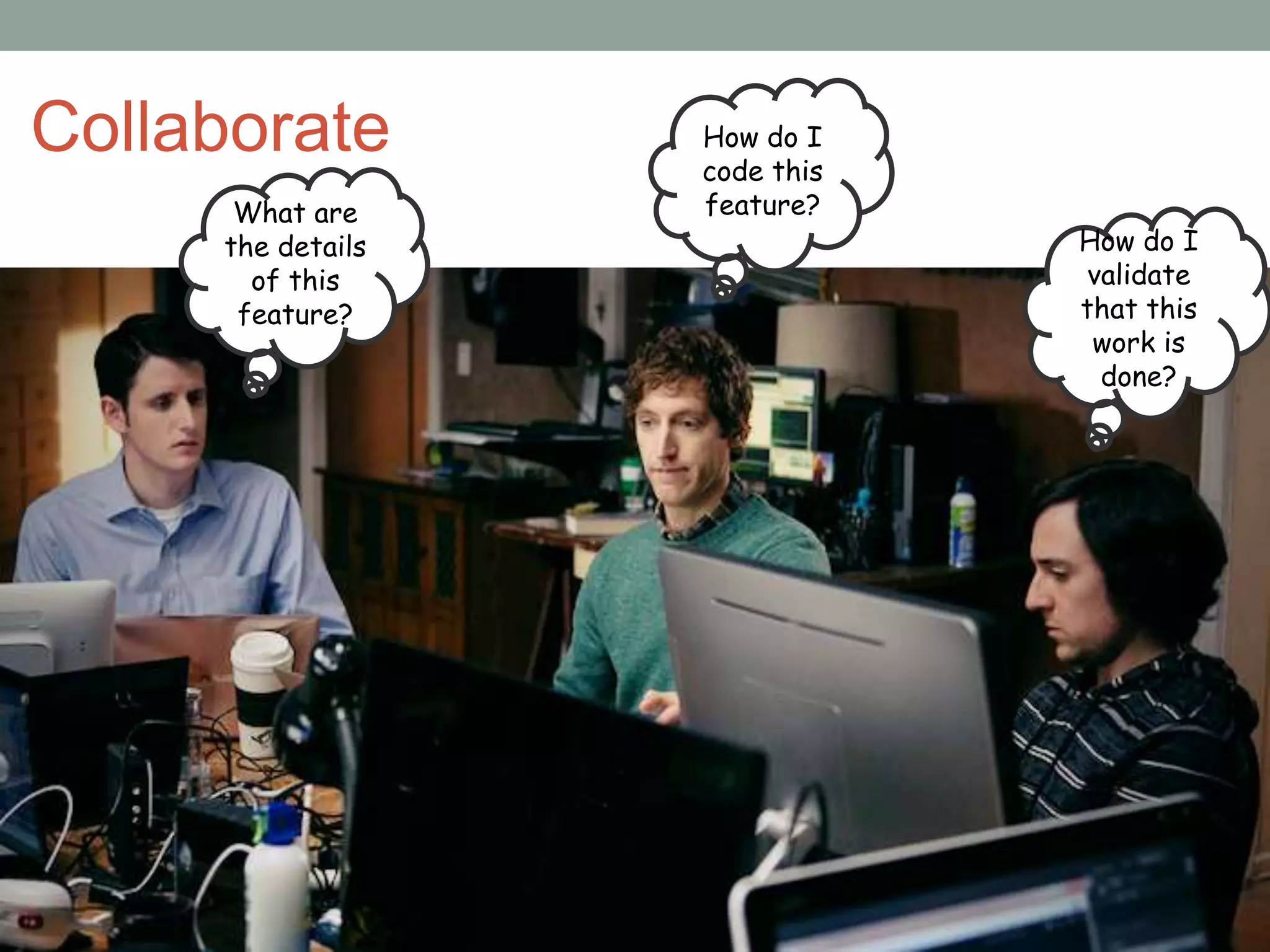
Collaborate How do I
code this
feature?What are
the details
of this
feature?
How do I
validate
that this
work is
done?
Three Amigos
• Business Analyst, Developers and Testers
• Collaborate
• Share knowledge
• Think about the desired outcome
• Shared understanding
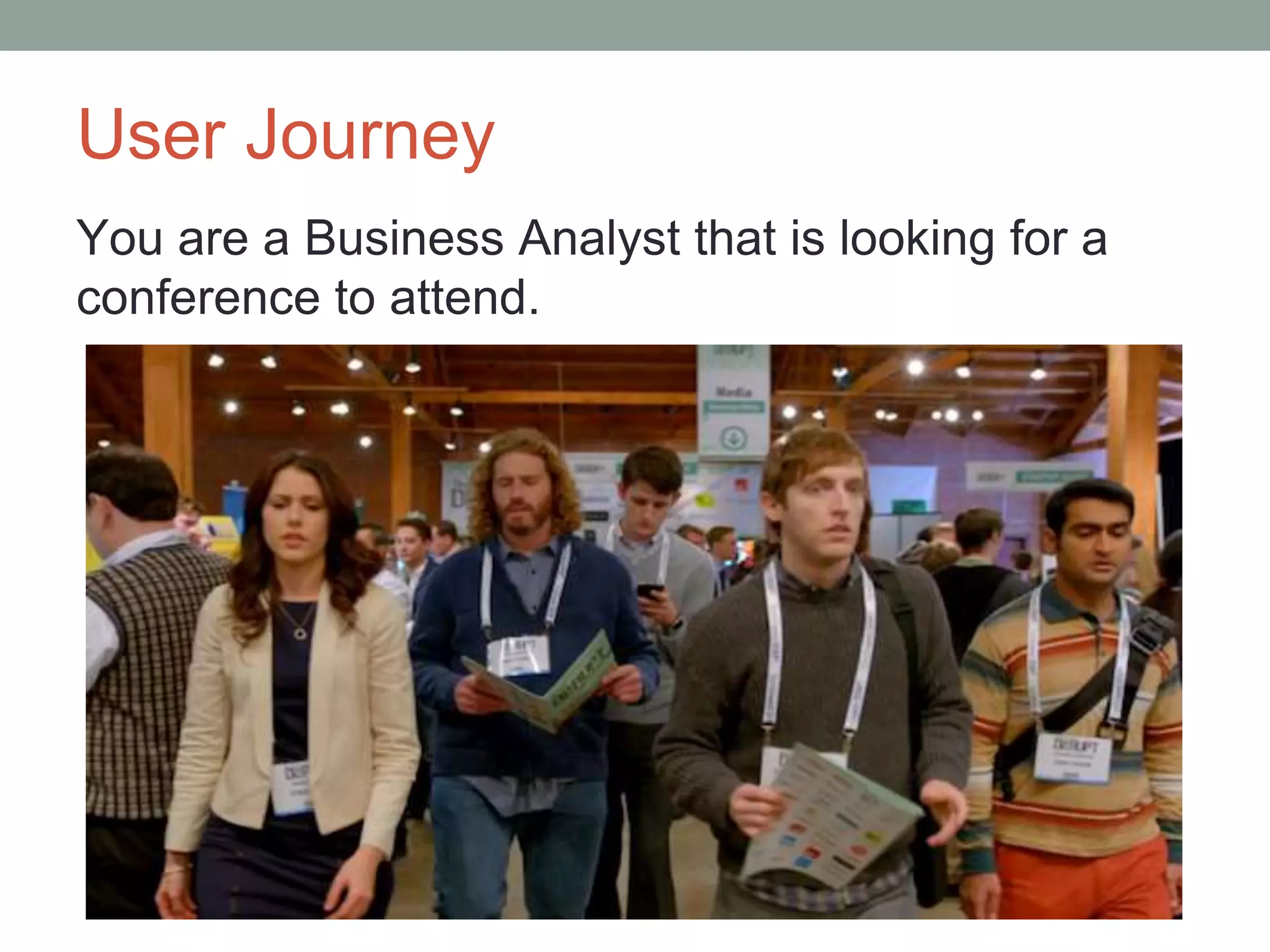
User Journey
You are a Business Analyst that is looking for a
conference to attend.
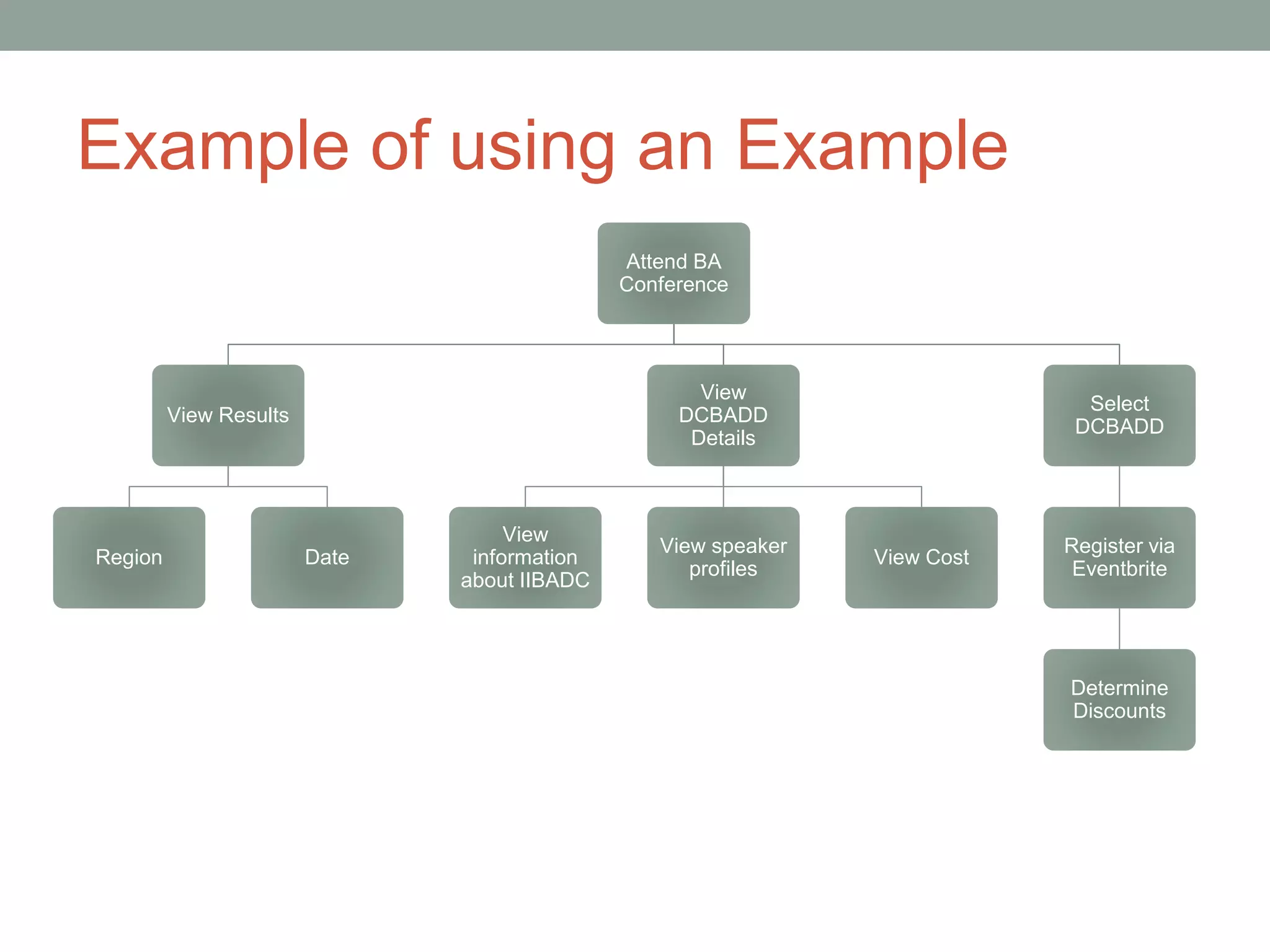
Example of using an Example
Attend BA
Conference
View Results
Region Date
View
DCBADD
Details
View
information
about IIBADC
View speaker
profiles
View Cost
Select
DCBADD
Register via
Eventbrite
Determine
Discounts
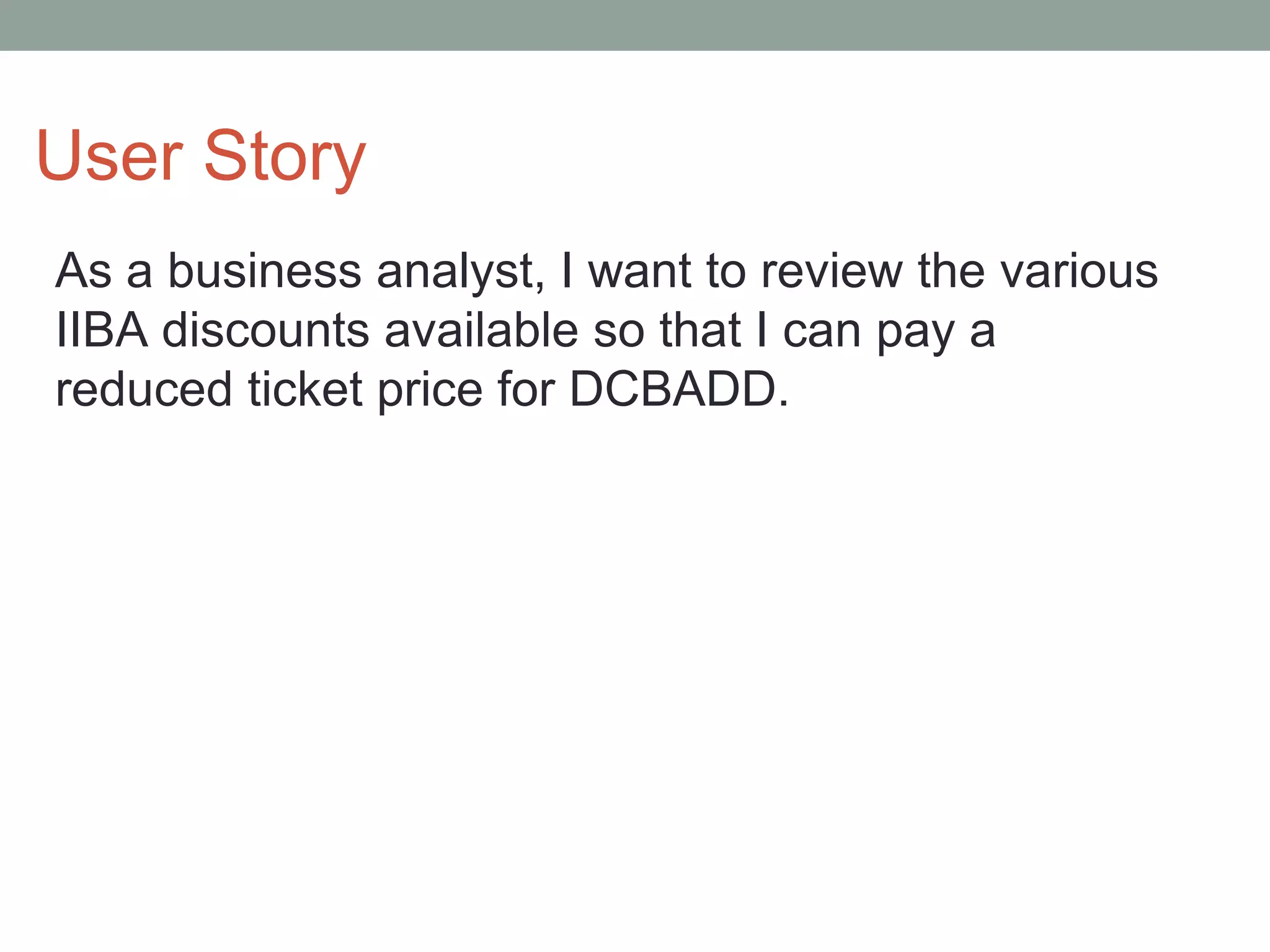
User Story
As a business analyst, I want to review the various
IIBA discounts available so that I can pay a
reduced ticket price for DCBADD.
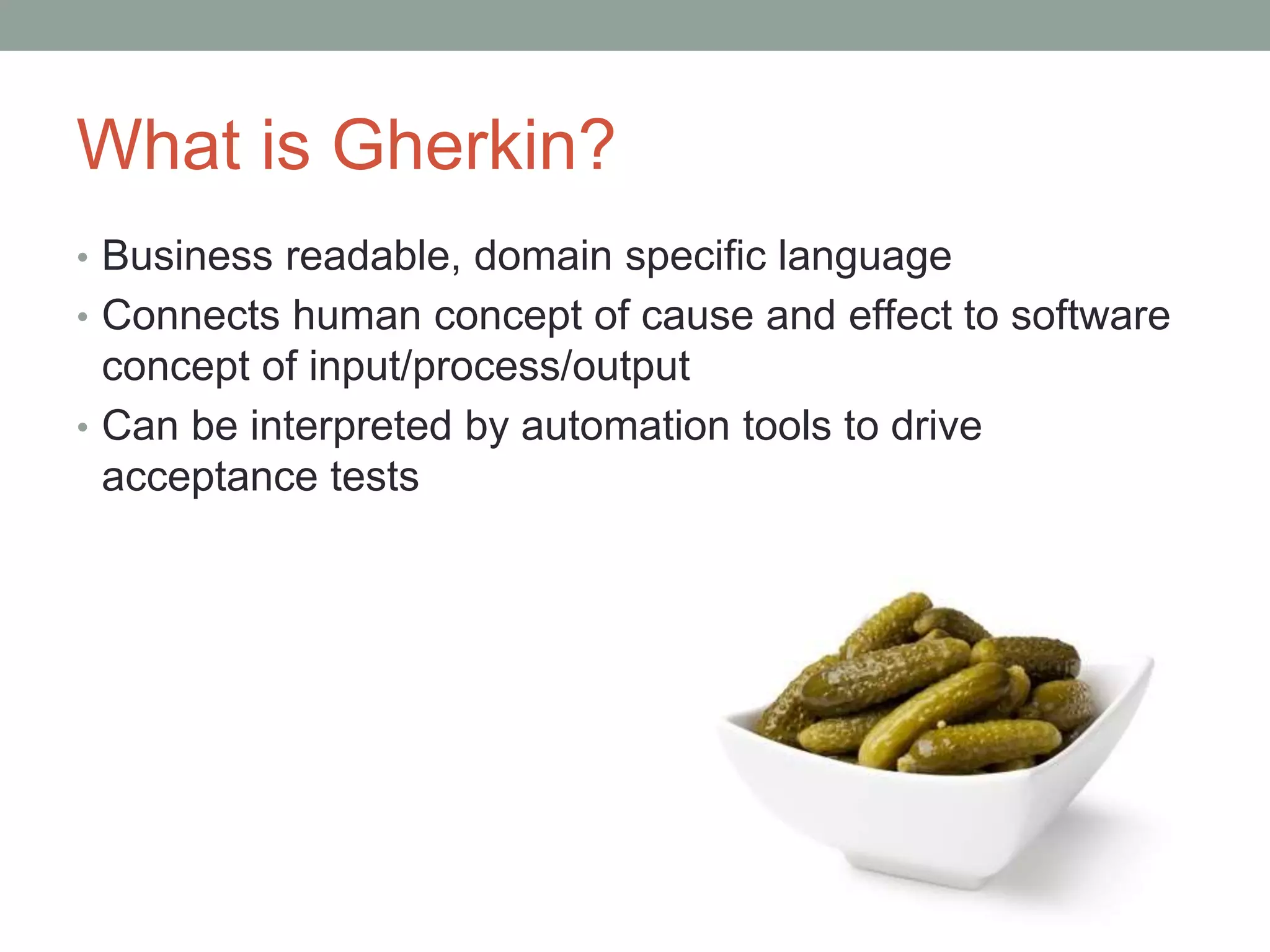
What is Gherkin?
• Business readable, domain specific language
• Connects human concept of cause and effect to software
concept of input/process/output
• Can be interpreted by automation tools to drive
acceptance tests
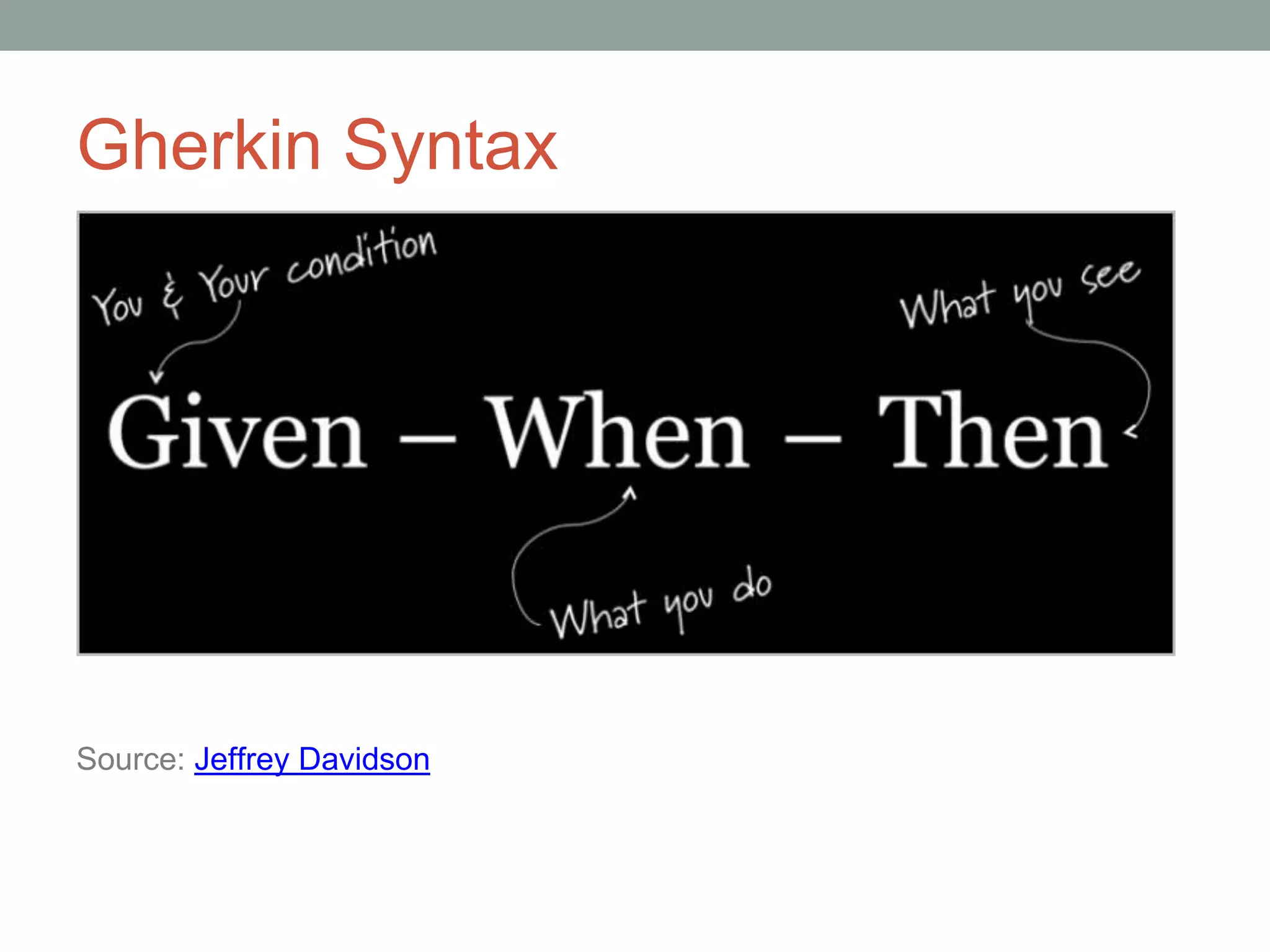
Gherkin Syntax
Source: Jeffrey Davidson
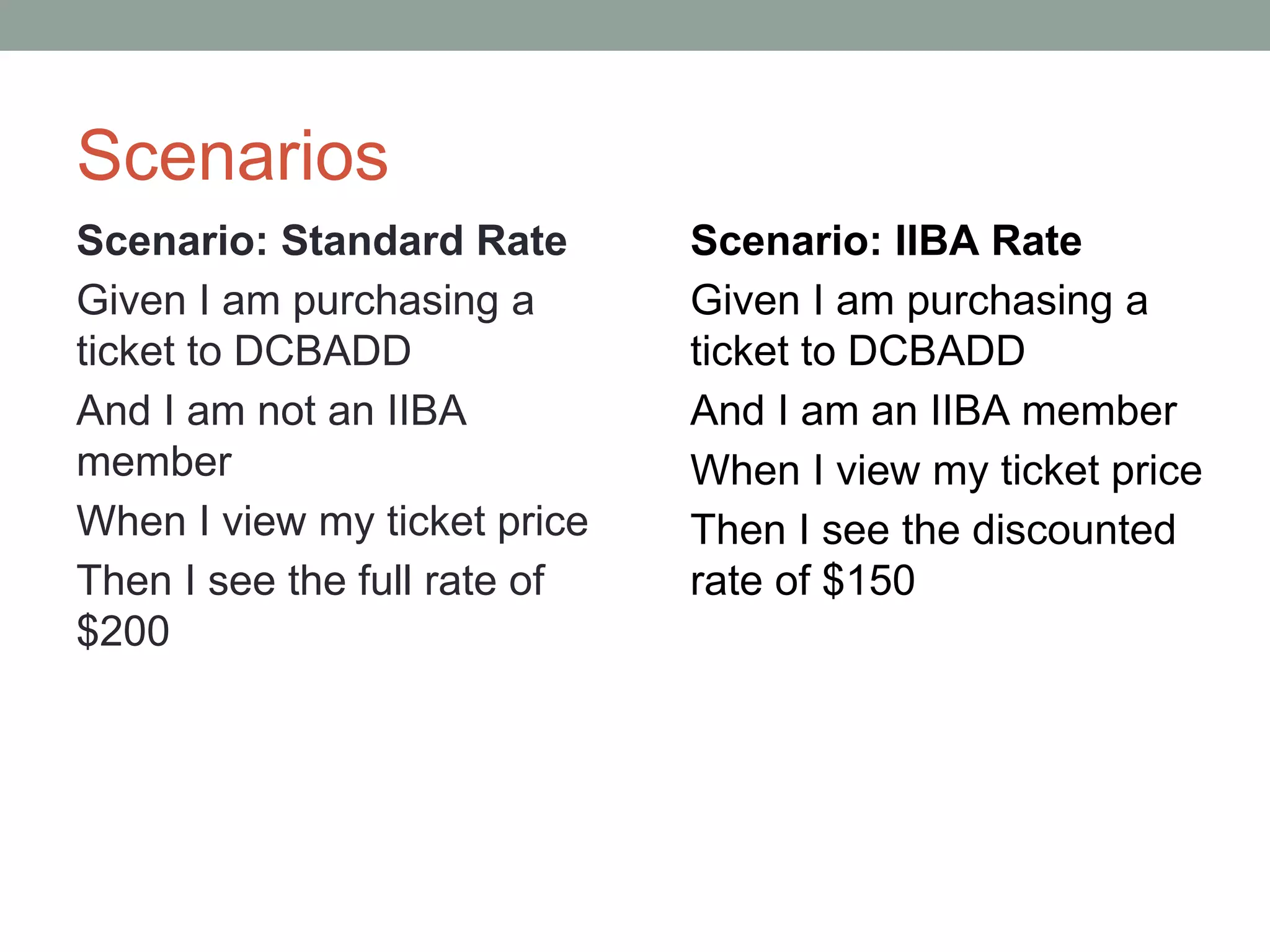
Scenarios
Scenario: Standard Rate
Given I am purchasing a
ticket to DCBADD
And I am not an IIBA
member
When I view my ticket price
Then I see the full rate of
$200
Scenario: IIBA Rate
Given I am purchasing a
ticket to DCBADD
And I am an IIBA member
When I view my ticket price
Then I see the discounted
rate of $150
Example
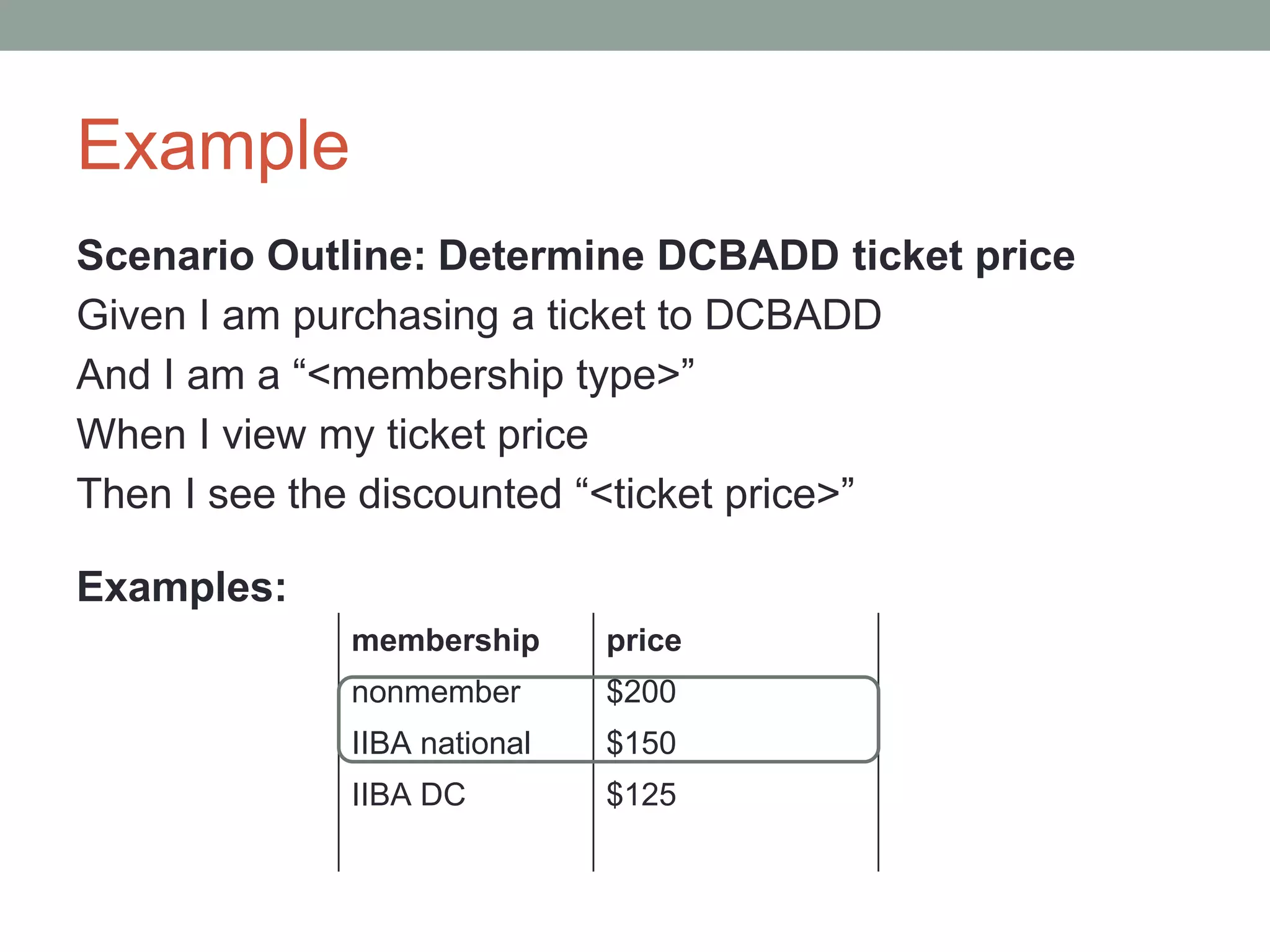
Scenario Outline: Determine DCBADD ticket price
Given I am purchasing a ticket to DCBADD
And I am a “<membership type>”
When I view my ticket price
Then I see the discounted “<ticket price>”
Examples:
membership price
nonmember $200
IIBA national $150
IIBA DC $125
Example
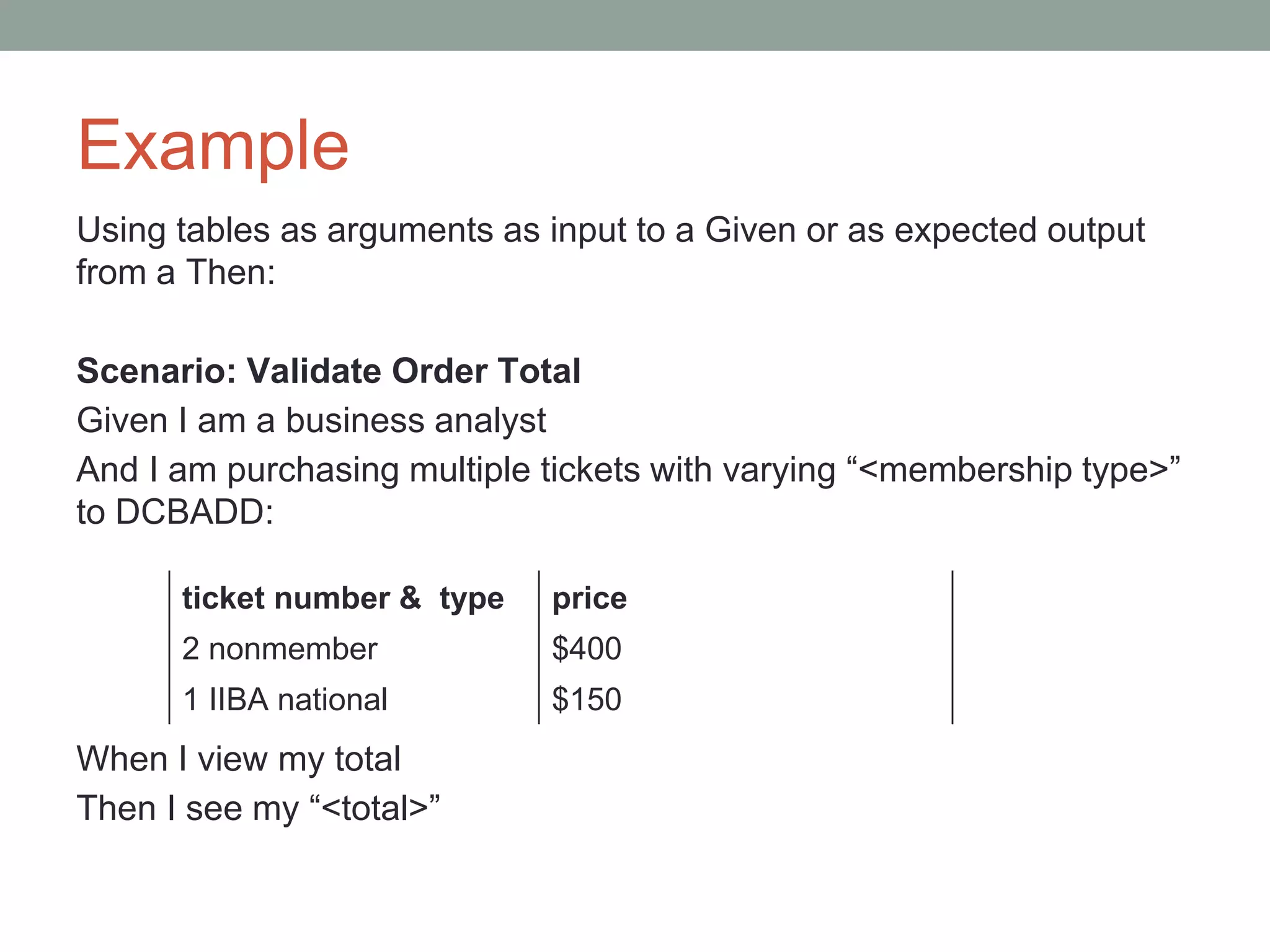
Using tables as arguments as input to a Given or as expected output
from a Then:
Scenario: Validate Order Total
Given I am a business analyst
And I am purchasing multiple tickets with varying “<membership type>”
to DCBADD:
When I view my total
Then I see my “<total>”
ticket number & type price
2 nonmember $400
1 IIBA national $150
Guidelines
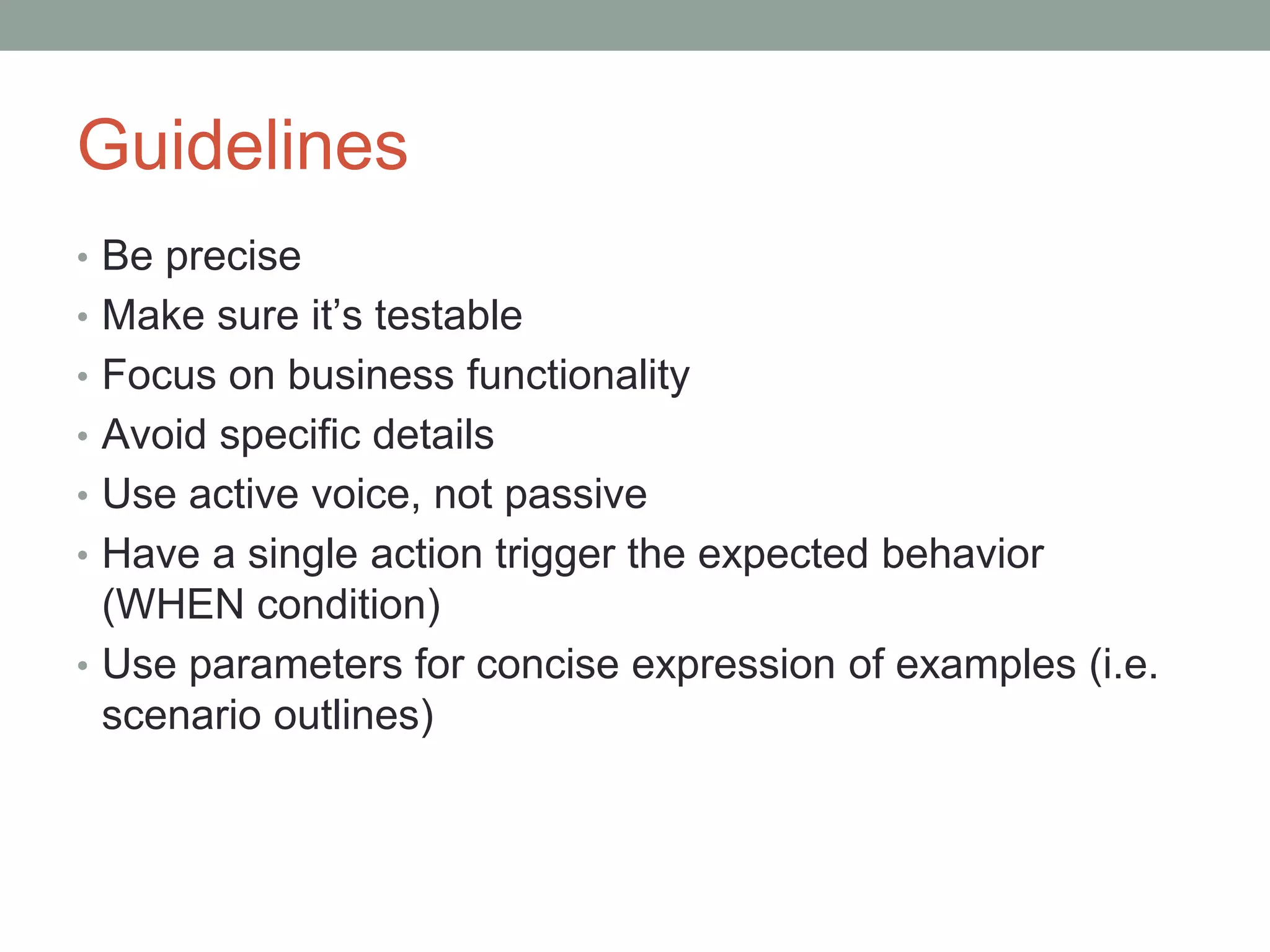
• Be precise
• Make sure it’s testable
• Focus on business functionality
• Avoid specific details
• Use active voice, not passive
• Have a single action trigger the expected behavior
(WHEN condition)
• Use parameters for concise expression of examples (i.e.
scenario outlines)
Automating the scenarios
Automated Acceptance Tests
(AATs)
• Code automates them
• They run constantly
Why Have AATs? (Pros)
Communication
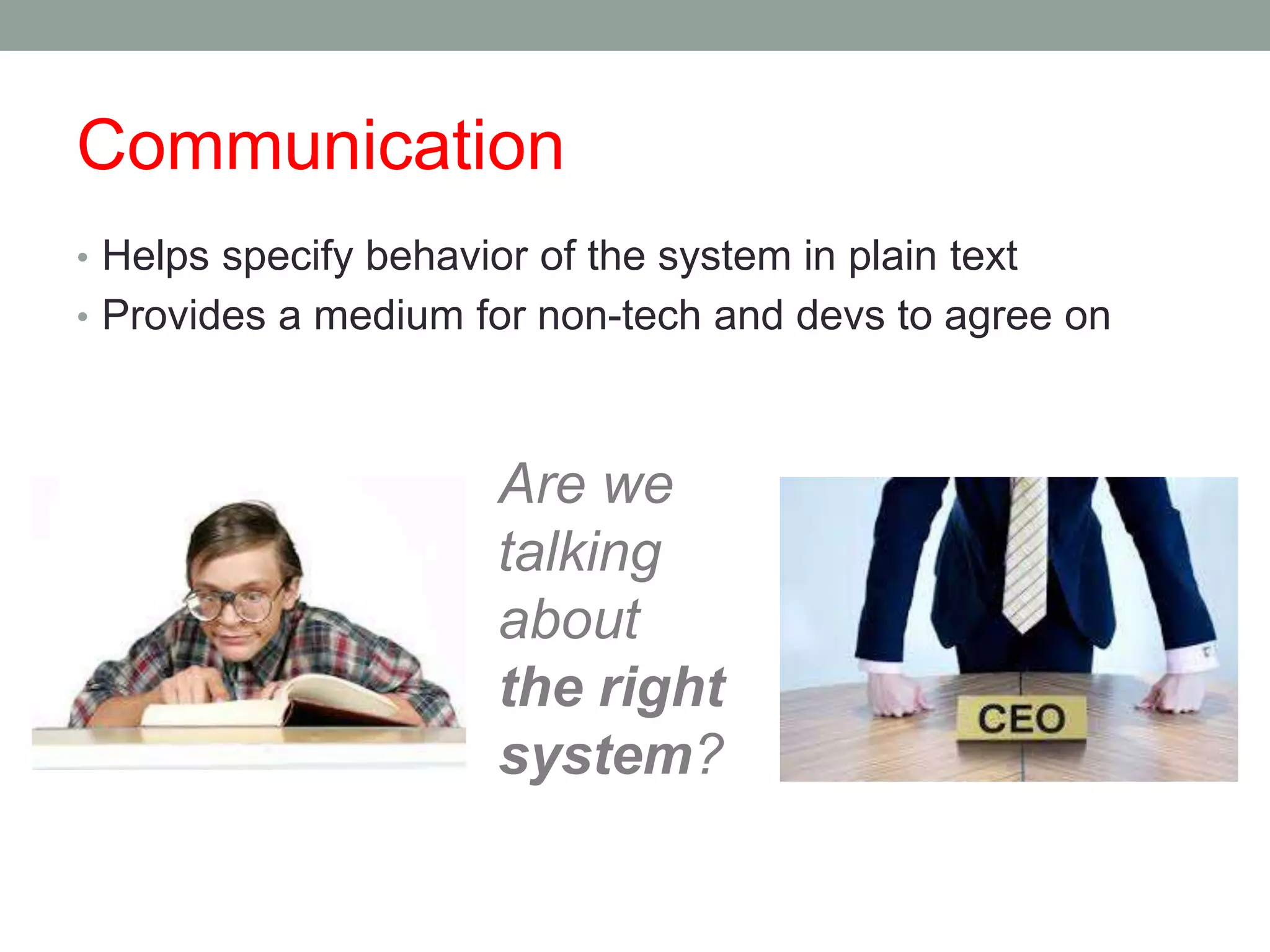
• Helps specify behavior of the system in plain text
• Provides a medium for non-tech and devs to agree on
Are we
talking
about
the right
system?
Seams, unit test mistakes
Automation
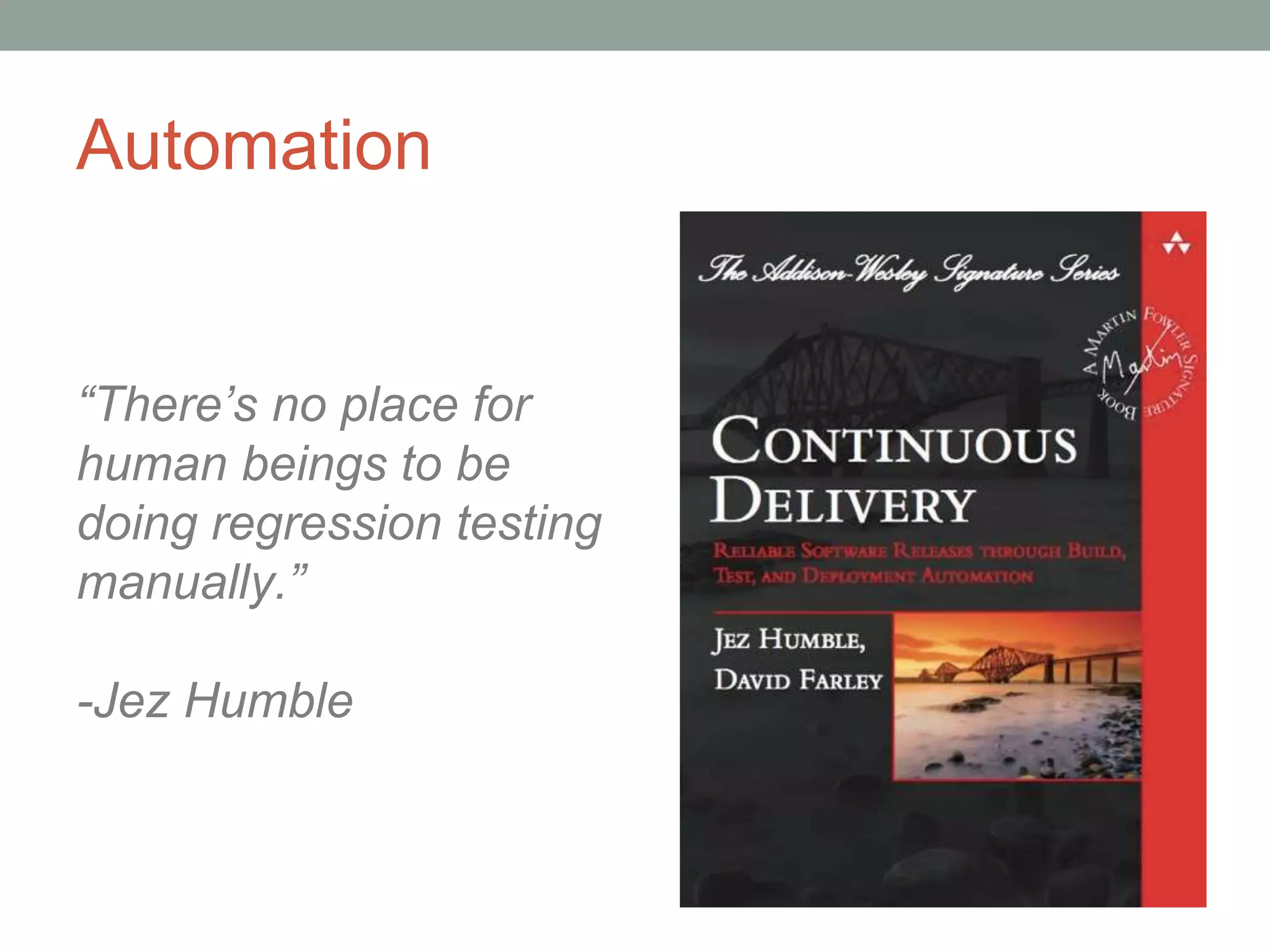
“There’s no place for
human beings to be
doing regression testing
manually.”
-Jez Humble
Speedier deployments
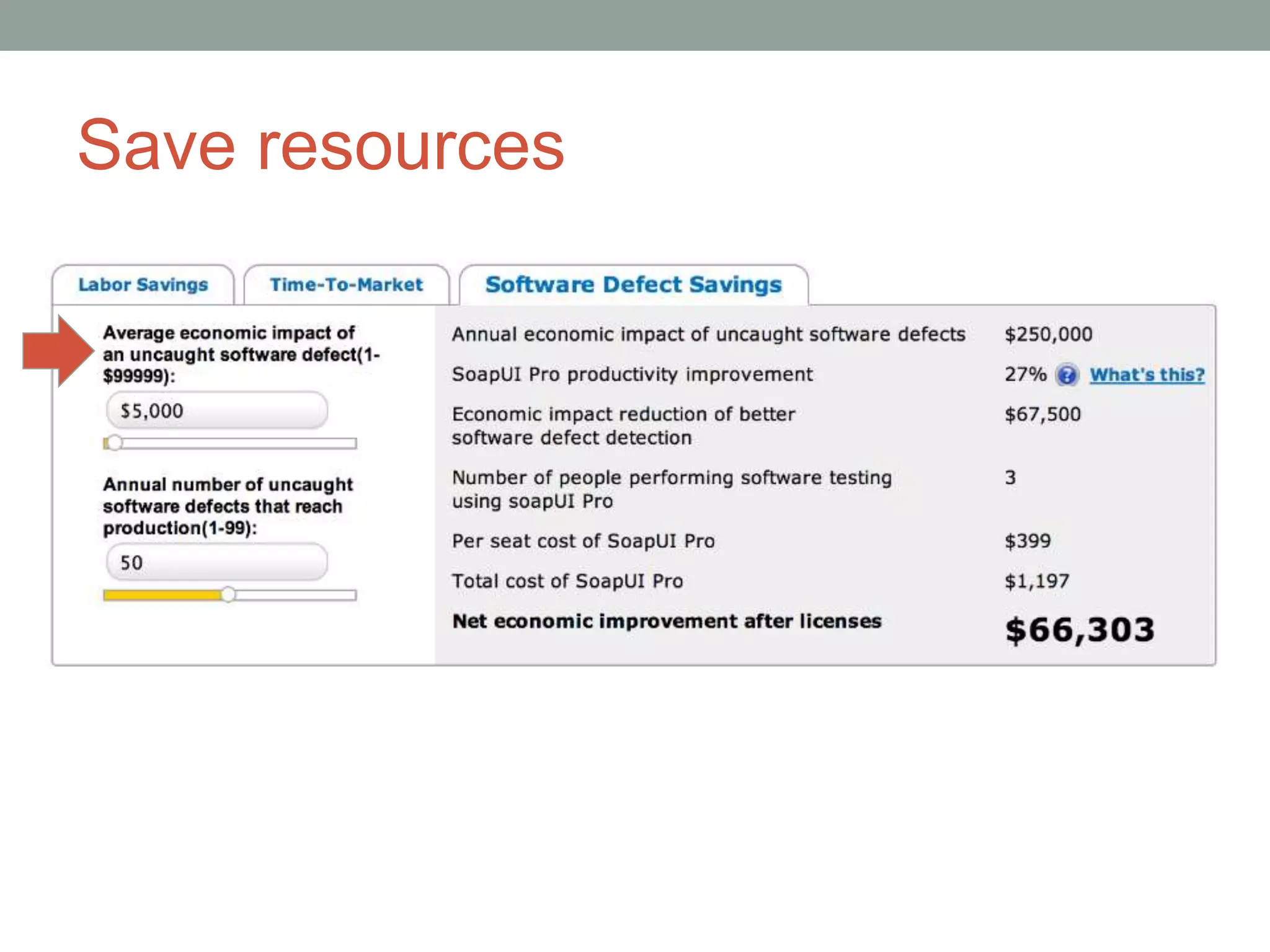
Save resources
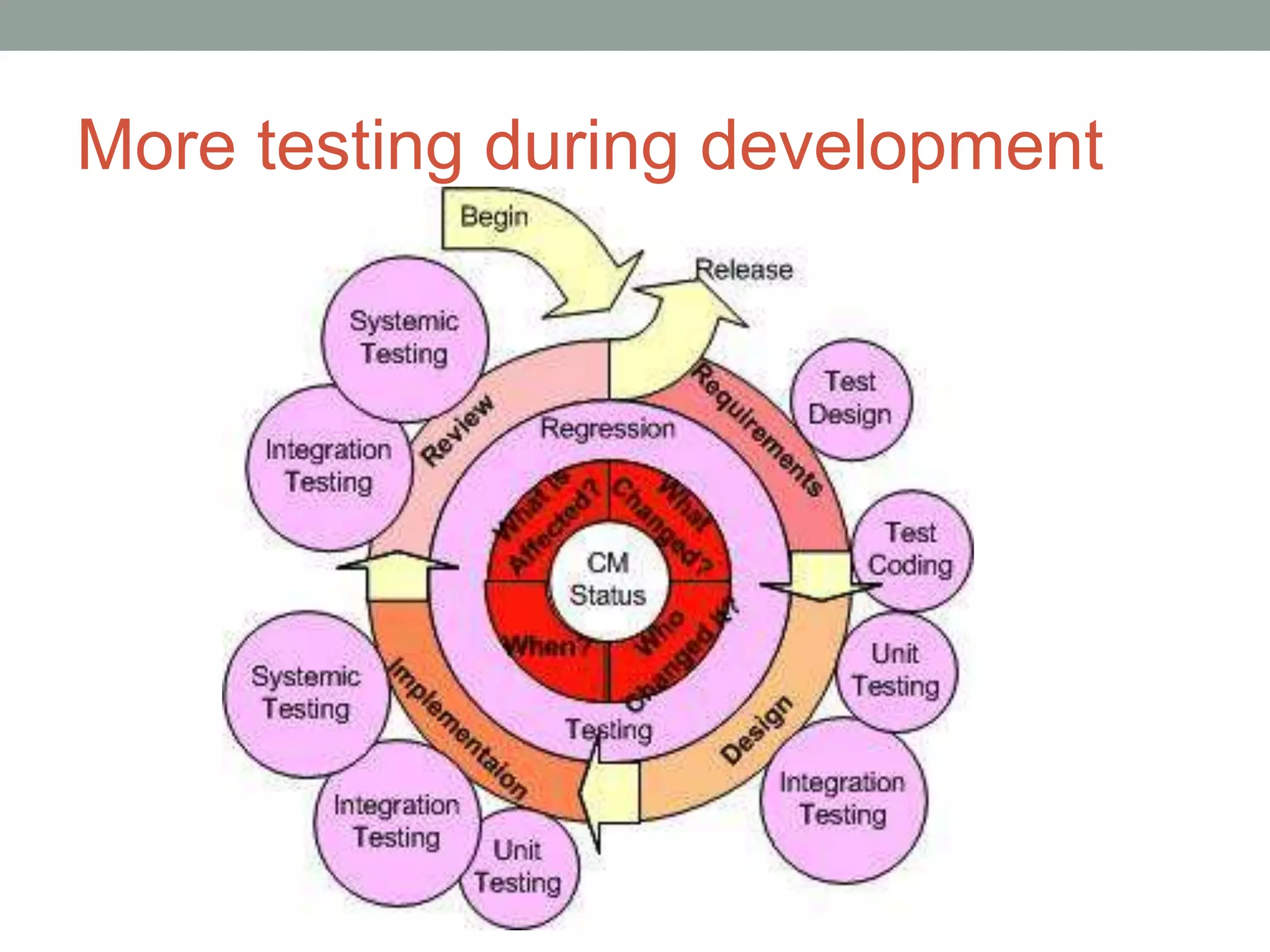
More testing during development
Why NOT Have AATs?
(Cons)
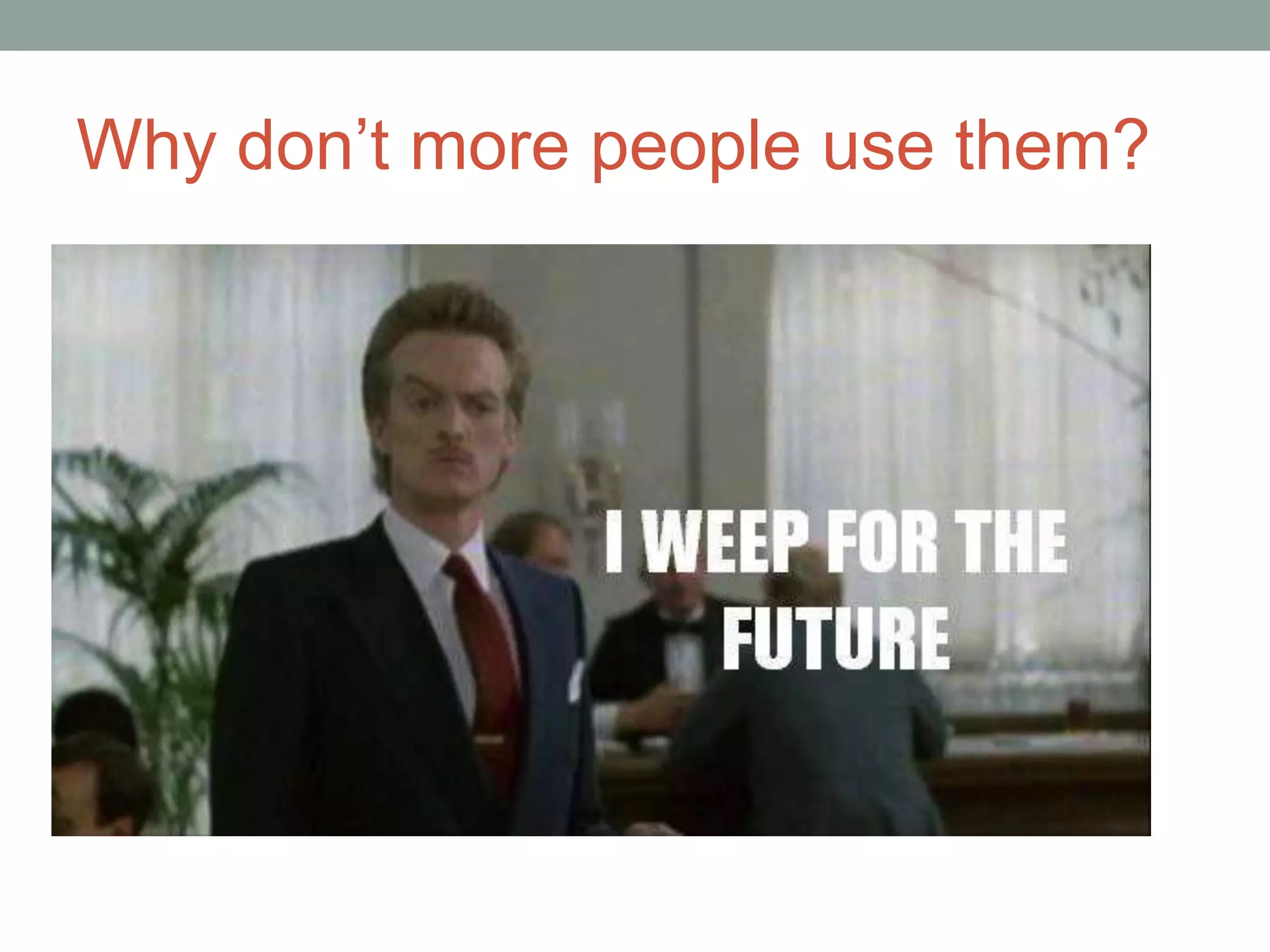
Why don’t more people use them?
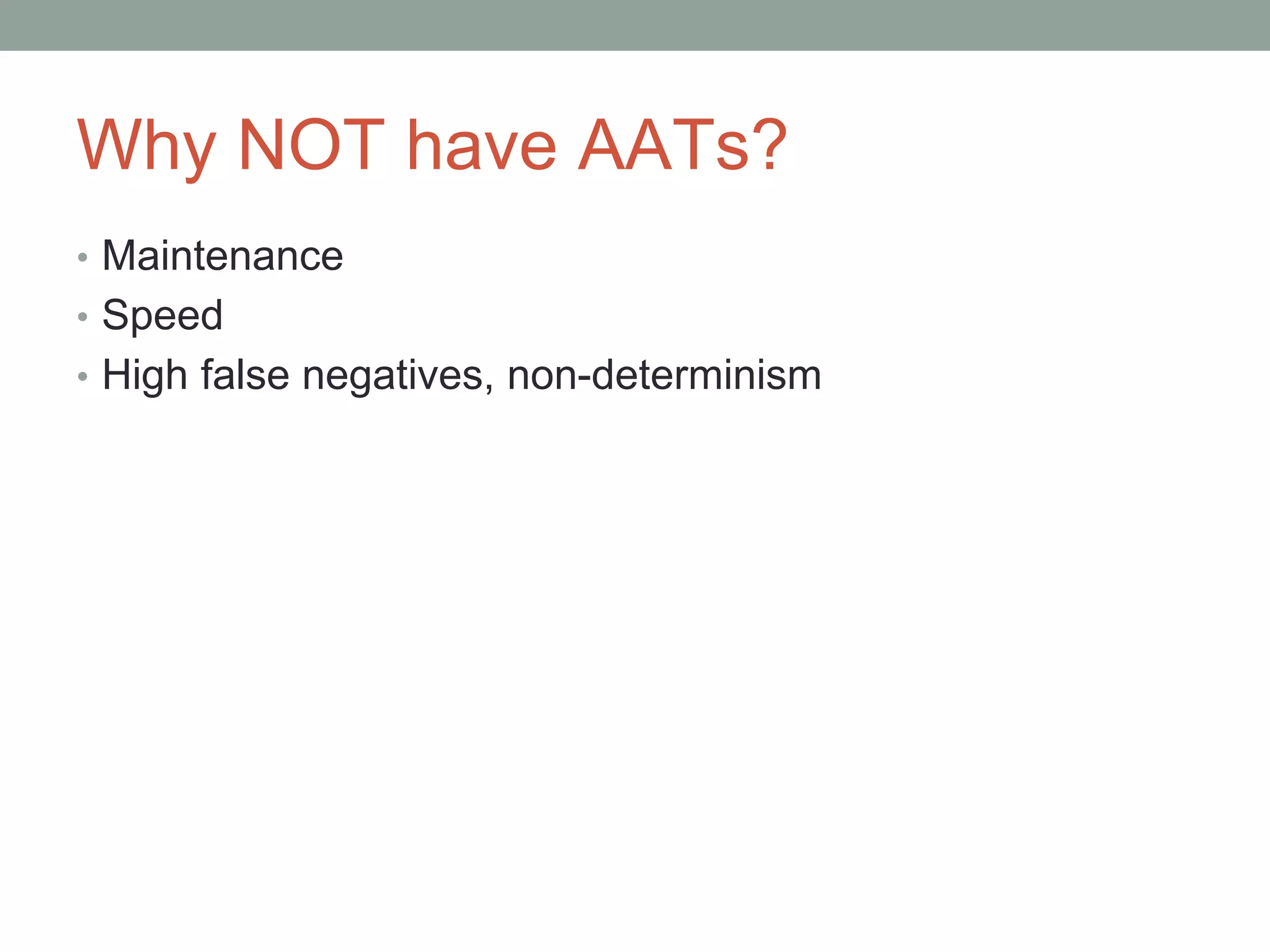
Why NOT have AATs?
• Maintenance
• Speed
• High false negatives, non-determinism
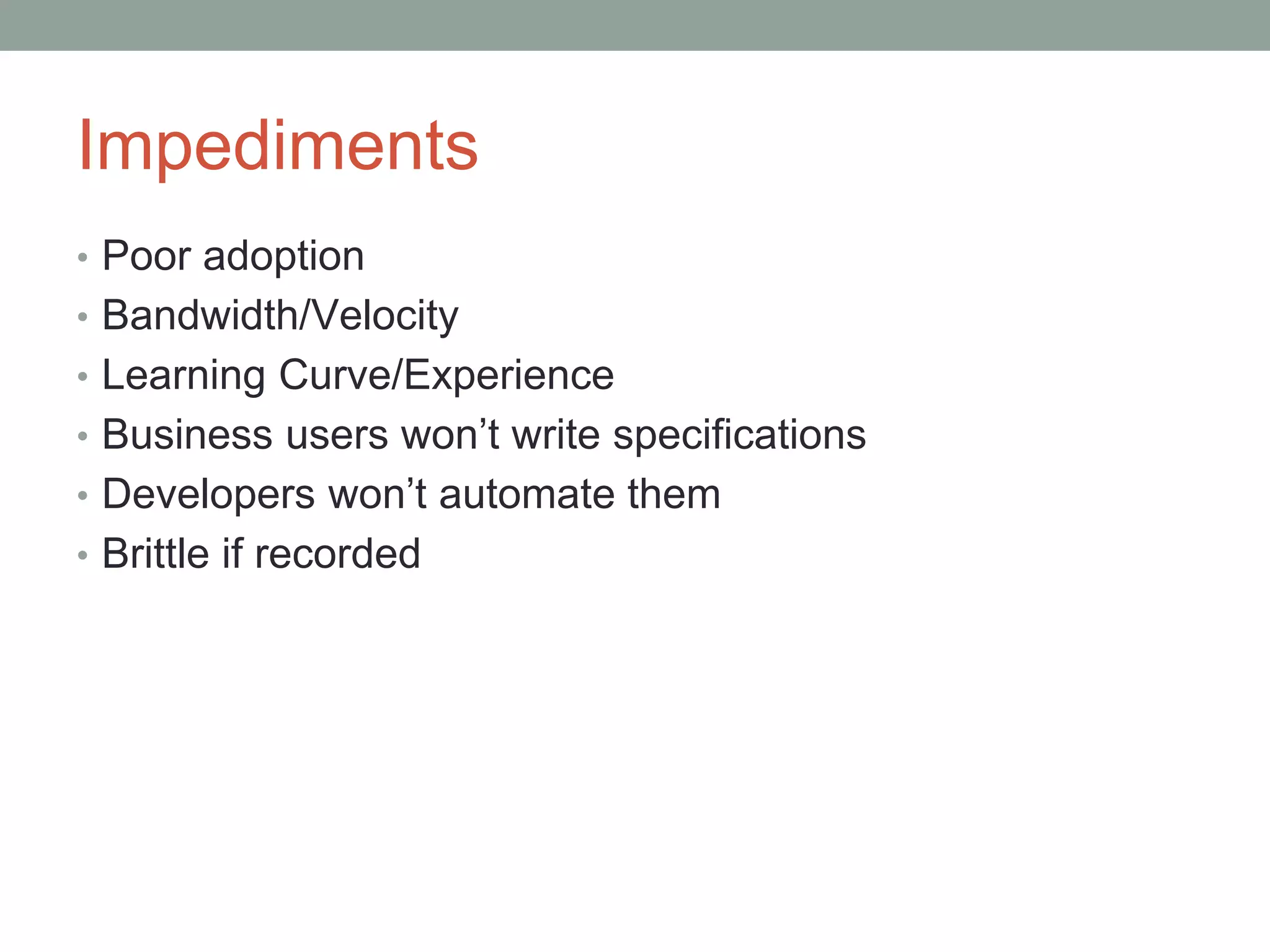
Impediments
• Poor adoption
• Bandwidth/Velocity
• Learning Curve/Experience
• Business users won’t write specifications
• Developers won’t automate them
• Brittle if recorded
Solutions
Acceptance Test Strategy
• Happy paths
• Major unhappy paths
• Legacy
• Regression
Minimize # of end-to-end tests
• AATs for journeys, not stories
• Is your new story entirely new?
• Balance high # of unit tests + selected end-to-end &
acceptance
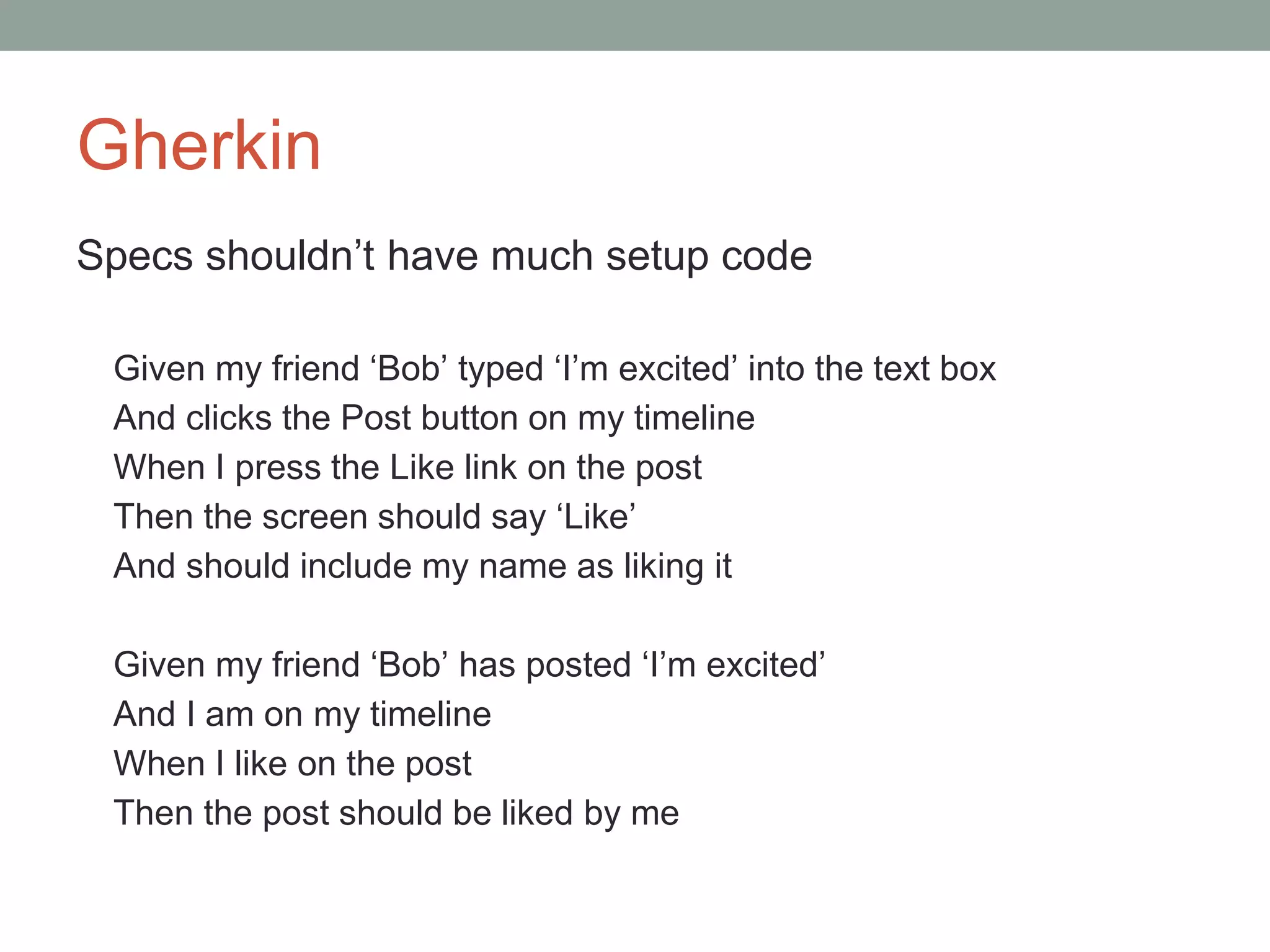
Gherkin
Specs shouldn’t have much setup code
Given my friend ‘Bob’ typed ‘I’m excited’ into the text box
And clicks the Post button on my timeline
When I press the Like link on the post
Then the screen should say ‘Like’
And should include my name as liking it
Given my friend ‘Bob’ has posted ‘I’m excited’
And I am on my timeline
When I like on the post
Then the post should be liked by me
General Tips
• Create different levels of suites depending on depth/level
of feedback desired:
• Smoke, Current iteration/sprint, Regression
• Run AATs as close to the real environment as possible
When Acceptances Tests catches a
bug
• See why bug got through unit/integration tests
• Add unit, integration tests
• Prune AATs?
UI tests
• Sometimes tests will fail if the page doesn’t have enough
time to load. Use implicit waits, and explicit when really
needed
• Capture screen shots when tests fail
• Selenium IDE
AAT Workflow
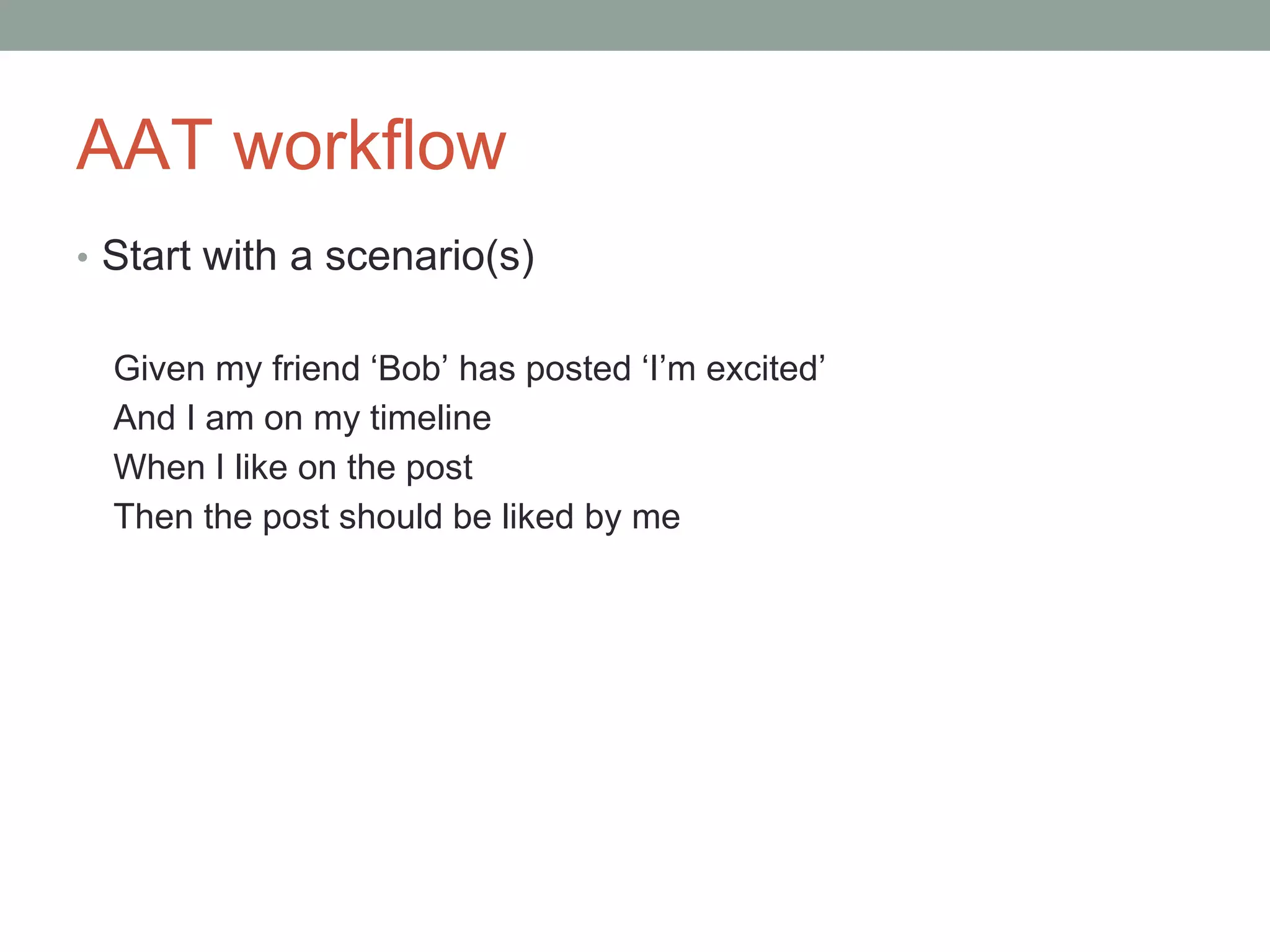
AAT workflow
• Start with a scenario(s)
Given my friend ‘Bob’ has posted ‘I’m excited’
And I am on my timeline
When I like on the post
Then the post should be liked by me
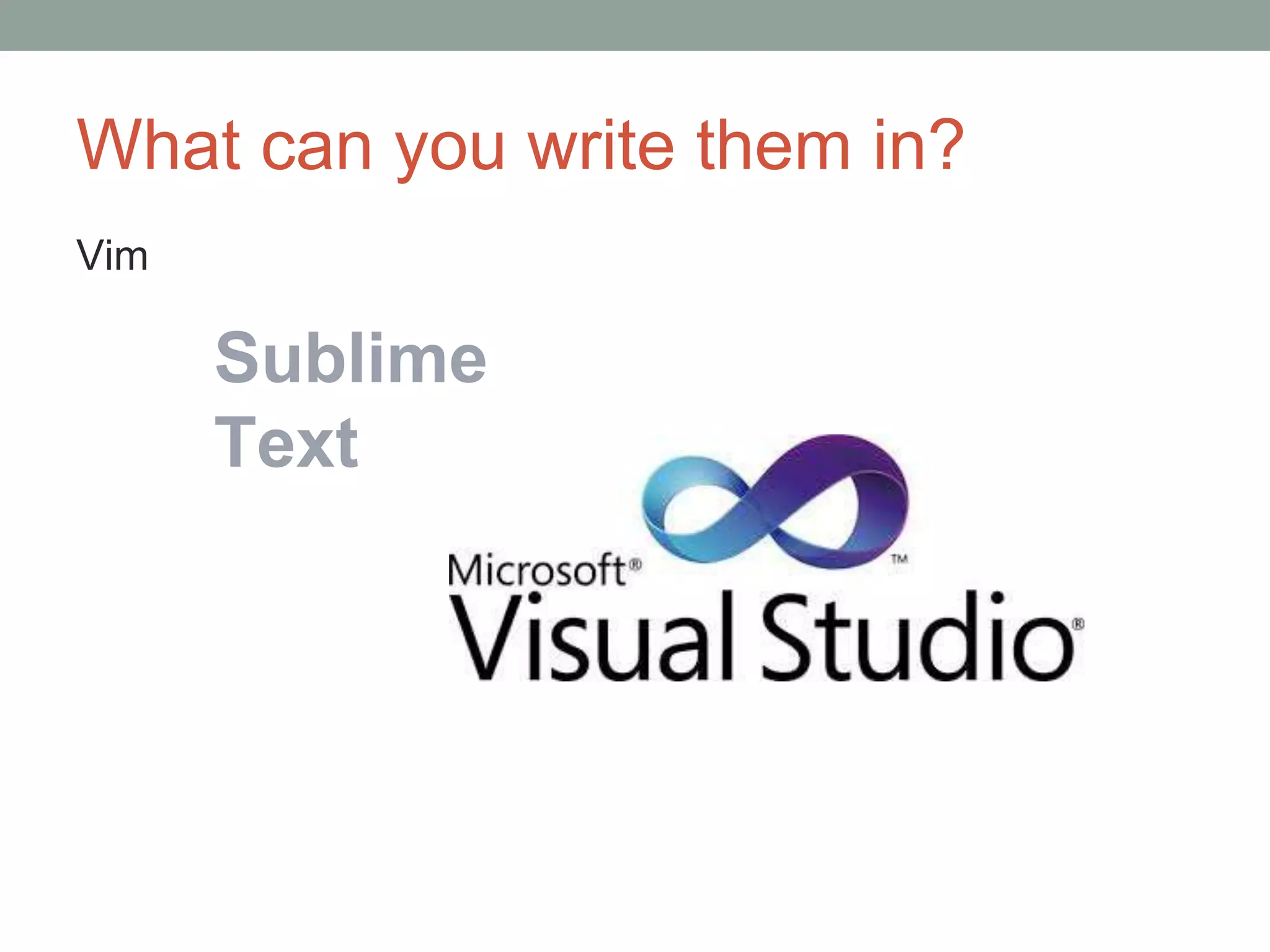
What can you write them in?
Vim
Sublime
Text
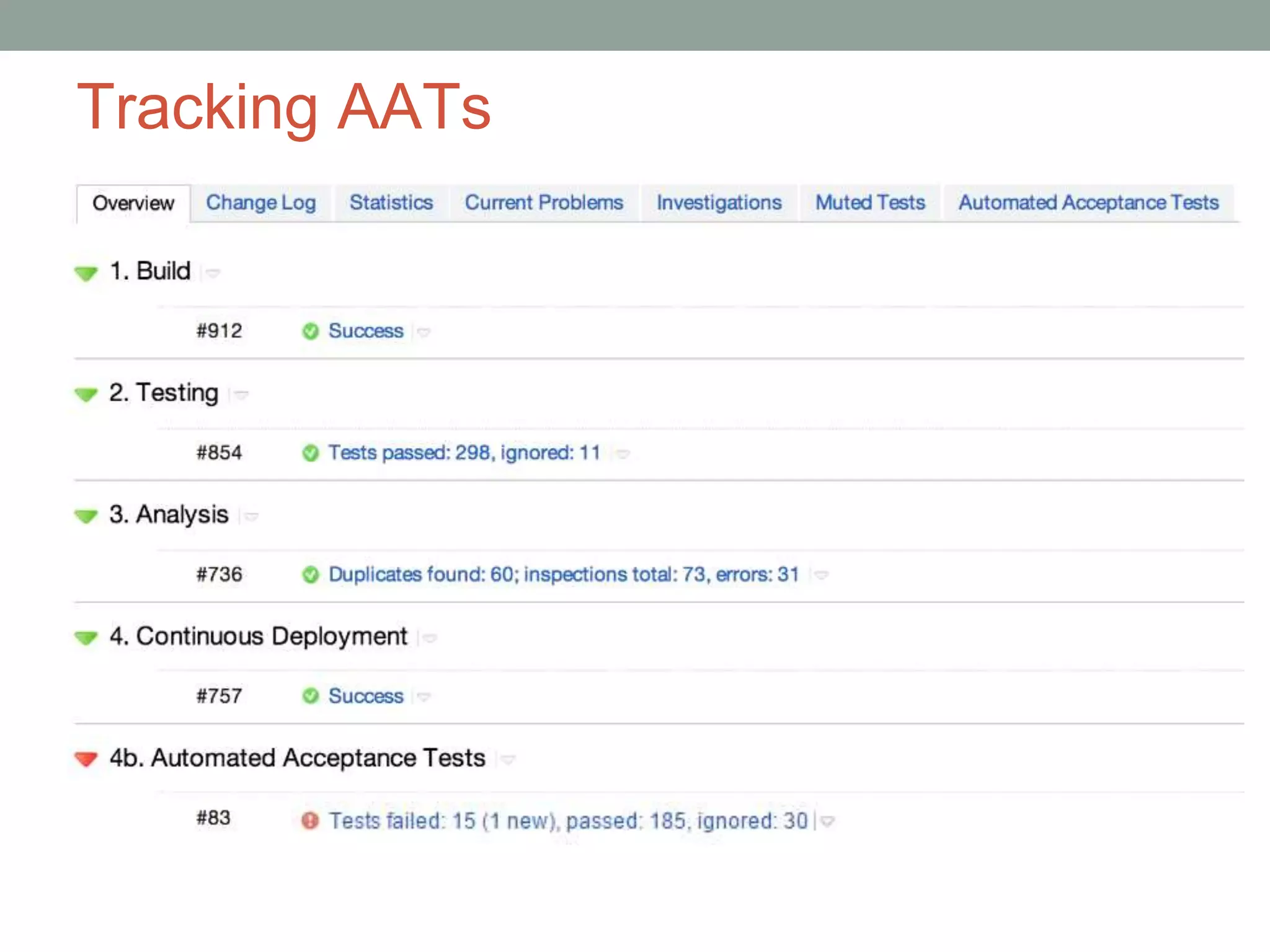
Tracking AATs
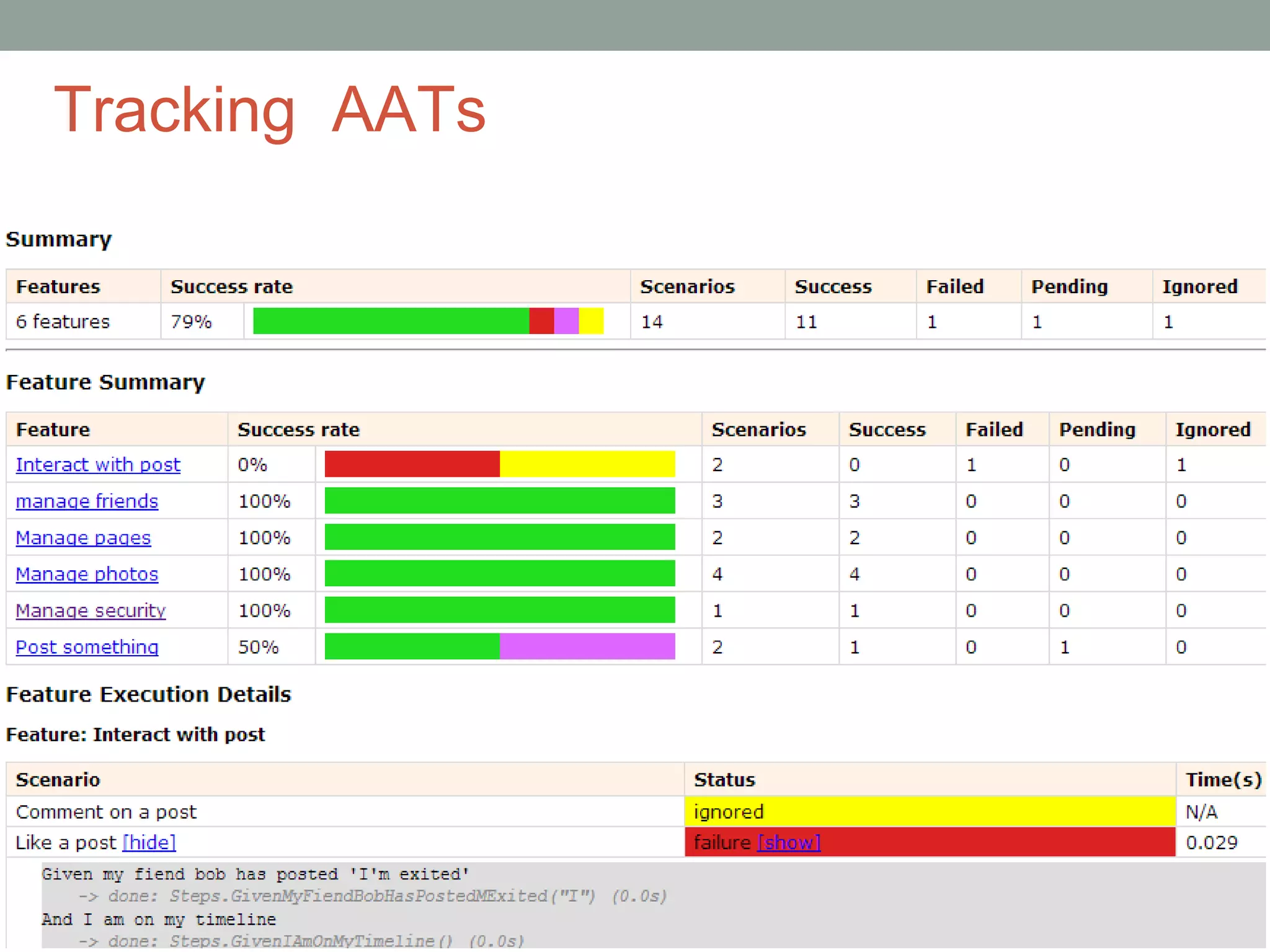
Tracking AATs
Conclusion
• Worth the investment if done properly
• Very expensive and wasteful if not
• Requires collaboration between analysts, testers,
developers
• Developers automate the gherkin
• Focus on journey and scenarios as opposed to stories
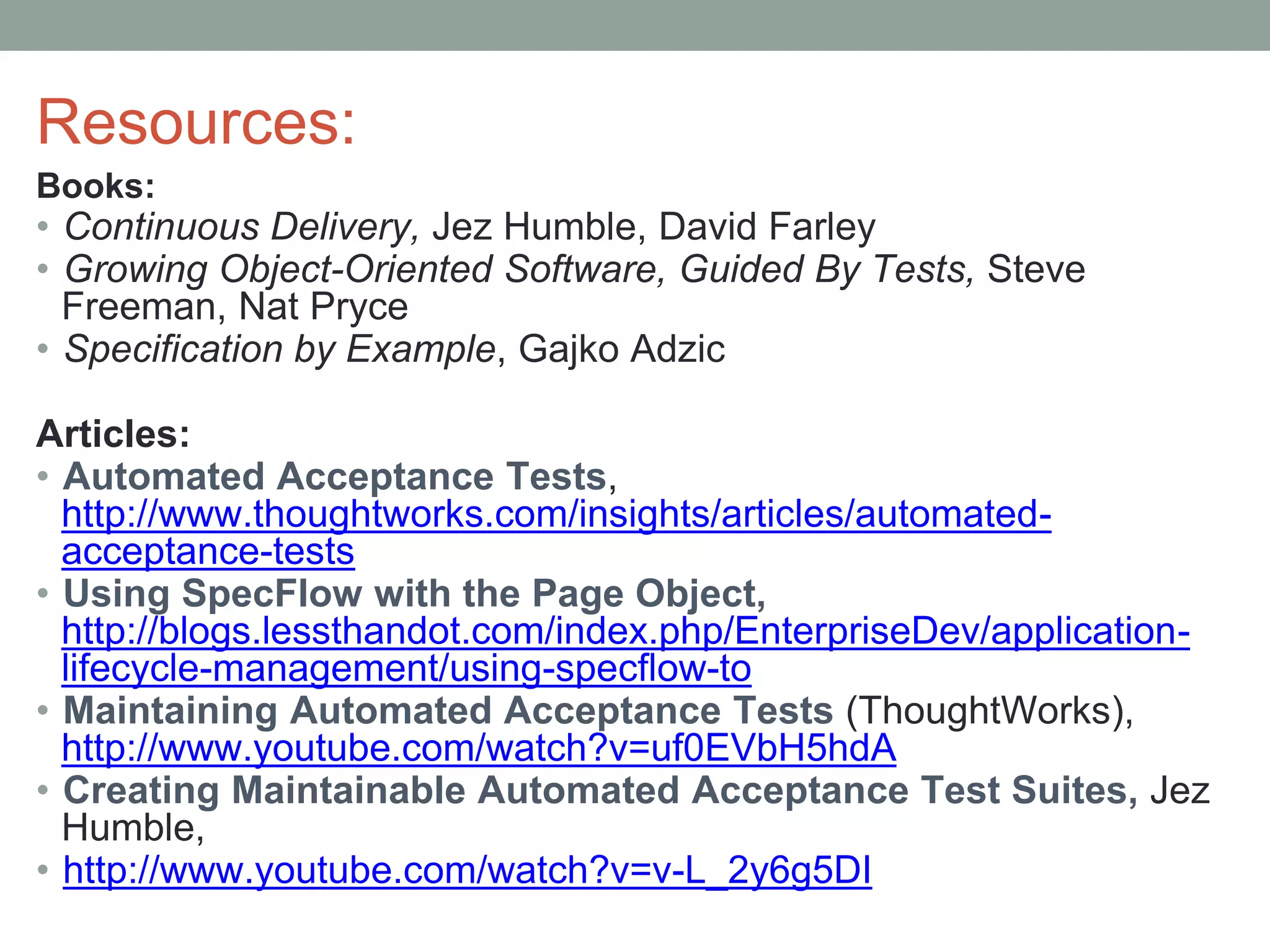
Resources:
Books:
• Continuous Delivery, Jez Humble, David Farley
• Growing Object-Oriented Software, Guided By Tests, Steve
Freeman, Nat Pryce
• Specification by Example, Gajko Adzic
Articles:
• Automated Acceptance Tests,
http://www.thoughtworks.com/insights/articles/automated-
acceptance-tests
• Using SpecFlow with the Page Object,
http://blogs.lessthandot.com/index.php/EnterpriseDev/application-
lifecycle-management/using-specflow-to
• Maintaining Automated Acceptance Tests (ThoughtWorks),
http://www.youtube.com/watch?v=uf0EVbH5hdA
• Creating Maintainable Automated Acceptance Test Suites, Jez
Humble,
• http://www.youtube.com/watch?v=v-L_2y6g5DI
Thanks!
Bharti Rupani
@bhartir24
brupani@enterprise-knowledge.com
https://www.linkedin.com/in/bhartir
Wyn Van Devanter
@wynv
wyn.vandevanter@excella.com
https://www.linkedin.com/in/wyntuition
http://www.slideshare.net/wynvandevanter

Testable requirements

  • 1.
  • 2.
    About Us Bharti Rupani @bhartir24 brupani@enterprise-knowledge.com https://www.linkedin.com/in/bhartir WynVan Devanter @wynv wyn.vandevanter@excella.com https://www.linkedin.com/in/wyntuition http://www.slideshare.net/wynvandevanter
  • 3.
    Terminology • Specification byExample • Executable Specifications • Automated Acceptance Tests (AAT) • Behavior Driven Development (BDD) • Acceptance Test Driven Development (ATDD) • Testable Requirements
  • 4.
  • 5.
    Testable Requirements • UserJourneys • Deliver business value • Clear examples • Executable
  • 6.
    Why should youcare? • Clearly communicate the specifications • No functional gaps • Verify business rules • Build the right thing 6
  • 7.
    Building Quality Plan CollaborateDeliver Build the right thing Build the thing right
  • 8.
    Developing Examples Collaboration Prioritized Backlog Business GoalsUser Journey User Story 2 Acceptance Criteria 1 Example 1 User Story 1 Acceptance Criteria 1 Example 1 Acceptance Criteria 2 Example 1
  • 9.
    Collaborate How doI code this feature?What are the details of this feature? How do I validate that this work is done?
  • 10.
    Three Amigos • BusinessAnalyst, Developers and Testers • Collaborate • Share knowledge • Think about the desired outcome • Shared understanding
  • 11.
    User Journey You area Business Analyst that is looking for a conference to attend.
  • 12.
    Example of usingan Example Attend BA Conference View Results Region Date View DCBADD Details View information about IIBADC View speaker profiles View Cost Select DCBADD Register via Eventbrite Determine Discounts
  • 13.
    User Story As abusiness analyst, I want to review the various IIBA discounts available so that I can pay a reduced ticket price for DCBADD.
  • 14.
    What is Gherkin? •Business readable, domain specific language • Connects human concept of cause and effect to software concept of input/process/output • Can be interpreted by automation tools to drive acceptance tests
  • 15.
  • 16.
    Scenarios Scenario: Standard Rate GivenI am purchasing a ticket to DCBADD And I am not an IIBA member When I view my ticket price Then I see the full rate of $200 Scenario: IIBA Rate Given I am purchasing a ticket to DCBADD And I am an IIBA member When I view my ticket price Then I see the discounted rate of $150
  • 17.
    Example Scenario Outline: DetermineDCBADD ticket price Given I am purchasing a ticket to DCBADD And I am a “<membership type>” When I view my ticket price Then I see the discounted “<ticket price>” Examples: membership price nonmember $200 IIBA national $150 IIBA DC $125
  • 18.
    Example Using tables asarguments as input to a Given or as expected output from a Then: Scenario: Validate Order Total Given I am a business analyst And I am purchasing multiple tickets with varying “<membership type>” to DCBADD: When I view my total Then I see my “<total>” ticket number & type price 2 nonmember $400 1 IIBA national $150
  • 19.
    Guidelines • Be precise •Make sure it’s testable • Focus on business functionality • Avoid specific details • Use active voice, not passive • Have a single action trigger the expected behavior (WHEN condition) • Use parameters for concise expression of examples (i.e. scenario outlines)
  • 20.
  • 21.
    Automated Acceptance Tests (AATs) •Code automates them • They run constantly
  • 22.
  • 23.
    Communication • Helps specifybehavior of the system in plain text • Provides a medium for non-tech and devs to agree on Are we talking about the right system?
  • 24.
  • 25.
    Automation “There’s no placefor human beings to be doing regression testing manually.” -Jez Humble
  • 26.
  • 27.
  • 28.
  • 29.
    Why NOT HaveAATs? (Cons)
  • 30.
    Why don’t morepeople use them?
  • 31.
    Why NOT haveAATs? • Maintenance • Speed • High false negatives, non-determinism
  • 32.
    Impediments • Poor adoption •Bandwidth/Velocity • Learning Curve/Experience • Business users won’t write specifications • Developers won’t automate them • Brittle if recorded
  • 33.
  • 34.
    Acceptance Test Strategy •Happy paths • Major unhappy paths • Legacy • Regression
  • 35.
    Minimize # ofend-to-end tests • AATs for journeys, not stories • Is your new story entirely new? • Balance high # of unit tests + selected end-to-end & acceptance
  • 36.
    Gherkin Specs shouldn’t havemuch setup code Given my friend ‘Bob’ typed ‘I’m excited’ into the text box And clicks the Post button on my timeline When I press the Like link on the post Then the screen should say ‘Like’ And should include my name as liking it Given my friend ‘Bob’ has posted ‘I’m excited’ And I am on my timeline When I like on the post Then the post should be liked by me
  • 37.
    General Tips • Createdifferent levels of suites depending on depth/level of feedback desired: • Smoke, Current iteration/sprint, Regression • Run AATs as close to the real environment as possible
  • 38.
    When Acceptances Testscatches a bug • See why bug got through unit/integration tests • Add unit, integration tests • Prune AATs?
  • 39.
    UI tests • Sometimestests will fail if the page doesn’t have enough time to load. Use implicit waits, and explicit when really needed • Capture screen shots when tests fail • Selenium IDE
  • 40.
  • 41.
    AAT workflow • Startwith a scenario(s) Given my friend ‘Bob’ has posted ‘I’m excited’ And I am on my timeline When I like on the post Then the post should be liked by me
  • 42.
    What can youwrite them in? Vim Sublime Text
  • 43.
  • 44.
  • 45.
    Conclusion • Worth theinvestment if done properly • Very expensive and wasteful if not • Requires collaboration between analysts, testers, developers • Developers automate the gherkin • Focus on journey and scenarios as opposed to stories
  • 46.
    Resources: Books: • Continuous Delivery,Jez Humble, David Farley • Growing Object-Oriented Software, Guided By Tests, Steve Freeman, Nat Pryce • Specification by Example, Gajko Adzic Articles: • Automated Acceptance Tests, http://www.thoughtworks.com/insights/articles/automated- acceptance-tests • Using SpecFlow with the Page Object, http://blogs.lessthandot.com/index.php/EnterpriseDev/application- lifecycle-management/using-specflow-to • Maintaining Automated Acceptance Tests (ThoughtWorks), http://www.youtube.com/watch?v=uf0EVbH5hdA • Creating Maintainable Automated Acceptance Test Suites, Jez Humble, • http://www.youtube.com/watch?v=v-L_2y6g5DI
  • 47.
    Thanks! Bharti Rupani @bhartir24 brupani@enterprise-knowledge.com https://www.linkedin.com/in/bhartir Wyn VanDevanter @wynv wyn.vandevanter@excella.com https://www.linkedin.com/in/wyntuition http://www.slideshare.net/wynvandevanter