Prestige Institute of Engineering Management and Research
Presented by :
Sahil Khan
Mansoori
Rohit Rathore
Rupali Roy
Saloni Patel
Presented to :
Dr. Charu Verma
Topic :Cache memory Mapping types
Cache Mapping
Cache Mapping types
• Direct Mapping
• Fully Associative Mapping
• K-way Set Associative Mapping
 Pros. And Cons. Of all type of mapping
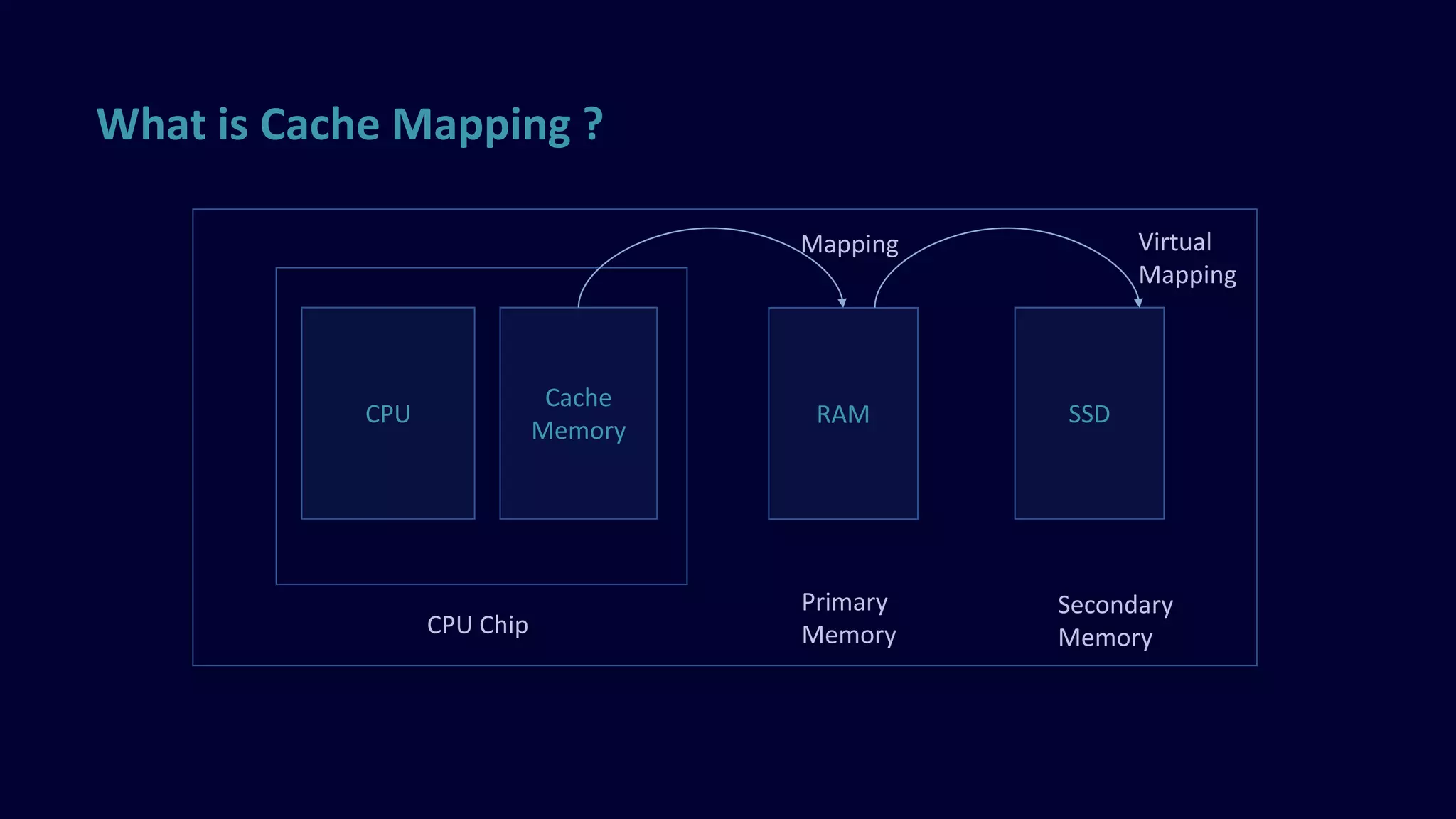
What is Cache Mapping ?
Cache Mapping refers to a technique
using which the content present in the
main memory is brought into the memory
of the cache .
What is Cache Mapping ?
CPU
Cache
Memory
RAM SSD
CPU Chip
Primary
Memory
Secondary
Memory
Mapping Virtual
Mapping
Types of Cache Mapping
There are three type of Cache Mapping
K-way Set
Associative Mapping
Cache
Mapping
Direct
Mapping
Associative
Mapping
What is Direct Mapping ?
In the case of direct mapping, a
certain block of the main memory
would be able to map a cache only up
to a certain line of the cache.
What is Direct Mapping ?
B0
B1
B2
B3
B4
B31
L1
L2
L3
L4
128 Word
16 word
Cache Memory
RAM
W0 W1 W2 W3
W4 W5 W6 W7
W8 W9 W10 W11
W12 W13 W14 W15
W16 W17 W18 W19
W124 W125 W126 W127
The total line numbers of cache to which any distinct block
can map :
K mod n
Here, k=Block No. , n = no. of line
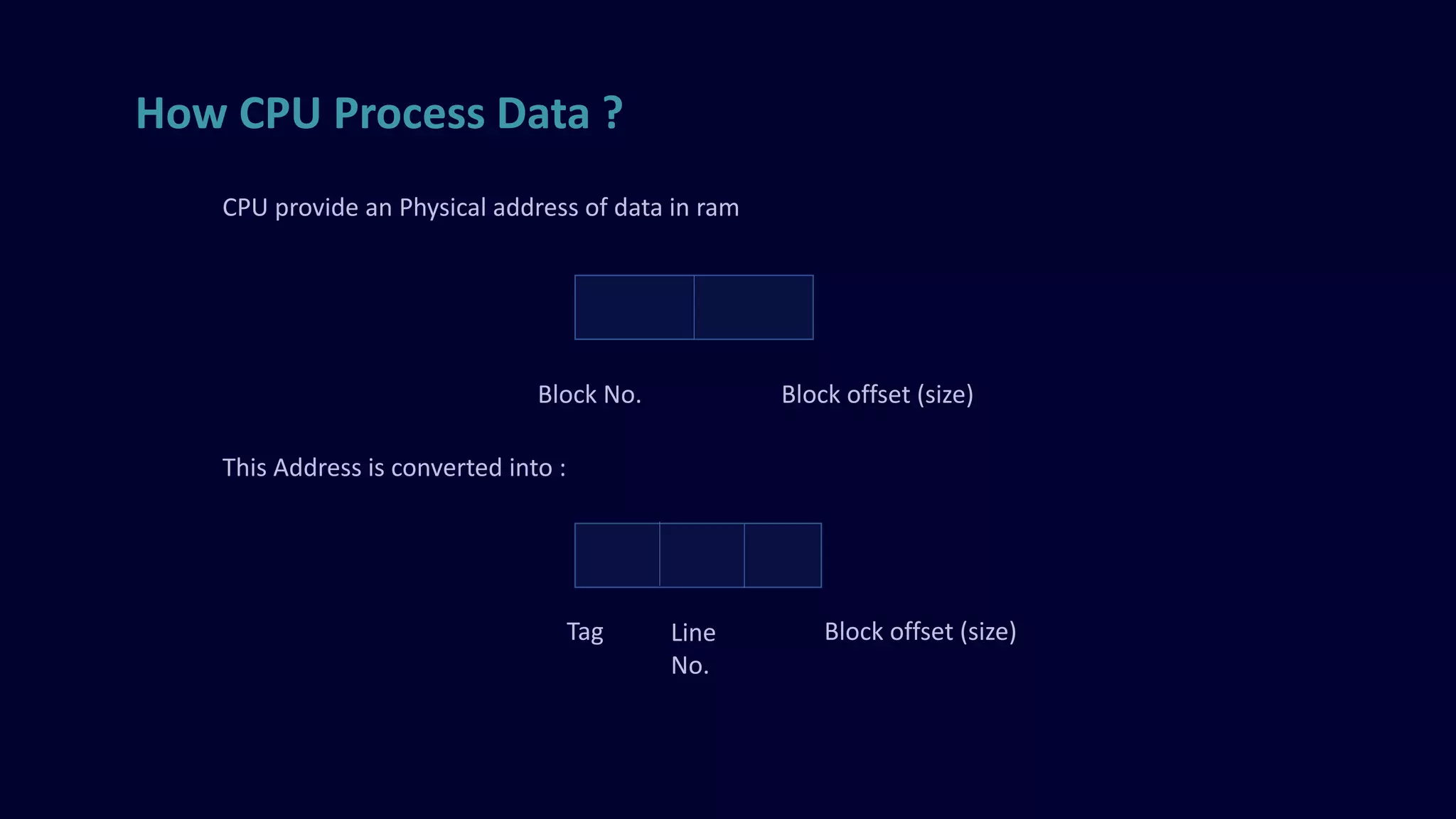
How CPU Process Data ?
CPU provide an Physical address of data in ram
Block offset (size)
Block No.
This Address is converted into :
Block offset (size)
Line
No.
Tag
Question ?
Consider a direct mapped Cache of size 32 KB with block size 32 bytes . The CPU generates 32
bit addresses , find the no. of bits required for line indexing and tag bits respectively
Solve :
Block offset (size)
Tag Line
No.
32 bit
Block size = 32 bytes = 25
which means 5 bit required
Line number = Cache size / block size
= 32 KB / 32 B
= 210
5 bit
Which means
10 bit required
for line no.
10 bit
17 bit
What is Associative Mapping ?
The main memory block is capable of
mapping to any given line of the
cache that’s available freely at that
particular moment.
What is Associative Mapping ?
B0
B1
B2
B3
B4
B31
L1
L2
L3
L4
128 Word
16 word
Cache Memory
RAM
W0 W1 W2 W3
W4 W5 W6 W7
W8 W9 W10 W11
W12 W13 W14 W15
W16 W17 W18 W19
W124 W125 W126 W127
How CPU Process Data ?
CPU provide an Physical address of data in ram
Block offset (size)
Block No.
This Address is converted into :
Block offset (size)
Tag
What is K- way Set Associative Mapping ?
The grouping of the cache lines occurs
into various sets where all the sets
consist of k number of lines.
Any given main memory block can
map only to a particular cache set.
B0
B1
B2
B3
B4
B31
L1
L2
L3
L4
128 Word
16 word
Cache Memory
RAM
W0 W1 W2 W3
W4 W5 W6 W7
W8 W9 W10 W11
W12 W13 W14 W15
W16 W17 W18 W19
W124 W125 W126 W127
What is K- way Set Associative Mapping ?
S0
S1
The total set numbers of cache to which any distinct block can
map :
k mod n
no. of set = no. of line / K
Here, k=Block No. , n = no. of sets
How CPU Process Data ?
CPU provide an Physical address of data in ram
Block offset (size)
Block No.
This Address is converted into :
Block offset (size)
Set
No.
Tag
Thank you

Coa presentation.pptx

  • 1.
    Prestige Institute ofEngineering Management and Research Presented by : Sahil Khan Mansoori Rohit Rathore Rupali Roy Saloni Patel Presented to : Dr. Charu Verma Topic :Cache memory Mapping types
  • 2.
    Cache Mapping Cache Mappingtypes • Direct Mapping • Fully Associative Mapping • K-way Set Associative Mapping  Pros. And Cons. Of all type of mapping
  • 3.
    What is CacheMapping ? Cache Mapping refers to a technique using which the content present in the main memory is brought into the memory of the cache .
  • 4.
    What is CacheMapping ? CPU Cache Memory RAM SSD CPU Chip Primary Memory Secondary Memory Mapping Virtual Mapping
  • 5.
    Types of CacheMapping There are three type of Cache Mapping K-way Set Associative Mapping Cache Mapping Direct Mapping Associative Mapping
  • 6.
    What is DirectMapping ? In the case of direct mapping, a certain block of the main memory would be able to map a cache only up to a certain line of the cache.
  • 7.
    What is DirectMapping ? B0 B1 B2 B3 B4 B31 L1 L2 L3 L4 128 Word 16 word Cache Memory RAM W0 W1 W2 W3 W4 W5 W6 W7 W8 W9 W10 W11 W12 W13 W14 W15 W16 W17 W18 W19 W124 W125 W126 W127 The total line numbers of cache to which any distinct block can map : K mod n Here, k=Block No. , n = no. of line
  • 8.
    How CPU ProcessData ? CPU provide an Physical address of data in ram Block offset (size) Block No. This Address is converted into : Block offset (size) Line No. Tag
  • 9.
    Question ? Consider adirect mapped Cache of size 32 KB with block size 32 bytes . The CPU generates 32 bit addresses , find the no. of bits required for line indexing and tag bits respectively Solve : Block offset (size) Tag Line No. 32 bit Block size = 32 bytes = 25 which means 5 bit required Line number = Cache size / block size = 32 KB / 32 B = 210 5 bit Which means 10 bit required for line no. 10 bit 17 bit
  • 10.
    What is AssociativeMapping ? The main memory block is capable of mapping to any given line of the cache that’s available freely at that particular moment.
  • 11.
    What is AssociativeMapping ? B0 B1 B2 B3 B4 B31 L1 L2 L3 L4 128 Word 16 word Cache Memory RAM W0 W1 W2 W3 W4 W5 W6 W7 W8 W9 W10 W11 W12 W13 W14 W15 W16 W17 W18 W19 W124 W125 W126 W127
  • 12.
    How CPU ProcessData ? CPU provide an Physical address of data in ram Block offset (size) Block No. This Address is converted into : Block offset (size) Tag
  • 13.
    What is K-way Set Associative Mapping ? The grouping of the cache lines occurs into various sets where all the sets consist of k number of lines. Any given main memory block can map only to a particular cache set.
  • 14.
    B0 B1 B2 B3 B4 B31 L1 L2 L3 L4 128 Word 16 word CacheMemory RAM W0 W1 W2 W3 W4 W5 W6 W7 W8 W9 W10 W11 W12 W13 W14 W15 W16 W17 W18 W19 W124 W125 W126 W127 What is K- way Set Associative Mapping ? S0 S1 The total set numbers of cache to which any distinct block can map : k mod n no. of set = no. of line / K Here, k=Block No. , n = no. of sets
  • 15.
    How CPU ProcessData ? CPU provide an Physical address of data in ram Block offset (size) Block No. This Address is converted into : Block offset (size) Set No. Tag
  • 16.