"A business modeldescribes the rationale of
how an organization creates, delivers, and
captures value." —
Alexander Osterwalder
3.
About Business Models
Abusiness model is a strategic framework for
creating, delivering, and capturing value.
Why It Matters: Helps organizations understand
revenue generation, cost structure, and value
proposition.
Examples: Subscription models (Netflix),
Marketplace models (Amazon), SaaS models
(Salesforce).
4.
Business Model CanvasOverview
A strategic tool developed by
Alexander Osterwalder to visualize
and refine a business model.
Purpose: Simplifies business
planning by breaking it into key
components.
Application: Used by startups and
enterprises to optimize operations
and growth strategies.
5.
Business Model Patterns
Theseinvolve creating
entirely new business
models that disrupt
industries or introduce
novel ways of delivering
value.
Examples: Tesla,
Airbnb.
Invent Patterns Shift Patterns
These involve adapting
or modifying existing
business models to new
market conditions,
emerging technologies,
or evolving customer
needs.
Examples:
Netflix,Apple
6.
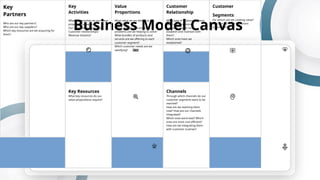
Business Model Canvas
Key
Partners
Whoare our key partners?
Who are our key suppliers?
Which key resources are we acquiring for
them?
Key
Activities
What key activities do our value
propositions require?
Our distribution channels?
Customer relationships?
Revenue streams?
Value
Proportions
What value do we deliver to the
customer?
Which one of our customer’s
problems are we helping to solve?
What bundles of products and
services are we offering to each
customer segment?
Which customer needs are we
satisfying?
Customer
Relationship
What type of relationship does
each of our customer
segments expect us to
establish and maintain with
them?
Which ones have we
established?
Customer
Segments
For whom are we creating value?
Who are our most important
customers?
Key Resources
What key resources do our
value propositions require?
Channels
Through which channels do our
customer segments want to be
reached?
How are we reaching them
now? How are our channels
integrated?
Which ones work best? Which
ones are most cost-efficient?
How are we integrating them
with customer routines?
7.
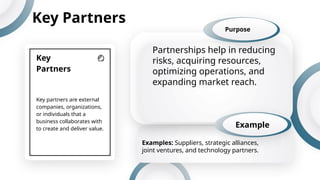
Key
Partners
Key partners areexternal
companies, organizations,
or individuals that a
business collaborates with
to create and deliver value.
Key Partners
Partnerships help in reducing
risks, acquiring resources,
optimizing operations, and
expanding market reach.
Purpose
Example
Examples: Suppliers, strategic alliances,
joint ventures, and technology partners.
8.
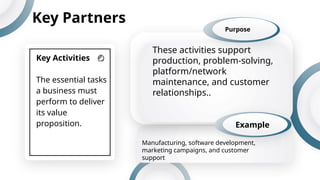
Key Activities
The essentialtasks
a business must
perform to deliver
its value
proposition.
Key Partners
These activities support
production, problem-solving,
platform/network
maintenance, and customer
relationships..
Purpose
Example
Manufacturing, software development,
marketing campaigns, and customer
support
9.
The most critical
assets(physical,
intellectual,
human, or
financial) required
to operate the
business.
Key Resources
These resources
enable the business
to create value,
reach customers,
and sustain
operations. ..
Purpose
Example
Patents, brand reputation, skilled
workforce, distribution networks,
and funding.
10.
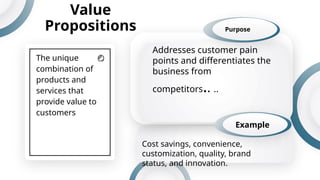
The unique
combination of
productsand
services that
provide value to
customers
Value
Propositions
Addresses customer pain
points and differentiates the
business from
competitors.. ..
Purpose
Example
Cost savings, convenience,
customization, quality, brand
status, and innovation.
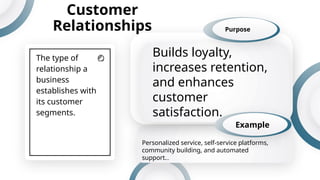
11.
The type of
relationshipa
business
establishes with
its customer
segments.
Customer
Relationships
Builds loyalty,
increases retention,
and enhances
customer
satisfaction.
Purpose
Example
Personalized service, self-service platforms,
community building, and automated
support...
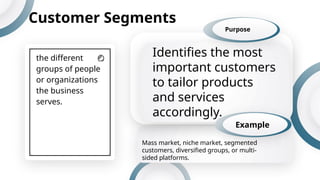
12.
the different
groups ofpeople
or organizations
the business
serves.
Customer Segments
Identifies the most
important customers
to tailor products
and services
accordingly.
Purpose
Example
Mass market, niche market, segmented
customers, diversified groups, or multi-
sided platforms.
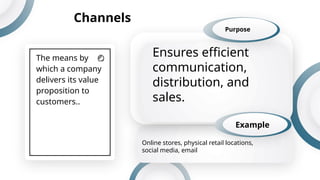
13.
The means by
whicha company
delivers its value
proposition to
customers..
Channels
Ensures efficient
communication,
distribution, and
sales.
Purpose
Example
Online stores, physical retail locations,
social media, email
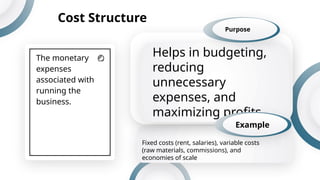
14.
The monetary
expenses
associated with
runningthe
business.
Cost Structure
Helps in budgeting,
reducing
unnecessary
expenses, and
maximizing profits.
Purpose
Example
Fixed costs (rent, salaries), variable costs
(raw materials, commissions), and
economies of scale