HIMSS – National Capitol Area Rosslyn, VA October 16, 2008 Medicaid IT Architecture and Interoperability Rick Friedman, Dir.  Division of State Systems  CMSO, CMS richard.friedman@cms.hhs.gov
Medicaid Background Information
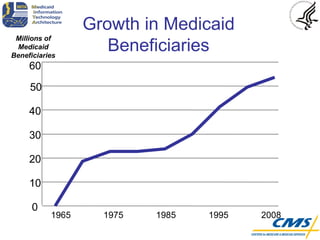
Growth in Medicaid Beneficiaries Millions of Medicaid Beneficiaries 0 10 20 30 40 50 60 1965 1975 1985 1995 2008
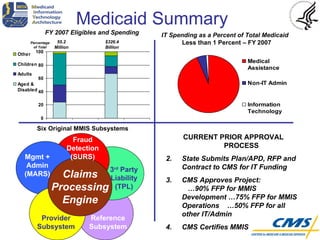
Medicaid Summary Percentage of Total 55.2 Million $326.4 Billion IT Spending as a Percent of Total Medicaid   Less than 1 Percent – FY   2007 FY 2007 Eligibles and Spending Claims Processing Engine Fraud Detection (SURS) Mgmt + Admin (MARS) 3 rd  Party Liability (TPL) Provider Subsystem Reference Subsystem Six Original MMIS Subsystems CURRENT PRIOR APPROVAL PROCESS State Submits Plan/APD, RFP and Contract to CMS for IT Funding CMS Approves Project:  …90% FFP for MMIS Development …75% FFP for MMIS Operations  …50% FFP for all other IT/Admin CMS Certifies MMIS
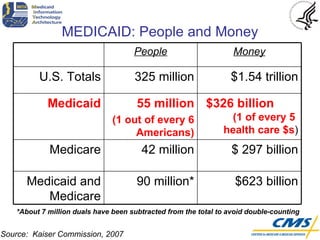
MEDICAID: People and Money *About 7 million duals have been subtracted from the total to avoid double-counting Source:  Kaiser Commission, 2007 $623 billion 90 million* Medicaid and Medicare $ 297 billion 42 million Medicare $326 billion  (1 of every 5  health care $s ) 55 million (1 out of every 6 Americans) Medicaid $1.54 trillion 325 million U.S. Totals Money People
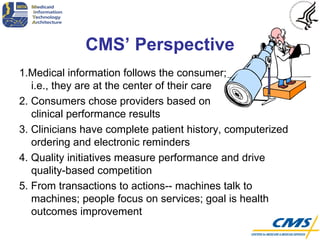
CMS’ Perspective 1.Medical information follows the consumer;  i.e., they are at the center of their care 2. Consumers chose providers based on  clinical performance results 3. Clinicians have complete patient history, computerized ordering and electronic reminders 4. Quality initiatives measure performance and drive quality-based competition 5. From transactions to actions-- machines talk to machines; people focus on services; goal is health outcomes improvement
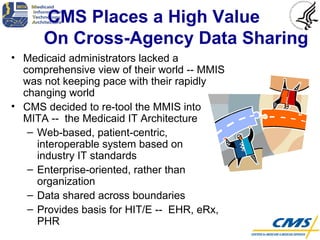
CMS Places a High Value  On Cross-Agency Data Sharing Medicaid administrators lacked a comprehensive view of their world -- MMIS was not keeping pace with their rapidly changing world CMS decided to re-tool the MMIS into  MITA --  the Medicaid IT Architecture Web-based, patient-centric,  interoperable system based on  industry IT standards Enterprise-oriented, rather than organization Data shared across boundaries Provides basis for HIT/E --  EHR, eRx, PHR
Medicaid Information Technology Architecture  (MITA)
What Is MITA? MITA is a  FRAMEWORK MITA is  a  TOOL KIT MITA is a  ROAD MAP NOTE:  MITA is NOT a  one-size-fits-all approach  Each State builds its own IT solution  based on standards, models and  processes contained within the MITA  Framework that have been developed  with the help of all States and the IT  industry
Key Principles--MITA Support State-driven program  requirements as well as Federal Provide Medicaid managers at all levels with robust data sets that significantly enhance their ability  to focus on outcomes Business-driven enterprise architecture Commonalities and differences co-exist peacefully Standards first Built-in Security and Privacy Data consistency across the enterprise
MITA’s Goals Provide State Medicaid agencies with a powerful analytical tool Improve health care outcomes Align with Federal Health  Architecture  Ensure patient-centric views  not  constrained by organizational  barriers Make use of common IT and data standards
MITA’s Objectives Foster interoperability between and within State Medicaid organizations  Provide web-based access and integration while respecting patient privacy and confidentiality concerns Support software reusability with commercial off-the-shelf (COTS) software Integrate seamlessly clinical and public health data
MITA’s Orientation Business-driven service oriented architecture solution  (focus on supporting biz not tech) Firmly grounded in enterprise architecture principles ( in use by many other industries ) Defines a business transformation over a five year and long-term (10 years and greater) timeframe Includes a technical architecture and a transition strategy to enable the business transformation
How Would CMS Handle Funding in a Collaborative Environment that Focuses on Interoperability? Three Scenarios and  e-Rx Data Flow
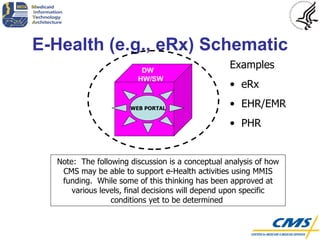
E-Health (e.g., eRx) Schematic Note:  The following discussion is a conceptual analysis of how CMS may be able to support e-Health activities using MMIS funding.  While some of this thinking has been approved at various levels, final decisions will depend upon specific conditions yet to be determined  DW  HW/SW WEB PORTAL Examples eRx EHR/EMR PHR
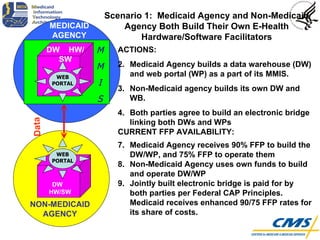
NON-MEDICAID AGENCY DW  HW/SW ACTIONS: Medicaid Agency builds a data warehouse (DW) and web portal (WP) as a part of its MMIS.  Non-Medicaid agency builds its own DW and WB.  Both parties agree to build an electronic bridge linking both DWs and WPs CURRENT FFP AVAILABILITY: Medicaid Agency receives 90% FFP to build the DW/WP, and 75% FFP to operate them Non-Medicaid Agency uses own funds to build and operate DW/WP Jointly built electronic bridge is paid for by both parties per Federal CAP Principles. Medicaid receives enhanced 90/75 FFP rates for its share of costs. MEDICAID AGENCY Scenario 1:  Medicaid Agency and Non-Medicaid Agency Both Build Their Own E-Health Hardware/Software Facilitators DW  HW/SW Data WEB PORTAL M M I S WEB PORTAL
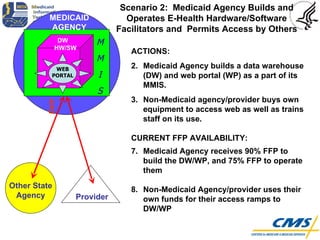
Other State Agency DW  HW/SW ACTIONS: Medicaid Agency builds a data warehouse (DW) and web portal (WP) as a part of its MMIS.  Non-Medicaid agency/provider buys own equipment to access web as well as trains staff on its use.  CURRENT FFP AVAILABILITY: Medicaid Agency receives 90% FFP to build the DW/WP, and 75% FFP to operate them Non-Medicaid Agency/provider uses their own funds for their access ramps to DW/WP MEDICAID AGENCY Scenario 2:  Medicaid Agency Builds and Operates E-Health Hardware/Software Facilitators and  Permits Access by Others Data M M I S WEB PORTAL Provider
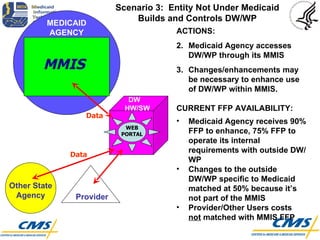
Other State Agency DW  HW/SW ACTIONS: Medicaid Agency accesses DW/WP through its MMIS Changes/enhancements may be necessary to enhance use of DW/WP within MMIS.  CURRENT FFP AVAILABILITY: Medicaid Agency receives 90% FFP to enhance, 75% FFP to operate its internal requirements with outside DW/WP Changes to the outside DW/WP specific to Medicaid matched at 50% because it’s not part of the MMIS Provider/Other Users costs  not  matched with MMIS FFP MEDICAID AGENCY Scenario 3:  Entity Not Under Medicaid Builds and Controls DW/WP MMIS WEB PORTAL Provider Data Data
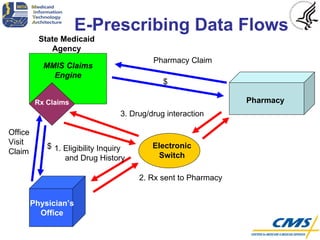
E-Prescribing Data Flows Physician’s Office Electronic Switch Pharmacy State Medicaid Agency MMIS Claims Engine Rx Claims 1. Eligibility Inquiry  and Drug History 2. Rx sent to Pharmacy $ $ Office Visit Claim Pharmacy Claim 3. Drug/drug interaction

CMS MITA Presentation 10/16/2008

  • 1.
    HIMSS – NationalCapitol Area Rosslyn, VA October 16, 2008 Medicaid IT Architecture and Interoperability Rick Friedman, Dir. Division of State Systems CMSO, CMS richard.friedman@cms.hhs.gov
  • 2.
  • 3.
    Growth in MedicaidBeneficiaries Millions of Medicaid Beneficiaries 0 10 20 30 40 50 60 1965 1975 1985 1995 2008
  • 4.
    Medicaid Summary Percentageof Total 55.2 Million $326.4 Billion IT Spending as a Percent of Total Medicaid Less than 1 Percent – FY 2007 FY 2007 Eligibles and Spending Claims Processing Engine Fraud Detection (SURS) Mgmt + Admin (MARS) 3 rd Party Liability (TPL) Provider Subsystem Reference Subsystem Six Original MMIS Subsystems CURRENT PRIOR APPROVAL PROCESS State Submits Plan/APD, RFP and Contract to CMS for IT Funding CMS Approves Project: …90% FFP for MMIS Development …75% FFP for MMIS Operations …50% FFP for all other IT/Admin CMS Certifies MMIS
  • 5.
    MEDICAID: People andMoney *About 7 million duals have been subtracted from the total to avoid double-counting Source: Kaiser Commission, 2007 $623 billion 90 million* Medicaid and Medicare $ 297 billion 42 million Medicare $326 billion (1 of every 5 health care $s ) 55 million (1 out of every 6 Americans) Medicaid $1.54 trillion 325 million U.S. Totals Money People
  • 6.
    CMS’ Perspective 1.Medicalinformation follows the consumer; i.e., they are at the center of their care 2. Consumers chose providers based on clinical performance results 3. Clinicians have complete patient history, computerized ordering and electronic reminders 4. Quality initiatives measure performance and drive quality-based competition 5. From transactions to actions-- machines talk to machines; people focus on services; goal is health outcomes improvement
  • 7.
    CMS Places aHigh Value On Cross-Agency Data Sharing Medicaid administrators lacked a comprehensive view of their world -- MMIS was not keeping pace with their rapidly changing world CMS decided to re-tool the MMIS into MITA -- the Medicaid IT Architecture Web-based, patient-centric, interoperable system based on industry IT standards Enterprise-oriented, rather than organization Data shared across boundaries Provides basis for HIT/E -- EHR, eRx, PHR
  • 8.
  • 9.
    What Is MITA?MITA is a FRAMEWORK MITA is a TOOL KIT MITA is a ROAD MAP NOTE: MITA is NOT a one-size-fits-all approach Each State builds its own IT solution based on standards, models and processes contained within the MITA Framework that have been developed with the help of all States and the IT industry
  • 10.
    Key Principles--MITA SupportState-driven program requirements as well as Federal Provide Medicaid managers at all levels with robust data sets that significantly enhance their ability to focus on outcomes Business-driven enterprise architecture Commonalities and differences co-exist peacefully Standards first Built-in Security and Privacy Data consistency across the enterprise
  • 11.
    MITA’s Goals ProvideState Medicaid agencies with a powerful analytical tool Improve health care outcomes Align with Federal Health Architecture Ensure patient-centric views not constrained by organizational barriers Make use of common IT and data standards
  • 12.
    MITA’s Objectives Fosterinteroperability between and within State Medicaid organizations Provide web-based access and integration while respecting patient privacy and confidentiality concerns Support software reusability with commercial off-the-shelf (COTS) software Integrate seamlessly clinical and public health data
  • 13.
    MITA’s Orientation Business-drivenservice oriented architecture solution (focus on supporting biz not tech) Firmly grounded in enterprise architecture principles ( in use by many other industries ) Defines a business transformation over a five year and long-term (10 years and greater) timeframe Includes a technical architecture and a transition strategy to enable the business transformation
  • 14.
    How Would CMSHandle Funding in a Collaborative Environment that Focuses on Interoperability? Three Scenarios and e-Rx Data Flow
  • 15.
    E-Health (e.g., eRx)Schematic Note: The following discussion is a conceptual analysis of how CMS may be able to support e-Health activities using MMIS funding. While some of this thinking has been approved at various levels, final decisions will depend upon specific conditions yet to be determined DW HW/SW WEB PORTAL Examples eRx EHR/EMR PHR
  • 16.
    NON-MEDICAID AGENCY DW HW/SW ACTIONS: Medicaid Agency builds a data warehouse (DW) and web portal (WP) as a part of its MMIS. Non-Medicaid agency builds its own DW and WB. Both parties agree to build an electronic bridge linking both DWs and WPs CURRENT FFP AVAILABILITY: Medicaid Agency receives 90% FFP to build the DW/WP, and 75% FFP to operate them Non-Medicaid Agency uses own funds to build and operate DW/WP Jointly built electronic bridge is paid for by both parties per Federal CAP Principles. Medicaid receives enhanced 90/75 FFP rates for its share of costs. MEDICAID AGENCY Scenario 1: Medicaid Agency and Non-Medicaid Agency Both Build Their Own E-Health Hardware/Software Facilitators DW HW/SW Data WEB PORTAL M M I S WEB PORTAL
  • 17.
    Other State AgencyDW HW/SW ACTIONS: Medicaid Agency builds a data warehouse (DW) and web portal (WP) as a part of its MMIS. Non-Medicaid agency/provider buys own equipment to access web as well as trains staff on its use. CURRENT FFP AVAILABILITY: Medicaid Agency receives 90% FFP to build the DW/WP, and 75% FFP to operate them Non-Medicaid Agency/provider uses their own funds for their access ramps to DW/WP MEDICAID AGENCY Scenario 2: Medicaid Agency Builds and Operates E-Health Hardware/Software Facilitators and Permits Access by Others Data M M I S WEB PORTAL Provider
  • 18.
    Other State AgencyDW HW/SW ACTIONS: Medicaid Agency accesses DW/WP through its MMIS Changes/enhancements may be necessary to enhance use of DW/WP within MMIS. CURRENT FFP AVAILABILITY: Medicaid Agency receives 90% FFP to enhance, 75% FFP to operate its internal requirements with outside DW/WP Changes to the outside DW/WP specific to Medicaid matched at 50% because it’s not part of the MMIS Provider/Other Users costs not matched with MMIS FFP MEDICAID AGENCY Scenario 3: Entity Not Under Medicaid Builds and Controls DW/WP MMIS WEB PORTAL Provider Data Data
  • 19.
    E-Prescribing Data FlowsPhysician’s Office Electronic Switch Pharmacy State Medicaid Agency MMIS Claims Engine Rx Claims 1. Eligibility Inquiry and Drug History 2. Rx sent to Pharmacy $ $ Office Visit Claim Pharmacy Claim 3. Drug/drug interaction