Kids Living and LearningWith New Media
Tim Sprague
CMS 298
Chapter 7 :Work
Work,Youth, and New Media
 In the United States youth are largely shut
out from the primary labor market (p 296)
 Activities such as “helping” at home or in
class often are not counted as work,
although they are clearly productive labor
(p297)
 New media learning is validated by the by
the expectation it will translate to job
relevant skills in the future.(p 298)
2
Work,Youth, and New Media
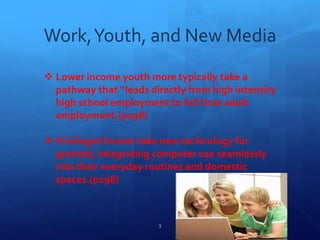
 Lower income youth more typically take a
pathway that “leads directly from high intensity
high school employment to full time adult
employment.(p298)
 Privileged homes take new technology for
granted, integrating computer use seamlessly
into their everyday routines and domestic
spaces.(p298)
3
Work,Youth, and New Media
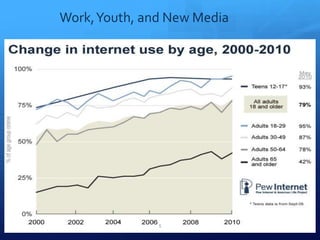
 Digital and networked media have opened up
0pportunities for economic activity for young
people that are not part of the existing ghettoes of
youth labor, but rather involve young people’s
mobilizing and hustling to market their new media
skills in a more entrepreneurial vein.(p299)
4
Work,Youth, and New Media
5
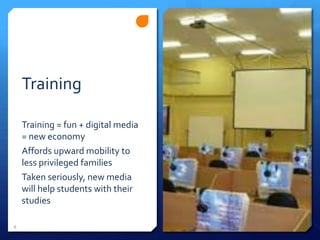
Training
Training = fun + digital media
= new economy
Affords upward mobility to
less privileged families
Taken seriously, new media
will help students with their
studies
6
Training Continued
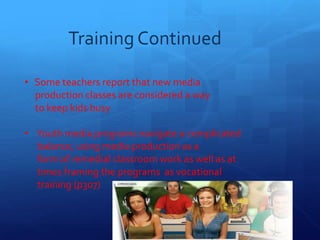
• Some teachers report that new media
production classes are considered a way
to keep kids busy
• Youth media programs navigate a complicated
balance, using media production as a
form of remedial classroom work as well as at
times framing the programs as vocational
training (p307)
7
Entrepreneurism
Historically, technology has been an area where
kids traditionally spent money, now with the
almost seamless transition between recreational
media and potential money making avenues, young
people are recognizing value in terms of dollars, that
this former pastime represents
8
Publishing and Distribution
Anime: a style of animation originating in Japan that is characterized by stark colorful
graphics depicting vibrant characters in action filled plots often with fantastic or futuristic
themes
9
Publishing and Distribution Cont.
• While the vast majority of these efforts are not oriented toward immediate gain,
some of the more entrepreneurial young creators are reaping economic benefits
from their creative work (p310)
• Online revenue is obtained by either selling advertising space or by selling their
actual end product
• Mizuko Ito quoting Mahiri et al reports that, “artists can often feel conflicting
loyalties over whether they are pursuing their craft for the love of the work or
for economic goals.” (p310)
• Anime sales in North America in 2010 totaled approximately $180
million. Needless to say Anime is a lucrative business
10
Freelancing
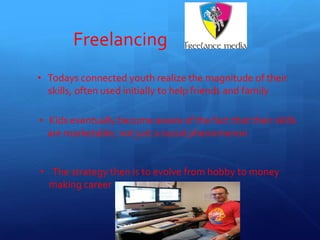
• Todays connected youth realize the magnitude of their
skills, often used initially to help friends and family
• Kids eventually become aware of the fact that their skills
are marketable, not just a social phenomenon
• The strategy then is to evolve from hobby to money
making career
11
Enterprises
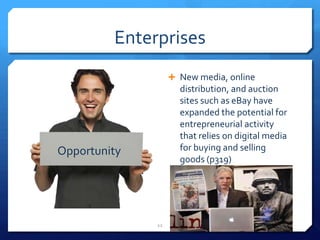
 New media, online
distribution, and auction
sites such as eBay have
expanded the potential for
entrepreneurial activity
that relies on digital media
for buying and selling
goods (p319)
Opportunity
12
Enterprises Cont.
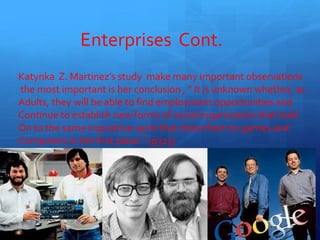
Katynka Z. Martinez’s study make many important observations
the most important is her conclusion , ” It is unknown whether, as
Adults, they will be able to find employment opportunities and
Continue to establish new forms of social organization that hold
On to the same inquisitive spirit that drew them to games and
Computers in the first place.” (p323)
13
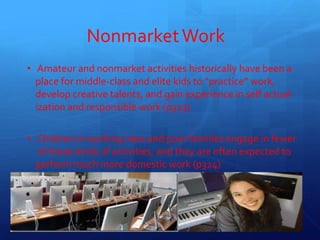
NonmarketWork
• Amateur and nonmarket activities historically have been a
place for middle-class and elite kids to “practice” work,
develop creative talents, and gain experience in self actual-
ization and responsible work (p323)
• Children in working class and poor families engage in fewer
of these kinds of activities, and they are often expected to
perform much more domestic work (p324)
14
Nonmarket Peer Production
• Fan subbing: amateur Amine subtitlers who translate and
subtitle anime and release it through Internet distribution
• No Compensation
• Fansubbers do their work for “fellow fans” and for the
pleasure of working with other like-minded members
15
Conclusion
This study of socioeconomic groups in the new digital age,
sheds lite on the workings and strategies of cultural clans
In various settings. The middle class and elitists described
In chapter 7 take their digital circumstances almost for granted,
While the poor and less fortunate alliances are aware of their
Disadvantaged economic conditions and strive to take advantage
Of the few opportunities that are present
16
17
Reference
Ito, M., Baumer, S., Bittani, M., Cody, R., Herr-Stephenson, , Horst, H.
A., &Tripp, L. (2010). Hanging out, messing around, and
geeking out; kids living and learning with new media.
Cambridge, MA: Massachusetts Institute ofTechnology.
Retrieved from http://mitpress.mit.edu/books/hanging-out-
messing-around-and-geeking-out

Cms 298 geeking

  • 1.
    Kids Living andLearningWith New Media Tim Sprague CMS 298 Chapter 7 :Work
  • 2.
    Work,Youth, and NewMedia  In the United States youth are largely shut out from the primary labor market (p 296)  Activities such as “helping” at home or in class often are not counted as work, although they are clearly productive labor (p297)  New media learning is validated by the by the expectation it will translate to job relevant skills in the future.(p 298) 2
  • 3.
    Work,Youth, and NewMedia  Lower income youth more typically take a pathway that “leads directly from high intensity high school employment to full time adult employment.(p298)  Privileged homes take new technology for granted, integrating computer use seamlessly into their everyday routines and domestic spaces.(p298) 3
  • 4.
    Work,Youth, and NewMedia  Digital and networked media have opened up 0pportunities for economic activity for young people that are not part of the existing ghettoes of youth labor, but rather involve young people’s mobilizing and hustling to market their new media skills in a more entrepreneurial vein.(p299) 4
  • 5.
  • 6.
    Training Training = fun+ digital media = new economy Affords upward mobility to less privileged families Taken seriously, new media will help students with their studies 6
  • 7.
    Training Continued • Someteachers report that new media production classes are considered a way to keep kids busy • Youth media programs navigate a complicated balance, using media production as a form of remedial classroom work as well as at times framing the programs as vocational training (p307) 7
  • 8.
    Entrepreneurism Historically, technology hasbeen an area where kids traditionally spent money, now with the almost seamless transition between recreational media and potential money making avenues, young people are recognizing value in terms of dollars, that this former pastime represents 8
  • 9.
    Publishing and Distribution Anime:a style of animation originating in Japan that is characterized by stark colorful graphics depicting vibrant characters in action filled plots often with fantastic or futuristic themes 9
  • 10.
    Publishing and DistributionCont. • While the vast majority of these efforts are not oriented toward immediate gain, some of the more entrepreneurial young creators are reaping economic benefits from their creative work (p310) • Online revenue is obtained by either selling advertising space or by selling their actual end product • Mizuko Ito quoting Mahiri et al reports that, “artists can often feel conflicting loyalties over whether they are pursuing their craft for the love of the work or for economic goals.” (p310) • Anime sales in North America in 2010 totaled approximately $180 million. Needless to say Anime is a lucrative business 10
  • 11.
    Freelancing • Todays connectedyouth realize the magnitude of their skills, often used initially to help friends and family • Kids eventually become aware of the fact that their skills are marketable, not just a social phenomenon • The strategy then is to evolve from hobby to money making career 11
  • 12.
    Enterprises  New media,online distribution, and auction sites such as eBay have expanded the potential for entrepreneurial activity that relies on digital media for buying and selling goods (p319) Opportunity 12
  • 13.
    Enterprises Cont. Katynka Z.Martinez’s study make many important observations the most important is her conclusion , ” It is unknown whether, as Adults, they will be able to find employment opportunities and Continue to establish new forms of social organization that hold On to the same inquisitive spirit that drew them to games and Computers in the first place.” (p323) 13
  • 14.
    NonmarketWork • Amateur andnonmarket activities historically have been a place for middle-class and elite kids to “practice” work, develop creative talents, and gain experience in self actual- ization and responsible work (p323) • Children in working class and poor families engage in fewer of these kinds of activities, and they are often expected to perform much more domestic work (p324) 14
  • 15.
    Nonmarket Peer Production •Fan subbing: amateur Amine subtitlers who translate and subtitle anime and release it through Internet distribution • No Compensation • Fansubbers do their work for “fellow fans” and for the pleasure of working with other like-minded members 15
  • 16.
    Conclusion This study ofsocioeconomic groups in the new digital age, sheds lite on the workings and strategies of cultural clans In various settings. The middle class and elitists described In chapter 7 take their digital circumstances almost for granted, While the poor and less fortunate alliances are aware of their Disadvantaged economic conditions and strive to take advantage Of the few opportunities that are present 16
  • 17.
    17 Reference Ito, M., Baumer,S., Bittani, M., Cody, R., Herr-Stephenson, , Horst, H. A., &Tripp, L. (2010). Hanging out, messing around, and geeking out; kids living and learning with new media. Cambridge, MA: Massachusetts Institute ofTechnology. Retrieved from http://mitpress.mit.edu/books/hanging-out- messing-around-and-geeking-out

Editor's Notes

  • #3 edudemic.com
  • #4  blog.associaliving.com 
  • #5 boomergrandparents.comblog.associaliving.com 
  • #6 http://pewinternet.org/Infographics/2010/Internet-acess-by-age-group-over-time-Update.aspx
  • #7 www.e-comsystems.cz
  • #8 www.roycan.com
  • #10 www.fanpop.comhttp://www.merriam-webster.com/dictionary/anime
  • #11 http://iipdigital.usembassy.gov/st/english/inbrief/2012/03/201203152164.html#axzz2R2BywVtr
  • #12 dbn.momsmatter.co.zawww.marshall.edu 
  • #13 inforrm.wordpress.com
  • #14 www.bornrich.comprofiles.google.comwww.earthlyissues.com
  • #15 itls.usu.edu people.cs.vt.edu
  • #16 www.crunchyroll.com
  • #17 www.mchenrylibrary.org