11
Workbook 4Workbook 1
Authored by:
Alexander Doré
August 14, 2010
Workbook 3.3
Architecture Services Mobilization
Operational Model – Enablement - Roles and
Responsibilities
Business Architecture Program
Business Enterprise Architecture Governance (BEAG)
Confidential
C-MAD Group Inc
Computer Science & Engineering Architecture Consulting Services
22
1
Introduction
Enterprise Architecture Delivery Process:
Architecture Delivery Process (ADP)
Architecture Design Document (ADD)
33
3
Roles and Responsibilities
Application Architect
Information Architect
Integration Architect (IAS)
Infrastructure Architect
Service [SOA] Designer (IAS)
Application Designer/Developer
Infrastructure Engineer
Database Administrator
Responsibility Matrix
Business Sponsor
Business SME
Business Analyst
Business System Analyst
Enterprise Architect
Business Architect
Lead Architect
44
Roles and Responsibilities
Responsibility Matrix
Artifact
Business
Sponsor
Business
SME
Business
Analyst
Business
Systems
Analyst
Enterprise
Architect
Business
Architect
Lead
Architect
Application
Architect
Information
Architect
Integration
Architect
(IAS)
Service
Designer
(IAS)
Infrastructure
Architect
Infrastructure
Engineering
Application
Development
Database
Administrator
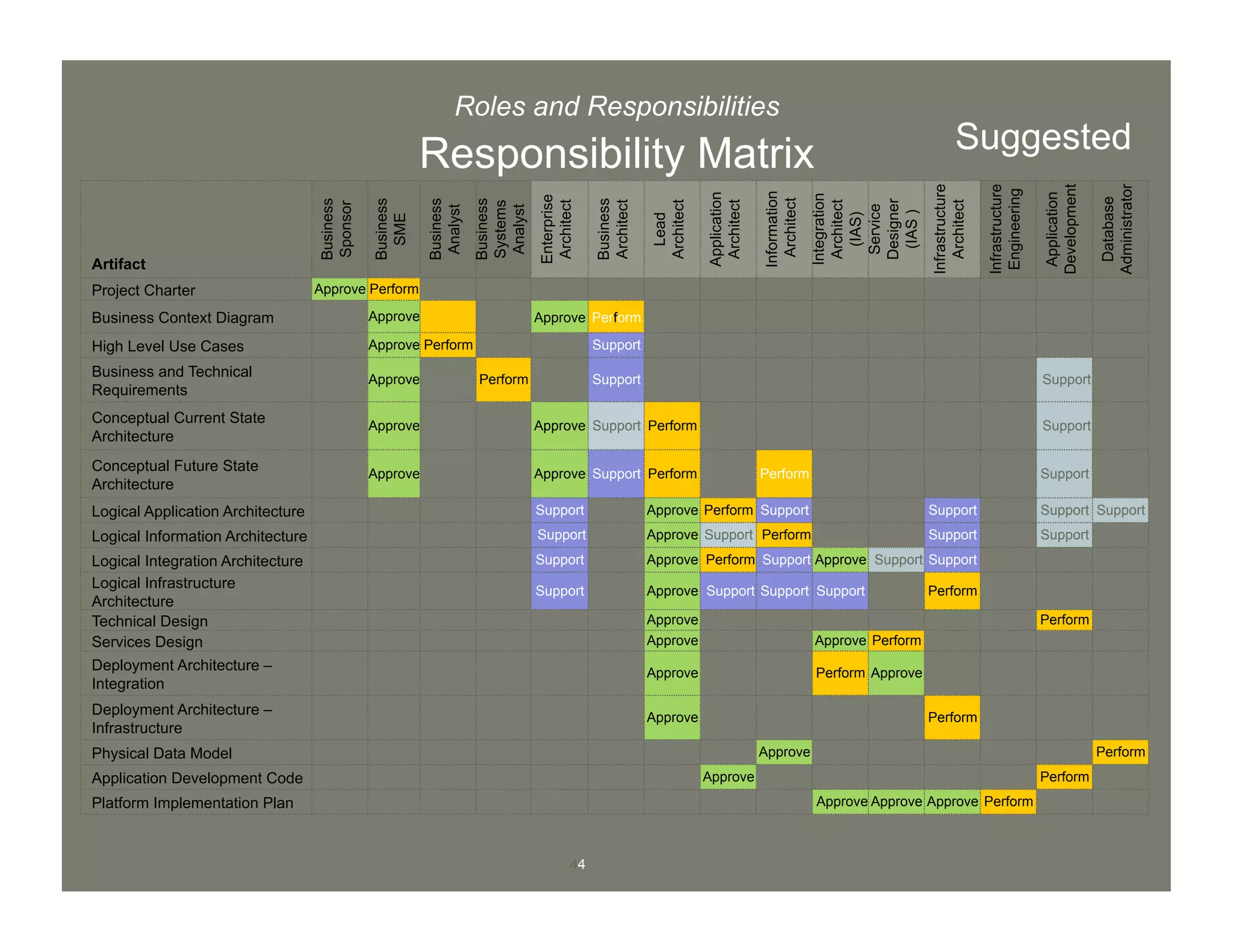
Project Charter Approve Perform
Business Context Diagram Approve Approve Perform
High Level Use Cases Approve Perform Support
Business and Technical
Requirements
Approve Perform Support Support
Conceptual Current State
Architecture
Approve Approve Support Perform Support
Conceptual Future State
Architecture
Approve Approve Support Perform Perform Support
Logical Application Architecture Support Approve Perform Support Support Support Support
Logical Information Architecture Support Approve Support Perform Support Support
Logical Integration Architecture Support Approve Perform Support Approve Support Support
Logical Infrastructure
Architecture
Support Approve Support Support Support Perform
Technical Design Approve Perform
Services Design Approve Approve Perform
Deployment Architecture –
Integration
Approve Perform Approve
Deployment Architecture –
Infrastructure
Approve Perform
Physical Data Model Approve Perform
Application Development Code Approve Perform
Platform Implementation Plan Approve Approve Approve Perform
Suggested
55
Roles and Responsibilities
Business Sponsor
Requirements & Analysis Design
Construct, Test, &
Deploy
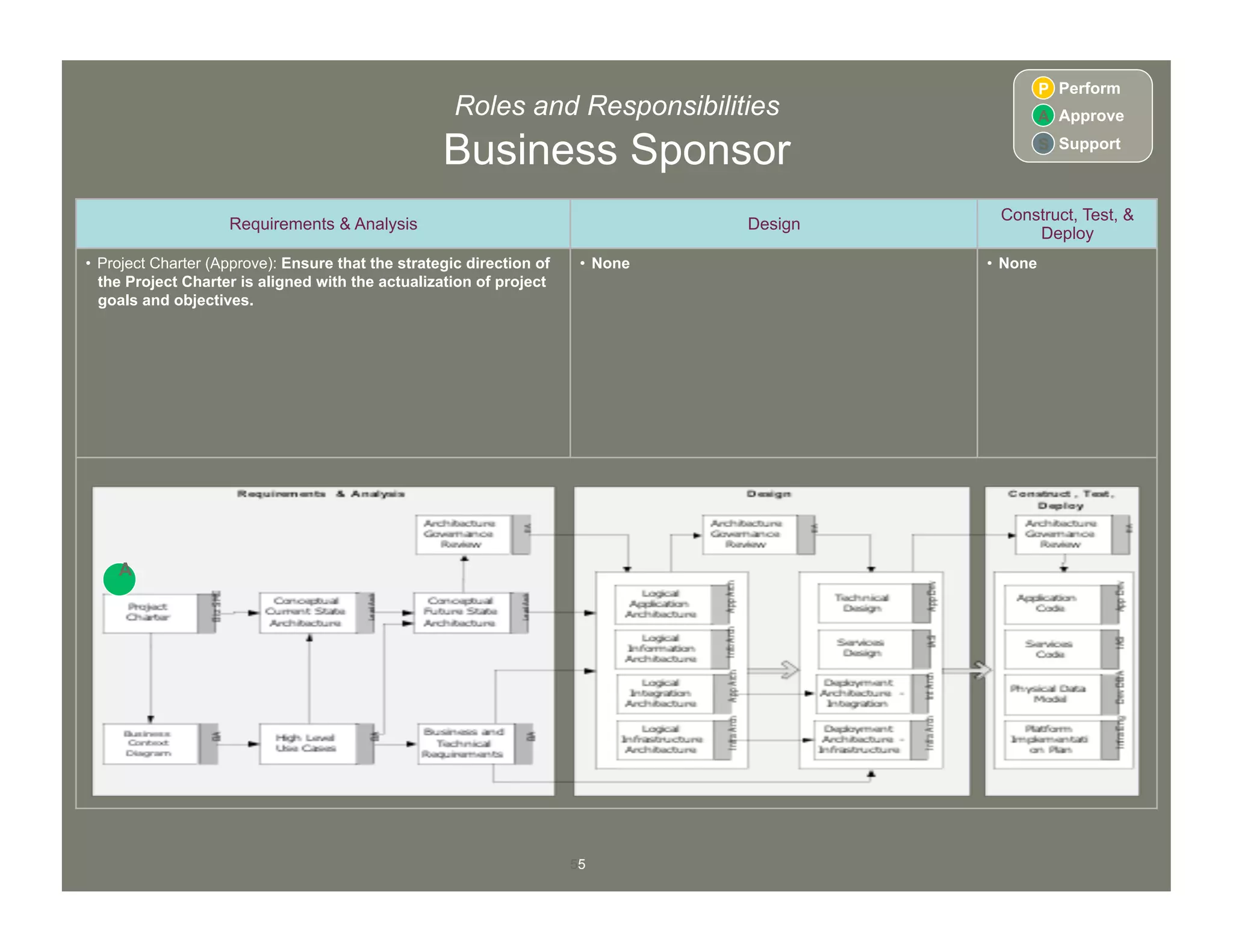
•  Project Charter (Approve): Ensure that the strategic direction of
the Project Charter is aligned with the actualization of project
goals and objectives.
•  None •  None
A
P
A
Perform
Approve
S Support
66
Roles and Responsibilities
Business SME
Requirements & Analysis Design
Construct, Test, &
Deploy
•  Project Charter (Perform): Creates the project charter based on
goals and objectives defined by the business
•  Business Context Diagram (Approve): Ensures that scope is not
outside of the boundaries set by Project Charter
•  High Level Use Cases (Approve): Ensures alignment with Project
Charter
•  Requirements (Approve): Ensures that all functionality defined in
the Project Charter and High Level Use cases are accounted
for
•  Conceptual Architecture (Approve): Ensures that all processes,
components, and systems within the scope of the project are
defined
•  None •  None
A A
AAA
P
P
A
Perform
Approve
S Support
77
Roles and Responsibilities
Business Analyst
Requirements & Analysis Design
Construct, Test, &
Deploy
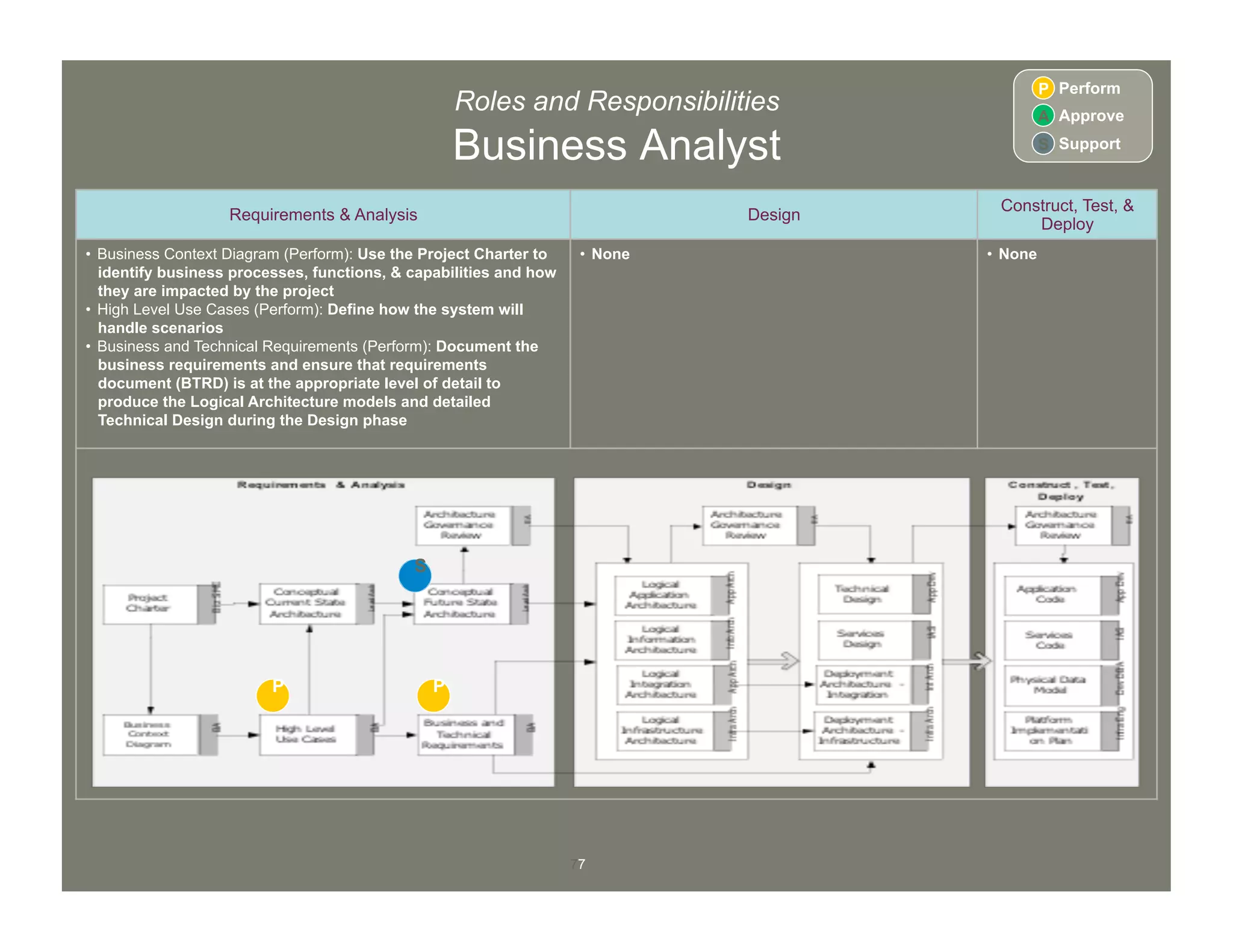
•  Business Context Diagram (Perform): Use the Project Charter to
identify business processes, functions, & capabilities and how
they are impacted by the project
•  High Level Use Cases (Perform): Define how the system will
handle scenarios
•  Business and Technical Requirements (Perform): Document the
business requirements and ensure that requirements
document (BTRD) is at the appropriate level of detail to
produce the Logical Architecture models and detailed
Technical Design during the Design phase
•  None •  None
P P
S
P
A
Perform
Approve
S Support
88
Roles and Responsibilities
Business System Analyst
Requirements & Analysis Design
Construct, Test, &
Deploy
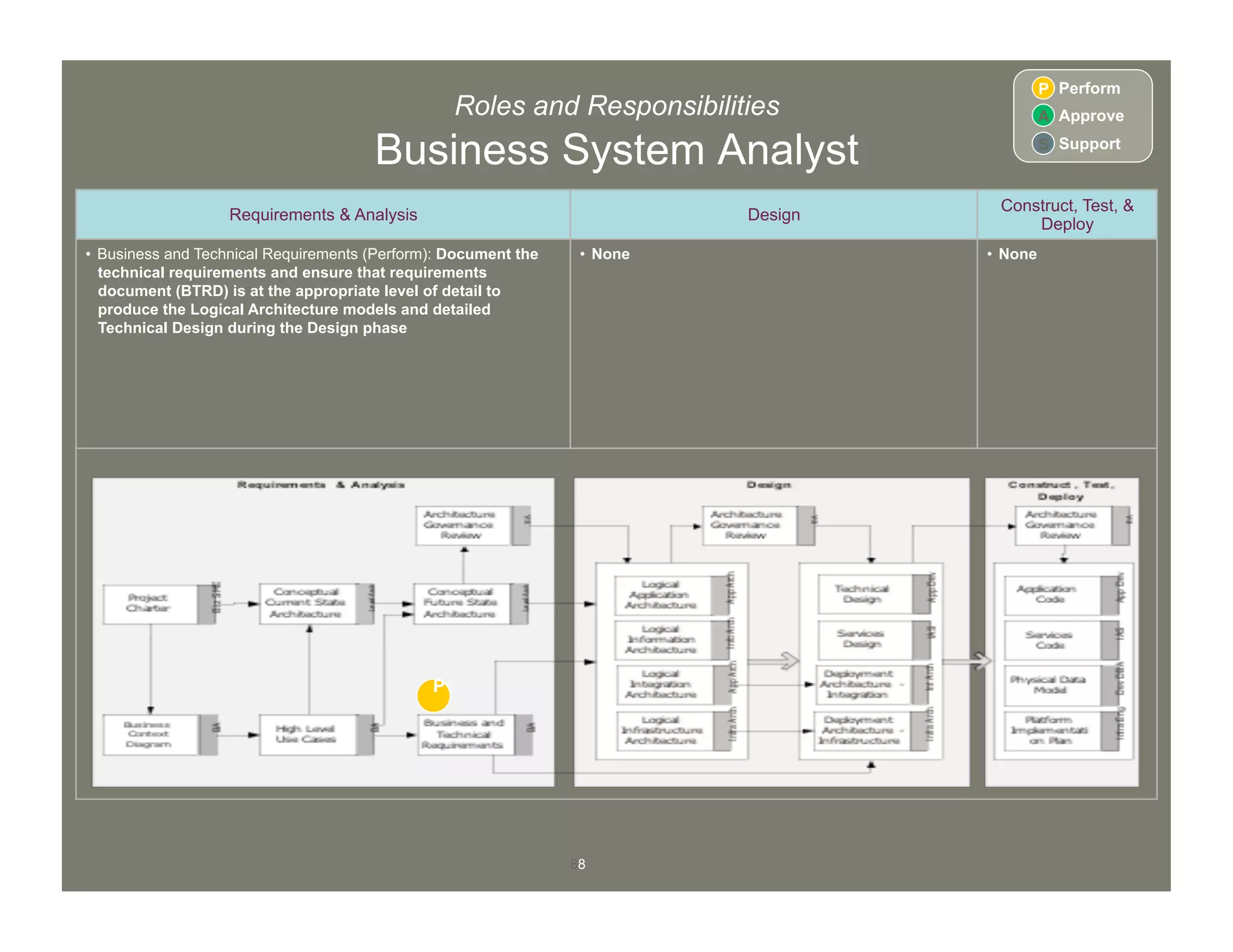
•  Business and Technical Requirements (Perform): Document the
technical requirements and ensure that requirements
document (BTRD) is at the appropriate level of detail to
produce the Logical Architecture models and detailed
Technical Design during the Design phase
•  None •  None
P
P
A
Perform
Approve
S Support
99
Roles and Responsibilities
Enterprise Architect
Requirements & Analysis Design
Construct, Test, &
Deploy
•  Business Context Diagram (Approve): Ensures that scope is not
outside of the boundaries set by Project Charter is consistent
with the other projects/initiatives
•  Conceptual Current State Architecture (Approve): Ensure that the
current state is accurately captured
•  Conceptual Future State Architecture (Approve): Ensure that the
solution meets the functional and non-functional requirements,
and conforms to enterprise best practices
•  Logical Architecture (Support): Ensure that he logical
architecture models provide the necessary
information for detailed design. Also, guide the
Project Lead Architect in determining opportunities
to use enterprise assets and services
•  None
AA
A
S
S
S
S
P
A
Perform
Approve
S Support
1010
Roles and Responsibilities
Business Architect
Requirements & Analysis Design
Construct, Test, &
Deploy
•  Business Context Diagram (Perform): Creates the Business
Context Diagram and ensures that scope is not outside of the
boundaries set by Project Charter
•  High Level Use Cases (Support): Ensures alignment with Project
Charter
•  Conceptual Architecture (Support): Assist in creating the
conceptual architecture and ensure that the solution meets the
functional and non-functional requirements
•  None •  None
P
P
A
Perform
Approve
S Support
S
S S
S
1111
Roles and Responsibilities
Lead Architect
Requirements & Analysis Design
Construct, Test, &
Deploy
•  Business Context Diagram (Approve): Ensures that scope is not
outside of the boundaries set by Project Charter
•  Conceptual Current State Architecture (Perform): Ensure that the
current state is accurately captured
•  Conceptual Future State Architecture (Perform): Ensure that the
solution meets the functional and non-functional requirements,
and conforms to enterprise best practices
•  Logical Architecture (Approve): Ensure that the
models provide the necessary information for
design.
•  Deployments Architecture (Approve): Ensure that he
deployment architecture models are achievable
and adhere to standards
•  Technical Design (Approve): Ensure that technical
design is within the boundary conditions defined in
logical architecture models
•  Services Design (Approve): Ensure that the Services
meet project needs
•  None
AAA
P P A
A
A
A
A
A
A
A
P
A
Perform
Approve
S Support
1212
Roles and Responsibilities
Application Architect
Requirements & Analysis Design
Construct, Test, &
Deploy
•  Conceptual Future State Architecture (Support): Assist in creating
the conceptual architecture and ensure that the solution meets
the functional and non-functional requirements
•  Logical Application Architecture (Perform): Identify the
architecturally significant application components of the future
state solution
•  Logical Application Architecture (Perform): Develop
high-level interactions between application
components and articulate the boundaries for
application designers
•  Logical Integration Architecture (Perform): Logical
model and the component context diagrams (CCD)
to capture components, component placement and
interconnections
•  Logical Information and Integration Architecture
(Support): Assist in developing information
architecture and infrastructure architecture models
•  None
S
P
P
S
S
P
A
Perform
Approve
S Support
1313
Roles and Responsibilities
Information Architect
Requirements & Analysis Design
Construct, Test, &
Deploy
•  Business Context Diagram (Support): Define the information
context within which a solution is being designed
•  Conceptual Future State Architecture (Perform): Create the
conceptual information models including Information
Architecture – Highlights , Conceptual Information Domain
Architecture , Information Flow, Metadata
•  Logical Information Architecture (Perform): Identify the
architecturally significant application components of the future
state solution
•  Logical Information Architecture (Perform): Logical
model and the component context diagrams (CCD)
to capture components, component placement and
interconnections
•  Logical Information and Integration Architecture
(Support): Assist in developing information
architecture and infrastructure architecture models
•  None
P
S
S
S
P
A
Perform
Approve
S Support
P
S
P
1414
Roles and Responsibilities
Integration Architect (IAS)
Requirements & Analysis Design
Construct, Test, &
Deploy
•  Conceptual Future State Architecture (Support): Assist in creating
the conceptual architecture and ensure that the solution meets
the functional and non-functional requirements
•  Logical Integration Architecture (Perform): Identify the
architecturally significant application components of the future
state solution
•  Logical Integration Architecture (Approve): Approve
the logical integration model and the component
context diagrams (CCD) to capture components,
component placement and interconnections
•  Deployment Architecture – Integration (Perform):
Create the deployment architecture for integration
needs of the project
•  Platform
Implementation Plan
(Approve): Ensure
that the plan is
aligned with the
Deployment
Architecture for
Integration
PA
S
P
A
Perform
Approve
S Support
S
1515
Roles and Responsibilities
Infrastructure Architect
Requirements & Analysis Design
Construct, Test, &
Deploy
•  Conceptual Future State Architecture (Support): Assist in creating
the conceptual architecture and ensure that the solution meets
the functional and non-functional requirements
•  Logical Infrastructure Architecture (Perform): Create
the logical infrastructure architecture to support
the future solution environment
•  Deployment Architecture – Infrastructure (Perform):
Create the deployment architecture for
infrastructure needs of the project
•  Logical Information and Integration Architecture
(Support): Assist in developing information
architecture and infrastructure architecture models
•  Platform
Implementation Plan
(Approve): Ensure
that the Platform
Implementation
Plan is aligned with
the Logical
Infrastructure
Architecture
PP
S
S
S
P
A
Perform
Approve
S Support
A
1616
Roles and Responsibilities
Service [SOA] Designer (IAS)
Requirements & Analysis Design
Construct, Test, &
Deploy
•  None •  Services Design (Perform): Create the design for
integration services based on project needs
•  Logical Integration Architecture (Support): Assist in
developing information architecture models
•  Deployment Architecture – Integration (Approve):
Review the deployment architecture for integration
and approve if it meets the needs of the project
•  Platform
Implementation Plan
(Approve): Ensure
that the plan is
aligned with the
Deployment
Architecture for
Integration
S
P
A
Perform
Approve
S Support
A
A
P
1717
Roles and Responsibilities
Application Designer/Developer
Requirements & Analysis Design
Construct, Test, &
Deploy
•  None •  Logical Architecture (Support): Assist the architects
in developing the that he logical architecture
models by providing necessary information on the
current state and technical nuances
•  Technical Design (Perform): Develop the low-level
design based on the logical architecture models
and create detailed specifications for system
components
•  Application Code
(Perform): Use the
Technical Design
artifacts and
implement
technology specific
coding
S
P
A
Perform
Approve
S Support
P
S
S
S
P
1818
Roles and Responsibilities
Infrastructure Engineer
Requirements & Analysis Design
Construct, Test, &
Deploy
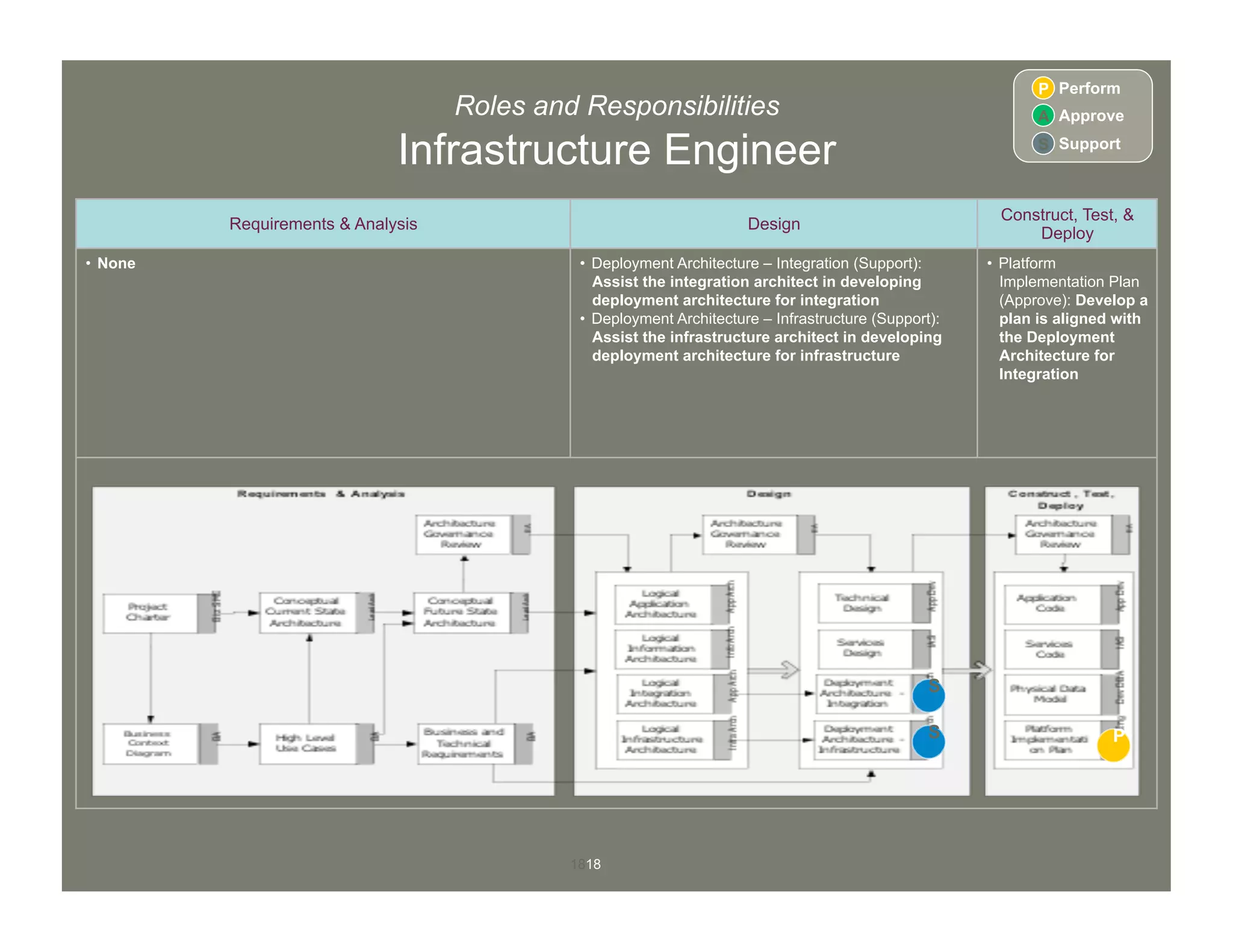
•  None •  Deployment Architecture – Integration (Support):
Assist the integration architect in developing
deployment architecture for integration
•  Deployment Architecture – Infrastructure (Support):
Assist the infrastructure architect in developing
deployment architecture for infrastructure
•  Platform
Implementation Plan
(Approve): Develop a
plan is aligned with
the Deployment
Architecture for
Integration
P
A
Perform
Approve
S Support
S
S P
1919
Roles and Responsibilities
Database Administrator
Requirements & Analysis Design
Construct, Test, &
Deploy
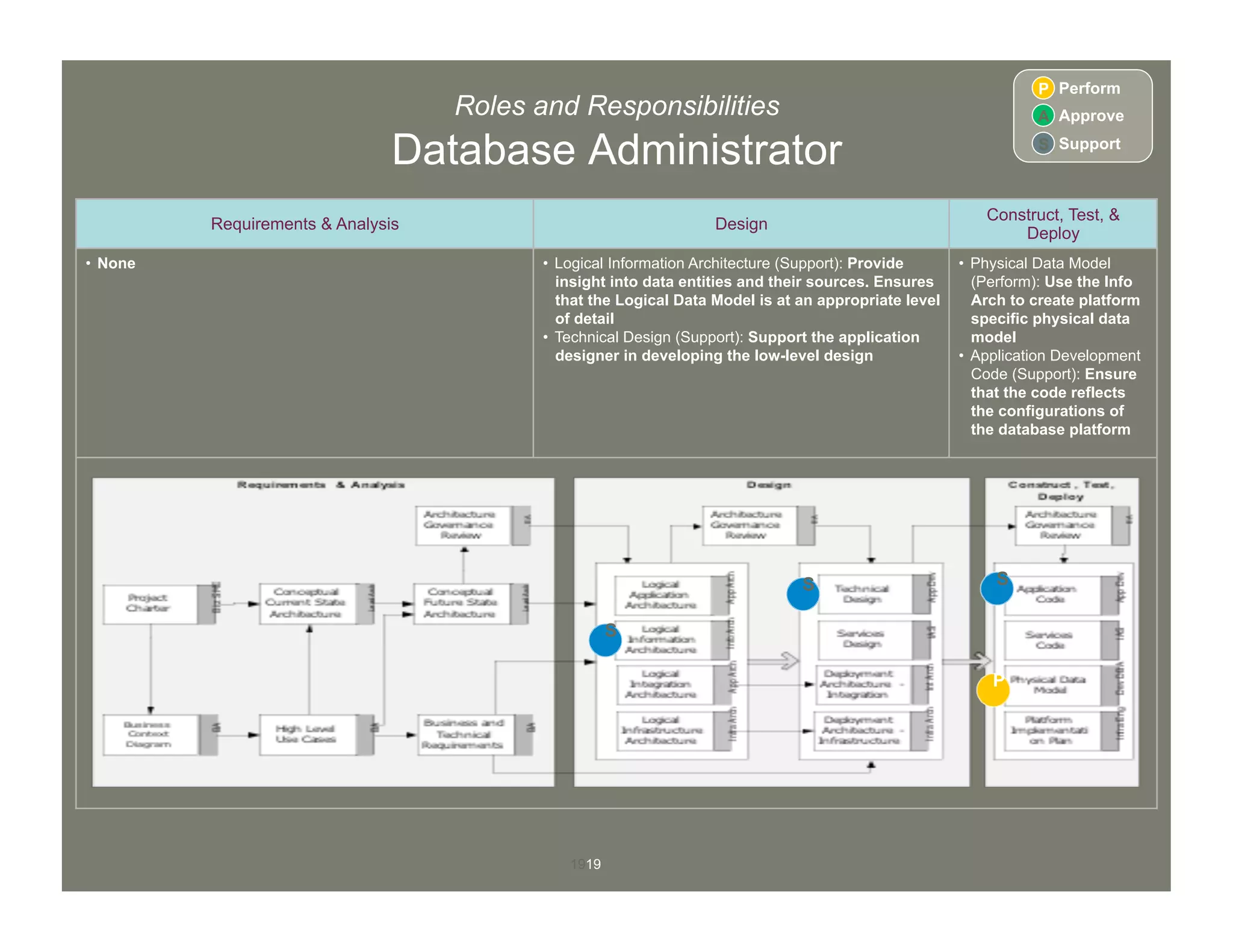
•  None •  Logical Information Architecture (Support): Provide
insight into data entities and their sources. Ensures
that the Logical Data Model is at an appropriate level
of detail
•  Technical Design (Support): Support the application
designer in developing the low-level design
•  Physical Data Model
(Perform): Use the Info
Arch to create platform
specific physical data
model
•  Application Development
Code (Support): Ensure
that the code reflects
the configurations of
the database platform
P
A
Perform
Approve
S Support
S
P
S S

CMAD Group Workbook 3.3 Op Model Enable

  • 1.
    11 Workbook 4Workbook 1 Authoredby: Alexander Doré August 14, 2010 Workbook 3.3 Architecture Services Mobilization Operational Model – Enablement - Roles and Responsibilities Business Architecture Program Business Enterprise Architecture Governance (BEAG) Confidential C-MAD Group Inc Computer Science & Engineering Architecture Consulting Services
  • 2.
    22 1 Introduction Enterprise Architecture DeliveryProcess: Architecture Delivery Process (ADP) Architecture Design Document (ADD)
  • 3.
    33 3 Roles and Responsibilities ApplicationArchitect Information Architect Integration Architect (IAS) Infrastructure Architect Service [SOA] Designer (IAS) Application Designer/Developer Infrastructure Engineer Database Administrator Responsibility Matrix Business Sponsor Business SME Business Analyst Business System Analyst Enterprise Architect Business Architect Lead Architect
  • 4.
    44 Roles and Responsibilities ResponsibilityMatrix Artifact Business Sponsor Business SME Business Analyst Business Systems Analyst Enterprise Architect Business Architect Lead Architect Application Architect Information Architect Integration Architect (IAS) Service Designer (IAS) Infrastructure Architect Infrastructure Engineering Application Development Database Administrator Project Charter Approve Perform Business Context Diagram Approve Approve Perform High Level Use Cases Approve Perform Support Business and Technical Requirements Approve Perform Support Support Conceptual Current State Architecture Approve Approve Support Perform Support Conceptual Future State Architecture Approve Approve Support Perform Perform Support Logical Application Architecture Support Approve Perform Support Support Support Support Logical Information Architecture Support Approve Support Perform Support Support Logical Integration Architecture Support Approve Perform Support Approve Support Support Logical Infrastructure Architecture Support Approve Support Support Support Perform Technical Design Approve Perform Services Design Approve Approve Perform Deployment Architecture – Integration Approve Perform Approve Deployment Architecture – Infrastructure Approve Perform Physical Data Model Approve Perform Application Development Code Approve Perform Platform Implementation Plan Approve Approve Approve Perform Suggested
  • 5.
    55 Roles and Responsibilities BusinessSponsor Requirements & Analysis Design Construct, Test, & Deploy •  Project Charter (Approve): Ensure that the strategic direction of the Project Charter is aligned with the actualization of project goals and objectives. •  None •  None A P A Perform Approve S Support
  • 6.
    66 Roles and Responsibilities BusinessSME Requirements & Analysis Design Construct, Test, & Deploy •  Project Charter (Perform): Creates the project charter based on goals and objectives defined by the business •  Business Context Diagram (Approve): Ensures that scope is not outside of the boundaries set by Project Charter •  High Level Use Cases (Approve): Ensures alignment with Project Charter •  Requirements (Approve): Ensures that all functionality defined in the Project Charter and High Level Use cases are accounted for •  Conceptual Architecture (Approve): Ensures that all processes, components, and systems within the scope of the project are defined •  None •  None A A AAA P P A Perform Approve S Support
  • 7.
    77 Roles and Responsibilities BusinessAnalyst Requirements & Analysis Design Construct, Test, & Deploy •  Business Context Diagram (Perform): Use the Project Charter to identify business processes, functions, & capabilities and how they are impacted by the project •  High Level Use Cases (Perform): Define how the system will handle scenarios •  Business and Technical Requirements (Perform): Document the business requirements and ensure that requirements document (BTRD) is at the appropriate level of detail to produce the Logical Architecture models and detailed Technical Design during the Design phase •  None •  None P P S P A Perform Approve S Support
  • 8.
    88 Roles and Responsibilities BusinessSystem Analyst Requirements & Analysis Design Construct, Test, & Deploy •  Business and Technical Requirements (Perform): Document the technical requirements and ensure that requirements document (BTRD) is at the appropriate level of detail to produce the Logical Architecture models and detailed Technical Design during the Design phase •  None •  None P P A Perform Approve S Support
  • 9.
    99 Roles and Responsibilities EnterpriseArchitect Requirements & Analysis Design Construct, Test, & Deploy •  Business Context Diagram (Approve): Ensures that scope is not outside of the boundaries set by Project Charter is consistent with the other projects/initiatives •  Conceptual Current State Architecture (Approve): Ensure that the current state is accurately captured •  Conceptual Future State Architecture (Approve): Ensure that the solution meets the functional and non-functional requirements, and conforms to enterprise best practices •  Logical Architecture (Support): Ensure that he logical architecture models provide the necessary information for detailed design. Also, guide the Project Lead Architect in determining opportunities to use enterprise assets and services •  None AA A S S S S P A Perform Approve S Support
  • 10.
    1010 Roles and Responsibilities BusinessArchitect Requirements & Analysis Design Construct, Test, & Deploy •  Business Context Diagram (Perform): Creates the Business Context Diagram and ensures that scope is not outside of the boundaries set by Project Charter •  High Level Use Cases (Support): Ensures alignment with Project Charter •  Conceptual Architecture (Support): Assist in creating the conceptual architecture and ensure that the solution meets the functional and non-functional requirements •  None •  None P P A Perform Approve S Support S S S S
  • 11.
    1111 Roles and Responsibilities LeadArchitect Requirements & Analysis Design Construct, Test, & Deploy •  Business Context Diagram (Approve): Ensures that scope is not outside of the boundaries set by Project Charter •  Conceptual Current State Architecture (Perform): Ensure that the current state is accurately captured •  Conceptual Future State Architecture (Perform): Ensure that the solution meets the functional and non-functional requirements, and conforms to enterprise best practices •  Logical Architecture (Approve): Ensure that the models provide the necessary information for design. •  Deployments Architecture (Approve): Ensure that he deployment architecture models are achievable and adhere to standards •  Technical Design (Approve): Ensure that technical design is within the boundary conditions defined in logical architecture models •  Services Design (Approve): Ensure that the Services meet project needs •  None AAA P P A A A A A A A A P A Perform Approve S Support
  • 12.
    1212 Roles and Responsibilities ApplicationArchitect Requirements & Analysis Design Construct, Test, & Deploy •  Conceptual Future State Architecture (Support): Assist in creating the conceptual architecture and ensure that the solution meets the functional and non-functional requirements •  Logical Application Architecture (Perform): Identify the architecturally significant application components of the future state solution •  Logical Application Architecture (Perform): Develop high-level interactions between application components and articulate the boundaries for application designers •  Logical Integration Architecture (Perform): Logical model and the component context diagrams (CCD) to capture components, component placement and interconnections •  Logical Information and Integration Architecture (Support): Assist in developing information architecture and infrastructure architecture models •  None S P P S S P A Perform Approve S Support
  • 13.
    1313 Roles and Responsibilities InformationArchitect Requirements & Analysis Design Construct, Test, & Deploy •  Business Context Diagram (Support): Define the information context within which a solution is being designed •  Conceptual Future State Architecture (Perform): Create the conceptual information models including Information Architecture – Highlights , Conceptual Information Domain Architecture , Information Flow, Metadata •  Logical Information Architecture (Perform): Identify the architecturally significant application components of the future state solution •  Logical Information Architecture (Perform): Logical model and the component context diagrams (CCD) to capture components, component placement and interconnections •  Logical Information and Integration Architecture (Support): Assist in developing information architecture and infrastructure architecture models •  None P S S S P A Perform Approve S Support P S P
  • 14.
    1414 Roles and Responsibilities IntegrationArchitect (IAS) Requirements & Analysis Design Construct, Test, & Deploy •  Conceptual Future State Architecture (Support): Assist in creating the conceptual architecture and ensure that the solution meets the functional and non-functional requirements •  Logical Integration Architecture (Perform): Identify the architecturally significant application components of the future state solution •  Logical Integration Architecture (Approve): Approve the logical integration model and the component context diagrams (CCD) to capture components, component placement and interconnections •  Deployment Architecture – Integration (Perform): Create the deployment architecture for integration needs of the project •  Platform Implementation Plan (Approve): Ensure that the plan is aligned with the Deployment Architecture for Integration PA S P A Perform Approve S Support S
  • 15.
    1515 Roles and Responsibilities InfrastructureArchitect Requirements & Analysis Design Construct, Test, & Deploy •  Conceptual Future State Architecture (Support): Assist in creating the conceptual architecture and ensure that the solution meets the functional and non-functional requirements •  Logical Infrastructure Architecture (Perform): Create the logical infrastructure architecture to support the future solution environment •  Deployment Architecture – Infrastructure (Perform): Create the deployment architecture for infrastructure needs of the project •  Logical Information and Integration Architecture (Support): Assist in developing information architecture and infrastructure architecture models •  Platform Implementation Plan (Approve): Ensure that the Platform Implementation Plan is aligned with the Logical Infrastructure Architecture PP S S S P A Perform Approve S Support A
  • 16.
    1616 Roles and Responsibilities Service[SOA] Designer (IAS) Requirements & Analysis Design Construct, Test, & Deploy •  None •  Services Design (Perform): Create the design for integration services based on project needs •  Logical Integration Architecture (Support): Assist in developing information architecture models •  Deployment Architecture – Integration (Approve): Review the deployment architecture for integration and approve if it meets the needs of the project •  Platform Implementation Plan (Approve): Ensure that the plan is aligned with the Deployment Architecture for Integration S P A Perform Approve S Support A A P
  • 17.
    1717 Roles and Responsibilities ApplicationDesigner/Developer Requirements & Analysis Design Construct, Test, & Deploy •  None •  Logical Architecture (Support): Assist the architects in developing the that he logical architecture models by providing necessary information on the current state and technical nuances •  Technical Design (Perform): Develop the low-level design based on the logical architecture models and create detailed specifications for system components •  Application Code (Perform): Use the Technical Design artifacts and implement technology specific coding S P A Perform Approve S Support P S S S P
  • 18.
    1818 Roles and Responsibilities InfrastructureEngineer Requirements & Analysis Design Construct, Test, & Deploy •  None •  Deployment Architecture – Integration (Support): Assist the integration architect in developing deployment architecture for integration •  Deployment Architecture – Infrastructure (Support): Assist the infrastructure architect in developing deployment architecture for infrastructure •  Platform Implementation Plan (Approve): Develop a plan is aligned with the Deployment Architecture for Integration P A Perform Approve S Support S S P
  • 19.
    1919 Roles and Responsibilities DatabaseAdministrator Requirements & Analysis Design Construct, Test, & Deploy •  None •  Logical Information Architecture (Support): Provide insight into data entities and their sources. Ensures that the Logical Data Model is at an appropriate level of detail •  Technical Design (Support): Support the application designer in developing the low-level design •  Physical Data Model (Perform): Use the Info Arch to create platform specific physical data model •  Application Development Code (Support): Ensure that the code reflects the configurations of the database platform P A Perform Approve S Support S P S S