Clutch Fundamentals
Objectives
• Describe the basic clutch parts
• Explain the operation of the clutch
• Compare differences in clutch design
• Describe the different methods of releasing
the clutch
Introduction
• Clutch
– Found on vehicles with manually shifted
transmissions
– Disengages engine from transmission
– Releases engine from transmission during gear
shifts
– Driver controls clutch application from inside the
vehicle with a clutch pedal
• Engine does not make sufficient torque at lower rpm to
be able to move the car
• Clutch must gradually couple rear wheels to engine
Clutch Parts and Operation
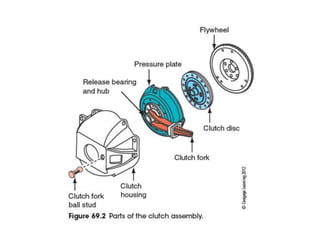
• Clutch parts
– Flywheel
– Pressure plate
– Friction disc
– Release mechanism
• Clutch disc pushed against flywheel with
enough force
– Disc will rotate with flywheel
Clutch Disc
• Characteristics
– Clutch hub: inner part of disc and has splines
– Torsional dampers: absorb shock
– Clutch disc has facings made of friction material
• Contain molded or woven asbestos
– Facings riveted to both sides of cushion plate
• Cushion plate is riveted to disc plate
– Clutch is engaged: air is trapped in grooves
• Clutch is released: trapped air pushes disc away from
pressure plate and flywheel
Pressure Plate
• Pressure plate is cast iron plate
– Part of cover assembly
• Cover assembly is bolted to the flywheel
– Clutch disc is wedged between pressure plate and
flywheel
– Space between pressure plate and flywheel is less
than thickness of clutch disc
– Engine and transmission are physically connected
when clutch pedal released
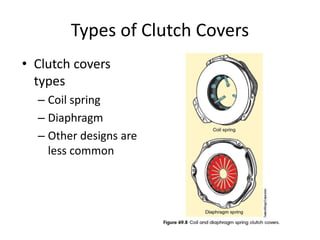
Types of Clutch Covers
• Clutch covers
types
– Coil spring
– Diaphragm
– Other designs are
less common
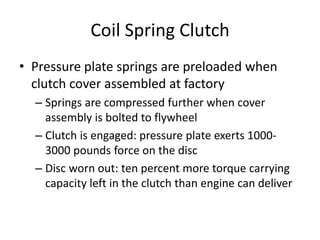
Coil Spring Clutch
• Pressure plate springs are preloaded when
clutch cover assembled at factory
– Springs are compressed further when cover
assembly is bolted to flywheel
– Clutch is engaged: pressure plate exerts 1000-
3000 pounds force on the disc
– Disc worn out: ten percent more torque carrying
capacity left in the clutch than engine can deliver
Release Levers
• Attached to cover assembly at pivot points
– Pushing clutch pedal moves pivot lever
• Pulls pressure plate away from flywheel
• Advantages of coil springs
– More coil springs can be installed
– Centrifugal force applies clutch more tightly
• Disadvantages of coil springs
– More pedal pressure required
– Clutch applied less heavily as disc wears
– Must be precisely balanced after assembly
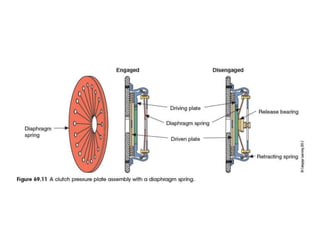
Diaphragm Clutch
• Diaphragm spring replaces release levers and coil
springs
– Diaphragm pivots off pivot rings when clutch pedal is
depressed
• Advantages
– Requires less effort and takes up less space
– Spring pressure becomes greater as disc wears
– Well balanced
• Dual mass flywheel: reduces noise and vibration
– Allows smoother gear shifting
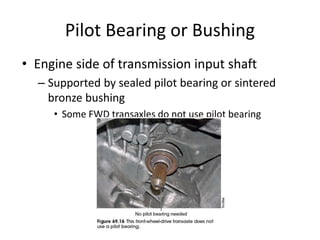
Pilot Bearing or Bushing
• Engine side of transmission input shaft
– Supported by sealed pilot bearing or sintered
bronze bushing
• Some FWD transaxles do not use pilot bearing
Release Bearing
• Allows pressure plate release mechanism to
operate as crankshaft rotates
– Slides on the front transmission bearing retainer
– Lubricated and sealed at the factory
• Self-centering release bearings
– Used on FWD cars
– Do not use pilot bearing in the crankshaft
• Specially designed release bearings
– Found on vehicles that have pressure plates that pull
to release
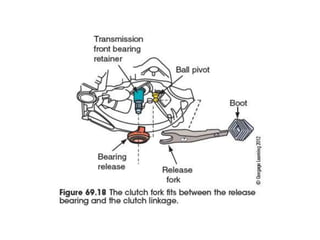
Clutch Fork
• Release bearing hub has provision to attach it
to the clutch fork
– Clutch fork fits between release bearing and
clutch cable or linkage
• Has pivot shaft, pivot ball, or raised area in the bell
housing off which it pivots
Clutch Release Methods
• Clutch pedal operates clutch fork using:
– Linkage
– Cable
– Hydraulic cylinders
• Clutch start switch
– Included on the clutch pedal
– Prevents engine from starting unless the clutch
pedal is depressed
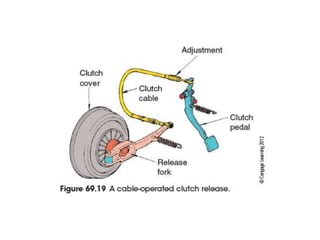
Clutch Cable
• Some cars use a cable to operate the clutch
– Adjustment remains the same as the engine
moves
– Develop friction and wear with repeated use
• Linkage can push on clutch arm
– Cable can only pull on it
• Pivot point of fork
– Must be on the outside of input shaft
• Away from cable end
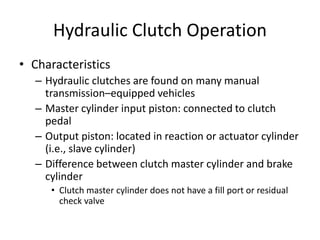
Hydraulic Clutch Operation
• Characteristics
– Hydraulic clutches are found on many manual
transmission–equipped vehicles
– Master cylinder input piston: connected to clutch
pedal
– Output piston: located in reaction or actuator cylinder
(i.e., slave cylinder)
– Difference between clutch master cylinder and brake
cylinder
• Clutch master cylinder does not have a fill port or residual
check valve
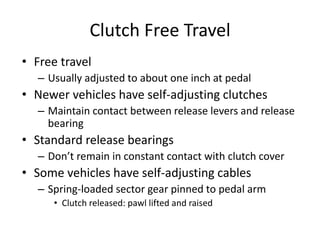
Clutch Free Travel
• Free travel
– Usually adjusted to about one inch at pedal
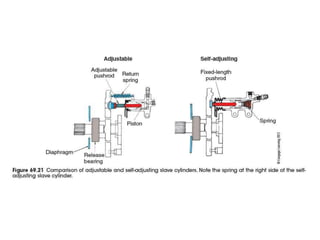
• Newer vehicles have self-adjusting clutches
– Maintain contact between release levers and release
bearing
• Standard release bearings
– Don’t remain in constant contact with clutch cover
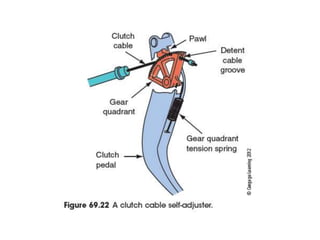
• Some vehicles have self-adjusting cables
– Spring-loaded sector gear pinned to pedal arm
• Clutch released: pawl lifted and raised
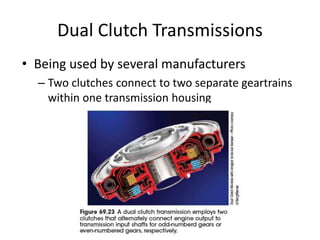
Dual Clutch Transmissions
• Being used by several manufacturers
– Two clutches connect to two separate geartrains
within one transmission housing

clutch fundamentals .ppt

  • 1.
  • 2.
    Objectives • Describe thebasic clutch parts • Explain the operation of the clutch • Compare differences in clutch design • Describe the different methods of releasing the clutch
  • 3.
    Introduction • Clutch – Foundon vehicles with manually shifted transmissions – Disengages engine from transmission – Releases engine from transmission during gear shifts – Driver controls clutch application from inside the vehicle with a clutch pedal • Engine does not make sufficient torque at lower rpm to be able to move the car • Clutch must gradually couple rear wheels to engine
  • 4.
    Clutch Parts andOperation • Clutch parts – Flywheel – Pressure plate – Friction disc – Release mechanism • Clutch disc pushed against flywheel with enough force – Disc will rotate with flywheel
  • 6.
    Clutch Disc • Characteristics –Clutch hub: inner part of disc and has splines – Torsional dampers: absorb shock – Clutch disc has facings made of friction material • Contain molded or woven asbestos – Facings riveted to both sides of cushion plate • Cushion plate is riveted to disc plate – Clutch is engaged: air is trapped in grooves • Clutch is released: trapped air pushes disc away from pressure plate and flywheel
  • 7.
    Pressure Plate • Pressureplate is cast iron plate – Part of cover assembly • Cover assembly is bolted to the flywheel – Clutch disc is wedged between pressure plate and flywheel – Space between pressure plate and flywheel is less than thickness of clutch disc – Engine and transmission are physically connected when clutch pedal released
  • 8.
    Types of ClutchCovers • Clutch covers types – Coil spring – Diaphragm – Other designs are less common
  • 9.
    Coil Spring Clutch •Pressure plate springs are preloaded when clutch cover assembled at factory – Springs are compressed further when cover assembly is bolted to flywheel – Clutch is engaged: pressure plate exerts 1000- 3000 pounds force on the disc – Disc worn out: ten percent more torque carrying capacity left in the clutch than engine can deliver
  • 10.
    Release Levers • Attachedto cover assembly at pivot points – Pushing clutch pedal moves pivot lever • Pulls pressure plate away from flywheel • Advantages of coil springs – More coil springs can be installed – Centrifugal force applies clutch more tightly • Disadvantages of coil springs – More pedal pressure required – Clutch applied less heavily as disc wears – Must be precisely balanced after assembly
  • 11.
    Diaphragm Clutch • Diaphragmspring replaces release levers and coil springs – Diaphragm pivots off pivot rings when clutch pedal is depressed • Advantages – Requires less effort and takes up less space – Spring pressure becomes greater as disc wears – Well balanced • Dual mass flywheel: reduces noise and vibration – Allows smoother gear shifting
  • 13.
    Pilot Bearing orBushing • Engine side of transmission input shaft – Supported by sealed pilot bearing or sintered bronze bushing • Some FWD transaxles do not use pilot bearing
  • 14.
    Release Bearing • Allowspressure plate release mechanism to operate as crankshaft rotates – Slides on the front transmission bearing retainer – Lubricated and sealed at the factory • Self-centering release bearings – Used on FWD cars – Do not use pilot bearing in the crankshaft • Specially designed release bearings – Found on vehicles that have pressure plates that pull to release
  • 15.
    Clutch Fork • Releasebearing hub has provision to attach it to the clutch fork – Clutch fork fits between release bearing and clutch cable or linkage • Has pivot shaft, pivot ball, or raised area in the bell housing off which it pivots
  • 17.
    Clutch Release Methods •Clutch pedal operates clutch fork using: – Linkage – Cable – Hydraulic cylinders • Clutch start switch – Included on the clutch pedal – Prevents engine from starting unless the clutch pedal is depressed
  • 18.
    Clutch Cable • Somecars use a cable to operate the clutch – Adjustment remains the same as the engine moves – Develop friction and wear with repeated use • Linkage can push on clutch arm – Cable can only pull on it • Pivot point of fork – Must be on the outside of input shaft • Away from cable end
  • 20.
    Hydraulic Clutch Operation •Characteristics – Hydraulic clutches are found on many manual transmission–equipped vehicles – Master cylinder input piston: connected to clutch pedal – Output piston: located in reaction or actuator cylinder (i.e., slave cylinder) – Difference between clutch master cylinder and brake cylinder • Clutch master cylinder does not have a fill port or residual check valve
  • 21.
    Clutch Free Travel •Free travel – Usually adjusted to about one inch at pedal • Newer vehicles have self-adjusting clutches – Maintain contact between release levers and release bearing • Standard release bearings – Don’t remain in constant contact with clutch cover • Some vehicles have self-adjusting cables – Spring-loaded sector gear pinned to pedal arm • Clutch released: pawl lifted and raised
  • 24.
    Dual Clutch Transmissions •Being used by several manufacturers – Two clutches connect to two separate geartrains within one transmission housing