Cloud Computing: Concepts,
Technologies and Business
Implications
B. Ramamurthy & K. Madurai
bina@buffalo.edu & kumar.madurai@ctg.com
This talks is partially supported by National Science
Foundation grants DUE: #0920335, OCI: #1041280
6/23/2010
Wipro Chennai 2011 1
Outline of the talk
• Introduction to cloud context
o Technology context: multi-core, virtualization, 64-bit processors, parallel
computing models, big-data storages…
o Cloud models: IaaS (Amazon AWS), PaaS (Microsoft Azure), SaaS (Google
App Engine)
• Demonstration of cloud capabilities
o Cloud models
o Data and Computing models: MapReduce
o Graph processing using amazon elastic mapreduce
• A case-study of real business application of the
cloud
• Questions and Answers
6/23/2010
Wipro Chennai 2011 2
Speakers’ Background in cloud
computing
• Bina:
o Has two current NSF (National Science Foundation of USA)
awards related to cloud computing:
o 2009-2012: Data-Intensive computing education: CCLI Phase 2:
$250K
o 2010-2012: Cloud-enabled Evolutionary Genetics Testbed: OCI-
CI-TEAM: $250K
o Faculty at the CSE department at University at Buffalo.
• Kumar:
o Principal Consultant at CTG
o Currently heading a large semantic technology business
initiative that leverages cloud computing
o Adjunct Professor at School of Management, University at
Buffalo.
6/23/2010
Wipro Chennai 2011 3
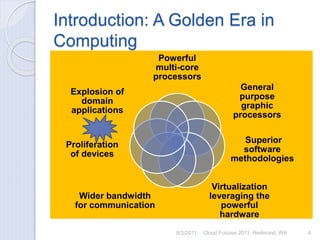
Introduction: A Golden Era in
Computing
Powerful
multi-core
processors
General
purpose
graphic
processors
Superior
software
methodologies
Virtualization
leveraging the
powerful
hardware
Wider bandwidth
for communication
Proliferation
of devices
Explosion of
domain
applications
6/2/2011 Cloud Futures 2011, Redmond, WA 4
Cloud Concepts, Enabling-
technologies, and Models: The
Cloud Context
6/23/2010
Wipro Chennai 2011 5
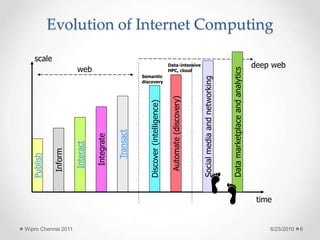
Evolution of Internet Computing
Publish
Inform
Interact
Integrate
Transact
Discover
(intelligence)
Automate
(discovery)
time
scale
Social
media
and
networking
Semantic
discovery
Data-intensive
HPC, cloud
web
deep web
Data
marketplace
and
analytics
6/23/2010
Wipro Chennai 2011 6
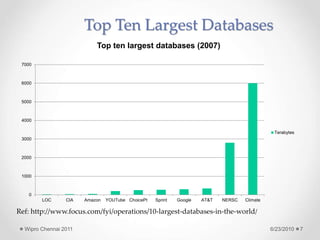
Top Ten Largest Databases
0
1000
2000
3000
4000
5000
6000
7000
LOC CIA Amazon YOUTube ChoicePt Sprint Google AT&T NERSC Climate
Top ten largest databases (2007)
Terabytes
Ref: http://www.focus.com/fyi/operations/10-largest-databases-in-the-world/
6/23/2010
Wipro Chennai 2011 7
Challenges
• Alignment with the needs of the business / user / non-
computer specialists / community and society
• Need to address the scalability issue: large scale data, high
performance computing, automation, response time, rapid
prototyping, and rapid time to production
• Need to effectively address (i) ever shortening cycle of
obsolescence, (ii) heterogeneity and (iii) rapid changes in
requirements
• Transform data from diverse sources into intelligence and
deliver intelligence to right people/user/systems
• What about providing all this in a cost-effective manner?
6/23/2010
Wipro Chennai 2011 8
Enter the cloud
• Cloud computing is Internet-based computing, whereby
shared resources, software and information are provided
to computers and other devices on-demand, like the
electricity grid.
• The cloud computing is a culmination of numerous
attempts at large scale computing with seamless access
to virtually limitless resources.
o on-demand computing, utility computing, ubiquitous computing, autonomic
computing, platform computing, edge computing, elastic computing, grid
computing, …
6/23/2010
Wipro Chennai 2011 9
“Grid Technology: A slide from my presentation
to Industry (2005)
• Emerging enabling technology.
• Natural evolution of distributed systems and the Internet.
• Middleware supporting network of systems to facilitate
sharing, standardization and openness.
• Infrastructure and application model dealing with sharing of
compute cycles, data, storage and other resources.
• Publicized by prominent industries as on-demand computing,
utility computing, etc.
• Move towards delivering “computing” to masses similar to
other utilities (electricity and voice communication).”
• Now,
Hmmm…sounds like the definition for cloud computing!!!!!
6/23/2010
Wipro Chennai 2011 10
It is a changed world now…
• Explosive growth in applications: biomedical informatics, space exploration,
business analytics, web 2.0 social networking: YouTube, Facebook
• Extreme scale content generation: e-science and e-business data deluge
• Extraordinary rate of digital content consumption: digital gluttony: Apple
iPhone, iPad, Amazon Kindle
• Exponential growth in compute capabilities: multi-core, storage, bandwidth,
virtual machines (virtualization)
• Very short cycle of obsolescence in technologies: Windows Vista
Windows 7; Java versions; CC#; Phython
• Newer architectures: web services, persistence models, distributed file
systems/repositories (Google, Hadoop), multi-core, wireless and mobile
• Diverse knowledge and skill levels of the workforce
• You simply cannot manage this complex situation with your traditional IT
infrastructure:
6/23/2010
Wipro Chennai 2011 11
Answer: The Cloud Computing?
• Typical requirements and models:
o platform (PaaS),
o software (SaaS),
o infrastructure (IaaS),
o Services-based application programming interface (API)
• A cloud computing environment can provide one or more
of these requirements for a cost
• Pay as you go model of business
• When using a public cloud the model is similar to renting
a property than owning one.
• An organization could also maintain a private cloud
and/or use both.
6/23/2010
Wipro Chennai 2011 12
Enabling Technologies
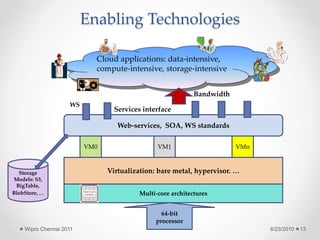
64-bit
processor
Multi-core architectures
Virtualization: bare metal, hypervisor. …
VM0 VM1 VMn
Web-services, SOA, WS standards
Services interface
Cloud applications: data-intensive,
compute-intensive, storage-intensive
Storage
Models: S3,
BigTable,
BlobStore, ...
Bandwidth
WS
6/23/2010
Wipro Chennai 2011 13
Common Features of Cloud Providers
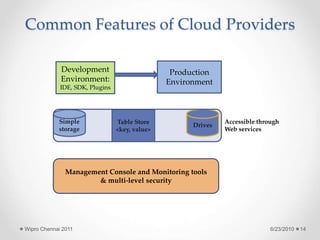
Development
Environment:
IDE, SDK, Plugins
Production
Environment
Simple
storage
Table Store
<key, value>
Drives
Accessible through
Web services
Management Console and Monitoring tools
& multi-level security
6/23/2010
Wipro Chennai 2011 14
Windows Azure
• Enterprise-level on-demand capacity builder
• Fabric of cycles and storage available on-request for a
cost
• You have to use Azure API to work with the infrastructure
offered by Microsoft
• Significant features: web role, worker role , blob storage,
table and drive-storage
6/23/2010
Wipro Chennai 2011 15
Amazon EC2
• Amazon EC2 is one large complex web service.
• EC2 provided an API for instantiating computing
instances with any of the operating systems supported.
• It can facilitate computations through Amazon Machine
Images (AMIs) for various other models.
• Signature features: S3, Cloud Management Console,
MapReduce Cloud, Amazon Machine Image (AMI)
• Excellent distribution, load balancing, cloud monitoring
tools
6/23/2010
Wipro Chennai 2011 16
Google App Engine
• This is more a web interface for a development
environment that offers a one stop facility for design,
development and deployment Java and Python-based
applications in Java, Go and Python.
• Google offers the same reliability, availability and
scalability at par with Google’s own applications
• Interface is software programming based
• Comprehensive programming platform irrespective of the
size (small or large)
• Signature features: templates and appspot, excellent
monitoring and management console
6/23/2010
Wipro Chennai 2011 17
Demos
• Amazon AWS: EC2 & S3 (among the many infrastructure
services)
o Linux machine
o Windows machine
o A three-tier enterprise application
• Google app Engine
o Eclipse plug-in for GAE
o Development and deployment of an application
• Windows Azure
o Storage: blob store/container
o MS Visual Studio Azure development and production environment
6/23/2010
Wipro Chennai 2011 18
Cloud Programming Models
6/23/2010
Wipro Chennai 2011 19
The Context: Big-data
• Data mining huge amounts of data collected in a wide range of domains
from astronomy to healthcare has become essential for planning and
performance.
• We are in a knowledge economy.
o Data is an important asset to any organization
o Discovery of knowledge; Enabling discovery; annotation of data
o Complex computational models
o No single environment is good enough: need elastic, on-demand
capacities
• We are looking at newer
o Programming models, and
o Supporting algorithms and data structures.
6/23/2010
Wipro Chennai 2011 20
Google File System
• Internet introduced a new challenge in the form web logs,
web crawler’s data: large scale “peta scale”
• But observe that this type of data has an uniquely different
characteristic than your transactional or the “customer
order” data : “write once read many (WORM)” ;
• Privacy protected healthcare and patient information;
• Historical financial data;
• Other historical data
• Google exploited this characteristics in its Google file
system (GFS)
6/23/2010
Wipro Chennai 2011 21
What is Hadoop?
 At Google MapReduce operation are run on a special file
system called Google File System (GFS) that is highly
optimized for this purpose.
 GFS is not open source.
 Doug Cutting and others at Yahoo! reverse engineered the
GFS and called it Hadoop Distributed File System (HDFS).
 The software framework that supports HDFS, MapReduce
and other related entities is called the project Hadoop or
simply Hadoop.
 This is open source and distributed by Apache.
6/23/2010
Wipro Chennai 2011 22
Fault tolerance
• Failure is the norm rather than exception
• A HDFS instance may consist of thousands of server
machines, each storing part of the file system’s data.
• Since we have huge number of components and that each
component has non-trivial probability of failure means that
there is always some component that is non-functional.
• Detection of faults and quick, automatic recovery from them
is a core architectural goal of HDFS.
6/23/2010
Wipro Chennai 2011 23
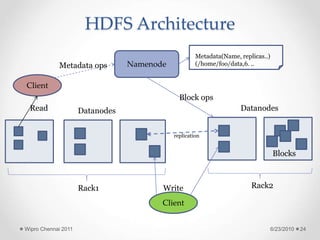
HDFS Architecture
Namenode
B
replication
Rack1 Rack2
Client
Blocks
Datanodes Datanodes
Client
Write
Read
Metadata ops
Metadata(Name, replicas..)
(/home/foo/data,6. ..
Block ops
6/23/2010
Wipro Chennai 2011 24
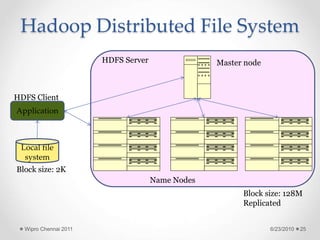
Hadoop Distributed File System
Application
Local file
system
Master node
Name Nodes
HDFS Client
HDFS Server
Block size: 2K
Block size: 128M
Replicated
6/23/2010
Wipro Chennai 2011 25
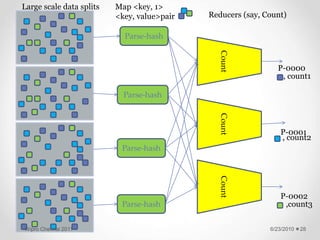
What is MapReduce?
 MapReduce is a programming model Google has used successfully is
processing its “big-data” sets (~ 20000 peta bytes per day)
 A map function extracts some intelligence from raw data.
 A reduce function aggregates according to some guides the data
output by the map.
 Users specify the computation in terms of a map and a reduce
function,
 Underlying runtime system automatically parallelizes the
computation across large-scale clusters of machines, and
 Underlying system also handles machine failures, efficient
communications, and performance issues.
-- Reference: Dean, J. and Ghemawat, S. 2008. MapReduce: simplified data
processing on large clusters. Communication of ACM 51, 1 (Jan. 2008), 107-113.
6/23/2010
Wipro Chennai 2011 26
Classes of problems “mapreducable”
 Benchmark for comparing: Jim Gray’s challenge on data-
intensive computing. Ex: “Sort”
 Google uses it for wordcount, adwords, pagerank, indexing data.
 Simple algorithms such as grep, text-indexing, reverse indexing
 Bayesian classification: data mining domain
 Facebook uses it for various operations: demographics
 Financial services use it for analytics
 Astronomy: Gaussian analysis for locating extra-terrestrial
objects.
 Expected to play a critical role in semantic web and in web 3.0
6/23/2010
Wipro Chennai 2011 27
Count
Count
Count
Large scale data splits
Parse-hash
Parse-hash
Parse-hash
Parse-hash
Map <key, 1>
<key, value>pair Reducers (say, Count)
P-0000
P-0001
P-0002
, count1
, count2
,count3
6/23/2010
Wipro Chennai 2011 28
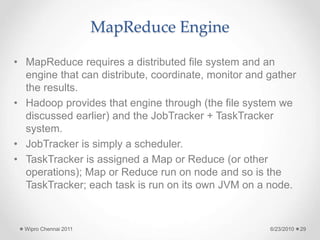
MapReduce Engine
• MapReduce requires a distributed file system and an
engine that can distribute, coordinate, monitor and gather
the results.
• Hadoop provides that engine through (the file system we
discussed earlier) and the JobTracker + TaskTracker
system.
• JobTracker is simply a scheduler.
• TaskTracker is assigned a Map or Reduce (or other
operations); Map or Reduce run on node and so is the
TaskTracker; each task is run on its own JVM on a node.
6/23/2010
Wipro Chennai 2011 29
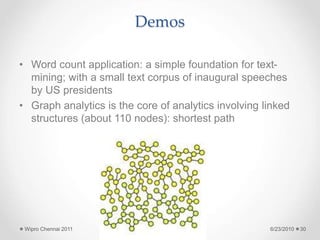
Demos
• Word count application: a simple foundation for text-
mining; with a small text corpus of inaugural speeches
by US presidents
• Graph analytics is the core of analytics involving linked
structures (about 110 nodes): shortest path
6/23/2010
Wipro Chennai 2011 30
A Case-study in Business:
Cloud Strategies
6/23/2010
Wipro Chennai 2011 31
Predictive Quality Project Overview
• Identify special causes that relate to bad outcomes for the quality-related
parameters of the products and visually inspected defects
• Complex upstream process conditions and dependencies making the
problem difficult to solve using traditional statistical / analytical methods
• Determine the optimal process settings that can increase the yield and
reduce defects through predictive quality assurance
• Potential savings huge as the cost of rework and rejects are very high
Problem / Motivation:
Solution:
• Use ontology to model the complex manufacturing processes and utilize
semantic technologies to provide key insights into how outcomes and causes
are related
• Develop a rich internet application that allows the user to evaluate process
outcomes and conditions at a high level and drill down to specific areas of
interest to address performance issues
6/23/2010
Wipro Chennai 2011 32
Why Cloud Computing for this Project
• Well-suited for incubation of new technologies
o Semantic technologies still evolving
o Use of Prototyping and Extreme Programming
o Server and Storage requirements not completely known
• Technologies used (TopBraid, Tomcat) not part of
emerging or core technologies supported by corporate IT
• Scalability on demand
• Development and implementation on a private cloud
6/23/2010
Wipro Chennai 2011 33
Public Cloud vs. Private Cloud
Rationale for Private Cloud:
• Security and privacy of business data was a big concern
• Potential for vendor lock-in
• SLA’s required for real-time performance and reliability
• Cost savings of the shared model achieved because of
the multiple projects involving semantic technologies that
the company is actively developing
6/23/2010
Wipro Chennai 2011 34
Cloud Computing for the Enterprise
What should IT Do
• Revise cost model to utility-based computing: CPU/hour,
GB/day etc.
• Include hidden costs for management, training
• Different cloud models for different applications -
evaluate
• Use for prototyping applications and learn
• Link it to current strategic plans for Services-Oriented
Architecture, Disaster Recovery, etc.
6/23/2010
Wipro Chennai 2011 35
References & useful links
• Amazon AWS: http://aws.amazon.com/free/
• AWS Cost Calculator:
http://calculator.s3.amazonaws.com/calc5.html
• Windows Azure: http://www.azurepilot.com/
• Google App Engine (GAE):
http://code.google.com/appengine/docs/whatisgoogleapp
engine.html
• Graph Analytics:
http://www.umiacs.umd.edu/~jimmylin/Cloud9/docs/cont
ent/Lin_Schatz_MLG2010.pdf
• For miscellaneous information:
http://www.cse.buffalo.edu/~bina
6/23/2010
Wipro Chennai 2011 36
Summary
• We illustrated cloud concepts and demonstrated the cloud
capabilities through simple applications
• We discussed the features of the Hadoop File System, and
mapreduce to handle big-data sets.
• We also explored some real business issues in adoption of
cloud.
• Cloud is indeed an impactful technology that is sure to
transform computing in business.
6/23/2010
Wipro Chennai 2011 37

CloudComputingJun28.ppt

  • 1.
    Cloud Computing: Concepts, Technologiesand Business Implications B. Ramamurthy & K. Madurai bina@buffalo.edu & kumar.madurai@ctg.com This talks is partially supported by National Science Foundation grants DUE: #0920335, OCI: #1041280 6/23/2010 Wipro Chennai 2011 1
  • 2.
    Outline of thetalk • Introduction to cloud context o Technology context: multi-core, virtualization, 64-bit processors, parallel computing models, big-data storages… o Cloud models: IaaS (Amazon AWS), PaaS (Microsoft Azure), SaaS (Google App Engine) • Demonstration of cloud capabilities o Cloud models o Data and Computing models: MapReduce o Graph processing using amazon elastic mapreduce • A case-study of real business application of the cloud • Questions and Answers 6/23/2010 Wipro Chennai 2011 2
  • 3.
    Speakers’ Background incloud computing • Bina: o Has two current NSF (National Science Foundation of USA) awards related to cloud computing: o 2009-2012: Data-Intensive computing education: CCLI Phase 2: $250K o 2010-2012: Cloud-enabled Evolutionary Genetics Testbed: OCI- CI-TEAM: $250K o Faculty at the CSE department at University at Buffalo. • Kumar: o Principal Consultant at CTG o Currently heading a large semantic technology business initiative that leverages cloud computing o Adjunct Professor at School of Management, University at Buffalo. 6/23/2010 Wipro Chennai 2011 3
  • 4.
    Introduction: A GoldenEra in Computing Powerful multi-core processors General purpose graphic processors Superior software methodologies Virtualization leveraging the powerful hardware Wider bandwidth for communication Proliferation of devices Explosion of domain applications 6/2/2011 Cloud Futures 2011, Redmond, WA 4
  • 5.
    Cloud Concepts, Enabling- technologies,and Models: The Cloud Context 6/23/2010 Wipro Chennai 2011 5
  • 6.
    Evolution of InternetComputing Publish Inform Interact Integrate Transact Discover (intelligence) Automate (discovery) time scale Social media and networking Semantic discovery Data-intensive HPC, cloud web deep web Data marketplace and analytics 6/23/2010 Wipro Chennai 2011 6
  • 7.
    Top Ten LargestDatabases 0 1000 2000 3000 4000 5000 6000 7000 LOC CIA Amazon YOUTube ChoicePt Sprint Google AT&T NERSC Climate Top ten largest databases (2007) Terabytes Ref: http://www.focus.com/fyi/operations/10-largest-databases-in-the-world/ 6/23/2010 Wipro Chennai 2011 7
  • 8.
    Challenges • Alignment withthe needs of the business / user / non- computer specialists / community and society • Need to address the scalability issue: large scale data, high performance computing, automation, response time, rapid prototyping, and rapid time to production • Need to effectively address (i) ever shortening cycle of obsolescence, (ii) heterogeneity and (iii) rapid changes in requirements • Transform data from diverse sources into intelligence and deliver intelligence to right people/user/systems • What about providing all this in a cost-effective manner? 6/23/2010 Wipro Chennai 2011 8
  • 9.
    Enter the cloud •Cloud computing is Internet-based computing, whereby shared resources, software and information are provided to computers and other devices on-demand, like the electricity grid. • The cloud computing is a culmination of numerous attempts at large scale computing with seamless access to virtually limitless resources. o on-demand computing, utility computing, ubiquitous computing, autonomic computing, platform computing, edge computing, elastic computing, grid computing, … 6/23/2010 Wipro Chennai 2011 9
  • 10.
    “Grid Technology: Aslide from my presentation to Industry (2005) • Emerging enabling technology. • Natural evolution of distributed systems and the Internet. • Middleware supporting network of systems to facilitate sharing, standardization and openness. • Infrastructure and application model dealing with sharing of compute cycles, data, storage and other resources. • Publicized by prominent industries as on-demand computing, utility computing, etc. • Move towards delivering “computing” to masses similar to other utilities (electricity and voice communication).” • Now, Hmmm…sounds like the definition for cloud computing!!!!! 6/23/2010 Wipro Chennai 2011 10
  • 11.
    It is achanged world now… • Explosive growth in applications: biomedical informatics, space exploration, business analytics, web 2.0 social networking: YouTube, Facebook • Extreme scale content generation: e-science and e-business data deluge • Extraordinary rate of digital content consumption: digital gluttony: Apple iPhone, iPad, Amazon Kindle • Exponential growth in compute capabilities: multi-core, storage, bandwidth, virtual machines (virtualization) • Very short cycle of obsolescence in technologies: Windows Vista Windows 7; Java versions; CC#; Phython • Newer architectures: web services, persistence models, distributed file systems/repositories (Google, Hadoop), multi-core, wireless and mobile • Diverse knowledge and skill levels of the workforce • You simply cannot manage this complex situation with your traditional IT infrastructure: 6/23/2010 Wipro Chennai 2011 11
  • 12.
    Answer: The CloudComputing? • Typical requirements and models: o platform (PaaS), o software (SaaS), o infrastructure (IaaS), o Services-based application programming interface (API) • A cloud computing environment can provide one or more of these requirements for a cost • Pay as you go model of business • When using a public cloud the model is similar to renting a property than owning one. • An organization could also maintain a private cloud and/or use both. 6/23/2010 Wipro Chennai 2011 12
  • 13.
    Enabling Technologies 64-bit processor Multi-core architectures Virtualization:bare metal, hypervisor. … VM0 VM1 VMn Web-services, SOA, WS standards Services interface Cloud applications: data-intensive, compute-intensive, storage-intensive Storage Models: S3, BigTable, BlobStore, ... Bandwidth WS 6/23/2010 Wipro Chennai 2011 13
  • 14.
    Common Features ofCloud Providers Development Environment: IDE, SDK, Plugins Production Environment Simple storage Table Store <key, value> Drives Accessible through Web services Management Console and Monitoring tools & multi-level security 6/23/2010 Wipro Chennai 2011 14
  • 15.
    Windows Azure • Enterprise-levelon-demand capacity builder • Fabric of cycles and storage available on-request for a cost • You have to use Azure API to work with the infrastructure offered by Microsoft • Significant features: web role, worker role , blob storage, table and drive-storage 6/23/2010 Wipro Chennai 2011 15
  • 16.
    Amazon EC2 • AmazonEC2 is one large complex web service. • EC2 provided an API for instantiating computing instances with any of the operating systems supported. • It can facilitate computations through Amazon Machine Images (AMIs) for various other models. • Signature features: S3, Cloud Management Console, MapReduce Cloud, Amazon Machine Image (AMI) • Excellent distribution, load balancing, cloud monitoring tools 6/23/2010 Wipro Chennai 2011 16
  • 17.
    Google App Engine •This is more a web interface for a development environment that offers a one stop facility for design, development and deployment Java and Python-based applications in Java, Go and Python. • Google offers the same reliability, availability and scalability at par with Google’s own applications • Interface is software programming based • Comprehensive programming platform irrespective of the size (small or large) • Signature features: templates and appspot, excellent monitoring and management console 6/23/2010 Wipro Chennai 2011 17
  • 18.
    Demos • Amazon AWS:EC2 & S3 (among the many infrastructure services) o Linux machine o Windows machine o A three-tier enterprise application • Google app Engine o Eclipse plug-in for GAE o Development and deployment of an application • Windows Azure o Storage: blob store/container o MS Visual Studio Azure development and production environment 6/23/2010 Wipro Chennai 2011 18
  • 19.
  • 20.
    The Context: Big-data •Data mining huge amounts of data collected in a wide range of domains from astronomy to healthcare has become essential for planning and performance. • We are in a knowledge economy. o Data is an important asset to any organization o Discovery of knowledge; Enabling discovery; annotation of data o Complex computational models o No single environment is good enough: need elastic, on-demand capacities • We are looking at newer o Programming models, and o Supporting algorithms and data structures. 6/23/2010 Wipro Chennai 2011 20
  • 21.
    Google File System •Internet introduced a new challenge in the form web logs, web crawler’s data: large scale “peta scale” • But observe that this type of data has an uniquely different characteristic than your transactional or the “customer order” data : “write once read many (WORM)” ; • Privacy protected healthcare and patient information; • Historical financial data; • Other historical data • Google exploited this characteristics in its Google file system (GFS) 6/23/2010 Wipro Chennai 2011 21
  • 22.
    What is Hadoop? At Google MapReduce operation are run on a special file system called Google File System (GFS) that is highly optimized for this purpose.  GFS is not open source.  Doug Cutting and others at Yahoo! reverse engineered the GFS and called it Hadoop Distributed File System (HDFS).  The software framework that supports HDFS, MapReduce and other related entities is called the project Hadoop or simply Hadoop.  This is open source and distributed by Apache. 6/23/2010 Wipro Chennai 2011 22
  • 23.
    Fault tolerance • Failureis the norm rather than exception • A HDFS instance may consist of thousands of server machines, each storing part of the file system’s data. • Since we have huge number of components and that each component has non-trivial probability of failure means that there is always some component that is non-functional. • Detection of faults and quick, automatic recovery from them is a core architectural goal of HDFS. 6/23/2010 Wipro Chennai 2011 23
  • 24.
    HDFS Architecture Namenode B replication Rack1 Rack2 Client Blocks DatanodesDatanodes Client Write Read Metadata ops Metadata(Name, replicas..) (/home/foo/data,6. .. Block ops 6/23/2010 Wipro Chennai 2011 24
  • 25.
    Hadoop Distributed FileSystem Application Local file system Master node Name Nodes HDFS Client HDFS Server Block size: 2K Block size: 128M Replicated 6/23/2010 Wipro Chennai 2011 25
  • 26.
    What is MapReduce? MapReduce is a programming model Google has used successfully is processing its “big-data” sets (~ 20000 peta bytes per day)  A map function extracts some intelligence from raw data.  A reduce function aggregates according to some guides the data output by the map.  Users specify the computation in terms of a map and a reduce function,  Underlying runtime system automatically parallelizes the computation across large-scale clusters of machines, and  Underlying system also handles machine failures, efficient communications, and performance issues. -- Reference: Dean, J. and Ghemawat, S. 2008. MapReduce: simplified data processing on large clusters. Communication of ACM 51, 1 (Jan. 2008), 107-113. 6/23/2010 Wipro Chennai 2011 26
  • 27.
    Classes of problems“mapreducable”  Benchmark for comparing: Jim Gray’s challenge on data- intensive computing. Ex: “Sort”  Google uses it for wordcount, adwords, pagerank, indexing data.  Simple algorithms such as grep, text-indexing, reverse indexing  Bayesian classification: data mining domain  Facebook uses it for various operations: demographics  Financial services use it for analytics  Astronomy: Gaussian analysis for locating extra-terrestrial objects.  Expected to play a critical role in semantic web and in web 3.0 6/23/2010 Wipro Chennai 2011 27
  • 28.
    Count Count Count Large scale datasplits Parse-hash Parse-hash Parse-hash Parse-hash Map <key, 1> <key, value>pair Reducers (say, Count) P-0000 P-0001 P-0002 , count1 , count2 ,count3 6/23/2010 Wipro Chennai 2011 28
  • 29.
    MapReduce Engine • MapReducerequires a distributed file system and an engine that can distribute, coordinate, monitor and gather the results. • Hadoop provides that engine through (the file system we discussed earlier) and the JobTracker + TaskTracker system. • JobTracker is simply a scheduler. • TaskTracker is assigned a Map or Reduce (or other operations); Map or Reduce run on node and so is the TaskTracker; each task is run on its own JVM on a node. 6/23/2010 Wipro Chennai 2011 29
  • 30.
    Demos • Word countapplication: a simple foundation for text- mining; with a small text corpus of inaugural speeches by US presidents • Graph analytics is the core of analytics involving linked structures (about 110 nodes): shortest path 6/23/2010 Wipro Chennai 2011 30
  • 31.
    A Case-study inBusiness: Cloud Strategies 6/23/2010 Wipro Chennai 2011 31
  • 32.
    Predictive Quality ProjectOverview • Identify special causes that relate to bad outcomes for the quality-related parameters of the products and visually inspected defects • Complex upstream process conditions and dependencies making the problem difficult to solve using traditional statistical / analytical methods • Determine the optimal process settings that can increase the yield and reduce defects through predictive quality assurance • Potential savings huge as the cost of rework and rejects are very high Problem / Motivation: Solution: • Use ontology to model the complex manufacturing processes and utilize semantic technologies to provide key insights into how outcomes and causes are related • Develop a rich internet application that allows the user to evaluate process outcomes and conditions at a high level and drill down to specific areas of interest to address performance issues 6/23/2010 Wipro Chennai 2011 32
  • 33.
    Why Cloud Computingfor this Project • Well-suited for incubation of new technologies o Semantic technologies still evolving o Use of Prototyping and Extreme Programming o Server and Storage requirements not completely known • Technologies used (TopBraid, Tomcat) not part of emerging or core technologies supported by corporate IT • Scalability on demand • Development and implementation on a private cloud 6/23/2010 Wipro Chennai 2011 33
  • 34.
    Public Cloud vs.Private Cloud Rationale for Private Cloud: • Security and privacy of business data was a big concern • Potential for vendor lock-in • SLA’s required for real-time performance and reliability • Cost savings of the shared model achieved because of the multiple projects involving semantic technologies that the company is actively developing 6/23/2010 Wipro Chennai 2011 34
  • 35.
    Cloud Computing forthe Enterprise What should IT Do • Revise cost model to utility-based computing: CPU/hour, GB/day etc. • Include hidden costs for management, training • Different cloud models for different applications - evaluate • Use for prototyping applications and learn • Link it to current strategic plans for Services-Oriented Architecture, Disaster Recovery, etc. 6/23/2010 Wipro Chennai 2011 35
  • 36.
    References & usefullinks • Amazon AWS: http://aws.amazon.com/free/ • AWS Cost Calculator: http://calculator.s3.amazonaws.com/calc5.html • Windows Azure: http://www.azurepilot.com/ • Google App Engine (GAE): http://code.google.com/appengine/docs/whatisgoogleapp engine.html • Graph Analytics: http://www.umiacs.umd.edu/~jimmylin/Cloud9/docs/cont ent/Lin_Schatz_MLG2010.pdf • For miscellaneous information: http://www.cse.buffalo.edu/~bina 6/23/2010 Wipro Chennai 2011 36
  • 37.
    Summary • We illustratedcloud concepts and demonstrated the cloud capabilities through simple applications • We discussed the features of the Hadoop File System, and mapreduce to handle big-data sets. • We also explored some real business issues in adoption of cloud. • Cloud is indeed an impactful technology that is sure to transform computing in business. 6/23/2010 Wipro Chennai 2011 37
Editor's Notes