Use ful for beginers
Cloud
Computing ..
What is it?
And
what dose it
mean?
WHAT IS CLOUD COMPUTING?
• Cloud computing is an information technology paradigm
that enables ubiquitous access to shared pools of
configurable system resources
• higher-level services that can be rapidly provisioned with
minimal management effort, often over the Internet.
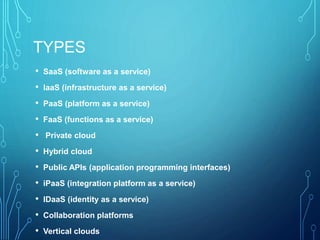
TYPES
• SaaS (software as a service)
• IaaS (infrastructure as a service)
• PaaS (platform as a service)
• FaaS (functions as a service)
• Private cloud
• Hybrid cloud
• Public APIs (application programming interfaces)
• iPaaS (integration platform as a service)
• IDaaS (identity as a service)
• Collaboration platforms
• Vertical clouds
SAAS
• This type of public cloud computing delivers
applications over the internet through the browser.
• Typically, SaaS applications offer extensive
configuration options as well as development
environments
• That enable customers to code their own
modifications and additions.
IAAS
• At a basic level, IaaS public cloud providers offer
storage and compute services on a pay-per-use
basis.
• But the full array of services offered by all major
public cloud providers is staggering.
• Highly scalable databases, virtual private networks,
big data analytics, developer tools, machine
learning, application monitoring, and so on.
PAAS
• PaaS provides sets of services and workflows that
specifically target developers and APIs to
accelerate the development, test, and deployment
of applications.
• Note that a variety of PaaS tailored for developers
of mobile applications generally goes by the name
of MBaaS (mobile back end as a service), or
sometimes just BaaS (back end as a service).
FAAS
• FaaS, the cloud instantiation of adds another layer of
abstraction to PaaS.
• so that developers are completely insulated from
everything in the stack below their code
• All the major clouds offer FaaS on top of IaaS: AWS
Lambda, Azure Functions, Google Cloud Functions, and
IBM OpenWhisk.
• A special benefit of FaaS applications is that they
consume no IaaS resources until an event occurs,
reducing pay-per-use fees.
PRIVATE CLOUD
• The private cloud downsizes the technologies used
to run IaaS public clouds into software that can be
deployed and operated in a customer’s data center.
• VMware’s Software Defined Data Center stack is
the most popular commercial private cloud
software, while OpenStack is the open source
leader.
HYBRID CLOUD
• A hybrid cloud is the integration of a private cloud with a
public cloud.
• The hybrid cloud involves creating parallel
environments in which applications can move easily
between private and public clouds.
• The types of integrations between private and public
cloud vary widely, but they must be extensive to earn a
hybrid cloud designation.
PUBLIC API’S
• Just as SaaS delivers applications to users over the
internet, public APIs offer developers application
functionality that can be accessed programmatically.
• For example, in building web applications, developers
often tap into Google Maps’ API to provide driving
directions;
• To integrate with social media, developers may call upon
APIs maintained by Twitter, Facebook, or LinkedIn.
IPAAS
• Data integration is a key issue for any sizeable
company, but particularly for those that adopt SaaS at
scale.
• iPaaS providers typically offer prebuilt connectors for
sharing data among popular SaaS applications
• on-premises enterprise applications, though providers
may focus more or less on B-to-B and ecommerce
integrations, cloud integrations, or traditional SOA-style
integrations.
IDAAS
• The most difficult security issue related to cloud
computing is the management of user identity and its
associated rights and permissions across private data
centers and pubic cloud sites
• IDaaS providers maintain cloud-based user profiles that
authenticate users
• Enable access to resources or applications based on
security policies, user groups, and individual privileges.
COLLABORATION PLATFORMS
• Collaboration solutions such as Slack, Microsoft
Teams, and Hip Chat have become vital messaging
platforms that enable groups to communicate and
work together effectively.
• Basically, these solutions are relatively simple SaaS
applications that support chat-style messaging
along with file sharing and audio or video
communication.
VERTICAL CLOUDS
• Key players in such industries as financial services,
healthcare, retail, life sciences, and manufacturing
• Provide PaaS clouds to enable customers to build
vertical applications that tap into industry-specific,
API-accessible services
• Most vertical clouds are built with the intent of
nurturing partner ecosystems.
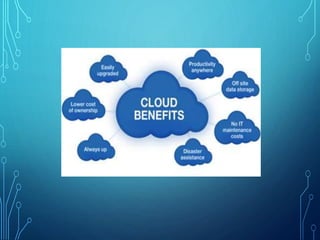
ADVANTAGES
• The cloud’s main appeal is to reduce the time to
market of applications that need to scale
dynamically.
• Although businesses sometimes migrate legacy
applications to the cloud to reduce data center
resource requirements.
• The real benefits accrue to new applications that
take advantage of cloud services and “cloud native”
attributes
Cloud  Computing..What is it? and  what does it mean?

Cloud Computing..What is it? and what does it mean?

  • 1.
    Use ful forbeginers Cloud Computing .. What is it? And what dose it mean?
  • 2.
    WHAT IS CLOUDCOMPUTING? • Cloud computing is an information technology paradigm that enables ubiquitous access to shared pools of configurable system resources • higher-level services that can be rapidly provisioned with minimal management effort, often over the Internet.
  • 4.
    TYPES • SaaS (softwareas a service) • IaaS (infrastructure as a service) • PaaS (platform as a service) • FaaS (functions as a service) • Private cloud • Hybrid cloud • Public APIs (application programming interfaces) • iPaaS (integration platform as a service) • IDaaS (identity as a service) • Collaboration platforms • Vertical clouds
  • 5.
    SAAS • This typeof public cloud computing delivers applications over the internet through the browser. • Typically, SaaS applications offer extensive configuration options as well as development environments • That enable customers to code their own modifications and additions.
  • 6.
    IAAS • At abasic level, IaaS public cloud providers offer storage and compute services on a pay-per-use basis. • But the full array of services offered by all major public cloud providers is staggering. • Highly scalable databases, virtual private networks, big data analytics, developer tools, machine learning, application monitoring, and so on.
  • 7.
    PAAS • PaaS providessets of services and workflows that specifically target developers and APIs to accelerate the development, test, and deployment of applications. • Note that a variety of PaaS tailored for developers of mobile applications generally goes by the name of MBaaS (mobile back end as a service), or sometimes just BaaS (back end as a service).
  • 8.
    FAAS • FaaS, thecloud instantiation of adds another layer of abstraction to PaaS. • so that developers are completely insulated from everything in the stack below their code • All the major clouds offer FaaS on top of IaaS: AWS Lambda, Azure Functions, Google Cloud Functions, and IBM OpenWhisk. • A special benefit of FaaS applications is that they consume no IaaS resources until an event occurs, reducing pay-per-use fees.
  • 9.
    PRIVATE CLOUD • Theprivate cloud downsizes the technologies used to run IaaS public clouds into software that can be deployed and operated in a customer’s data center. • VMware’s Software Defined Data Center stack is the most popular commercial private cloud software, while OpenStack is the open source leader.
  • 10.
    HYBRID CLOUD • Ahybrid cloud is the integration of a private cloud with a public cloud. • The hybrid cloud involves creating parallel environments in which applications can move easily between private and public clouds. • The types of integrations between private and public cloud vary widely, but they must be extensive to earn a hybrid cloud designation.
  • 11.
    PUBLIC API’S • Justas SaaS delivers applications to users over the internet, public APIs offer developers application functionality that can be accessed programmatically. • For example, in building web applications, developers often tap into Google Maps’ API to provide driving directions; • To integrate with social media, developers may call upon APIs maintained by Twitter, Facebook, or LinkedIn.
  • 12.
    IPAAS • Data integrationis a key issue for any sizeable company, but particularly for those that adopt SaaS at scale. • iPaaS providers typically offer prebuilt connectors for sharing data among popular SaaS applications • on-premises enterprise applications, though providers may focus more or less on B-to-B and ecommerce integrations, cloud integrations, or traditional SOA-style integrations.
  • 13.
    IDAAS • The mostdifficult security issue related to cloud computing is the management of user identity and its associated rights and permissions across private data centers and pubic cloud sites • IDaaS providers maintain cloud-based user profiles that authenticate users • Enable access to resources or applications based on security policies, user groups, and individual privileges.
  • 14.
    COLLABORATION PLATFORMS • Collaborationsolutions such as Slack, Microsoft Teams, and Hip Chat have become vital messaging platforms that enable groups to communicate and work together effectively. • Basically, these solutions are relatively simple SaaS applications that support chat-style messaging along with file sharing and audio or video communication.
  • 15.
    VERTICAL CLOUDS • Keyplayers in such industries as financial services, healthcare, retail, life sciences, and manufacturing • Provide PaaS clouds to enable customers to build vertical applications that tap into industry-specific, API-accessible services • Most vertical clouds are built with the intent of nurturing partner ecosystems.
  • 16.
    ADVANTAGES • The cloud’smain appeal is to reduce the time to market of applications that need to scale dynamically. • Although businesses sometimes migrate legacy applications to the cloud to reduce data center resource requirements. • The real benefits accrue to new applications that take advantage of cloud services and “cloud native” attributes