By: R.Dinesh Kumar
Overview
●Definition
●Service Models
●Deployment Models
●Issues
●Research
●Why its important?
●Q&A
Definition
Cloud computing:
–Internet-based computing in which large groups of
remote servers are networked so as to allow sharing
of data-processing tasks, centralized data storage,
and online access to computer services or resources.
–Any computer related task that is done entirely on
the Internet
What is Cloud Computing?
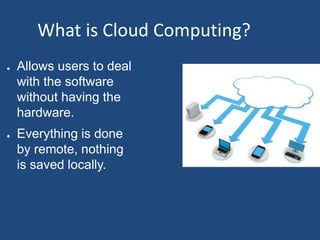
● Allows users to deal
with the software
without having the
hardware.
● Everything is done
by remote, nothing
is saved locally.
Characteristics
● Resource pooling
● On-Demand self-service
● Cost
● Measured and reporting service
● Virtualization
● Reliability
● Scalability and Elasticity
● Security
● Maintenance
Service Models
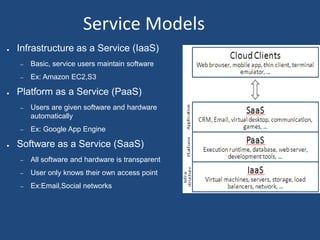
● Infrastructure as a Service (IaaS)
– Basic, service users maintain software
– Ex: Amazon EC2,S3
● Platform as a Service (PaaS)
– Users are given software and hardware
automatically
– Ex: Google App Engine
● Software as a Service (SaaS)
– All software and hardware is transparent
– User only knows their own access point
– Ex:Email,Social networks
Deployment Models
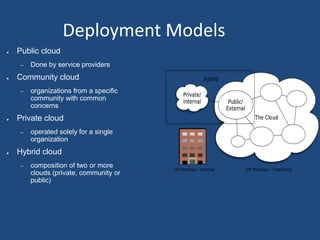
● Public cloud
– Done by service providers
● Community cloud
– organizations from a specific
community with common
concerns
● Private cloud
– operated solely for a single
organization
● Hybrid cloud
– composition of two or more
clouds (private, community or
public)
Security and privacy
● Data protection
● Physical Control
● Physical and personnel security
● Availability
● Application security
● Privacy
● Legal issues
Issues
● Privacy:
The user data can be accessed by the host company with or
without permission. The service provider may access the
data that is on the cloud at any point in time..
● Compliance:
There are many regulations in places related data and
hosting. User may have to adopt deployment modes that are
expensive.
● Security:
Cloud-based services involve third-party for storage and
security.They may share user’s information with
others.Security presents a real threat to cloud.
Issues
● Abuse
– a banking trojan illegally used the popular Amazon
service as a command and control channel that issued
software updates and malicious instructions to PCs that
were infected by the malware
● Open source
– provided the foundation for many cloud computing
implementations
● Open standards
– Some vendors have adopted others' APIs and there are a
number of open standards under development, with a
view to delivering interoperability and portability
Research
● Continues to grow
● Increases with the explosion of cloud
computing
● High speed/ performance is heavily researched
Cloud Clients
● Google
Chromebook
● Web browsers
● Company specific
applications
Importance
● We use clouds everyday
● Used to save huge amounts of
data
● Make maintaining information
easy
● Makes security easy
● Maintainability and
sustainability are better
cloud computing.pptx fundamentals and deployment models

cloud computing.pptx fundamentals and deployment models

  • 1.
  • 2.
  • 3.
    Definition Cloud computing: –Internet-based computingin which large groups of remote servers are networked so as to allow sharing of data-processing tasks, centralized data storage, and online access to computer services or resources. –Any computer related task that is done entirely on the Internet
  • 4.
    What is CloudComputing? ● Allows users to deal with the software without having the hardware. ● Everything is done by remote, nothing is saved locally.
  • 5.
    Characteristics ● Resource pooling ●On-Demand self-service ● Cost ● Measured and reporting service ● Virtualization ● Reliability ● Scalability and Elasticity ● Security ● Maintenance
  • 6.
    Service Models ● Infrastructureas a Service (IaaS) – Basic, service users maintain software – Ex: Amazon EC2,S3 ● Platform as a Service (PaaS) – Users are given software and hardware automatically – Ex: Google App Engine ● Software as a Service (SaaS) – All software and hardware is transparent – User only knows their own access point – Ex:Email,Social networks
  • 7.
    Deployment Models ● Publiccloud – Done by service providers ● Community cloud – organizations from a specific community with common concerns ● Private cloud – operated solely for a single organization ● Hybrid cloud – composition of two or more clouds (private, community or public)
  • 8.
    Security and privacy ●Data protection ● Physical Control ● Physical and personnel security ● Availability ● Application security ● Privacy ● Legal issues
  • 9.
    Issues ● Privacy: The userdata can be accessed by the host company with or without permission. The service provider may access the data that is on the cloud at any point in time.. ● Compliance: There are many regulations in places related data and hosting. User may have to adopt deployment modes that are expensive. ● Security: Cloud-based services involve third-party for storage and security.They may share user’s information with others.Security presents a real threat to cloud.
  • 10.
    Issues ● Abuse – abanking trojan illegally used the popular Amazon service as a command and control channel that issued software updates and malicious instructions to PCs that were infected by the malware ● Open source – provided the foundation for many cloud computing implementations ● Open standards – Some vendors have adopted others' APIs and there are a number of open standards under development, with a view to delivering interoperability and portability
  • 11.
    Research ● Continues togrow ● Increases with the explosion of cloud computing ● High speed/ performance is heavily researched
  • 12.
    Cloud Clients ● Google Chromebook ●Web browsers ● Company specific applications
  • 13.
    Importance ● We useclouds everyday ● Used to save huge amounts of data ● Make maintaining information easy ● Makes security easy ● Maintainability and sustainability are better