INTRODUCTION
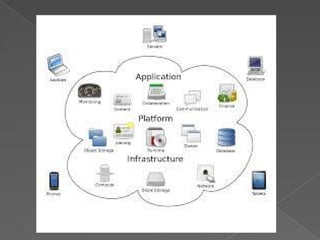
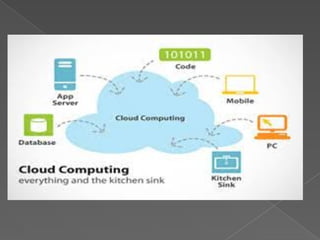
⦿Cloud computing isthe delivery of
different services through the Internet.
These resources include tools and
applications like data storage, servers,
databases, networking, and software. ...
As long as an electronic device has
access to the web, it has access to the
data and the software programs to run
it.
4.
HOW DOES CLOUD
COMPUTINGWORK?
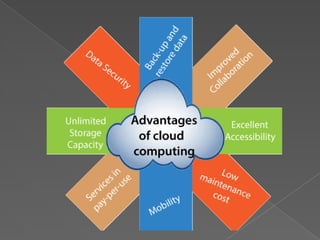
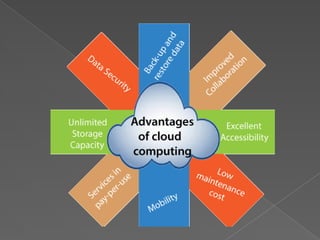
⦿One benefit of using cloud computing
services is that firms can avoid the upfront
cost and complexity of owning and
maintaining their own IT infrastructure, and
instead simply pay for what they use, when
they use it. In turn, providers of cloud
computing services can benefit from
significant economies of scale by
delivering the same services to a wide
range of customers.
6.
What cloud computing
servicesare available?
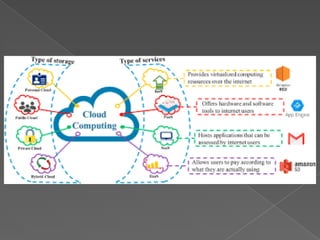
⦿Cloud computing services cover a vast
range of options now, from the basics of
storage, networking, and processing
power through to natural language
processing and artificial intelligence as
well as standard office applications.
Pretty much any service that doesn't
require you to be physically close to the
computer hardware that you are using
can now be delivered via the cloud.
8.
What are examplesof cloud
computing?
⦿ Cloud computing underpins a vast number of
services. That includes consumer services like
Gmail or the cloud back-up of the photos on
your smartphone, though to the services
which allow large enterprises to host all their
data and run all of their applications in the
cloud. Netflix relies on cloud computing
services to run its its video streaming service
and its other business systems too, and have
a number of other organisations.
10.
Cloud computing isbecoming the
default option for many apps:
software vendors are increasingly
offering their applications as services
over the internet rather than
standalone products as they try to
switch to a subscription model.
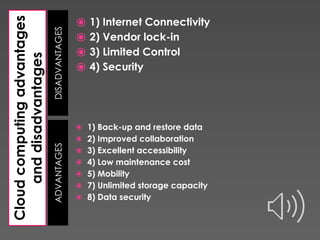
However, there is a potential
downside to cloud computing, in that
it can also introduce new costs and
new risks for companies using it.
12.
The history ofcloud computing
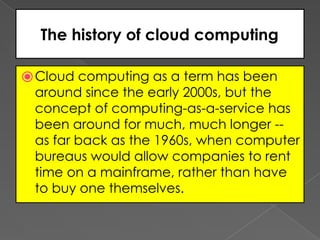
⦿Cloud computing as a term has been
around since the early 2000s, but the
concept of computing-as-a-service has
been around for much, much longer --
as far back as the 1960s, when computer
bureaus would allow companies to rent
time on a mainframe, rather than have
to buy one themselves.
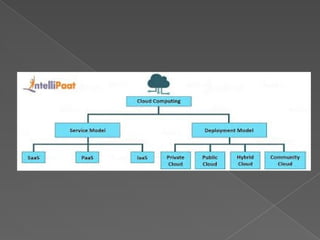
Public cloud
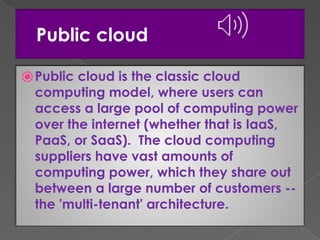
⦿Public cloudis the classic cloud
computing model, where users can
access a large pool of computing power
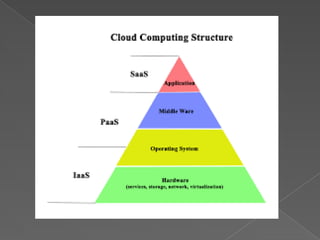
over the internet (whether that is IaaS,
PaaS, or SaaS). The cloud computing
suppliers have vast amounts of
computing power, which they share out
between a large number of customers --
the 'multi-tenant' architecture.
18.
Private cloud
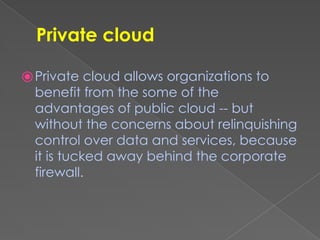
⦿Private cloudallows organizations to
benefit from the some of the
advantages of public cloud -- but
without the concerns about relinquishing
control over data and services, because
it is tucked away behind the corporate
firewall.
20.
Hybrid cloud
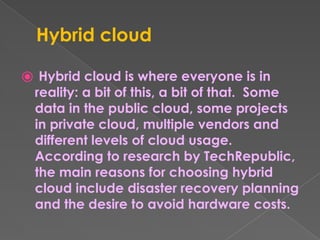
⦿ Hybridcloud is where everyone is in
reality: a bit of this, a bit of that. Some
data in the public cloud, some projects
in private cloud, multiple vendors and
different levels of cloud usage.
According to research by TechRepublic,
the main reasons for choosing hybrid
cloud include disaster recovery planning
and the desire to avoid hardware costs.
23.
What is thefuture of cloud
computing?
⦿ Cloud computing is still at a relatively early stage of
adoption, despite its long history. Many companies
are still considering which apps to move and when.
However, usage is only likely to climb as
organisations get more comfortable with the idea
of their data being somewhere other than a server
in the basement. We're still relatively early into
cloud adoption -- some estimates suggest that only
10% of the workloads that could be move have
actually been transferred across. Those are the
easy ones where the economics are hard for CIOs
to argue with.