
MAY 9, 2013, Vilnius - Yerevan
Vazgen Ghazaryan
CLOUD COMPUTING
DEVELOPMENT
IN ARMENIA
Master Thesis
Supervisor of master thesis
Prof. dr. Aelita Skaržauskienė
CLOUD COMPUTING DEVELOPMENT IN ARMENIA
Vazgen Ghazaryan
Page 2 of 13
Problem: The problem is lack of knowledge (benefits/risks)
of Cloud Computing for business users.
Purpose: The purpose of the thesis is to clarify benefits and
risks of Cloud Computing from the perspective of business
users.
Objectives:
To analyze Cloud Computing risks
To analyze Cloud Computing benefits
To analyze Cloud Computing possible implementation
CLOUD COMPUTING DEVELOPMENT IN ARMENIA
Vazgen Ghazaryan
Page 3 of 13
What is Cloud Computing?
National Institute of Standards and Technology of the U.S.
Department of Commerce defines Cloud Computing as:
Model for enabling convenient, on-demand network access
to a shared pool of configurable computing resources (e.g.,
networks, servers, storage, applications, and services) that
can be rapidly provisioned and released with minimal
management effort or service provider interaction.
CLOUD COMPUTING DEVELOPMENT IN ARMENIA
Vazgen Ghazaryan
Page 4 of 13
Motivation
• Previous researchers focused on technical questions of
Cloud Computing
• Previous researchers focused on end users
Relevance and novelty of this thesis is to analyze benefits
and risks of Cloud Computing business users, i.e.
companies that use IT technologies a lot
CLOUD COMPUTING DEVELOPMENT IN ARMENIA
Vazgen Ghazaryan
Page 5 of 13
Research questions
Q1: How can company benefit from using Cloud
Computing compared to other solutions?
Q2: What are possible issues that occur with Cloud
Computing?
Q3: How would Cloud Computing change an
organizations’ IT infrastructure?
CLOUD COMPUTING DEVELOPMENT IN ARMENIA
Vazgen Ghazaryan
Page 6 of 13
Methodology of research
Theoretical
• Review of selected scientific literature on Cloud
Computing
• Comparative analysis of empirical data with scientific
literature
CLOUD COMPUTING DEVELOPMENT IN ARMENIA
Vazgen Ghazaryan
Page 7 of 13
Methodology of research
Empirical (Qualitative Method)
• Expert analysis through semi-structured interviews
The date collection: I have carried out semi-structured
interviews with experts in the field. I identified the
respondents using snowballing method.
• Interviews with two Armenian IT companies
Research design method: Descriptive inference is the
process of understanding an unobserved phenomenon on
the basis of a set of observations.
CLOUD COMPUTING DEVELOPMENT IN ARMENIA
Vazgen Ghazaryan
Page 8 of 13
Cloud Computing Risks
Policy and Organizational – Cloud service termination or
failure, Loss of governance, Supply chain failure etc.
Technical – Intercepting data in transit, Insecure or
ineffective deletion of data, Distributed denial of service
(DDoS), Conflicts between customer hardening procedures
and cloud environment etc.
Legal – Licensing risks, Data protection risks etc.
CLOUD COMPUTING DEVELOPMENT IN ARMENIA
Vazgen Ghazaryan
Page 9 of 13
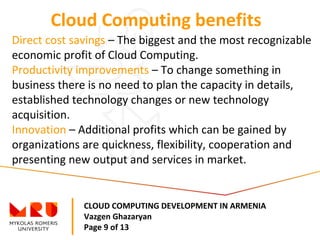
Cloud Computing benefits
Direct cost savings – The biggest and the most recognizable
economic profit of Cloud Computing.
Productivity improvements – To change something in
business there is no need to plan the capacity in details,
established technology changes or new technology
acquisition.
Innovation – Additional profits which can be gained by
organizations are quickness, flexibility, cooperation and
presenting new output and services in market.
CLOUD COMPUTING DEVELOPMENT IN ARMENIA
Vazgen Ghazaryan
Page 10 of 13
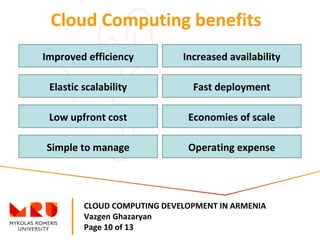
Cloud Computing benefits
Improved efficiency Increased availability
Elastic scalability
Low upfront cost
Simple to manage
Fast deployment
Economies of scale
Operating expense
CLOUD COMPUTING DEVELOPMENT IN ARMENIA
Vazgen Ghazaryan
Page 11 of 13
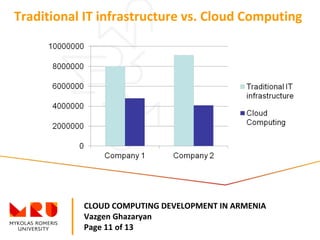
Traditional IT infrastructure vs. Cloud Computing
CLOUD COMPUTING DEVELOPMENT IN ARMENIA
Vazgen Ghazaryan
Page 12 of 13
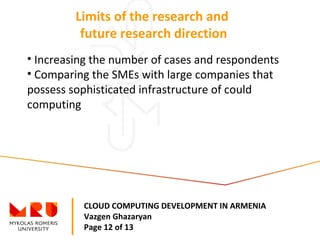
Limits of the research and
future research direction
• Increasing the number of cases and respondents
• Comparing the SMEs with large companies that
possess sophisticated infrastructure of could
computing
G.Paražinskaitė - April 2012
THANK YOU
FOR YOUR ATTENTION!!
Vazgen Ghazaryan

Cloud Computing Development in Armenia

  • 1.
    MAY 9, 2013,Vilnius - Yerevan Vazgen Ghazaryan CLOUD COMPUTING DEVELOPMENT IN ARMENIA Master Thesis Supervisor of master thesis Prof. dr. Aelita Skaržauskienė
  • 2.
    CLOUD COMPUTING DEVELOPMENTIN ARMENIA Vazgen Ghazaryan Page 2 of 13 Problem: The problem is lack of knowledge (benefits/risks) of Cloud Computing for business users. Purpose: The purpose of the thesis is to clarify benefits and risks of Cloud Computing from the perspective of business users. Objectives: To analyze Cloud Computing risks To analyze Cloud Computing benefits To analyze Cloud Computing possible implementation
  • 3.
    CLOUD COMPUTING DEVELOPMENTIN ARMENIA Vazgen Ghazaryan Page 3 of 13 What is Cloud Computing? National Institute of Standards and Technology of the U.S. Department of Commerce defines Cloud Computing as: Model for enabling convenient, on-demand network access to a shared pool of configurable computing resources (e.g., networks, servers, storage, applications, and services) that can be rapidly provisioned and released with minimal management effort or service provider interaction.
  • 4.
    CLOUD COMPUTING DEVELOPMENTIN ARMENIA Vazgen Ghazaryan Page 4 of 13 Motivation • Previous researchers focused on technical questions of Cloud Computing • Previous researchers focused on end users Relevance and novelty of this thesis is to analyze benefits and risks of Cloud Computing business users, i.e. companies that use IT technologies a lot
  • 5.
    CLOUD COMPUTING DEVELOPMENTIN ARMENIA Vazgen Ghazaryan Page 5 of 13 Research questions Q1: How can company benefit from using Cloud Computing compared to other solutions? Q2: What are possible issues that occur with Cloud Computing? Q3: How would Cloud Computing change an organizations’ IT infrastructure?
  • 6.
    CLOUD COMPUTING DEVELOPMENTIN ARMENIA Vazgen Ghazaryan Page 6 of 13 Methodology of research Theoretical • Review of selected scientific literature on Cloud Computing • Comparative analysis of empirical data with scientific literature
  • 7.
    CLOUD COMPUTING DEVELOPMENTIN ARMENIA Vazgen Ghazaryan Page 7 of 13 Methodology of research Empirical (Qualitative Method) • Expert analysis through semi-structured interviews The date collection: I have carried out semi-structured interviews with experts in the field. I identified the respondents using snowballing method. • Interviews with two Armenian IT companies Research design method: Descriptive inference is the process of understanding an unobserved phenomenon on the basis of a set of observations.
  • 8.
    CLOUD COMPUTING DEVELOPMENTIN ARMENIA Vazgen Ghazaryan Page 8 of 13 Cloud Computing Risks Policy and Organizational – Cloud service termination or failure, Loss of governance, Supply chain failure etc. Technical – Intercepting data in transit, Insecure or ineffective deletion of data, Distributed denial of service (DDoS), Conflicts between customer hardening procedures and cloud environment etc. Legal – Licensing risks, Data protection risks etc.
  • 9.
    CLOUD COMPUTING DEVELOPMENTIN ARMENIA Vazgen Ghazaryan Page 9 of 13 Cloud Computing benefits Direct cost savings – The biggest and the most recognizable economic profit of Cloud Computing. Productivity improvements – To change something in business there is no need to plan the capacity in details, established technology changes or new technology acquisition. Innovation – Additional profits which can be gained by organizations are quickness, flexibility, cooperation and presenting new output and services in market.
  • 10.
    CLOUD COMPUTING DEVELOPMENTIN ARMENIA Vazgen Ghazaryan Page 10 of 13 Cloud Computing benefits Improved efficiency Increased availability Elastic scalability Low upfront cost Simple to manage Fast deployment Economies of scale Operating expense
  • 11.
    CLOUD COMPUTING DEVELOPMENTIN ARMENIA Vazgen Ghazaryan Page 11 of 13 Traditional IT infrastructure vs. Cloud Computing
  • 12.
    CLOUD COMPUTING DEVELOPMENTIN ARMENIA Vazgen Ghazaryan Page 12 of 13 Limits of the research and future research direction • Increasing the number of cases and respondents • Comparing the SMEs with large companies that possess sophisticated infrastructure of could computing
  • 13.
    G.Paražinskaitė - April2012 THANK YOU FOR YOUR ATTENTION!! Vazgen Ghazaryan