Picture: https://www.supraits.com/infrastructure/managed-cloud/hybrid-cloud-
WHAT IS
CLOUD
COMPUTIN
G?
Picture: https://www.supraits.com/infrastructure/managed-cloud/hybrid-cloud-
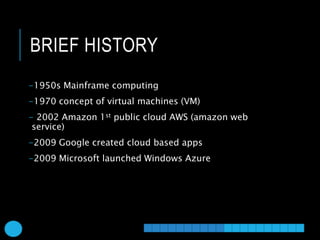
BRIEF HISTORY
-1950s Mainframe computing
-1970 concept of virtual machines (VM)
- 2002 Amazon 1st public cloud AWS (amazon web
service)
-2009 Google created cloud based apps
-2009 Microsoft launched Windows Azure
WHY USE
CLOUD
COMPUTIN
G?
WHY USE CLOUD COMPUTING
• Store backups
•Collaboration efficiency
• Store backups
Collaboration efficiency
WHY USE CLOUD COMPUTING
• Store backups
•Collaboration efficiency
•More jobs
• reduced IT costs
• Store backups
Collaboration efficiency
More jobs
Reduced IT costs
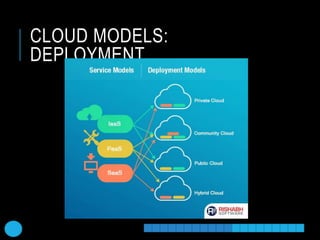
CLOUD MODELS:
DEPLOYMENT
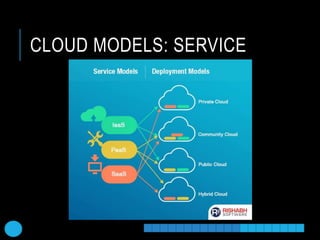
CLOUD MODELS: SERVICE
TOO GOOD TO BE TRUE?
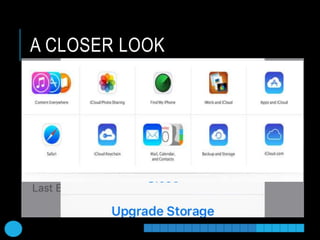
A CLOSER LOOK
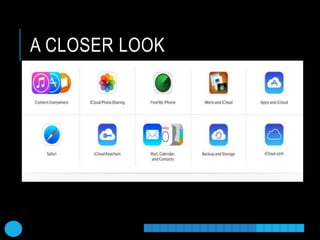
A CLOSER LOOK
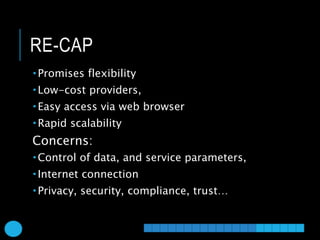
RE-CAP
 Promises flexibility
 Low-cost providers,
 Easy access via web browser
 Rapid scalability
Concerns:
 Control of data, and service parameters,
 Internet connection
 Privacy, security, compliance, trust…
SOURCES
https://dzone.com/articles/cloud-computing-security-
challenges-and-considerat
https://www.infoworld.com/article/2683784/what-is-
cloud-computing.html
https://www.salesforce.com/products/platform/best-
practices/cloud-computing/
https://aws.amazon.com/what-is-cloud-computing/

Cloud Computing

Editor's Notes

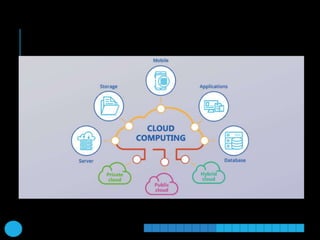
  • #2 How it works - graphics
  • #3 What is it: show one words popping up on the screen
  • #6 What is it: show one words popping up on the screen
  • #9 Represents, a specific cloud environment. This can be distinguished by ownership, size, access Examples that will go in depth with are public, private, and hybrid.
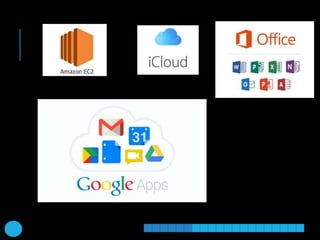
  • #10 Service models consist of 3 different approaches, Iaas – when a vendor provides the user with access to computing resources (servers, storage) Paas – where users can develop, manage, and deliver apps Saas- user is given access to vendors cloud based software applications reside on local cloud network
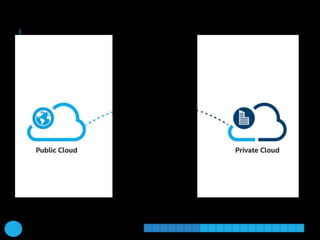
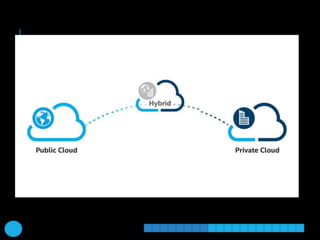
  • #11 Not all clouds are the same Several different models, types, and services have been made to offer the right solution for your needs. There are three different ways to deploy cloud services The first being on a public cloud Public clouds are owned and operated by a third-party cloud service providers which deliver their computing resources, like servers and storage, over the Internet The second, Private cloud, refers to cloud computing resources that are used solely by a single business or organization This can be found on the companies on-site datacenter
  • #12 The third, Hybrid clouds, is a combination of the two bound together by technology it allows data and applications to be shared between them By allowing data and applications to move between private and public clouds, a hybrid cloud gives your business greater flexibility, more deployment options
  • #13 - You’re probably using cloud computing right now, even if you don’t realize it - If you use an online service to send email, edit documents, watch movies or TV, listen to music, play games, or store pictures and other files, As mentioned before, Protect your data more cost-efficiently through backups Video streaming: the ability to listen to high-definition video anywhere on any device Analyze data by sharing your data across teams, divisions, and locations in the cloud. Test and build applications to reduce cost and time by using cloud Imbedded intelligence: Use intelligent models to help engage customers and provide valuable insights from the data captured.
  • #15 Requires good internet speed Security : lack of control and overall visibility . It is unclear how safe out-sourced data is. Limited control on infrastructure