1
healthcare consulting
Clinical Integration
Kevin Locke, Principal, DHG Healthcare
Michael Strilesky, Principal, DHG Healthcare
2
healthcare consulting
Agenda
 Accelerators for CIN Development
 Overview of CINs
 Financial Considerations for Networks
 Value and Risk-Based Contracts
 Legal Considerations
 Q&A
3
healthcare consulting
The Tipping Point: Volume to Value
4
healthcare consulting
Accelerators: CMS
______________________________________________________________________________________
“HHS has set a goal of tying 30 percent of traditional, or fee-for-service,
Medicare payments to quality or value through alternative payment
models, such as Accountable Care Organizations (ACOs) or bundled
payment arrangements by the end of 2016, and tying 50 percent of
payments to these models by the end of 2018. HHS also set a goal of
tying 85 percent of all traditional Medicare payments to quality or value
by 2016 and 90 percent by 2018 through programs such as the Hospital
Value Based Purchasing and the Hospital Readmissions Reduction
Programs….”
– HHS Press Release, January 26, 2015
“Entities furnishing DHS face the predicament of trying to achieve clinical
and financial integration with other health care providers, including
physicians, while simultaneously having to satisfy the requirements of an
exception to the physician self-referral law’s prohibitions if they wish to
compensate physicians to help them.”
- CMS, Physician Fee Schedule Proposed Rule, July 2015
8
5
healthcare consulting Source: HFMA 2010 The Advisory Board 2010
Source: Consumer Price Index & CMS Reimbursements Data
Accelerators: Provider and Payer Economics
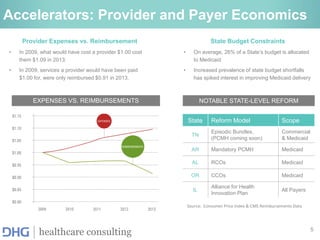
Provider Expenses vs. Reimbursement
• In 2009, what would have cost a provider $1.00 cost
them $1.09 in 2013.
• In 2009, services a provider would have been paid
$1.00 for, were only reimbursed $0.91 in 2013.
State Budget Constraints
• On average, 26% of a State’s budget is allocated
to Medicaid
• Increased prevalence of state budget shortfalls
has spiked interest in improving Medicaid delivery
NOTABLE STATE-LEVEL REFORM
State Reform Model Scope
TN
Episodic Bundles,
(PCMH coming soon)
Commercial
& Medicaid
AR Mandatory PCMH Medicaid
AL RCOs Medicaid
OR CCOs Medicaid
IL
Alliance for Health
Innovation Plan
All Payers
EXPENSES VS. REIMBURSEMENTS
6
healthcare consulting Source: HFMA 2010 The Advisory Board 2010
Source: Consumer Price Index & CMS Reimbursements Data
Accelerator: Consolidation
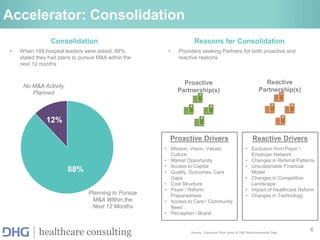
Consolidation
• When 189 hospital leaders were asked, 88%
stated they had plans to pursue M&A within the
next 12 months
88%
12%
No M&A Activity
Planned
Planning to Pursue
M&A Within the
Next 12 Months
Proactive
Partnership(s)
Reactive
Partnership(s)
Proactive Drivers
• Mission, Vision, Values,
Culture
• Market Opportunity
• Access to Capital
• Quality, Outcomes, Care
Gaps
• Cost Structure
• Payer / Reform
Preparedness
• Access to Care / Community
Need
• Perception / Brand
Reactive Drivers
• Exclusion from Payer /
Employer Network
• Changes in Referral Patterns
• Unsustainable Financial
Model
• Changes in Competitive
Landscape
• Impact of Healthcare Reform
• Changes in Technology
Reasons for Consolidation
• Providers seeking Partners for both proactive and
reactive reasons
7
healthcare consulting Source: HFMA 2010 The Advisory Board 2010
Source: Consumer Price Index & CMS Reimbursement Data
Accelerators: Payment and Volume Risk
Shifting Risk to Providers & Consumers
FEE-FOR-
SERVICE
SHARED
SAVINGS
PAY-FOR-
PERFORMANCE
VALUE-BASED
PURCHASING
BUNDLED
PAYMENTS
GLOBAL
PAYMENTS
EMPLOYERS
HEALTH PLANS
GOVERNMENT PAYERS
PHYSICIANS
HOSPITALS
CONSUMERS
Increasing Consumer Choice / Power
Clear plan comparison
on exchange platforms
Easy for individuals to
switch plans annually
Variable individual
premium contribution,
high deductibles
900+ Locations
400+ Locations
125+ Locations
Estimated to be
nearly 3,000
retail clinics in
the US by the
end of 2015
RETAIL
CLINICS
New and increased
choices for provider
access
RISK SHIFT
8
healthcare consulting
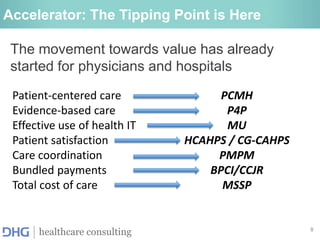
Accelerator: The Tipping Point is Here
The movement towards value has already
started for physicians and hospitals
Patient-centered care
Evidence-based care
Effective use of health IT
Patient satisfaction
Care coordination
Bundled payments
Total cost of care
PCMH
P4P
MU
HCAHPS / CG-CAHPS
PMPM
BPCI/CCJR
MSSP
9
healthcare consulting
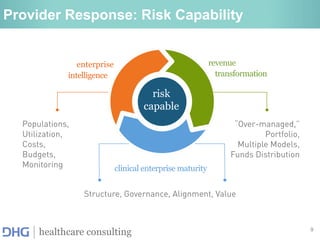
Provider Response: Risk Capability
10
healthcare consulting
Provider Response: Clinical Integration
IMPROVE QUALITY
- Consistent
Performance
Metrics
- Evidence-based
Protocols
- Defined Provider
Expectations
ENHANCE ACCESS
- Emphasis on
Prevention
- Use of Telehealth
and Virtual Tools
- Expanded
Provider
Availability
CREATE
EFFICIENCIES
- Utilization Review
- Right Time, Right
Place
- Decrease Spend per
Beneficiary
- Care Coordination
CIN GOALS
DELIVER VALUE
- Improve Performance
- Pursue Contracts that Reward Value
CIN OUTCOMES
A Clinically Integrated Network (CIN) is a selective partnership of physicians collaborating with
hospital(s) and other providers to deliver evidence-based care, improve quality and efficiency,
manage populations and demonstrate value to the market. Once these objectives are met, the network
may contract on behalf of participants
MANAGE DEFINED POPULATIONS
11
healthcare consulting
“The future is already here –
it’s just not evenly distributed”
William Gibson
12
healthcare consulting
Clinically Integrated Networks (CINs)
13
healthcare consulting
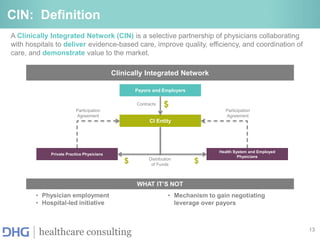
A Clinically Integrated Network (CIN) is a selective partnership of physicians collaborating
with hospitals to deliver evidence-based care, improve quality, efficiency, and coordination of
care, and demonstrate value to the market.
Clinically Integrated Network
Health System and Employed
Physicians
Private Practice Physicians
CI Entity
Payors and Employers
$
$ $
Contracts
WHAT IT’S NOT
• Physician employment
• Hospital-led initiative
• Mechanism to gain negotiating
leverage over payors
Distribution
of Funds
Participation
Agreement
Participation
Agreement
CIN: Definition
14
healthcare consulting
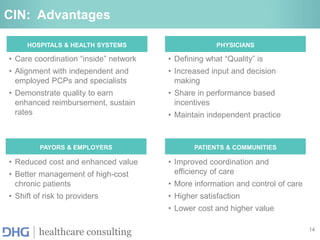
CIN: Advantages
• Improved coordination and
efficiency of care
• More information and control of care
• Higher satisfaction
• Lower cost and higher value
PATIENTS & COMMUNITIES
HOSPITALS & HEALTH SYSTEMS
• Care coordination “inside” network
• Alignment with independent and
employed PCPs and specialists
• Demonstrate quality to earn
enhanced reimbursement, sustain
rates
• Defining what “Quality” is
• Increased input and decision
making
• Share in performance based
incentives
• Maintain independent practice
PHYSICIANS
• Reduced cost and enhanced value
• Better management of high-cost
chronic patients
• Shift of risk to providers
PAYORS & EMPLOYERS
15
healthcare consulting
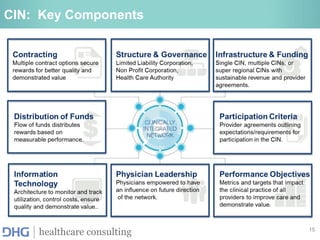
CIN: Key Components
16
healthcare consulting
Observed Characteristics:
• Physicians can elect Board Members
• Participation Fees will be different for Owners than for Participants
• All physicians will sign the same Membership Agreement
• Active participation is required to achieve performance goals
• Profit distribution to owners only, based on company’s profits
• Performance rewards will be available to Owners and Participants based on
performance
50%
Health System
CIN
Physician
Owners
Payers
50%
Physician
Participants
Infrastructure: Joint-Venture LLC Model
17
healthcare consulting
Observed Characteristics:
• Physicians can nominate Board Members, that are approved by Health System
• Participation Fees are typically the same for all Physician Participants,
assuming all physicians sign the same Participation Agreement
• Active participation is required to achieve performance goals
• Distribution pool developed at the discretion of Health System, factoring in
overhead costs for the network
• Networks can create rewards to physicians
100%
Health System
CIN
Payers
Physician
Participants
Infrastructure: Subsidiary LLC Model
18
healthcare consulting
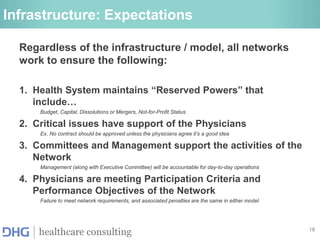
Infrastructure: Expectations
Regardless of the infrastructure / model, all networks
work to ensure the following:
1. Health System maintains “Reserved Powers” that
include…
Budget, Capital, Dissolutions or Mergers, Not-for-Profit Status
2. Critical issues have support of the Physicians
Ex. No contract should be approved unless the physicians agree it’s a good idea
3. Committees and Management support the activities of the
Network
Management (along with Executive Committee) will be accountable for day-to-day operations
4. Physicians are meeting Participation Criteria and
Performance Objectives of the Network
Failure to meet network requirements, and associated penalties are the same in either model
18
19
healthcare consulting
IPA Legal Framework
Health
System(s)
Payors /
Employers
IPA
Participating
Agreement(s)
100%
Physician
Groups
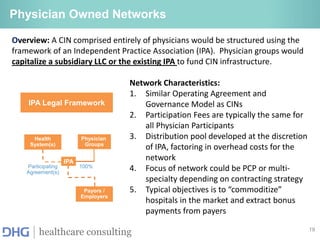
Overview: A CIN comprised entirely of physicians would be structured using the
framework of an Independent Practice Association (IPA). Physician groups would
capitalize a subsidiary LLC or the existing IPA to fund CIN infrastructure.
Physician Owned Networks
Network Characteristics:
1. Similar Operating Agreement and
Governance Model as CINs
2. Participation Fees are typically the same for
all Physician Participants
3. Distribution pool developed at the discretion
of IPA, factoring in overhead costs for the
network
4. Focus of network could be PCP or multi-
specialty depending on contracting strategy
5. Typical objectives is to “commoditize”
hospitals in the market and extract bonus
payments from payers
20
healthcare consulting
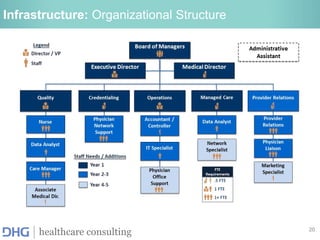
Infrastructure: Organizational Structure
21
healthcare consulting
Infrastructure: Care Management
22
healthcare consulting
MATURITY OF CIN
Membership
Fees
LOW HIGH
Hospital
Efficiency
Program
Self Funded
Health Plan
Payer Contracts (no
Risk)
Direct to Employer
Contracts
Pay-for-
Performance
The CIN is a separate business entity with a distinct identity, mission, and vision,
dedicated leadership and staff, sustainable sources of revenue to offset operations.
Sources of Revenue
Funding: Aligned with Start-Up and Contracting
Private Label Health
Plan
Payer Contracts
(Risk)
23
healthcare consulting
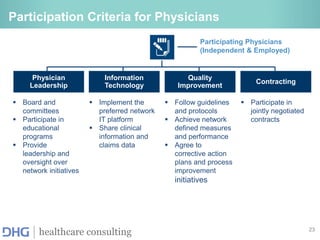
Participating Physicians
(Independent & Employed)
Physician
Leadership
Information
Technology
Quality
Improvement
Contracting
 Board and
committees
 Participate in
educational
programs
 Provide
leadership and
oversight over
network initiatives
 Implement the
preferred network
IT platform
 Share clinical
information and
claims data
 Follow guidelines
and protocols
 Achieve network
defined measures
and performance
 Agree to
corrective action
plans and process
improvement
initiatives
 Participate in
jointly negotiated
contracts
Participation Criteria for Physicians
24
healthcare consulting
Element Description Examples
Variance & Cost
Reduction
Minimize variable physician
performance not related to patient
characteristics
• Minimize orthopedics supply chain cost
• Staffing and productivity opportunities
Unnecessary Care
Reduction
Reduce avoidable, unproductive and
duplicative services
• Prostate cancer screenings for elderly
patients
• Reduce Readmissions
Clinical Restructuring
Ensure treatment in most optimal
setting with most appropriate level
of provider
• Early step down from an IP to SNF bed
• Partnerships with a local retail clinic to
offer non-urgent care
System Optimization
Shift focus to upstream, preventative
care with emphasis on CI and
population health
• Disease-based medical homes
• Patient engagement strategies using
telehealth
Source: Sg2 Analysis
Examples of Performance Improvement
Metrics and targets designed to meaningfully impact the clinical practice of all network physicians,
and to align their conduct with hospital initiatives, so as to improve quality and demonstrate value
across the entire continuum of care.
Performance Objectives
25
healthcare consulting
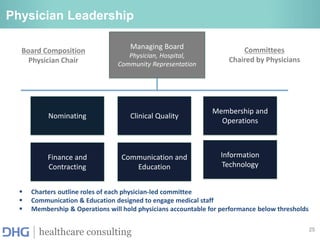
Physician Leadership
Managing Board
Physician, Hospital,
Community Representation
Finance and
Contracting
Clinical Quality
Membership and
Operations
Communication and
Education
Information
Technology
Board Composition
Physician Chair
Committees
Chaired by Physicians
Nominating
 Charters outline roles of each physician-led committee
 Communication & Education designed to engage medical staff
 Membership & Operations will hold physicians accountable for performance below thresholds
26
healthcare consulting
IT Connectivity for Population Health
27
healthcare consulting
Developing the Population Health Model
28
healthcare consulting
PAYORS &
EMPLOYERS
 Cost Savings
 Efficiency Gains
 P4P Contracts
 Shared Savings
 Increased Rates
 Hospital
 Specialty
 Location
 Equal distribution  Performance targets
 Educational event attendance
 Submission of Data
 Adoption of IT platform
INDIVIDUAL ACTIVITY/
OUTCOMES
%
LOCAL NETWORK
PERFORMANCE
%
NETWORK
GLOBAL NETWORK
PERFORMANCE
%
$ $
Overview: The CIN establishes an organized plan to link performance on defined
gradients to eligibility for incentive payments.
Distribution Framework
HOSPITAL /
SYSTEM
29
healthcare consulting
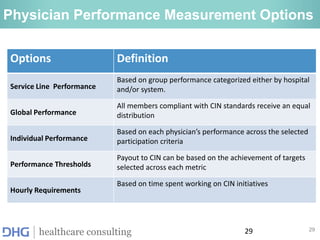
Physician Performance Measurement Options
29
Options Definition
Service Line Performance
Based on group performance categorized either by hospital
and/or system.
Global Performance
All members compliant with CIN standards receive an equal
distribution
Individual Performance
Based on each physician’s performance across the selected
participation criteria
Performance Thresholds
Payout to CIN can be based on the achievement of targets
selected across each metric
Hourly Requirements
Based on time spent working on CIN initiatives
30
healthcare consulting
Fair Market Value
Fair Market Value (FMV) firms evaluate the commercial
reasonableness of compensation that is transferred
between providers. Typical circumstances to receive a
FMV Opinion include the validation of:
1. Compensation between Hospital and CIN
2. Downstream compensation formula between Hospital-
owned CIN and individual physicians
3. Performance targets, benchmarks and processes that
do not include funds from third party payers
30
31
healthcare consulting
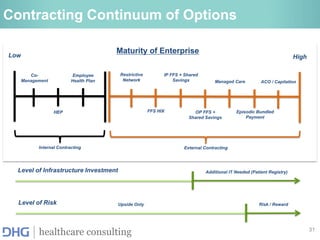
Contracting Continuum of Options
Maturity of Enterprise
Low High
Co-
Management
HEP
Employee
Health Plan
Restrictive
Network
FFS HIX
IP FFS + Shared
Savings
OP FFS +
Shared Savings
Managed Care
Episodic Bundled
Payment
ACO / Capitation
Level of Infrastructure Investment Additional IT Needed (Patient Registry)
Level of Risk Risk / Reward
Upside Only
Internal Contracting External Contracting
32
healthcare consulting
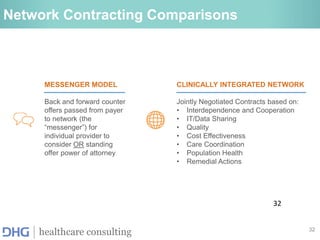
Network Contracting Comparisons
32
MESSENGER MODEL
Back and forward counter
offers passed from payer
to network (the
“messenger”) for
individual provider to
consider OR standing
offer power of attorney
CLINICALLY INTEGRATED NETWORK
Jointly Negotiated Contracts based on:
• Interdependence and Cooperation
• IT/Data Sharing
• Quality
• Cost Effectiveness
• Care Coordination
• Population Health
• Remedial Actions
33
healthcare consulting
The Phases of Network Maturation
• Network maturation should follow a systematic process paced to market opportunities,
allowing the hospital and its physicians to prepare for the future while remaining focused on
short-term initiatives
• While the phases of maturity are sequential, unique local dynamics will dictate how a market
approaches the progression (if appropriate) from each phase to another
• Local committees formed to
begin service line and
market-focused growth
strategies
• Committees foster shared
vision across market
• Committees evaluate quality
and cost opportunities
• Expectation is that stronger
engagement and loyalty
leads to sustainability under
a FFS model while building
the infrastructure to become
risk-capable
PHYSICIAN ALIGNMENT AND ENGAGEMENT
• Data collection allows definition
of quality baselines and targets
• Physician-approved care
protocols and processes drive
standardization, cost reduction
and quality improvement
• Typical models that
accommodate this phase include
co-management, shared savings
with hospital employee health
plan & HEP contracts
QUALITY, EFFICIENCY AND STANDARDIZATION
• Demonstrated improvement in quality and performance creates new
value proposition for contract negotiations
• Value proposition positions hospital and physicians for enhanced
reimbursement and narrow network opportunities
• incentives from payers and/or employers shared with network
participants
• Expectation is that new revenue through PMPM rates, P4P, VBP
and shared savings reimbursement will offset costs of network
development
STRATEGIC
OBJECTIVES
VALUE-BASED CONTRACTING
• 3
3
34
healthcare consulting
Financial Considerations for Networks
35
healthcare consulting
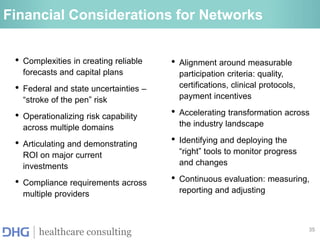
Financial Considerations for Networks
• Complexities in creating reliable
forecasts and capital plans
• Federal and state uncertainties –
“stroke of the pen” risk
• Operationalizing risk capability
across multiple domains
• Articulating and demonstrating
ROI on major current
investments
• Compliance requirements across
multiple providers
• Alignment around measurable
participation criteria: quality,
certifications, clinical protocols,
payment incentives
• Accelerating transformation across
the industry landscape
• Identifying and deploying the
“right” tools to monitor progress
and changes
• Continuous evaluation: measuring,
reporting and adjusting
36
healthcare consulting
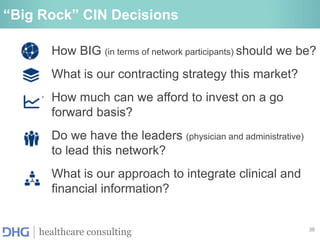
“Big Rock” CIN Decisions
• How BIG (in terms of network participants) should we be?
• What is our contracting strategy this market?
• How much can we afford to invest on a go
forward basis?
• Do we have the leaders (physician and administrative)
to lead this network?
• What is our approach to integrate clinical and
financial information?
37
healthcare consulting
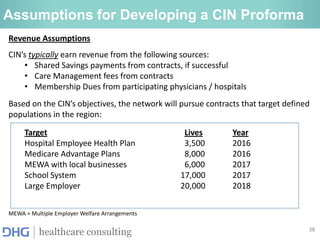
Network Metrics for Management Professionals
Metric Measurement
Participants # of Physicians / Providers / Facilities
Covered Lives “Belly Buttons”
Access Drive Time to PCPs
Quality Metrics - Acute Hospital Compare Metrics
Quality Metrics – Ambulatory HEDIS, PQRS
Value-Based Agreements # of Contracts
Employer Relationships # of Contracts / Wellness Clients
Revenue at Risk % of Total Revenue tied to VBP
38
healthcare consulting
Assumptions for Developing a CIN Proforma
Revenue Assumptions
CIN’s typically earn revenue from the following sources:
• Shared Savings payments from contracts, if successful
• Care Management fees from contracts
• Membership Dues from participating physicians / hospitals
Based on the CIN’s objectives, the network will pursue contracts that target defined
populations in the region:
Target Lives Year
Hospital Employee Health Plan 3,500 2016
Medicare Advantage Plans 8,000 2016
MEWA with local businesses 6,000 2017
School System 17,000 2017
Large Employer 20,000 2018
MEWA = Multiple Employer Welfare Arrangements
39
healthcare consulting
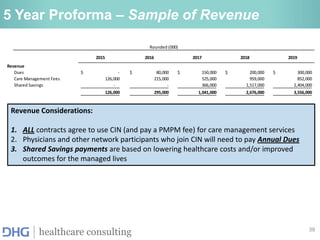
5 Year Proforma – Sample of Revenue
2015 2016 2017 2018 2019
Revenue
Dues -
$ 80,000
$ 150,000
$ 200,000
$ 300,000
$
Care Management Fees 126,000 215,000 525,000 959,000 852,000
Shared Savings - - 366,000 1,517,000 2,404,000
126,000 295,000 1,041,000 2,676,000 3,556,000
Expenses
Salaries and Benefits 788,000 812,000 1,068,000 1,422,000 1,465,000
General & Administrative 200,000 206,000 212,000 219,000 225,000
Care Management 126,000 204,000 473,000 815,000 682,000
Information Technology 64,000 122,000 235,000 464,000 387,000
Outside Services 120,000 124,000 127,000 131,000 135,000
1,298,000 1,468,000 2,115,000 3,051,000 2,894,000
Net Income (1,172,000)
$ (1,173,000)
$ (1,074,000)
$ (375,000)
$ 662,000
$
Rounded (000)
Revenue Considerations:
1. ALL contracts agree to use CIN (and pay a PMPM fee) for care management services
2. Physicians and other network participants who join CIN will need to pay Annual Dues
3. Shared Savings payments are based on lowering healthcare costs and/or improved
outcomes for the managed lives
40
healthcare consulting
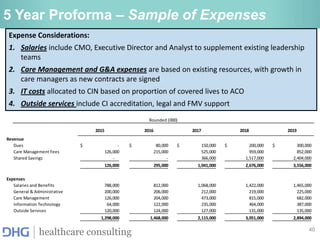
5 Year Proforma – Sample of Expenses
2015 2016 2017 2018 2019
Revenue
Dues -
$ 80,000
$ 150,000
$ 200,000
$ 300,000
$
Care Management Fees 126,000 215,000 525,000 959,000 852,000
Shared Savings - - 366,000 1,517,000 2,404,000
126,000 295,000 1,041,000 2,676,000 3,556,000
Expenses
Salaries and Benefits 788,000 812,000 1,068,000 1,422,000 1,465,000
General & Administrative 200,000 206,000 212,000 219,000 225,000
Care Management 126,000 204,000 473,000 815,000 682,000
Information Technology 64,000 122,000 235,000 464,000 387,000
Outside Services 120,000 124,000 127,000 131,000 135,000
1,298,000 1,468,000 2,115,000 3,051,000 2,894,000
Rounded (000)
Expense Considerations:
1. Salaries include CMO, Executive Director and Analyst to supplement existing leadership
teams
2. Care Management and G&A expenses are based on existing resources, with growth in
care managers as new contracts are signed
3. IT costs allocated to CIN based on proportion of covered lives to ACO
4. Outside services include CI accreditation, legal and FMV support
41
healthcare consulting
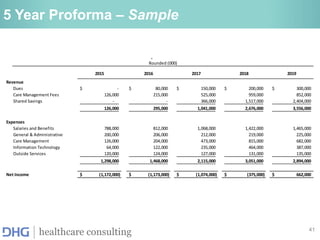
5 Year Proforma – Sample
2015 2016 2017 2018 2019
Revenue
Dues -
$ 80,000
$ 150,000
$ 200,000
$ 300,000
$
Care Management Fees 126,000 215,000 525,000 959,000 852,000
Shared Savings - - 366,000 1,517,000 2,404,000
126,000 295,000 1,041,000 2,676,000 3,556,000
Expenses
Salaries and Benefits 788,000 812,000 1,068,000 1,422,000 1,465,000
General & Administrative 200,000 206,000 212,000 219,000 225,000
Care Management 126,000 204,000 473,000 815,000 682,000
Information Technology 64,000 122,000 235,000 464,000 387,000
Outside Services 120,000 124,000 127,000 131,000 135,000
1,298,000 1,468,000 2,115,000 3,051,000 2,894,000
Net Income (1,172,000)
$ (1,173,000)
$ (1,074,000)
$ (375,000)
$ 662,000
$
p
Rounded (000)
42
healthcare consulting
Value-Based and Risk-Based Contracting
43
healthcare consulting
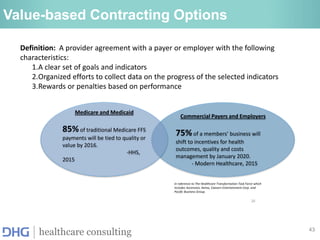
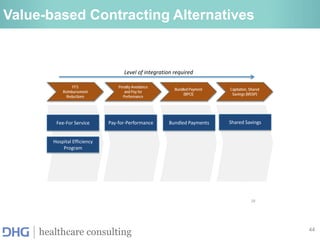
Value-based Contracting Options
26
Definition: A provider agreement with a payer or employer with the following
characteristics:
1.A clear set of goals and indicators
2.Organized efforts to collect data on the progress of the selected indicators
3.Rewards or penalties based on performance
Commercial Payers and Employers
75%of a members’ business will
shift to incentives for health
outcomes, quality and costs
management by January 2020.
- Modern Healthcare, 2015
Medicare and Medicaid
85%of traditional Medicare FFS
payments will be tied to quality or
value by 2016.
-HHS,
2015
In reference to The Healthcare Transformation Task Force which
includes Ascension, Aetna, Caesars Entertainment Corp. and
Pacific Business Group.
44
healthcare consulting
FFS
Reimbursement
Reductions
Penalty Avoidance
and Pay for
Performance
Bundled Payment
(BPCI)
Capitation, Shared
Savings (MSSP)
Fee-For Service
Hospital Efficiency
Program
Pay-for-Performance Bundled Payments Shared Savings
Level of integration required
Value-based Contracting Alternatives
28
45
healthcare consulting
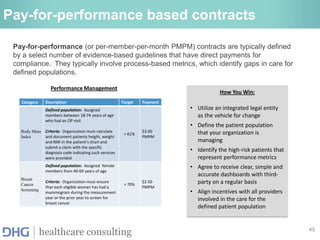
Category Description Target Payment
Body Mass
Index
Defined population: Assigned
members between 18-74 years of age
who had an OP visit
Criteria: Organization must calculate
and document patients height, weight
and BMI in the patient’s chart and
submit a claim with the specific
diagnosis code indicating such services
were provided
> 61%
$3.00
PMPM
Breast
Cancer
Screening
Defined population: Assigned female
members from 40-69 years of age
Criteria: Organization must ensure
that each eligible woman has had a
mammogram during the measurement
year or the prior year to screen for
breast cancer
> 70%
$2.50
PMPM
How You Win:
• Utilize an integrated legal entity
as the vehicle for change
• Define the patient population
that your organization is
managing
• Identify the high-risk patients that
represent performance metrics
• Agree to receive clear, simple and
accurate dashboards with third-
party on a regular basis
• Align incentives with all providers
involved in the care for the
defined patient population
Performance Management
Pay-for-performance based contracts
Pay-for-performance (or per-member-per-month PMPM) contracts are typically defined
by a select number of evidence-based guidelines that have direct payments for
compliance. They typically involve process-based metrics, which identify gaps in care for
defined populations.
46
healthcare consulting
Bundled Payments – Medicare
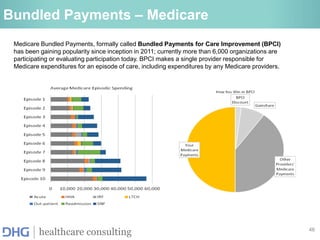
Medicare Bundled Payments, formally called Bundled Payments for Care Improvement (BPCI)
has been gaining popularity since inception in 2011; currently more than 6,000 organizations are
participating or evaluating participation today. BPCI makes a single provider responsible for
Medicare expenditures for an episode of care, including expenditures by any Medicare providers.
47
healthcare consulting
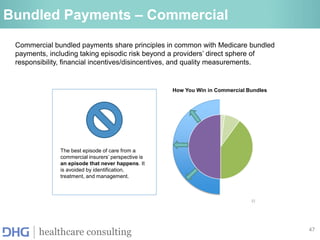
Commercial bundled payments share principles in common with Medicare bundled
payments, including taking episodic risk beyond a providers’ direct sphere of
responsibility, financial incentives/disincentives, and quality measurements.
The best episode of care from a
commercial insurers’ perspective is
an episode that never happens. It
is avoided by identification,
treatment, and management.
How You Win in Commercial Bundles
Bundled Payments – Commercial
32
48
healthcare consulting
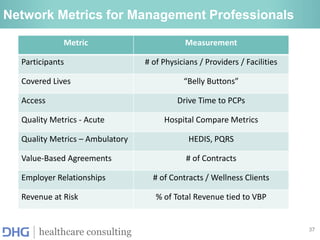
Key Metrics Baseline Target 1 Target 2
Admissions Trend # 1% Reduction 3% Reduction
Total Payout $50,000 $100,000
ER Visits # 1% Reduction 3% Reduction
Total Payout $50,000 $100,000
 Quality and Efficiency Metrics
Metrics Baseline Target
30-Day Readmission Rate % %
HEDIS Measures % %
Cost Metrics
Shared savings contracts are regularly scheduled FFS payments in addition to
opportunities for bonus payments based on the achievement of quality targets and
decreased expenditures.

How You Win:
• Utilize an integrated legal entity as
the vehicle for change
• Define the patient population that
your organization is managing
• Identify the high-risk patients that
represent performance metrics
• Agree to receive clear, simple and
accurate dashboards with third-party
on a regular basis
• Align incentives with all providers
involved in the care for the defined
patient population
Performance Management
Shared Savings
49
healthcare consulting
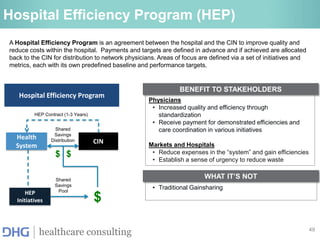
Hospital Efficiency Program (HEP)
A Hospital Efficiency Program is an agreement between the hospital and the CIN to improve quality and
reduce costs within the hospital. Payments and targets are defined in advance and if achieved are allocated
back to the CIN for distribution to network physicians. Areas of focus are defined via a set of initiatives and
metrics, each with its own predefined baseline and performance targets.
Physicians
• Increased quality and efficiency through
standardization
• Receive payment for demonstrated efficiencies and
care coordination in various initiatives
Markets and Hospitals
• Reduce expenses in the “system” and gain efficiencies
• Establish a sense of urgency to reduce waste
BENEFIT TO STAKEHOLDERS
WHAT IT’S NOT
• Traditional Gainsharing
Shared
Savings
Distribution
HEP
Initiatives
CIN
Health
System
Shared
Savings
Pool
$
HEP Contract (1-3 Years)
Hospital Efficiency Program
$
$
50
healthcare consulting
Align CMS criteria to other performance-based
contracts
27
Value-
based
purchasing
Hospital
Acquired
Conditions
Readmissions
Bundled
Payments
MSSP
Oncology
Care
Model
CMS Programs
What is stopping you from creating
the same type of performance-based
contracts with commercial payers
and employers?
Rewards and/or
penalties are linked to
each program
Scope of services and
requirements are already
defined
Workflow changes for CMS
programs will directly
impact on other patient
populations.
51
healthcare consulting
Legal Considerations
52
healthcare consulting
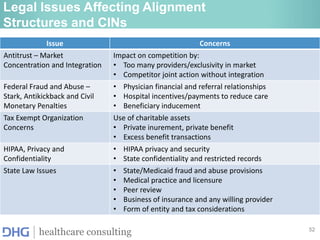
Legal Issues Affecting Alignment
Structures and CINs
Issue Concerns
Antitrust – Market
Concentration and Integration
Impact on competition by:
• Too many providers/exclusivity in market
• Competitor joint action without integration
Federal Fraud and Abuse –
Stark, Antikickback and Civil
Monetary Penalties
• Physician financial and referral relationships
• Hospital incentives/payments to reduce care
• Beneficiary inducement
Tax Exempt Organization
Concerns
Use of charitable assets
• Private inurement, private benefit
• Excess benefit transactions
HIPAA, Privacy and
Confidentiality
• HIPAA privacy and security
• State confidentiality and restricted records
State Law Issues • State/Medicaid fraud and abuse provisions
• Medical practice and licensure
• Peer review
• Business of insurance and any willing provider
• Form of entity and tax considerations
53
healthcare consulting
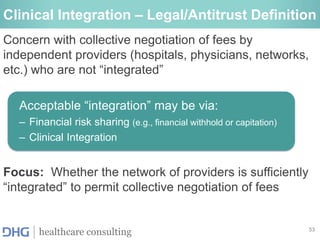
Clinical Integration – Legal/Antitrust Definition
Concern with collective negotiation of fees by
independent providers (hospitals, physicians, networks,
etc.) who are not “integrated”
Acceptable “integration” may be via:
– Financial risk sharing (e.g., financial withhold or capitation)
– Clinical Integration
Focus: Whether the network of providers is sufficiently
“integrated” to permit collective negotiation of fees
54
healthcare consulting
Clinical Integration – Blended Operational and
Legal Definitions
• Clinically Integrated Networks involve arrangements in
which:
– Physicians participate in active and ongoing programs to
evaluate and modify practice patterns
– Create a high degree interdependence and cooperation, in
order to
– Control costs and ensure the quality of services
– Agreements concerning price and other terms are
reasonably necessary to obtain significant efficiencies
– Joint contracting is necessary to the end goal; not end of
itself
55
healthcare consulting
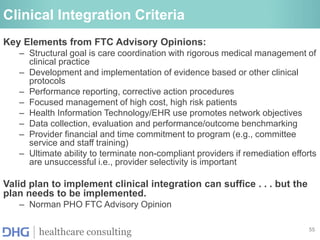
Clinical Integration Criteria
Key Elements from FTC Advisory Opinions:
– Structural goal is care coordination with rigorous medical management of
clinical practice
– Development and implementation of evidence based or other clinical
protocols
– Performance reporting, corrective action procedures
– Focused management of high cost, high risk patients
– Health Information Technology/EHR use promotes network objectives
– Data collection, evaluation and performance/outcome benchmarking
– Provider financial and time commitment to program (e.g., committee
service and staff training)
– Ultimate ability to terminate non-compliant providers if remediation efforts
are unsuccessful i.e., provider selectivity is important
Valid plan to implement clinical integration can suffice . . . but the
plan needs to be implemented.
– Norman PHO FTC Advisory Opinion
56
healthcare consulting
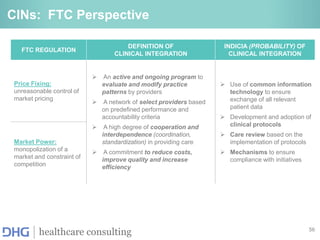
CINs: FTC Perspective
FTC REGULATION
DEFINITION OF
CLINICAL INTEGRATION
INDICIA (PROBABILITY) OF
CLINICAL INTEGRATION
Price Fixing:
unreasonable control of
market pricing
 An active and ongoing program to
evaluate and modify practice
patterns by providers
 A network of select providers based
on predefined performance and
accountability criteria
 A high degree of cooperation and
interdependence (coordination,
standardization) in providing care
 A commitment to reduce costs,
improve quality and increase
efficiency
 Use of common information
technology to ensure
exchange of all relevant
patient data
 Development and adoption of
clinical protocols
 Care review based on the
implementation of protocols
 Mechanisms to ensure
compliance with initiatives
Market Power:
monopolization of a
market and constraint of
competition
57
healthcare consulting
Clinical Integration Network
Key Takeaways
58
healthcare consulting
Is Shifting Away From FFS a Threat…YES!!
…what are your options if the market tips and a new
entrant captures volume, with a disruptive strategy?
59
healthcare consulting
Why Invest in a CIN?
Vehicle to drive clinical performance
improvement to decrease cost/patient
Shared cost of infrastructure to support
population health
Lower cost/physician integration than
employment
Proactive (if possible) contracts that align with your
market and organizational pace of change
60
healthcare consulting
Q & A
61
healthcare consulting
Thank You, Feel Free to Contact Us
Michael Strilesky
Principal
Michael.Strilesky@dhgllp.com
330.606.0455
Cleveland, OH
Kevin Locke
Principal
Kevin.Locke@dhgllp.com
330.606.4699
Nashville, TN
DHG Healthcare CIN Development Team

Clinical Integration

  • 1.
    1 healthcare consulting Clinical Integration KevinLocke, Principal, DHG Healthcare Michael Strilesky, Principal, DHG Healthcare
  • 2.
    2 healthcare consulting Agenda  Acceleratorsfor CIN Development  Overview of CINs  Financial Considerations for Networks  Value and Risk-Based Contracts  Legal Considerations  Q&A
  • 3.
  • 4.
    4 healthcare consulting Accelerators: CMS ______________________________________________________________________________________ “HHShas set a goal of tying 30 percent of traditional, or fee-for-service, Medicare payments to quality or value through alternative payment models, such as Accountable Care Organizations (ACOs) or bundled payment arrangements by the end of 2016, and tying 50 percent of payments to these models by the end of 2018. HHS also set a goal of tying 85 percent of all traditional Medicare payments to quality or value by 2016 and 90 percent by 2018 through programs such as the Hospital Value Based Purchasing and the Hospital Readmissions Reduction Programs….” – HHS Press Release, January 26, 2015 “Entities furnishing DHS face the predicament of trying to achieve clinical and financial integration with other health care providers, including physicians, while simultaneously having to satisfy the requirements of an exception to the physician self-referral law’s prohibitions if they wish to compensate physicians to help them.” - CMS, Physician Fee Schedule Proposed Rule, July 2015 8
  • 5.
    5 healthcare consulting Source:HFMA 2010 The Advisory Board 2010 Source: Consumer Price Index & CMS Reimbursements Data Accelerators: Provider and Payer Economics Provider Expenses vs. Reimbursement • In 2009, what would have cost a provider $1.00 cost them $1.09 in 2013. • In 2009, services a provider would have been paid $1.00 for, were only reimbursed $0.91 in 2013. State Budget Constraints • On average, 26% of a State’s budget is allocated to Medicaid • Increased prevalence of state budget shortfalls has spiked interest in improving Medicaid delivery NOTABLE STATE-LEVEL REFORM State Reform Model Scope TN Episodic Bundles, (PCMH coming soon) Commercial & Medicaid AR Mandatory PCMH Medicaid AL RCOs Medicaid OR CCOs Medicaid IL Alliance for Health Innovation Plan All Payers EXPENSES VS. REIMBURSEMENTS
  • 6.
    6 healthcare consulting Source:HFMA 2010 The Advisory Board 2010 Source: Consumer Price Index & CMS Reimbursements Data Accelerator: Consolidation Consolidation • When 189 hospital leaders were asked, 88% stated they had plans to pursue M&A within the next 12 months 88% 12% No M&A Activity Planned Planning to Pursue M&A Within the Next 12 Months Proactive Partnership(s) Reactive Partnership(s) Proactive Drivers • Mission, Vision, Values, Culture • Market Opportunity • Access to Capital • Quality, Outcomes, Care Gaps • Cost Structure • Payer / Reform Preparedness • Access to Care / Community Need • Perception / Brand Reactive Drivers • Exclusion from Payer / Employer Network • Changes in Referral Patterns • Unsustainable Financial Model • Changes in Competitive Landscape • Impact of Healthcare Reform • Changes in Technology Reasons for Consolidation • Providers seeking Partners for both proactive and reactive reasons
  • 7.
    7 healthcare consulting Source:HFMA 2010 The Advisory Board 2010 Source: Consumer Price Index & CMS Reimbursement Data Accelerators: Payment and Volume Risk Shifting Risk to Providers & Consumers FEE-FOR- SERVICE SHARED SAVINGS PAY-FOR- PERFORMANCE VALUE-BASED PURCHASING BUNDLED PAYMENTS GLOBAL PAYMENTS EMPLOYERS HEALTH PLANS GOVERNMENT PAYERS PHYSICIANS HOSPITALS CONSUMERS Increasing Consumer Choice / Power Clear plan comparison on exchange platforms Easy for individuals to switch plans annually Variable individual premium contribution, high deductibles 900+ Locations 400+ Locations 125+ Locations Estimated to be nearly 3,000 retail clinics in the US by the end of 2015 RETAIL CLINICS New and increased choices for provider access RISK SHIFT
  • 8.
    8 healthcare consulting Accelerator: TheTipping Point is Here The movement towards value has already started for physicians and hospitals Patient-centered care Evidence-based care Effective use of health IT Patient satisfaction Care coordination Bundled payments Total cost of care PCMH P4P MU HCAHPS / CG-CAHPS PMPM BPCI/CCJR MSSP
  • 9.
  • 10.
    10 healthcare consulting Provider Response:Clinical Integration IMPROVE QUALITY - Consistent Performance Metrics - Evidence-based Protocols - Defined Provider Expectations ENHANCE ACCESS - Emphasis on Prevention - Use of Telehealth and Virtual Tools - Expanded Provider Availability CREATE EFFICIENCIES - Utilization Review - Right Time, Right Place - Decrease Spend per Beneficiary - Care Coordination CIN GOALS DELIVER VALUE - Improve Performance - Pursue Contracts that Reward Value CIN OUTCOMES A Clinically Integrated Network (CIN) is a selective partnership of physicians collaborating with hospital(s) and other providers to deliver evidence-based care, improve quality and efficiency, manage populations and demonstrate value to the market. Once these objectives are met, the network may contract on behalf of participants MANAGE DEFINED POPULATIONS
  • 11.
    11 healthcare consulting “The futureis already here – it’s just not evenly distributed” William Gibson
  • 12.
  • 13.
    13 healthcare consulting A ClinicallyIntegrated Network (CIN) is a selective partnership of physicians collaborating with hospitals to deliver evidence-based care, improve quality, efficiency, and coordination of care, and demonstrate value to the market. Clinically Integrated Network Health System and Employed Physicians Private Practice Physicians CI Entity Payors and Employers $ $ $ Contracts WHAT IT’S NOT • Physician employment • Hospital-led initiative • Mechanism to gain negotiating leverage over payors Distribution of Funds Participation Agreement Participation Agreement CIN: Definition
  • 14.
    14 healthcare consulting CIN: Advantages •Improved coordination and efficiency of care • More information and control of care • Higher satisfaction • Lower cost and higher value PATIENTS & COMMUNITIES HOSPITALS & HEALTH SYSTEMS • Care coordination “inside” network • Alignment with independent and employed PCPs and specialists • Demonstrate quality to earn enhanced reimbursement, sustain rates • Defining what “Quality” is • Increased input and decision making • Share in performance based incentives • Maintain independent practice PHYSICIANS • Reduced cost and enhanced value • Better management of high-cost chronic patients • Shift of risk to providers PAYORS & EMPLOYERS
  • 15.
  • 16.
    16 healthcare consulting Observed Characteristics: •Physicians can elect Board Members • Participation Fees will be different for Owners than for Participants • All physicians will sign the same Membership Agreement • Active participation is required to achieve performance goals • Profit distribution to owners only, based on company’s profits • Performance rewards will be available to Owners and Participants based on performance 50% Health System CIN Physician Owners Payers 50% Physician Participants Infrastructure: Joint-Venture LLC Model
  • 17.
    17 healthcare consulting Observed Characteristics: •Physicians can nominate Board Members, that are approved by Health System • Participation Fees are typically the same for all Physician Participants, assuming all physicians sign the same Participation Agreement • Active participation is required to achieve performance goals • Distribution pool developed at the discretion of Health System, factoring in overhead costs for the network • Networks can create rewards to physicians 100% Health System CIN Payers Physician Participants Infrastructure: Subsidiary LLC Model
  • 18.
    18 healthcare consulting Infrastructure: Expectations Regardlessof the infrastructure / model, all networks work to ensure the following: 1. Health System maintains “Reserved Powers” that include… Budget, Capital, Dissolutions or Mergers, Not-for-Profit Status 2. Critical issues have support of the Physicians Ex. No contract should be approved unless the physicians agree it’s a good idea 3. Committees and Management support the activities of the Network Management (along with Executive Committee) will be accountable for day-to-day operations 4. Physicians are meeting Participation Criteria and Performance Objectives of the Network Failure to meet network requirements, and associated penalties are the same in either model 18
  • 19.
    19 healthcare consulting IPA LegalFramework Health System(s) Payors / Employers IPA Participating Agreement(s) 100% Physician Groups Overview: A CIN comprised entirely of physicians would be structured using the framework of an Independent Practice Association (IPA). Physician groups would capitalize a subsidiary LLC or the existing IPA to fund CIN infrastructure. Physician Owned Networks Network Characteristics: 1. Similar Operating Agreement and Governance Model as CINs 2. Participation Fees are typically the same for all Physician Participants 3. Distribution pool developed at the discretion of IPA, factoring in overhead costs for the network 4. Focus of network could be PCP or multi- specialty depending on contracting strategy 5. Typical objectives is to “commoditize” hospitals in the market and extract bonus payments from payers
  • 20.
  • 21.
  • 22.
    22 healthcare consulting MATURITY OFCIN Membership Fees LOW HIGH Hospital Efficiency Program Self Funded Health Plan Payer Contracts (no Risk) Direct to Employer Contracts Pay-for- Performance The CIN is a separate business entity with a distinct identity, mission, and vision, dedicated leadership and staff, sustainable sources of revenue to offset operations. Sources of Revenue Funding: Aligned with Start-Up and Contracting Private Label Health Plan Payer Contracts (Risk)
  • 23.
    23 healthcare consulting Participating Physicians (Independent& Employed) Physician Leadership Information Technology Quality Improvement Contracting  Board and committees  Participate in educational programs  Provide leadership and oversight over network initiatives  Implement the preferred network IT platform  Share clinical information and claims data  Follow guidelines and protocols  Achieve network defined measures and performance  Agree to corrective action plans and process improvement initiatives  Participate in jointly negotiated contracts Participation Criteria for Physicians
  • 24.
    24 healthcare consulting Element DescriptionExamples Variance & Cost Reduction Minimize variable physician performance not related to patient characteristics • Minimize orthopedics supply chain cost • Staffing and productivity opportunities Unnecessary Care Reduction Reduce avoidable, unproductive and duplicative services • Prostate cancer screenings for elderly patients • Reduce Readmissions Clinical Restructuring Ensure treatment in most optimal setting with most appropriate level of provider • Early step down from an IP to SNF bed • Partnerships with a local retail clinic to offer non-urgent care System Optimization Shift focus to upstream, preventative care with emphasis on CI and population health • Disease-based medical homes • Patient engagement strategies using telehealth Source: Sg2 Analysis Examples of Performance Improvement Metrics and targets designed to meaningfully impact the clinical practice of all network physicians, and to align their conduct with hospital initiatives, so as to improve quality and demonstrate value across the entire continuum of care. Performance Objectives
  • 25.
    25 healthcare consulting Physician Leadership ManagingBoard Physician, Hospital, Community Representation Finance and Contracting Clinical Quality Membership and Operations Communication and Education Information Technology Board Composition Physician Chair Committees Chaired by Physicians Nominating  Charters outline roles of each physician-led committee  Communication & Education designed to engage medical staff  Membership & Operations will hold physicians accountable for performance below thresholds
  • 26.
  • 27.
  • 28.
    28 healthcare consulting PAYORS & EMPLOYERS Cost Savings  Efficiency Gains  P4P Contracts  Shared Savings  Increased Rates  Hospital  Specialty  Location  Equal distribution  Performance targets  Educational event attendance  Submission of Data  Adoption of IT platform INDIVIDUAL ACTIVITY/ OUTCOMES % LOCAL NETWORK PERFORMANCE % NETWORK GLOBAL NETWORK PERFORMANCE % $ $ Overview: The CIN establishes an organized plan to link performance on defined gradients to eligibility for incentive payments. Distribution Framework HOSPITAL / SYSTEM
  • 29.
    29 healthcare consulting Physician PerformanceMeasurement Options 29 Options Definition Service Line Performance Based on group performance categorized either by hospital and/or system. Global Performance All members compliant with CIN standards receive an equal distribution Individual Performance Based on each physician’s performance across the selected participation criteria Performance Thresholds Payout to CIN can be based on the achievement of targets selected across each metric Hourly Requirements Based on time spent working on CIN initiatives
  • 30.
    30 healthcare consulting Fair MarketValue Fair Market Value (FMV) firms evaluate the commercial reasonableness of compensation that is transferred between providers. Typical circumstances to receive a FMV Opinion include the validation of: 1. Compensation between Hospital and CIN 2. Downstream compensation formula between Hospital- owned CIN and individual physicians 3. Performance targets, benchmarks and processes that do not include funds from third party payers 30
  • 31.
    31 healthcare consulting Contracting Continuumof Options Maturity of Enterprise Low High Co- Management HEP Employee Health Plan Restrictive Network FFS HIX IP FFS + Shared Savings OP FFS + Shared Savings Managed Care Episodic Bundled Payment ACO / Capitation Level of Infrastructure Investment Additional IT Needed (Patient Registry) Level of Risk Risk / Reward Upside Only Internal Contracting External Contracting
  • 32.
    32 healthcare consulting Network ContractingComparisons 32 MESSENGER MODEL Back and forward counter offers passed from payer to network (the “messenger”) for individual provider to consider OR standing offer power of attorney CLINICALLY INTEGRATED NETWORK Jointly Negotiated Contracts based on: • Interdependence and Cooperation • IT/Data Sharing • Quality • Cost Effectiveness • Care Coordination • Population Health • Remedial Actions
  • 33.
    33 healthcare consulting The Phasesof Network Maturation • Network maturation should follow a systematic process paced to market opportunities, allowing the hospital and its physicians to prepare for the future while remaining focused on short-term initiatives • While the phases of maturity are sequential, unique local dynamics will dictate how a market approaches the progression (if appropriate) from each phase to another • Local committees formed to begin service line and market-focused growth strategies • Committees foster shared vision across market • Committees evaluate quality and cost opportunities • Expectation is that stronger engagement and loyalty leads to sustainability under a FFS model while building the infrastructure to become risk-capable PHYSICIAN ALIGNMENT AND ENGAGEMENT • Data collection allows definition of quality baselines and targets • Physician-approved care protocols and processes drive standardization, cost reduction and quality improvement • Typical models that accommodate this phase include co-management, shared savings with hospital employee health plan & HEP contracts QUALITY, EFFICIENCY AND STANDARDIZATION • Demonstrated improvement in quality and performance creates new value proposition for contract negotiations • Value proposition positions hospital and physicians for enhanced reimbursement and narrow network opportunities • incentives from payers and/or employers shared with network participants • Expectation is that new revenue through PMPM rates, P4P, VBP and shared savings reimbursement will offset costs of network development STRATEGIC OBJECTIVES VALUE-BASED CONTRACTING • 3 3
  • 34.
  • 35.
    35 healthcare consulting Financial Considerationsfor Networks • Complexities in creating reliable forecasts and capital plans • Federal and state uncertainties – “stroke of the pen” risk • Operationalizing risk capability across multiple domains • Articulating and demonstrating ROI on major current investments • Compliance requirements across multiple providers • Alignment around measurable participation criteria: quality, certifications, clinical protocols, payment incentives • Accelerating transformation across the industry landscape • Identifying and deploying the “right” tools to monitor progress and changes • Continuous evaluation: measuring, reporting and adjusting
  • 36.
    36 healthcare consulting “Big Rock”CIN Decisions • How BIG (in terms of network participants) should we be? • What is our contracting strategy this market? • How much can we afford to invest on a go forward basis? • Do we have the leaders (physician and administrative) to lead this network? • What is our approach to integrate clinical and financial information?
  • 37.
    37 healthcare consulting Network Metricsfor Management Professionals Metric Measurement Participants # of Physicians / Providers / Facilities Covered Lives “Belly Buttons” Access Drive Time to PCPs Quality Metrics - Acute Hospital Compare Metrics Quality Metrics – Ambulatory HEDIS, PQRS Value-Based Agreements # of Contracts Employer Relationships # of Contracts / Wellness Clients Revenue at Risk % of Total Revenue tied to VBP
  • 38.
    38 healthcare consulting Assumptions forDeveloping a CIN Proforma Revenue Assumptions CIN’s typically earn revenue from the following sources: • Shared Savings payments from contracts, if successful • Care Management fees from contracts • Membership Dues from participating physicians / hospitals Based on the CIN’s objectives, the network will pursue contracts that target defined populations in the region: Target Lives Year Hospital Employee Health Plan 3,500 2016 Medicare Advantage Plans 8,000 2016 MEWA with local businesses 6,000 2017 School System 17,000 2017 Large Employer 20,000 2018 MEWA = Multiple Employer Welfare Arrangements
  • 39.
    39 healthcare consulting 5 YearProforma – Sample of Revenue 2015 2016 2017 2018 2019 Revenue Dues - $ 80,000 $ 150,000 $ 200,000 $ 300,000 $ Care Management Fees 126,000 215,000 525,000 959,000 852,000 Shared Savings - - 366,000 1,517,000 2,404,000 126,000 295,000 1,041,000 2,676,000 3,556,000 Expenses Salaries and Benefits 788,000 812,000 1,068,000 1,422,000 1,465,000 General & Administrative 200,000 206,000 212,000 219,000 225,000 Care Management 126,000 204,000 473,000 815,000 682,000 Information Technology 64,000 122,000 235,000 464,000 387,000 Outside Services 120,000 124,000 127,000 131,000 135,000 1,298,000 1,468,000 2,115,000 3,051,000 2,894,000 Net Income (1,172,000) $ (1,173,000) $ (1,074,000) $ (375,000) $ 662,000 $ Rounded (000) Revenue Considerations: 1. ALL contracts agree to use CIN (and pay a PMPM fee) for care management services 2. Physicians and other network participants who join CIN will need to pay Annual Dues 3. Shared Savings payments are based on lowering healthcare costs and/or improved outcomes for the managed lives
  • 40.
    40 healthcare consulting 5 YearProforma – Sample of Expenses 2015 2016 2017 2018 2019 Revenue Dues - $ 80,000 $ 150,000 $ 200,000 $ 300,000 $ Care Management Fees 126,000 215,000 525,000 959,000 852,000 Shared Savings - - 366,000 1,517,000 2,404,000 126,000 295,000 1,041,000 2,676,000 3,556,000 Expenses Salaries and Benefits 788,000 812,000 1,068,000 1,422,000 1,465,000 General & Administrative 200,000 206,000 212,000 219,000 225,000 Care Management 126,000 204,000 473,000 815,000 682,000 Information Technology 64,000 122,000 235,000 464,000 387,000 Outside Services 120,000 124,000 127,000 131,000 135,000 1,298,000 1,468,000 2,115,000 3,051,000 2,894,000 Rounded (000) Expense Considerations: 1. Salaries include CMO, Executive Director and Analyst to supplement existing leadership teams 2. Care Management and G&A expenses are based on existing resources, with growth in care managers as new contracts are signed 3. IT costs allocated to CIN based on proportion of covered lives to ACO 4. Outside services include CI accreditation, legal and FMV support
  • 41.
    41 healthcare consulting 5 YearProforma – Sample 2015 2016 2017 2018 2019 Revenue Dues - $ 80,000 $ 150,000 $ 200,000 $ 300,000 $ Care Management Fees 126,000 215,000 525,000 959,000 852,000 Shared Savings - - 366,000 1,517,000 2,404,000 126,000 295,000 1,041,000 2,676,000 3,556,000 Expenses Salaries and Benefits 788,000 812,000 1,068,000 1,422,000 1,465,000 General & Administrative 200,000 206,000 212,000 219,000 225,000 Care Management 126,000 204,000 473,000 815,000 682,000 Information Technology 64,000 122,000 235,000 464,000 387,000 Outside Services 120,000 124,000 127,000 131,000 135,000 1,298,000 1,468,000 2,115,000 3,051,000 2,894,000 Net Income (1,172,000) $ (1,173,000) $ (1,074,000) $ (375,000) $ 662,000 $ p Rounded (000)
  • 42.
  • 43.
    43 healthcare consulting Value-based ContractingOptions 26 Definition: A provider agreement with a payer or employer with the following characteristics: 1.A clear set of goals and indicators 2.Organized efforts to collect data on the progress of the selected indicators 3.Rewards or penalties based on performance Commercial Payers and Employers 75%of a members’ business will shift to incentives for health outcomes, quality and costs management by January 2020. - Modern Healthcare, 2015 Medicare and Medicaid 85%of traditional Medicare FFS payments will be tied to quality or value by 2016. -HHS, 2015 In reference to The Healthcare Transformation Task Force which includes Ascension, Aetna, Caesars Entertainment Corp. and Pacific Business Group.
  • 44.
    44 healthcare consulting FFS Reimbursement Reductions Penalty Avoidance andPay for Performance Bundled Payment (BPCI) Capitation, Shared Savings (MSSP) Fee-For Service Hospital Efficiency Program Pay-for-Performance Bundled Payments Shared Savings Level of integration required Value-based Contracting Alternatives 28
  • 45.
    45 healthcare consulting Category DescriptionTarget Payment Body Mass Index Defined population: Assigned members between 18-74 years of age who had an OP visit Criteria: Organization must calculate and document patients height, weight and BMI in the patient’s chart and submit a claim with the specific diagnosis code indicating such services were provided > 61% $3.00 PMPM Breast Cancer Screening Defined population: Assigned female members from 40-69 years of age Criteria: Organization must ensure that each eligible woman has had a mammogram during the measurement year or the prior year to screen for breast cancer > 70% $2.50 PMPM How You Win: • Utilize an integrated legal entity as the vehicle for change • Define the patient population that your organization is managing • Identify the high-risk patients that represent performance metrics • Agree to receive clear, simple and accurate dashboards with third- party on a regular basis • Align incentives with all providers involved in the care for the defined patient population Performance Management Pay-for-performance based contracts Pay-for-performance (or per-member-per-month PMPM) contracts are typically defined by a select number of evidence-based guidelines that have direct payments for compliance. They typically involve process-based metrics, which identify gaps in care for defined populations.
  • 46.
    46 healthcare consulting Bundled Payments– Medicare Medicare Bundled Payments, formally called Bundled Payments for Care Improvement (BPCI) has been gaining popularity since inception in 2011; currently more than 6,000 organizations are participating or evaluating participation today. BPCI makes a single provider responsible for Medicare expenditures for an episode of care, including expenditures by any Medicare providers.
  • 47.
    47 healthcare consulting Commercial bundledpayments share principles in common with Medicare bundled payments, including taking episodic risk beyond a providers’ direct sphere of responsibility, financial incentives/disincentives, and quality measurements. The best episode of care from a commercial insurers’ perspective is an episode that never happens. It is avoided by identification, treatment, and management. How You Win in Commercial Bundles Bundled Payments – Commercial 32
  • 48.
    48 healthcare consulting Key MetricsBaseline Target 1 Target 2 Admissions Trend # 1% Reduction 3% Reduction Total Payout $50,000 $100,000 ER Visits # 1% Reduction 3% Reduction Total Payout $50,000 $100,000  Quality and Efficiency Metrics Metrics Baseline Target 30-Day Readmission Rate % % HEDIS Measures % % Cost Metrics Shared savings contracts are regularly scheduled FFS payments in addition to opportunities for bonus payments based on the achievement of quality targets and decreased expenditures.  How You Win: • Utilize an integrated legal entity as the vehicle for change • Define the patient population that your organization is managing • Identify the high-risk patients that represent performance metrics • Agree to receive clear, simple and accurate dashboards with third-party on a regular basis • Align incentives with all providers involved in the care for the defined patient population Performance Management Shared Savings
  • 49.
    49 healthcare consulting Hospital EfficiencyProgram (HEP) A Hospital Efficiency Program is an agreement between the hospital and the CIN to improve quality and reduce costs within the hospital. Payments and targets are defined in advance and if achieved are allocated back to the CIN for distribution to network physicians. Areas of focus are defined via a set of initiatives and metrics, each with its own predefined baseline and performance targets. Physicians • Increased quality and efficiency through standardization • Receive payment for demonstrated efficiencies and care coordination in various initiatives Markets and Hospitals • Reduce expenses in the “system” and gain efficiencies • Establish a sense of urgency to reduce waste BENEFIT TO STAKEHOLDERS WHAT IT’S NOT • Traditional Gainsharing Shared Savings Distribution HEP Initiatives CIN Health System Shared Savings Pool $ HEP Contract (1-3 Years) Hospital Efficiency Program $ $
  • 50.
    50 healthcare consulting Align CMScriteria to other performance-based contracts 27 Value- based purchasing Hospital Acquired Conditions Readmissions Bundled Payments MSSP Oncology Care Model CMS Programs What is stopping you from creating the same type of performance-based contracts with commercial payers and employers? Rewards and/or penalties are linked to each program Scope of services and requirements are already defined Workflow changes for CMS programs will directly impact on other patient populations.
  • 51.
  • 52.
    52 healthcare consulting Legal IssuesAffecting Alignment Structures and CINs Issue Concerns Antitrust – Market Concentration and Integration Impact on competition by: • Too many providers/exclusivity in market • Competitor joint action without integration Federal Fraud and Abuse – Stark, Antikickback and Civil Monetary Penalties • Physician financial and referral relationships • Hospital incentives/payments to reduce care • Beneficiary inducement Tax Exempt Organization Concerns Use of charitable assets • Private inurement, private benefit • Excess benefit transactions HIPAA, Privacy and Confidentiality • HIPAA privacy and security • State confidentiality and restricted records State Law Issues • State/Medicaid fraud and abuse provisions • Medical practice and licensure • Peer review • Business of insurance and any willing provider • Form of entity and tax considerations
  • 53.
    53 healthcare consulting Clinical Integration– Legal/Antitrust Definition Concern with collective negotiation of fees by independent providers (hospitals, physicians, networks, etc.) who are not “integrated” Acceptable “integration” may be via: – Financial risk sharing (e.g., financial withhold or capitation) – Clinical Integration Focus: Whether the network of providers is sufficiently “integrated” to permit collective negotiation of fees
  • 54.
    54 healthcare consulting Clinical Integration– Blended Operational and Legal Definitions • Clinically Integrated Networks involve arrangements in which: – Physicians participate in active and ongoing programs to evaluate and modify practice patterns – Create a high degree interdependence and cooperation, in order to – Control costs and ensure the quality of services – Agreements concerning price and other terms are reasonably necessary to obtain significant efficiencies – Joint contracting is necessary to the end goal; not end of itself
  • 55.
    55 healthcare consulting Clinical IntegrationCriteria Key Elements from FTC Advisory Opinions: – Structural goal is care coordination with rigorous medical management of clinical practice – Development and implementation of evidence based or other clinical protocols – Performance reporting, corrective action procedures – Focused management of high cost, high risk patients – Health Information Technology/EHR use promotes network objectives – Data collection, evaluation and performance/outcome benchmarking – Provider financial and time commitment to program (e.g., committee service and staff training) – Ultimate ability to terminate non-compliant providers if remediation efforts are unsuccessful i.e., provider selectivity is important Valid plan to implement clinical integration can suffice . . . but the plan needs to be implemented. – Norman PHO FTC Advisory Opinion
  • 56.
    56 healthcare consulting CINs: FTCPerspective FTC REGULATION DEFINITION OF CLINICAL INTEGRATION INDICIA (PROBABILITY) OF CLINICAL INTEGRATION Price Fixing: unreasonable control of market pricing  An active and ongoing program to evaluate and modify practice patterns by providers  A network of select providers based on predefined performance and accountability criteria  A high degree of cooperation and interdependence (coordination, standardization) in providing care  A commitment to reduce costs, improve quality and increase efficiency  Use of common information technology to ensure exchange of all relevant patient data  Development and adoption of clinical protocols  Care review based on the implementation of protocols  Mechanisms to ensure compliance with initiatives Market Power: monopolization of a market and constraint of competition
  • 57.
  • 58.
    58 healthcare consulting Is ShiftingAway From FFS a Threat…YES!! …what are your options if the market tips and a new entrant captures volume, with a disruptive strategy?
  • 59.
    59 healthcare consulting Why Investin a CIN? Vehicle to drive clinical performance improvement to decrease cost/patient Shared cost of infrastructure to support population health Lower cost/physician integration than employment Proactive (if possible) contracts that align with your market and organizational pace of change
  • 60.
  • 61.
    61 healthcare consulting Thank You,Feel Free to Contact Us Michael Strilesky Principal Michael.Strilesky@dhgllp.com 330.606.0455 Cleveland, OH Kevin Locke Principal Kevin.Locke@dhgllp.com 330.606.4699 Nashville, TN DHG Healthcare CIN Development Team