Climate Change Leadership
Workshop
Report from the Climate Change leadership
program September 2014 Overview
Introduction:
The Climate Change leadership workshop was a great success. With
a wide ranging programs consisting of sessions of disaster
preparedness, management, simulations, volunteerism, and report
writing exceeds their expectations and has resulted in them
implementing plans to become leaders of positive change in their
local communities.
The impact assessment indicates that:
22/25 participants feel they now have the leadership skills required to
make a difference in their local community.
21/25 participants have a basic understanding of global and local
issues affecting their community.
20/25 reported being capable and confident to work with people to
lead positive changes in their area.
The Climate Change Leadership Programme 2014 took place from
14
th
–15
th
September in Khanjania Gonobiddalaya, Shudorghona,
Bagerhat in Khulna.
About the Programme
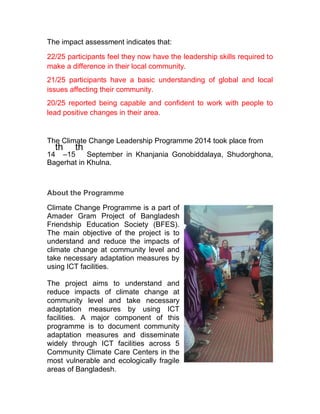
Climate Change Programme is a part of
Amader Gram Project of Bangladesh
Friendship Education Society (BFES).
The main objective of the project is to
understand and reduce the impacts of
climate change at community level and
take necessary adaptation measures by
using ICT facilities.
The project aims to understand and
reduce impacts of climate change at
community level and take necessary
adaptation measures by using ICT
facilities. A major component of this
programme is to document community
adaptation measures and disseminate
widely through ICT facilities across 5
Community Climate Care Centers in the
most vulnerable and ecologically fragile
areas of Bangladesh.
Training Objective:
This leadership workshop has reached 25 young people across
Bagerhat, Khulna, Goplaganj, Pirojpur, and Chittagong districts of
Bangladesh. Each center has a selected youth group of 25. 5 youths
each center was selected to participate in leadership training. The
ultimate goal is that these five youths selected from these 5 districts
will design a similar programme to train the remaining 20 youths of
each of their centers. Ultimately, using a TOT (Training of Trainers)
methodology, 100 more youths will develop leadership skills, inspire
thinking about global issues and equip young people to become
involved in their local communities. Together, 125 youths will develop
leadership skills in supporting their community in adapting with
Climate Change impacts.
The center managers selected 5 youths among the 25 from each
center. Center manager selected the youths by following this rubric
1.Basic leadership skills present in the youth. This skill was integral
so that the participant can develop leadership quality already present
in him.
2.Communication skill: basic reading/writing/speaking ability will
ensure effective participation.
3.Adaptability: participants can learn from each other in an unfamiliar
environment.
4.Youth must be able to stay away from home and participate in a
residential training.

The training aims to:
 Develop leadership ability and an aspiration be an agent of
change 

 Develop understanding of key global issues and inspire positive
thinking to address them 

 Equip participants to become an active and positive part of their
community 
The Programme begins by gathering 25 delegates together, along
with 5 center managers a period of intense residential training.
The session topic was leadership, disaster preparedness, disaster
management, volunteerism, and report writing.
Each session was participatory and included discussions, question
answer sessions, simulations (indoor and outdoor), theatrical,
individual and group presentations followed by review and peer
performance analysis.
Open Space Technology (OST) methodology was used, participants
seated in chairs in a circular manner, which enabled continuous
interaction among each other.
Flash Cards were used to stick traits of leadership around the room.
These are the leadership qualities that the participants decided,
thought upon without guidance of facilitators.
To encourage a continuous appreciative behavior among peers, 25
pages each containing individual names of participants was put up.
Every participant wrote positive notes for others during breaks. After
the workshop, the notes were given to participants to be taken back.
Each participants received a certificate of appreciation at the end of
the workshop, 5 best participants received an appreciation token of
16 GB flash drive each. 14 female participants were given a white
and pink scarf of Amader Gram designed by fashion designer BiBi
Russel, who is also an ambassador of Amader Gram.
Center managers selected Participants after an interview process,
with a combination of leadership potential and passion about their
local community.
DAY 1, September 14, 2014
Ice Breaking:
Session started sharp at 9 am with an icebreaking session
introducing each other. Male and female participants stood beside
each other interchangeably. A female participant introduced her male
peer to group. Interchangeably, the male participant introduced the
female member.
This icebreaking session resulted in participants getting to know each
other. Furthermore, they developed a team through introducing their
friend, and a friend introducing them instead of introducing
themselves. This session was specifically designed to break an initial
inhibition of a male and female proactively conversing with each other
(which often is considered a taboo)
Leadership session (Facilitator: Maherin Ahmed)
Participants discussed leadership qualities. Delegates founded
positive and negative traits of leaders according to their perception.
The traits were written in flash cards and pinned up across the room.
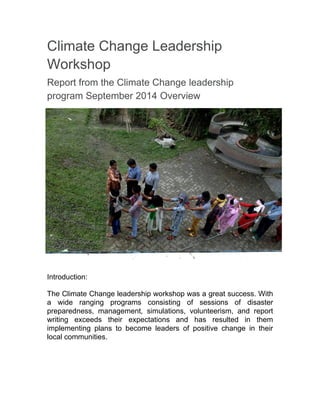
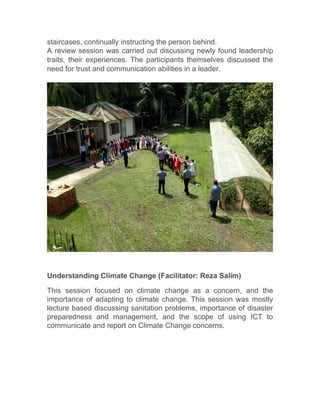
Blind simulation was carried out to get an in -depth understanding of
leadership. All participants were blind folded. Putting one’s hand over
another’s shoulder, they walked over grasses, muddy areas, crossed
staircases, continually instructing the person behind.
A review session was carried out discussing newly found leadership
traits, their experiences. The participants themselves discussed the
need for trust and communication abilities in a leader.
Understanding Climate Change (Facilitator: Reza Salim)
This session focused on climate change as a concern, and the
importance of adapting to climate change. This session was mostly
lecture based discussing sanitation problems, importance of disaster
preparedness and management, and the scope of using ICT to
communicate and report on Climate Change concerns.
Disaster Preparedness and Management
(Facilitators: Debashish Nag,Toufikul Islam,
Maherin Ahmed)
This session included discussions on
different types of disasters (manmade,
natural, chemical), and examples of disaster
management case studies.
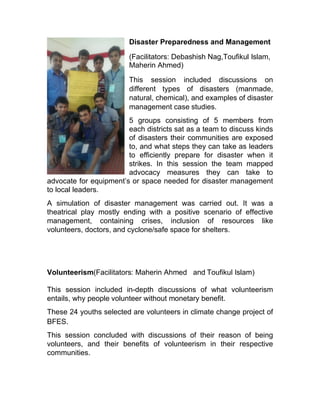
5 groups consisting of 5 members from
each districts sat as a team to discuss kinds
of disasters their communities are exposed
to, and what steps they can take as leaders
to efficiently prepare for disaster when it
strikes. In this session the team mapped
advocacy measures they can take to
advocate for equipment’s or space needed for disaster management
to local leaders.
A simulation of disaster management was carried out. It was a
theatrical play mostly ending with a positive scenario of effective
management, containing crises, inclusion of resources like
volunteers, doctors, and cyclone/safe space for shelters.
Volunteerism(Facilitators: Maherin Ahmed and Toufikul Islam)
This session included in-depth discussions of what volunteerism
entails, why people volunteer without monetary benefit.
These 24 youths selected are volunteers in climate change project of
BFES.
This session concluded with discussions of their reason of being
volunteers, and their benefits of volunteerism in their respective
communities.
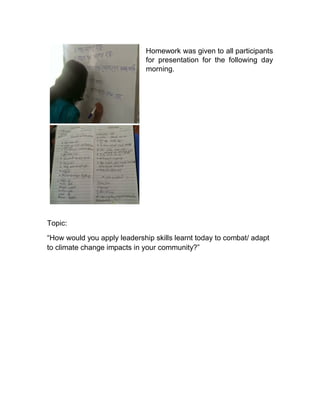
Homework was given to all participants
for presentation for the following day
morning.
Topic:
“How would you apply leadership skills learnt today to combat/ adapt
to climate change impacts in your community?”
DAY 2, September 15 2014
The day started with presenting their plans on their role as climate
change leaders in their communities. Five groups from five districts
presented as a group to others.
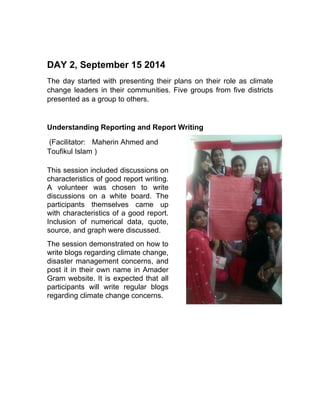
Understanding Reporting and Report Writing
(Facilitator: Maherin Ahmed and
Toufikul Islam )
This session included discussions on
characteristics of good report writing.
A volunteer was chosen to write
discussions on a white board. The
participants themselves came up
with characteristics of a good report.
Inclusion of numerical data, quote,
source, and graph were discussed.
The session demonstrated on how to
write blogs regarding climate change,
disaster management concerns, and
post it in their own name in Amader
Gram website. It is expected that all
participants will write regular blogs
regarding climate change concerns.
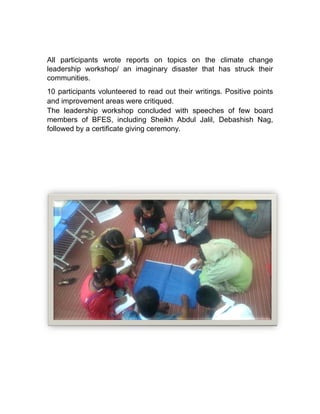
All participants wrote reports on topics on the climate change
leadership workshop/ an imaginary disaster that has struck their
communities.
10 participants volunteered to read out their writings. Positive points
and improvement areas were critiqued.
The leadership workshop concluded with speeches of few board
members of BFES, including Sheikh Abdul Jalil, Debashish Nag,
followed by a certificate giving ceremony.
All participants wrote reports on topics on the climate change
eadership workshop/ an imaginary disaster that has struck their
10 participants volunteered to read out their writings. Positive points
and improvement areas were critiqued.
The leadership workshop concluded with speeches of few board
of BFES, including Sheikh Abdul Jalil, Debashish Nag,
followed by a certificate giving ceremony.
All participants wrote reports on topics on the climate change
eadership workshop/ an imaginary disaster that has struck their
10 participants volunteered to read out their writings. Positive points
The leadership workshop concluded with speeches of few board
of BFES, including Sheikh Abdul Jalil, Debashish Nag,
PROGRAMME FOLLOWUP:
1. 5 trained youths from each center (25 youths) will discuss
and train remaining 20 youths during monthly meetings.
2. 25 youths will write regular blogs containing features,
case studies, report on climate change concerns in their
community.
3. 5 youths from each center will be in charge on 5 divided
areas of their own village. Therefore each youth will be in
charge of an area of their own community where they will
support their communities adapt to climate change issues.
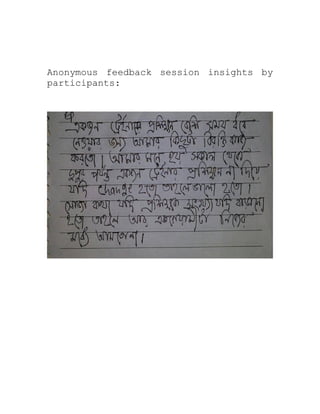
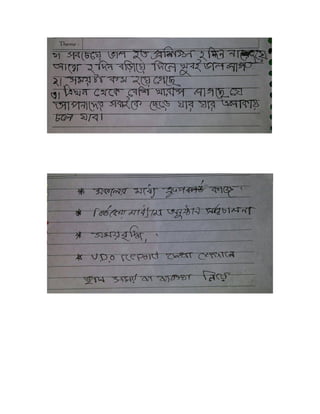
Anonymous feedback session insights by
participants:
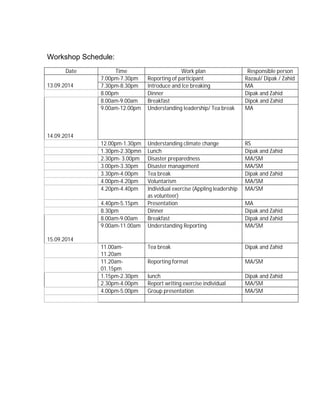
Workshop Schedule:
Date Time Work plan Responsible person
13.09.2014
7.00pm-7.30pm Reporting of participant Razaul/ Dipak / Zahid
7.30pm-8.30pm Introduce and Ice breaking MA
8.00pm Dinner Dipak and Zahid
14.09.2014
8.00am-9.00am Breakfast Dipok and Zahid
9.00am-12.00pm Understanding leadership/ Tea break MA
12.00pm-1.30pm Understanding climate change RS
1.30pm-2.30pmn Lunch Dipak and Zahid
2.30pm- 3.00pm Disaster preparedness MA/SM
3.00pm-3.30pm Disaster management MA/SM
3.30pm-4.00pm Tea break Dipak and Zahid
4.00pm-4.20pm Voluntarism MA/SM
4.20pm-4.40pm Individual exercise (Appling leadership
as volunteer)
MA/SM
4.40pm-5.15pm Presentation MA
8.30pm Dinner Dipak and Zahid
15.09.2014
8.00am-9.00am Breakfast Dipak and Zahid
9.00am-11.00am Understanding Reporting MA/SM
11.00am-
11.20am
Tea break Dipak and Zahid
11.20am-
01.15pm
Reporting format MA/SM
1.15pm-2.30pm lunch Dipak and Zahid
2.30pm-4.00pm Report writing exercise individual MA/SM
4.00pm-5.00pm Group presentation MA/SM
Prepared by:
Maherin Ahmed (Project Consultant, and workshop facilitator)
For more information, Please contact
 Maherin Ahmed
Email: maherinahmed@gmail.com
 Toufikul Islam Shamrat
Email: toufik.msj@gmail.com
 Reza Salim
Email: rezasalim02@yahoo.com

Climate-Change-Leadership-Report

  • 1.
    Climate Change Leadership Workshop Reportfrom the Climate Change leadership program September 2014 Overview Introduction: The Climate Change leadership workshop was a great success. With a wide ranging programs consisting of sessions of disaster preparedness, management, simulations, volunteerism, and report writing exceeds their expectations and has resulted in them implementing plans to become leaders of positive change in their local communities.
  • 2.
    The impact assessmentindicates that: 22/25 participants feel they now have the leadership skills required to make a difference in their local community. 21/25 participants have a basic understanding of global and local issues affecting their community. 20/25 reported being capable and confident to work with people to lead positive changes in their area. The Climate Change Leadership Programme 2014 took place from 14 th –15 th September in Khanjania Gonobiddalaya, Shudorghona, Bagerhat in Khulna. About the Programme Climate Change Programme is a part of Amader Gram Project of Bangladesh Friendship Education Society (BFES). The main objective of the project is to understand and reduce the impacts of climate change at community level and take necessary adaptation measures by using ICT facilities. The project aims to understand and reduce impacts of climate change at community level and take necessary adaptation measures by using ICT facilities. A major component of this programme is to document community adaptation measures and disseminate widely through ICT facilities across 5 Community Climate Care Centers in the most vulnerable and ecologically fragile areas of Bangladesh.
  • 3.
    Training Objective: This leadershipworkshop has reached 25 young people across Bagerhat, Khulna, Goplaganj, Pirojpur, and Chittagong districts of Bangladesh. Each center has a selected youth group of 25. 5 youths each center was selected to participate in leadership training. The ultimate goal is that these five youths selected from these 5 districts will design a similar programme to train the remaining 20 youths of each of their centers. Ultimately, using a TOT (Training of Trainers) methodology, 100 more youths will develop leadership skills, inspire thinking about global issues and equip young people to become involved in their local communities. Together, 125 youths will develop leadership skills in supporting their community in adapting with Climate Change impacts. The center managers selected 5 youths among the 25 from each center. Center manager selected the youths by following this rubric 1.Basic leadership skills present in the youth. This skill was integral so that the participant can develop leadership quality already present in him. 2.Communication skill: basic reading/writing/speaking ability will ensure effective participation. 3.Adaptability: participants can learn from each other in an unfamiliar environment. 4.Youth must be able to stay away from home and participate in a residential training. 
  • 4.
    The training aimsto:  Develop leadership ability and an aspiration be an agent of change    Develop understanding of key global issues and inspire positive thinking to address them    Equip participants to become an active and positive part of their community  The Programme begins by gathering 25 delegates together, along with 5 center managers a period of intense residential training. The session topic was leadership, disaster preparedness, disaster management, volunteerism, and report writing. Each session was participatory and included discussions, question answer sessions, simulations (indoor and outdoor), theatrical, individual and group presentations followed by review and peer performance analysis. Open Space Technology (OST) methodology was used, participants seated in chairs in a circular manner, which enabled continuous interaction among each other. Flash Cards were used to stick traits of leadership around the room. These are the leadership qualities that the participants decided, thought upon without guidance of facilitators. To encourage a continuous appreciative behavior among peers, 25 pages each containing individual names of participants was put up. Every participant wrote positive notes for others during breaks. After the workshop, the notes were given to participants to be taken back.
  • 5.
    Each participants receiveda certificate of appreciation at the end of the workshop, 5 best participants received an appreciation token of 16 GB flash drive each. 14 female participants were given a white and pink scarf of Amader Gram designed by fashion designer BiBi Russel, who is also an ambassador of Amader Gram. Center managers selected Participants after an interview process, with a combination of leadership potential and passion about their local community. DAY 1, September 14, 2014 Ice Breaking: Session started sharp at 9 am with an icebreaking session introducing each other. Male and female participants stood beside each other interchangeably. A female participant introduced her male peer to group. Interchangeably, the male participant introduced the female member. This icebreaking session resulted in participants getting to know each other. Furthermore, they developed a team through introducing their friend, and a friend introducing them instead of introducing themselves. This session was specifically designed to break an initial inhibition of a male and female proactively conversing with each other (which often is considered a taboo) Leadership session (Facilitator: Maherin Ahmed) Participants discussed leadership qualities. Delegates founded positive and negative traits of leaders according to their perception. The traits were written in flash cards and pinned up across the room. Blind simulation was carried out to get an in -depth understanding of leadership. All participants were blind folded. Putting one’s hand over another’s shoulder, they walked over grasses, muddy areas, crossed
  • 6.
    staircases, continually instructingthe person behind. A review session was carried out discussing newly found leadership traits, their experiences. The participants themselves discussed the need for trust and communication abilities in a leader. Understanding Climate Change (Facilitator: Reza Salim) This session focused on climate change as a concern, and the importance of adapting to climate change. This session was mostly lecture based discussing sanitation problems, importance of disaster preparedness and management, and the scope of using ICT to communicate and report on Climate Change concerns.
  • 7.
    Disaster Preparedness andManagement (Facilitators: Debashish Nag,Toufikul Islam, Maherin Ahmed) This session included discussions on different types of disasters (manmade, natural, chemical), and examples of disaster management case studies. 5 groups consisting of 5 members from each districts sat as a team to discuss kinds of disasters their communities are exposed to, and what steps they can take as leaders to efficiently prepare for disaster when it strikes. In this session the team mapped advocacy measures they can take to advocate for equipment’s or space needed for disaster management to local leaders. A simulation of disaster management was carried out. It was a theatrical play mostly ending with a positive scenario of effective management, containing crises, inclusion of resources like volunteers, doctors, and cyclone/safe space for shelters. Volunteerism(Facilitators: Maherin Ahmed and Toufikul Islam) This session included in-depth discussions of what volunteerism entails, why people volunteer without monetary benefit. These 24 youths selected are volunteers in climate change project of BFES. This session concluded with discussions of their reason of being volunteers, and their benefits of volunteerism in their respective communities.
  • 8.
    Homework was givento all participants for presentation for the following day morning. Topic: “How would you apply leadership skills learnt today to combat/ adapt to climate change impacts in your community?”
  • 9.
    DAY 2, September15 2014 The day started with presenting their plans on their role as climate change leaders in their communities. Five groups from five districts presented as a group to others. Understanding Reporting and Report Writing (Facilitator: Maherin Ahmed and Toufikul Islam ) This session included discussions on characteristics of good report writing. A volunteer was chosen to write discussions on a white board. The participants themselves came up with characteristics of a good report. Inclusion of numerical data, quote, source, and graph were discussed. The session demonstrated on how to write blogs regarding climate change, disaster management concerns, and post it in their own name in Amader Gram website. It is expected that all participants will write regular blogs regarding climate change concerns.
  • 10.
    All participants wrotereports on topics on the climate change leadership workshop/ an imaginary disaster that has struck their communities. 10 participants volunteered to read out their writings. Positive points and improvement areas were critiqued. The leadership workshop concluded with speeches of few board members of BFES, including Sheikh Abdul Jalil, Debashish Nag, followed by a certificate giving ceremony. All participants wrote reports on topics on the climate change eadership workshop/ an imaginary disaster that has struck their 10 participants volunteered to read out their writings. Positive points and improvement areas were critiqued. The leadership workshop concluded with speeches of few board of BFES, including Sheikh Abdul Jalil, Debashish Nag, followed by a certificate giving ceremony. All participants wrote reports on topics on the climate change eadership workshop/ an imaginary disaster that has struck their 10 participants volunteered to read out their writings. Positive points The leadership workshop concluded with speeches of few board of BFES, including Sheikh Abdul Jalil, Debashish Nag,
  • 11.
    PROGRAMME FOLLOWUP: 1. 5trained youths from each center (25 youths) will discuss and train remaining 20 youths during monthly meetings. 2. 25 youths will write regular blogs containing features, case studies, report on climate change concerns in their community. 3. 5 youths from each center will be in charge on 5 divided areas of their own village. Therefore each youth will be in charge of an area of their own community where they will support their communities adapt to climate change issues.
  • 12.
    Anonymous feedback sessioninsights by participants:
  • 14.
    Workshop Schedule: Date TimeWork plan Responsible person 13.09.2014 7.00pm-7.30pm Reporting of participant Razaul/ Dipak / Zahid 7.30pm-8.30pm Introduce and Ice breaking MA 8.00pm Dinner Dipak and Zahid 14.09.2014 8.00am-9.00am Breakfast Dipok and Zahid 9.00am-12.00pm Understanding leadership/ Tea break MA 12.00pm-1.30pm Understanding climate change RS 1.30pm-2.30pmn Lunch Dipak and Zahid 2.30pm- 3.00pm Disaster preparedness MA/SM 3.00pm-3.30pm Disaster management MA/SM 3.30pm-4.00pm Tea break Dipak and Zahid 4.00pm-4.20pm Voluntarism MA/SM 4.20pm-4.40pm Individual exercise (Appling leadership as volunteer) MA/SM 4.40pm-5.15pm Presentation MA 8.30pm Dinner Dipak and Zahid 15.09.2014 8.00am-9.00am Breakfast Dipak and Zahid 9.00am-11.00am Understanding Reporting MA/SM 11.00am- 11.20am Tea break Dipak and Zahid 11.20am- 01.15pm Reporting format MA/SM 1.15pm-2.30pm lunch Dipak and Zahid 2.30pm-4.00pm Report writing exercise individual MA/SM 4.00pm-5.00pm Group presentation MA/SM
  • 15.
    Prepared by: Maherin Ahmed(Project Consultant, and workshop facilitator) For more information, Please contact  Maherin Ahmed Email: maherinahmed@gmail.com  Toufikul Islam Shamrat Email: toufik.msj@gmail.com  Reza Salim Email: rezasalim02@yahoo.com