7/29/09


            Heat
in,
Heat
Out
                                     Too
cold

                                                •  If
all
the
heat
coming
in
went
out
the
average

                                                   temperature
on
the
Earth’s
surface
would
be


                                                                       ‐19


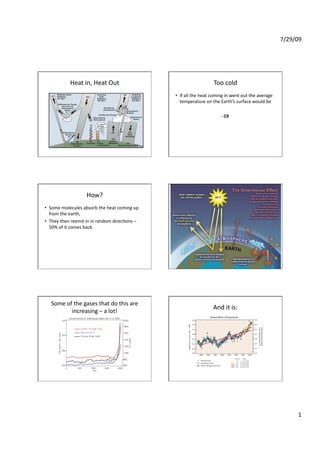
                   How?

•  Some
molecules
absorb
the
heat
coming
up

   from
the
earth,

•  They
then
reemit
in
in
random
direcFons
–

   50%
of
it
comes
back.


   Some
of
the
gases
that
do
this
are

                                                                   And
it
is:

          increasing
–
a
lot!


                                                                                                           1

7/29/09


     So?
It
might
make
Canberra’s
winter

               more
bearable…

  •  But
we
are
already
seeing
increases
in:

       –  Floods

       –  Droughts

       –  Cyclones
                                                                                                               Ice
is
melFng

  •  In
some
places
the
monsoon
are
failing

  •  Some
diseases
are
more
widespread

  •  Salt
is
intruding
into
groundwater


                                                  And


Understand the Size                                                                                 Understand the Scale of the Challenges
 of the Challenges                                               Satellite Image early Marc
                                                                                           h 2000


 Measure
           it                                                                   2
                                                                     11,000 km

                                       295 km
                                                            km
                                                            37


            Iceberg B15 calving from                                                                        The Edg
                                       the Ross Ice Shelf                                                             e of B15
                                                                                                                              A


Go in for a closer look                                                                             Iceberg Alley


                                                                                                                                                         2

7/29/09


                                                                    Sea
levels
do
change

                                                      •  During
the
last
ice
age
(20,000
years
ago)
sea

                                                         levels
were
about
120m
lower.

                                                      •  14,000
years
ago
sea
levels
rose
20m
in
just

                                                         400
years
as
some
major
ice
sheets
melted.


      But
when
they
wrote
the
report
you
             •  Current
sea
levels
have
been
remarkably

       have
been
asked
to
read,
no
one
                  stable
since
about
3000
years
ago


          thought
this
would
happen
                          •  about
the
Fme
humans
started
building
things,
mostly

                                                                 by
the
sea.


       Greenland
and
AntarcFca
                               So
what
might
this
look
like:

•  Greenland
is
now
clearly
melFng
much
faster
       •  hZp://flood.firetree.net

   than
previously
thought.
AntarcFca
probably
is

   too.


•  Each
could
raise
sea
levels
by
5m,
that’s
10m

   in
total.
And
it
could
happen
within
this

   century.


          Will
Steffen
@
ANU

                                                      What
we
are
risking
at
a
2
degree
rise:

   says
things
can
change
in
a
hurry:

  …the
rapid
disintegraFon
of
the
large
ice
sheets
   •    Sea
levels

  on
Greenland
and
AntarFca
or
large
scale
and

  uncontrollable
feedbacks
in
the
carbon
cycle:
      •    15‐40%
plant
and
animal
species

  acFvaFon
of
the
methane
clathrates
[frozen
         •    Ocean
acidificaFon

  water
and
methane]
buried
under
sediments
in

  the
ocean
floor,
the
rapid
loss
of
methane
from
     •    Widespread
drought
and
deserFficaFon


  warmer
and
drier
tundra
ecosystems,
increasing
     •    Increasing
heatwaves

  wildfires
in
the
boreal
and
tropical
zones,
the
     •    Monsoon
failure

  conversion
of
the
Amozon
rainforest
to
savannah,

  the
release
of
carbon
dioxide
from
warming
         •    Glacial
water
supply
–
Asia
and
South
America

  soils…
                                             •    Loss
of
major
agricultural
lands


                                                                                                                               3


Climate

  • 1.
    7/29/09
 Heat
in,
Heat
Out
 Too
cold
 •  If
all
the
heat
coming
in
went
out
the
average
 temperature
on
the
Earth’s
surface
would
be
 ‐19
 How?
 •  Some
molecules
absorb
the
heat
coming
up
 from
the
earth,
 •  They
then
reemit
in
in
random
direcFons
–
 50%
of
it
comes
back.
 Some
of
the
gases
that
do
this
are
 And
it
is:
 increasing
–
a
lot!
 1

  • 2.
    7/29/09
 So?
It
might
make
Canberra’s
winter
 more
bearable…
 •  But
we
are
already
seeing
increases
in:
 –  Floods
 –  Droughts
 –  Cyclones
 Ice
is
melFng
 •  In
some
places
the
monsoon
are
failing
 •  Some
diseases
are
more
widespread
 •  Salt
is
intruding
into
groundwater
 And
 Understand the Size Understand the Scale of the Challenges of the Challenges Satellite Image early Marc h 2000 Measure it 2 11,000 km 295 km km 37 Iceberg B15 calving from The Edg the Ross Ice Shelf e of B15 A Go in for a closer look Iceberg Alley 2

  • 3.
    7/29/09
 Sea
levels
do
change
 •  During
the
last
ice
age
(20,000
years
ago)
sea
 levels
were
about
120m
lower.
 •  14,000
years
ago
sea
levels
rose
20m
in
just
 400
years
as
some
major
ice
sheets
melted.
 But
when
they
wrote
the
report
you
 •  Current
sea
levels
have
been
remarkably
 have
been
asked
to
read,
no
one
 stable
since
about
3000
years
ago

 thought
this
would
happen
 •  about
the
Fme
humans
started
building
things,
mostly
 by
the
sea.
 Greenland
and
AntarcFca
 So
what
might
this
look
like:
 •  Greenland
is
now
clearly
melFng
much
faster
 •  hZp://flood.firetree.net
 than
previously
thought.
AntarcFca
probably
is
 too.
 •  Each
could
raise
sea
levels
by
5m,
that’s
10m
 in
total.
And
it
could
happen
within
this
 century.

 Will
Steffen
@
ANU
 What
we
are
risking
at
a
2
degree
rise:
 says
things
can
change
in
a
hurry:
 …the
rapid
disintegraFon
of
the
large
ice
sheets
 •  Sea
levels
 on
Greenland
and
AntarFca
or
large
scale
and
 uncontrollable
feedbacks
in
the
carbon
cycle:
 •  15‐40%
plant
and
animal
species
 acFvaFon
of
the
methane
clathrates
[frozen
 •  Ocean
acidificaFon
 water
and
methane]
buried
under
sediments
in
 the
ocean
floor,
the
rapid
loss
of
methane
from
 •  Widespread
drought
and
deserFficaFon

 warmer
and
drier
tundra
ecosystems,
increasing
 •  Increasing
heatwaves
 wildfires
in
the
boreal
and
tropical
zones,
the
 •  Monsoon
failure
 conversion
of
the
Amozon
rainforest
to
savannah,
 the
release
of
carbon
dioxide
from
warming
 •  Glacial
water
supply
–
Asia
and
South
America
 soils…
 •  Loss
of
major
agricultural
lands
 3