Climate Info Graphic
Some Tips from Angela Henderson
 Keep It Simple Students!
 Determine your purpose :
 What do you want your audience to do?
 If your topic is e-waste, then it would be recycle your used cell
phones
 If your topic is the CA drought, then it would be save the water
from showers in a bucket
 If your topic is the coral reefs, then it would be stop visiting
aquariums.
 DO NOT pick Save the Coral Reefs or Stop Global
Warming as your topic! Too broad.
K.I.S.S.
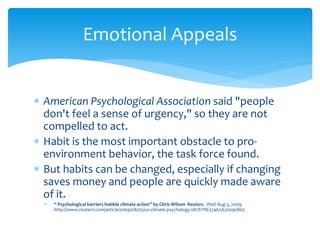
 American Psychological Association said "people
don't feel a sense of urgency," so they are not
compelled to act.
 Habit is the most important obstacle to pro-
environment behavior, the task force found.
 But habits can be changed, especially if changing
saves money and people are quickly made aware
of it.
 “ Psychological barriers hobble climate action” by Chris Wilson Reuters. Wed Aug 5, 2009.
http://www.reuters.com/article/2009/08/05/us-climate-psychology-idUSTRE57462A20090805
Emotional Appeals
 Think strategically about what emotions to evoke.
What feelings would best compel your audience?
 Look at the appeals in Chapter 9 of DCRS
 Look at the appeals in Jib Fowles’ article
How will you compel your
audience to adopt your policy???
 American Psychological Association found
generalized assumptions about climate change are:
 uncertainty over climate change
 mistrust of the messages about risk from scientists or
government officials
 denial that climate change is occurring or that it is
related to human activity.
 “ Psychological barriers hobble climate action” by Chris Wilson Reuters. Wed Aug 5, 2009.
http://www.reuters.com/article/2009/08/05/us-climate-psychology-idUSTRE57462A20090805
Assumptions
 Think about your topic – why don’t people do what
you want them to do?
 For example, why don’t they stop eating meat?
 Why don’t they bicycle to work?
 Why don’t they stop buying water in plastic bottles?
 Remember: Assumptions are the values or beliefs
that underlie the argument.
Pick Two Assumptions
 Address two mental barriers from “Dragons of
Inaction”
 What two mental barriers apply most directly to your
topic? Environmental numbness? Ignorance?
Optimism bias? Technosalvation?
 Refer to your worksheet on this article
 Determine what facts/statistics or other information
will address each mental barrier.
“Dragons of Inaction”
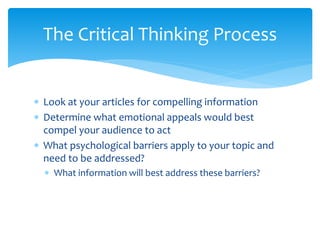
 Look at your articles for compelling information
 Determine what emotional appeals would best
compel your audience to act
 What psychological barriers apply to your topic and
need to be addressed?
 What information will best address these barriers?
The Critical Thinking Process
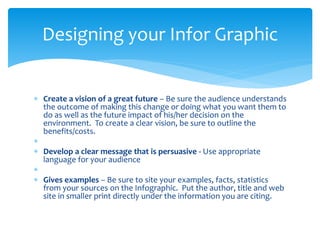
 Create a vision of a great future – Be sure the audience understands
the outcome of making this change or doing what you want them to
do as well as the future impact of his/her decision on the
environment. To create a clear vision, be sure to outline the
benefits/costs.

 Develop a clear message that is persuasive - Use appropriate
language for your audience

 Gives examples – Be sure to site your examples, facts, statistics
from your sources on the Infographic. Put the author, title and web
site in smaller print directly under the information you are citing.
Designing your Infor Graphic
 Use the free templates on Piktochart.com
OR
Use this free info graphic site:
 https://www.canva.com
For this project, you will just submit the PDF or URL
for your info graphic. You do not need to print it and
turn it in (this would be optional).
DUE DATE: Sunday, May 15, 2016
Info Graphic Programs

Climate info graphic

  • 1.
    Climate Info Graphic SomeTips from Angela Henderson
  • 2.
     Keep ItSimple Students!  Determine your purpose :  What do you want your audience to do?  If your topic is e-waste, then it would be recycle your used cell phones  If your topic is the CA drought, then it would be save the water from showers in a bucket  If your topic is the coral reefs, then it would be stop visiting aquariums.  DO NOT pick Save the Coral Reefs or Stop Global Warming as your topic! Too broad. K.I.S.S.
  • 3.
     American PsychologicalAssociation said "people don't feel a sense of urgency," so they are not compelled to act.  Habit is the most important obstacle to pro- environment behavior, the task force found.  But habits can be changed, especially if changing saves money and people are quickly made aware of it.  “ Psychological barriers hobble climate action” by Chris Wilson Reuters. Wed Aug 5, 2009. http://www.reuters.com/article/2009/08/05/us-climate-psychology-idUSTRE57462A20090805 Emotional Appeals
  • 4.
     Think strategicallyabout what emotions to evoke. What feelings would best compel your audience?  Look at the appeals in Chapter 9 of DCRS  Look at the appeals in Jib Fowles’ article How will you compel your audience to adopt your policy???
  • 5.
     American PsychologicalAssociation found generalized assumptions about climate change are:  uncertainty over climate change  mistrust of the messages about risk from scientists or government officials  denial that climate change is occurring or that it is related to human activity.  “ Psychological barriers hobble climate action” by Chris Wilson Reuters. Wed Aug 5, 2009. http://www.reuters.com/article/2009/08/05/us-climate-psychology-idUSTRE57462A20090805 Assumptions
  • 6.
     Think aboutyour topic – why don’t people do what you want them to do?  For example, why don’t they stop eating meat?  Why don’t they bicycle to work?  Why don’t they stop buying water in plastic bottles?  Remember: Assumptions are the values or beliefs that underlie the argument. Pick Two Assumptions
  • 7.
     Address twomental barriers from “Dragons of Inaction”  What two mental barriers apply most directly to your topic? Environmental numbness? Ignorance? Optimism bias? Technosalvation?  Refer to your worksheet on this article  Determine what facts/statistics or other information will address each mental barrier. “Dragons of Inaction”
  • 8.
     Look atyour articles for compelling information  Determine what emotional appeals would best compel your audience to act  What psychological barriers apply to your topic and need to be addressed?  What information will best address these barriers? The Critical Thinking Process
  • 9.
     Create avision of a great future – Be sure the audience understands the outcome of making this change or doing what you want them to do as well as the future impact of his/her decision on the environment. To create a clear vision, be sure to outline the benefits/costs.   Develop a clear message that is persuasive - Use appropriate language for your audience   Gives examples – Be sure to site your examples, facts, statistics from your sources on the Infographic. Put the author, title and web site in smaller print directly under the information you are citing. Designing your Infor Graphic
  • 10.
     Use thefree templates on Piktochart.com OR Use this free info graphic site:  https://www.canva.com For this project, you will just submit the PDF or URL for your info graphic. You do not need to print it and turn it in (this would be optional). DUE DATE: Sunday, May 15, 2016 Info Graphic Programs