Climate
Change
Table of contents
01 What is climate change?
02 Greenhouse effect
03 Consequences of climate change
04 Environmental education is URGENT
What is
climate change?
01
• Is climate change real?
• Is climate change man-
made or is it just a
natural occurrence?
Climate change
Unfortunately, it is
happening at a very
fast pace, so it is
necessary to learn
more about this issue
and act
There is an alteration
of the Earth's
temperature,
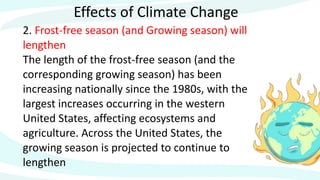
damaging
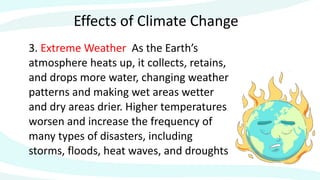
ecosystems and
human beings
Climate change,
according to the United
Nations, is the long-term
changes in temperatures
and weather patterns in the
Earth
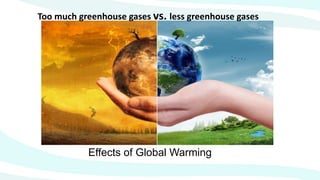
Effects of Global Warming
Too much greenhouse gases vs. less greenhouse gases
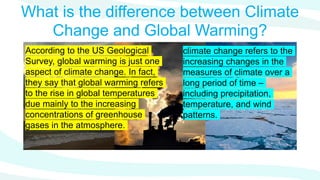
What is the difference between Climate
Change and Global Warming?
According to the US Geological
Survey, global warming is just one
aspect of climate change. In fact,
they say that global warming refers
to the rise in global temperatures
due mainly to the increasing
concentrations of greenhouse
gases in the atmosphere.
climate change refers to the
increasing changes in the
measures of climate over a
long period of time –
including precipitation,
temperature, and wind
patterns.
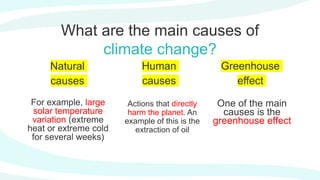
What are the main causes of
climate change?
For example, large
solar temperature
variation (extreme
heat or extreme cold
for several weeks)
One of the main
causes is the
greenhouse effect
Actions that directly
harm the planet. An
example of this is the
extraction of oil
Natural
causes
Greenhouse
effect
Human
causes
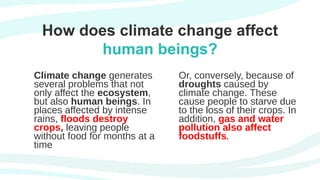
How does climate change affect
human beings?
Climate change generates
several problems that not
only affect the ecosystem,
but also human beings. In
places affected by intense
rains, floods destroy
crops, leaving people
without food for months at a
time
Or, conversely, because of
droughts caused by
climate change. These
cause people to starve due
to the loss of their crops. In
addition, gas and water
pollution also affect
foodstuffs.
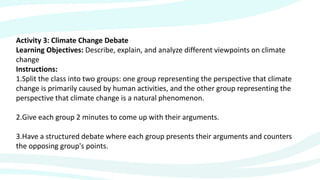
Activity 3: Climate Change Debate
Learning Objectives: Describe, explain, and analyze different viewpoints on climate
change
Instructions:
1.Split the class into two groups: one group representing the perspective that climate
change is primarily caused by human activities, and the other group representing the
perspective that climate change is a natural phenomenon.
2.Give each group 2 minutes to come up with their arguments.
3.Have a structured debate where each group presents their arguments and counters
the opposing group's points.
Greenhouse
effect
02
JUMBLED LETTERS
1. TERWA ROVAP
2. RBONCA XIDIODE
3. HANEMET
4. ONEZO
5. TORSUNI XIDEO
6. BONSOLHCROULFRAC
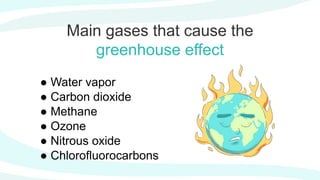
Main gases that cause the
greenhouse effect
● Water vapor
● Carbon dioxide
● Methane
● Ozone
● Nitrous oxide
● Chlorofluorocarbons
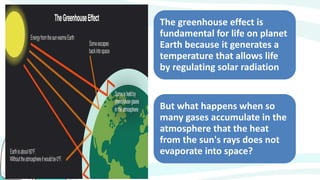
What is it? The greenhouse effect is
fundamental for life on planet
Earth because it generates a
temperature that allows life
by regulating solar radiation
But what happens when so
many gases accumulate in the
atmosphere that the heat
from the sun's rays does not
evaporate into space?
Main gases that cause the
greenhouse effect
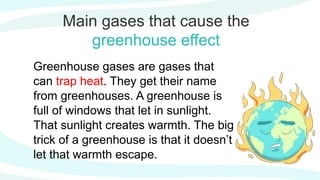
Greenhouse gases are gases that
can trap heat. They get their name
from greenhouses. A greenhouse is
full of windows that let in sunlight.
That sunlight creates warmth. The big
trick of a greenhouse is that it doesn’t
let that warmth escape.
Main gases that cause the greenhouse effect
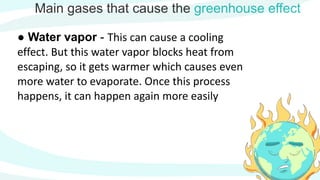
● Water vapor - This can cause a cooling
effect. But this water vapor blocks heat from
escaping, so it gets warmer which causes even
more water to evaporate. Once this process
happens, it can happen again more easily
Main gases that cause the greenhouse effect
Carbon dioxide- Made up of Carbon and
Oxygen, 𝐶𝑂2 is all around us naturally. It comes
from decaying and living organisms, and from
volcanoes. But 𝐶𝑂2 is also released when
burning fossil fuels like coal and oil. It’s the
most important contributor to humancaused
global warming.
Main gases that cause the greenhouse effect
Methane - Made up of Carbon and Hydrogen,
CH4 is a normal gas released from wetlands,
growing rice, raising cattle, using natural gas,
and mining coal. This gas can contribute to the
rising temperature of the Earth because it traps
a lot of heat. Scientists consider it the second
most important contributor to human-caused
global warming of all the greenhouse gases.
Main gases that cause the greenhouse effect
Ozone (𝑶𝟑) - Up in the atmosphere
where the planes fly, the ozone layer
blocks the sun’s radiation, which helps
protect us from powerful rays. Close to
the ground, ozone acts as a
greenhouse gas and can be formed by
burning gas in cars and factories.
Main gases that cause the greenhouse effect
Nitrous oxide (𝑵𝟐𝑂)- Nitrous oxide is
a natural part of the Nitrogen cycle.
Bacteria in soil and the ocean make it.
Nitrous oxide is released by some
types of factories, power plants and
some fertilizer. It damages the
protective ozone layer and is a
powerful greenhouse gas.
Main gases that cause the greenhouse effect
CFCs (chlorofluorocarbons)-
Fluorinated gases are not created in
nature. They damage the protective
ozone layer and are powerful
greenhouse gases. The most common
source of CFCs are refrigerants, but fire
suppression systems for aircraft and
aerosols also emit CFCs into the
atmosphere.
Effects of Climate Change
1. Temperatures will continue to rise
Because human-induced warming is
superimposed on a naturally varying
climate, the temperature rise has not
been, and will not be, uniform or smooth
across the globe or over time.
Effects of Climate Change
2. Frost-free season (and Growing season) will
lengthen
The length of the frost-free season (and the
corresponding growing season) has been
increasing nationally since the 1980s, with the
largest increases occurring in the western
United States, affecting ecosystems and
agriculture. Across the United States, the
growing season is projected to continue to
lengthen
Effects of Climate Change
3. Extreme Weather As the Earth’s
atmosphere heats up, it collects, retains,
and drops more water, changing weather
patterns and making wet areas wetter
and dry areas drier. Higher temperatures
worsen and increase the frequency of
many types of disasters, including
storms, floods, heat waves, and droughts
Effects of Climate Change
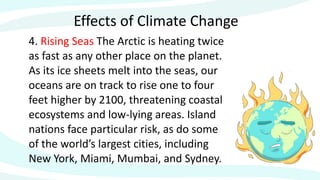
4. Rising Seas The Arctic is heating twice
as fast as any other place on the planet.
As its ice sheets melt into the seas, our
oceans are on track to rise one to four
feet higher by 2100, threatening coastal
ecosystems and low-lying areas. Island
nations face particular risk, as do some
of the world’s largest cities, including
New York, Miami, Mumbai, and Sydney.
Effects of Climate Change
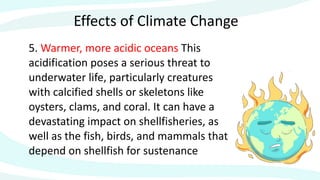
5. Warmer, more acidic oceans This
acidification poses a serious threat to
underwater life, particularly creatures
with calcified shells or skeletons like
oysters, clams, and coral. It can have a
devastating impact on shellfisheries, as
well as the fish, birds, and mammals that
depend on shellfish for sustenance
Effects of Climate Change
Assignment : on a clear sheet of paper
(short bond paper) Differentiate El Niño
from La Niña…
- Written poba?
- Yes written..
- Short bond paper poba?
- Yes short bond paper…
Consequence
s of climate
change
03
Top 5 consequences of
climate change
01. Rising temperatures: as explained above,
temperatures are rising at a very fast rate, generating
an increasingly warmer than normal climate
02. Droughts: rising temperatures mean less and less
rainfall. Plants and crops need water to flourish
03. Extreme weather events: sudden
changes in temperature alter the
Earth's meteorological cycles,
generating tsunamis, tornadoes,
torrential rains...
04. Floods: Although it may seem contradictory, rising temperatures can also produce
torrential rains. These rains wash away crops and cities, causing floods that result in
irreparable damage
05. Migrations due to climate: the effects of climate change have forced many humans
to move around the globe to avoid high temperatures, torrential rains, droughts or the
ravages of natural disasters
Top 5 consequences of
climate change
Environmental
education is URGENT
04
Environmental education
is URGENT
To generate change, it is necessary to communicate and
raise awareness about environmental education
Planet Earth is the place where we live and, therefore,
we are not only actors, but also protagonists in its care
and conservation
I am committed to collaborating in the
care of the environment...
• Paying attention to energy saving at home: turning off lights, taking
shorter showers, making conscious use of water consumption,
unplugging or turning off electrical appliances if they are not in use...
• Reducing consumption: investing in the circular economy. Whether in
clothing, electronics, furniture, etc.
• Using public transportation or electric vehicles
• Consuming plant-based products
• Raising my voice: raising awareness is vital for our future
"Education is the most powerful
weapon to change the world"
—Nelson Mandela
CREDITS: This presentation template was created by Slidesgo, including icons by
Flaticon, infographics & images by Freepik and content by Eliana Delacour
Thanks!
Any questions?
youremail@freepik.com
+91 620 421 838
yourwebpage.com
Please keep this slide for attribution
Alternative resources
Here’s an assortment of alternative resources whose style fits the one of this template:
Vectors
• Hand drawn climate change instagram stories collection
Did you like the resources in this template? Get them for free at our other creative websites:
Vectors
• Hand drawn climate change instagram stories collection
• Hand drawn climate change landing page template
Resources

climate change-greenhouseeffect and cause.pptx

  • 2.
  • 3.
    Table of contents 01What is climate change? 02 Greenhouse effect 03 Consequences of climate change 04 Environmental education is URGENT
  • 4.
  • 5.
    • Is climatechange real? • Is climate change man- made or is it just a natural occurrence?
  • 6.
    Climate change Unfortunately, itis happening at a very fast pace, so it is necessary to learn more about this issue and act There is an alteration of the Earth's temperature, damaging ecosystems and human beings Climate change, according to the United Nations, is the long-term changes in temperatures and weather patterns in the Earth
  • 7.
    Effects of GlobalWarming Too much greenhouse gases vs. less greenhouse gases
  • 8.
    What is thedifference between Climate Change and Global Warming? According to the US Geological Survey, global warming is just one aspect of climate change. In fact, they say that global warming refers to the rise in global temperatures due mainly to the increasing concentrations of greenhouse gases in the atmosphere. climate change refers to the increasing changes in the measures of climate over a long period of time – including precipitation, temperature, and wind patterns.
  • 9.
    What are themain causes of climate change? For example, large solar temperature variation (extreme heat or extreme cold for several weeks) One of the main causes is the greenhouse effect Actions that directly harm the planet. An example of this is the extraction of oil Natural causes Greenhouse effect Human causes
  • 10.
    How does climatechange affect human beings? Climate change generates several problems that not only affect the ecosystem, but also human beings. In places affected by intense rains, floods destroy crops, leaving people without food for months at a time Or, conversely, because of droughts caused by climate change. These cause people to starve due to the loss of their crops. In addition, gas and water pollution also affect foodstuffs.
  • 11.
    Activity 3: ClimateChange Debate Learning Objectives: Describe, explain, and analyze different viewpoints on climate change Instructions: 1.Split the class into two groups: one group representing the perspective that climate change is primarily caused by human activities, and the other group representing the perspective that climate change is a natural phenomenon. 2.Give each group 2 minutes to come up with their arguments. 3.Have a structured debate where each group presents their arguments and counters the opposing group's points.
  • 12.
  • 13.
    JUMBLED LETTERS 1. TERWAROVAP 2. RBONCA XIDIODE 3. HANEMET 4. ONEZO 5. TORSUNI XIDEO 6. BONSOLHCROULFRAC
  • 14.
    Main gases thatcause the greenhouse effect ● Water vapor ● Carbon dioxide ● Methane ● Ozone ● Nitrous oxide ● Chlorofluorocarbons
  • 15.
    What is it?The greenhouse effect is fundamental for life on planet Earth because it generates a temperature that allows life by regulating solar radiation But what happens when so many gases accumulate in the atmosphere that the heat from the sun's rays does not evaporate into space?
  • 16.
    Main gases thatcause the greenhouse effect Greenhouse gases are gases that can trap heat. They get their name from greenhouses. A greenhouse is full of windows that let in sunlight. That sunlight creates warmth. The big trick of a greenhouse is that it doesn’t let that warmth escape.
  • 17.
    Main gases thatcause the greenhouse effect ● Water vapor - This can cause a cooling effect. But this water vapor blocks heat from escaping, so it gets warmer which causes even more water to evaporate. Once this process happens, it can happen again more easily
  • 18.
    Main gases thatcause the greenhouse effect Carbon dioxide- Made up of Carbon and Oxygen, 𝐶𝑂2 is all around us naturally. It comes from decaying and living organisms, and from volcanoes. But 𝐶𝑂2 is also released when burning fossil fuels like coal and oil. It’s the most important contributor to humancaused global warming.
  • 19.
    Main gases thatcause the greenhouse effect Methane - Made up of Carbon and Hydrogen, CH4 is a normal gas released from wetlands, growing rice, raising cattle, using natural gas, and mining coal. This gas can contribute to the rising temperature of the Earth because it traps a lot of heat. Scientists consider it the second most important contributor to human-caused global warming of all the greenhouse gases.
  • 20.
    Main gases thatcause the greenhouse effect Ozone (𝑶𝟑) - Up in the atmosphere where the planes fly, the ozone layer blocks the sun’s radiation, which helps protect us from powerful rays. Close to the ground, ozone acts as a greenhouse gas and can be formed by burning gas in cars and factories.
  • 21.
    Main gases thatcause the greenhouse effect Nitrous oxide (𝑵𝟐𝑂)- Nitrous oxide is a natural part of the Nitrogen cycle. Bacteria in soil and the ocean make it. Nitrous oxide is released by some types of factories, power plants and some fertilizer. It damages the protective ozone layer and is a powerful greenhouse gas.
  • 22.
    Main gases thatcause the greenhouse effect CFCs (chlorofluorocarbons)- Fluorinated gases are not created in nature. They damage the protective ozone layer and are powerful greenhouse gases. The most common source of CFCs are refrigerants, but fire suppression systems for aircraft and aerosols also emit CFCs into the atmosphere.
  • 23.
    Effects of ClimateChange 1. Temperatures will continue to rise Because human-induced warming is superimposed on a naturally varying climate, the temperature rise has not been, and will not be, uniform or smooth across the globe or over time.
  • 24.
    Effects of ClimateChange 2. Frost-free season (and Growing season) will lengthen The length of the frost-free season (and the corresponding growing season) has been increasing nationally since the 1980s, with the largest increases occurring in the western United States, affecting ecosystems and agriculture. Across the United States, the growing season is projected to continue to lengthen
  • 25.
    Effects of ClimateChange 3. Extreme Weather As the Earth’s atmosphere heats up, it collects, retains, and drops more water, changing weather patterns and making wet areas wetter and dry areas drier. Higher temperatures worsen and increase the frequency of many types of disasters, including storms, floods, heat waves, and droughts
  • 26.
    Effects of ClimateChange 4. Rising Seas The Arctic is heating twice as fast as any other place on the planet. As its ice sheets melt into the seas, our oceans are on track to rise one to four feet higher by 2100, threatening coastal ecosystems and low-lying areas. Island nations face particular risk, as do some of the world’s largest cities, including New York, Miami, Mumbai, and Sydney.
  • 27.
    Effects of ClimateChange 5. Warmer, more acidic oceans This acidification poses a serious threat to underwater life, particularly creatures with calcified shells or skeletons like oysters, clams, and coral. It can have a devastating impact on shellfisheries, as well as the fish, birds, and mammals that depend on shellfish for sustenance
  • 28.
    Effects of ClimateChange Assignment : on a clear sheet of paper (short bond paper) Differentiate El Niño from La Niña… - Written poba? - Yes written.. - Short bond paper poba? - Yes short bond paper…
  • 29.
  • 30.
    Top 5 consequencesof climate change 01. Rising temperatures: as explained above, temperatures are rising at a very fast rate, generating an increasingly warmer than normal climate 02. Droughts: rising temperatures mean less and less rainfall. Plants and crops need water to flourish 03. Extreme weather events: sudden changes in temperature alter the Earth's meteorological cycles, generating tsunamis, tornadoes, torrential rains...
  • 31.
    04. Floods: Althoughit may seem contradictory, rising temperatures can also produce torrential rains. These rains wash away crops and cities, causing floods that result in irreparable damage 05. Migrations due to climate: the effects of climate change have forced many humans to move around the globe to avoid high temperatures, torrential rains, droughts or the ravages of natural disasters Top 5 consequences of climate change
  • 32.
  • 33.
    Environmental education is URGENT Togenerate change, it is necessary to communicate and raise awareness about environmental education Planet Earth is the place where we live and, therefore, we are not only actors, but also protagonists in its care and conservation
  • 34.
    I am committedto collaborating in the care of the environment... • Paying attention to energy saving at home: turning off lights, taking shorter showers, making conscious use of water consumption, unplugging or turning off electrical appliances if they are not in use... • Reducing consumption: investing in the circular economy. Whether in clothing, electronics, furniture, etc. • Using public transportation or electric vehicles • Consuming plant-based products • Raising my voice: raising awareness is vital for our future
  • 35.
    "Education is themost powerful weapon to change the world" —Nelson Mandela
  • 36.
    CREDITS: This presentationtemplate was created by Slidesgo, including icons by Flaticon, infographics & images by Freepik and content by Eliana Delacour Thanks! Any questions? youremail@freepik.com +91 620 421 838 yourwebpage.com Please keep this slide for attribution
  • 37.
    Alternative resources Here’s anassortment of alternative resources whose style fits the one of this template: Vectors • Hand drawn climate change instagram stories collection
  • 38.
    Did you likethe resources in this template? Get them for free at our other creative websites: Vectors • Hand drawn climate change instagram stories collection • Hand drawn climate change landing page template Resources

Editor's Notes