COP26
Our Climate, Our Future
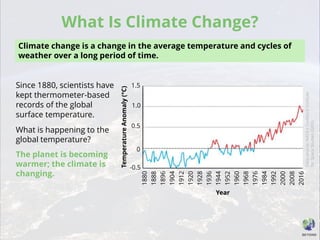
What Is Climate Change?
Since 1880, scientists have
kept thermometer-based
records of the global
surface temperature.
What is happening to the
global temperature?
The planet is becoming
warmer; the climate is
changing.
Climate change is a change in the average temperature and cycles of
weather over a long period of time.
Year
Temperature
Anomaly
(°C)
0
-0.5
0.5
1.0
1.5
Data
source:
NASA's
Goddard
Institute
for
Space
Studies
(GISS)
1880
1888
1904
1936
1960
2000
2016
1896
1912
1920
1928
1968
1944
1952
2008
1976
1984
1992
Why Is Climate Change a Problem?
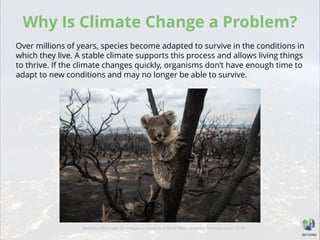
Over millions of years, species become adapted to survive in the conditions in
which they live. A stable climate supports this process and allows living things
to thrive. If the climate changes quickly, organisms don’t have enough time to
adapt to new conditions and may no longer be able to survive.
Bushfire Aftermath On Kangaroo Island by © Brad Fleet / Newspix licensed under CC BY
Why Is Climate Change a Problem?
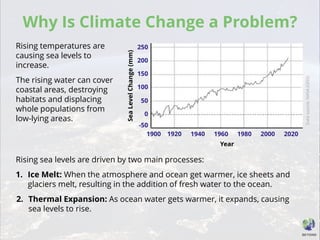
Rising temperatures are
causing sea levels to
increase.
The rising water can cover
coastal areas, destroying
habitats and displacing
whole populations from
low-lying areas.
Sea
Level
Change
(mm)
1900
0
-50
50
100
150
Year
1920 1940 1960 2000
1980 2020
200
250
Data
source:
NASA
(GISS)
Rising sea levels are driven by two main processes:
1. Ice Melt: When the atmosphere and ocean get warmer, ice sheets and
glaciers melt, resulting in the addition of fresh water to the ocean.
2. Thermal Expansion: As ocean water gets warmer, it expands, causing
sea levels to rise.
Why Is Climate Change a Problem?
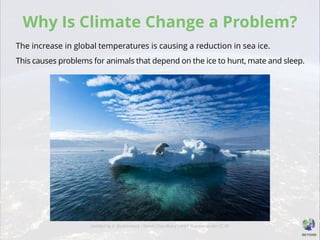
The increase in global temperatures is causing a reduction in sea ice.
This causes problems for animals that depend on the ice to hunt, mate and sleep.
Untitled by © Shutterstock / Ritesh Chaudhary / WWF licensed under CC BY
Why Is Climate Change a Problem?
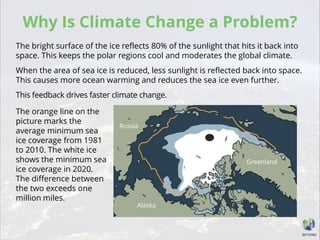
The bright surface of the ice reflects 80% of the sunlight that hits it back into
space. This keeps the polar regions cool and moderates the global climate.
When the area of sea ice is reduced, less sunlight is reflected back into space.
This causes more ocean warming and reduces the sea ice even further.
This feedback drives faster climate change.
The orange line on the
picture marks the
average minimum sea
ice coverage from 1981
to 2010. The white ice
shows the minimum sea
ice coverage in 2020.
The difference between
the two exceeds one
million miles.
Russia
Greenland
Alaska
Why Is Climate Change a Problem?
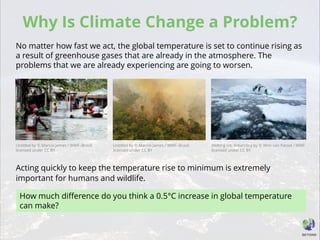
No matter how fast we act, the global temperature is set to continue rising as
a result of greenhouse gases that are already in the atmosphere. The
problems that we are already experiencing are going to worsen.
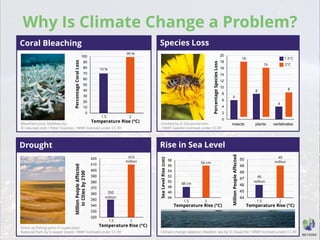
How much difference do you think a 0.5°C increase in global temperature
can make?
Acting quickly to keep the temperature rise to minimum is extremely
important for humans and wildlife.
Untitled by © Marcio James / WWF–Brazil
licensed under CC BY
Untitled by © Marcio James / WWF–Brazil
licensed under CC BY
Melting ice, Antarctica by © Wim van Passel / WWF
licensed under CC BY
Species Loss
Untitled by © Ola Jennersten
/ WWF-Sweden licensed under CC BY
6
8
4
0
2
4
6
8
10
12
14
16
18
20
insects plants vertebrates
Percentage
Species
Loss
2°C 1.5°C
Why Is Climate Change a Problem?
70 %
0
10
20
30
40
50
60
70
80
90
100
Percentage
Coral
Loss
Coral Bleaching
Temperature Rise (°C)
Bleached coral, Maldives by
© naturepl.com / Peter Scoones / WWF licensed under CC BY
1.5
99 %
2
Drought
350
million
320
330
340
350
360
370
380
390
400
410
420
Dried up fishing pans in Liuwa plain
National Park by © Jasper Doest / WWF licensed under CC BY
Temperature Rise (°C)
1.5
48 cm
44
46
48
50
52
54
56
58
Sea
Level
Rise
(cm)
46
million
44
45
46
47
48
49
50
Rise in Sea Level
Climate change adaption Wadden sea by © Claudi Nir / WWF licensed under CC BY
Million
People
Affected
Temperature Rise (°C)
1.5
Temperature Rise (°C)
1.5
18
16
8
2°C
410
million
2
56 cm
2
49
million
2
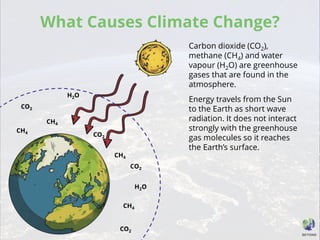
What Causes Climate Change?
Carbon dioxide (CO2),
methane (CH4) and water
vapour (H2O) are greenhouse
gases that are found in the
atmosphere.
Energy travels from the Sun
to the Earth as short wave
radiation. It does not interact
strongly with the greenhouse
gas molecules so it reaches
the Earth’s surface.
CO2
CO2
CH4
H2O
CH4
CO2
H2O
CH4
CH4
CO2
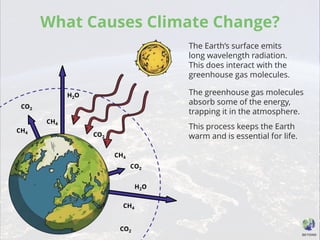
What Causes Climate Change?
The Earth’s surface emits
long wavelength radiation.
This does interact with the
greenhouse gas molecules.
The greenhouse gas molecules
absorb some of the energy,
trapping it in the atmosphere.
This process keeps the Earth
warm and is essential for life.
CO2
CO2
CH4
H2O
CH4
CO2
H2O
CH4
CH4
CO2
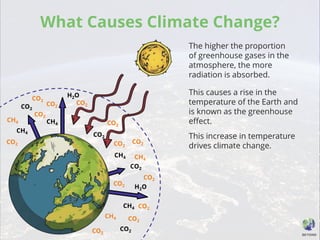
What Causes Climate Change?
The higher the proportion
of greenhouse gases in the
atmosphere, the more
radiation is absorbed.
This causes a rise in the
temperature of the Earth and
is known as the greenhouse
effect.
This increase in temperature
drives climate change.
CO2
CO2
CH4
H2O
CH4
CO2
H2O
CH4
CH4
CO2
CO2
CO2
CO2
CO2
CO2
CO2
CO2
CO2
CO2
CO2
CO2
CO2
CO2
CH4
CH4
CH4
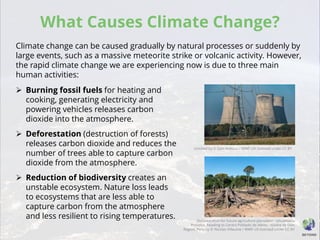
What Causes Climate Change?
Climate change can be caused gradually by natural processes or suddenly by
large events, such as a massive meteorite strike or volcanic activity. However,
the rapid climate change we are experiencing now is due to three main
human activities:
 Burning fossil fuels for heating and
cooking, generating electricity and
powering vehicles releases carbon
dioxide into the atmosphere.
 Deforestation (destruction of forests)
releases carbon dioxide and reduces the
number of trees able to capture carbon
dioxide from the atmosphere.
 Reduction of biodiversity creates an
unstable ecosystem. Nature loss leads
to ecosystems that are less able to
capture carbon from the atmosphere
and less resilient to rising temperatures.
Untitled by © Sam Hobson / WWF-UK licensed under CC BY
Deforestation for future agriculture plantation-Tahuamanu
Province, heading to Centro Poblado de Alerta - Madre de Dios
Region, Peru by © Nicolas Villaume / WWF-US licensed under CC BY
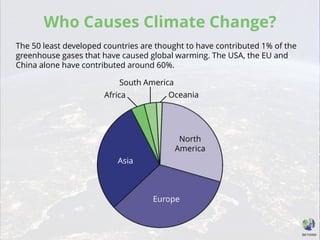
Who Causes Climate Change?
The 50 least developed countries are thought to have contributed 1% of the
greenhouse gases that have caused global warming. The USA, the EU and
China alone have contributed around 60%.
Oceania
Africa
South America
North
America
Europe
Asia
Who Does Climate Change Affect?
In the long term, everyone will feel the effects of climate change. However,
some people are currently more affected than others.
In most cases, the wealth of prosperous countries has come from activities
which contribute to greenhouse gas emissions. This wealth allows these
countries to protect themselves from the effects of climate change.
Poorer countries are less able to adapt to climate change and therefore suffer
the most from its effects. They are also less able to develop because they need
to focus on addressing the challenges caused by climate change.
The countries who have contributed the least to the climate crisis are the
ones who are affected the most.
Is this fair?
Social Justice
Justice is the concept of fairness.
Social justice relates to fairness within a society.
The idea of social justice is that people should have equal access to wealth,
health, opportunities and privileges within a society. All humans should have
the right to a certain standard of living, including a healthy diet, access to clean
water, shelter, clothing, education and healthcare.
The people most likely to be left behind by development are those that face
inequalities.
Those that are most affected have intersecting inequalities. This means that
they may face exclusion or discrimination because they fall into multiple
disadvantaged groups, for example, Black women, disabled LGBTQ+ people or
poor children.
Climate Justice
The impacts of climate change affect disadvantaged groups of people the
most. The effect of climate change on these groups needs to be recognised
and addressed.
Climate justice means looking at the climate crisis from the perspective of
social justice. Solutions need to not only curb climate change; they need to
protect and empower the most vulnerable groups of people too.
We have the responsibility to consider the most vulnerable when planning
climate action. Remember, these groups of people contribute to climate
change the least. This means putting the people and communities that are
most vulnerable to the impact of climate change at the heart of development.
Climate solutions will not work if we do not address social justice issues. For
example, if we do not address poverty, then unsustainable lifestyles will
continue to damage ecosystems and we will fail to curb climate change.
Who Can Fix It?
Governments can make laws and policies that reduce the amount
of greenhouse gas emissions.
Businesses can change their processes to run more sustainably.
We can all make choices in our own lives that reduce our carbon footprint
(the impact our actions and purchases have on climate change).
We can also use our voices to let businesses and governments know that
we want them to act quickly to reduce their impact on climate change.
New Opportunities
The transition to a low-carbon economy in the years ahead brings with it many
opportunities.
Transitioning to low-carbon economies will provide lots of opportunity for
innovation.
There will be a need for people leaving education to do things differently, to
come up with new ideas for products and technologies and to explore new
conservation methods. These opportunities are exciting!
New job sectors will be created and new skills will be valued in the jobs
market. In the future, you may be applying for jobs that don’t even exist yet!
Innovation is the process of turning an idea into a solution that solves a problem.
COP26
197 countries (parties) have signed up to the
United Nations Framework Convention on
Climate Change (UNFCCC).
The UNFCCC aims to prevent human activity
from causing dangerous levels of climate
change.
Every time the member nations meet it is called a COP, which stands for
Conference of the Parties. They look at the current state of the climate and
discuss the actions they will take to address climate change.
This November will see the 26th of these meetings taking place, so you will
hear the event being described as COP26 as well as the UN Climate Change
Conference. It will be hosted by the UK in Glasgow.
UNFCCC logo by UNclimatechange licensed under CC BY
Climate change helper.pptx

Climate change helper.pptx

  • 1.
  • 2.
    What Is ClimateChange? Since 1880, scientists have kept thermometer-based records of the global surface temperature. What is happening to the global temperature? The planet is becoming warmer; the climate is changing. Climate change is a change in the average temperature and cycles of weather over a long period of time. Year Temperature Anomaly (°C) 0 -0.5 0.5 1.0 1.5 Data source: NASA's Goddard Institute for Space Studies (GISS) 1880 1888 1904 1936 1960 2000 2016 1896 1912 1920 1928 1968 1944 1952 2008 1976 1984 1992
  • 3.
    Why Is ClimateChange a Problem? Over millions of years, species become adapted to survive in the conditions in which they live. A stable climate supports this process and allows living things to thrive. If the climate changes quickly, organisms don’t have enough time to adapt to new conditions and may no longer be able to survive. Bushfire Aftermath On Kangaroo Island by © Brad Fleet / Newspix licensed under CC BY
  • 4.
    Why Is ClimateChange a Problem? Rising temperatures are causing sea levels to increase. The rising water can cover coastal areas, destroying habitats and displacing whole populations from low-lying areas. Sea Level Change (mm) 1900 0 -50 50 100 150 Year 1920 1940 1960 2000 1980 2020 200 250 Data source: NASA (GISS) Rising sea levels are driven by two main processes: 1. Ice Melt: When the atmosphere and ocean get warmer, ice sheets and glaciers melt, resulting in the addition of fresh water to the ocean. 2. Thermal Expansion: As ocean water gets warmer, it expands, causing sea levels to rise.
  • 5.
    Why Is ClimateChange a Problem? The increase in global temperatures is causing a reduction in sea ice. This causes problems for animals that depend on the ice to hunt, mate and sleep. Untitled by © Shutterstock / Ritesh Chaudhary / WWF licensed under CC BY
  • 6.
    Why Is ClimateChange a Problem? The bright surface of the ice reflects 80% of the sunlight that hits it back into space. This keeps the polar regions cool and moderates the global climate. When the area of sea ice is reduced, less sunlight is reflected back into space. This causes more ocean warming and reduces the sea ice even further. This feedback drives faster climate change. The orange line on the picture marks the average minimum sea ice coverage from 1981 to 2010. The white ice shows the minimum sea ice coverage in 2020. The difference between the two exceeds one million miles. Russia Greenland Alaska
  • 7.
    Why Is ClimateChange a Problem? No matter how fast we act, the global temperature is set to continue rising as a result of greenhouse gases that are already in the atmosphere. The problems that we are already experiencing are going to worsen. How much difference do you think a 0.5°C increase in global temperature can make? Acting quickly to keep the temperature rise to minimum is extremely important for humans and wildlife. Untitled by © Marcio James / WWF–Brazil licensed under CC BY Untitled by © Marcio James / WWF–Brazil licensed under CC BY Melting ice, Antarctica by © Wim van Passel / WWF licensed under CC BY
  • 8.
    Species Loss Untitled by© Ola Jennersten / WWF-Sweden licensed under CC BY 6 8 4 0 2 4 6 8 10 12 14 16 18 20 insects plants vertebrates Percentage Species Loss 2°C 1.5°C Why Is Climate Change a Problem? 70 % 0 10 20 30 40 50 60 70 80 90 100 Percentage Coral Loss Coral Bleaching Temperature Rise (°C) Bleached coral, Maldives by © naturepl.com / Peter Scoones / WWF licensed under CC BY 1.5 99 % 2 Drought 350 million 320 330 340 350 360 370 380 390 400 410 420 Dried up fishing pans in Liuwa plain National Park by © Jasper Doest / WWF licensed under CC BY Temperature Rise (°C) 1.5 48 cm 44 46 48 50 52 54 56 58 Sea Level Rise (cm) 46 million 44 45 46 47 48 49 50 Rise in Sea Level Climate change adaption Wadden sea by © Claudi Nir / WWF licensed under CC BY Million People Affected Temperature Rise (°C) 1.5 Temperature Rise (°C) 1.5 18 16 8 2°C 410 million 2 56 cm 2 49 million 2
  • 9.
    What Causes ClimateChange? Carbon dioxide (CO2), methane (CH4) and water vapour (H2O) are greenhouse gases that are found in the atmosphere. Energy travels from the Sun to the Earth as short wave radiation. It does not interact strongly with the greenhouse gas molecules so it reaches the Earth’s surface. CO2 CO2 CH4 H2O CH4 CO2 H2O CH4 CH4 CO2
  • 10.
    What Causes ClimateChange? The Earth’s surface emits long wavelength radiation. This does interact with the greenhouse gas molecules. The greenhouse gas molecules absorb some of the energy, trapping it in the atmosphere. This process keeps the Earth warm and is essential for life. CO2 CO2 CH4 H2O CH4 CO2 H2O CH4 CH4 CO2
  • 11.
    What Causes ClimateChange? The higher the proportion of greenhouse gases in the atmosphere, the more radiation is absorbed. This causes a rise in the temperature of the Earth and is known as the greenhouse effect. This increase in temperature drives climate change. CO2 CO2 CH4 H2O CH4 CO2 H2O CH4 CH4 CO2 CO2 CO2 CO2 CO2 CO2 CO2 CO2 CO2 CO2 CO2 CO2 CO2 CO2 CH4 CH4 CH4
  • 12.
    What Causes ClimateChange? Climate change can be caused gradually by natural processes or suddenly by large events, such as a massive meteorite strike or volcanic activity. However, the rapid climate change we are experiencing now is due to three main human activities:  Burning fossil fuels for heating and cooking, generating electricity and powering vehicles releases carbon dioxide into the atmosphere.  Deforestation (destruction of forests) releases carbon dioxide and reduces the number of trees able to capture carbon dioxide from the atmosphere.  Reduction of biodiversity creates an unstable ecosystem. Nature loss leads to ecosystems that are less able to capture carbon from the atmosphere and less resilient to rising temperatures. Untitled by © Sam Hobson / WWF-UK licensed under CC BY Deforestation for future agriculture plantation-Tahuamanu Province, heading to Centro Poblado de Alerta - Madre de Dios Region, Peru by © Nicolas Villaume / WWF-US licensed under CC BY
  • 13.
    Who Causes ClimateChange? The 50 least developed countries are thought to have contributed 1% of the greenhouse gases that have caused global warming. The USA, the EU and China alone have contributed around 60%. Oceania Africa South America North America Europe Asia
  • 14.
    Who Does ClimateChange Affect? In the long term, everyone will feel the effects of climate change. However, some people are currently more affected than others. In most cases, the wealth of prosperous countries has come from activities which contribute to greenhouse gas emissions. This wealth allows these countries to protect themselves from the effects of climate change. Poorer countries are less able to adapt to climate change and therefore suffer the most from its effects. They are also less able to develop because they need to focus on addressing the challenges caused by climate change. The countries who have contributed the least to the climate crisis are the ones who are affected the most. Is this fair?
  • 15.
    Social Justice Justice isthe concept of fairness. Social justice relates to fairness within a society. The idea of social justice is that people should have equal access to wealth, health, opportunities and privileges within a society. All humans should have the right to a certain standard of living, including a healthy diet, access to clean water, shelter, clothing, education and healthcare. The people most likely to be left behind by development are those that face inequalities. Those that are most affected have intersecting inequalities. This means that they may face exclusion or discrimination because they fall into multiple disadvantaged groups, for example, Black women, disabled LGBTQ+ people or poor children.
  • 16.
    Climate Justice The impactsof climate change affect disadvantaged groups of people the most. The effect of climate change on these groups needs to be recognised and addressed. Climate justice means looking at the climate crisis from the perspective of social justice. Solutions need to not only curb climate change; they need to protect and empower the most vulnerable groups of people too. We have the responsibility to consider the most vulnerable when planning climate action. Remember, these groups of people contribute to climate change the least. This means putting the people and communities that are most vulnerable to the impact of climate change at the heart of development. Climate solutions will not work if we do not address social justice issues. For example, if we do not address poverty, then unsustainable lifestyles will continue to damage ecosystems and we will fail to curb climate change.
  • 17.
    Who Can FixIt? Governments can make laws and policies that reduce the amount of greenhouse gas emissions. Businesses can change their processes to run more sustainably. We can all make choices in our own lives that reduce our carbon footprint (the impact our actions and purchases have on climate change). We can also use our voices to let businesses and governments know that we want them to act quickly to reduce their impact on climate change.
  • 18.
    New Opportunities The transitionto a low-carbon economy in the years ahead brings with it many opportunities. Transitioning to low-carbon economies will provide lots of opportunity for innovation. There will be a need for people leaving education to do things differently, to come up with new ideas for products and technologies and to explore new conservation methods. These opportunities are exciting! New job sectors will be created and new skills will be valued in the jobs market. In the future, you may be applying for jobs that don’t even exist yet! Innovation is the process of turning an idea into a solution that solves a problem.
  • 19.
    COP26 197 countries (parties)have signed up to the United Nations Framework Convention on Climate Change (UNFCCC). The UNFCCC aims to prevent human activity from causing dangerous levels of climate change. Every time the member nations meet it is called a COP, which stands for Conference of the Parties. They look at the current state of the climate and discuss the actions they will take to address climate change. This November will see the 26th of these meetings taking place, so you will hear the event being described as COP26 as well as the UN Climate Change Conference. It will be hosted by the UK in Glasgow. UNFCCC logo by UNclimatechange licensed under CC BY