Students Needs
• 25 7th graders enrolled in a CLIL program.
• Greatest area of need: more linguistic and
strategic than content-based.
• Unit plan is thematically based.
• Content areas to be covered: Language
Arts, Social Studies, and Science.
• Engagement: highly interactive
methodology.
Materials Review
• Materials: printed version of Little
Red Riding Hood, Little Red Riding
Hood and the Wolf poem by Roald
Dahl, and Roald Dahl’s webpage.
• 3 types of learning: metacognitive,
cognitive and affective.
• Authenticity of materials promotes
meaningful activities and motivation
in the CLIL classroom.
Objectives
• Language:
• Listen to, speak, read and write about subject matter.
• Analyze, synthesize, infer from information,
hypothesize and predict.
• Content:
• Identify two genres.
• Analyze plot and characters.
• Compare and contrast.
• Identify poetry features.
• Learning strategies:
• Metacognitive: selective attention, organizational
planning, self-assessment.
• Cognitive: prior knowledge, critical thinking,
inferences.
• Affective: cooperative learning through interaction.
Unit Plan distribution
• Lesson 1: LRRH reading
(Apperances can be deceptive).
• Lesson 2: The LRRH and the
Wolf by Roald Dahl.
• Lesson3: Roald Dahl’s webpage
and books.
Some activities
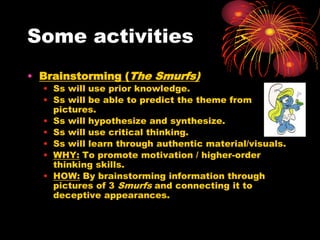
• Brainstorming (The Smurfs)
• Ss will use prior knowledge.
• Ss will be able to predict the theme from
pictures.
• Ss will hypothesize and synthesize.
• Ss will use critical thinking.
• Ss will learn through authentic material/visuals.
• WHY: To promote motivation / higher-order
thinking skills.
• HOW: By brainstorming information through
pictures of 3 Smurfs and connecting it to
deceptive appearances.
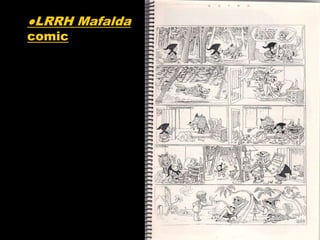
●LRRH Mafalda
comic
• Ss will predict final strip of a comic.
• Ss will provide their own ending.
• Ss will develop critical thinking.
• Ss will work cooperatively.
• Ss will learn by visuals.
• Ss will analyze how values change.
• WHY: To compare how social values in
LRRH have changed.
• HOW: By drawing new ending for the
comic making use of critical thinking
and cooperative learning.
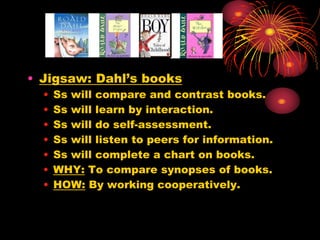
• Jigsaw: Dahl’s books
• Ss will compare and contrast books.
• Ss will learn by interaction.
• Ss will do self-assessment.
• Ss will listen to peers for information.
• Ss will complete a chart on books.
• WHY: To compare synopses of books.
• HOW: By working cooperatively.
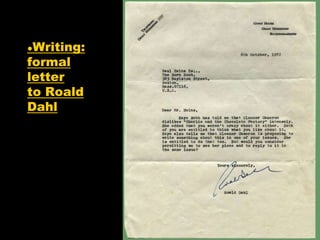
●Writing:
formal
letter
to Roald
Dahl
• -Ss will be able to develop
academic writing.
• -Ss will use discourse.
• WHY: To improve academic
writing.
• HOW: By writing formal letter to
Roald Dahl.
Assessment
• Formal assessement:
• Ss’ projects (graphic organizers,
presentations, writing samples).
• Use of reading and writing rubrics.
• Informal assessement:
• Ss’ performance.
• Self-assessement:
• Reading and writing journal entries to be
kept in portfolios.
• Checklists on reading, writing and
contribution to group discussion.

Clil unit: All that glitters is not gold

  • 2.
    Students Needs • 257th graders enrolled in a CLIL program. • Greatest area of need: more linguistic and strategic than content-based. • Unit plan is thematically based. • Content areas to be covered: Language Arts, Social Studies, and Science. • Engagement: highly interactive methodology.
  • 3.
    Materials Review • Materials:printed version of Little Red Riding Hood, Little Red Riding Hood and the Wolf poem by Roald Dahl, and Roald Dahl’s webpage. • 3 types of learning: metacognitive, cognitive and affective. • Authenticity of materials promotes meaningful activities and motivation in the CLIL classroom.
  • 4.
    Objectives • Language: • Listento, speak, read and write about subject matter. • Analyze, synthesize, infer from information, hypothesize and predict. • Content: • Identify two genres. • Analyze plot and characters. • Compare and contrast. • Identify poetry features. • Learning strategies: • Metacognitive: selective attention, organizational planning, self-assessment. • Cognitive: prior knowledge, critical thinking, inferences. • Affective: cooperative learning through interaction.
  • 5.
    Unit Plan distribution •Lesson 1: LRRH reading (Apperances can be deceptive). • Lesson 2: The LRRH and the Wolf by Roald Dahl. • Lesson3: Roald Dahl’s webpage and books.
  • 6.
    Some activities • Brainstorming(The Smurfs) • Ss will use prior knowledge. • Ss will be able to predict the theme from pictures. • Ss will hypothesize and synthesize. • Ss will use critical thinking. • Ss will learn through authentic material/visuals. • WHY: To promote motivation / higher-order thinking skills. • HOW: By brainstorming information through pictures of 3 Smurfs and connecting it to deceptive appearances.
  • 7.
  • 8.
    • Ss willpredict final strip of a comic. • Ss will provide their own ending. • Ss will develop critical thinking. • Ss will work cooperatively. • Ss will learn by visuals. • Ss will analyze how values change. • WHY: To compare how social values in LRRH have changed. • HOW: By drawing new ending for the comic making use of critical thinking and cooperative learning.
  • 9.
    • Jigsaw: Dahl’sbooks • Ss will compare and contrast books. • Ss will learn by interaction. • Ss will do self-assessment. • Ss will listen to peers for information. • Ss will complete a chart on books. • WHY: To compare synopses of books. • HOW: By working cooperatively.
  • 10.
  • 11.
    • -Ss willbe able to develop academic writing. • -Ss will use discourse. • WHY: To improve academic writing. • HOW: By writing formal letter to Roald Dahl.
  • 12.
    Assessment • Formal assessement: •Ss’ projects (graphic organizers, presentations, writing samples). • Use of reading and writing rubrics. • Informal assessement: • Ss’ performance. • Self-assessement: • Reading and writing journal entries to be kept in portfolios. • Checklists on reading, writing and contribution to group discussion.