Cambridge Mill Cleaner Production Audit
Final Course Project: Waste (CP) Audit of an Institution
EDRD 4500 Planning Industrial Ecology: Design for Sustainability
2
Table of Contents
1.0 Introduction.......................................................................................................................3
2.0 Definition and Benefits of a Waste (CP) Audit..................................................................4
3.0 Report Goals.....................................................................................................................5
4.0 Process of Negotiating an Agreement..............................................................................5
5.0 Restaurant Walkthrough...................................................................................................6
6.0 Restaurant Layout.............................................................................................................7
7.0 Site Map............................................................................................................................7
8.0 Restaurant Description.....................................................................................................8
9.0 Waste Generation at the Cambridge Mill: Fishbone Diagram..........................................9
10.0 Current Waste Reduction Initiatives...............................................................................9
11.0 Waste Management.....................................................................................................10
12.0 Regulations.......................................................................... .......................................10
13.0 Waste Disposal Methods.............................................................................................10
13.1 Garbage.................................................................................................................10
13.2 Recycling................................................................................................................11
13.3 Glass......................................................................................................................11
14.0 Glass Waste.................................................................................................................11
14.1 Glass Waste: Process Flow Chart.........................................................................12
14.2 Glass Waste: Types, Amount, Sources.................................................................13
14.3 CP Opportunities for glass waste..........................................................................13
14.4 Feasibility of Options and Barriers to Implementation...........................................14
15.0 Food Waste.................................................................................................................15
15.1 Process Flow Chart..............................................................................................15
15.2 Food Waste: Types, Amount, Sources.................................................................16
15.3 CP Opportunities for Glass Waste.......................................................................17
15.4 Feasibility of Options and Barriers to Implementation..........................................20
16.0 Reflections on the Assignment & Concluding Comments........................................20
17.0 References.................................................................................................................22
18.0 Appendix.....................................................................................................................23
3
1.0 Introduction
In this 21st century, the waste patterns of our consumerist society are contributing to the
depletion of natural resources and the decline of the integrity of the environment in
which we live. Undeniably, our consumption is a function of our culture. Indeed, by
producing and selling goods and service, our capitalist society thrives. In this way, the
more we produce and purchase, the greater is the progression and prosperity of our
society. This being said, this consumerist way of living has a devastating toll on the
earth's natural resources and ecosystems. As stated by Gary Garnder, director of
research for Worldwatch, "most of the environmental issues we see today can be linked
to consumption'' (Mayell, 2004).
Waste in the food service industry is one of the most recognizable areas of waste in
North America. This not only includes food waste, which accounts for a large
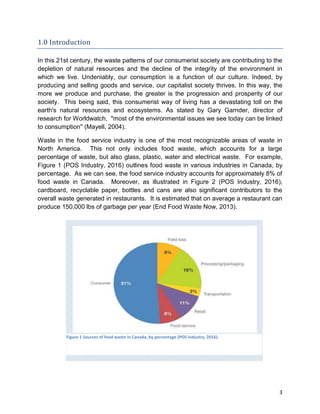
percentage of waste, but also glass, plastic, water and electrical waste. For example,
Figure 1 (POS Industry, 2016) outlines food waste in various industries in Canada, by
percentage. As we can see, the food service industry accounts for approximately 8% of
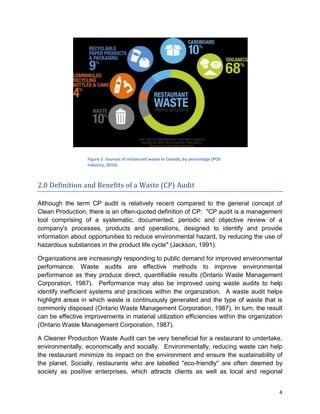
food waste in Canada. Moreover, as illustrated in Figure 2 (POS Industry, 2016),
cardboard, recyclable paper, bottles and cans are also significant contributors to the
overall waste generated in restaurants. It is estimated that on average a restaurant can
produce 150,000 lbs of garbage per year (End Food Waste Now, 2013).
Figure 1 Sources of food waste in Canada, by percentage (POS Industry, 2016).
4
2.0 Definition and Benefits of a Waste (CP) Audit
Although the term CP audit is relatively recent compared to the general concept of
Clean Production, there is an often-quoted definition of CP: "CP audit is a management
tool comprising of a systematic, documented, periodic and objective review of a
company's processes, products and operations, designed to identify and provide
information about opportunities to reduce environmental hazard, by reducing the use of
hazardous substances in the product life cycle" (Jackson, 1991).
Organizations are increasingly responding to public demand for improved environmental
performance. Waste audits are effective methods to improve environmental
performance as they produce direct, quantifiable results (Ontario Waste Management
Corporation, 1987). Performance may also be improved using waste audits to help
identify inefficient systems and practices within the organization. A waste audit helps
highlight areas in which waste is continuously generated and the type of waste that is
commonly disposed (Ontario Waste Management Corporation, 1987). In turn, the result
can be effective improvements in material utilization efficiencies within the organization
(Ontario Waste Management Corporation, 1987).
A Cleaner Production Waste Audit can be very beneficial for a restaurant to undertake,
environmentally, economically and socially. Environmentally, reducing waste can help
the restaurant minimize its impact on the environment and ensure the sustainability of
the planet. Socially, restaurants who are labelled ''eco-friendly'' are often deemed by
society as positive enterprises, which attracts clients as well as local and regional
Figure 2 Sources of restaurant waste in Canada, by percentage (POS
Industry, 2016).
5
recognition. Economically, the reduction of waste helps cut costs by finding more
efficient waste disposal methods and reducing overall waste. In other words, companies
often save significantly following the implementation of solutions generated from the
waste audit.
3.0 Report Goals
The report goals are the following:
1) Identify and quantify the major sources of food waste and glass waste.
2) Reduce solid waste generation that is shipped off the site to reduce disposal costs
and long-term liability.
3) Increase treatment and disposal efficiency for staff.
4) Identify opportunities for waste reduction.
5) Assess the feasibility of the implementation of these waste reduction opportunities.
During the cleaner production audit, I aimed to identify all wastes and investigate where,
how, and why they are generated. Following this, I attempted to identify where the
Cambridge Mill restaurant can make positive changes to reduce, reuse, and recycle
waste where possible.
4.0 Process of Negotiating an Agreement
I approached General Manager of the Cambridge Mill, Mrs. Judith Sloan regarding
conducting a Cleaner Production Waste Audit of the facility in early February. I
expressed to her my interest in conducting this audit with the Cambridge Mill, as it is a
fairly large, complex facility where a comprehensive waste audit could be effectively
conducted. Moreover, I explained to Mrs. Sloan the benefits of performing a Cleaner
Production Waste Audit, including the social, economic and environmental benefits.
Immediately, Mrs. Sloan showed significant interest and enthusiasm for this project.
Mrs. Sloan directed me towards Executive Chef Brad Lomanto, who is responsible for
most aspects of waste collection and monitoring at the restaurant. I approached Mr.
Lomanto and we set up an initial meeting to discuss the details of the Waste Audit.
During this meeting, I presented the waste audit work plan in a letter outlining the
course project, general information, and requirements along with the specific goals I had
developed for the audit. I described to him the commitment required on his part for me
to effectively perform the audit, including his availability to answer questions that I may
have by email or in person, the procurement of certain documents needed, along with
6
interviews from him or other staff members. On my part, I assured him that I would
accommodate interviews around his work schedule, as well as refrain from approaching
him during peak restaurant hours, events, and holidays. I also stated that I would
procure him and Mrs. Sloan with a copy of the waste audit for their review before
submission to my Professor. With the above conditions, Mr. Lomanto granted me
permission and signed the ''Letter to Placement Employers: Process for Workplace
Safety and Insurance Board Coverage'', required for me to begin my audit.
Through continued communication, Mr. Lomanto and other management provided me
with the information I needed to perform my waste audit. Specifically, he openly
disclosed to me waste disposal costs, methods and collection procedures. Bar
Manager Brittany Hutchison provided me details with glass recycling system put in
place for bottled beer and wine, along with associated costs and revenues.
I inquired if there were any waste issues that Mr. Lomanto was personally concerned
with, being a long-time employee of the company. Regarding this, he informed me that
he believed the food waste generated from the restaurant could be reduced by an
organic waste program, and that this was a project he would be very interested in doing
at the Cambridge Mill.
With the above information on hand, I did a walkthrough of the restaurant to provide
myself with a better understanding of the operations that take place.
5.0 Restaurant Walkthrough
Walkthrough Information Gathered:
 General layout of the facility
 Determined where materials come in and how waste moves through the facility
 Identified waste-producing activities
 Detected inefficiencies in operations or the way waste moves
 Identified and assessed current waste reduction efforts
7
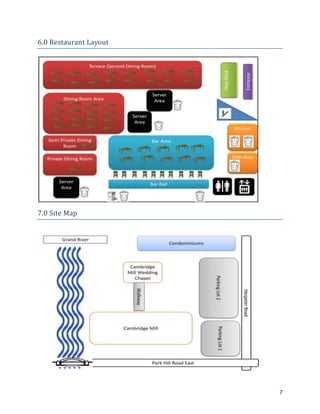
6.0 Restaurant Layout
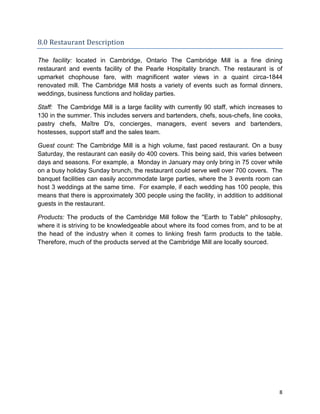
7.0 Site Map
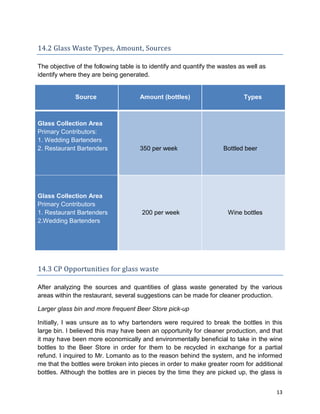
8
8.0 Restaurant Description
The facility: located in Cambridge, Ontario The Cambridge Mill is a fine dining
restaurant and events facility of the Pearle Hospitality branch. The restaurant is of
upmarket chophouse fare, with magnificent water views in a quaint circa-1844
renovated mill. The Cambridge Mill hosts a variety of events such as formal dinners,
weddings, business functions and holiday parties.
Staff: The Cambridge Mill is a large facility with currently 90 staff, which increases to
130 in the summer. This includes servers and bartenders, chefs, sous-chefs, line cooks,
pastry chefs, Maître D's, concierges, managers, event severs and bartenders,
hostesses, support staff and the sales team.
Guest count: The Cambridge Mill is a high volume, fast paced restaurant. On a busy
Saturday, the restaurant can easily do 400 covers. This being said, this varies between
days and seasons. For example, a Monday in January may only bring in 75 cover while
on a busy holiday Sunday brunch, the restaurant could serve well over 700 covers. The
banquet facilities can easily accommodate large parties, where the 3 events room can
host 3 weddings at the same time. For example, if each wedding has 100 people, this
means that there is approximately 300 people using the facility, in addition to additional
guests in the restaurant.
Products: The products of the Cambridge Mill follow the ''Earth to Table'' philosophy,
where it is striving to be knowledgeable about where its food comes from, and to be at
the head of the industry when it comes to linking fresh farm products to the table.
Therefore, much of the products served at the Cambridge Mill are locally sourced.
9
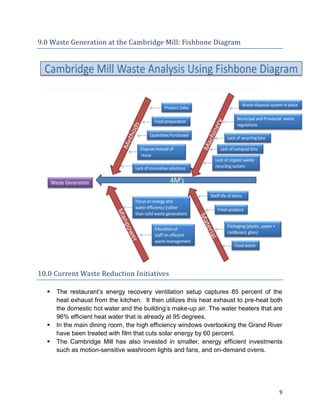
9.0 Waste Generation at the Cambridge Mill: Fishbone Diagram
10.0 Current Waste Reduction Initiatives
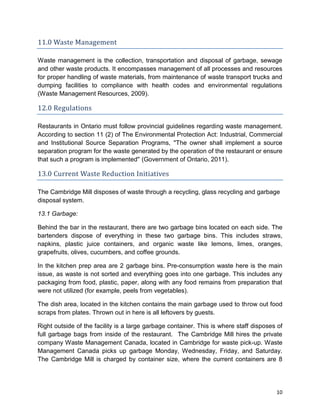
 The restaurant’s energy recovery ventilation setup captures 85 percent of the
heat exhaust from the kitchen. It then utilizes this heat exhaust to pre-heat both
the domestic hot water and the building’s make-up air. The water heaters that are
96% efficient heat water that is already at 95 degrees.
 In the main dining room, the high efficiency windows overlooking the Grand River
have been treated with film that cuts solar energy by 60 percent.
 The Cambridge Mill has also invested in smaller, energy efficient investments
such as motion-sensitive washroom lights and fans, and on-demand ovens.
10
11.0 Waste Management
Waste management is the collection, transportation and disposal of garbage, sewage
and other waste products. It encompasses management of all processes and resources
for proper handling of waste materials, from maintenance of waste transport trucks and
dumping facilities to compliance with health codes and environmental regulations
(Waste Management Resources, 2009).
12.0 Regulations
Restaurants in Ontario must follow provincial guidelines regarding waste management.
According to section 11 (2) of The Environmental Protection Act: Industrial, Commercial
and Institutional Source Separation Programs, ''The owner shall implement a source
separation program for the waste generated by the operation of the restaurant or ensure
that such a program is implemented'' (Government of Ontario, 2011).
13.0 Current Waste Reduction Initiatives
The Cambridge Mill disposes of waste through a recycling, glass recycling and garbage
disposal system.
13.1 Garbage:
Behind the bar in the restaurant, there are two garbage bins located on each side. The
bartenders dispose of everything in these two garbage bins. This includes straws,
napkins, plastic juice containers, and organic waste like lemons, limes, oranges,
grapefruits, olives, cucumbers, and coffee grounds.
In the kitchen prep area are 2 garbage bins. Pre-consumption waste here is the main
issue, as waste is not sorted and everything goes into one garbage. This includes any
packaging from food, plastic, paper, along with any food remains from preparation that
were not utilized (for example, peels from vegetables).
The dish area, located in the kitchen contains the main garbage used to throw out food
scraps from plates. Thrown out in here is all leftovers by guests.
Right outside of the facility is a large garbage container. This is where staff disposes of
full garbage bags from inside of the restaurant. The Cambridge Mill hires the private
company Waste Management Canada, located in Cambridge for waste pick-up. Waste
Management Canada picks up garbage Monday, Wednesday, Friday, and Saturday.
The Cambridge Mill is charged by container size, where the current containers are 8
11
yards by 8 yards. The Cambridge Mill pays Waste Management $2,000 on a monthly
basis for the scheduled pick-ups.
13.2 Recycling:
At the bar area in the restaurant, the bartenders will bring up empty milk crates before
every shift. During the shift, this is where empty wine and beer bottles will be placed. At
the end of the shift, the bartender will bring down the full containers to the glass area
downstairs.
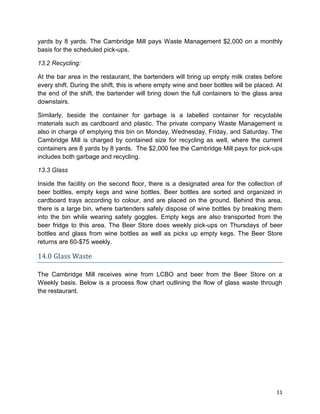
Similarly, beside the container for garbage is a labelled container for recyclable
materials such as cardboard and plastic. The private company Waste Management is
also in charge of emptying this bin on Monday, Wednesday, Friday, and Saturday. The
Cambridge Mill is charged by contained size for recycling as well, where the current
containers are 8 yards by 8 yards. The $2,000 fee the Cambridge Mill pays for pick-ups
includes both garbage and recycling.
13.3 Glass
Inside the facility on the second floor, there is a designated area for the collection of
beer bottles, empty kegs and wine bottles. Beer bottles are sorted and organized in
cardboard trays according to colour, and are placed on the ground. Behind this area,
there is a large bin, where bartenders safely dispose of wine bottles by breaking them
into the bin while wearing safety goggles. Empty kegs are also transported from the
beer fridge to this area. The Beer Store does weekly pick-ups on Thursdays of beer
bottles and glass from wine bottles as well as picks up empty kegs. The Beer Store
returns are 60-$75 weekly.
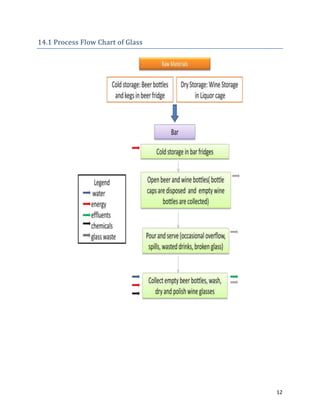
14.0 Glass Waste
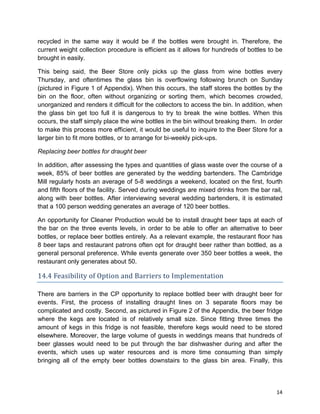
The Cambridge Mill receives wine from LCBO and beer from the Beer Store on a
Weekly basis. Below is a process flow chart outlining the flow of glass waste through
the restaurant.
12
14.1 Process Flow Chart of Glass
13
14.2 Glass Waste Types, Amount, Sources
The objective of the following table is to identify and quantify the wastes as well as
identify where they are being generated.
Source Amount (bottles) Types
Glass Collection Area
Primary Contributors:
1. Wedding Bartenders
2. Restaurant Bartenders 350 per week Bottled beer
Glass Collection Area
Primary Contributors
1. Restaurant Bartenders
2.Wedding Bartenders
200 per week Wine bottles
14.3 CP Opportunities for glass waste
After analyzing the sources and quantities of glass waste generated by the various
areas within the restaurant, several suggestions can be made for cleaner production.
Larger glass bin and more frequent Beer Store pick-up
Initially, I was unsure as to why bartenders were required to break the bottles in this
large bin. I believed this may have been an opportunity for cleaner production, and that
it may have been more economically and environmentally beneficial to take in the wine
bottles to the Beer Store in order for them to be recycled in exchange for a partial
refund. I inquired to Mr. Lomanto as to the reason behind the system, and he informed
me that the bottles were broken into pieces in order to make greater room for additional
bottles. Although the bottles are in pieces by the time they are picked up, the glass is
14
recycled in the same way it would be if the bottles were brought in. Therefore, the
current weight collection procedure is efficient as it allows for hundreds of bottles to be
brought in easily.
This being said, the Beer Store only picks up the glass from wine bottles every
Thursday, and oftentimes the glass bin is overflowing following brunch on Sunday
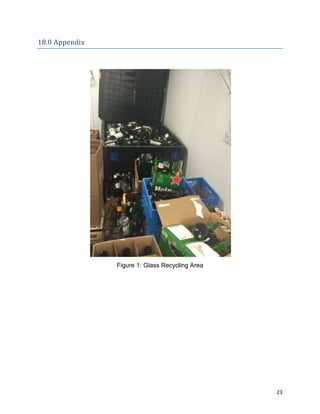
(pictured in Figure 1 of Appendix). When this occurs, the staff stores the bottles by the
bin on the floor, often without organizing or sorting them, which becomes crowded,
unorganized and renders it difficult for the collectors to access the bin. In addition, when
the glass bin get too full it is dangerous to try to break the wine bottles. When this
occurs, the staff simply place the wine bottles in the bin without breaking them. In order
to make this process more efficient, it would be useful to inquire to the Beer Store for a
larger bin to fit more bottles, or to arrange for bi-weekly pick-ups.
Replacing beer bottles for draught beer
In addition, after assessing the types and quantities of glass waste over the course of a
week, 85% of beer bottles are generated by the wedding bartenders. The Cambridge
Mill regularly hosts an average of 5-8 weddings a weekend, located on the first, fourth
and fifth floors of the facility. Served during weddings are mixed drinks from the bar rail,
along with beer bottles. After interviewing several wedding bartenders, it is estimated
that a 100 person wedding generates an average of 120 beer bottles.
An opportunity for Cleaner Production would be to install draught beer taps at each of
the bar on the three events levels, in order to be able to offer an alternative to beer
bottles, or replace beer bottles entirely. As a relevant example, the restaurant floor has
8 beer taps and restaurant patrons often opt for draught beer rather than bottled, as a
general personal preference. While events generate over 350 beer bottles a week, the
restaurant only generates about 50.
14.4 Feasibility of Option and Barriers to Implementation
There are barriers in the CP opportunity to replace bottled beer with draught beer for
events. First, the process of installing draught lines on 3 separate floors may be
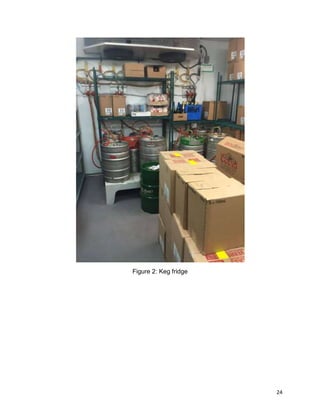
complicated and costly. Second, as pictured in Figure 2 of the Appendix, the beer fridge
where the kegs are located is of relatively small size. Since fitting three times the
amount of kegs in this fridge is not feasible, therefore kegs would need to be stored
elsewhere. Moreover, the large volume of guests in weddings means that hundreds of
beer glasses would need to be put through the bar dishwasher during and after the
events, which uses up water resources and is more time consuming than simply
bringing all of the empty beer bottles downstairs to the glass bin area. Finally, this
15
option would be assuming that wedding guests have a preference for draught beer,
which may not be the case.
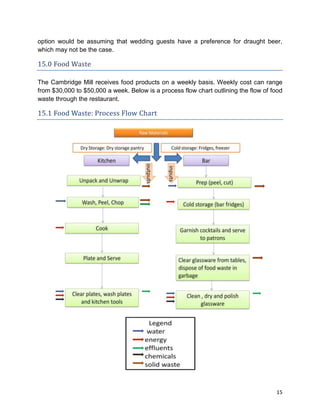
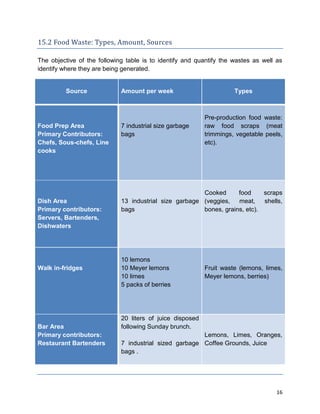
15.0 Food Waste
The Cambridge Mill receives food products on a weekly basis. Weekly cost can range
from $30,000 to $50,000 a week. Below is a process flow chart outlining the flow of food
waste through the restaurant.
15.1 Food Waste: Process Flow Chart
16
15.2 Food Waste: Types, Amount, Sources
The objective of the following table is to identify and quantify the wastes as well as
identify where they are being generated.
Source Amount per week Types
Food Prep Area
Primary Contributors:
Chefs, Sous-chefs, Line
cooks
7 industrial size garbage
bags
Pre-production food waste:
raw food scraps (meat
trimmings, vegetable peels,
etc).
Dish Area
Primary contributors:
Servers, Bartenders,
Dishwaters
13 industrial size garbage
bags
Cooked food scraps
(veggies, meat, shells,
bones, grains, etc).
Walk in-fridges
10 lemons
10 Meyer lemons
10 limes
5 packs of berries
Fruit waste (lemons, limes,
Meyer lemons, berries)
Bar Area
Primary contributors:
Restaurant Bartenders
20 liters of juice disposed
following Sunday brunch.
7 industrial sized garbage
bags .
Lemons, Limes, Oranges,
Coffee Grounds, Juice
17
15.3 CP Opportunities: Food Waste
After analyzing the sources and quantities of food waste generated by the various areas
within the restaurant, several suggestions can be made for cleaner production.
Implementation of organic waste program
The restaurant would greatly benefit from an organic waste program. The organization
could look into private companies that perform organic waste pick up along with
garbage and recycling pick up. The Cambridge Mill could ask Waste Management
Canada about organic waste pick up, or reach out to other private companies regarding
this.
Waste separation system
Although the audit focuses on glass and food waste, paper and plastic waste can also
be addressed by a waste separation system. A waste separation system could be put
in place both in the kitchen and behind the bar in order to sort waste. Behind the bar,
one of the two garbages could be used for recycling. This can be done by transforming
the bin into a clearly labelled recycling bin and using a transparent bag instead of a
black bag. For food waste, a clearly labelled, small compost bin could also be placed
beside the garbage in order to sort food waste.
A similar system could be introduced in the kitchen, with a compost bin set up both for
the servers to scrape food from the plates, as well as for the kitchen staff to dispose of
any extra food used during preparation. A garbage could also be turned into a recycling
bin in the kitchen for the chefs, sous-chefs and line cooks to dispose of any recyclable
packaging from ingredients.
The key to the success of this option would be to clearly label all three bins (compost,
garbage, recycling) with a description of exactly what can be put in each bins.
Moreover, the success of these changes would depend on the education and co-
operation of the staff members. In order to effectively implement these changes, a staff
meeting outlining the new changes and procedures would be required for all parties.
Transportation of organic food waste to Pearle Hospitality Farm for compost
The Cambridge Mill is owned by Pearle Hospitality, which owns various restaurants and
event venues. The Farm is an extension of Pearle Hospitality's Earth to Table food
philosophy. With 100 acres, the Farm supplies the Cambridge Mill and other Pearle
Hospitality restaurants with fruits and vegetables and Craft Cut Premium Steaks
(Ancaster Mill, 2015). On the Farm, seedlings have been planted in the hopes of
growing an orchard. An insightful and innovative option for organic waste disposal
18
would be to arrange for the transportation of organic waste to be used as compost on
the Farm.
Organic waste for pig feed
An opportunity that could be examined by the restaurant is having employees fill the
compost bins with organic materials, and have a farmer could pick up this organic waste
and utilize it as pig feed. For example, I have recently spoken to a manager at Borealis
who has an agreement with pig farmer Andy Macdonald, who pays for and picks up the
organic waste from the restaurant a few times a week. The farmer then uses the
collected organic waste to feed his pigs. In turn, Borealis purchases meat from his farm.
A similar system could be introduced at the Cambridge Mill, by inquiring to our meat
suppliers and advertising the opportunity. This option would both reduce food waste and
bring additional revenue to the restaurant.
Altering fresh produce purchasing practices
Although the restaurant is efficient as it prepares food to order to minimize waste
(excluding large ''family style'' event functions such as Sunday brunch), I have noticed
significant fruit waste from several walkthroughs of both walk-in fridges, noted in Table
15.2. This fruit and vegetable waste comes from the lemon, limes, oranges and berries
purchased for the kitchen to use for dishes, and for bartenders to use for drinks. More
than often, boxes of fruits and vegetables accumulate in the fridges without being used,
and their short shelf life enables them to go bad quickly. Therefore, in order to cut food
costs and reduce food waste, the organization should reduce its weekly orders of
lemons, Meyer lemons, limes, oranges and berries.
Reduction of juice waste during brunch
After analyzing the sources of food waste, it was noted that a large percentage of waste
occurs during Sunday brunch. This is due to the high guest count (often over 500 during
the day), and the waste management practices utilized. For example, there is a display
of 4 types of fresh juice for guests to enjoy during brunch. These are 20 liter jugs for
every juice, often half-filled at the beginning of brunch and constantly refilled throughout
the day. Once brunch is done, the bartender collects 1 liter of each juice, and throw out
the rest. This often reaches 20 liters of waste in total. In order to minimize this waste,
the bartenders could fill large empty jugs with the juice, and use these throughout the
week. Another option would be to freeze the juices, and use them for brunch smoothies
the following Sunday, or for blended cocktails during the week.
19
Reduction of fruit and vegetable waste during brunch
Moreover, during brunch, there are artistic fruit and vegetable displays on the bar.
These include bananas, berries, tomatoes, red peppers, and oranges. After brunch,
these fruits and vegetables are thrown out for sanitary reasons and as they often go bad
by the end of the day. To avoid this waste, it would be beneficial for the company to
exchange real fruit for glass or plastic fruits and vegetables. In this way, the displays are
reusable, and the company would save by foregoing the need to waste real fruit and
vegetables for the display.
Reduction of brunch food quantities and plate size
As noted in Table 14.2, a significant percentage of food waste occurs during Sunday
brunch. This occurs as the brunch is ''buffet-style'', where guests fill their plate up with
desired food items. In this way, guests do not have portioned plates, and since most
people serve themselves at the buffet several times, they often end up not finishing
everything that is on their plates. This leads to significantly more food waste, as a single
person can generate several plates of uneaten food to be disposed. Pursuing this
further, the guest count during brunch is significantly higher than on the other days of
the week, with exponentially perpetuates the issue. Since the meals are not created ''to
order'', this also creates significant food waste. Although following brunch some of the
food is stored in the fridge and utilized the following days, certain dishes must be thrown
out due to health regulations. Moreover, the food cannot be donated because food
banks and shelters do not accept food that has been exposed to the air.
In order to solve these issues, the restaurant could offer customers plates that a size in
between side plates and regular dinner plate. In this way, customers are more likely to
fill their plates up with an amount of food they will actually eat. Moreover, the restaurant
could serve the same variety of foods on the buffet tables, just in smaller portions. This
would ultimately minimize the food needing to be thrown out at the end of brunch.
Implementation of ''à-la-carte'' brunch menu
As another option, the Cambridge Mill could consider an ''à-la-carte'' brunch menu,
where customers have a set menu with brunch items to chose from. Apart from greatly
minimizing food waste, and ''à-la-carte'' menu may be more appealing to certain guests.
Indeed, this means that every meal a customer eats, it can be customized to fit their
specific wants and needs. Moreover, higher end options can be offered in à-la-carte
because certain foods at a buffet are not economically feasible. Since the Cambridge
Mill is a fine dining establishment that prides itself on high-end quality food, an ''à-la-
carte'' menu makes sense.
20
15.4 Measures for Implementation and Possible Barriers
The implementation of a waste program would obviously require some time and effort
from the part of management. This would require several phone calls for information
and estimates to various companies in the region in order to find a new waste
management company that also collects compost. This being said, this option would
reduce the greatest amount of food waste in the restaurant, and enable the
implementation of a waste separation system. Speaking of this, implementing a waste
separation system is a very feasible, low-cost option. In order to undertake this CP
measure the restaurant would simply need to designate 3 separate bins and place them
behind both the bar and in the kitchen and dish area.
The option to alter food purchasing practices regarding fruit is fairly simple to undertake.
This measure only requires the manager in charge of food inventory to request less
cases of each fruit ordered when submitting purchase orders. In order to undertake the
CP measure of reducing juice waste from brunch, this requires the co-operation of the
bartenders to collect and store the juices in the freezers following brunch. Similarly, the
reduction of fruit and vegetable waste on the brunch displays would require the
bartender's cooperation to cease using real fruit, and would require the manager to go
out and purchase fake fruit displays. A possible barrier to this would be the aesthetic
look of the fake fruit displays versus the real fruit, which may not please everyone.
In order to reduce brunch food quantities and plate size, this would require a general
agreement between all managers, and the co-operation of the kitchen staff in reducing
the quantity of food made. It is important to note that for the implementation of any of
the above options, success depends on the leadership and support of the management
and the willingness of staff to alter their behaviors and waste disposal methods. Indeed,
staff are the most important component of waste reduction as they are the ones
ultimately carrying out the CP measures.
16.0 Reflections on the Assignments & Concluding Comments
Undertaking the waste audit was a challenging, yet rewarding experience. The
openness and positive attitude of the management and staff at the Cambridge Mill
enabled the completion of the waste audit to be effective and efficient. This being said,
the waste audit was not completed without challenges along the way. The volume and
rotation of staff rendered it difficult to estimate certain types of waste, as many
employees gave me different estimates of the waste they produced on a weekly basis.
This required me to perform several site visits in order to calculate weekly waste myself
for better accurate estimates.
21
The Cambridge Mill restaurant has been featured in various business articles regarding
its commitment to energy efficiency and energy reduction initiatives, which have been
included in the references section. Moving forward, it is hoped that the establishment
will transfer its enthusiasm and commitment for environmental stewardship to the other
types of wastes it creates, being a large complex facility. Pearle Hospitality's ''Earth to
Table'' food philosophy and the restaurant's general support for local, sustainable
farming go hand-in-hand with environmentally friendly waste management practices. As
stated as one of Earth to Table's philosophy mandates: ''We want be part of something
greater than ourselves; a sustainable system that nourishes our lives and
our Community'' (Earth to Table, 2012). There is no doubt that greater waste reduction
initiatives would support the Cambridge Mill's dedication to this sustainable system. All
in all, the implementation of the recommendations outlined in the waste audit is an
opportunity for the Cambridge Mill to showcase it overall excellence and responsible
approach to the environment.
The majority of information gathered in audit was obtained from site visits, interviews
with staff and management, emails received from management and documents
procured by management. Additional sources are listed in reference list.
22
17.0 References
Ancaster Mill. (2015). The Farm. Retrieved March 21, 2016 from
http://ancastermill.ca/posts/1-the-farm
Earth to Table. (2012). Earth to Table. Retrieved March 29, 2016 from:
http://hamilton.breadbar.ca/about-us/earth-to-table#.VwMhAaR97IU
End Food Waste Now. (2013). Restaurants Retrieved March 20, 2016 from:
http://endfoodwastenow.org/index.php/issues/issues-restaurants
Jackson, J. (1991). Citizen’s groups perspectives on integrated waste management
planning. In Municipal solid waste management: Making decisions in the face of
uncertainty, ed. Murray Haight. Waterloo, Canada: University of Waterloo.
Government of Ontario. (2011). Environmental Protection Act, R.S.O. 1990, c. E.19.
Retrieved March 20, 2016 from: http://www.bizenergy.ca/success-stories/new-
cambridge-mill-showcases-energy-efficiency/
Ontario Waste Management Corporation. (1987). Industrial Waste Audit and Reduction
Manual. A practical guide to developing and conducting a manufacturing process
survey for waste minimization opportunities. 98p.
Mayell, H. (2004). As Consumerism Spread, Earth Suffers, Study Says. National
Geographics. Retrieved April 4, from :
http://news.nationalgeographic.com/news/2004/01/0111_040112_consumerism.html
Waste Management Resources. (2009). Waste Management Resources. Retrieved
April 4, from: http://www.wrfound.org.uk/
Images
End Food Waste Now. (2013). Restaurants Retrieved March 20, 2016 from:
http://endfoodwastenow.org/index.php/issues/issues-restaurants
POS Sector Canada (2016). 16 Tips for Restaurant Food Waste Reduction. Retrieved
March 21, 2016 from: http://possector.com/management/restaurant-food-waste-
reduction
Articles featuring the Cambridge Mill
Chapel, S. (2011). New Cambridge Mill showcases energy efficiency. BizEnergy.
Retrieved March 20, 2016 from: http://www.bizenergy.ca/success-
stories/new-cambridge-mill-showcases-energy-efficiency/
Chapel, S. (2012). Green elegance shines at the Cambridge Mill. BizEnergy. Retrieved
March 20, 2016 from: http://www.bizenergy.ca/success-stories/green-
elegance-shines-at-the-cambridge-mill/
23
18.0 Appendix
Figure 1: Glass Recycling Area
24
Figure 2: Keg fridge

Cleaner Production Waste Audit

  • 1.
    Cambridge Mill CleanerProduction Audit Final Course Project: Waste (CP) Audit of an Institution EDRD 4500 Planning Industrial Ecology: Design for Sustainability
  • 2.
    2 Table of Contents 1.0Introduction.......................................................................................................................3 2.0 Definition and Benefits of a Waste (CP) Audit..................................................................4 3.0 Report Goals.....................................................................................................................5 4.0 Process of Negotiating an Agreement..............................................................................5 5.0 Restaurant Walkthrough...................................................................................................6 6.0 Restaurant Layout.............................................................................................................7 7.0 Site Map............................................................................................................................7 8.0 Restaurant Description.....................................................................................................8 9.0 Waste Generation at the Cambridge Mill: Fishbone Diagram..........................................9 10.0 Current Waste Reduction Initiatives...............................................................................9 11.0 Waste Management.....................................................................................................10 12.0 Regulations.......................................................................... .......................................10 13.0 Waste Disposal Methods.............................................................................................10 13.1 Garbage.................................................................................................................10 13.2 Recycling................................................................................................................11 13.3 Glass......................................................................................................................11 14.0 Glass Waste.................................................................................................................11 14.1 Glass Waste: Process Flow Chart.........................................................................12 14.2 Glass Waste: Types, Amount, Sources.................................................................13 14.3 CP Opportunities for glass waste..........................................................................13 14.4 Feasibility of Options and Barriers to Implementation...........................................14 15.0 Food Waste.................................................................................................................15 15.1 Process Flow Chart..............................................................................................15 15.2 Food Waste: Types, Amount, Sources.................................................................16 15.3 CP Opportunities for Glass Waste.......................................................................17 15.4 Feasibility of Options and Barriers to Implementation..........................................20 16.0 Reflections on the Assignment & Concluding Comments........................................20 17.0 References.................................................................................................................22 18.0 Appendix.....................................................................................................................23
  • 3.
    3 1.0 Introduction In this21st century, the waste patterns of our consumerist society are contributing to the depletion of natural resources and the decline of the integrity of the environment in which we live. Undeniably, our consumption is a function of our culture. Indeed, by producing and selling goods and service, our capitalist society thrives. In this way, the more we produce and purchase, the greater is the progression and prosperity of our society. This being said, this consumerist way of living has a devastating toll on the earth's natural resources and ecosystems. As stated by Gary Garnder, director of research for Worldwatch, "most of the environmental issues we see today can be linked to consumption'' (Mayell, 2004). Waste in the food service industry is one of the most recognizable areas of waste in North America. This not only includes food waste, which accounts for a large percentage of waste, but also glass, plastic, water and electrical waste. For example, Figure 1 (POS Industry, 2016) outlines food waste in various industries in Canada, by percentage. As we can see, the food service industry accounts for approximately 8% of food waste in Canada. Moreover, as illustrated in Figure 2 (POS Industry, 2016), cardboard, recyclable paper, bottles and cans are also significant contributors to the overall waste generated in restaurants. It is estimated that on average a restaurant can produce 150,000 lbs of garbage per year (End Food Waste Now, 2013). Figure 1 Sources of food waste in Canada, by percentage (POS Industry, 2016).
  • 4.
    4 2.0 Definition andBenefits of a Waste (CP) Audit Although the term CP audit is relatively recent compared to the general concept of Clean Production, there is an often-quoted definition of CP: "CP audit is a management tool comprising of a systematic, documented, periodic and objective review of a company's processes, products and operations, designed to identify and provide information about opportunities to reduce environmental hazard, by reducing the use of hazardous substances in the product life cycle" (Jackson, 1991). Organizations are increasingly responding to public demand for improved environmental performance. Waste audits are effective methods to improve environmental performance as they produce direct, quantifiable results (Ontario Waste Management Corporation, 1987). Performance may also be improved using waste audits to help identify inefficient systems and practices within the organization. A waste audit helps highlight areas in which waste is continuously generated and the type of waste that is commonly disposed (Ontario Waste Management Corporation, 1987). In turn, the result can be effective improvements in material utilization efficiencies within the organization (Ontario Waste Management Corporation, 1987). A Cleaner Production Waste Audit can be very beneficial for a restaurant to undertake, environmentally, economically and socially. Environmentally, reducing waste can help the restaurant minimize its impact on the environment and ensure the sustainability of the planet. Socially, restaurants who are labelled ''eco-friendly'' are often deemed by society as positive enterprises, which attracts clients as well as local and regional Figure 2 Sources of restaurant waste in Canada, by percentage (POS Industry, 2016).
  • 5.
    5 recognition. Economically, thereduction of waste helps cut costs by finding more efficient waste disposal methods and reducing overall waste. In other words, companies often save significantly following the implementation of solutions generated from the waste audit. 3.0 Report Goals The report goals are the following: 1) Identify and quantify the major sources of food waste and glass waste. 2) Reduce solid waste generation that is shipped off the site to reduce disposal costs and long-term liability. 3) Increase treatment and disposal efficiency for staff. 4) Identify opportunities for waste reduction. 5) Assess the feasibility of the implementation of these waste reduction opportunities. During the cleaner production audit, I aimed to identify all wastes and investigate where, how, and why they are generated. Following this, I attempted to identify where the Cambridge Mill restaurant can make positive changes to reduce, reuse, and recycle waste where possible. 4.0 Process of Negotiating an Agreement I approached General Manager of the Cambridge Mill, Mrs. Judith Sloan regarding conducting a Cleaner Production Waste Audit of the facility in early February. I expressed to her my interest in conducting this audit with the Cambridge Mill, as it is a fairly large, complex facility where a comprehensive waste audit could be effectively conducted. Moreover, I explained to Mrs. Sloan the benefits of performing a Cleaner Production Waste Audit, including the social, economic and environmental benefits. Immediately, Mrs. Sloan showed significant interest and enthusiasm for this project. Mrs. Sloan directed me towards Executive Chef Brad Lomanto, who is responsible for most aspects of waste collection and monitoring at the restaurant. I approached Mr. Lomanto and we set up an initial meeting to discuss the details of the Waste Audit. During this meeting, I presented the waste audit work plan in a letter outlining the course project, general information, and requirements along with the specific goals I had developed for the audit. I described to him the commitment required on his part for me to effectively perform the audit, including his availability to answer questions that I may have by email or in person, the procurement of certain documents needed, along with
  • 6.
    6 interviews from himor other staff members. On my part, I assured him that I would accommodate interviews around his work schedule, as well as refrain from approaching him during peak restaurant hours, events, and holidays. I also stated that I would procure him and Mrs. Sloan with a copy of the waste audit for their review before submission to my Professor. With the above conditions, Mr. Lomanto granted me permission and signed the ''Letter to Placement Employers: Process for Workplace Safety and Insurance Board Coverage'', required for me to begin my audit. Through continued communication, Mr. Lomanto and other management provided me with the information I needed to perform my waste audit. Specifically, he openly disclosed to me waste disposal costs, methods and collection procedures. Bar Manager Brittany Hutchison provided me details with glass recycling system put in place for bottled beer and wine, along with associated costs and revenues. I inquired if there were any waste issues that Mr. Lomanto was personally concerned with, being a long-time employee of the company. Regarding this, he informed me that he believed the food waste generated from the restaurant could be reduced by an organic waste program, and that this was a project he would be very interested in doing at the Cambridge Mill. With the above information on hand, I did a walkthrough of the restaurant to provide myself with a better understanding of the operations that take place. 5.0 Restaurant Walkthrough Walkthrough Information Gathered:  General layout of the facility  Determined where materials come in and how waste moves through the facility  Identified waste-producing activities  Detected inefficiencies in operations or the way waste moves  Identified and assessed current waste reduction efforts
  • 7.
  • 8.
    8 8.0 Restaurant Description Thefacility: located in Cambridge, Ontario The Cambridge Mill is a fine dining restaurant and events facility of the Pearle Hospitality branch. The restaurant is of upmarket chophouse fare, with magnificent water views in a quaint circa-1844 renovated mill. The Cambridge Mill hosts a variety of events such as formal dinners, weddings, business functions and holiday parties. Staff: The Cambridge Mill is a large facility with currently 90 staff, which increases to 130 in the summer. This includes servers and bartenders, chefs, sous-chefs, line cooks, pastry chefs, Maître D's, concierges, managers, event severs and bartenders, hostesses, support staff and the sales team. Guest count: The Cambridge Mill is a high volume, fast paced restaurant. On a busy Saturday, the restaurant can easily do 400 covers. This being said, this varies between days and seasons. For example, a Monday in January may only bring in 75 cover while on a busy holiday Sunday brunch, the restaurant could serve well over 700 covers. The banquet facilities can easily accommodate large parties, where the 3 events room can host 3 weddings at the same time. For example, if each wedding has 100 people, this means that there is approximately 300 people using the facility, in addition to additional guests in the restaurant. Products: The products of the Cambridge Mill follow the ''Earth to Table'' philosophy, where it is striving to be knowledgeable about where its food comes from, and to be at the head of the industry when it comes to linking fresh farm products to the table. Therefore, much of the products served at the Cambridge Mill are locally sourced.
  • 9.
    9 9.0 Waste Generationat the Cambridge Mill: Fishbone Diagram 10.0 Current Waste Reduction Initiatives  The restaurant’s energy recovery ventilation setup captures 85 percent of the heat exhaust from the kitchen. It then utilizes this heat exhaust to pre-heat both the domestic hot water and the building’s make-up air. The water heaters that are 96% efficient heat water that is already at 95 degrees.  In the main dining room, the high efficiency windows overlooking the Grand River have been treated with film that cuts solar energy by 60 percent.  The Cambridge Mill has also invested in smaller, energy efficient investments such as motion-sensitive washroom lights and fans, and on-demand ovens.
  • 10.
    10 11.0 Waste Management Wastemanagement is the collection, transportation and disposal of garbage, sewage and other waste products. It encompasses management of all processes and resources for proper handling of waste materials, from maintenance of waste transport trucks and dumping facilities to compliance with health codes and environmental regulations (Waste Management Resources, 2009). 12.0 Regulations Restaurants in Ontario must follow provincial guidelines regarding waste management. According to section 11 (2) of The Environmental Protection Act: Industrial, Commercial and Institutional Source Separation Programs, ''The owner shall implement a source separation program for the waste generated by the operation of the restaurant or ensure that such a program is implemented'' (Government of Ontario, 2011). 13.0 Current Waste Reduction Initiatives The Cambridge Mill disposes of waste through a recycling, glass recycling and garbage disposal system. 13.1 Garbage: Behind the bar in the restaurant, there are two garbage bins located on each side. The bartenders dispose of everything in these two garbage bins. This includes straws, napkins, plastic juice containers, and organic waste like lemons, limes, oranges, grapefruits, olives, cucumbers, and coffee grounds. In the kitchen prep area are 2 garbage bins. Pre-consumption waste here is the main issue, as waste is not sorted and everything goes into one garbage. This includes any packaging from food, plastic, paper, along with any food remains from preparation that were not utilized (for example, peels from vegetables). The dish area, located in the kitchen contains the main garbage used to throw out food scraps from plates. Thrown out in here is all leftovers by guests. Right outside of the facility is a large garbage container. This is where staff disposes of full garbage bags from inside of the restaurant. The Cambridge Mill hires the private company Waste Management Canada, located in Cambridge for waste pick-up. Waste Management Canada picks up garbage Monday, Wednesday, Friday, and Saturday. The Cambridge Mill is charged by container size, where the current containers are 8
  • 11.
    11 yards by 8yards. The Cambridge Mill pays Waste Management $2,000 on a monthly basis for the scheduled pick-ups. 13.2 Recycling: At the bar area in the restaurant, the bartenders will bring up empty milk crates before every shift. During the shift, this is where empty wine and beer bottles will be placed. At the end of the shift, the bartender will bring down the full containers to the glass area downstairs. Similarly, beside the container for garbage is a labelled container for recyclable materials such as cardboard and plastic. The private company Waste Management is also in charge of emptying this bin on Monday, Wednesday, Friday, and Saturday. The Cambridge Mill is charged by contained size for recycling as well, where the current containers are 8 yards by 8 yards. The $2,000 fee the Cambridge Mill pays for pick-ups includes both garbage and recycling. 13.3 Glass Inside the facility on the second floor, there is a designated area for the collection of beer bottles, empty kegs and wine bottles. Beer bottles are sorted and organized in cardboard trays according to colour, and are placed on the ground. Behind this area, there is a large bin, where bartenders safely dispose of wine bottles by breaking them into the bin while wearing safety goggles. Empty kegs are also transported from the beer fridge to this area. The Beer Store does weekly pick-ups on Thursdays of beer bottles and glass from wine bottles as well as picks up empty kegs. The Beer Store returns are 60-$75 weekly. 14.0 Glass Waste The Cambridge Mill receives wine from LCBO and beer from the Beer Store on a Weekly basis. Below is a process flow chart outlining the flow of glass waste through the restaurant.
  • 12.
    12 14.1 Process FlowChart of Glass
  • 13.
    13 14.2 Glass WasteTypes, Amount, Sources The objective of the following table is to identify and quantify the wastes as well as identify where they are being generated. Source Amount (bottles) Types Glass Collection Area Primary Contributors: 1. Wedding Bartenders 2. Restaurant Bartenders 350 per week Bottled beer Glass Collection Area Primary Contributors 1. Restaurant Bartenders 2.Wedding Bartenders 200 per week Wine bottles 14.3 CP Opportunities for glass waste After analyzing the sources and quantities of glass waste generated by the various areas within the restaurant, several suggestions can be made for cleaner production. Larger glass bin and more frequent Beer Store pick-up Initially, I was unsure as to why bartenders were required to break the bottles in this large bin. I believed this may have been an opportunity for cleaner production, and that it may have been more economically and environmentally beneficial to take in the wine bottles to the Beer Store in order for them to be recycled in exchange for a partial refund. I inquired to Mr. Lomanto as to the reason behind the system, and he informed me that the bottles were broken into pieces in order to make greater room for additional bottles. Although the bottles are in pieces by the time they are picked up, the glass is
  • 14.
    14 recycled in thesame way it would be if the bottles were brought in. Therefore, the current weight collection procedure is efficient as it allows for hundreds of bottles to be brought in easily. This being said, the Beer Store only picks up the glass from wine bottles every Thursday, and oftentimes the glass bin is overflowing following brunch on Sunday (pictured in Figure 1 of Appendix). When this occurs, the staff stores the bottles by the bin on the floor, often without organizing or sorting them, which becomes crowded, unorganized and renders it difficult for the collectors to access the bin. In addition, when the glass bin get too full it is dangerous to try to break the wine bottles. When this occurs, the staff simply place the wine bottles in the bin without breaking them. In order to make this process more efficient, it would be useful to inquire to the Beer Store for a larger bin to fit more bottles, or to arrange for bi-weekly pick-ups. Replacing beer bottles for draught beer In addition, after assessing the types and quantities of glass waste over the course of a week, 85% of beer bottles are generated by the wedding bartenders. The Cambridge Mill regularly hosts an average of 5-8 weddings a weekend, located on the first, fourth and fifth floors of the facility. Served during weddings are mixed drinks from the bar rail, along with beer bottles. After interviewing several wedding bartenders, it is estimated that a 100 person wedding generates an average of 120 beer bottles. An opportunity for Cleaner Production would be to install draught beer taps at each of the bar on the three events levels, in order to be able to offer an alternative to beer bottles, or replace beer bottles entirely. As a relevant example, the restaurant floor has 8 beer taps and restaurant patrons often opt for draught beer rather than bottled, as a general personal preference. While events generate over 350 beer bottles a week, the restaurant only generates about 50. 14.4 Feasibility of Option and Barriers to Implementation There are barriers in the CP opportunity to replace bottled beer with draught beer for events. First, the process of installing draught lines on 3 separate floors may be complicated and costly. Second, as pictured in Figure 2 of the Appendix, the beer fridge where the kegs are located is of relatively small size. Since fitting three times the amount of kegs in this fridge is not feasible, therefore kegs would need to be stored elsewhere. Moreover, the large volume of guests in weddings means that hundreds of beer glasses would need to be put through the bar dishwasher during and after the events, which uses up water resources and is more time consuming than simply bringing all of the empty beer bottles downstairs to the glass bin area. Finally, this
  • 15.
    15 option would beassuming that wedding guests have a preference for draught beer, which may not be the case. 15.0 Food Waste The Cambridge Mill receives food products on a weekly basis. Weekly cost can range from $30,000 to $50,000 a week. Below is a process flow chart outlining the flow of food waste through the restaurant. 15.1 Food Waste: Process Flow Chart
  • 16.
    16 15.2 Food Waste:Types, Amount, Sources The objective of the following table is to identify and quantify the wastes as well as identify where they are being generated. Source Amount per week Types Food Prep Area Primary Contributors: Chefs, Sous-chefs, Line cooks 7 industrial size garbage bags Pre-production food waste: raw food scraps (meat trimmings, vegetable peels, etc). Dish Area Primary contributors: Servers, Bartenders, Dishwaters 13 industrial size garbage bags Cooked food scraps (veggies, meat, shells, bones, grains, etc). Walk in-fridges 10 lemons 10 Meyer lemons 10 limes 5 packs of berries Fruit waste (lemons, limes, Meyer lemons, berries) Bar Area Primary contributors: Restaurant Bartenders 20 liters of juice disposed following Sunday brunch. 7 industrial sized garbage bags . Lemons, Limes, Oranges, Coffee Grounds, Juice
  • 17.
    17 15.3 CP Opportunities:Food Waste After analyzing the sources and quantities of food waste generated by the various areas within the restaurant, several suggestions can be made for cleaner production. Implementation of organic waste program The restaurant would greatly benefit from an organic waste program. The organization could look into private companies that perform organic waste pick up along with garbage and recycling pick up. The Cambridge Mill could ask Waste Management Canada about organic waste pick up, or reach out to other private companies regarding this. Waste separation system Although the audit focuses on glass and food waste, paper and plastic waste can also be addressed by a waste separation system. A waste separation system could be put in place both in the kitchen and behind the bar in order to sort waste. Behind the bar, one of the two garbages could be used for recycling. This can be done by transforming the bin into a clearly labelled recycling bin and using a transparent bag instead of a black bag. For food waste, a clearly labelled, small compost bin could also be placed beside the garbage in order to sort food waste. A similar system could be introduced in the kitchen, with a compost bin set up both for the servers to scrape food from the plates, as well as for the kitchen staff to dispose of any extra food used during preparation. A garbage could also be turned into a recycling bin in the kitchen for the chefs, sous-chefs and line cooks to dispose of any recyclable packaging from ingredients. The key to the success of this option would be to clearly label all three bins (compost, garbage, recycling) with a description of exactly what can be put in each bins. Moreover, the success of these changes would depend on the education and co- operation of the staff members. In order to effectively implement these changes, a staff meeting outlining the new changes and procedures would be required for all parties. Transportation of organic food waste to Pearle Hospitality Farm for compost The Cambridge Mill is owned by Pearle Hospitality, which owns various restaurants and event venues. The Farm is an extension of Pearle Hospitality's Earth to Table food philosophy. With 100 acres, the Farm supplies the Cambridge Mill and other Pearle Hospitality restaurants with fruits and vegetables and Craft Cut Premium Steaks (Ancaster Mill, 2015). On the Farm, seedlings have been planted in the hopes of growing an orchard. An insightful and innovative option for organic waste disposal
  • 18.
    18 would be toarrange for the transportation of organic waste to be used as compost on the Farm. Organic waste for pig feed An opportunity that could be examined by the restaurant is having employees fill the compost bins with organic materials, and have a farmer could pick up this organic waste and utilize it as pig feed. For example, I have recently spoken to a manager at Borealis who has an agreement with pig farmer Andy Macdonald, who pays for and picks up the organic waste from the restaurant a few times a week. The farmer then uses the collected organic waste to feed his pigs. In turn, Borealis purchases meat from his farm. A similar system could be introduced at the Cambridge Mill, by inquiring to our meat suppliers and advertising the opportunity. This option would both reduce food waste and bring additional revenue to the restaurant. Altering fresh produce purchasing practices Although the restaurant is efficient as it prepares food to order to minimize waste (excluding large ''family style'' event functions such as Sunday brunch), I have noticed significant fruit waste from several walkthroughs of both walk-in fridges, noted in Table 15.2. This fruit and vegetable waste comes from the lemon, limes, oranges and berries purchased for the kitchen to use for dishes, and for bartenders to use for drinks. More than often, boxes of fruits and vegetables accumulate in the fridges without being used, and their short shelf life enables them to go bad quickly. Therefore, in order to cut food costs and reduce food waste, the organization should reduce its weekly orders of lemons, Meyer lemons, limes, oranges and berries. Reduction of juice waste during brunch After analyzing the sources of food waste, it was noted that a large percentage of waste occurs during Sunday brunch. This is due to the high guest count (often over 500 during the day), and the waste management practices utilized. For example, there is a display of 4 types of fresh juice for guests to enjoy during brunch. These are 20 liter jugs for every juice, often half-filled at the beginning of brunch and constantly refilled throughout the day. Once brunch is done, the bartender collects 1 liter of each juice, and throw out the rest. This often reaches 20 liters of waste in total. In order to minimize this waste, the bartenders could fill large empty jugs with the juice, and use these throughout the week. Another option would be to freeze the juices, and use them for brunch smoothies the following Sunday, or for blended cocktails during the week.
  • 19.
    19 Reduction of fruitand vegetable waste during brunch Moreover, during brunch, there are artistic fruit and vegetable displays on the bar. These include bananas, berries, tomatoes, red peppers, and oranges. After brunch, these fruits and vegetables are thrown out for sanitary reasons and as they often go bad by the end of the day. To avoid this waste, it would be beneficial for the company to exchange real fruit for glass or plastic fruits and vegetables. In this way, the displays are reusable, and the company would save by foregoing the need to waste real fruit and vegetables for the display. Reduction of brunch food quantities and plate size As noted in Table 14.2, a significant percentage of food waste occurs during Sunday brunch. This occurs as the brunch is ''buffet-style'', where guests fill their plate up with desired food items. In this way, guests do not have portioned plates, and since most people serve themselves at the buffet several times, they often end up not finishing everything that is on their plates. This leads to significantly more food waste, as a single person can generate several plates of uneaten food to be disposed. Pursuing this further, the guest count during brunch is significantly higher than on the other days of the week, with exponentially perpetuates the issue. Since the meals are not created ''to order'', this also creates significant food waste. Although following brunch some of the food is stored in the fridge and utilized the following days, certain dishes must be thrown out due to health regulations. Moreover, the food cannot be donated because food banks and shelters do not accept food that has been exposed to the air. In order to solve these issues, the restaurant could offer customers plates that a size in between side plates and regular dinner plate. In this way, customers are more likely to fill their plates up with an amount of food they will actually eat. Moreover, the restaurant could serve the same variety of foods on the buffet tables, just in smaller portions. This would ultimately minimize the food needing to be thrown out at the end of brunch. Implementation of ''à-la-carte'' brunch menu As another option, the Cambridge Mill could consider an ''à-la-carte'' brunch menu, where customers have a set menu with brunch items to chose from. Apart from greatly minimizing food waste, and ''à-la-carte'' menu may be more appealing to certain guests. Indeed, this means that every meal a customer eats, it can be customized to fit their specific wants and needs. Moreover, higher end options can be offered in à-la-carte because certain foods at a buffet are not economically feasible. Since the Cambridge Mill is a fine dining establishment that prides itself on high-end quality food, an ''à-la- carte'' menu makes sense.
  • 20.
    20 15.4 Measures forImplementation and Possible Barriers The implementation of a waste program would obviously require some time and effort from the part of management. This would require several phone calls for information and estimates to various companies in the region in order to find a new waste management company that also collects compost. This being said, this option would reduce the greatest amount of food waste in the restaurant, and enable the implementation of a waste separation system. Speaking of this, implementing a waste separation system is a very feasible, low-cost option. In order to undertake this CP measure the restaurant would simply need to designate 3 separate bins and place them behind both the bar and in the kitchen and dish area. The option to alter food purchasing practices regarding fruit is fairly simple to undertake. This measure only requires the manager in charge of food inventory to request less cases of each fruit ordered when submitting purchase orders. In order to undertake the CP measure of reducing juice waste from brunch, this requires the co-operation of the bartenders to collect and store the juices in the freezers following brunch. Similarly, the reduction of fruit and vegetable waste on the brunch displays would require the bartender's cooperation to cease using real fruit, and would require the manager to go out and purchase fake fruit displays. A possible barrier to this would be the aesthetic look of the fake fruit displays versus the real fruit, which may not please everyone. In order to reduce brunch food quantities and plate size, this would require a general agreement between all managers, and the co-operation of the kitchen staff in reducing the quantity of food made. It is important to note that for the implementation of any of the above options, success depends on the leadership and support of the management and the willingness of staff to alter their behaviors and waste disposal methods. Indeed, staff are the most important component of waste reduction as they are the ones ultimately carrying out the CP measures. 16.0 Reflections on the Assignments & Concluding Comments Undertaking the waste audit was a challenging, yet rewarding experience. The openness and positive attitude of the management and staff at the Cambridge Mill enabled the completion of the waste audit to be effective and efficient. This being said, the waste audit was not completed without challenges along the way. The volume and rotation of staff rendered it difficult to estimate certain types of waste, as many employees gave me different estimates of the waste they produced on a weekly basis. This required me to perform several site visits in order to calculate weekly waste myself for better accurate estimates.
  • 21.
    21 The Cambridge Millrestaurant has been featured in various business articles regarding its commitment to energy efficiency and energy reduction initiatives, which have been included in the references section. Moving forward, it is hoped that the establishment will transfer its enthusiasm and commitment for environmental stewardship to the other types of wastes it creates, being a large complex facility. Pearle Hospitality's ''Earth to Table'' food philosophy and the restaurant's general support for local, sustainable farming go hand-in-hand with environmentally friendly waste management practices. As stated as one of Earth to Table's philosophy mandates: ''We want be part of something greater than ourselves; a sustainable system that nourishes our lives and our Community'' (Earth to Table, 2012). There is no doubt that greater waste reduction initiatives would support the Cambridge Mill's dedication to this sustainable system. All in all, the implementation of the recommendations outlined in the waste audit is an opportunity for the Cambridge Mill to showcase it overall excellence and responsible approach to the environment. The majority of information gathered in audit was obtained from site visits, interviews with staff and management, emails received from management and documents procured by management. Additional sources are listed in reference list.
  • 22.
    22 17.0 References Ancaster Mill.(2015). The Farm. Retrieved March 21, 2016 from http://ancastermill.ca/posts/1-the-farm Earth to Table. (2012). Earth to Table. Retrieved March 29, 2016 from: http://hamilton.breadbar.ca/about-us/earth-to-table#.VwMhAaR97IU End Food Waste Now. (2013). Restaurants Retrieved March 20, 2016 from: http://endfoodwastenow.org/index.php/issues/issues-restaurants Jackson, J. (1991). Citizen’s groups perspectives on integrated waste management planning. In Municipal solid waste management: Making decisions in the face of uncertainty, ed. Murray Haight. Waterloo, Canada: University of Waterloo. Government of Ontario. (2011). Environmental Protection Act, R.S.O. 1990, c. E.19. Retrieved March 20, 2016 from: http://www.bizenergy.ca/success-stories/new- cambridge-mill-showcases-energy-efficiency/ Ontario Waste Management Corporation. (1987). Industrial Waste Audit and Reduction Manual. A practical guide to developing and conducting a manufacturing process survey for waste minimization opportunities. 98p. Mayell, H. (2004). As Consumerism Spread, Earth Suffers, Study Says. National Geographics. Retrieved April 4, from : http://news.nationalgeographic.com/news/2004/01/0111_040112_consumerism.html Waste Management Resources. (2009). Waste Management Resources. Retrieved April 4, from: http://www.wrfound.org.uk/ Images End Food Waste Now. (2013). Restaurants Retrieved March 20, 2016 from: http://endfoodwastenow.org/index.php/issues/issues-restaurants POS Sector Canada (2016). 16 Tips for Restaurant Food Waste Reduction. Retrieved March 21, 2016 from: http://possector.com/management/restaurant-food-waste- reduction Articles featuring the Cambridge Mill Chapel, S. (2011). New Cambridge Mill showcases energy efficiency. BizEnergy. Retrieved March 20, 2016 from: http://www.bizenergy.ca/success- stories/new-cambridge-mill-showcases-energy-efficiency/ Chapel, S. (2012). Green elegance shines at the Cambridge Mill. BizEnergy. Retrieved March 20, 2016 from: http://www.bizenergy.ca/success-stories/green- elegance-shines-at-the-cambridge-mill/
  • 23.
    23 18.0 Appendix Figure 1:Glass Recycling Area
  • 24.