Beginnings of the Cold War: 1945 - 1949
Focus: Who was to blame? Read, don’t write: In May 1945 American troops entered Berlin from the west, as Russian troops moved in from the east.  They met and celebrated victory together.  Yet three years later these former allies were arguing over Berlin and war between them seemed a real possibility.  What had gone wrong? In this unit you will consider: How the wartime alliance between the USA & the USSR broke down How the Soviet Union gained control over eastern Europe & how the USA responded The consequences of the Berlin Blockade of 1948 Finally, you will make up your own mind as to whether the USA or the USSR was more to blame for the outbreak of the Cold War
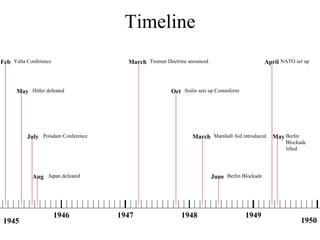
Timeline 1946 1947 1948 1949 1950 1945 Feb May July March Oct March April May Yalta Conference Hitler defeated Potsdam Conference Truman Doctrine anounced Stalin sets up Cominform June Marshall Aid introduced Berlin Blockade NATO set up Berlin Blockade lifted Aug Japan defeated
Yalta Conference, February 1945 Big 3 met in Yalta, Ukraine (USSR) to plan for post-war Europe Conference went well Despite differences, agreement reached on some important matters So what message is FDR trying to make in his speech?  In no less than 25 words identify that message FDR’s speech to a Joint Session of Congress upon his return from Yalta, Russia
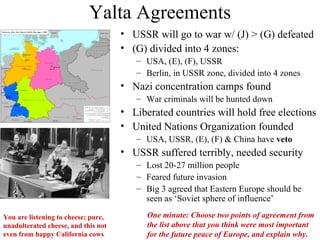
Yalta Agreements USSR will go to war w/ (J) > (G) defeated (G) divided into 4 zones: USA, (E), (F), USSR Berlin, in USSR zone, divided into 4 zones Nazi concentration camps found War criminals will be hunted down Liberated countries will hold free elections United Nations Organization founded USA, USSR, (E), (F) & China have  veto USSR suffered terribly, needed security Lost 20-27 million people Feared future invasion Big 3 agreed that Eastern Europe should be seen as ‘Soviet sphere of influence’ You are listening to cheese; pure, unadulterated cheese, and this not even from happy California cows One minute: Choose two points of agreement from the list above that you think were most important for the future peace of Europe, and explain why.
Yalta Disagreement Stalin wanted Polish border moved westward, expanding Soviet territory S wanted land (P) took in 1921 returned S wanted some (G) territory given to (P) Churchill & FDR didn’t like idea Could do little, as USSR controlled area Churchill, FDR make deal w/ Stalin They will not resist S’s taking (P) territory if S did not interfere w/ (E)’s attempt to put down Communist revolt in Greece S accepted this as  realpolitik S also liked precedent of major power establishing a friendly gov’t S could claim same privilege in E Europe
Focus Task: What was going on behind the scenes at Yalta? I want to drink to our alliance, that it should not lose its … intimacy, its free expression of views … I know of no such close alliance of three Great Powers as this  … May it be strong and stable, may we be as frank as possible - Stalin, proposing a toast at a dinner at the Yalta conference, 1945 As members of a three-person OSS team of secret agents (OSS is the predecessor of the CIA) you have ‘come into possession’ of secret documents relating to the Yalta Conference. The war against Hitler had united Roosevelt, Stalin and Churchill and at the Yalta Conference they appeared to get on well.  The above quote illustrates the ‘public’ face of Yalta.  But what was going on behind the scenes? Examine the quotes on the handouts and decide for yourself. -Use a table like the above to analyze the sources. - The value & limitations are from the perspective of a historian  researching the level of trust between the ‘Big Three’ at Yalta Limitations Value Purpose Origin
PSDs for Yalta Conference  Perhaps you think that just because we are the allies of the English we have forgotten who they are and who Churchill is.  There’s nothing they like better than to trick their allies.  During the first World War they constantly tricked the Russians and the French.  And Churchill?  Churchill is the kind of man who will pick your pocket of a kopeck [penny]!  And Roosevelt?  Roosevelt is not like that.  He dips in his hand only for bigger coins.  But Churchill?  He will do it for a kopeck. Stalin speaking to a fellow Communist, Milovan Djilas, in 1945.  Djilas was a supporter of Stalin In the hallway [at Yalta] we stopped before a map of the world  on which the Soviet Union was colored in red.  Stalin waved his hand over the Soviet Union and exclaimed, ‘They [Roosevelt and Churchill] will never accept the idea that so great a space should be red, never, never!’ Milovan Djilas, writing about Yalta in 1948
PSDs for Yalta Conference Once, Churchill asked Stalin to send him the music of the new Soviet Russian anthem so that it could be broadcast before the summary of the news from the Soviet German front.  Stalin sent the words [as well] and expressed the hope that Churchill would set about learning the new tune and whistling it to members of the conservative Party.  While Stalin behaved with relative discretion with Roosevelt, he continually teased Churchill throughout the war. Written by Soviet historian Sergei Kudryashov after the war The Soviet Union has become a danger to the free world.  A new front must be created against her onward sweep.  This front should be as far east as possible.  A settlement must be reached on all major issues between West and East in Europe before the armies of democracy melt away. Churchill writing to Roosevelt shortly after the Yalta Conference
PSDs for Yalta Conference  [At Yalta] Churchill feared that Roosevelt was too pro-Russian.  He pressed for a French zone to be added to the other three to add another anti-Russian voice to the armies of occupation. Written by Christopher Culpin in a school textbook,  The Modern World , 1984 A Soviet cartoon published in  Provda  (‘Truth’), the primary Soviet newspaper.  Churchill is shown with two flags, the first proclaiming that ‘Anglo-Saxons must rule the world’ and the other threatening an ‘iron curtain’.
PSDs for Yalta Conference  One could see that Churchill had left a deep impression on the Soviet leaders as a farsighted and dangerous statesman – although they did not like him. Milovan Djilas comments, in 1948, on Stalin’s assessment of Churchill [In May 1945] Churchill ordered Montgomery to keep the German arms intact, in case they had to be used against the Russians. Written by historian Hugh Higgins in  The Cold War , 1974 One night Stalin stung Churchill when proposing a toast by reminding Churchill of his failures at Gallipoli in the First World War.  Another night Churchill declared (whilst slightly drunk) that he deserved a medal for teaching the Soviet army to fight so well through the intervention at Archangel. The Soviet Foreign Minister Molotov writing about Yalta.  In 1915 Churchill had been responsible for a failed attack at Gallipoli.  In 1918 Churchill had supported the British decision to send troops to Archangel to help in the fight against the Communists in the Russian Civil War
Activity: BBC World Service Reporting Work in pairs Role-play being two investigative journalists for the British Broadcasting Company, one from 1945, just after the Yalta conference, and one from today, having just uncovered the primary sources on your handout. Together, produce a press release from the Yalta Conference to be sent to newspapers in Britain in 1945 for public consumption (remember, censorship!). Then, produce a press release for today. Be prepared to present the results of your work in a “that was then, this is now” format.
Fin

Cld War01 Beginnings Web

  • 1.
    Beginnings of theCold War: 1945 - 1949
  • 2.
    Focus: Who wasto blame? Read, don’t write: In May 1945 American troops entered Berlin from the west, as Russian troops moved in from the east. They met and celebrated victory together. Yet three years later these former allies were arguing over Berlin and war between them seemed a real possibility. What had gone wrong? In this unit you will consider: How the wartime alliance between the USA & the USSR broke down How the Soviet Union gained control over eastern Europe & how the USA responded The consequences of the Berlin Blockade of 1948 Finally, you will make up your own mind as to whether the USA or the USSR was more to blame for the outbreak of the Cold War
  • 3.
    Timeline 1946 19471948 1949 1950 1945 Feb May July March Oct March April May Yalta Conference Hitler defeated Potsdam Conference Truman Doctrine anounced Stalin sets up Cominform June Marshall Aid introduced Berlin Blockade NATO set up Berlin Blockade lifted Aug Japan defeated
  • 4.
    Yalta Conference, February1945 Big 3 met in Yalta, Ukraine (USSR) to plan for post-war Europe Conference went well Despite differences, agreement reached on some important matters So what message is FDR trying to make in his speech? In no less than 25 words identify that message FDR’s speech to a Joint Session of Congress upon his return from Yalta, Russia
  • 5.
    Yalta Agreements USSRwill go to war w/ (J) > (G) defeated (G) divided into 4 zones: USA, (E), (F), USSR Berlin, in USSR zone, divided into 4 zones Nazi concentration camps found War criminals will be hunted down Liberated countries will hold free elections United Nations Organization founded USA, USSR, (E), (F) & China have veto USSR suffered terribly, needed security Lost 20-27 million people Feared future invasion Big 3 agreed that Eastern Europe should be seen as ‘Soviet sphere of influence’ You are listening to cheese; pure, unadulterated cheese, and this not even from happy California cows One minute: Choose two points of agreement from the list above that you think were most important for the future peace of Europe, and explain why.
  • 6.
    Yalta Disagreement Stalinwanted Polish border moved westward, expanding Soviet territory S wanted land (P) took in 1921 returned S wanted some (G) territory given to (P) Churchill & FDR didn’t like idea Could do little, as USSR controlled area Churchill, FDR make deal w/ Stalin They will not resist S’s taking (P) territory if S did not interfere w/ (E)’s attempt to put down Communist revolt in Greece S accepted this as realpolitik S also liked precedent of major power establishing a friendly gov’t S could claim same privilege in E Europe
  • 7.
    Focus Task: Whatwas going on behind the scenes at Yalta? I want to drink to our alliance, that it should not lose its … intimacy, its free expression of views … I know of no such close alliance of three Great Powers as this … May it be strong and stable, may we be as frank as possible - Stalin, proposing a toast at a dinner at the Yalta conference, 1945 As members of a three-person OSS team of secret agents (OSS is the predecessor of the CIA) you have ‘come into possession’ of secret documents relating to the Yalta Conference. The war against Hitler had united Roosevelt, Stalin and Churchill and at the Yalta Conference they appeared to get on well. The above quote illustrates the ‘public’ face of Yalta. But what was going on behind the scenes? Examine the quotes on the handouts and decide for yourself. -Use a table like the above to analyze the sources. - The value & limitations are from the perspective of a historian researching the level of trust between the ‘Big Three’ at Yalta Limitations Value Purpose Origin
  • 8.
    PSDs for YaltaConference Perhaps you think that just because we are the allies of the English we have forgotten who they are and who Churchill is. There’s nothing they like better than to trick their allies. During the first World War they constantly tricked the Russians and the French. And Churchill? Churchill is the kind of man who will pick your pocket of a kopeck [penny]! And Roosevelt? Roosevelt is not like that. He dips in his hand only for bigger coins. But Churchill? He will do it for a kopeck. Stalin speaking to a fellow Communist, Milovan Djilas, in 1945. Djilas was a supporter of Stalin In the hallway [at Yalta] we stopped before a map of the world on which the Soviet Union was colored in red. Stalin waved his hand over the Soviet Union and exclaimed, ‘They [Roosevelt and Churchill] will never accept the idea that so great a space should be red, never, never!’ Milovan Djilas, writing about Yalta in 1948
  • 9.
    PSDs for YaltaConference Once, Churchill asked Stalin to send him the music of the new Soviet Russian anthem so that it could be broadcast before the summary of the news from the Soviet German front. Stalin sent the words [as well] and expressed the hope that Churchill would set about learning the new tune and whistling it to members of the conservative Party. While Stalin behaved with relative discretion with Roosevelt, he continually teased Churchill throughout the war. Written by Soviet historian Sergei Kudryashov after the war The Soviet Union has become a danger to the free world. A new front must be created against her onward sweep. This front should be as far east as possible. A settlement must be reached on all major issues between West and East in Europe before the armies of democracy melt away. Churchill writing to Roosevelt shortly after the Yalta Conference
  • 10.
    PSDs for YaltaConference [At Yalta] Churchill feared that Roosevelt was too pro-Russian. He pressed for a French zone to be added to the other three to add another anti-Russian voice to the armies of occupation. Written by Christopher Culpin in a school textbook, The Modern World , 1984 A Soviet cartoon published in Provda (‘Truth’), the primary Soviet newspaper. Churchill is shown with two flags, the first proclaiming that ‘Anglo-Saxons must rule the world’ and the other threatening an ‘iron curtain’.
  • 11.
    PSDs for YaltaConference One could see that Churchill had left a deep impression on the Soviet leaders as a farsighted and dangerous statesman – although they did not like him. Milovan Djilas comments, in 1948, on Stalin’s assessment of Churchill [In May 1945] Churchill ordered Montgomery to keep the German arms intact, in case they had to be used against the Russians. Written by historian Hugh Higgins in The Cold War , 1974 One night Stalin stung Churchill when proposing a toast by reminding Churchill of his failures at Gallipoli in the First World War. Another night Churchill declared (whilst slightly drunk) that he deserved a medal for teaching the Soviet army to fight so well through the intervention at Archangel. The Soviet Foreign Minister Molotov writing about Yalta. In 1915 Churchill had been responsible for a failed attack at Gallipoli. In 1918 Churchill had supported the British decision to send troops to Archangel to help in the fight against the Communists in the Russian Civil War
  • 12.
    Activity: BBC WorldService Reporting Work in pairs Role-play being two investigative journalists for the British Broadcasting Company, one from 1945, just after the Yalta conference, and one from today, having just uncovered the primary sources on your handout. Together, produce a press release from the Yalta Conference to be sent to newspapers in Britain in 1945 for public consumption (remember, censorship!). Then, produce a press release for today. Be prepared to present the results of your work in a “that was then, this is now” format.
  • 13.