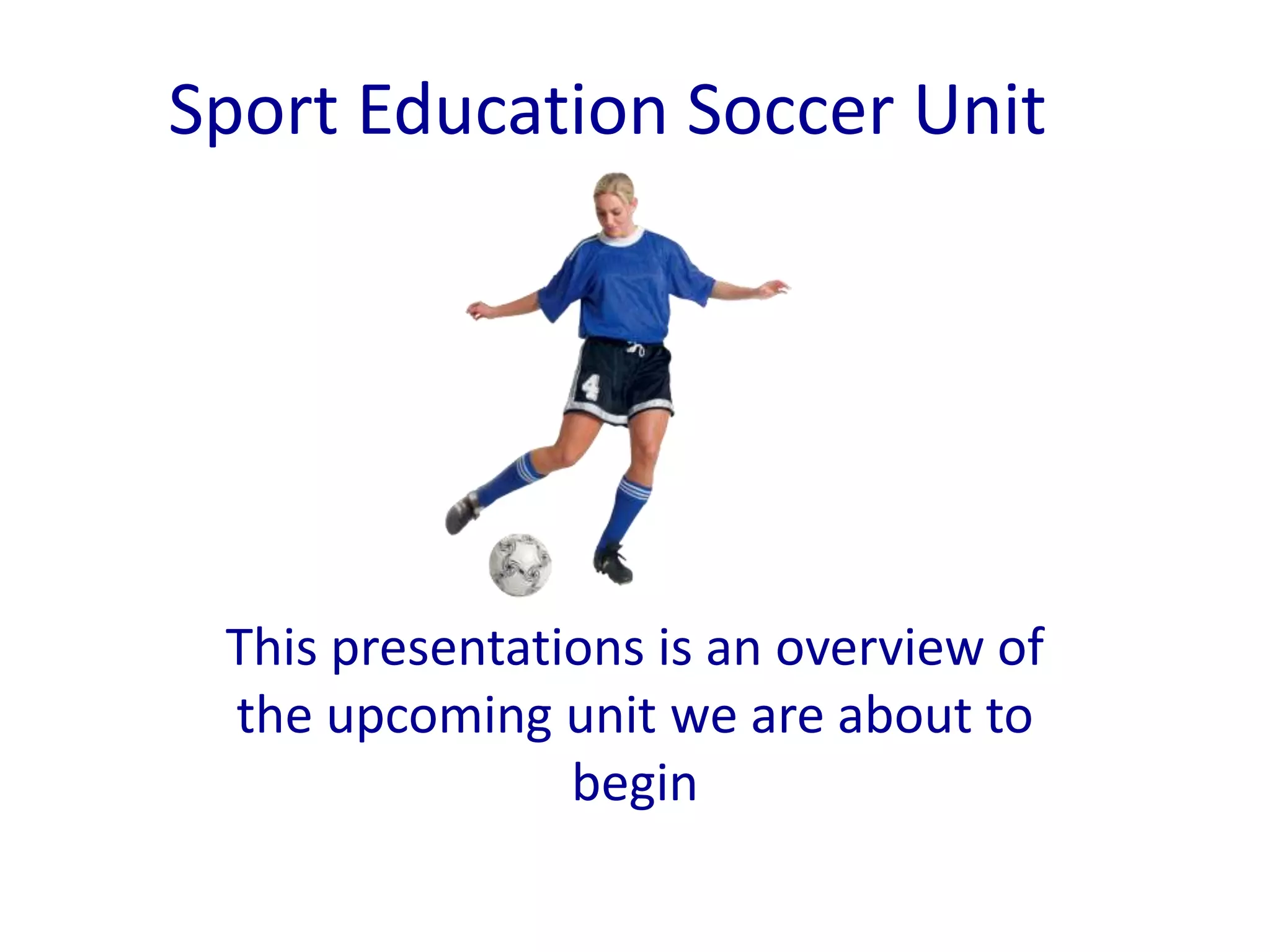
Sport Education Soccer Unit


 This presentations is an overview of
 the upcoming unit we are about to
                begin
Sport Education Unit
•   Sport education is a fairly new curriculum in the world of physical education.
•   The goal of sport education is for students to be players in the fullest sense
    and to help them develop as competent, literate, and enthusiastic
    sportspersons.
•   Objectives throughout this curriculum include.
•   Develop sport specific techniques and fitness
•   Appreciate and be able to execute sport specific strategic play
•   Participate at a developmentally appropriate level
•   Share planning and administration of sport experiences
•   Provide responsible leadership
•   Work effectively with your team to pursue common goals
•   Appreciate the rituals and conventions that give sports their unique meanings
•   Develop the capacity to make reasoned decisions about sport concerns
•   Develop and apply knowledge about umpiring , refereeing, and training
•   Become involved with sport and physical activity outside of school
Student Roles and Participation
• In our class we are going to be playing soccer for our sport.
• Students will be divide into small teams, no more than 7 per team.
• Each member of the team will have a role and be expected to fulfill it (ex.
  Captain, warm up leader, statistician, scout, reporter, coach,Trainer )
• Each students will be expected to referee a game at some point during the
  season
• Fair play points are awarded to teams that do not argue with officials
• Teams are responsible for recording their results after each game on their
  team poster
• The deeper into the season the students become more in charge, while
  the teacher takes a step back.
• Students are responsible for being on time for games and getting the
  proper equipment everyday before class.
Teacher Role
In the sport education model, teachers shift from
teacher centered to student centered instruction.
Teachers must establish strong managerial system with
rules, routines, and expectorations.
Teacher then has time to instruct, facilitate, and
assess student learning more effectively.
Benefits of a Sport Education Unit

• In sport education all students participate equally at all points in the
  season. Sport education has no first strings, and no substitutes, all
  participants get equal playing time.
• Students learn diverse roles that take place on a team and in the sport.
• Sport Education uses small sided teams so that students get considerably
  more opportunities to learn the techniques and tactics needed to play the
  game well.
• Most of the activities are modified to enable students to have success,
  particularly in the number of players per side and the modification of the
  activities themselves.
• In sport education the primary rules are always protected, while some
  secondary rules may be modified for early success.
Contact Information
•   Email wjmoore1@crimson.ua.edu
•   Skype willmoore43
•   Phone 555-555-5555
•   Website wdheducators.com

Classroom newsletter

  • 1.
    Sport Education SoccerUnit This presentations is an overview of the upcoming unit we are about to begin
  • 2.
    Sport Education Unit • Sport education is a fairly new curriculum in the world of physical education. • The goal of sport education is for students to be players in the fullest sense and to help them develop as competent, literate, and enthusiastic sportspersons. • Objectives throughout this curriculum include. • Develop sport specific techniques and fitness • Appreciate and be able to execute sport specific strategic play • Participate at a developmentally appropriate level • Share planning and administration of sport experiences • Provide responsible leadership • Work effectively with your team to pursue common goals • Appreciate the rituals and conventions that give sports their unique meanings • Develop the capacity to make reasoned decisions about sport concerns • Develop and apply knowledge about umpiring , refereeing, and training • Become involved with sport and physical activity outside of school
  • 3.
    Student Roles andParticipation • In our class we are going to be playing soccer for our sport. • Students will be divide into small teams, no more than 7 per team. • Each member of the team will have a role and be expected to fulfill it (ex. Captain, warm up leader, statistician, scout, reporter, coach,Trainer ) • Each students will be expected to referee a game at some point during the season • Fair play points are awarded to teams that do not argue with officials • Teams are responsible for recording their results after each game on their team poster • The deeper into the season the students become more in charge, while the teacher takes a step back. • Students are responsible for being on time for games and getting the proper equipment everyday before class.
  • 4.
    Teacher Role In thesport education model, teachers shift from teacher centered to student centered instruction. Teachers must establish strong managerial system with rules, routines, and expectorations. Teacher then has time to instruct, facilitate, and assess student learning more effectively.
  • 5.
    Benefits of aSport Education Unit • In sport education all students participate equally at all points in the season. Sport education has no first strings, and no substitutes, all participants get equal playing time. • Students learn diverse roles that take place on a team and in the sport. • Sport Education uses small sided teams so that students get considerably more opportunities to learn the techniques and tactics needed to play the game well. • Most of the activities are modified to enable students to have success, particularly in the number of players per side and the modification of the activities themselves. • In sport education the primary rules are always protected, while some secondary rules may be modified for early success.
  • 6.
    Contact Information • Email wjmoore1@crimson.ua.edu • Skype willmoore43 • Phone 555-555-5555 • Website wdheducators.com