Components of a behavior
management plan
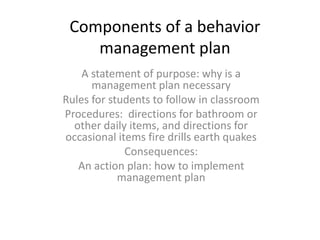
A statement of purpose: why is a
management plan necessary
Rules for students to follow in classroom
Procedures: directions for bathroom or
other daily items, and directions for
occasional items fire drills earth quakes
Consequences:
An action plan: how to implement
management plan
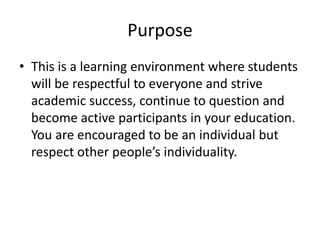
Purpose
• This is a learning environment where students
will be respectful to everyone and strive
academic success, continue to question and
become active participants in your education.
You are encouraged to be an individual but
respect other people’s individuality.
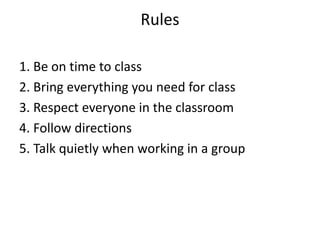
Rules
1. Be on time to class
2. Bring everything you need for class
3. Respect everyone in the classroom
4. Follow directions
5. Talk quietly when working in a group
Procedures
• Arrival
• Cell phones
• Late/Tardy
• Bathroom
• Water bottles/Gum
• Fire alarms
• Earth quake
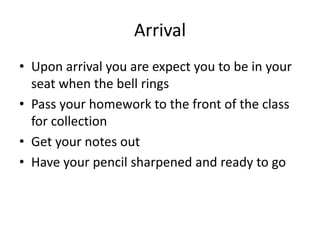
Arrival
• Upon arrival you are expect you to be in your
seat when the bell rings
• Pass your homework to the front of the class
for collection
• Get your notes out
• Have your pencil sharpened and ready to go
Cell phones
• Phones are not to be out in class unless
required for an assignment and only during
the assignment
• Phones will be taken for the day if not being
used for school work and the appropriate
consequence will be given
Late/Tardy
• Come into the room quietly and sit down
• Pull out your notes
• Be prepared to ask what you missed at the
end of class
Bathroom
• Ask to use the restroom
• Sign out on the sheet by the door
• Go to the bathroom
• Upon returning sign back in
• Return to your seat quietly
Water bottles/Food
• You may bring water to drink from (only
water)
• The bottle must have a lid
• There will be no food in the classroom unless
permission is given
Fire alarms
• Look up some standard procedures
• Note this will vary depending on the school
Earth quake
• Look up some standard procedures
• Note this will vary depending on the school
Needs of younger Students
• Determine/research what younger students
need
Needs of older Students
• Determine/research what older students need
Consequences
• Positive
• Negative
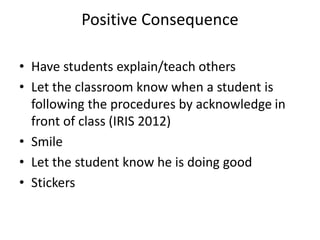
Positive Consequence
• Have students explain/teach others
• Let the classroom know when a student is
following the procedures by acknowledge in
front of class (IRIS 2012)
• Smile
• Let the student know he is doing good
• Stickers
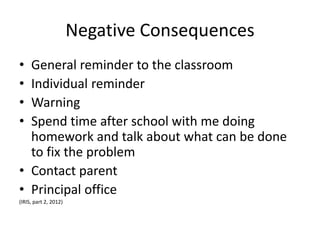
Negative Consequences
• General reminder to the classroom
• Individual reminder
• Warning
• Spend time after school with me doing
homework and talk about what can be done
to fix the problem
• Contact parent
• Principal office
(IRIS, part 2, 2012)
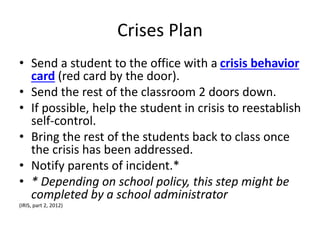
Crises Plan
• Send a student to the office with a crisis behavior
card (red card by the door).
• Send the rest of the classroom 2 doors down.
• If possible, help the student in crisis to reestablish
self-control.
• Bring the rest of the students back to class once
the crisis has been addressed.
• Notify parents of incident.*
• * Depending on school policy, this step might be
completed by a school administrator
(IRIS, part 2, 2012)
Action Plan
• Develop a tool kit
• Teach the plan to the students
• Share the plan with others – parents,
administrators, substitute, coworkers
• Review the plan regularly
Sharing the action plan with Peers
• Give a copy of my rules and procedures to co-
workers
• Make sure management has a copy
• Make a folder for substitute and leave a copy
inside.
• More information might be included then in
the student packet
• Research more ideas
Action Plan teach students
• Make a hand out at the beginning of the year
with the information
• Make a classroom poster with the rules
• Make a poster with everyday classroom
procedures
• Research more ideas
Action Plan share with Parents
• research ideas on how best to let parents
know about the plan
• Any ideas?
Action Plan Review
• Slide 12 and research ideas
References
• The IRIS Center for Training Enhancements.
(2012). Classroom management (Part 1):
Learning the components of a comprehensive
behavior management plan. Retrieved from
http://iris.peabody.vanderbilt.edu/module/beh1/
• The IRIS Center for Training Enhancements.
(2012). Classroom management (Part 2):
Developing Your Own Comprehensive Behavior
Management Plan. Retrieved from
http://iris.peabody.vanderbilt.edu/module/beh1/

Classroom management plan

  • 1.
    Components of abehavior management plan A statement of purpose: why is a management plan necessary Rules for students to follow in classroom Procedures: directions for bathroom or other daily items, and directions for occasional items fire drills earth quakes Consequences: An action plan: how to implement management plan
  • 2.
    Purpose • This isa learning environment where students will be respectful to everyone and strive academic success, continue to question and become active participants in your education. You are encouraged to be an individual but respect other people’s individuality.
  • 3.
    Rules 1. Be ontime to class 2. Bring everything you need for class 3. Respect everyone in the classroom 4. Follow directions 5. Talk quietly when working in a group
  • 4.
    Procedures • Arrival • Cellphones • Late/Tardy • Bathroom • Water bottles/Gum • Fire alarms • Earth quake
  • 5.
    Arrival • Upon arrivalyou are expect you to be in your seat when the bell rings • Pass your homework to the front of the class for collection • Get your notes out • Have your pencil sharpened and ready to go
  • 6.
    Cell phones • Phonesare not to be out in class unless required for an assignment and only during the assignment • Phones will be taken for the day if not being used for school work and the appropriate consequence will be given
  • 7.
    Late/Tardy • Come intothe room quietly and sit down • Pull out your notes • Be prepared to ask what you missed at the end of class
  • 8.
    Bathroom • Ask touse the restroom • Sign out on the sheet by the door • Go to the bathroom • Upon returning sign back in • Return to your seat quietly
  • 9.
    Water bottles/Food • Youmay bring water to drink from (only water) • The bottle must have a lid • There will be no food in the classroom unless permission is given
  • 10.
    Fire alarms • Lookup some standard procedures • Note this will vary depending on the school
  • 11.
    Earth quake • Lookup some standard procedures • Note this will vary depending on the school
  • 12.
    Needs of youngerStudents • Determine/research what younger students need
  • 13.
    Needs of olderStudents • Determine/research what older students need
  • 14.
  • 15.
    Positive Consequence • Havestudents explain/teach others • Let the classroom know when a student is following the procedures by acknowledge in front of class (IRIS 2012) • Smile • Let the student know he is doing good • Stickers
  • 16.
    Negative Consequences • Generalreminder to the classroom • Individual reminder • Warning • Spend time after school with me doing homework and talk about what can be done to fix the problem • Contact parent • Principal office (IRIS, part 2, 2012)
  • 17.
    Crises Plan • Senda student to the office with a crisis behavior card (red card by the door). • Send the rest of the classroom 2 doors down. • If possible, help the student in crisis to reestablish self-control. • Bring the rest of the students back to class once the crisis has been addressed. • Notify parents of incident.* • * Depending on school policy, this step might be completed by a school administrator (IRIS, part 2, 2012)
  • 18.
    Action Plan • Developa tool kit • Teach the plan to the students • Share the plan with others – parents, administrators, substitute, coworkers • Review the plan regularly
  • 19.
    Sharing the actionplan with Peers • Give a copy of my rules and procedures to co- workers • Make sure management has a copy • Make a folder for substitute and leave a copy inside. • More information might be included then in the student packet • Research more ideas
  • 20.
    Action Plan teachstudents • Make a hand out at the beginning of the year with the information • Make a classroom poster with the rules • Make a poster with everyday classroom procedures • Research more ideas
  • 21.
    Action Plan sharewith Parents • research ideas on how best to let parents know about the plan • Any ideas?
  • 22.
    Action Plan Review •Slide 12 and research ideas
  • 23.
    References • The IRISCenter for Training Enhancements. (2012). Classroom management (Part 1): Learning the components of a comprehensive behavior management plan. Retrieved from http://iris.peabody.vanderbilt.edu/module/beh1/ • The IRIS Center for Training Enhancements. (2012). Classroom management (Part 2): Developing Your Own Comprehensive Behavior Management Plan. Retrieved from http://iris.peabody.vanderbilt.edu/module/beh1/