Week 6 Discussion
Presentation
Classroom Environment
The effects it has on a child’s behavior
Intro
The following presentation will be discussing the effects a classroom
environment has on a child’s behavior. I will be using three sources to further
elaborate on my claim. Throughout the discussion, I hope you will gain better
knowledge and ideas on how to improve your classroom space.
Clear Pathways
http://www.earlychildhoodnews.com/earlyc
hildhood/article_view.aspx?ArticleID=413
Each classroom should have a clear pathway
that leads to an area of play. There should be
little to no obstructed in the opening of the area.
This promotes that the child can “do it
themselves”, which allows the teacher to tend to
others areas if needed.
According to the site Early Childhood News it
states, “These include dead spaces that
encourage wandering and unruly behavior, and
pathways that lead nowhere or interfere with
play already in progress. When space is poorly
organized, children depend on the teacher for
guidance and the teacher's behavior becomes
directive.” In the beginning of the year, the
children may be very dependent on the teacher
especially for those who are “first year”.
However, the goal is for the children to be self-
dependent.
Classroom Acoustics
https://www.kaplanco.com/ii/presch
ool-classroom-layout-tips
The classroom acoustics or volume
can have a dramatic affect on the
classroom and how the children focus.
As a teacher, it is best to consider
which areas will be put near each
other and how they will affect one
another. For example, according to the
Kaplan website, “Try to keep spaces
with a low noise level placed together
and separate from spaces that tend to
have a high noise level”. Try not to put
the library area next to the block area
as it may promote more noise in the
quieter area than intended. A
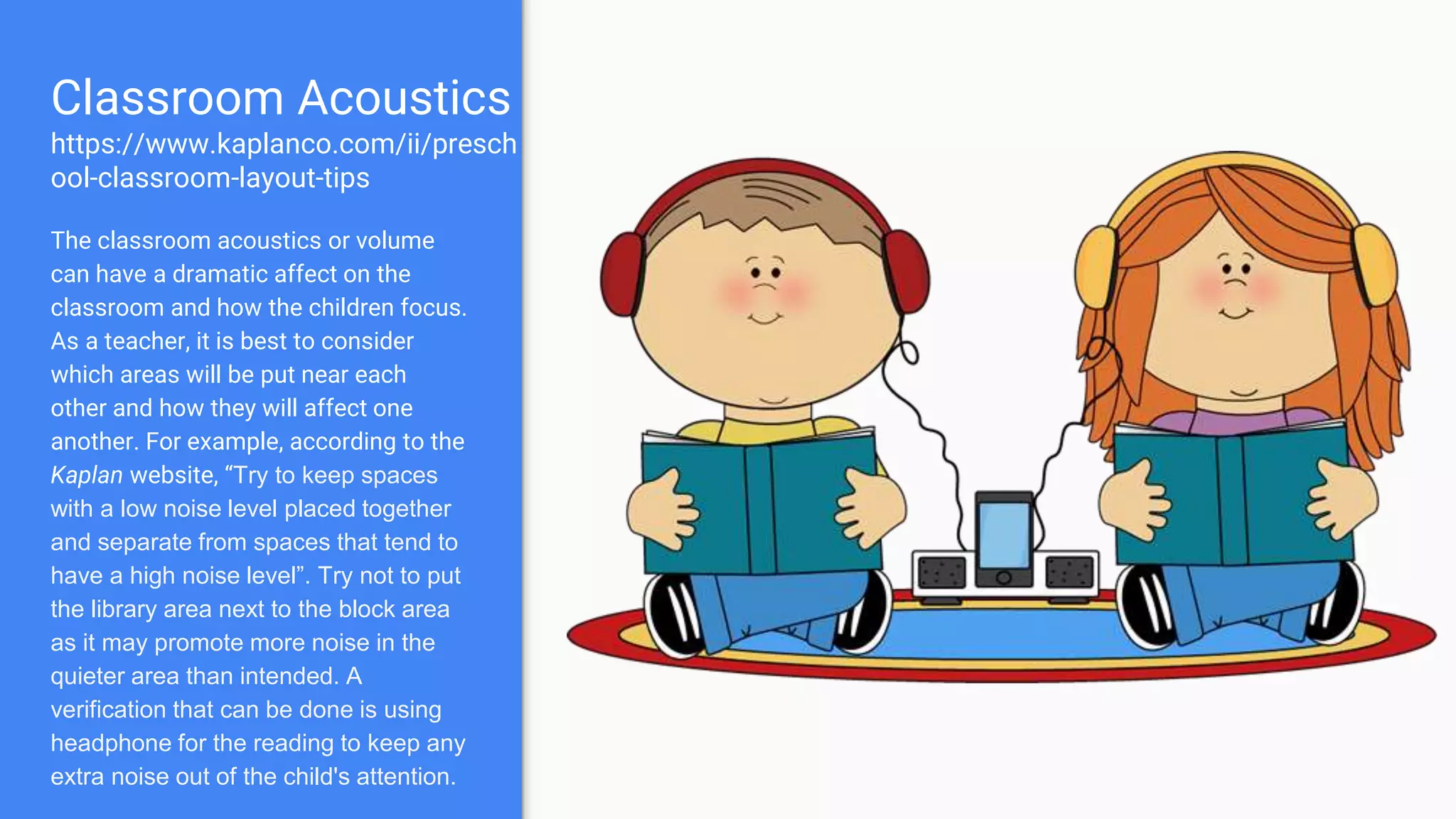
verification that can be done is using
headphone for the reading to keep any
extra noise out of the child's attention.
Limit Excessive Wall Displays
https://www2.ed.gov/teachers/how/early/teachingouryoungest/page_pg4.html
The classroom walls should not be filled with too many displays which can
cause noise that may interfere with the child’s focus. As it was mentioned by
the U.S. Department of Education, She displays many examples of printed
materials, yet she does not display excessive print or print that is not
meaningful. The children are able to see labels, signs, and printed directions in
the places that count”. With less materials on the walls to distract the
classroom attention and focus on the activity. However, this is not to say that
the classroom walls should be bare but rather have the walls covered in the
children work. In my classroom we display the children’s work based on the
activities done for that “study”. Once the study is complete, we remove the
work and leave the walls bare to later be filled with work from the new study.
Final point
A classroom is not just a room
the children spend their day in
but it is the solid grounds where
the children will learn and grow.
Each area will affect these
children which is why it is very
important to provide a safe and
appropriate environment for
them to thrive in.
“A teacher is a compass that activates the magnets of
curiosity, knowledge, and wisdom in the pupils.”
- Ever Garrison
The main point to take away from this presentation is:
to remember that children are sponges, which is why it is important to provide them
with the knowledge and tools to develop successfully.
References
Earlychildhood NEWS - Article
Reading Center. (n.d.). Retrieved
February 17, 2017, from
http://www.earlychildhoodnews.com/e
arlychildhood/article_view.aspx?Article
ID=413
How to Plan a Great Classroom
Layout (Preschool Edition). (2017).
Retrieved February 17, 2017, from
https://www.kaplanco.com/ii/preschool
-classroom-layout-tips
Schickendanz, J. (2007, August 31).
Teaching Our Youngest: A Guide for
Preschool Teachers & Child Care &
Family Providers - Index-- Pg 4.
Retrieved February 17, 2017, from
https://www2.ed.gov/teachers/how/earl
y/teachingouryoungest/page_pg4.html

Classroom Environment and its effects on a child's development

  • 1.
  • 2.
    Classroom Environment The effectsit has on a child’s behavior
  • 3.
    Intro The following presentationwill be discussing the effects a classroom environment has on a child’s behavior. I will be using three sources to further elaborate on my claim. Throughout the discussion, I hope you will gain better knowledge and ideas on how to improve your classroom space.
  • 4.
    Clear Pathways http://www.earlychildhoodnews.com/earlyc hildhood/article_view.aspx?ArticleID=413 Each classroomshould have a clear pathway that leads to an area of play. There should be little to no obstructed in the opening of the area. This promotes that the child can “do it themselves”, which allows the teacher to tend to others areas if needed. According to the site Early Childhood News it states, “These include dead spaces that encourage wandering and unruly behavior, and pathways that lead nowhere or interfere with play already in progress. When space is poorly organized, children depend on the teacher for guidance and the teacher's behavior becomes directive.” In the beginning of the year, the children may be very dependent on the teacher especially for those who are “first year”. However, the goal is for the children to be self- dependent.
  • 5.
    Classroom Acoustics https://www.kaplanco.com/ii/presch ool-classroom-layout-tips The classroomacoustics or volume can have a dramatic affect on the classroom and how the children focus. As a teacher, it is best to consider which areas will be put near each other and how they will affect one another. For example, according to the Kaplan website, “Try to keep spaces with a low noise level placed together and separate from spaces that tend to have a high noise level”. Try not to put the library area next to the block area as it may promote more noise in the quieter area than intended. A verification that can be done is using headphone for the reading to keep any extra noise out of the child's attention.
  • 6.
    Limit Excessive WallDisplays https://www2.ed.gov/teachers/how/early/teachingouryoungest/page_pg4.html The classroom walls should not be filled with too many displays which can cause noise that may interfere with the child’s focus. As it was mentioned by the U.S. Department of Education, She displays many examples of printed materials, yet she does not display excessive print or print that is not meaningful. The children are able to see labels, signs, and printed directions in the places that count”. With less materials on the walls to distract the classroom attention and focus on the activity. However, this is not to say that the classroom walls should be bare but rather have the walls covered in the children work. In my classroom we display the children’s work based on the activities done for that “study”. Once the study is complete, we remove the work and leave the walls bare to later be filled with work from the new study.
  • 7.
    Final point A classroomis not just a room the children spend their day in but it is the solid grounds where the children will learn and grow. Each area will affect these children which is why it is very important to provide a safe and appropriate environment for them to thrive in.
  • 8.
    “A teacher isa compass that activates the magnets of curiosity, knowledge, and wisdom in the pupils.” - Ever Garrison
  • 9.
    The main pointto take away from this presentation is: to remember that children are sponges, which is why it is important to provide them with the knowledge and tools to develop successfully.
  • 10.
    References Earlychildhood NEWS -Article Reading Center. (n.d.). Retrieved February 17, 2017, from http://www.earlychildhoodnews.com/e arlychildhood/article_view.aspx?Article ID=413 How to Plan a Great Classroom Layout (Preschool Edition). (2017). Retrieved February 17, 2017, from https://www.kaplanco.com/ii/preschool -classroom-layout-tips Schickendanz, J. (2007, August 31). Teaching Our Youngest: A Guide for Preschool Teachers & Child Care & Family Providers - Index-- Pg 4. Retrieved February 17, 2017, from https://www2.ed.gov/teachers/how/earl y/teachingouryoungest/page_pg4.html