Classroom Interaction
Sinclair Model
• Medleyand Mitzel(1963),Biddle(1967), Meux(1967)Weick(1968)
have vast literature and comprehensive reviews on one type of
verbal interaction between teachers and pupils. Naturally, such
studies have educational priorities but none is concerned with
simply observing the interaction and describing its linguistic
structure, turn-taking system, or productive, interpretive and
sequencing rules.
Studies of Gallagher and Aschner(1963) and Taba
et.al (1964) concerned with the levels of thinking,
produce an analysis in terms of abstract categories
several stages removed from the linguistics data.
There are , however, three descriptive system which
do attend closely to the linguistic data ---Barnes
(1969), Flanders (1970) and Bellack et al (1966), Barns
has two major educational tenets: that pupils should
be encouraged to participate and draw on their own
knowledge and experience as much as possible, and
that teachers’ questioning
Should be more concerned with stimulating
thinking than eliciting factual information.
Two aspects of the interaction
a. Pupils participation
b. Teachers' questioning
Four categories of teachers’ questioning
> factual, reasoning (open and closed), other open
questions (not requiring reasoning), social.
Classroom as a structured activity
Flanders (1970 teacher talks are structured Asking Questions, Giving Directions, Accepting
Feeling, and so on
Bellack and his colleagues (1966) conceive hirerarchy terms of nature classroom as
game,sub-game, cycle and move (adopted by Sinclair and Coulthard). A move could be one of
four types: Soliciting, in which responses (verbal or non-verbal) were actively sought by the
person doing the soliciting; Responding, involving some reciprocal relation to the Soliciting
move; Structuring, in which pedagogical activity was set in train, either by initiating some
course of action or by excluding others; and finally Reacting, where this was a move
undertaken in reaction to any of the others.
Sinclair and Coulthard : Lesson, Transaction, Exchange, Move and Act . Moves they
identified: the so-called Initiation, Response, Feedback move, known as the IRF, or
sometimes,following a similar description in Mehan's work (1979) as the Initiation, Response,
Evaluation move, the IRE.
Sinclair Model
• Sinclair purposed five ranks to handle the structure of classroom
interaction:
1. Lesson
2. Transaction
3. Exchange
4. Move
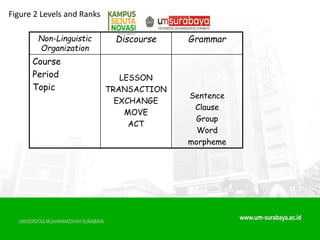
Figure 2 Levels and Ranks
Non-Linguistic
Organization
Discourse Grammar
Course
Period
Topic
LESSON
TRANSACTION
EXCHANGE
MOVE
ACT
Sentence
Clause
Group
Word
morpheme
• Informing, directing, and eliciting exchanges are concerned with what
is more commonly know as stating, commanding, questioning
behavior.
• The structure of exchanges are expressed in the terms of moves
• A three moves structured was proposed for exchanges Initiation,
Response, Follow-up
Discourse Structure
• Transaction : have structure, expressed in terms of exchanges
• Acts are speech acts
Verbal interaction inside the classroom differs markedly
from desultory conversation in that its main purpose is to
instruct and inform and this difference is reflected in the
structure of the discourse.
In conversation, topic changes are unpredictable and
uncontrollable.
Inside the classroom it is one of the functions of the
teacher to choose the topic, decide how it will be
subdivided into smaller units and cope with digressions
and misunderstanding
Transactions have a structure expressed in terms of exchanges—they
begin with a boundary exchange, which consists of a frame and/ or
focus and then followed by a succession of informing-stating,
directing-commanding, or eliciting exchanges- questioning.
The structure of exchanges is expressed in terms of moves.
Discourse Structure
• The boundaries of transactions are tipically marked by frames whose
realization at the level of form is limited five words : Ok, well, now,
right, good, uttered with strong stress high falling intonation and
followed by a short pause.
• A frame indicating the beginning of transaction with a focus
Frame: well
Focus : today I tought we’d do three quizzes
• End : transaction with another focus summarizing the transaction
Focus : what we have done is given some energy to this pen
Frame : now
Transaction have a structure expressed in terms of exchanges-they
begin and often with a boundary exchange, which consists of a frame
and/or a focus followed by a succession of informing, directing, or
eliciting exchanges
Moves combine to form exchanges; moves themselves const of one or
more acts.
The category act is very different in kind from Austin’s illocutionary act and
Searrle’s speech act.
Acts-are defined principally by their function in the discourse, by the way
they serve to initiate succeeding discourse activity or respond to earlier
discourse activity.
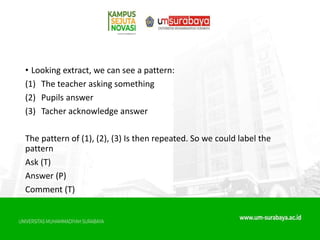
• Looking extract, we can see a pattern:
(1) The teacher asking something
(2) Pupils answer
(3) Tacher acknowledge answer
The pattern of (1), (2), (3) Is then repeated. So we could label the
pattern
Ask (T)
Answer (P)
Comment (T)
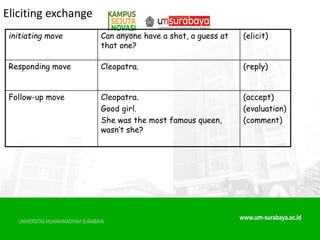
Eliciting exchange
initiating move Can anyone have a shot, a guess at
that one?
(elicit)
Responding move Cleopatra. (reply)
Follow-up move Cleopatra.
Good girl.
She was the most famous queen,
wasn’t she?
(accept)
(evaluation)
(comment)
Discourse Structure
Sinclair
Transaction
Exchange
Move
Act
Forms and Function
Sinclair et al observe that while their categories of elicitation,
directive and informative are frequently realized by
interrogative, imperative and declarative structures
respectively there are occasion when this is not so.
The opportunity for variety arises from the relationship
between grammar (in the broad sense) and discourse.
The unmarked form of a directive may be imperative,' Shut
the door’, but there are many marked versions, using
interrogatives, declarative and moodless structures.
Can you shut the door?
Would you mind shutting the door?
I wonder if you could shut the door.
The door is still open.
The door.
Sinclair et al
Situation- refers to all relavant factors in the environment, social
convention and the shared experience of the participants.
Tactics- handles the syntagmatic patterns of discourse, the way in which
items precede, follow and are related to each other.
Sinclair et al suggest that there are four questions one need to ask
about the grammatical form of a clause in order to be able to
analyze it as the realization of a particular function.
1. If the clause is interrogative is the addressee also the subject?
2. What actions or activities are physically possible at the time of
utterance?
3. What actions or activities are proscribed at the time of
utterance?
4. What actions or activities have been prescribed up to the time of
utterance?
Rule 1
An interrogative clause is to be interpreted as a command to do if it fulfils all
the following conditions:
(i) It contains one of the modals can, could, will, would, (and sometimes going
to)
(ii) If the subject of the clause is also the addressee;
(iii) The predicate describes an action which is physically possible at the time of
the utterance.
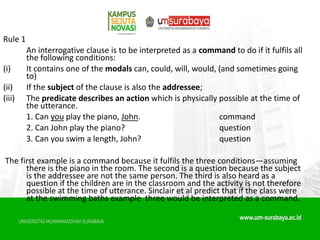
1. Can you play the piano, John. command
2. Can John play the piano? question
3. Can you swim a length, John? question
The first example is a command because it fulfils the three conditions—assuming
there is the piano in the room. The second is a question because the subject
is the addressee are not the same person. The third is also heard as a
question if the children are in the classroom and the activity is not therefore
possible at the time of utterance. Sinclair et al predict that if the class were
at the swimming baths example three would be interpreted as a command.
Rule 2
Any declarative or interrogative is to be interpreted as a command to
stop if it refers to an action or activity which is proscribed at the time of
the utterance.
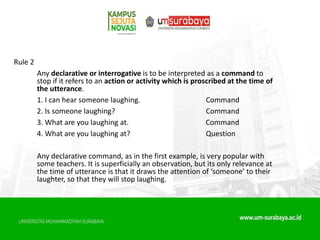
1. I can hear someone laughing. Command
2. Is someone laughing? Command
3. What are you laughing at. Command
4. What are you laughing at? Question
Any declarative command, as in the first example, is very popular with
some teachers. It is superficially an observation, but its only relevance at
the time of utterance is that it draws the attention of ‘someone’ to their
laughter, so that they will stop laughing.
Rule 3
Any declarative or interrogative is to be interpreted as a command to do if it
refers to an action or activity which the teacher and pupil(s) know ought to
have been performed or completed and hasn’t been.
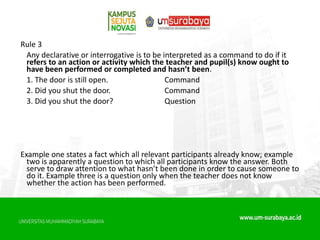
1. The door is still open. Command
2. Did you shut the door. Command
3. Did you shut the door? Question
Example one states a fact which all relevant participants already know; example
two is apparently a question to which all participants know the answer. Both
serve to draw attention to what hasn’t been done in order to cause someone to
do it. Example three is a question only when the teacher does not know
whether the action has been performed.
Tactics
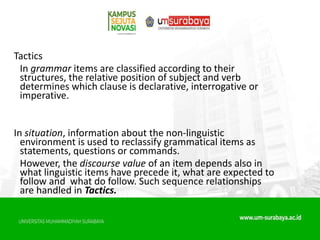
In grammar items are classified according to their
structures, the relative position of subject and verb
determines which clause is declarative, interrogative or
imperative.
In situation, information about the non-linguistic
environment is used to reclassify grammatical items as
statements, questions or commands.
However, the discourse value of an item depends also in
what linguistic items have precede it, what are expected to
follow and what do follow. Such sequence relationships
are handled in Tactics.
Task : Classroom Discourse Analysis
Analyze this video : https://www.youtube.com/watch?v=Y9LBUf1NzU0
by using Sinclair and Coulthard theory of classroom discourse analyisis:
Analyze :
• Lesson
• Transaction
• Exchange
• Move
• Act
How the discourse pattern and meaning in the class?
Email me to sri.lestari@fkip.um-surabaya.ac.id
Pedagogic Discourse and
Curriculum Macrogenres
• Pedagogic discourse as the rule which embeds a discourse of competence (skills
of various kinds) into a discourse of social order in such a way that the latter
always dominates the former. We shall call the discourse transmitting specialised
competences and their relation to each other instructional discourse, and the
discourse creating specialised order, relation and identity regulative discourse.
(Bernstein, 1990: 183; his italics)
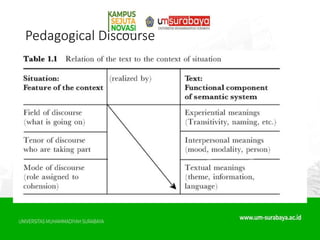
Pedagogical Discourse
Macrogenres
Macrogenre was first proposed by Martin (1994, 1995), and his proposal emerged
in the main from work he had undertaken with Rothery (e.g. 1980, 1981) and others
in exploring the written genres of schooling, especially those of primary and junior
secondary science. He had observed the tendency of what he termed 'elemental'
genres such as recounts, reports, explanations or procedures to create larger unities
in written texts —as for example in school science textbooks.
work on written genres
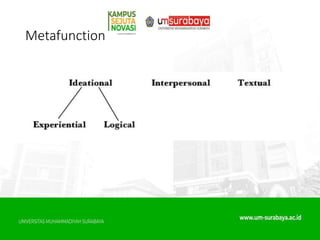
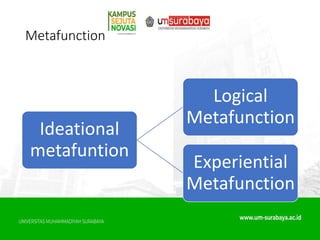
Metafunction
Metafunction
Ideational
metafuntion
Logical
Metafunction
Experiential
Metafunction
Metafunction
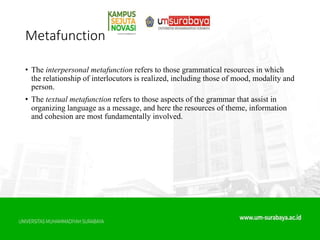
• The interpersonal metafunction refers to those grammatical resources in which
the relationship of interlocutors is realized, including those of mood, modality and
person.
• The textual metafunction refers to those aspects of the grammar that assist in
organizing language as a message, and here the resources of theme, information
and cohesion are most fundamentally involved.
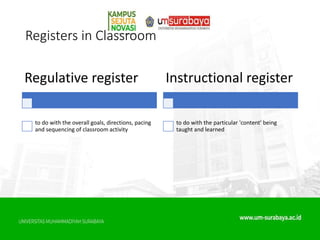
Registers in Classroom
Regulative register
to do with the overall goals, directions, pacing
and sequencing of classroom activity
Instructional register
to do with the particular 'content' being
taught and learned
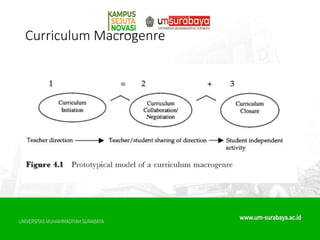
Curriculum Macrogenre
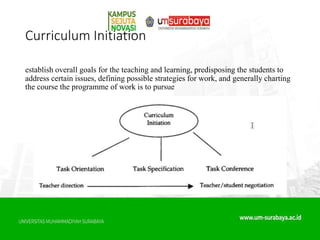
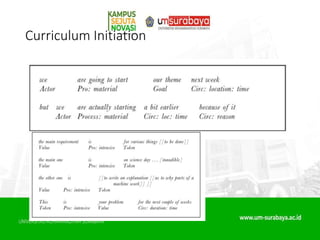
Curriculum Initiation
establish overall goals for the teaching and learning, predisposing the students to
address certain issues, defining possible strategies for work, and generally charting
the course the programme of work is to pursue
The Task Orientation starts
T: Right, OK now we are going to start our theme next week, but we are actually
starting a bit earlier because of it. The mam requirement is for various things to be
done. The mam one is on science day....[inaudible] So we’ve got to do a lot of
concentrating. There will be two pieces of writing, one is a procedural text... .
[inaudible] The other one is to write an explanation as to why parts of a machine
work. So a bit of concentration. Um, you can start by looking up the basis of how
the machines workin a series of sciencebooks....[inaudible]For instance a catapult.
You'll be making an exact replica of a catapult, not the full size of course. Think
about it. This v-,your problem for the next couple of weeks. The other thing you
might do is making a lift or wishing well or even a Spanish windlass, ifs basically a
barrel.
Curriculum Initiation
Curriculum Collaboration
the work necessary towards achievement of the tasks. This might involve
reading of selected materials, researching in libraries, viewing films,
interviewing people, going on field trips, reading a class novel, conducting
experiments, constructing models and/or charts, or any of a number of
other activities, depending upon what is being taught and learned, much
of the essential work is done, and that is at times recursive.
Curriculum Closure
• some clear sense of a closure, normally requiring of the students
completion of some task(s) depend on teacher skills developed and/or
issues examined which will be taken up again in another curriculum
activity.

Classroom Discourse Analysis: Pedagogical discourse analysis

  • 1.
  • 2.
    • Medleyand Mitzel(1963),Biddle(1967),Meux(1967)Weick(1968) have vast literature and comprehensive reviews on one type of verbal interaction between teachers and pupils. Naturally, such studies have educational priorities but none is concerned with simply observing the interaction and describing its linguistic structure, turn-taking system, or productive, interpretive and sequencing rules.
  • 3.
    Studies of Gallagherand Aschner(1963) and Taba et.al (1964) concerned with the levels of thinking, produce an analysis in terms of abstract categories several stages removed from the linguistics data. There are , however, three descriptive system which do attend closely to the linguistic data ---Barnes (1969), Flanders (1970) and Bellack et al (1966), Barns has two major educational tenets: that pupils should be encouraged to participate and draw on their own knowledge and experience as much as possible, and that teachers’ questioning
  • 4.
    Should be moreconcerned with stimulating thinking than eliciting factual information. Two aspects of the interaction a. Pupils participation b. Teachers' questioning Four categories of teachers’ questioning > factual, reasoning (open and closed), other open questions (not requiring reasoning), social.
  • 5.
    Classroom as astructured activity Flanders (1970 teacher talks are structured Asking Questions, Giving Directions, Accepting Feeling, and so on Bellack and his colleagues (1966) conceive hirerarchy terms of nature classroom as game,sub-game, cycle and move (adopted by Sinclair and Coulthard). A move could be one of four types: Soliciting, in which responses (verbal or non-verbal) were actively sought by the person doing the soliciting; Responding, involving some reciprocal relation to the Soliciting move; Structuring, in which pedagogical activity was set in train, either by initiating some course of action or by excluding others; and finally Reacting, where this was a move undertaken in reaction to any of the others. Sinclair and Coulthard : Lesson, Transaction, Exchange, Move and Act . Moves they identified: the so-called Initiation, Response, Feedback move, known as the IRF, or sometimes,following a similar description in Mehan's work (1979) as the Initiation, Response, Evaluation move, the IRE.
  • 6.
    Sinclair Model • Sinclairpurposed five ranks to handle the structure of classroom interaction: 1. Lesson 2. Transaction 3. Exchange 4. Move
  • 7.
    Figure 2 Levelsand Ranks Non-Linguistic Organization Discourse Grammar Course Period Topic LESSON TRANSACTION EXCHANGE MOVE ACT Sentence Clause Group Word morpheme
  • 8.
    • Informing, directing,and eliciting exchanges are concerned with what is more commonly know as stating, commanding, questioning behavior. • The structure of exchanges are expressed in the terms of moves • A three moves structured was proposed for exchanges Initiation, Response, Follow-up
  • 9.
    Discourse Structure • Transaction: have structure, expressed in terms of exchanges • Acts are speech acts
  • 10.
    Verbal interaction insidethe classroom differs markedly from desultory conversation in that its main purpose is to instruct and inform and this difference is reflected in the structure of the discourse. In conversation, topic changes are unpredictable and uncontrollable. Inside the classroom it is one of the functions of the teacher to choose the topic, decide how it will be subdivided into smaller units and cope with digressions and misunderstanding
  • 11.
    Transactions have astructure expressed in terms of exchanges—they begin with a boundary exchange, which consists of a frame and/ or focus and then followed by a succession of informing-stating, directing-commanding, or eliciting exchanges- questioning. The structure of exchanges is expressed in terms of moves.
  • 12.
    Discourse Structure • Theboundaries of transactions are tipically marked by frames whose realization at the level of form is limited five words : Ok, well, now, right, good, uttered with strong stress high falling intonation and followed by a short pause. • A frame indicating the beginning of transaction with a focus Frame: well Focus : today I tought we’d do three quizzes
  • 13.
    • End :transaction with another focus summarizing the transaction Focus : what we have done is given some energy to this pen Frame : now Transaction have a structure expressed in terms of exchanges-they begin and often with a boundary exchange, which consists of a frame and/or a focus followed by a succession of informing, directing, or eliciting exchanges
  • 14.
    Moves combine toform exchanges; moves themselves const of one or more acts. The category act is very different in kind from Austin’s illocutionary act and Searrle’s speech act. Acts-are defined principally by their function in the discourse, by the way they serve to initiate succeeding discourse activity or respond to earlier discourse activity.
  • 15.
    • Looking extract,we can see a pattern: (1) The teacher asking something (2) Pupils answer (3) Tacher acknowledge answer The pattern of (1), (2), (3) Is then repeated. So we could label the pattern Ask (T) Answer (P) Comment (T)
  • 16.
    Eliciting exchange initiating moveCan anyone have a shot, a guess at that one? (elicit) Responding move Cleopatra. (reply) Follow-up move Cleopatra. Good girl. She was the most famous queen, wasn’t she? (accept) (evaluation) (comment)
  • 17.
    Discourse Structure Sinclair Transaction Exchange Move Act Forms andFunction Sinclair et al observe that while their categories of elicitation, directive and informative are frequently realized by interrogative, imperative and declarative structures respectively there are occasion when this is not so.
  • 18.
    The opportunity forvariety arises from the relationship between grammar (in the broad sense) and discourse. The unmarked form of a directive may be imperative,' Shut the door’, but there are many marked versions, using interrogatives, declarative and moodless structures. Can you shut the door? Would you mind shutting the door? I wonder if you could shut the door. The door is still open. The door.
  • 19.
    Sinclair et al Situation-refers to all relavant factors in the environment, social convention and the shared experience of the participants. Tactics- handles the syntagmatic patterns of discourse, the way in which items precede, follow and are related to each other.
  • 20.
    Sinclair et alsuggest that there are four questions one need to ask about the grammatical form of a clause in order to be able to analyze it as the realization of a particular function. 1. If the clause is interrogative is the addressee also the subject? 2. What actions or activities are physically possible at the time of utterance? 3. What actions or activities are proscribed at the time of utterance? 4. What actions or activities have been prescribed up to the time of utterance?
  • 21.
    Rule 1 An interrogativeclause is to be interpreted as a command to do if it fulfils all the following conditions: (i) It contains one of the modals can, could, will, would, (and sometimes going to) (ii) If the subject of the clause is also the addressee; (iii) The predicate describes an action which is physically possible at the time of the utterance. 1. Can you play the piano, John. command 2. Can John play the piano? question 3. Can you swim a length, John? question The first example is a command because it fulfils the three conditions—assuming there is the piano in the room. The second is a question because the subject is the addressee are not the same person. The third is also heard as a question if the children are in the classroom and the activity is not therefore possible at the time of utterance. Sinclair et al predict that if the class were at the swimming baths example three would be interpreted as a command.
  • 22.
    Rule 2 Any declarativeor interrogative is to be interpreted as a command to stop if it refers to an action or activity which is proscribed at the time of the utterance. 1. I can hear someone laughing. Command 2. Is someone laughing? Command 3. What are you laughing at. Command 4. What are you laughing at? Question Any declarative command, as in the first example, is very popular with some teachers. It is superficially an observation, but its only relevance at the time of utterance is that it draws the attention of ‘someone’ to their laughter, so that they will stop laughing.
  • 23.
    Rule 3 Any declarativeor interrogative is to be interpreted as a command to do if it refers to an action or activity which the teacher and pupil(s) know ought to have been performed or completed and hasn’t been. 1. The door is still open. Command 2. Did you shut the door. Command 3. Did you shut the door? Question Example one states a fact which all relevant participants already know; example two is apparently a question to which all participants know the answer. Both serve to draw attention to what hasn’t been done in order to cause someone to do it. Example three is a question only when the teacher does not know whether the action has been performed.
  • 24.
    Tactics In grammar itemsare classified according to their structures, the relative position of subject and verb determines which clause is declarative, interrogative or imperative. In situation, information about the non-linguistic environment is used to reclassify grammatical items as statements, questions or commands. However, the discourse value of an item depends also in what linguistic items have precede it, what are expected to follow and what do follow. Such sequence relationships are handled in Tactics.
  • 25.
    Task : ClassroomDiscourse Analysis Analyze this video : https://www.youtube.com/watch?v=Y9LBUf1NzU0 by using Sinclair and Coulthard theory of classroom discourse analyisis: Analyze : • Lesson • Transaction • Exchange • Move • Act How the discourse pattern and meaning in the class? Email me to sri.lestari@fkip.um-surabaya.ac.id
  • 26.
  • 27.
    • Pedagogic discourseas the rule which embeds a discourse of competence (skills of various kinds) into a discourse of social order in such a way that the latter always dominates the former. We shall call the discourse transmitting specialised competences and their relation to each other instructional discourse, and the discourse creating specialised order, relation and identity regulative discourse. (Bernstein, 1990: 183; his italics)
  • 28.
  • 29.
    Macrogenres Macrogenre was firstproposed by Martin (1994, 1995), and his proposal emerged in the main from work he had undertaken with Rothery (e.g. 1980, 1981) and others in exploring the written genres of schooling, especially those of primary and junior secondary science. He had observed the tendency of what he termed 'elemental' genres such as recounts, reports, explanations or procedures to create larger unities in written texts —as for example in school science textbooks. work on written genres
  • 30.
  • 31.
  • 32.
    Metafunction • The interpersonalmetafunction refers to those grammatical resources in which the relationship of interlocutors is realized, including those of mood, modality and person. • The textual metafunction refers to those aspects of the grammar that assist in organizing language as a message, and here the resources of theme, information and cohesion are most fundamentally involved.
  • 33.
    Registers in Classroom Regulativeregister to do with the overall goals, directions, pacing and sequencing of classroom activity Instructional register to do with the particular 'content' being taught and learned
  • 34.
  • 35.
    Curriculum Initiation establish overallgoals for the teaching and learning, predisposing the students to address certain issues, defining possible strategies for work, and generally charting the course the programme of work is to pursue
  • 36.
    The Task Orientationstarts T: Right, OK now we are going to start our theme next week, but we are actually starting a bit earlier because of it. The mam requirement is for various things to be done. The mam one is on science day....[inaudible] So we’ve got to do a lot of concentrating. There will be two pieces of writing, one is a procedural text... . [inaudible] The other one is to write an explanation as to why parts of a machine work. So a bit of concentration. Um, you can start by looking up the basis of how the machines workin a series of sciencebooks....[inaudible]For instance a catapult. You'll be making an exact replica of a catapult, not the full size of course. Think about it. This v-,your problem for the next couple of weeks. The other thing you might do is making a lift or wishing well or even a Spanish windlass, ifs basically a barrel.
  • 37.
  • 39.
    Curriculum Collaboration the worknecessary towards achievement of the tasks. This might involve reading of selected materials, researching in libraries, viewing films, interviewing people, going on field trips, reading a class novel, conducting experiments, constructing models and/or charts, or any of a number of other activities, depending upon what is being taught and learned, much of the essential work is done, and that is at times recursive.
  • 40.
    Curriculum Closure • someclear sense of a closure, normally requiring of the students completion of some task(s) depend on teacher skills developed and/or issues examined which will be taken up again in another curriculum activity.

Editor's Notes

  • #30 curriculum genres can similarly be thought of as involving meanings that are experiential, interpersonal and textual, all reflecting the values of the three metafunctions involved.
  • #32 Logical Metafunction: the more abstract business of building connectedness between the meanings of clauses Experiential Metafunction: representation of the world and its experiences, using the resources of transitivity and of lexis
  • #36 The opening genre normally has a series of phases or stages within it, all important to the definition of tasks and the establishment of a framework for working, as well as indicating those criteria for evaluation that apply in judging students' performance. An ultimate task to be completed is very often established in prospect in this initiating genre, as a necessary aspect of establishing the evaluation principles that will apply.
  • #38 Nominal groups such as the main requirement or the main oneare very forceful expressions in teacher talk, and indeed participants of this kind are very centrally involved in the operation of the interpersonal metafunction here. As a general principle, teachers make sparing, if effective, use of identifying processes. They are involved, on occasion, in establishing technical language, either to do with the instructional register, or with the regulative register. Where they are used, as here, to build an aspect of the regulative register, their effect is to express directions that are categorical: some course of action is to be pursued, where other possibilitiesare not to be entertained. In fact, the first of these three identifying processes is really an interpersonal metaphor, where the more congruent realization would have been: you must do various things. The text extract is interpersonally powerful in other ways, as for example, in the process which involves a use of high modality (underlined):