Classification of resources
By Anushka Routray
Class-VII A
RESOURCES
Renewability
Renewable Non
Renewable
Origin
Biotic Abiotic
Occurrence
Natural Man made
Development
Potential Actual
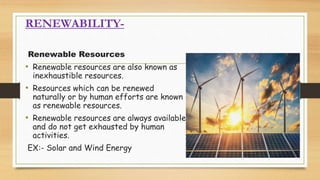
RENEWABILITY-
Renewable Resources
• Renewable resources are also known as
inexhaustible resources.
• Resources which can be renewed
naturally or by human efforts are known
as renewable resources.
• Renewable resources are always available
and do not get exhausted by human
activities.
EX:- Solar and Wind Energy
Non-Renewable resources
• Non-Renewable resources are also known as
exhaustible resources.
• Resources which take millions of years to form
or renew are known as non renewable
resources.
• Non-Renewable resources are available in
limited amount on the Earth’s surface.
EX:- Coal , Petrol , Natural gas etc.
ORIGIN-
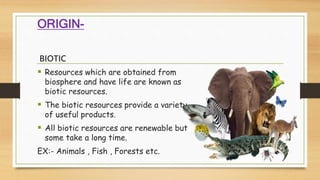
BIOTIC
 Resources which are obtained from
biosphere and have life are known as
biotic resources.
 The biotic resources provide a variety
of useful products.
 All biotic resources are renewable but
some take a long time.
EX:- Animals , Fish , Forests etc.
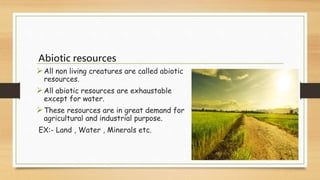
Abiotic resources
All non living creatures are called abiotic
resources.
All abiotic resources are exhaustable
except for water.
These resources are in great demand for
agricultural and industrial purpose.
EX:- Land , Water , Minerals etc.
OCCURANCE:-
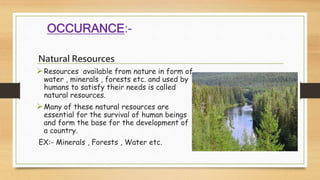
Natural Resources
Resources available from nature in form of
water , minerals , forests etc. and used by
humans to satisfy their needs is called
natural resources.
Many of these natural resources are
essential for the survival of human beings
and form the base for the development of
a country.
EX:- Minerals , Forests , Water etc.
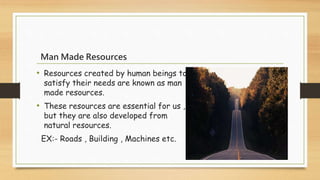
Man Made Resources
• Resources created by human beings to
satisfy their needs are known as man
made resources.
• These resources are essential for us ,
but they are also developed from
natural resources.
EX:- Roads , Building , Machines etc.
DEVELOPMENT:-
Potential Resources
 Available resources in a country , which are
not fully tapped , are known as potential
resources .
 The potential resources need detailed
survey for estimating their quality and
quantity.
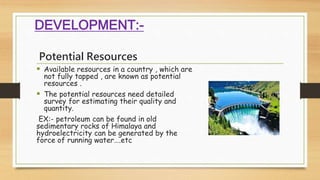
EX:- petroleum can be found in old
sedimentary rocks of Himalaya and
hydroelectricity can be generated by the
force of running water….etc
Actual resources
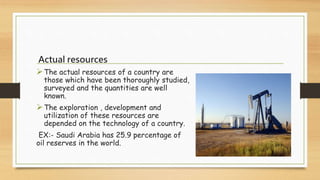
The actual resources of a country are
those which have been thoroughly studied,
surveyed and the quantities are well
known.
The exploration , development and
utilization of these resources are
depended on the technology of a country.
EX:- Saudi Arabia has 25.9 percentage of
oil reserves in the world.
What is Sustainable
Development ?
SUSTAINABLE DEVELOPMENT
• Sustainable development is the overarching paradigm of the United Nations.
The concept of sustainable development was described by the 1987 Bruntland
Commission Report as “development that meets the needs of the present
without compromising the ability of future generations to meet their own
needs.”
• There are four dimensions to sustainable development – society, environment,
culture and economy – which are intertwined, not separate. Sustainability is a
paradigm for thinking about the future in which environmental, societal and
economic considerations are balanced in the pursuit of an improved quality of
life. For example, a prosperous society relies on a healthy environment to
provide food and resources, safe drinking water and clean air for its citizens
Difference between sustainable development and
sustainability?
• Sustainability is often thought of as a long-
term goal (i.e. a more sustainable world),
while sustainable development refers to the
many processes and pathways to achieve it
(e.g. sustainable agriculture and forestry,
sustainable production and consumption,
good government, research and technology
transfer, education and training, etc.).
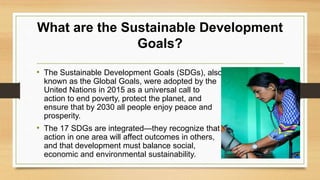
What are the Sustainable Development
Goals?
• The Sustainable Development Goals (SDGs), also
known as the Global Goals, were adopted by the
United Nations in 2015 as a universal call to
action to end poverty, protect the planet, and
ensure that by 2030 all people enjoy peace and
prosperity.
• The 17 SDGs are integrated—they recognize that
action in one area will affect outcomes in others,
and that development must balance social,
economic and environmental sustainability.
1) No Poverty
2) Zero Hunger
3) Good Health and Well Being
4) Quality Education
5) Gender Equality
6) Clean water and sanitation
ETC……………….
Classification of resources.pptx

Classification of resources.pptx

  • 1.
    Classification of resources ByAnushka Routray Class-VII A
  • 2.
  • 3.
    RENEWABILITY- Renewable Resources • Renewableresources are also known as inexhaustible resources. • Resources which can be renewed naturally or by human efforts are known as renewable resources. • Renewable resources are always available and do not get exhausted by human activities. EX:- Solar and Wind Energy
  • 4.
    Non-Renewable resources • Non-Renewableresources are also known as exhaustible resources. • Resources which take millions of years to form or renew are known as non renewable resources. • Non-Renewable resources are available in limited amount on the Earth’s surface. EX:- Coal , Petrol , Natural gas etc.
  • 5.
    ORIGIN- BIOTIC  Resources whichare obtained from biosphere and have life are known as biotic resources.  The biotic resources provide a variety of useful products.  All biotic resources are renewable but some take a long time. EX:- Animals , Fish , Forests etc.
  • 6.
    Abiotic resources All nonliving creatures are called abiotic resources. All abiotic resources are exhaustable except for water. These resources are in great demand for agricultural and industrial purpose. EX:- Land , Water , Minerals etc.
  • 7.
    OCCURANCE:- Natural Resources Resources availablefrom nature in form of water , minerals , forests etc. and used by humans to satisfy their needs is called natural resources. Many of these natural resources are essential for the survival of human beings and form the base for the development of a country. EX:- Minerals , Forests , Water etc.
  • 8.
    Man Made Resources •Resources created by human beings to satisfy their needs are known as man made resources. • These resources are essential for us , but they are also developed from natural resources. EX:- Roads , Building , Machines etc.
  • 9.
    DEVELOPMENT:- Potential Resources  Availableresources in a country , which are not fully tapped , are known as potential resources .  The potential resources need detailed survey for estimating their quality and quantity. EX:- petroleum can be found in old sedimentary rocks of Himalaya and hydroelectricity can be generated by the force of running water….etc
  • 10.
    Actual resources The actualresources of a country are those which have been thoroughly studied, surveyed and the quantities are well known. The exploration , development and utilization of these resources are depended on the technology of a country. EX:- Saudi Arabia has 25.9 percentage of oil reserves in the world.
  • 11.
  • 12.
    SUSTAINABLE DEVELOPMENT • Sustainabledevelopment is the overarching paradigm of the United Nations. The concept of sustainable development was described by the 1987 Bruntland Commission Report as “development that meets the needs of the present without compromising the ability of future generations to meet their own needs.” • There are four dimensions to sustainable development – society, environment, culture and economy – which are intertwined, not separate. Sustainability is a paradigm for thinking about the future in which environmental, societal and economic considerations are balanced in the pursuit of an improved quality of life. For example, a prosperous society relies on a healthy environment to provide food and resources, safe drinking water and clean air for its citizens
  • 13.
    Difference between sustainabledevelopment and sustainability? • Sustainability is often thought of as a long- term goal (i.e. a more sustainable world), while sustainable development refers to the many processes and pathways to achieve it (e.g. sustainable agriculture and forestry, sustainable production and consumption, good government, research and technology transfer, education and training, etc.).
  • 14.
    What are theSustainable Development Goals? • The Sustainable Development Goals (SDGs), also known as the Global Goals, were adopted by the United Nations in 2015 as a universal call to action to end poverty, protect the planet, and ensure that by 2030 all people enjoy peace and prosperity. • The 17 SDGs are integrated—they recognize that action in one area will affect outcomes in others, and that development must balance social, economic and environmental sustainability.
  • 15.
    1) No Poverty 2)Zero Hunger 3) Good Health and Well Being 4) Quality Education 5) Gender Equality 6) Clean water and sanitation ETC……………….