CLASSIFYING ORGANISMS: a web quest assignment
Why classify? Say you have only 10 minutes to run into a supermarket to get what you needed.  Could you do it?  You would probably head straight to the area where the items were located.  But what if you had to shop for the same items in a market where things were randomly placed throughout the store.  Where would you begin?  You would have to search through a lot of things before you found what you needed!  You could be there for a long time!  Biologists have organized living things with similarities into groups so that the organisms are easier to study.  This process is called  classification .
ASSIGNMENT In groups of  three , you will research the main distinguishing characteristics of the 6 kingdoms and those of animal and plant groups, using the guidelines & activities shown here and the internet. Your task will be to prepare a powerpoint presentation to be uploaded in the blog.  Your presentation must have all sources/references (web site links, pages with images or videoclips) and the group members.
WHAT TO SEARCH FOR As you explore the web, keep the following questions in mind: Why do scientists classify? What are the major levels of classification? How are organisms classified? What is binomial nomenclature? What are the six different kingdoms of organisms that are generally recognized by scientists today? What are some examples of major animal and plant phyla?
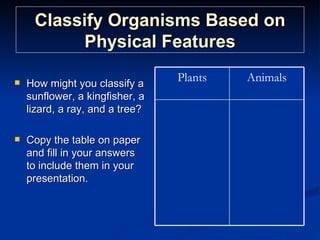
Classify Organisms Based on Physical Features How might you classify a sunflower, a kingfisher, a lizard, a ray, and a tree?  Copy the table on paper and fill in your answers to include them in your presentation.   Animals Plants
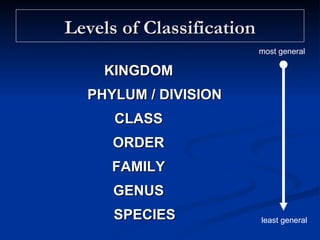
Levels of Classification KINGDOM PHYLUM / DIVISION CLASS ORDER FAMILY GENUS SPECIES most general least general
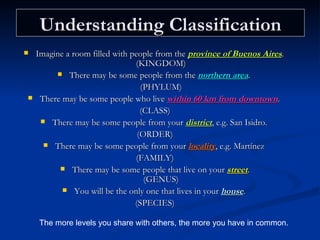
Understanding Classification Imagine a room filled with people from the  province of Buenos Aires .  (KINGDOM) There may be some people from the  northern area .  (PHYLUM) There may be some people who live  within 60 km from downtown .  (CLASS) There may be some people from your  district , e.g. San Isidro.  (ORDER) There may be some people from your  locality , e.g. Martínez  (FAMILY) There may be some people that live on your  street . (GENUS) You will be the only one that lives in your  house .  (SPECIES) The more levels you share with others, the more you have in common.
Use this link (or copy & paste it  in your browser) to complete this activity. http://www.quia.com/pp/51115.html?AP_rand=463451876 Return to this assignment when you are done.
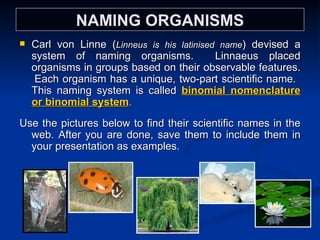
NAMING ORGANISMS Carl von Linne ( Linneus is his latinised name ) devised a system of naming organisms.  Linnaeus placed organisms in groups based on their observable features.  Each organism has a unique, two-part scientific name.  This naming system is called  binomial nomenclature or binomial system . Use the pictures below to find their scientific names in the web. After you are done, save them to include them in your presentation as examples.
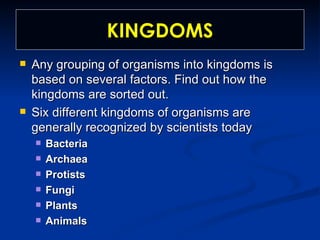
KINGDOMS Any grouping of organisms into kingdoms is based on several factors. Find out how the kingdoms are sorted out. Six different kingdoms of organisms are generally recognized by scientists today Bacteria Archaea Protists Fungi Plants Animals
MAJOR ANIMAL GROUPS Go to the following websites  and visit other sites  to find out what the main characteristics of these kingdoms are. Complete a chart on paper to later include it in your presentation. http://www.usoe.k12.ut.us/curr/science/sciber00/7th/classify/sciber/5king2.htm http://student.ccbcmd.edu/courses/bio141/lecguide/unit1/3domain/3domain.html http://www.middleschoolscience.com/cniderians.htm http://www.virted.org/Animals/Mollusks.html http://www.virted.org/Animals/Earthworms.html http://www.virted.org/Animals/Insect.html http://www.virted.org/Animals/Starfish.html http:// www.virted.org/Animals/Chordate.html
MAJOR PLANT GROUPS Go to the following web sites  or visit your own  to find out about the main plant groups. Then fill in the blanks. http:// www.virted.org/Plants/Mosses.html 1.  This plant division are found in .................................. areas and do not grow vertically too high but can spread out to be a yard long. http:// www.backyardnature.net/conifers.htm 2.  This plant division bears ............................., instead of real fruits. http:// www.virted.org/Plants/Ferns.html 3.  This plant division can mostly be found in .................................... http://www.virted.org/Plants/Flower.html 4.  The four basic parts of this plant division are .............................., ...................................., ......................... , and ................................
UNSCRAMBLE THESE WORDS! s m o s e s  o f r e s c n i  w o f l r n i g e  a l p s n t  n r s f e

Classification assignment

  • 1.
    CLASSIFYING ORGANISMS: aweb quest assignment
  • 2.
    Why classify? Sayyou have only 10 minutes to run into a supermarket to get what you needed. Could you do it? You would probably head straight to the area where the items were located. But what if you had to shop for the same items in a market where things were randomly placed throughout the store. Where would you begin? You would have to search through a lot of things before you found what you needed! You could be there for a long time! Biologists have organized living things with similarities into groups so that the organisms are easier to study. This process is called classification .
  • 3.
    ASSIGNMENT In groupsof three , you will research the main distinguishing characteristics of the 6 kingdoms and those of animal and plant groups, using the guidelines & activities shown here and the internet. Your task will be to prepare a powerpoint presentation to be uploaded in the blog. Your presentation must have all sources/references (web site links, pages with images or videoclips) and the group members.
  • 4.
    WHAT TO SEARCHFOR As you explore the web, keep the following questions in mind: Why do scientists classify? What are the major levels of classification? How are organisms classified? What is binomial nomenclature? What are the six different kingdoms of organisms that are generally recognized by scientists today? What are some examples of major animal and plant phyla?
  • 5.
    Classify Organisms Basedon Physical Features How might you classify a sunflower, a kingfisher, a lizard, a ray, and a tree? Copy the table on paper and fill in your answers to include them in your presentation. Animals Plants
  • 6.
    Levels of ClassificationKINGDOM PHYLUM / DIVISION CLASS ORDER FAMILY GENUS SPECIES most general least general
  • 7.
    Understanding Classification Imaginea room filled with people from the province of Buenos Aires . (KINGDOM) There may be some people from the northern area . (PHYLUM) There may be some people who live within 60 km from downtown . (CLASS) There may be some people from your district , e.g. San Isidro. (ORDER) There may be some people from your locality , e.g. Martínez (FAMILY) There may be some people that live on your street . (GENUS) You will be the only one that lives in your house . (SPECIES) The more levels you share with others, the more you have in common.
  • 8.
    Use this link(or copy & paste it in your browser) to complete this activity. http://www.quia.com/pp/51115.html?AP_rand=463451876 Return to this assignment when you are done.
  • 9.
    NAMING ORGANISMS Carlvon Linne ( Linneus is his latinised name ) devised a system of naming organisms. Linnaeus placed organisms in groups based on their observable features. Each organism has a unique, two-part scientific name. This naming system is called binomial nomenclature or binomial system . Use the pictures below to find their scientific names in the web. After you are done, save them to include them in your presentation as examples.
  • 10.
    KINGDOMS Any groupingof organisms into kingdoms is based on several factors. Find out how the kingdoms are sorted out. Six different kingdoms of organisms are generally recognized by scientists today Bacteria Archaea Protists Fungi Plants Animals
  • 11.
    MAJOR ANIMAL GROUPSGo to the following websites and visit other sites to find out what the main characteristics of these kingdoms are. Complete a chart on paper to later include it in your presentation. http://www.usoe.k12.ut.us/curr/science/sciber00/7th/classify/sciber/5king2.htm http://student.ccbcmd.edu/courses/bio141/lecguide/unit1/3domain/3domain.html http://www.middleschoolscience.com/cniderians.htm http://www.virted.org/Animals/Mollusks.html http://www.virted.org/Animals/Earthworms.html http://www.virted.org/Animals/Insect.html http://www.virted.org/Animals/Starfish.html http:// www.virted.org/Animals/Chordate.html
  • 12.
    MAJOR PLANT GROUPSGo to the following web sites or visit your own to find out about the main plant groups. Then fill in the blanks. http:// www.virted.org/Plants/Mosses.html 1. This plant division are found in .................................. areas and do not grow vertically too high but can spread out to be a yard long. http:// www.backyardnature.net/conifers.htm 2. This plant division bears ............................., instead of real fruits. http:// www.virted.org/Plants/Ferns.html 3. This plant division can mostly be found in .................................... http://www.virted.org/Plants/Flower.html 4. The four basic parts of this plant division are .............................., ...................................., ......................... , and ................................
  • 13.
    UNSCRAMBLE THESE WORDS!s m o s e s o f r e s c n i w o f l r n i g e a l p s n t n r s f e