CLASSIFYING ORGANISMS
Why classify? Say you have only 10 minutes to run into a supermarket to get what you needed.  Could you do it?  You would probably head straight to the area where the items were located.  But what if you had to shop for the same items in a market where things were randomly placed throughout the store.  Where would you begin?  You would have to search through a lot of things before you found what you needed!  You could be there for a long time!  Biologists have organized living things with similarities into groups so that the organisms are easier to study.  This process is called  classification .
WHAT TO SEARCH FOR As you explore the web, keep the following questions in mind: Why do scientists classify? What are the major levels of classification? How are organisms classified? What is binomial nomenclature? What are the six different kingdoms of organisms that are generally recognized by scientists today? What are some examples of major animal and plant phyla?
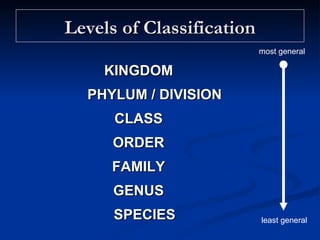
Levels of Classification KINGDOM PHYLUM / DIVISION CLASS ORDER FAMILY GENUS SPECIES most general least general
Understanding Classification Imagine a room filled with people from the  province of Buenos Aires .  (KINGDOM) There may be some people from the  northern area .  (PHYLUM) There may be some people who live  within 60 km from downtown .  (CLASS) There may be some people from your  district , e.g. San Isidro.  (ORDER) There may be some people from your  locality , e.g. Martínez  (FAMILY) There may be some people that live on your  street . (GENUS) You will be the only one that lives in your  house .  (SPECIES) The more levels you share with others, the more you have in common.
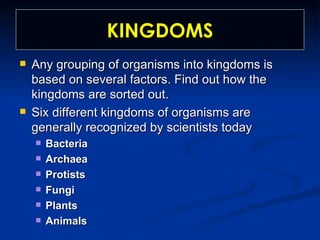
KINGDOMS Any grouping of organisms into kingdoms is based on several factors. Find out how the kingdoms are sorted out. Six different kingdoms of organisms are generally recognized by scientists today Bacteria Archaea Protists Fungi Plants Animals
UNSCRAMBLE THESE WORDS! s m o s e s  o f r e s c n i  w o f l r n i g e  a l p s n t  n r s f e

Classification facts

  • 1.
  • 2.
    Why classify? Sayyou have only 10 minutes to run into a supermarket to get what you needed. Could you do it? You would probably head straight to the area where the items were located. But what if you had to shop for the same items in a market where things were randomly placed throughout the store. Where would you begin? You would have to search through a lot of things before you found what you needed! You could be there for a long time! Biologists have organized living things with similarities into groups so that the organisms are easier to study. This process is called classification .
  • 3.
    WHAT TO SEARCHFOR As you explore the web, keep the following questions in mind: Why do scientists classify? What are the major levels of classification? How are organisms classified? What is binomial nomenclature? What are the six different kingdoms of organisms that are generally recognized by scientists today? What are some examples of major animal and plant phyla?
  • 4.
    Levels of ClassificationKINGDOM PHYLUM / DIVISION CLASS ORDER FAMILY GENUS SPECIES most general least general
  • 5.
    Understanding Classification Imaginea room filled with people from the province of Buenos Aires . (KINGDOM) There may be some people from the northern area . (PHYLUM) There may be some people who live within 60 km from downtown . (CLASS) There may be some people from your district , e.g. San Isidro. (ORDER) There may be some people from your locality , e.g. Martínez (FAMILY) There may be some people that live on your street . (GENUS) You will be the only one that lives in your house . (SPECIES) The more levels you share with others, the more you have in common.
  • 6.
    KINGDOMS Any groupingof organisms into kingdoms is based on several factors. Find out how the kingdoms are sorted out. Six different kingdoms of organisms are generally recognized by scientists today Bacteria Archaea Protists Fungi Plants Animals
  • 7.
    UNSCRAMBLE THESE WORDS!s m o s e s o f r e s c n i w o f l r n i g e a l p s n t n r s f e