Classical period
By cosby ,frank,muchiri
The background
 The Classical period was an era of classical music
between roughly 1730 and 1820. The Classical
period falls between the Baroque and the
Romantic periods. ... Instrumental music was
considered important by Classical period composers.
 The Classical period falls between the Baroque and
the Romantic periods. Classical music has a lighter,
clearer texture than Baroque music and is less
complex. It is mainly homophonic, using a
clear melody line over a subordinate
chordal accompaniment, but counterpoint was by no
means forgotten, especially later in the period. It
also makes use of style gallant which emphasized
light elegance in place of the Baroque's dignified
seriousness and impressive grandeur. Variety and
contrast within a piece became more pronounced
than before and the orchestra increased in size,
range, and power.
More about the
background
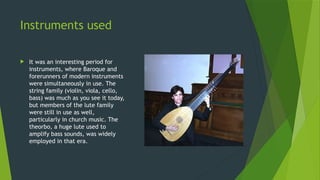
Instruments used
 It was an interesting period for
instruments, where Baroque and
forerunners of modern instruments
were simultaneously in use. The
string family (violin, viola, cello,
bass) was much as you see it today,
but members of the lute family
were still in use as well,
particularly in church music. The
theorbo, a huge lute used to
amplify bass sounds, was widely
employed in that era.
 Harpsichords had been replaced
by the pianoforte, which was
invented around 1700. Here is a
picture of Mozart’s own
instrument:
Modern brass and winds, which require highly skilled
metal-working, had many prototypes leading to the
instruments we use today. The serpent, a forerunner
of modern baritones and tubas, was in use in that era.
 Serpents were followed by
ophicleides “(ophis = serpent, kleis
= key/covering, therefore "keyed
serpent”)”, patented in 1821,
which were followed by
euphoniums and tubas.
Winds bore a lot more resemblance to their recorder
forebears. Here is a Bb clarinet circa 1780:
Here is a piece of roughly how it
sounded
composers
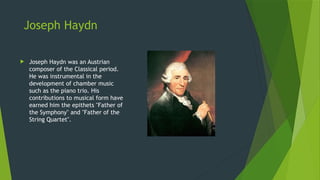
Joseph Haydn
 Joseph Haydn was an Austrian
composer of the Classical period.
He was instrumental in the
development of chamber music
such as the piano trio. His
contributions to musical form have
earned him the epithets "Father of
the Symphony" and "Father of the
String Quartet".
Johann Nepomuk
 Johann Nepomuk Hummel was an
Austrian composer and virtuoso
pianist. His music reflects the
transition from the Classical to the
Romantic musical era.
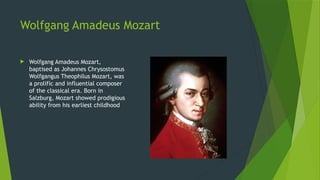
Wolfgang Amadeus Mozart
 Wolfgang Amadeus Mozart,
baptised as Johannes Chrysostomus
Wolfgangus Theophilus Mozart, was
a prolific and influential composer
of the classical era. Born in
Salzburg, Mozart showed prodigious
ability from his earliest childhood
Styles used
Classical” Music (1750-1820) ... The
composers of the early Classical period
changed direction, writing music that was
much simpler in texture. Homophony–
music in which melody and
accompaniment are distinct–dominated
the Classical style, and new forms of
composition were developed to
accommodate the transformation.
Classical period analysis from v=different learners

Classical period analysis from v=different learners

  • 1.
  • 2.
    The background  TheClassical period was an era of classical music between roughly 1730 and 1820. The Classical period falls between the Baroque and the Romantic periods. ... Instrumental music was considered important by Classical period composers.
  • 3.
     The Classicalperiod falls between the Baroque and the Romantic periods. Classical music has a lighter, clearer texture than Baroque music and is less complex. It is mainly homophonic, using a clear melody line over a subordinate chordal accompaniment, but counterpoint was by no means forgotten, especially later in the period. It also makes use of style gallant which emphasized light elegance in place of the Baroque's dignified seriousness and impressive grandeur. Variety and contrast within a piece became more pronounced than before and the orchestra increased in size, range, and power. More about the background
  • 4.
    Instruments used  Itwas an interesting period for instruments, where Baroque and forerunners of modern instruments were simultaneously in use. The string family (violin, viola, cello, bass) was much as you see it today, but members of the lute family were still in use as well, particularly in church music. The theorbo, a huge lute used to amplify bass sounds, was widely employed in that era.
  • 5.
     Harpsichords hadbeen replaced by the pianoforte, which was invented around 1700. Here is a picture of Mozart’s own instrument: Modern brass and winds, which require highly skilled metal-working, had many prototypes leading to the instruments we use today. The serpent, a forerunner of modern baritones and tubas, was in use in that era.
  • 6.
     Serpents werefollowed by ophicleides “(ophis = serpent, kleis = key/covering, therefore "keyed serpent”)”, patented in 1821, which were followed by euphoniums and tubas. Winds bore a lot more resemblance to their recorder forebears. Here is a Bb clarinet circa 1780:
  • 7.
    Here is apiece of roughly how it sounded
  • 8.
  • 9.
    Joseph Haydn  JosephHaydn was an Austrian composer of the Classical period. He was instrumental in the development of chamber music such as the piano trio. His contributions to musical form have earned him the epithets "Father of the Symphony" and "Father of the String Quartet".
  • 10.
    Johann Nepomuk  JohannNepomuk Hummel was an Austrian composer and virtuoso pianist. His music reflects the transition from the Classical to the Romantic musical era.
  • 11.
    Wolfgang Amadeus Mozart Wolfgang Amadeus Mozart, baptised as Johannes Chrysostomus Wolfgangus Theophilus Mozart, was a prolific and influential composer of the classical era. Born in Salzburg, Mozart showed prodigious ability from his earliest childhood
  • 12.
    Styles used Classical” Music(1750-1820) ... The composers of the early Classical period changed direction, writing music that was much simpler in texture. Homophony– music in which melody and accompaniment are distinct–dominated the Classical style, and new forms of composition were developed to accommodate the transformation.