CLASSICAL
MANAGEMENT
THEORY
DESIGNED AND MADE BY THE ONE AND
ONLY US
about
Constituent
Theories
FOUNDER
S
FEATURES
STRENGT
HS
WEAKNES
S
about
Constituent
Theories
FOUNDER
S
FEATURES
WEAKNES
S
Classical Management Theory is a branch of management theory
which evolved around 19th century. It was developed during the
Industrial revolution when problems related to Factory Systems began,
to recognize The role That Management plays in an organization
particularly Focusing on the efficiency of the work process.
Classical approach of management professes the body of
management though based on the belief that employees have
only economical and physical needs and that the social needs and
needs for job satisfaction either does not exist or are
unimportant.
STRENGTHS
about
Constituent
Theories
FOUNDER
S
FEATURES
STRENGT
HS
WEAKNES
S
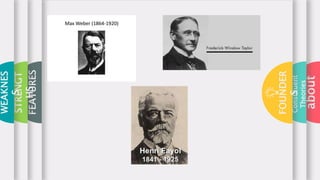
1. Scientific Management Theory - This theory was propounded by
Frederick Winslow Taylor. Taylor believed That by analysing Work in a
Scientific manner, it was possible to find the one best way to perform a
task. He felt That by organising Work in The most efficient way, the
organization’s productivity Would be increased, allowing it to reward
employees with additional remuneration, which Taylor argued was
employee’s only motivation.
2. Bureaucratic Management Theory - bureaucratic theory was
Developed a German Sociologist and political economist Max Weber
(1864-1920). According to Him, bureaucratic Is the most efficient From
of organization. The organization, has a well-defined line of authority. It
was clear rules an regulation which are strictly followed.
3. Administrative Management Theory - The First Expert of
Administrative Management theory was Henri Fayol (1841-1925).
Fayol is called the “Father of Modern Management”. According to the
Administrative Management Theory/School, management is the
process of getting Things done through people. Here importance is
given to groups and not Individuals.
about
Constituent
Theories
FOUNDER
S
FEATURES
STRENGT
HS
WEAKNES
S
about
Constituent
Theories
FOUNDER
S
FEATURES
STRENGT
HS
WEAKNES
S
 Management is viewed as a systematic process of interrelate
functions.
 Principle of Management are used as a guideline for the executives
 Function, principle and skills of management are universal.
 Formal education and training is needed for the Development of the
required skills.
 Emphasis is placed on the economic efficient
 People are motivated by economic gains and other incentives
 Classical theory pillar mainly stand on three pillars : Bureaucracy
Scientific management and Administration.
 Through this approach provides Specialization, Structure, rationality,
predictability and democracy but at the same time a lot of paperwork,
compartmentalization of work, rigidity and goal displacement is there.
about
FOUNDER
S
FEATURES
Constituent
Theories
STRENGT
HS
WEAKNES
S
about
FOUNDER
S
FEATURES
Constituent
Theories
STRENGT
HS
WEAKNES
S
Autocratic Leadership- the autocratic leadership approach is the
central part of classical management theory. It states that an
organization should have a single leader to make decisions , to
organize and direct the employees. All decisions are made at the level
and communicated down.
Monetary Incentive- According to classical management theory
employees should be motivated by monetary rewards. In other words,
they will work harder and become more productive if they have an
incentive to look forward to. This gives management easier control
over the workforce.
Division of Labour - One of the advantages of classical management
approach is the division of labour. Projects are broken down into
smaller tasks that are easy to complete. Employees responsibilities
and Expectations are clearly defined. This approach allow workers to
narrow their field of expertise and to specialize in one area.
Hierarchical Structure - One of the advantages of the classical
management structure is a clear organizational hierarchy with three
Distinct management levels. Each management group has its own
objectives and responsibilities.
about
Constituent
Theories
FOUNDER
S
FEATURES
STRENGT
HS
WEAKNES
S
 Untested Assumption - Manny of the assumption made by classical writers
were based not on scientific test but on value judgements that expressed what
they believed to be proper life-style, moral codes, and attitudes toward
success.
 Failure to consider the informed organization - in their stress on Formal
relationships in the organization, classical approaches tend to ignore informal
relations as characterized by social interchange among workers, the emergency
of group leaders apart from those specified by the formal organization, and so
forth.
 Static Conditions - Organization are influenced by external
conditions that often fluctuate over time, yet classical management,
theory present an image of an organization that is not shaped by
external influence.
 Human machinery - Classical theories leave the impression that the
organization is a machine and that workers are simply parts to be fitted into
the machine to make it run efficient. thus, many of the principles are
concerned first with making the organization efficient., with the assumption
that workers will conformed to the workers setting if the financial incentives
are agreeable.
REPORTERS:
JOVAN ROBENTA
ALBENDICT ZATE
LUIGI BUSTAMANTE
HADJI LEENASH BALLANGAN

CLASSICAL MANAGEMENT THEORY-1.pptx

  • 1.
    CLASSICAL MANAGEMENT THEORY DESIGNED AND MADEBY THE ONE AND ONLY US about Constituent Theories FOUNDER S FEATURES STRENGT HS WEAKNES S
  • 2.
    about Constituent Theories FOUNDER S FEATURES WEAKNES S Classical Management Theoryis a branch of management theory which evolved around 19th century. It was developed during the Industrial revolution when problems related to Factory Systems began, to recognize The role That Management plays in an organization particularly Focusing on the efficiency of the work process. Classical approach of management professes the body of management though based on the belief that employees have only economical and physical needs and that the social needs and needs for job satisfaction either does not exist or are unimportant. STRENGTHS
  • 3.
    about Constituent Theories FOUNDER S FEATURES STRENGT HS WEAKNES S 1. Scientific ManagementTheory - This theory was propounded by Frederick Winslow Taylor. Taylor believed That by analysing Work in a Scientific manner, it was possible to find the one best way to perform a task. He felt That by organising Work in The most efficient way, the organization’s productivity Would be increased, allowing it to reward employees with additional remuneration, which Taylor argued was employee’s only motivation. 2. Bureaucratic Management Theory - bureaucratic theory was Developed a German Sociologist and political economist Max Weber (1864-1920). According to Him, bureaucratic Is the most efficient From of organization. The organization, has a well-defined line of authority. It was clear rules an regulation which are strictly followed. 3. Administrative Management Theory - The First Expert of Administrative Management theory was Henri Fayol (1841-1925). Fayol is called the “Father of Modern Management”. According to the Administrative Management Theory/School, management is the process of getting Things done through people. Here importance is given to groups and not Individuals.
  • 4.
  • 5.
    about Constituent Theories FOUNDER S FEATURES STRENGT HS WEAKNES S  Management isviewed as a systematic process of interrelate functions.  Principle of Management are used as a guideline for the executives  Function, principle and skills of management are universal.  Formal education and training is needed for the Development of the required skills.  Emphasis is placed on the economic efficient  People are motivated by economic gains and other incentives  Classical theory pillar mainly stand on three pillars : Bureaucracy Scientific management and Administration.  Through this approach provides Specialization, Structure, rationality, predictability and democracy but at the same time a lot of paperwork, compartmentalization of work, rigidity and goal displacement is there.
  • 6.
  • 7.
    about FOUNDER S FEATURES Constituent Theories STRENGT HS WEAKNES S Autocratic Leadership- theautocratic leadership approach is the central part of classical management theory. It states that an organization should have a single leader to make decisions , to organize and direct the employees. All decisions are made at the level and communicated down. Monetary Incentive- According to classical management theory employees should be motivated by monetary rewards. In other words, they will work harder and become more productive if they have an incentive to look forward to. This gives management easier control over the workforce. Division of Labour - One of the advantages of classical management approach is the division of labour. Projects are broken down into smaller tasks that are easy to complete. Employees responsibilities and Expectations are clearly defined. This approach allow workers to narrow their field of expertise and to specialize in one area. Hierarchical Structure - One of the advantages of the classical management structure is a clear organizational hierarchy with three Distinct management levels. Each management group has its own objectives and responsibilities.
  • 8.
    about Constituent Theories FOUNDER S FEATURES STRENGT HS WEAKNES S  Untested Assumption- Manny of the assumption made by classical writers were based not on scientific test but on value judgements that expressed what they believed to be proper life-style, moral codes, and attitudes toward success.  Failure to consider the informed organization - in their stress on Formal relationships in the organization, classical approaches tend to ignore informal relations as characterized by social interchange among workers, the emergency of group leaders apart from those specified by the formal organization, and so forth.  Static Conditions - Organization are influenced by external conditions that often fluctuate over time, yet classical management, theory present an image of an organization that is not shaped by external influence.  Human machinery - Classical theories leave the impression that the organization is a machine and that workers are simply parts to be fitted into the machine to make it run efficient. thus, many of the principles are concerned first with making the organization efficient., with the assumption that workers will conformed to the workers setting if the financial incentives are agreeable.
  • 9.
    REPORTERS: JOVAN ROBENTA ALBENDICT ZATE LUIGIBUSTAMANTE HADJI LEENASH BALLANGAN

Editor's Notes

  • #2 Good Afternoon to all, ladies and gentlemen My name is Jovan Francis M. ROBENTA AND we are here to report to you the classical management theory.
  • #3 So first things first, What is classical management theory? Basically, classical management theory is…..So basically at that time, everything was changing and evolving. People were moving from farm to factories, from small shops to large companies due to the creation of machinery. Many emerging issue then came up that time, the industry was moving too fast, the companies were looking for answers regarding their situation at the time because people were working along side machinery which is too overwhelming for human beings at the time. So That’s why classical management theory was created, it was used as an approach to management that will manage organization to effectively and efficiently get things done. Continuing, the classical approach to management is……. So, the classical approach to management believes that the employees have only economical and physical needs in other words money. They don’t need those social relationships but only money. Kani mng gyng classical management theory they onlu view employees as mere numbers. Which means ilang sweldo mainly depends on their performance,
  • #4 Moving on,there are three constituents theory, the scientific management theory, bureaucratic management theory, and administrative management theory. The scientific management theory is a….So when we talk about scientific management theory, it is all About putting science into work, the one best way to do work through science. One example of this method was the brick laying study, in which Fredrick Taylor thought of ways to help workers change their motion and actions in laying bricks to efficiently do the work. The bureaucratic management theory was created by Max Weber due to his new thoughts of organizing a management. This approach to management has a strong set of rules and regulation that needs to be followed in order to attain the goal of the company. His main rule was that, employee must be divided into different levels and their role should be tied to the organization hierarchy. In other words, whatever is your role, you must be tied with it and be responsible with it. Lastly, The admistrative management theory was develop as an approach that would aid top managers in setting the direction of their company. Henri Fayol answered the question how to manage people. He also discuss here that it is crucial to Plan, Organize, Command, Coordinate, and Control in running a organization. His focus was on the direction and coordination of the whole organization, which is the domain of the top manager. So, all in all the constituents theory are the ones that make up the classical management theory, scientific management theory focuses on how to do work efficiently through putting science into work, then bureaucratic management theory is an approach to have good organizational heirarchy or structure with standardized hiring and firing rules and regulation and lastly the administrative management theory focuses on how to manage people.