Introduction
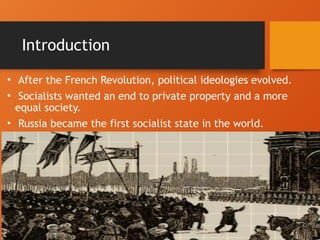
• After theFrench Revolution, political ideologies evolved.
• Socialists wanted an end to private property and a more
equal society.
• Russia became the first socialist state in the world.
3.
The Age ofSocial Change
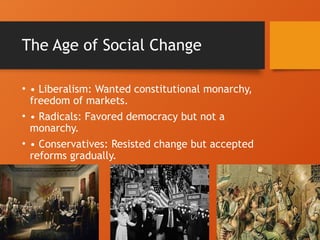
• • Liberalism: Wanted constitutional monarchy,
freedom of markets.
• • Radicals: Favored democracy but not a
monarchy.
• • Conservatives: Resisted change but accepted
reforms gradually.
4.
Liberals
Liberals wantedto bring change in society.
Liberals wanted secularism.
They opposed uncontrolled power of Dynastic Rulers.
They believe government should be elected by the
people.
The government should do that which is good for
people
They did not believe in Universal adult franchise.
Only Man can vote – Property
5.
Radicals
Radicals wanteda nation which
government was based on the majority
of a country’s population.
They opposed the privilages of great
landowners and wealthy factory
onwers.
6.
Conservatives
They werethe people who
supported monarchy and nobility.
They contended that gradual
changes should be brought in the
society.
7.
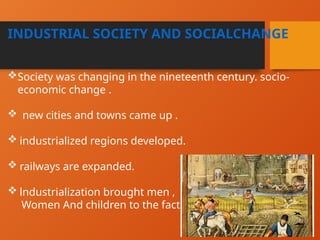
INDUSTRIAL SOCIETY ANDSOCIALCHANGE
Society was changing in the nineteenth century. socio-
economic change .
new cities and towns came up .
industrialized regions developed.
railways are expanded.
lndustrialization brought men ,
Women And children to the factories.
8.
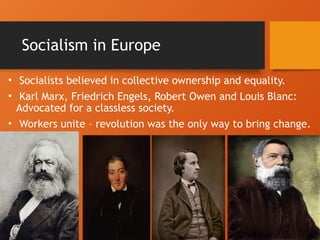
Socialism in Europe
•Socialists believed in collective ownership and equality.
• Karl Marx, Friedrich Engels, Robert Owen and Louis Blanc:
Advocated for a classless society.
• Workers unite – revolution was the only way to bring change.
9.
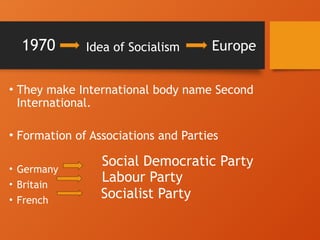
1970
• They makeInternational body name Second
International.
• Formation of Associations and Parties
• Germany
• Britain
• French
Idea of Socialism Europe
Social Democratic Party
Labour Party
Socialist Party
10.
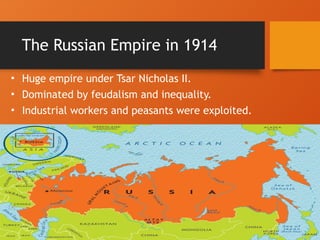
The Russian Empirein 1914
• Huge empire under Tsar Nicholas II.
• Dominated by feudalism and inequality.
• Industrial workers and peasants were exploited.
11.
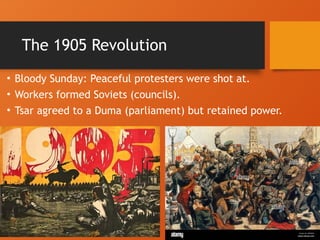
The 1905 Revolution
•Bloody Sunday: Peaceful protesters were shot at.
• Workers formed Soviets (councils).
• Tsar agreed to a Duma (parliament) but retained power.
12.
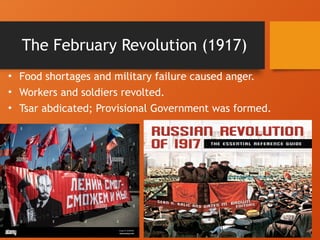
The February Revolution(1917)
• Food shortages and military failure caused anger.
• Workers and soldiers revolted.
• Tsar abdicated; Provisional Government was formed.
13.
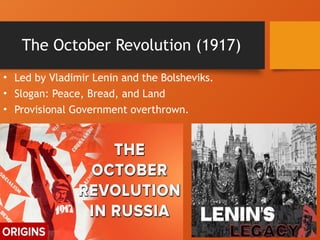
The October Revolution(1917)
• Led by Vladimir Lenin and the Bolsheviks.
• Slogan: Peace, Bread, and Land
• Provisional Government overthrown.
14.
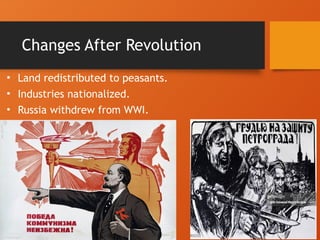
Changes After Revolution
•Land redistributed to peasants.
• Industries nationalized.
• Russia withdrew from WWI.
15.
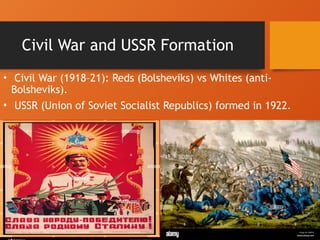
Civil War andUSSR Formation
• Civil War (1918–21): Reds (Bolsheviks) vs Whites (anti-
Bolsheviks).
• USSR (Union of Soviet Socialist Republics) formed in 1922.
16.
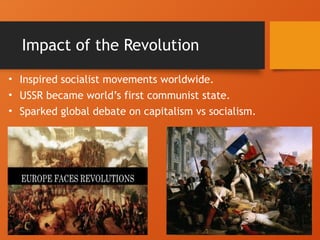
Impact of theRevolution
• Inspired socialist movements worldwide.
• USSR became world’s first communist state.
• Sparked global debate on capitalism vs socialism.
17.
Conclusion
• Russian Revolutionchanged history and
inspired global change.
• Shift from monarchy to socialism.
• Lessons on equality, power, and the people's
voice.



![[25]9th_History_Chapter_2_Socialism_in_Europe_and_the_Russian_Revolution1.pdf](https://cdn.slidesharecdn.com/ss_thumbnails/259thhistorychapter2socialismineuropeandtherussianrevolution1-240701120433-d6b73b50-thumbnail.jpg?width=640&height=640&fit=bounds)


