Notice and Particulars
&
Concurrent Delays
Notice and
Particulars
• Purpose of Notice:
• The primary purpose of issuing a notice is to ensure
that breaches, delays, or losses are promptly
addressed to prevent further negative
consequences such as escalating costs or
extended delays.
• Notices provide a formal mechanism to
communicate issues with clear expectations for
remedying them or mitigating their impacts.
Requirements for a Valid Notice:
BREACH DETAILS
AND LEGAL CLAUSES
COMPREHENSIVE
INFORMATION ON
DELAY
RELEVANT DATES
AND PERIODS
IMPACT ON
COMPLETION DATE
Breach Details
and Legal
Clauses
It is crucial to specify the breach in clear terms and
cite the specific clauses in the contract that have
been breached. These could include provisions
related to time, quality, or performance standards.
Comprehensive
Information on
Delay
Provide detailed information about the delay, such as
the reasons for it (e.g., weather, labor disputes,
material shortages), the period during which the delay
occurred, and the expected impact on the project
schedule.
Relevant
Dates and
Periods
The notice should include key dates, such as when
the breach or delay was first observed, when the
notice was issued, and how long the delay is expected
to last.
Impact on
Completion
Date
The notice should indicate how the delay or breach
affects the final completion date of the project. This
will allow the recipient to assess the impact on the
overall project timeline and decide whether an
extension of time is required.
Client’s Role
The client or project manager plays an essential role in
reviewing the notice. They must verify the facts presented,
ensuring that the delay or breach is correctly identified and
that the information is complete and accurate.
If any part of the notice seems unclear or
subjective, the client should request clarification
or provide additional documentation before
proceeding.
Importance of Timely Notice in
Construction Claims
Consequences of Failing to Provide
Timely Notice:
Waiver of Rights
Exposure to Penalties
Increased Disputes
Benefits of Proper Notice:
Encourages Early Problem Resolution
Promotes Cooperation
Legal Precedents
Concurrent
Delays
• What are Concurrent Delays?
• Concurrent delays occur when multiple delays,
caused by independent factors, occur at the same
time and overlap. For example, a delay due to late
design submissions from a consultant could
happen alongside a delay caused by a labor
dispute affecting critical work.
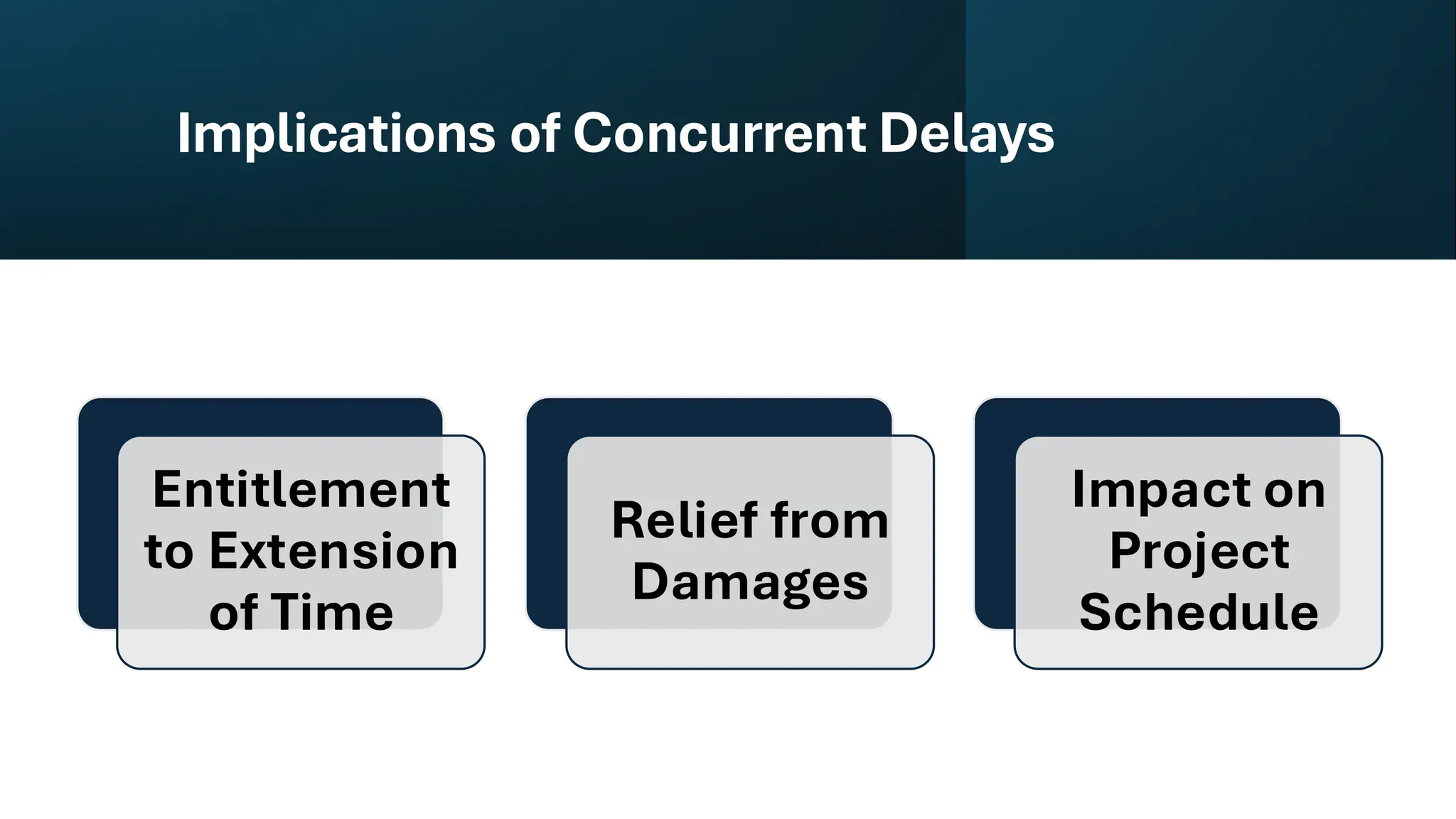
Implications of Concurrent Delays
Entitlement
to Extension
of Time
Relief from
Damages
Impact on
Project
Schedule
Entitlement
to Extension
of Time
Contractors are generally entitled to an extension of time
to complete the project if concurrent delays occur, as the
delays are typically considered beyond their control.
Relief from
Damages
While the contractor may be relieved from penalties for
delay, they are generally not entitled to compensation for
losses or expenses caused by the delay since the
responsibility for the delays is shared.
Impact on
Project
Schedule
The delays may impact the project schedule, but the
contractor can request an extension without incurring
financial penalties if they can demonstrate that the delays
were out of their control.
MSCM 601
CONTRACTS AND LEGAL ASPECTS
IN CONSTRUCTION MANAGEMENT
Module 8: Claims in the Philippines
POLYTECHNIC UNIVERSITY OF THE PHILIPPINES
OPEN UNIVERSITY SYSTEM
MASTER OF SCIENCE IN CONSTRUCTION MANAGEMENT
PRESENTER: CASTRO, MARK KIMUEL B.
Introduction
Construction projects in the Philippines often face
various challenges, from delays to unexpected costs,
that can lead to formal claims between contractors,
project owners, and other stakeholders. Claims are
an integral part of construction contracts, arising
when there is a perceived breach or failure to fulfill
the agreed obligations. Managing these claims
effectively is critical to avoiding protracted disputes,
project delays, and additional expenses. This report
explores the legal and contractual framework
governing claims in the Philippine construction
industry.
02.
Claims
Commonly arise between the parties to
construction contracts. This can be as a
result of problems such as delays, changes,
unforeseen circumstances, insufficient
information and conflicts. Claims might be
made for things such as loss and expense,
extension of time and liquidated damages.
The contract should set out exactly what
can constitute a claim and how it should be
dealt with. There may also be claims
associated with the appointment of
consultants.
03.
Claims Must Be Properly
Constituted and Documented:
04.
Proper legal entitlement must be
established.
Cause and effect must be clearly
demonstrated by contemporaneous
records.
Additional costs must be backed up by
full supporting documents.
05.
Unmerited and exaggerated claims should not be made, and
claimants should avoid unnecessary optimism when reporting
settlement figures to managers and should be willing to accept a
reasonable offer of settlement without recourse to expensive legal
action, which occupies management resources that would be
better utilized elsewhere. There is no guarantee of success in
court.
Clients
The client should keep mind:
The desirability of avoiding claims.
Their obligation to resolve proper claim
entitlements in an efficient and
professional way.
Investing in front-end surveys,
particularly ground investigation and
topographical surveys, can help reduce
the likelihood of claims.
06.
Clients
The client should keep mind:
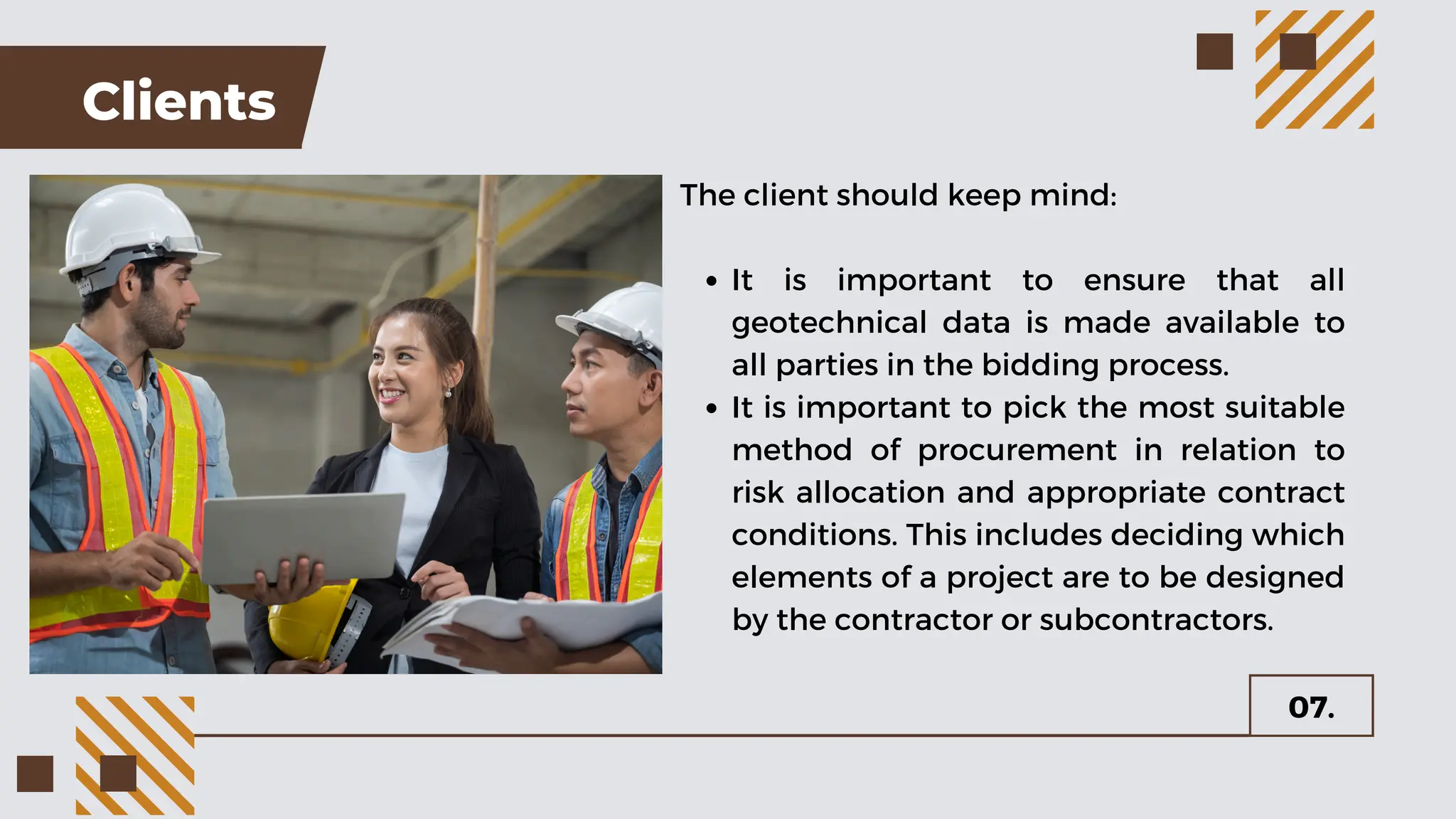
It is important to ensure that all
geotechnical data is made available to
all parties in the bidding process.
It is important to pick the most suitable
method of procurement in relation to
risk allocation and appropriate contract
conditions. This includes deciding which
elements of a project are to be designed
by the contractor or subcontractors.
07.
Clients
The client should keep mind:
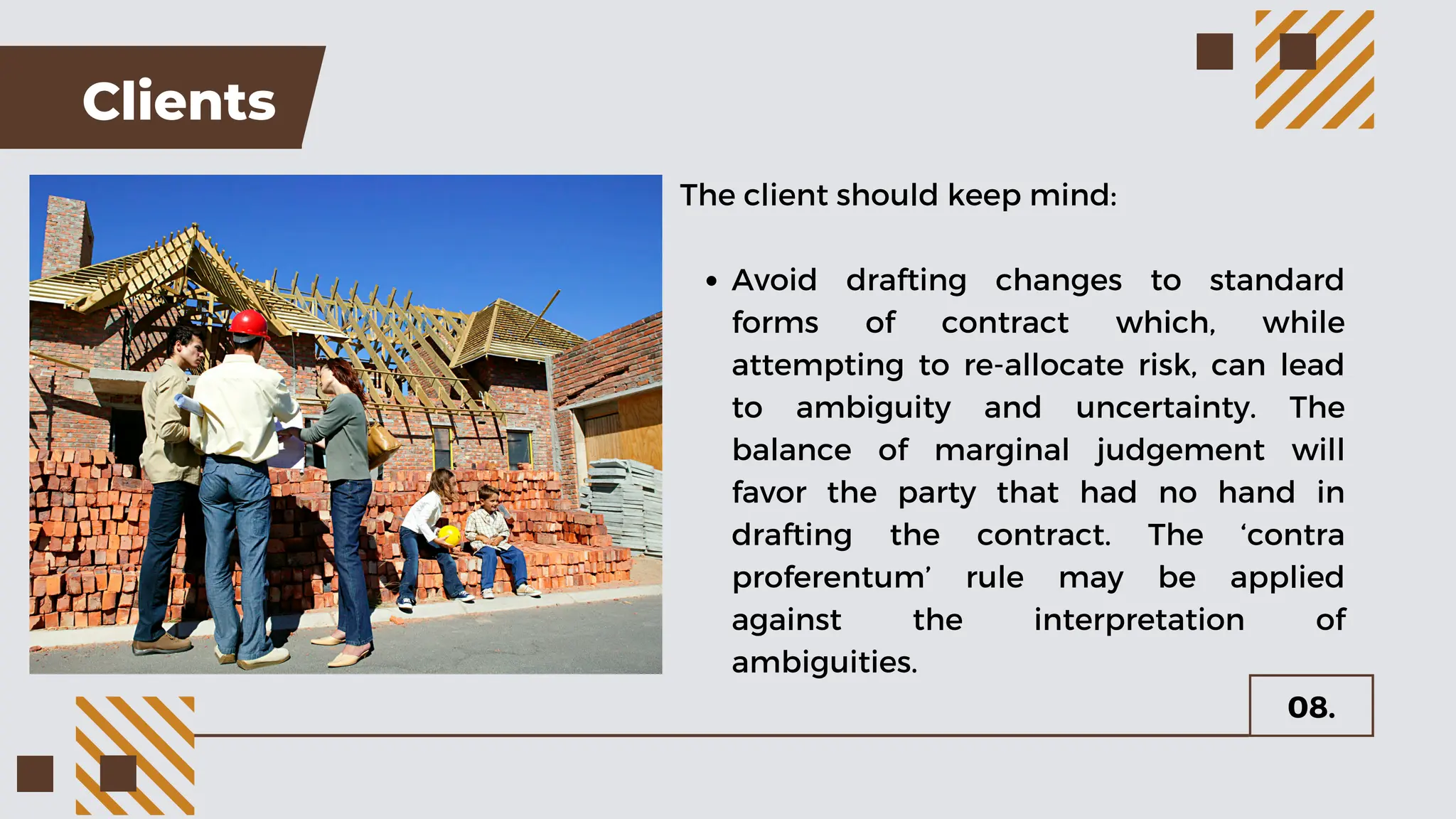
Avoid drafting changes to standard
forms of contract which, while
attempting to re-allocate risk, can lead
to ambiguity and uncertainty. The
balance of marginal judgement will
favor the party that had no hand in
drafting the contract. The ‘contra
proferentum’ rule may be applied
against the interpretation of
ambiguities.
08.
Clients
The client should keep mind:
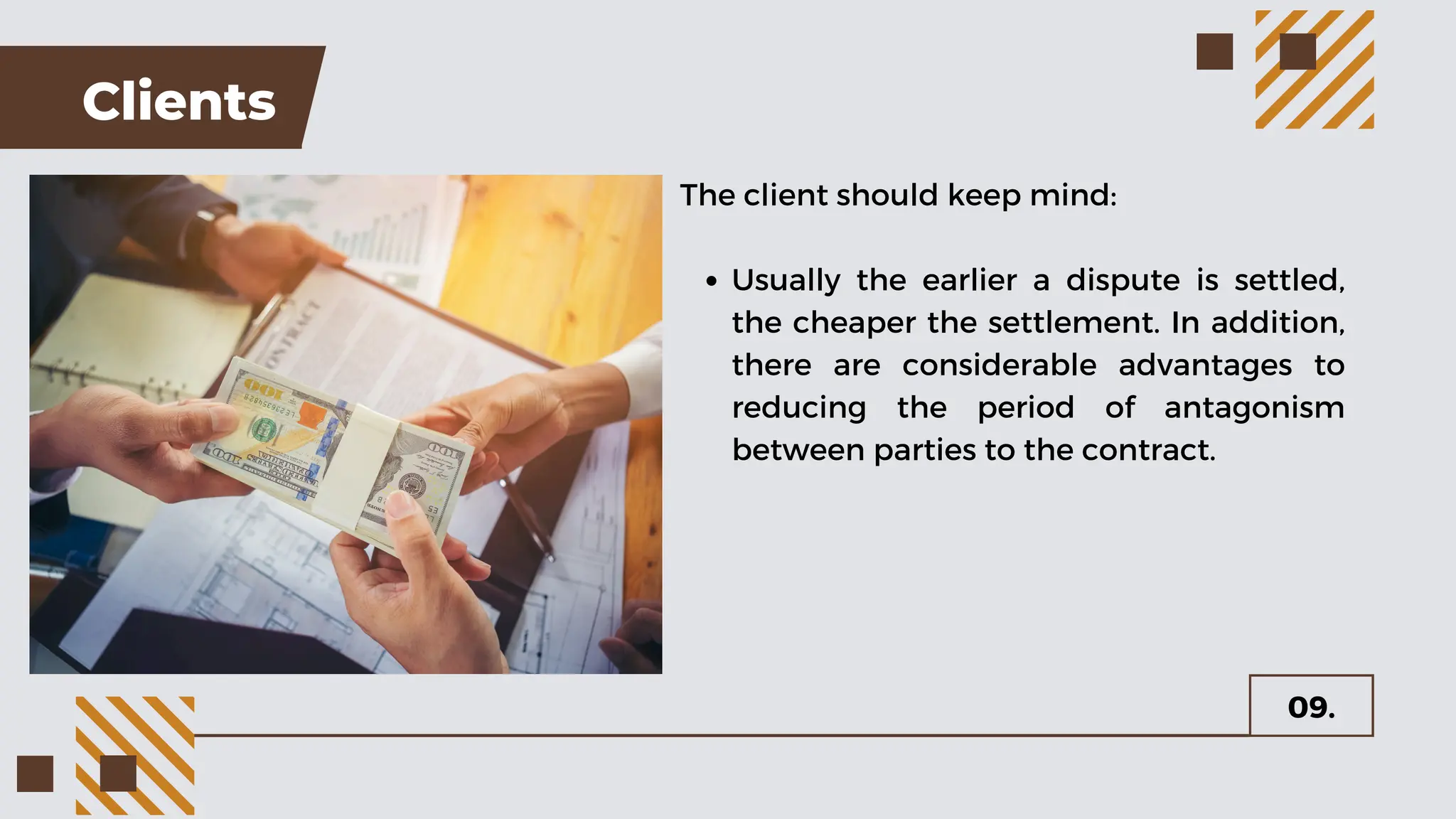
Usually the earlier a dispute is settled,
the cheaper the settlement. In addition,
there are considerable advantages to
reducing the period of antagonism
between parties to the contract.
09.
THANK
YOU
Module #8: Claims
(Continuation)
Contractor's Master Program
Cause and Effects in Construction Claims
Presenter: Ar. Ednalyn Turalba, UAP, RMP
POLYTECHNIC UNIVERSITY OF THE PHILIPPINES
OPEN UNIVERSITY SYSTEM
MASTERS OF SCIENCE IN CONSTRUCTION MANAGEMENT
Contractor’s Master Program
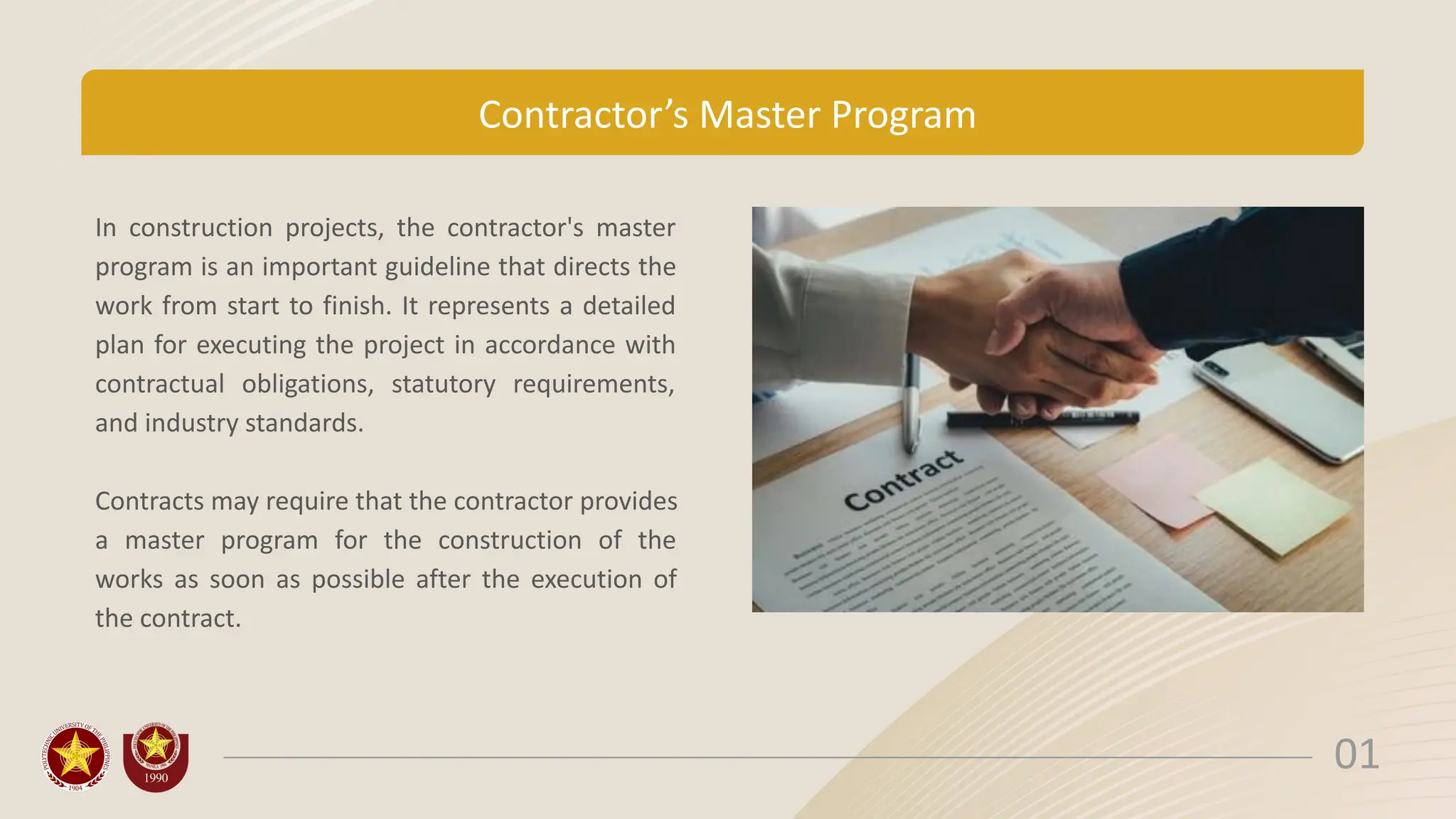
In construction projects, the contractor's master
program is an important guideline that directs the
work from start to finish. It represents a detailed
plan for executing the project in accordance with
contractual obligations, statutory requirements,
and industry standards.
Contracts may require that the contractor provides
a master program for the construction of the
works as soon as possible after the execution of
the contract.
01
Importance of the Contractor's Master Program
1. Sequencing and Coordination: Logical sequence of construction activities, ensuring efficient
coordination of resources, manpower, and equipment.
2. Time Management: By establishing realistic timelines and critical paths, the master programme
facilitates effective time management, enabling timely completion of the project.
3. Risk Management: Identification of potential bottlenecks, dependencies, and resource
constraints allows for proactive risk mitigation strategies, minimizing project delays and cost
overruns.
4. Communication Tool: It serves as a communication tool, providing stakeholders with a clear
understanding of project milestones, progress, and anticipated timelines.
02
Components of the Contractor's Master Program
A comprehensive contractor's master program typically comprises the following components:
1. Project Scope and Objectives: An overview of the project scope, objectives, and deliverables
2. Work Breakdown Structure (WBS): Hierarchical breakdown of project tasks
3. Activity Sequencing: Logical sequencing of construction activities
4. Resource Allocation: Allocation of resources such as labor, materials, and equipment
5. Duration Estimation: Estimating activity durations based on historical data, expert judgment, and
project-specific factors.
6. Critical Path Analysis: Identification of the critical path, which represents the longest sequence of
activities determining the project's minimum duration.
7. Milestones and Deliverables
03
Contractual Implications and Obligations
The contractor's master programme holds significant contractual implications, as it forms an integral part of
the contract documents. Key considerations include:
1. Timely Submission
2. Compliance with Contract Documents
3. Contract Administrator's Role
4. Basis for Claims and Extensions of Time
5. Update and Maintenance
04
Role in Project Execution and Dispute Resolution
Throughout the project lifecycle, the contractor's master programme plays a pivotal role in facilitating
effective project execution and resolving disputes. Its functions include:
1. Performance Monitoring
2. Communication and Collaboration
3. Dispute Resolution
4. Negotiation Tool
05
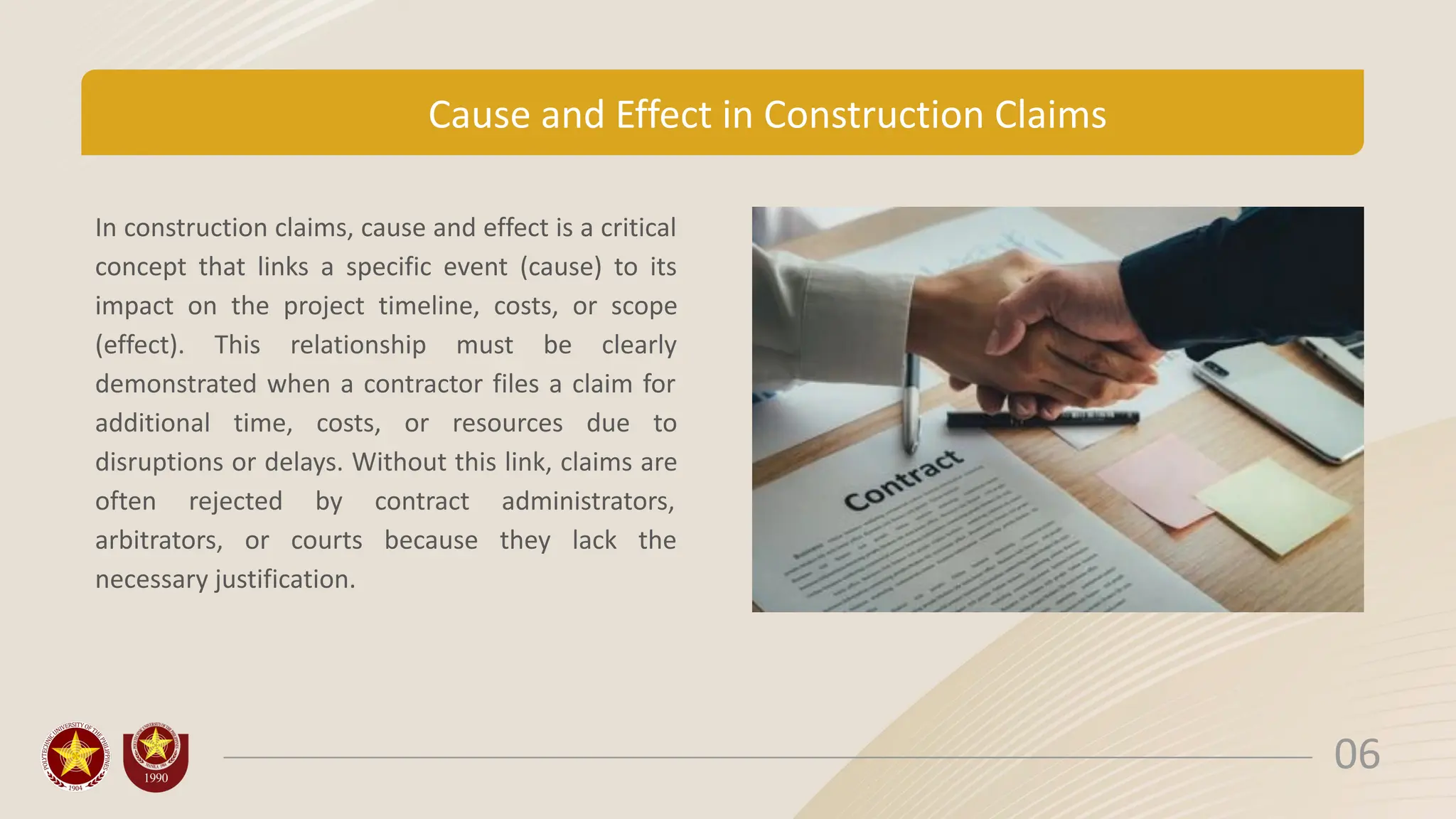
Cause and Effect in Construction Claims
In construction claims, cause and effect is a critical
concept that links a specific event (cause) to its
impact on the project timeline, costs, or scope
(effect). This relationship must be clearly
demonstrated when a contractor files a claim for
additional time, costs, or resources due to
disruptions or delays. Without this link, claims are
often rejected by contract administrators,
arbitrators, or courts because they lack the
necessary justification.
06
Key Points of Cause and Effect in Construction Claims
1. Cause: This is the event that disrupts the project, such as:
○ Delayed approvals or permits
○ Adverse weather conditions
○ Design changes or scope modifications
○ Resource shortages or late deliveries
2. Effect: This is the consequence of the cause, often visible in:
○ Project delays (affecting the schedule)
○ Increased costs (labor, materials, equipment)
○ Impact on resource allocation (manpower or machinery shifts)
07
Importance of Demonstrating Cause and Effect
For a claim to be valid, it must establish how the event (cause) specifically impacted the project’s critical path
or overall outcomes (effect). For example, if heavy rain delays the concrete pour for foundations, the delay
may push back other dependent activities. To justify an extension of time (EOT) or other compensations, the
contractor needs to show how this weather delay directly affected the schedule.
08
Methods of Demonstrating Cause and Effect
Several delay analysis methods are used to demonstrate cause and effect:
● As-Planned vs. As-Built Analysis: Compares planned schedules with actual progress to show
discrepancies caused by disruptions.
● Critical Path Analysis: Examines how delays impacted the longest path of dependent tasks, affecting
project completion.
● Time Impact Analysis: Adds potential delay events to the project schedule to assess their prospective
impact.
09
Practical Example
Suppose a contractor submits a claim for an extension of time due to a delayed material delivery. To validate
this claim, they would need to:
● Identify the original schedule for the material delivery (planned).
● Show the actual delay and its duration (actual).
● Demonstrate how the delay in receiving the material impacted the construction sequence and
completion date.
By proving cause and effect, the contractor can strengthen the claim, making it more likely to be accepted
and resolved fairly.
10
MSCM 601: CONTRACTS & LEGAL ASPECTS IN CONSTRUCTION MANAGEMENT
TENDER
20
24
DOCUMENTATION
TOPIC 7: CLAIMS
PRESENTED BY:
BRAVES ANTHONY C. GAPUSAN
WHAT IS
TENDER?
A tender is a written document that describes a construction
project and invites contractors to submit bids for completing it.
The tendering process is a formal way to select a contractor or
supplier for a construction project.
The term “tender” is more common than “bid”.
In some countries, tendering is also known as bidding
Not all main contracts go to tender.
RRL:
Gamboa, Chloe. “How the Tendering Process Works for Construction Projects.” BCI Central, 2 May 2023, www.bcicentral.com/blog/how-the-tendering-process-works-for-construction-projects/.
Johnson, Eve. “What Is Tender in Construction?” CPD Online College, 31 Aug. 2022, cpdonline.co.uk/knowledge-base/health-and-safety/tender-in-construction/.
The tendering process involves the following steps:
Invitation to tender
The client issues a request for tender (RFT) or invitation to tender
(ITT) to contractors and suppliers.
Tender Documents
Contractors prepare and submit documents that include pricing,
project schedules, technical specifications, and qualifications.
Evaluation
The client evaluates the bids based on criteria such as cost, quality,
experience, and realism of the plans.
Selection
The client chooses the contractor with the best proposal.
Negotiation
The client may invite the selected contractor to a meeting to
negotiate the details of the contract.
There are different types of tenders, including open, selective, and
negotiated, each with their own advantages and challenges.
RRL:
Gamboa, Chloe. “How the Tendering Process Works for Construction Projects.” BCI Central, 2 May 2023, www.bcicentral.com/blog/how-the-tendering-process-works-for-construction-projects/.
Johnson, Eve. “What Is Tender in Construction?” CPD Online College, 31 Aug. 2022, cpdonline.co.uk/knowledge-base/health-and-safety/tender-in-construction/.
What are the contents of Bidding Documents?
The Philippine Bidding Documents (PBDs) contain the following:
Invitation to Apply for Eligibility and to Bid (IAEB);
1.
Eligibility Documents;
2.
Eligibility Data Sheet;
3.
Instructions to Bidders (ITB);
4.
Bid Data Sheet (BDS);
5.
General Conditions of Contract (GCC);
6.
Special Conditions of Contract (SCC);
7.
Specifications;
8.
Drawings;
9.
Bill of Quantities; and
10.
Forms and Qualification Information.
11.
RRL:
Commission on Audit. Preparing the Bidding Documents. www.coa.gov.ph/wp-content/uploads/ABC-Help/Updated_Guidelines_in_the_Audit_of_Procurement/Annex%207/Section2-5.htm.
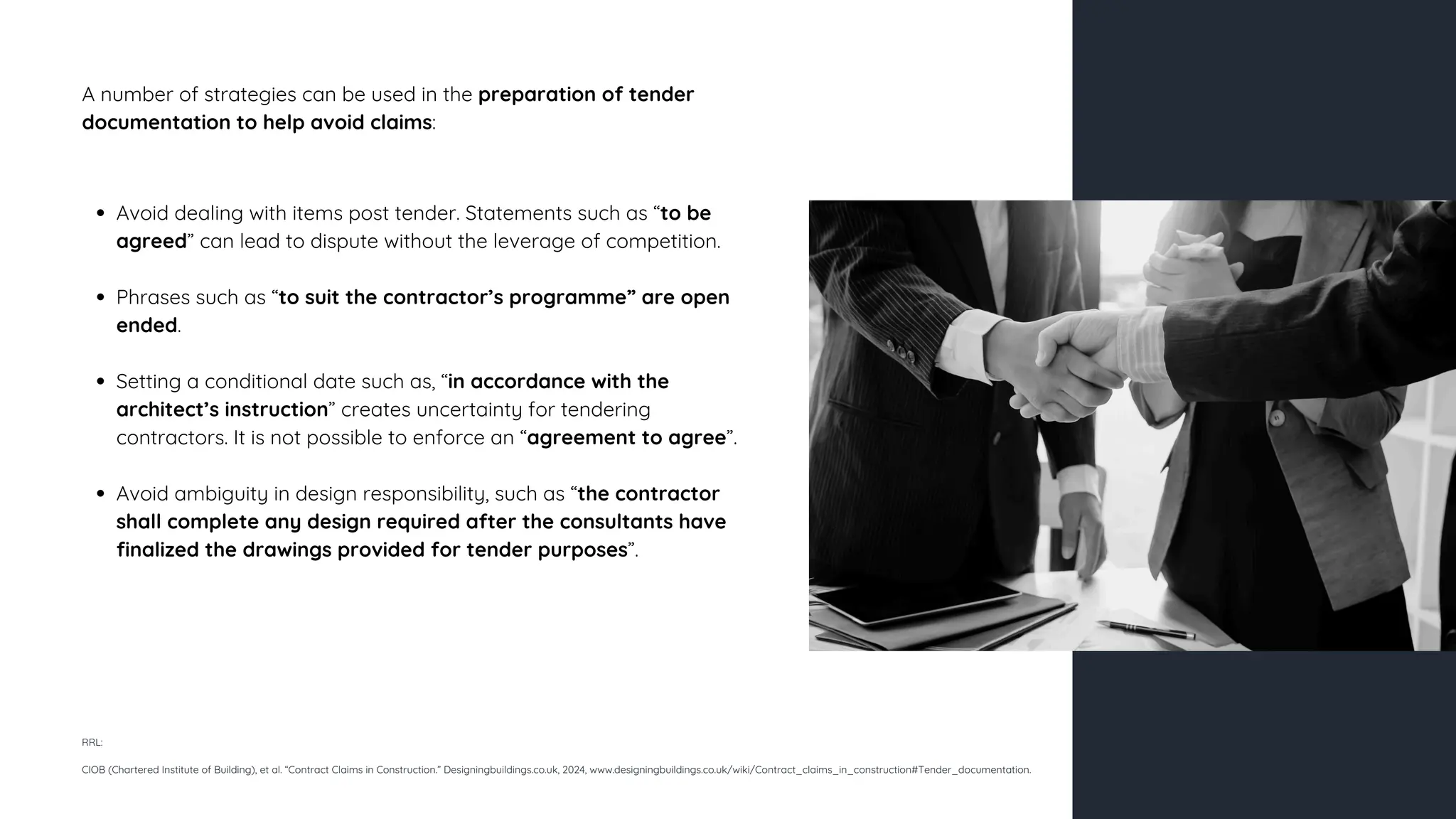
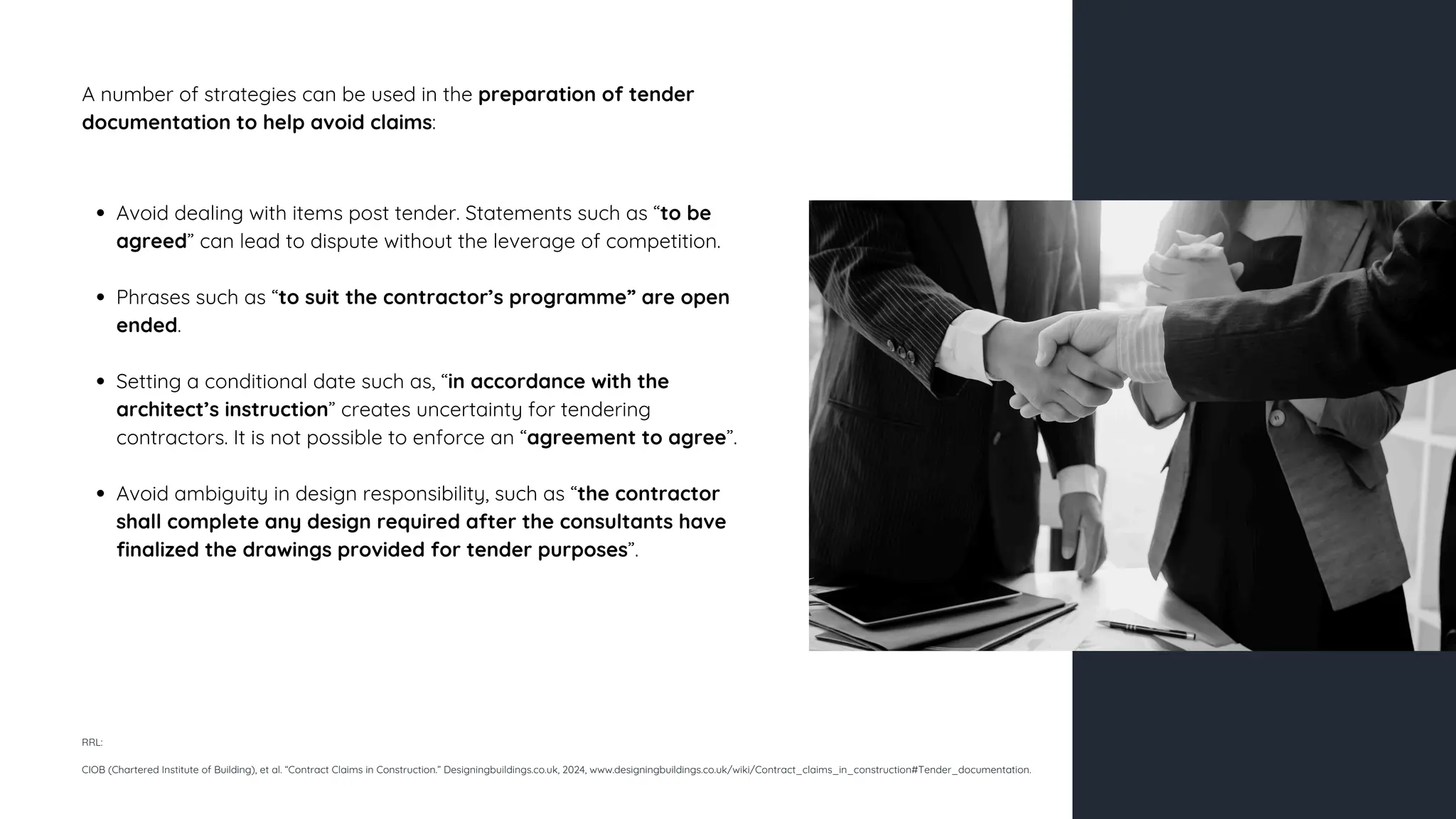
A number of strategies can be used in the preparation of tender
documentation to help avoid claims:
Avoid dealing with items post tender. Statements such as “to be
agreed” can lead to dispute without the leverage of competition.
Phrases such as “to suit the contractor’s programme” are open
ended.
Setting a conditional date such as, “in accordance with the
architect’s instruction” creates uncertainty for tendering
contractors. It is not possible to enforce an “agreement to agree”.
Avoid ambiguity in design responsibility, such as “the contractor
shall complete any design required after the consultants have
finalized the drawings provided for tender purposes”.
RRL:
CIOB (Chartered Institute of Building), et al. “Contract Claims in Construction.” Designingbuildings.co.uk, 2024, www.designingbuildings.co.uk/wiki/Contract_claims_in_construction#Tender_documentation.
A number of strategies can be used in the preparation of tender
documentation to help avoid claims:
Avoid dealing with items post tender. Statements such as “to be
agreed” can lead to dispute without the leverage of competition.
Phrases such as “to suit the contractor’s programme” are open
ended.
Setting a conditional date such as, “in accordance with the
architect’s instruction” creates uncertainty for tendering
contractors. It is not possible to enforce an “agreement to agree”.
Avoid ambiguity in design responsibility, such as “the contractor
shall complete any design required after the consultants have
finalized the drawings provided for tender purposes”.
RRL:
CIOB (Chartered Institute of Building), et al. “Contract Claims in Construction.” Designingbuildings.co.uk, 2024, www.designingbuildings.co.uk/wiki/Contract_claims_in_construction#Tender_documentation.
MSCM 601: CONTRACTS & LEGAL ASPECTS IN CONSTRUCTION MANAGEMENT
DESIGN
20
24
PRESENTED BY:
BRAVES ANTHONY C. GAPUSAN
TOPIC 7: CLAIMS
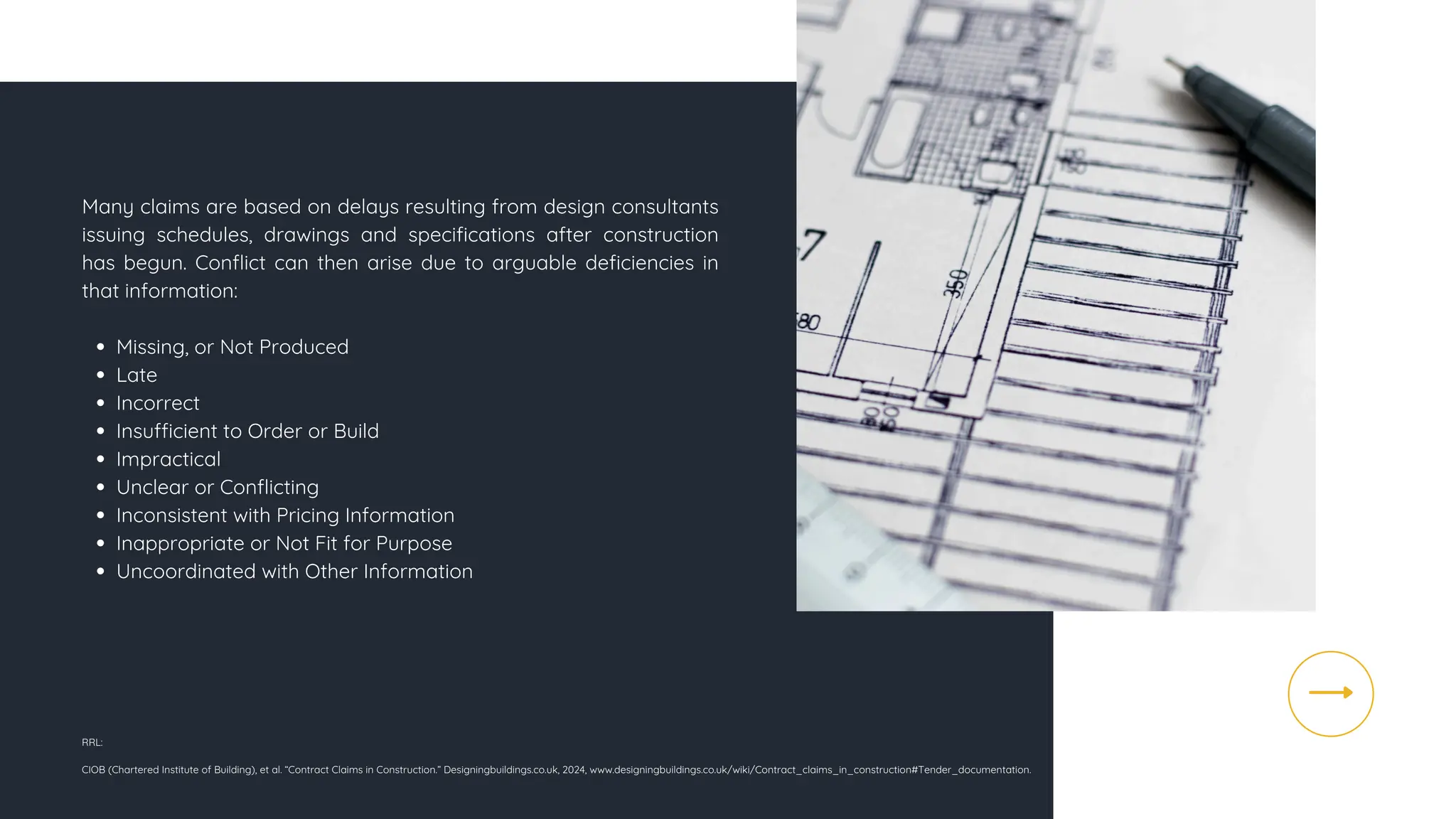
Many claims are based on delays resulting from design consultants
issuing schedules, drawings and specifications after construction
has begun. Conflict can then arise due to arguable deficiencies in
that information:
Missing, or Not Produced
Late
Incorrect
Insufficient to Order or Build
Impractical
Unclear or Conflicting
Inconsistent with Pricing Information
Inappropriate or Not Fit for Purpose
Uncoordinated with Other Information
RRL:
CIOB (Chartered Institute of Building), et al. “Contract Claims in Construction.” Designingbuildings.co.uk, 2024, www.designingbuildings.co.uk/wiki/Contract_claims_in_construction#Tender_documentation.
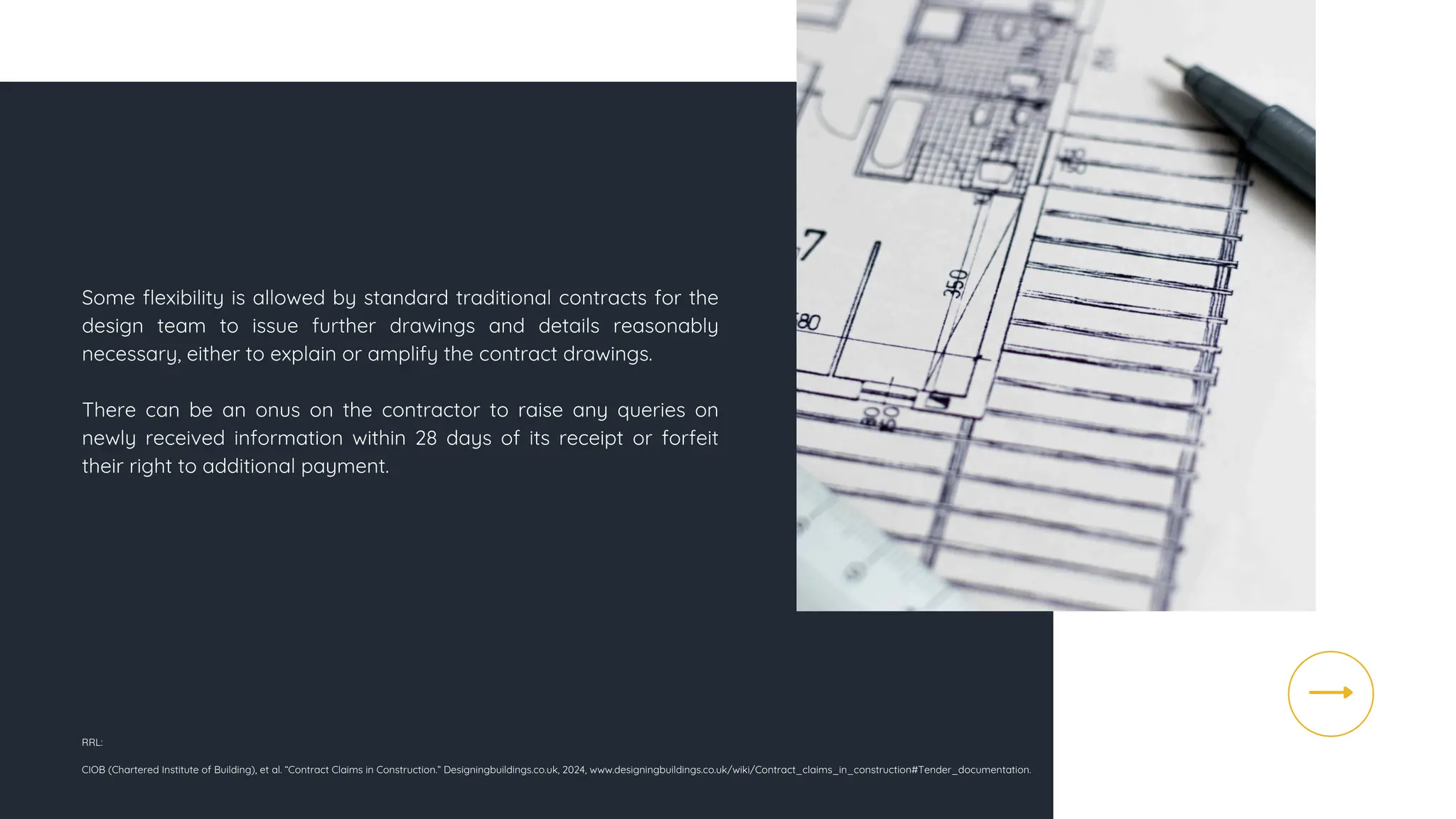
Some flexibility is allowed by standard traditional contracts for the
design team to issue further drawings and details reasonably
necessary, either to explain or amplify the contract drawings.
There can be an onus on the contractor to raise any queries on
newly received information within 28 days of its receipt or forfeit
their right to additional payment.
RRL:
CIOB (Chartered Institute of Building), et al. “Contract Claims in Construction.” Designingbuildings.co.uk, 2024, www.designingbuildings.co.uk/wiki/Contract_claims_in_construction#Tender_documentation.
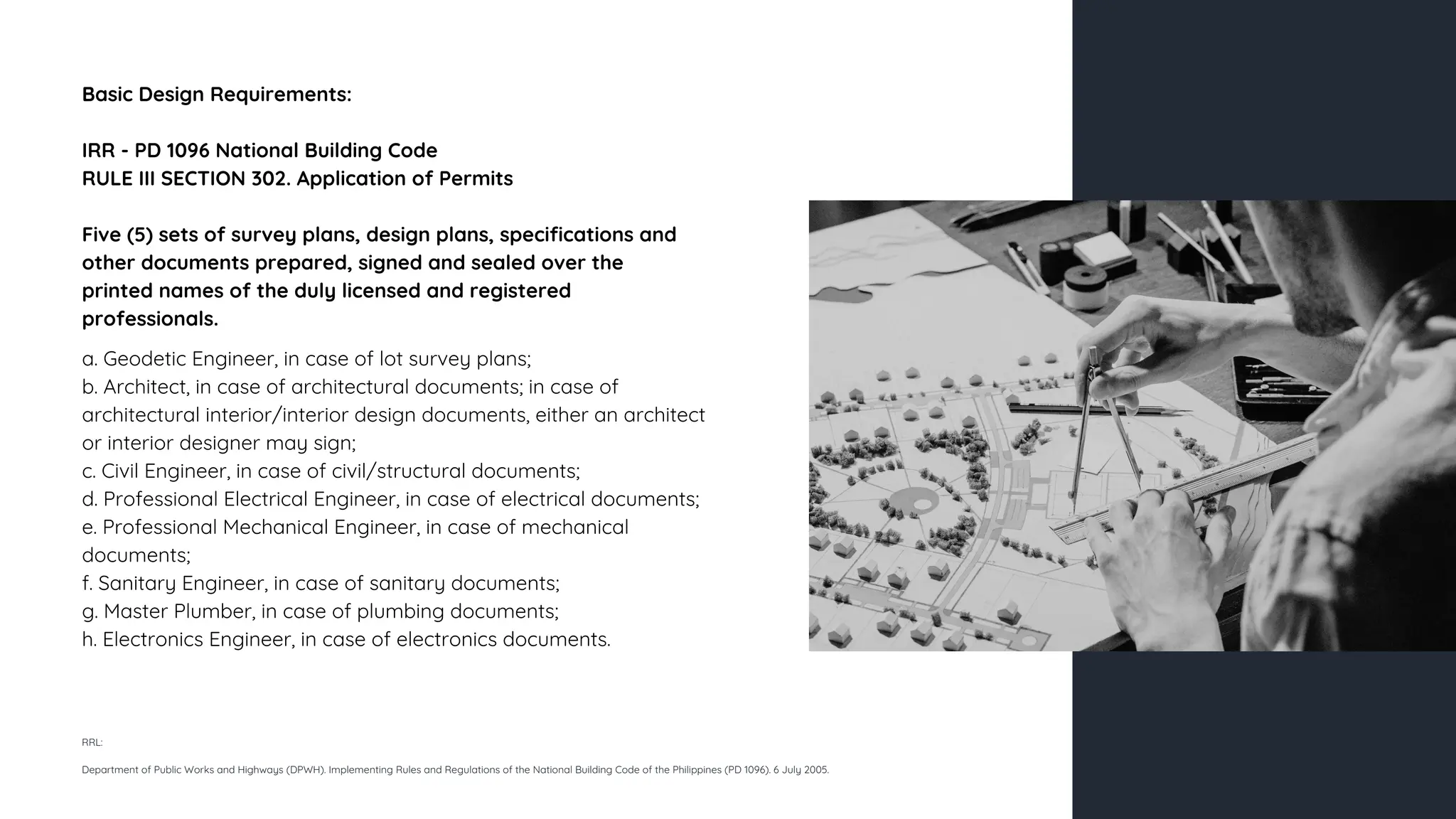
Basic Design Requirements:
IRR - PD 1096 National Building Code
RULE III SECTION 302. Application of Permits
Five (5) sets of survey plans, design plans, specifications and
other documents prepared, signed and sealed over the
printed names of the duly licensed and registered
professionals.
a. Geodetic Engineer, in case of lot survey plans;
b. Architect, in case of architectural documents; in case of
architectural interior/interior design documents, either an architect
or interior designer may sign;
c. Civil Engineer, in case of civil/structural documents;
d. Professional Electrical Engineer, in case of electrical documents;
e. Professional Mechanical Engineer, in case of mechanical
documents;
f. Sanitary Engineer, in case of sanitary documents;
g. Master Plumber, in case of plumbing documents;
h. Electronics Engineer, in case of electronics documents.
RRL:
Department of Public Works and Highways (DPWH). Implementing Rules and Regulations of the National Building Code of the Philippines (PD 1096). 6 July 2005.
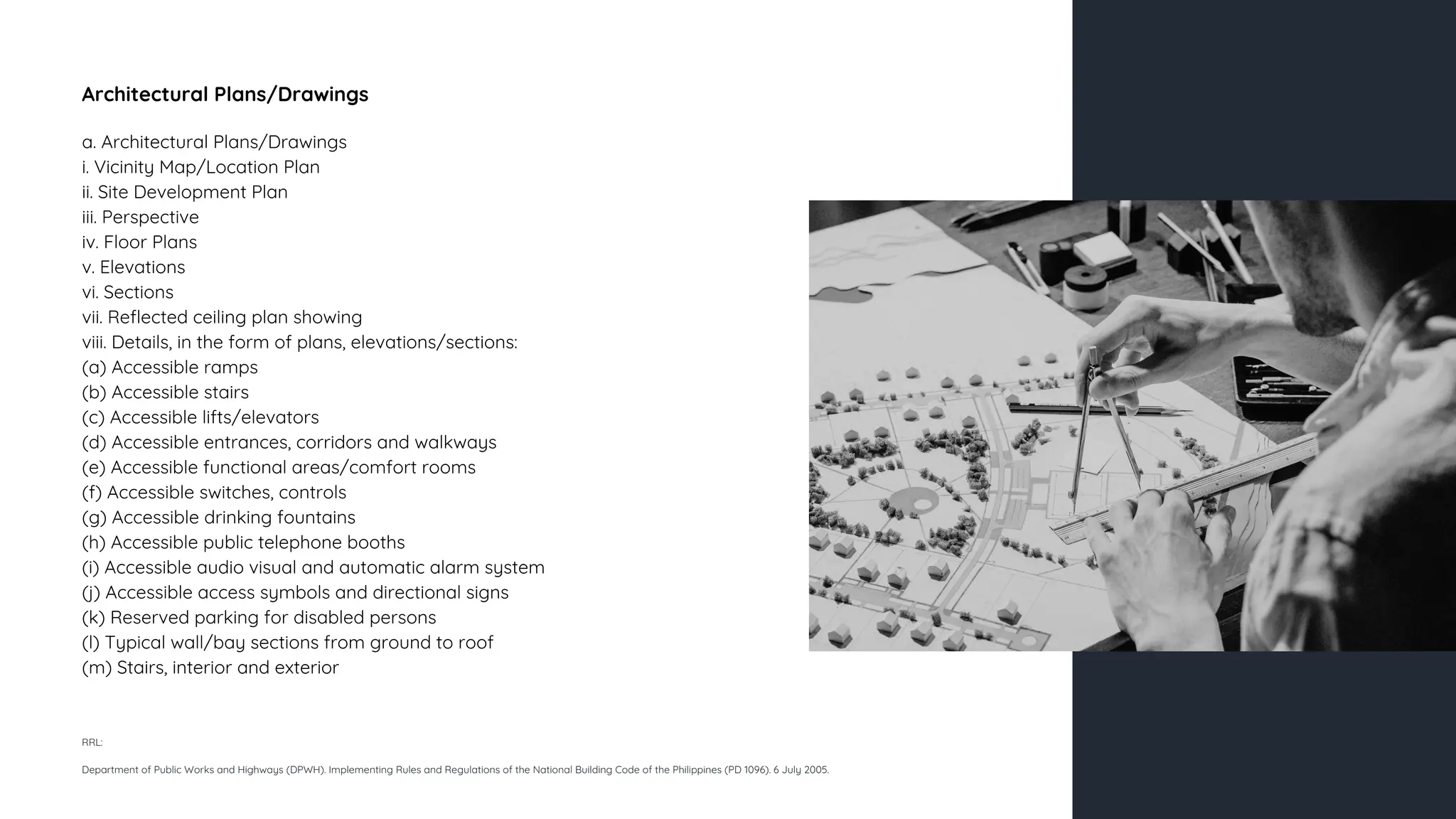
Architectural Plans/Drawings
a. Architectural Plans/Drawings
i. Vicinity Map/Location Plan
ii. Site Development Plan
iii. Perspective
iv. Floor Plans
v. Elevations
vi. Sections
vii. Reflected ceiling plan showing
viii. Details, in the form of plans, elevations/sections:
(a) Accessible ramps
(b) Accessible stairs
(c) Accessible lifts/elevators
(d) Accessible entrances, corridors and walkways
(e) Accessible functional areas/comfort rooms
(f) Accessible switches, controls
(g) Accessible drinking fountains
(h) Accessible public telephone booths
(i) Accessible audio visual and automatic alarm system
(j) Accessible access symbols and directional signs
(k) Reserved parking for disabled persons
(l) Typical wall/bay sections from ground to roof
(m) Stairs, interior and exterior
RRL:
Department of Public Works and Highways (DPWH). Implementing Rules and Regulations of the National Building Code of the Philippines (PD 1096). 6 July 2005.
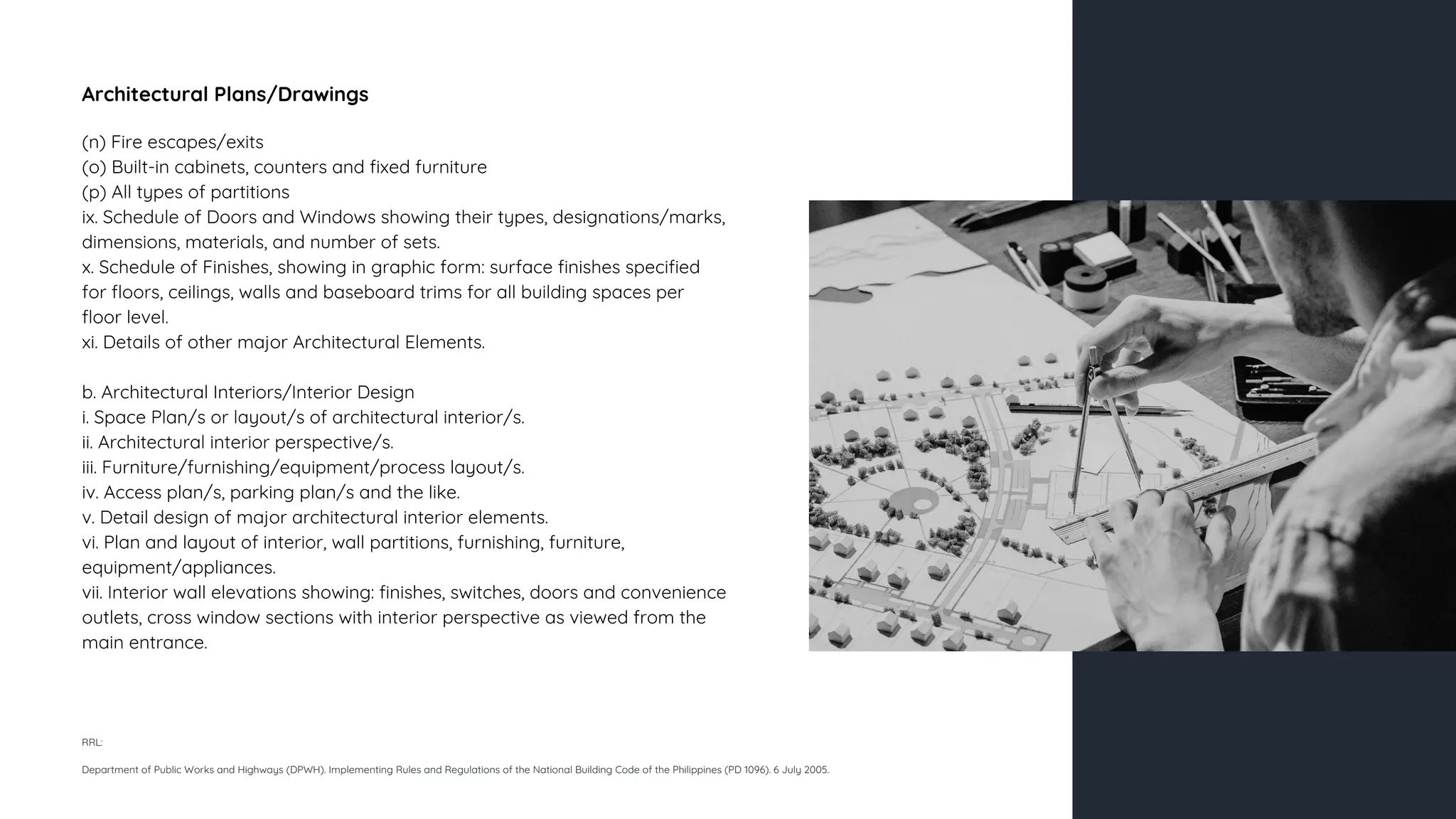
Architectural Plans/Drawings
(n) Fire escapes/exits
(o) Built-in cabinets, counters and fixed furniture
(p) All types of partitions
ix. Schedule of Doors and Windows showing their types, designations/marks,
dimensions, materials, and number of sets.
x. Schedule of Finishes, showing in graphic form: surface finishes specified
for floors, ceilings, walls and baseboard trims for all building spaces per
floor level.
xi. Details of other major Architectural Elements.
b. Architectural Interiors/Interior Design
i. Space Plan/s or layout/s of architectural interior/s.
ii. Architectural interior perspective/s.
iii. Furniture/furnishing/equipment/process layout/s.
iv. Access plan/s, parking plan/s and the like.
v. Detail design of major architectural interior elements.
vi. Plan and layout of interior, wall partitions, furnishing, furniture,
equipment/appliances.
vii. Interior wall elevations showing: finishes, switches, doors and convenience
outlets, cross window sections with interior perspective as viewed from the
main entrance.
RRL:
Department of Public Works and Highways (DPWH). Implementing Rules and Regulations of the National Building Code of the Philippines (PD 1096). 6 July 2005.
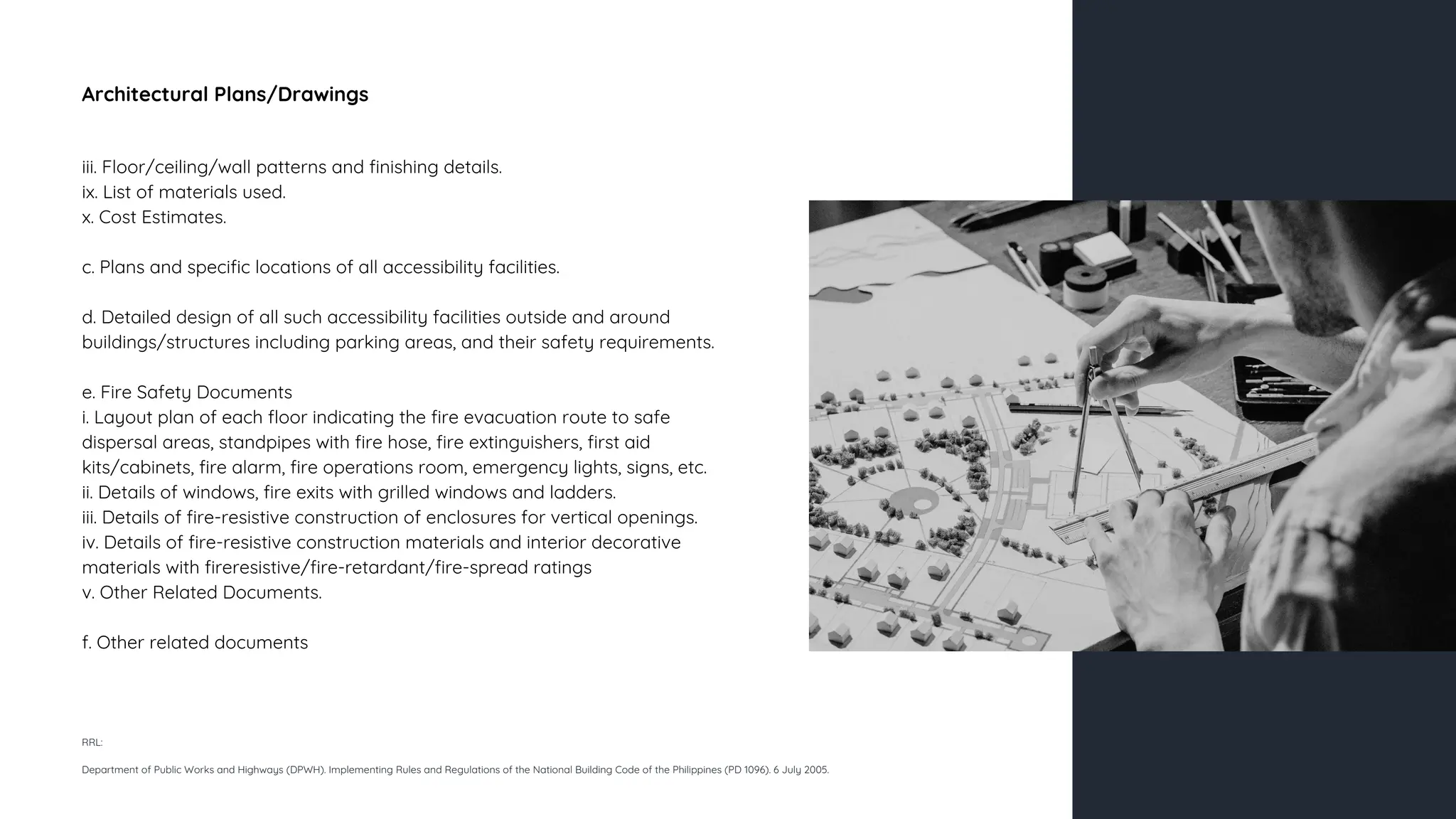
Architectural Plans/Drawings
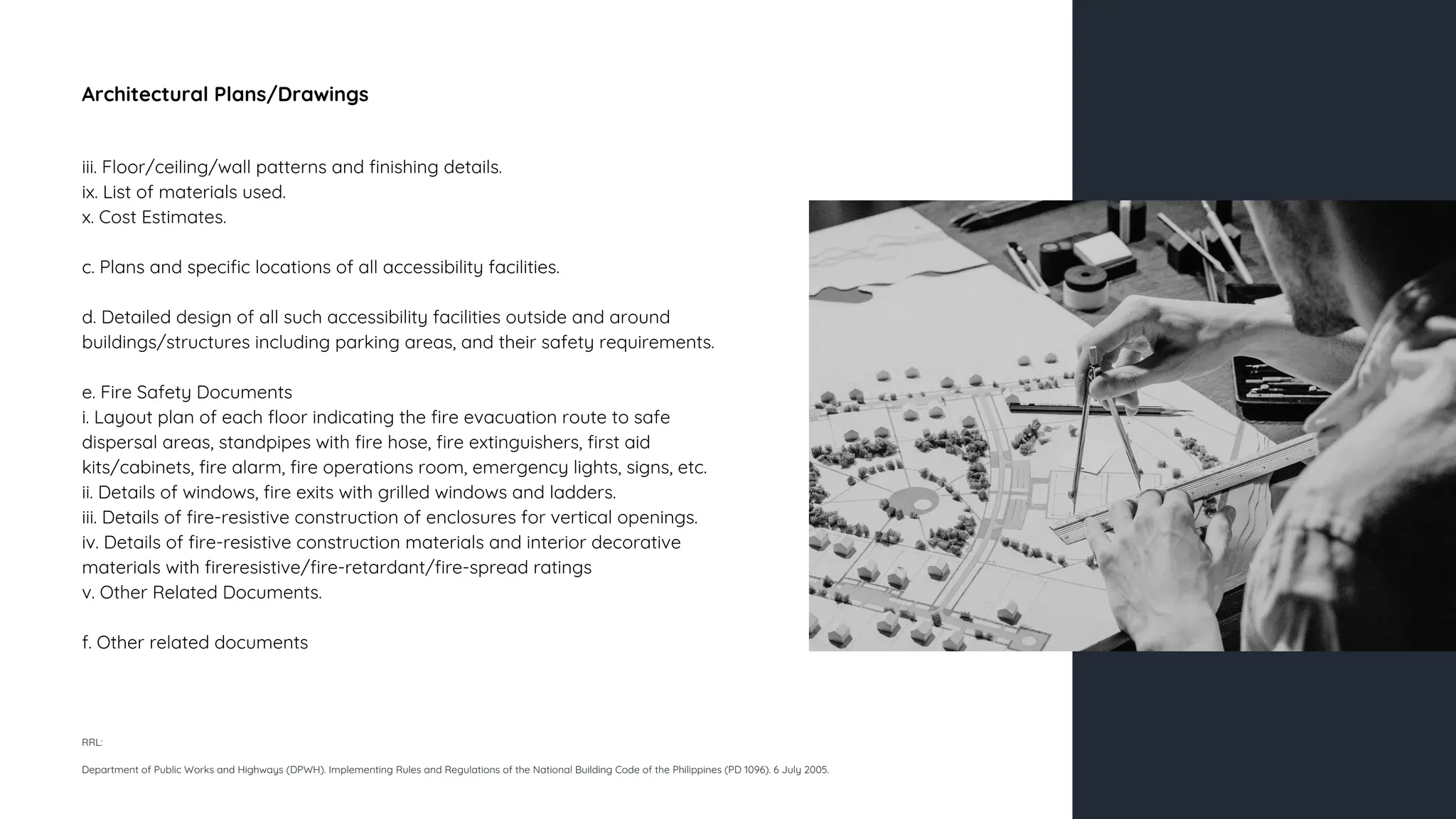
iii. Floor/ceiling/wall patterns and finishing details.
ix. List of materials used.
x. Cost Estimates.
c. Plans and specific locations of all accessibility facilities.
d. Detailed design of all such accessibility facilities outside and around
buildings/structures including parking areas, and their safety requirements.
e. Fire Safety Documents
i. Layout plan of each floor indicating the fire evacuation route to safe
dispersal areas, standpipes with fire hose, fire extinguishers, first aid
kits/cabinets, fire alarm, fire operations room, emergency lights, signs, etc.
ii. Details of windows, fire exits with grilled windows and ladders.
iii. Details of fire-resistive construction of enclosures for vertical openings.
iv. Details of fire-resistive construction materials and interior decorative
materials with fireresistive/fire-retardant/fire-spread ratings
v. Other Related Documents.
f. Other related documents
RRL:
Department of Public Works and Highways (DPWH). Implementing Rules and Regulations of the National Building Code of the Philippines (PD 1096). 6 July 2005.
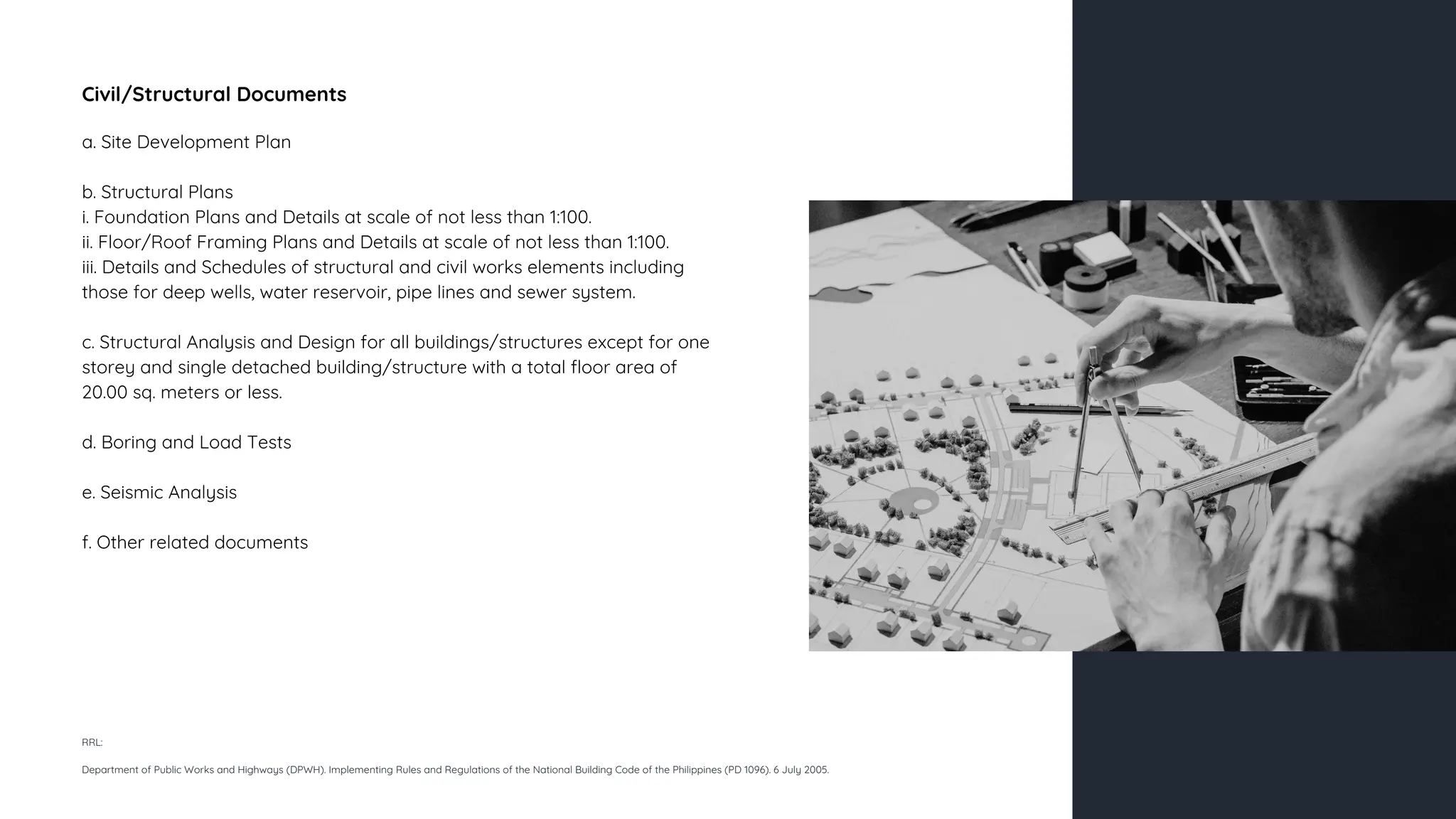
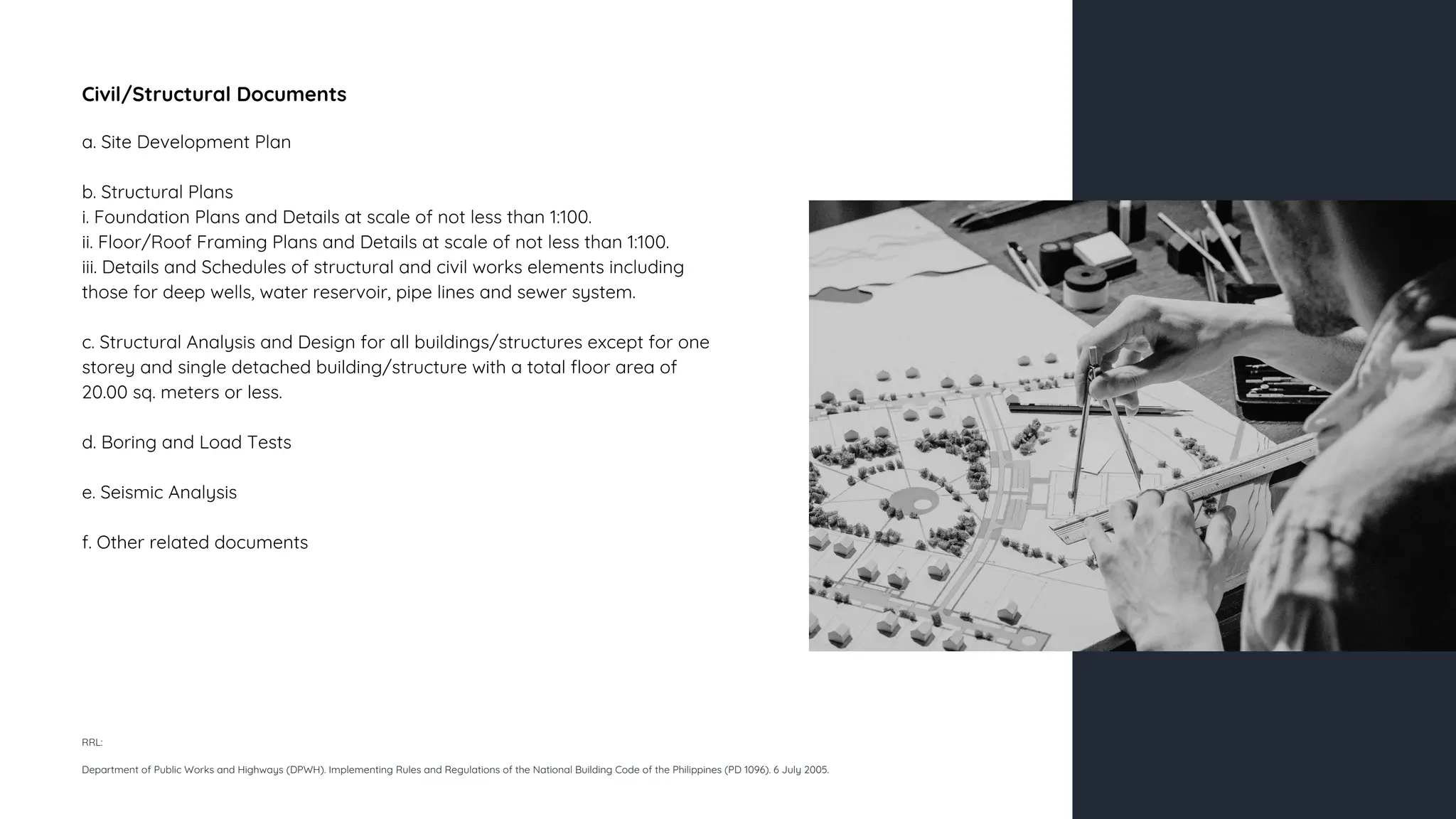
Civil/Structural Documents
a. Site Development Plan
b. Structural Plans
i. Foundation Plans and Details at scale of not less than 1:100.
ii. Floor/Roof Framing Plans and Details at scale of not less than 1:100.
iii. Details and Schedules of structural and civil works elements including
those for deep wells, water reservoir, pipe lines and sewer system.
c. Structural Analysis and Design for all buildings/structures except for one
storey and single detached building/structure with a total floor area of
20.00 sq. meters or less.
d. Boring and Load Tests
e. Seismic Analysis
f. Other related documents
RRL:
Department of Public Works and Highways (DPWH). Implementing Rules and Regulations of the National Building Code of the Philippines (PD 1096). 6 July 2005.
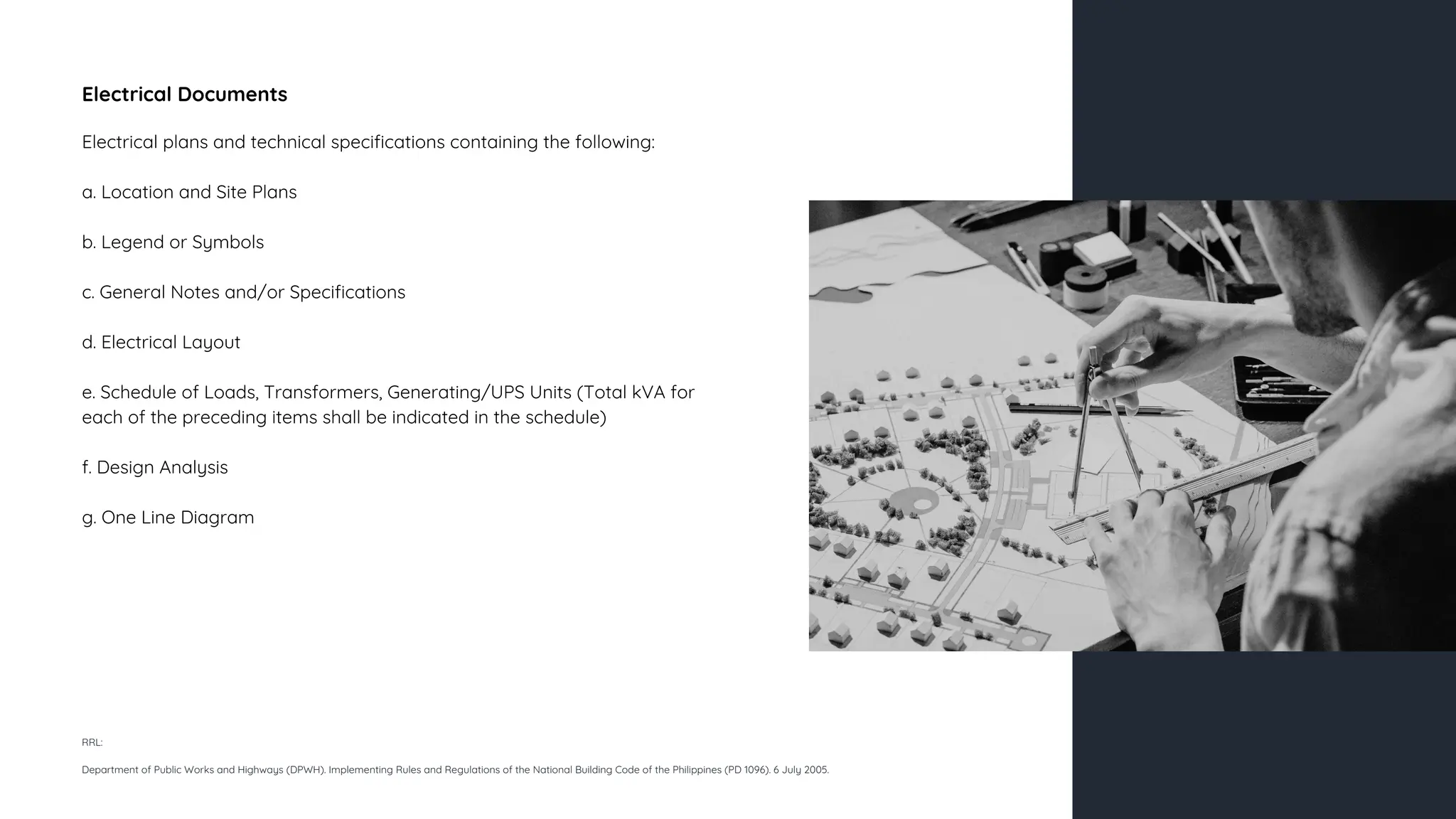
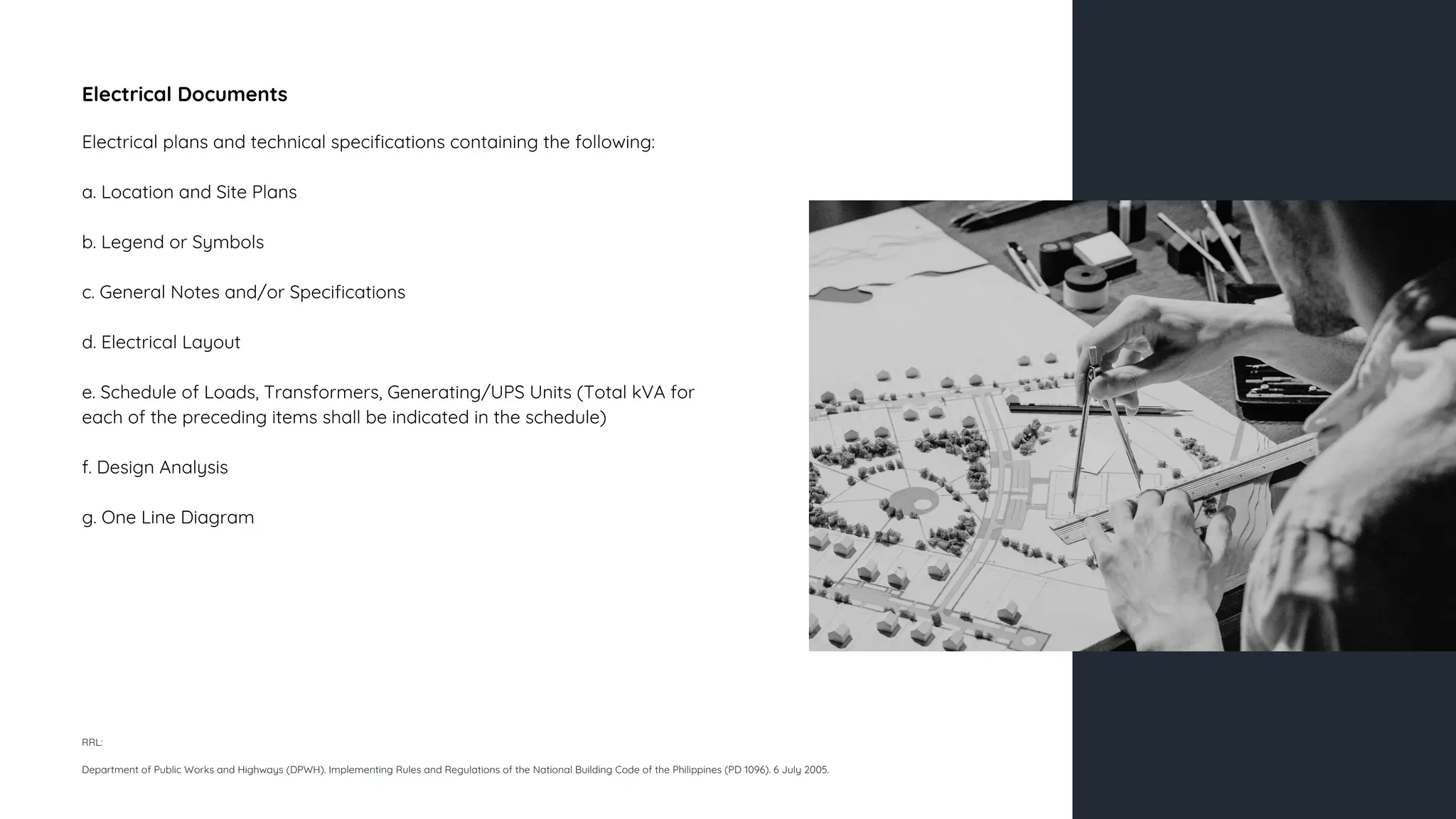
Electrical Documents
Electrical plans and technical specifications containing the following:
a. Location and Site Plans
b. Legend or Symbols
c. General Notes and/or Specifications
d. Electrical Layout
e. Schedule of Loads, Transformers, Generating/UPS Units (Total kVA for
each of the preceding items shall be indicated in the schedule)
f. Design Analysis
g. One Line Diagram
RRL:
Department of Public Works and Highways (DPWH). Implementing Rules and Regulations of the National Building Code of the Philippines (PD 1096). 6 July 2005.
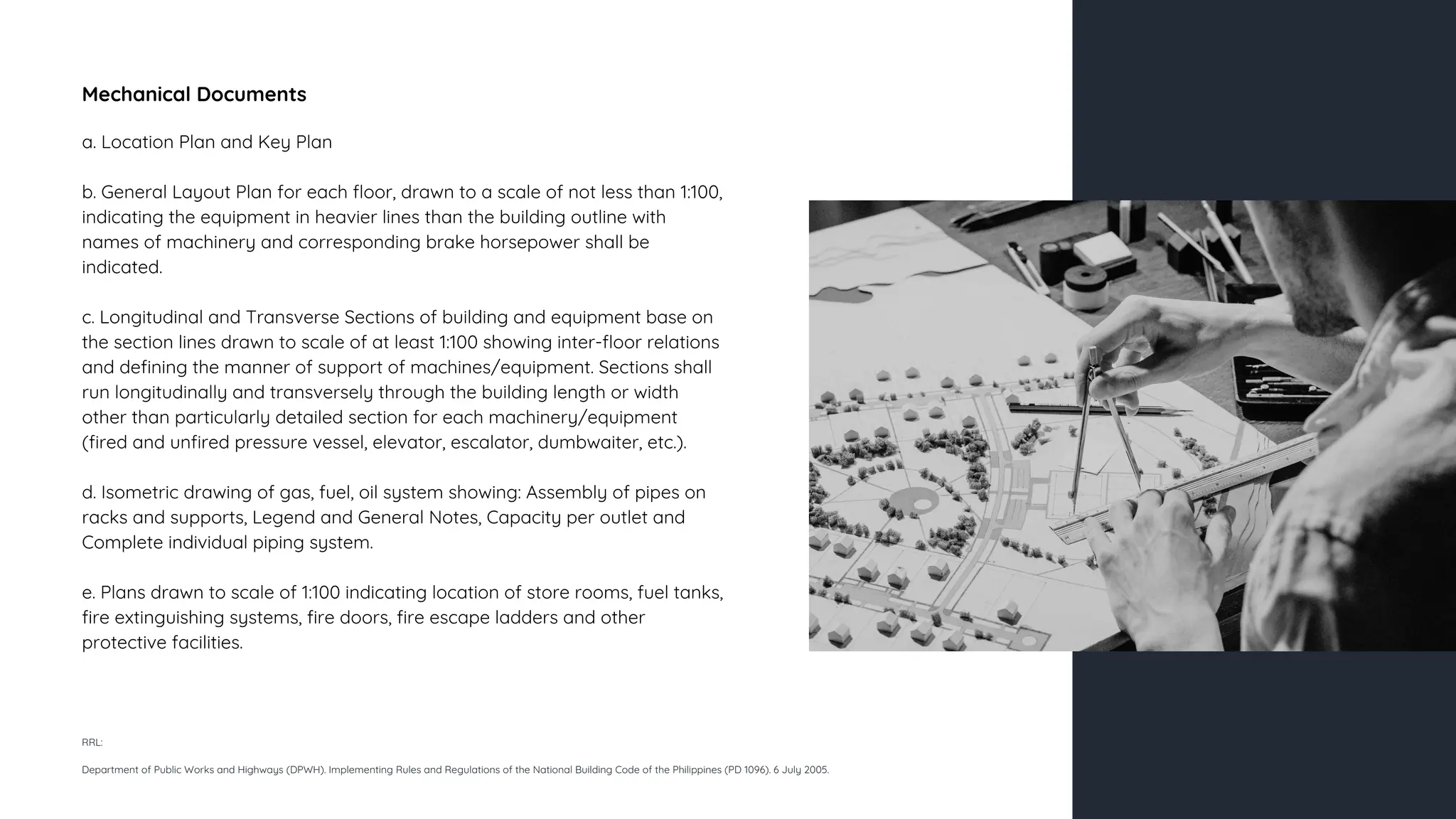
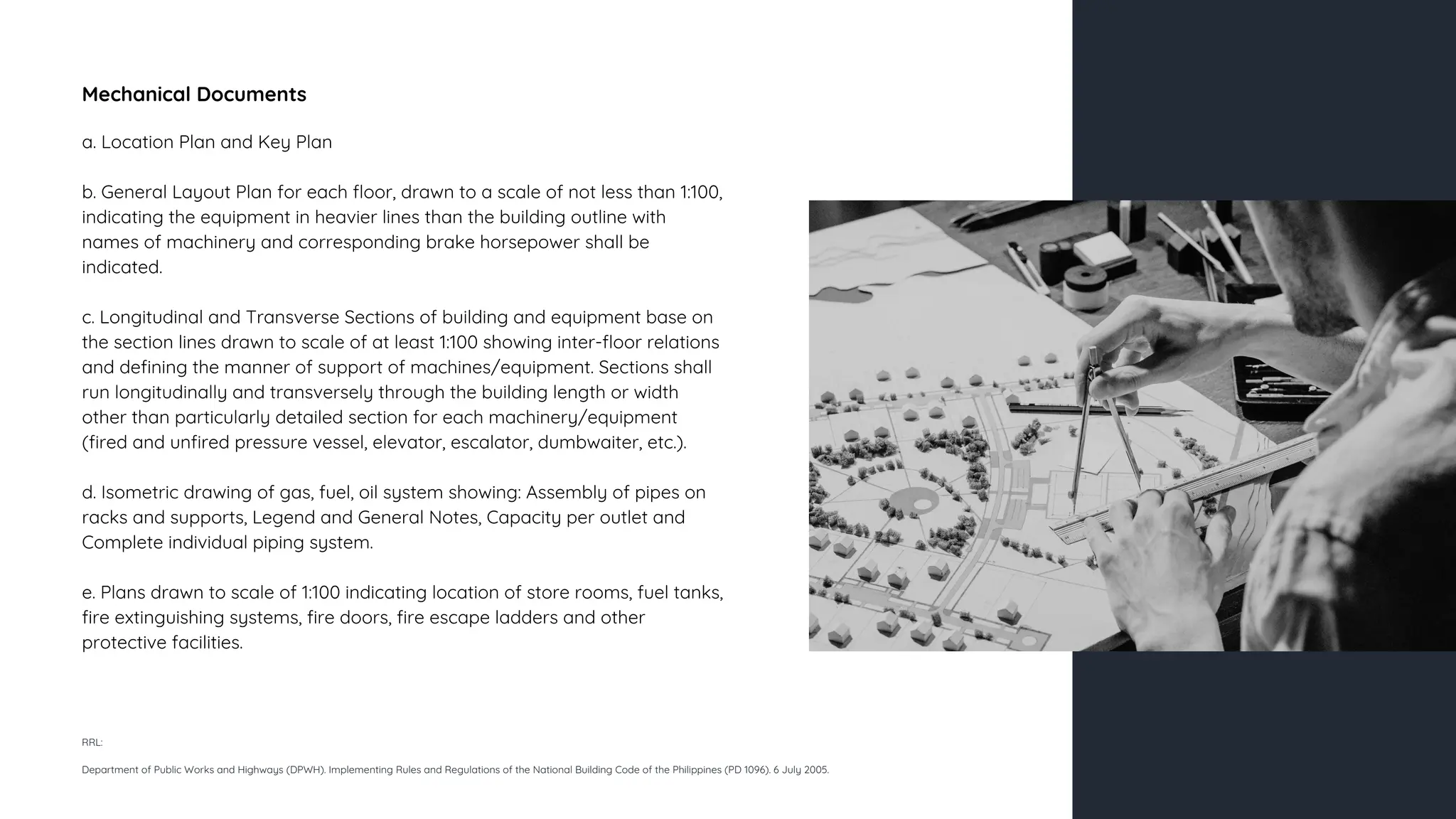
Mechanical Documents
a. Location Plan and Key Plan
b. General Layout Plan for each floor, drawn to a scale of not less than 1:100,
indicating the equipment in heavier lines than the building outline with
names of machinery and corresponding brake horsepower shall be
indicated.
c. Longitudinal and Transverse Sections of building and equipment base on
the section lines drawn to scale of at least 1:100 showing inter-floor relations
and defining the manner of support of machines/equipment. Sections shall
run longitudinally and transversely through the building length or width
other than particularly detailed section for each machinery/equipment
(fired and unfired pressure vessel, elevator, escalator, dumbwaiter, etc.).
d. Isometric drawing of gas, fuel, oil system showing: Assembly of pipes on
racks and supports, Legend and General Notes, Capacity per outlet and
Complete individual piping system.
e. Plans drawn to scale of 1:100 indicating location of store rooms, fuel tanks,
fire extinguishing systems, fire doors, fire escape ladders and other
protective facilities.
RRL:
Department of Public Works and Highways (DPWH). Implementing Rules and Regulations of the National Building Code of the Philippines (PD 1096). 6 July 2005.
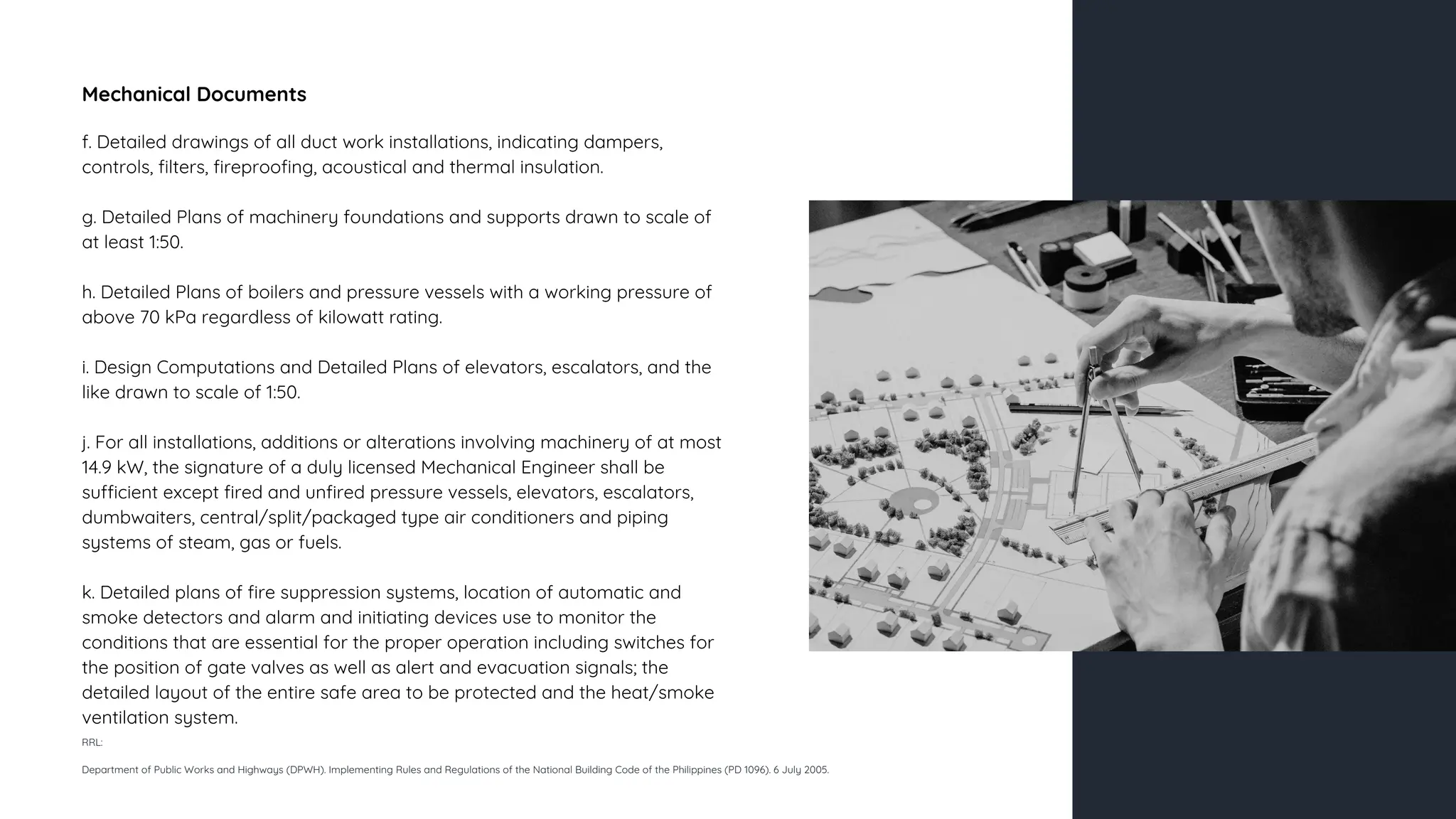
Mechanical Documents
f. Detailed drawings of all duct work installations, indicating dampers,
controls, filters, fireproofing, acoustical and thermal insulation.
g. Detailed Plans of machinery foundations and supports drawn to scale of
at least 1:50.
h. Detailed Plans of boilers and pressure vessels with a working pressure of
above 70 kPa regardless of kilowatt rating.
i. Design Computations and Detailed Plans of elevators, escalators, and the
like drawn to scale of 1:50.
j. For all installations, additions or alterations involving machinery of at most
14.9 kW, the signature of a duly licensed Mechanical Engineer shall be
sufficient except fired and unfired pressure vessels, elevators, escalators,
dumbwaiters, central/split/packaged type air conditioners and piping
systems of steam, gas or fuels.
k. Detailed plans of fire suppression systems, location of automatic and
smoke detectors and alarm and initiating devices use to monitor the
conditions that are essential for the proper operation including switches for
the position of gate valves as well as alert and evacuation signals; the
detailed layout of the entire safe area to be protected and the heat/smoke
ventilation system.
RRL:
Department of Public Works and Highways (DPWH). Implementing Rules and Regulations of the National Building Code of the Philippines (PD 1096). 6 July 2005.
Sanitary Documents
a. For deepwell, water purification plants, water collection and distribution
systems, reservoirs, drainage and sewer systems, sewage treatment plants,
malaria control structures, and sewage disposal systems:
i. Location Plan and Site Plan
ii. Detailed Plan and layout drawings of minimum scale 1:100
iii. Design Analysis and Technical Specifications
iv. Cost Estimates
b. For pest and vermin control, sanitation, and pollution control facilities:
i. Detailed plan, layout and drawing of abatement and control device of
minimum scale 1:100
ii. Design analysis and technical specification
iii. Cost Estimates
RRL:
Department of Public Works and Highways (DPWH). Implementing Rules and Regulations of the National Building Code of the Philippines (PD 1096). 6 July 2005.
Plumbing Documents
For all plumbing installations, additions and/or alterations involving hot and
cold water supply, fixtures, sewage drainage and vent system, storm
drainage and sewerage system within or adjacent to the building:
a. Location Plan and Site Plan of minimum scale 1:2000
b. Plumbing Plans, Layouts and Details, of minimum scale 1:50
c. Legend and General Notes
d. Isometric drawings of the systems
e. Design analysis and technical specifications
f. Cost Estimates
RRL:
Department of Public Works and Highways (DPWH). Implementing Rules and Regulations of the National Building Code of the Philippines (PD 1096). 6 July 2005.
Electronics Documents
Electronic plans and technical specifications for wired or wireless
telecommunications systems, broadcasting systems, including radio and TV
broadcast equipment for commercial and training purposes, cable or
wireless television systems, information technology (IT) systems, security
and alarm systems, electronic fire alarm systems, sound-reinforcement
systems, navigational aids and controls, indoor and outdoor signages,
electronically-controlled conveyance systems, electronic/computerized
process controls and automation systems, building automation,
management and control systems, including, but not limited to the following:
a. General layout plans with legends
b. Single line diagram
c. Riser diagram
d. Isometry of the system
e. Equipment specifications
f. Design analysis, as applicable
g. Cost estimates
RRL:
Department of Public Works and Highways (DPWH). Implementing Rules and Regulations of the National Building Code of the Philippines (PD 1096). 6 July 2005.
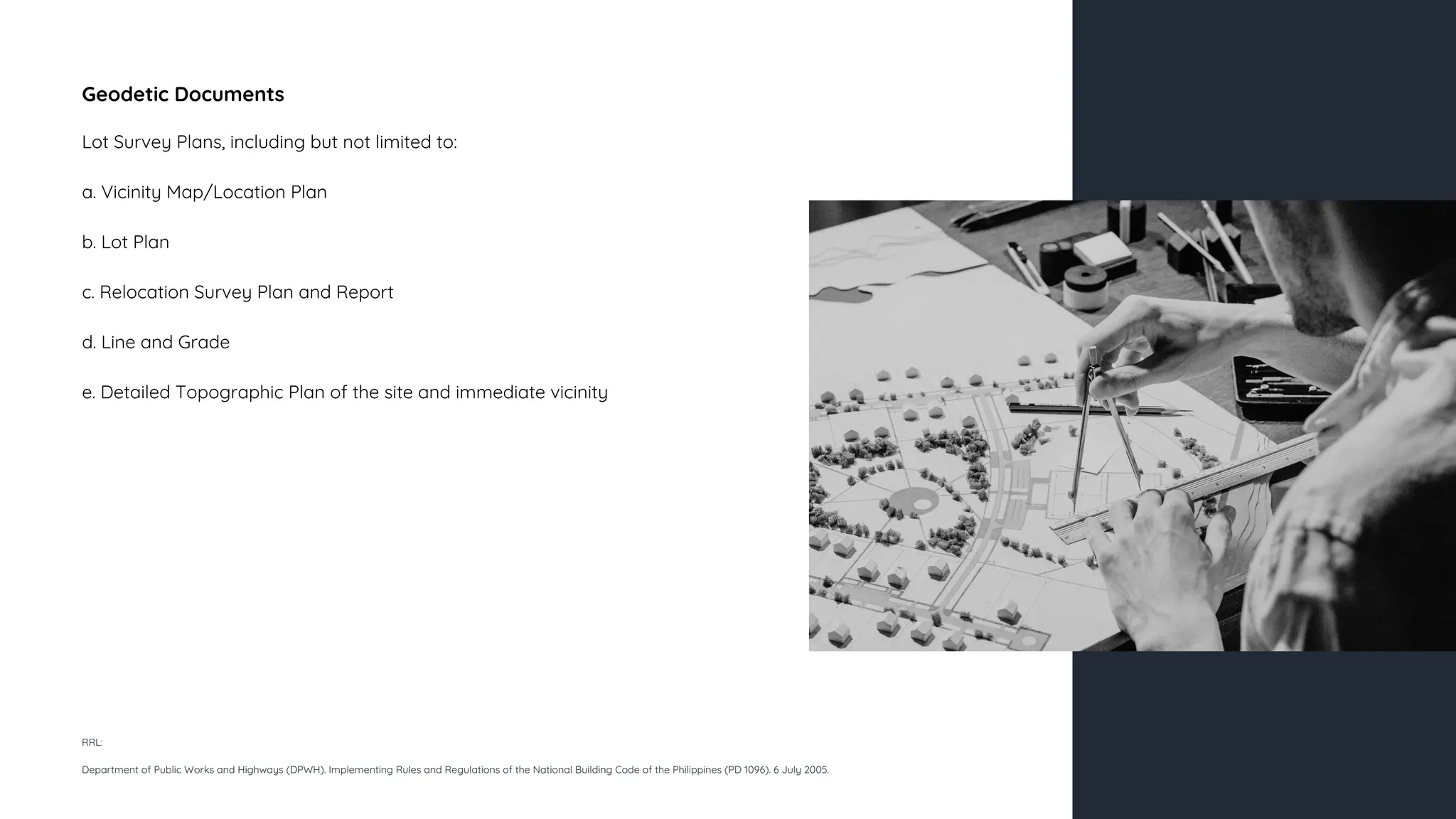
Geodetic Documents
Lot Survey Plans, including but not limited to:
a. Vicinity Map/Location Plan
b. Lot Plan
c. Relocation Survey Plan and Report
d. Line and Grade
e. Detailed Topographic Plan of the site and immediate vicinity
RRL:
Department of Public Works and Highways (DPWH). Implementing Rules and Regulations of the National Building Code of the Philippines (PD 1096). 6 July 2005.
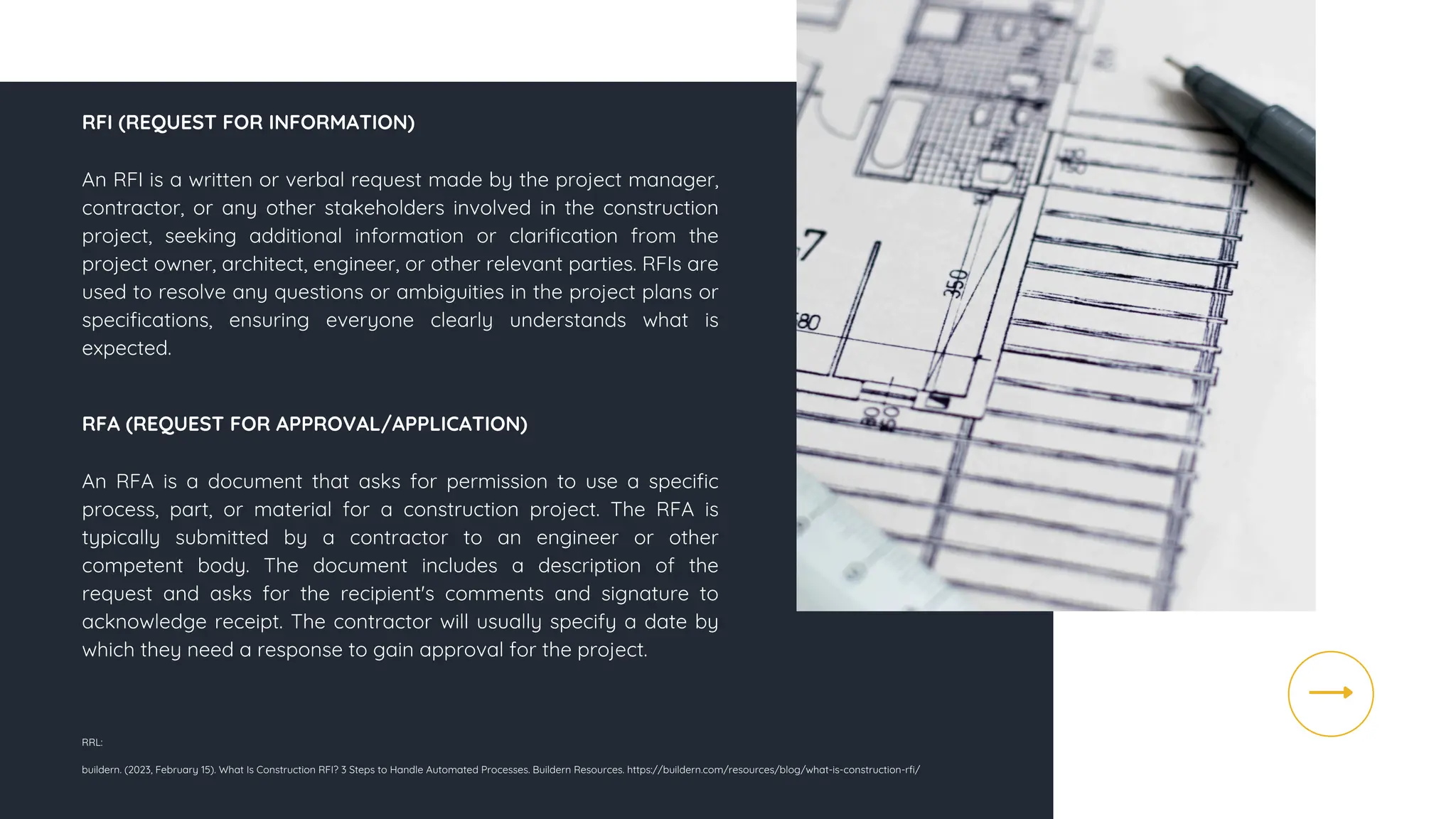
An RFI is a written or verbal request made by the project manager,
contractor, or any other stakeholders involved in the construction
project, seeking additional information or clarification from the
project owner, architect, engineer, or other relevant parties. RFIs are
used to resolve any questions or ambiguities in the project plans or
specifications, ensuring everyone clearly understands what is
expected.
RRL:
buildern. (2023, February 15). What Is Construction RFI? 3 Steps to Handle Automated Processes. Buildern Resources. https://buildern.com/resources/blog/what-is-construction-rfi/
RFI (REQUEST FOR INFORMATION)
RFA (REQUEST FOR APPROVAL/APPLICATION)
An RFA is a document that asks for permission to use a specific
process, part, or material for a construction project. The RFA is
typically submitted by a contractor to an engineer or other
competent body. The document includes a description of the
request and asks for the recipient's comments and signature to
acknowledge receipt. The contractor will usually specify a date by
which they need a response to gain approval for the project.
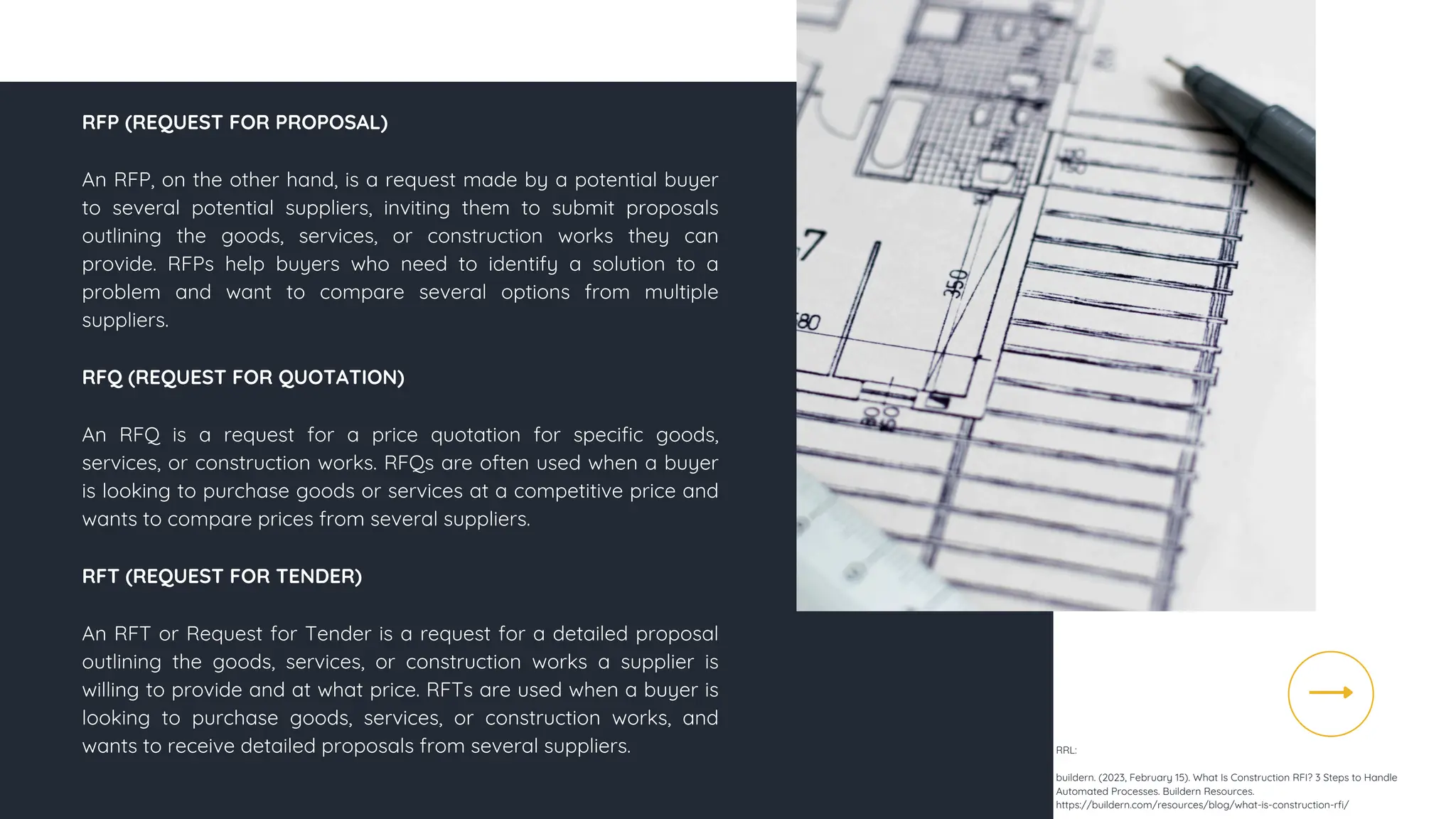
An RFP, on the other hand, is a request made by a potential buyer
to several potential suppliers, inviting them to submit proposals
outlining the goods, services, or construction works they can
provide. RFPs help buyers who need to identify a solution to a
problem and want to compare several options from multiple
suppliers.
RRL:
buildern. (2023, February 15). What Is Construction RFI? 3 Steps to Handle
Automated Processes. Buildern Resources.
https://buildern.com/resources/blog/what-is-construction-rfi/
RFP (REQUEST FOR PROPOSAL)
RFQ (REQUEST FOR QUOTATION)
An RFQ is a request for a price quotation for specific goods,
services, or construction works. RFQs are often used when a buyer
is looking to purchase goods or services at a competitive price and
wants to compare prices from several suppliers.
RFT (REQUEST FOR TENDER)
An RFT or Request for Tender is a request for a detailed proposal
outlining the goods, services, or construction works a supplier is
willing to provide and at what price. RFTs are used when a buyer is
looking to purchase goods, services, or construction works, and
wants to receive detailed proposals from several suppliers.
MSCM 601: CONTRACTS & LEGAL ASPECTS IN CONSTRUCTION MANAGEMENT
THANK
20
24
YOU!
END OF TENDER DOCUMENTATION & DESIGN
PRESENTED BY:
BRAVES ANTHONY C. GAPUSAN
MSCM 1-B 2024
MSCM 601: CONTRACTS & LEGAL ASPECTS IN CONSTRUCTION MANAGEMENT
TENDER
20
24
DOCUMENTATION
TOPIC 7: CLAIMS
PRESENTED BY:
BRAVES ANTHONY C. GAPUSAN
WHAT IS
TENDER?
A tender is a written document that describes a construction
project and invites contractors to submit bids for completing it.
The tendering process is a formal way to select a contractor or
supplier for a construction project.
The term “tender” is more common than “bid”.
In some countries, tendering is also known as bidding
Not all main contracts go to tender.
RRL:
Gamboa, Chloe. “How the Tendering Process Works for Construction Projects.” BCI Central, 2 May 2023, www.bcicentral.com/blog/how-the-tendering-process-works-for-construction-projects/.
Johnson, Eve. “What Is Tender in Construction?” CPD Online College, 31 Aug. 2022, cpdonline.co.uk/knowledge-base/health-and-safety/tender-in-construction/.
The tendering process involves the following steps:
Invitation to tender
The client issues a request for tender (RFT) or invitation to tender
(ITT) to contractors and suppliers.
Tender Documents
Contractors prepare and submit documents that include pricing,
project schedules, technical specifications, and qualifications.
Evaluation
The client evaluates the bids based on criteria such as cost, quality,
experience, and realism of the plans.
Selection
The client chooses the contractor with the best proposal.
Negotiation
The client may invite the selected contractor to a meeting to
negotiate the details of the contract.
There are different types of tenders, including open, selective, and
negotiated, each with their own advantages and challenges.
RRL:
Gamboa, Chloe. “How the Tendering Process Works for Construction Projects.” BCI Central, 2 May 2023, www.bcicentral.com/blog/how-the-tendering-process-works-for-construction-projects/.
Johnson, Eve. “What Is Tender in Construction?” CPD Online College, 31 Aug. 2022, cpdonline.co.uk/knowledge-base/health-and-safety/tender-in-construction/.
What are the contents of Bidding Documents?
The Philippine Bidding Documents (PBDs) contain the following:
Invitation to Apply for Eligibility and to Bid (IAEB);
1.
Eligibility Documents;
2.
Eligibility Data Sheet;
3.
Instructions to Bidders (ITB);
4.
Bid Data Sheet (BDS);
5.
General Conditions of Contract (GCC);
6.
Special Conditions of Contract (SCC);
7.
Specifications;
8.
Drawings;
9.
Bill of Quantities; and
10.
Forms and Qualification Information.
11.
RRL:
Commission on Audit. Preparing the Bidding Documents. www.coa.gov.ph/wp-content/uploads/ABC-Help/Updated_Guidelines_in_the_Audit_of_Procurement/Annex%207/Section2-5.htm.
A number of strategies can be used in the preparation of tender
documentation to help avoid claims:
Avoid dealing with items post tender. Statements such as “to be
agreed” can lead to dispute without the leverage of competition.
Phrases such as “to suit the contractor’s programme” are open
ended.
Setting a conditional date such as, “in accordance with the
architect’s instruction” creates uncertainty for tendering
contractors. It is not possible to enforce an “agreement to agree”.
Avoid ambiguity in design responsibility, such as “the contractor
shall complete any design required after the consultants have
finalized the drawings provided for tender purposes”.
RRL:
CIOB (Chartered Institute of Building), et al. “Contract Claims in Construction.” Designingbuildings.co.uk, 2024, www.designingbuildings.co.uk/wiki/Contract_claims_in_construction#Tender_documentation.
A number of strategies can be used in the preparation of tender
documentation to help avoid claims:
Avoid dealing with items post tender. Statements such as “to be
agreed” can lead to dispute without the leverage of competition.
Phrases such as “to suit the contractor’s programme” are open
ended.
Setting a conditional date such as, “in accordance with the
architect’s instruction” creates uncertainty for tendering
contractors. It is not possible to enforce an “agreement to agree”.
Avoid ambiguity in design responsibility, such as “the contractor
shall complete any design required after the consultants have
finalized the drawings provided for tender purposes”.
RRL:
CIOB (Chartered Institute of Building), et al. “Contract Claims in Construction.” Designingbuildings.co.uk, 2024, www.designingbuildings.co.uk/wiki/Contract_claims_in_construction#Tender_documentation.
MSCM 601: CONTRACTS & LEGAL ASPECTS IN CONSTRUCTION MANAGEMENT
DESIGN
20
24
PRESENTED BY:
BRAVES ANTHONY C. GAPUSAN
TOPIC 7: CLAIMS
Many claims are based on delays resulting from design consultants
issuing schedules, drawings and specifications after construction
has begun. Conflict can then arise due to arguable deficiencies in
that information:
Missing, or Not Produced
Late
Incorrect
Insufficient to Order or Build
Impractical
Unclear or Conflicting
Inconsistent with Pricing Information
Inappropriate or Not Fit for Purpose
Uncoordinated with Other Information
RRL:
CIOB (Chartered Institute of Building), et al. “Contract Claims in Construction.” Designingbuildings.co.uk, 2024, www.designingbuildings.co.uk/wiki/Contract_claims_in_construction#Tender_documentation.
Some flexibility is allowed by standard traditional contracts for the
design team to issue further drawings and details reasonably
necessary, either to explain or amplify the contract drawings.
There can be an onus on the contractor to raise any queries on
newly received information within 28 days of its receipt or forfeit
their right to additional payment.
RRL:
CIOB (Chartered Institute of Building), et al. “Contract Claims in Construction.” Designingbuildings.co.uk, 2024, www.designingbuildings.co.uk/wiki/Contract_claims_in_construction#Tender_documentation.
Basic Design Requirements:
IRR - PD 1096 National Building Code
RULE III SECTION 302. Application of Permits
Five (5) sets of survey plans, design plans, specifications and
other documents prepared, signed and sealed over the
printed names of the duly licensed and registered
professionals.
a. Geodetic Engineer, in case of lot survey plans;
b. Architect, in case of architectural documents; in case of
architectural interior/interior design documents, either an architect
or interior designer may sign;
c. Civil Engineer, in case of civil/structural documents;
d. Professional Electrical Engineer, in case of electrical documents;
e. Professional Mechanical Engineer, in case of mechanical
documents;
f. Sanitary Engineer, in case of sanitary documents;
g. Master Plumber, in case of plumbing documents;
h. Electronics Engineer, in case of electronics documents.
RRL:
Department of Public Works and Highways (DPWH). Implementing Rules and Regulations of the National Building Code of the Philippines (PD 1096). 6 July 2005.
Architectural Plans/Drawings
a. Architectural Plans/Drawings
i. Vicinity Map/Location Plan
ii. Site Development Plan
iii. Perspective
iv. Floor Plans
v. Elevations
vi. Sections
vii. Reflected ceiling plan showing
viii. Details, in the form of plans, elevations/sections:
(a) Accessible ramps
(b) Accessible stairs
(c) Accessible lifts/elevators
(d) Accessible entrances, corridors and walkways
(e) Accessible functional areas/comfort rooms
(f) Accessible switches, controls
(g) Accessible drinking fountains
(h) Accessible public telephone booths
(i) Accessible audio visual and automatic alarm system
(j) Accessible access symbols and directional signs
(k) Reserved parking for disabled persons
(l) Typical wall/bay sections from ground to roof
(m) Stairs, interior and exterior
RRL:
Department of Public Works and Highways (DPWH). Implementing Rules and Regulations of the National Building Code of the Philippines (PD 1096). 6 July 2005.
Architectural Plans/Drawings
(n) Fire escapes/exits
(o) Built-in cabinets, counters and fixed furniture
(p) All types of partitions
ix. Schedule of Doors and Windows showing their types, designations/marks,
dimensions, materials, and number of sets.
x. Schedule of Finishes, showing in graphic form: surface finishes specified
for floors, ceilings, walls and baseboard trims for all building spaces per
floor level.
xi. Details of other major Architectural Elements.
b. Architectural Interiors/Interior Design
i. Space Plan/s or layout/s of architectural interior/s.
ii. Architectural interior perspective/s.
iii. Furniture/furnishing/equipment/process layout/s.
iv. Access plan/s, parking plan/s and the like.
v. Detail design of major architectural interior elements.
vi. Plan and layout of interior, wall partitions, furnishing, furniture,
equipment/appliances.
vii. Interior wall elevations showing: finishes, switches, doors and convenience
outlets, cross window sections with interior perspective as viewed from the
main entrance.
RRL:
Department of Public Works and Highways (DPWH). Implementing Rules and Regulations of the National Building Code of the Philippines (PD 1096). 6 July 2005.
Architectural Plans/Drawings
iii. Floor/ceiling/wall patterns and finishing details.
ix. List of materials used.
x. Cost Estimates.
c. Plans and specific locations of all accessibility facilities.
d. Detailed design of all such accessibility facilities outside and around
buildings/structures including parking areas, and their safety requirements.
e. Fire Safety Documents
i. Layout plan of each floor indicating the fire evacuation route to safe
dispersal areas, standpipes with fire hose, fire extinguishers, first aid
kits/cabinets, fire alarm, fire operations room, emergency lights, signs, etc.
ii. Details of windows, fire exits with grilled windows and ladders.
iii. Details of fire-resistive construction of enclosures for vertical openings.
iv. Details of fire-resistive construction materials and interior decorative
materials with fireresistive/fire-retardant/fire-spread ratings
v. Other Related Documents.
f. Other related documents
RRL:
Department of Public Works and Highways (DPWH). Implementing Rules and Regulations of the National Building Code of the Philippines (PD 1096). 6 July 2005.
Civil/Structural Documents
a. Site Development Plan
b. Structural Plans
i. Foundation Plans and Details at scale of not less than 1:100.
ii. Floor/Roof Framing Plans and Details at scale of not less than 1:100.
iii. Details and Schedules of structural and civil works elements including
those for deep wells, water reservoir, pipe lines and sewer system.
c. Structural Analysis and Design for all buildings/structures except for one
storey and single detached building/structure with a total floor area of
20.00 sq. meters or less.
d. Boring and Load Tests
e. Seismic Analysis
f. Other related documents
RRL:
Department of Public Works and Highways (DPWH). Implementing Rules and Regulations of the National Building Code of the Philippines (PD 1096). 6 July 2005.
Electrical Documents
Electrical plans and technical specifications containing the following:
a. Location and Site Plans
b. Legend or Symbols
c. General Notes and/or Specifications
d. Electrical Layout
e. Schedule of Loads, Transformers, Generating/UPS Units (Total kVA for
each of the preceding items shall be indicated in the schedule)
f. Design Analysis
g. One Line Diagram
RRL:
Department of Public Works and Highways (DPWH). Implementing Rules and Regulations of the National Building Code of the Philippines (PD 1096). 6 July 2005.
Mechanical Documents
a. Location Plan and Key Plan
b. General Layout Plan for each floor, drawn to a scale of not less than 1:100,
indicating the equipment in heavier lines than the building outline with
names of machinery and corresponding brake horsepower shall be
indicated.
c. Longitudinal and Transverse Sections of building and equipment base on
the section lines drawn to scale of at least 1:100 showing inter-floor relations
and defining the manner of support of machines/equipment. Sections shall
run longitudinally and transversely through the building length or width
other than particularly detailed section for each machinery/equipment
(fired and unfired pressure vessel, elevator, escalator, dumbwaiter, etc.).
d. Isometric drawing of gas, fuel, oil system showing: Assembly of pipes on
racks and supports, Legend and General Notes, Capacity per outlet and
Complete individual piping system.
e. Plans drawn to scale of 1:100 indicating location of store rooms, fuel tanks,
fire extinguishing systems, fire doors, fire escape ladders and other
protective facilities.
RRL:
Department of Public Works and Highways (DPWH). Implementing Rules and Regulations of the National Building Code of the Philippines (PD 1096). 6 July 2005.
Mechanical Documents
f. Detailed drawings of all duct work installations, indicating dampers,
controls, filters, fireproofing, acoustical and thermal insulation.
g. Detailed Plans of machinery foundations and supports drawn to scale of
at least 1:50.
h. Detailed Plans of boilers and pressure vessels with a working pressure of
above 70 kPa regardless of kilowatt rating.
i. Design Computations and Detailed Plans of elevators, escalators, and the
like drawn to scale of 1:50.
j. For all installations, additions or alterations involving machinery of at most
14.9 kW, the signature of a duly licensed Mechanical Engineer shall be
sufficient except fired and unfired pressure vessels, elevators, escalators,
dumbwaiters, central/split/packaged type air conditioners and piping
systems of steam, gas or fuels.
k. Detailed plans of fire suppression systems, location of automatic and
smoke detectors and alarm and initiating devices use to monitor the
conditions that are essential for the proper operation including switches for
the position of gate valves as well as alert and evacuation signals; the
detailed layout of the entire safe area to be protected and the heat/smoke
ventilation system.
RRL:
Department of Public Works and Highways (DPWH). Implementing Rules and Regulations of the National Building Code of the Philippines (PD 1096). 6 July 2005.
Sanitary Documents
a. For deepwell, water purification plants, water collection and distribution
systems, reservoirs, drainage and sewer systems, sewage treatment plants,
malaria control structures, and sewage disposal systems:
i. Location Plan and Site Plan
ii. Detailed Plan and layout drawings of minimum scale 1:100
iii. Design Analysis and Technical Specifications
iv. Cost Estimates
b. For pest and vermin control, sanitation, and pollution control facilities:
i. Detailed plan, layout and drawing of abatement and control device of
minimum scale 1:100
ii. Design analysis and technical specification
iii. Cost Estimates
RRL:
Department of Public Works and Highways (DPWH). Implementing Rules and Regulations of the National Building Code of the Philippines (PD 1096). 6 July 2005.
Plumbing Documents
For all plumbing installations, additions and/or alterations involving hot and
cold water supply, fixtures, sewage drainage and vent system, storm
drainage and sewerage system within or adjacent to the building:
a. Location Plan and Site Plan of minimum scale 1:2000
b. Plumbing Plans, Layouts and Details, of minimum scale 1:50
c. Legend and General Notes
d. Isometric drawings of the systems
e. Design analysis and technical specifications
f. Cost Estimates
RRL:
Department of Public Works and Highways (DPWH). Implementing Rules and Regulations of the National Building Code of the Philippines (PD 1096). 6 July 2005.
Electronics Documents
Electronic plans and technical specifications for wired or wireless
telecommunications systems, broadcasting systems, including radio and TV
broadcast equipment for commercial and training purposes, cable or
wireless television systems, information technology (IT) systems, security
and alarm systems, electronic fire alarm systems, sound-reinforcement
systems, navigational aids and controls, indoor and outdoor signages,
electronically-controlled conveyance systems, electronic/computerized
process controls and automation systems, building automation,
management and control systems, including, but not limited to the following:
a. General layout plans with legends
b. Single line diagram
c. Riser diagram
d. Isometry of the system
e. Equipment specifications
f. Design analysis, as applicable
g. Cost estimates
RRL:
Department of Public Works and Highways (DPWH). Implementing Rules and Regulations of the National Building Code of the Philippines (PD 1096). 6 July 2005.
Geodetic Documents
Lot Survey Plans, including but not limited to:
a. Vicinity Map/Location Plan
b. Lot Plan
c. Relocation Survey Plan and Report
d. Line and Grade
e. Detailed Topographic Plan of the site and immediate vicinity
RRL:
Department of Public Works and Highways (DPWH). Implementing Rules and Regulations of the National Building Code of the Philippines (PD 1096). 6 July 2005.
An RFI is a written or verbal request made by the project manager,
contractor, or any other stakeholders involved in the construction
project, seeking additional information or clarification from the
project owner, architect, engineer, or other relevant parties. RFIs are
used to resolve any questions or ambiguities in the project plans or
specifications, ensuring everyone clearly understands what is
expected.
RRL:
buildern. (2023, February 15). What Is Construction RFI? 3 Steps to Handle Automated Processes. Buildern Resources. https://buildern.com/resources/blog/what-is-construction-rfi/
RFI (REQUEST FOR INFORMATION)
RFA (REQUEST FOR APPROVAL/APPLICATION)
An RFA is a document that asks for permission to use a specific
process, part, or material for a construction project. The RFA is
typically submitted by a contractor to an engineer or other
competent body. The document includes a description of the
request and asks for the recipient's comments and signature to
acknowledge receipt. The contractor will usually specify a date by
which they need a response to gain approval for the project.
An RFP, on the other hand, is a request made by a potential buyer
to several potential suppliers, inviting them to submit proposals
outlining the goods, services, or construction works they can
provide. RFPs help buyers who need to identify a solution to a
problem and want to compare several options from multiple
suppliers.
RRL:
buildern. (2023, February 15). What Is Construction RFI? 3 Steps to Handle
Automated Processes. Buildern Resources.
https://buildern.com/resources/blog/what-is-construction-rfi/
RFP (REQUEST FOR PROPOSAL)
RFQ (REQUEST FOR QUOTATION)
An RFQ is a request for a price quotation for specific goods,
services, or construction works. RFQs are often used when a buyer
is looking to purchase goods or services at a competitive price and
wants to compare prices from several suppliers.
RFT (REQUEST FOR TENDER)
An RFT or Request for Tender is a request for a detailed proposal
outlining the goods, services, or construction works a supplier is
willing to provide and at what price. RFTs are used when a buyer is
looking to purchase goods, services, or construction works, and
wants to receive detailed proposals from several suppliers.
MSCM 601: CONTRACTS & LEGAL ASPECTS IN CONSTRUCTION MANAGEMENT
THANK
20
24
YOU!
END OF TENDER DOCUMENTATION & DESIGN
PRESENTED BY:
BRAVES ANTHONY C. GAPUSAN
MSCM 1-B 2024
Polytechnic University of the Philippines
Open University System
Master of Science in Construction Management
MSCM 601
Contracts and Legal Aspects in
Construction Management
Topic 7- Claims
Part 9- Cost
DR. DANILO N. PILAR
Subject Specialist
Quantifying claims
Costs
• Actual cost is the proper basis for
evaluating claims.
• Costs may include allowance for
inflation resulting from delay.
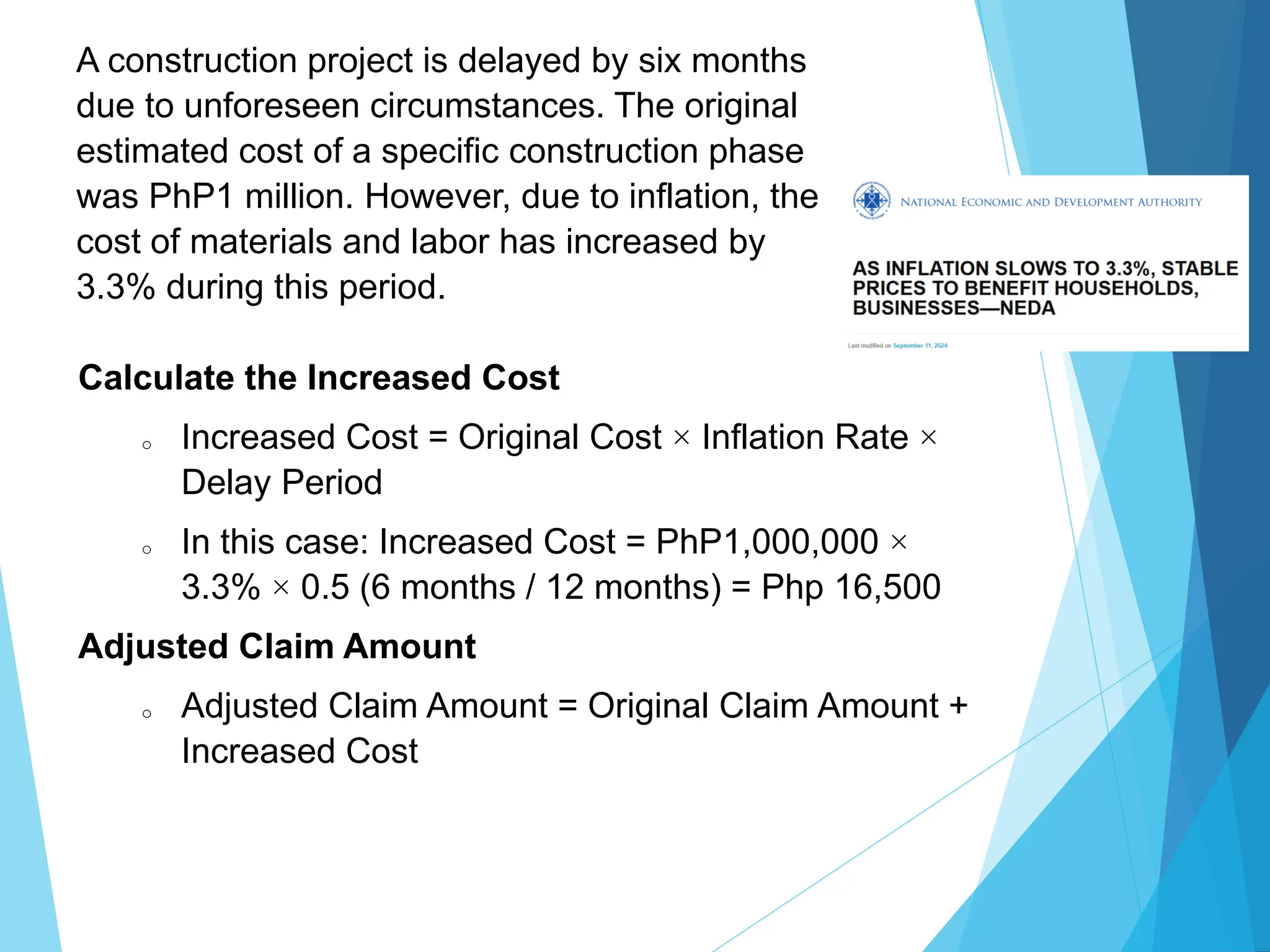
A construction project is delayed by six months
due to unforeseen circumstances. The original
estimated cost of a specific construction phase
was PhP1 million. However, due to inflation, the
cost of materials and labor has increased by
3.3% during this period.
Calculate the Increased Cost
o Increased Cost = Original Cost × Inflation Rate ×
Delay Period
o In this case: Increased Cost = PhP1,000,000 ×
3.3% × 0.5 (6 months / 12 months) = Php 16,500
Adjusted Claim Amount
o Adjusted Claim Amount = Original Claim Amount +
Increased Cost
Preliminaries
Preliminaries include set-up costs, running
costs and dismantling costs. Thus extensions
of time should not include set-up or dismantling
costs but merely running cost at the time of the
breach and its associated period of delay.
Set-up Costs:
o Mobilization Costs
o Site Establishment Costs
o Site Security Costs
o Utility Connection Costs
Preliminaries
Preliminaries include set-up costs, running
costs and dismantling costs. Thus extensions
of time should not include set-up or dismantling
costs but merely running cost at the time of the
breach and its associated period of delay.
Running Costs
• Site Overhead Costs
• Welfare Facilities Costs
• Plant and Equipment Hire Costs
• Material Procurement and Storage Costs
Preliminaries
Preliminaries include set-up costs, running
costs and dismantling costs. Thus extensions
of time should not include set-up or dismantling
costs but merely running cost at the time of the
breach and its associated period of delay.
Dismantling Costs
• Demobilization Costs
• Site Clearance Costs
• Restoration Costs
Disruption
- loss due to inefficient productivity.
- It is extremely difficult to assess.
- most effective approach is to localize the
claim to a specific area of breach.
- compare individuals productivity prior to and
after the disruption occurred against the
productivity during the period of disruption.
- Generic claims based on statements such as
‘this was the tender price and this is the
outturn cost’ are unlikely to succeed.
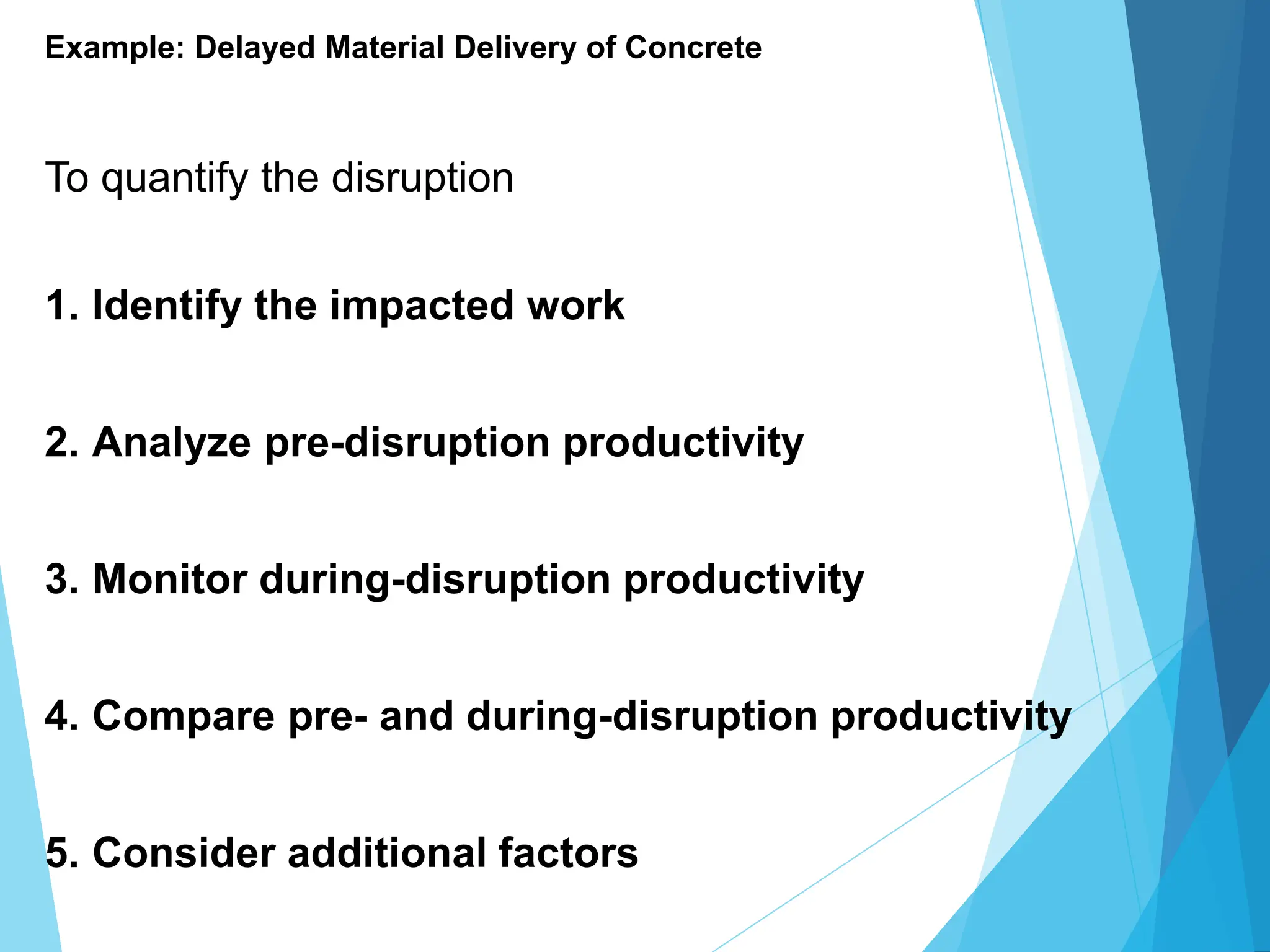
Example: Delayed Material Delivery of Concrete
To quantify the disruption
1. Identify the impacted work
2. Analyze pre-disruption productivity
3. Monitor during-disruption productivity
4. Compare pre- and during-disruption productivity
5. Consider additional factors
Loss of profit/opportunity costs
Valid only when the claimant can prove
breaches of contract directly prevented it
making a profit elsewhere.
Deductions must be made for additional profit
that has been paid on the project as a result of
extra work instructed and priced within the final
account.
To successfully claim loss of profit, a contractor must
demonstrate the following:
1. Direct Causation - The breach of contract must have
directly led to the loss of profit.
2. Lost Opportunity -The contractor must prove that they
had a specific opportunity to undertake another project
that was lost due to the delay or disruption caused by the
breach.
3. Quantifiable Loss - The lost profit must be quantifiable
and supported by reliable financial data, such as project
budgets, cost estimates, and historical financial
performance.
Finance charges and interest
Finance charges and interest on extra capital
required to fund costs arising from breaches in
the contract are recoverable providing:
 Interest rates are proven and reasonable (e.g
market rates prevailing during the period of
breach).
 If financed within the corporate group, the
rate will be that received from monies it has
placed on deposit.
Considerations for Claiming Interest
1. Contractual Provisions
2. Proof of Actual Costs
3. Reasonable Interest Rate
To quantify the claim for interest
1. Calculate the Additional Costs
2. Determine the Delay Period
3. Calculate the Interest Rate
4. Calculate the Interest
References:
 Lecture/PPT of Dr. Danny Pilar
 Contract Administration by CMDF
 Construction Industry Association of the Philippines
 3. Hare, J. I. Clark. 2003. The Law of Contracts. Clark, N.J.: Lawbook Exchange.
 4. Marsh, P.D.V. 2001. Contract Negotiation Handbook. Burlington, Vt: Gower.
 5. PMBOOK 5th Edition
Thank you very much!

CLAIMS AND GROUP 7 MS CONSTRUCTIONcombinepdf.pdf

  • 1.
  • 2.
    Notice and Particulars • Purposeof Notice: • The primary purpose of issuing a notice is to ensure that breaches, delays, or losses are promptly addressed to prevent further negative consequences such as escalating costs or extended delays. • Notices provide a formal mechanism to communicate issues with clear expectations for remedying them or mitigating their impacts.
  • 3.
    Requirements for aValid Notice: BREACH DETAILS AND LEGAL CLAUSES COMPREHENSIVE INFORMATION ON DELAY RELEVANT DATES AND PERIODS IMPACT ON COMPLETION DATE
  • 4.
    Breach Details and Legal Clauses Itis crucial to specify the breach in clear terms and cite the specific clauses in the contract that have been breached. These could include provisions related to time, quality, or performance standards.
  • 5.
    Comprehensive Information on Delay Provide detailedinformation about the delay, such as the reasons for it (e.g., weather, labor disputes, material shortages), the period during which the delay occurred, and the expected impact on the project schedule.
  • 6.
    Relevant Dates and Periods The noticeshould include key dates, such as when the breach or delay was first observed, when the notice was issued, and how long the delay is expected to last.
  • 7.
    Impact on Completion Date The noticeshould indicate how the delay or breach affects the final completion date of the project. This will allow the recipient to assess the impact on the overall project timeline and decide whether an extension of time is required.
  • 8.
    Client’s Role The clientor project manager plays an essential role in reviewing the notice. They must verify the facts presented, ensuring that the delay or breach is correctly identified and that the information is complete and accurate. If any part of the notice seems unclear or subjective, the client should request clarification or provide additional documentation before proceeding.
  • 9.
    Importance of TimelyNotice in Construction Claims Consequences of Failing to Provide Timely Notice: Waiver of Rights Exposure to Penalties Increased Disputes Benefits of Proper Notice: Encourages Early Problem Resolution Promotes Cooperation Legal Precedents
  • 10.
    Concurrent Delays • What areConcurrent Delays? • Concurrent delays occur when multiple delays, caused by independent factors, occur at the same time and overlap. For example, a delay due to late design submissions from a consultant could happen alongside a delay caused by a labor dispute affecting critical work.
  • 11.
    Implications of ConcurrentDelays Entitlement to Extension of Time Relief from Damages Impact on Project Schedule
  • 12.
    Entitlement to Extension of Time Contractorsare generally entitled to an extension of time to complete the project if concurrent delays occur, as the delays are typically considered beyond their control.
  • 13.
    Relief from Damages While thecontractor may be relieved from penalties for delay, they are generally not entitled to compensation for losses or expenses caused by the delay since the responsibility for the delays is shared.
  • 14.
    Impact on Project Schedule The delaysmay impact the project schedule, but the contractor can request an extension without incurring financial penalties if they can demonstrate that the delays were out of their control.
  • 15.
    MSCM 601 CONTRACTS ANDLEGAL ASPECTS IN CONSTRUCTION MANAGEMENT Module 8: Claims in the Philippines POLYTECHNIC UNIVERSITY OF THE PHILIPPINES OPEN UNIVERSITY SYSTEM MASTER OF SCIENCE IN CONSTRUCTION MANAGEMENT PRESENTER: CASTRO, MARK KIMUEL B.
  • 16.
    Introduction Construction projects inthe Philippines often face various challenges, from delays to unexpected costs, that can lead to formal claims between contractors, project owners, and other stakeholders. Claims are an integral part of construction contracts, arising when there is a perceived breach or failure to fulfill the agreed obligations. Managing these claims effectively is critical to avoiding protracted disputes, project delays, and additional expenses. This report explores the legal and contractual framework governing claims in the Philippine construction industry. 02.
  • 17.
    Claims Commonly arise betweenthe parties to construction contracts. This can be as a result of problems such as delays, changes, unforeseen circumstances, insufficient information and conflicts. Claims might be made for things such as loss and expense, extension of time and liquidated damages. The contract should set out exactly what can constitute a claim and how it should be dealt with. There may also be claims associated with the appointment of consultants. 03.
  • 18.
    Claims Must BeProperly Constituted and Documented: 04. Proper legal entitlement must be established. Cause and effect must be clearly demonstrated by contemporaneous records. Additional costs must be backed up by full supporting documents.
  • 19.
    05. Unmerited and exaggeratedclaims should not be made, and claimants should avoid unnecessary optimism when reporting settlement figures to managers and should be willing to accept a reasonable offer of settlement without recourse to expensive legal action, which occupies management resources that would be better utilized elsewhere. There is no guarantee of success in court.
  • 20.
    Clients The client shouldkeep mind: The desirability of avoiding claims. Their obligation to resolve proper claim entitlements in an efficient and professional way. Investing in front-end surveys, particularly ground investigation and topographical surveys, can help reduce the likelihood of claims. 06.
  • 21.
    Clients The client shouldkeep mind: It is important to ensure that all geotechnical data is made available to all parties in the bidding process. It is important to pick the most suitable method of procurement in relation to risk allocation and appropriate contract conditions. This includes deciding which elements of a project are to be designed by the contractor or subcontractors. 07.
  • 22.
    Clients The client shouldkeep mind: Avoid drafting changes to standard forms of contract which, while attempting to re-allocate risk, can lead to ambiguity and uncertainty. The balance of marginal judgement will favor the party that had no hand in drafting the contract. The ‘contra proferentum’ rule may be applied against the interpretation of ambiguities. 08.
  • 23.
    Clients The client shouldkeep mind: Usually the earlier a dispute is settled, the cheaper the settlement. In addition, there are considerable advantages to reducing the period of antagonism between parties to the contract. 09.
  • 24.
  • 25.
    Module #8: Claims (Continuation) Contractor'sMaster Program Cause and Effects in Construction Claims Presenter: Ar. Ednalyn Turalba, UAP, RMP POLYTECHNIC UNIVERSITY OF THE PHILIPPINES OPEN UNIVERSITY SYSTEM MASTERS OF SCIENCE IN CONSTRUCTION MANAGEMENT
  • 26.
    Contractor’s Master Program Inconstruction projects, the contractor's master program is an important guideline that directs the work from start to finish. It represents a detailed plan for executing the project in accordance with contractual obligations, statutory requirements, and industry standards. Contracts may require that the contractor provides a master program for the construction of the works as soon as possible after the execution of the contract. 01
  • 27.
    Importance of theContractor's Master Program 1. Sequencing and Coordination: Logical sequence of construction activities, ensuring efficient coordination of resources, manpower, and equipment. 2. Time Management: By establishing realistic timelines and critical paths, the master programme facilitates effective time management, enabling timely completion of the project. 3. Risk Management: Identification of potential bottlenecks, dependencies, and resource constraints allows for proactive risk mitigation strategies, minimizing project delays and cost overruns. 4. Communication Tool: It serves as a communication tool, providing stakeholders with a clear understanding of project milestones, progress, and anticipated timelines. 02
  • 28.
    Components of theContractor's Master Program A comprehensive contractor's master program typically comprises the following components: 1. Project Scope and Objectives: An overview of the project scope, objectives, and deliverables 2. Work Breakdown Structure (WBS): Hierarchical breakdown of project tasks 3. Activity Sequencing: Logical sequencing of construction activities 4. Resource Allocation: Allocation of resources such as labor, materials, and equipment 5. Duration Estimation: Estimating activity durations based on historical data, expert judgment, and project-specific factors. 6. Critical Path Analysis: Identification of the critical path, which represents the longest sequence of activities determining the project's minimum duration. 7. Milestones and Deliverables 03
  • 29.
    Contractual Implications andObligations The contractor's master programme holds significant contractual implications, as it forms an integral part of the contract documents. Key considerations include: 1. Timely Submission 2. Compliance with Contract Documents 3. Contract Administrator's Role 4. Basis for Claims and Extensions of Time 5. Update and Maintenance 04
  • 30.
    Role in ProjectExecution and Dispute Resolution Throughout the project lifecycle, the contractor's master programme plays a pivotal role in facilitating effective project execution and resolving disputes. Its functions include: 1. Performance Monitoring 2. Communication and Collaboration 3. Dispute Resolution 4. Negotiation Tool 05
  • 31.
    Cause and Effectin Construction Claims In construction claims, cause and effect is a critical concept that links a specific event (cause) to its impact on the project timeline, costs, or scope (effect). This relationship must be clearly demonstrated when a contractor files a claim for additional time, costs, or resources due to disruptions or delays. Without this link, claims are often rejected by contract administrators, arbitrators, or courts because they lack the necessary justification. 06
  • 32.
    Key Points ofCause and Effect in Construction Claims 1. Cause: This is the event that disrupts the project, such as: ○ Delayed approvals or permits ○ Adverse weather conditions ○ Design changes or scope modifications ○ Resource shortages or late deliveries 2. Effect: This is the consequence of the cause, often visible in: ○ Project delays (affecting the schedule) ○ Increased costs (labor, materials, equipment) ○ Impact on resource allocation (manpower or machinery shifts) 07
  • 33.
    Importance of DemonstratingCause and Effect For a claim to be valid, it must establish how the event (cause) specifically impacted the project’s critical path or overall outcomes (effect). For example, if heavy rain delays the concrete pour for foundations, the delay may push back other dependent activities. To justify an extension of time (EOT) or other compensations, the contractor needs to show how this weather delay directly affected the schedule. 08
  • 34.
    Methods of DemonstratingCause and Effect Several delay analysis methods are used to demonstrate cause and effect: ● As-Planned vs. As-Built Analysis: Compares planned schedules with actual progress to show discrepancies caused by disruptions. ● Critical Path Analysis: Examines how delays impacted the longest path of dependent tasks, affecting project completion. ● Time Impact Analysis: Adds potential delay events to the project schedule to assess their prospective impact. 09
  • 35.
    Practical Example Suppose acontractor submits a claim for an extension of time due to a delayed material delivery. To validate this claim, they would need to: ● Identify the original schedule for the material delivery (planned). ● Show the actual delay and its duration (actual). ● Demonstrate how the delay in receiving the material impacted the construction sequence and completion date. By proving cause and effect, the contractor can strengthen the claim, making it more likely to be accepted and resolved fairly. 10
  • 36.
    MSCM 601: CONTRACTS& LEGAL ASPECTS IN CONSTRUCTION MANAGEMENT TENDER 20 24 DOCUMENTATION TOPIC 7: CLAIMS PRESENTED BY: BRAVES ANTHONY C. GAPUSAN
  • 37.
    WHAT IS TENDER? A tenderis a written document that describes a construction project and invites contractors to submit bids for completing it. The tendering process is a formal way to select a contractor or supplier for a construction project. The term “tender” is more common than “bid”. In some countries, tendering is also known as bidding Not all main contracts go to tender. RRL: Gamboa, Chloe. “How the Tendering Process Works for Construction Projects.” BCI Central, 2 May 2023, www.bcicentral.com/blog/how-the-tendering-process-works-for-construction-projects/. Johnson, Eve. “What Is Tender in Construction?” CPD Online College, 31 Aug. 2022, cpdonline.co.uk/knowledge-base/health-and-safety/tender-in-construction/.
  • 38.
    The tendering processinvolves the following steps: Invitation to tender The client issues a request for tender (RFT) or invitation to tender (ITT) to contractors and suppliers. Tender Documents Contractors prepare and submit documents that include pricing, project schedules, technical specifications, and qualifications. Evaluation The client evaluates the bids based on criteria such as cost, quality, experience, and realism of the plans. Selection The client chooses the contractor with the best proposal. Negotiation The client may invite the selected contractor to a meeting to negotiate the details of the contract. There are different types of tenders, including open, selective, and negotiated, each with their own advantages and challenges. RRL: Gamboa, Chloe. “How the Tendering Process Works for Construction Projects.” BCI Central, 2 May 2023, www.bcicentral.com/blog/how-the-tendering-process-works-for-construction-projects/. Johnson, Eve. “What Is Tender in Construction?” CPD Online College, 31 Aug. 2022, cpdonline.co.uk/knowledge-base/health-and-safety/tender-in-construction/.
  • 39.
    What are thecontents of Bidding Documents? The Philippine Bidding Documents (PBDs) contain the following: Invitation to Apply for Eligibility and to Bid (IAEB); 1. Eligibility Documents; 2. Eligibility Data Sheet; 3. Instructions to Bidders (ITB); 4. Bid Data Sheet (BDS); 5. General Conditions of Contract (GCC); 6. Special Conditions of Contract (SCC); 7. Specifications; 8. Drawings; 9. Bill of Quantities; and 10. Forms and Qualification Information. 11. RRL: Commission on Audit. Preparing the Bidding Documents. www.coa.gov.ph/wp-content/uploads/ABC-Help/Updated_Guidelines_in_the_Audit_of_Procurement/Annex%207/Section2-5.htm.
  • 40.
    A number ofstrategies can be used in the preparation of tender documentation to help avoid claims: Avoid dealing with items post tender. Statements such as “to be agreed” can lead to dispute without the leverage of competition. Phrases such as “to suit the contractor’s programme” are open ended. Setting a conditional date such as, “in accordance with the architect’s instruction” creates uncertainty for tendering contractors. It is not possible to enforce an “agreement to agree”. Avoid ambiguity in design responsibility, such as “the contractor shall complete any design required after the consultants have finalized the drawings provided for tender purposes”. RRL: CIOB (Chartered Institute of Building), et al. “Contract Claims in Construction.” Designingbuildings.co.uk, 2024, www.designingbuildings.co.uk/wiki/Contract_claims_in_construction#Tender_documentation.
  • 41.
    A number ofstrategies can be used in the preparation of tender documentation to help avoid claims: Avoid dealing with items post tender. Statements such as “to be agreed” can lead to dispute without the leverage of competition. Phrases such as “to suit the contractor’s programme” are open ended. Setting a conditional date such as, “in accordance with the architect’s instruction” creates uncertainty for tendering contractors. It is not possible to enforce an “agreement to agree”. Avoid ambiguity in design responsibility, such as “the contractor shall complete any design required after the consultants have finalized the drawings provided for tender purposes”. RRL: CIOB (Chartered Institute of Building), et al. “Contract Claims in Construction.” Designingbuildings.co.uk, 2024, www.designingbuildings.co.uk/wiki/Contract_claims_in_construction#Tender_documentation.
  • 42.
    MSCM 601: CONTRACTS& LEGAL ASPECTS IN CONSTRUCTION MANAGEMENT DESIGN 20 24 PRESENTED BY: BRAVES ANTHONY C. GAPUSAN TOPIC 7: CLAIMS
  • 43.
    Many claims arebased on delays resulting from design consultants issuing schedules, drawings and specifications after construction has begun. Conflict can then arise due to arguable deficiencies in that information: Missing, or Not Produced Late Incorrect Insufficient to Order or Build Impractical Unclear or Conflicting Inconsistent with Pricing Information Inappropriate or Not Fit for Purpose Uncoordinated with Other Information RRL: CIOB (Chartered Institute of Building), et al. “Contract Claims in Construction.” Designingbuildings.co.uk, 2024, www.designingbuildings.co.uk/wiki/Contract_claims_in_construction#Tender_documentation.
  • 44.
    Some flexibility isallowed by standard traditional contracts for the design team to issue further drawings and details reasonably necessary, either to explain or amplify the contract drawings. There can be an onus on the contractor to raise any queries on newly received information within 28 days of its receipt or forfeit their right to additional payment. RRL: CIOB (Chartered Institute of Building), et al. “Contract Claims in Construction.” Designingbuildings.co.uk, 2024, www.designingbuildings.co.uk/wiki/Contract_claims_in_construction#Tender_documentation.
  • 45.
    Basic Design Requirements: IRR- PD 1096 National Building Code RULE III SECTION 302. Application of Permits Five (5) sets of survey plans, design plans, specifications and other documents prepared, signed and sealed over the printed names of the duly licensed and registered professionals. a. Geodetic Engineer, in case of lot survey plans; b. Architect, in case of architectural documents; in case of architectural interior/interior design documents, either an architect or interior designer may sign; c. Civil Engineer, in case of civil/structural documents; d. Professional Electrical Engineer, in case of electrical documents; e. Professional Mechanical Engineer, in case of mechanical documents; f. Sanitary Engineer, in case of sanitary documents; g. Master Plumber, in case of plumbing documents; h. Electronics Engineer, in case of electronics documents. RRL: Department of Public Works and Highways (DPWH). Implementing Rules and Regulations of the National Building Code of the Philippines (PD 1096). 6 July 2005.
  • 46.
    Architectural Plans/Drawings a. ArchitecturalPlans/Drawings i. Vicinity Map/Location Plan ii. Site Development Plan iii. Perspective iv. Floor Plans v. Elevations vi. Sections vii. Reflected ceiling plan showing viii. Details, in the form of plans, elevations/sections: (a) Accessible ramps (b) Accessible stairs (c) Accessible lifts/elevators (d) Accessible entrances, corridors and walkways (e) Accessible functional areas/comfort rooms (f) Accessible switches, controls (g) Accessible drinking fountains (h) Accessible public telephone booths (i) Accessible audio visual and automatic alarm system (j) Accessible access symbols and directional signs (k) Reserved parking for disabled persons (l) Typical wall/bay sections from ground to roof (m) Stairs, interior and exterior RRL: Department of Public Works and Highways (DPWH). Implementing Rules and Regulations of the National Building Code of the Philippines (PD 1096). 6 July 2005.
  • 47.
    Architectural Plans/Drawings (n) Fireescapes/exits (o) Built-in cabinets, counters and fixed furniture (p) All types of partitions ix. Schedule of Doors and Windows showing their types, designations/marks, dimensions, materials, and number of sets. x. Schedule of Finishes, showing in graphic form: surface finishes specified for floors, ceilings, walls and baseboard trims for all building spaces per floor level. xi. Details of other major Architectural Elements. b. Architectural Interiors/Interior Design i. Space Plan/s or layout/s of architectural interior/s. ii. Architectural interior perspective/s. iii. Furniture/furnishing/equipment/process layout/s. iv. Access plan/s, parking plan/s and the like. v. Detail design of major architectural interior elements. vi. Plan and layout of interior, wall partitions, furnishing, furniture, equipment/appliances. vii. Interior wall elevations showing: finishes, switches, doors and convenience outlets, cross window sections with interior perspective as viewed from the main entrance. RRL: Department of Public Works and Highways (DPWH). Implementing Rules and Regulations of the National Building Code of the Philippines (PD 1096). 6 July 2005.
  • 48.
    Architectural Plans/Drawings iii. Floor/ceiling/wallpatterns and finishing details. ix. List of materials used. x. Cost Estimates. c. Plans and specific locations of all accessibility facilities. d. Detailed design of all such accessibility facilities outside and around buildings/structures including parking areas, and their safety requirements. e. Fire Safety Documents i. Layout plan of each floor indicating the fire evacuation route to safe dispersal areas, standpipes with fire hose, fire extinguishers, first aid kits/cabinets, fire alarm, fire operations room, emergency lights, signs, etc. ii. Details of windows, fire exits with grilled windows and ladders. iii. Details of fire-resistive construction of enclosures for vertical openings. iv. Details of fire-resistive construction materials and interior decorative materials with fireresistive/fire-retardant/fire-spread ratings v. Other Related Documents. f. Other related documents RRL: Department of Public Works and Highways (DPWH). Implementing Rules and Regulations of the National Building Code of the Philippines (PD 1096). 6 July 2005.
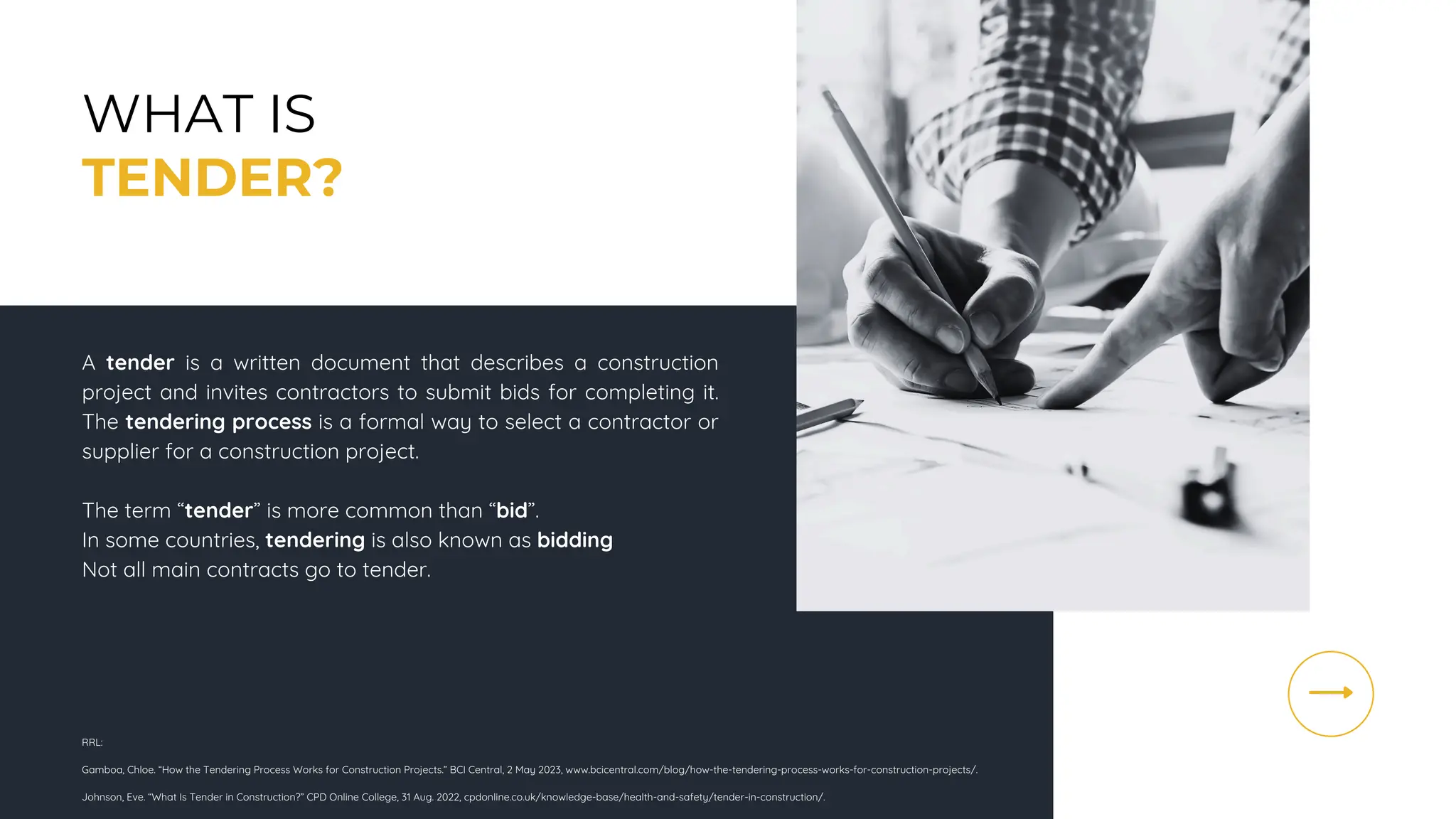
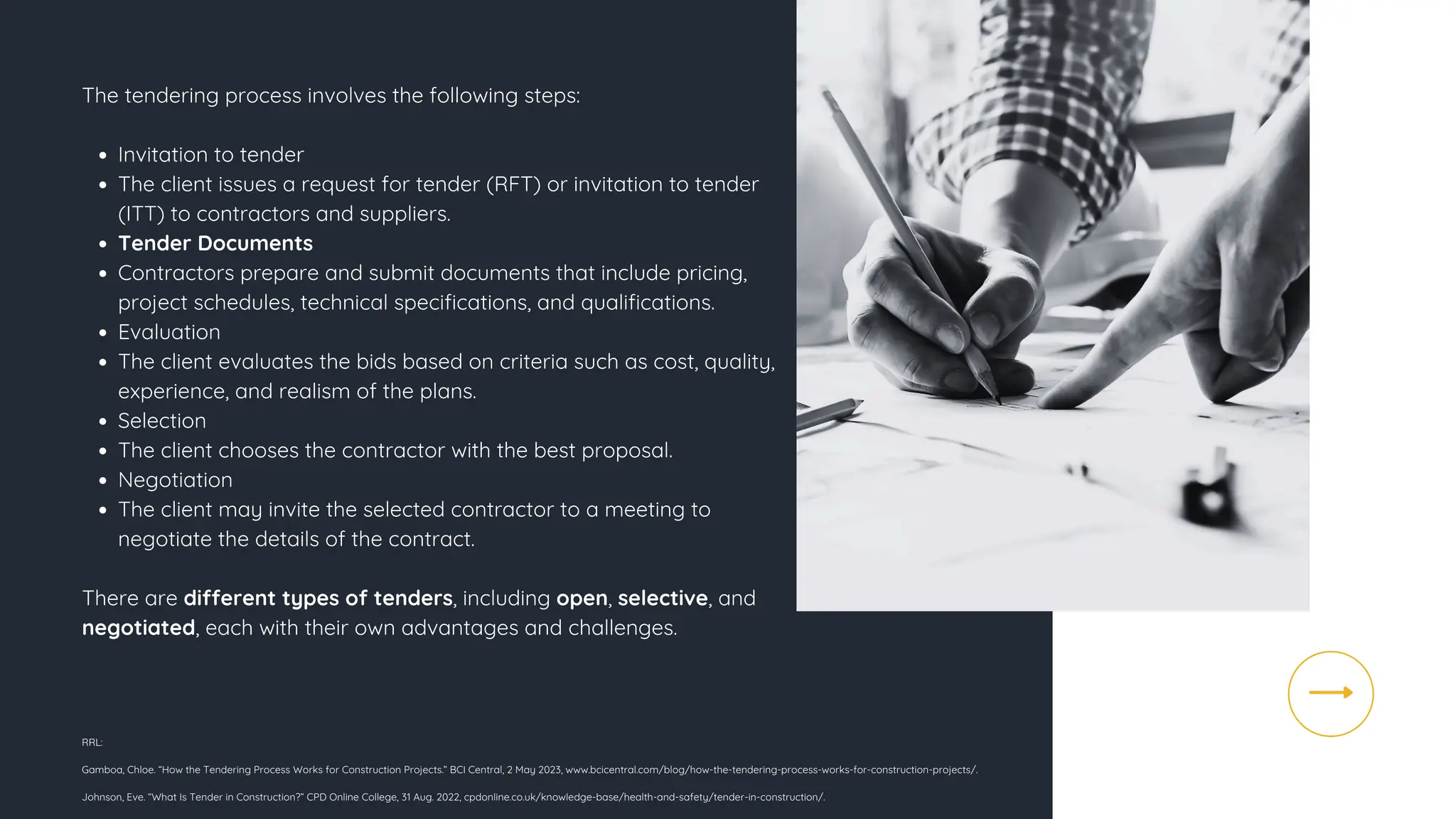
  • 49.
    Civil/Structural Documents a. SiteDevelopment Plan b. Structural Plans i. Foundation Plans and Details at scale of not less than 1:100. ii. Floor/Roof Framing Plans and Details at scale of not less than 1:100. iii. Details and Schedules of structural and civil works elements including those for deep wells, water reservoir, pipe lines and sewer system. c. Structural Analysis and Design for all buildings/structures except for one storey and single detached building/structure with a total floor area of 20.00 sq. meters or less. d. Boring and Load Tests e. Seismic Analysis f. Other related documents RRL: Department of Public Works and Highways (DPWH). Implementing Rules and Regulations of the National Building Code of the Philippines (PD 1096). 6 July 2005.
  • 50.
    Electrical Documents Electrical plansand technical specifications containing the following: a. Location and Site Plans b. Legend or Symbols c. General Notes and/or Specifications d. Electrical Layout e. Schedule of Loads, Transformers, Generating/UPS Units (Total kVA for each of the preceding items shall be indicated in the schedule) f. Design Analysis g. One Line Diagram RRL: Department of Public Works and Highways (DPWH). Implementing Rules and Regulations of the National Building Code of the Philippines (PD 1096). 6 July 2005.
  • 51.
    Mechanical Documents a. LocationPlan and Key Plan b. General Layout Plan for each floor, drawn to a scale of not less than 1:100, indicating the equipment in heavier lines than the building outline with names of machinery and corresponding brake horsepower shall be indicated. c. Longitudinal and Transverse Sections of building and equipment base on the section lines drawn to scale of at least 1:100 showing inter-floor relations and defining the manner of support of machines/equipment. Sections shall run longitudinally and transversely through the building length or width other than particularly detailed section for each machinery/equipment (fired and unfired pressure vessel, elevator, escalator, dumbwaiter, etc.). d. Isometric drawing of gas, fuel, oil system showing: Assembly of pipes on racks and supports, Legend and General Notes, Capacity per outlet and Complete individual piping system. e. Plans drawn to scale of 1:100 indicating location of store rooms, fuel tanks, fire extinguishing systems, fire doors, fire escape ladders and other protective facilities. RRL: Department of Public Works and Highways (DPWH). Implementing Rules and Regulations of the National Building Code of the Philippines (PD 1096). 6 July 2005.
  • 52.
    Mechanical Documents f. Detaileddrawings of all duct work installations, indicating dampers, controls, filters, fireproofing, acoustical and thermal insulation. g. Detailed Plans of machinery foundations and supports drawn to scale of at least 1:50. h. Detailed Plans of boilers and pressure vessels with a working pressure of above 70 kPa regardless of kilowatt rating. i. Design Computations and Detailed Plans of elevators, escalators, and the like drawn to scale of 1:50. j. For all installations, additions or alterations involving machinery of at most 14.9 kW, the signature of a duly licensed Mechanical Engineer shall be sufficient except fired and unfired pressure vessels, elevators, escalators, dumbwaiters, central/split/packaged type air conditioners and piping systems of steam, gas or fuels. k. Detailed plans of fire suppression systems, location of automatic and smoke detectors and alarm and initiating devices use to monitor the conditions that are essential for the proper operation including switches for the position of gate valves as well as alert and evacuation signals; the detailed layout of the entire safe area to be protected and the heat/smoke ventilation system. RRL: Department of Public Works and Highways (DPWH). Implementing Rules and Regulations of the National Building Code of the Philippines (PD 1096). 6 July 2005.
  • 53.
    Sanitary Documents a. Fordeepwell, water purification plants, water collection and distribution systems, reservoirs, drainage and sewer systems, sewage treatment plants, malaria control structures, and sewage disposal systems: i. Location Plan and Site Plan ii. Detailed Plan and layout drawings of minimum scale 1:100 iii. Design Analysis and Technical Specifications iv. Cost Estimates b. For pest and vermin control, sanitation, and pollution control facilities: i. Detailed plan, layout and drawing of abatement and control device of minimum scale 1:100 ii. Design analysis and technical specification iii. Cost Estimates RRL: Department of Public Works and Highways (DPWH). Implementing Rules and Regulations of the National Building Code of the Philippines (PD 1096). 6 July 2005.
  • 54.
    Plumbing Documents For allplumbing installations, additions and/or alterations involving hot and cold water supply, fixtures, sewage drainage and vent system, storm drainage and sewerage system within or adjacent to the building: a. Location Plan and Site Plan of minimum scale 1:2000 b. Plumbing Plans, Layouts and Details, of minimum scale 1:50 c. Legend and General Notes d. Isometric drawings of the systems e. Design analysis and technical specifications f. Cost Estimates RRL: Department of Public Works and Highways (DPWH). Implementing Rules and Regulations of the National Building Code of the Philippines (PD 1096). 6 July 2005.
  • 55.
    Electronics Documents Electronic plansand technical specifications for wired or wireless telecommunications systems, broadcasting systems, including radio and TV broadcast equipment for commercial and training purposes, cable or wireless television systems, information technology (IT) systems, security and alarm systems, electronic fire alarm systems, sound-reinforcement systems, navigational aids and controls, indoor and outdoor signages, electronically-controlled conveyance systems, electronic/computerized process controls and automation systems, building automation, management and control systems, including, but not limited to the following: a. General layout plans with legends b. Single line diagram c. Riser diagram d. Isometry of the system e. Equipment specifications f. Design analysis, as applicable g. Cost estimates RRL: Department of Public Works and Highways (DPWH). Implementing Rules and Regulations of the National Building Code of the Philippines (PD 1096). 6 July 2005.
  • 56.
    Geodetic Documents Lot SurveyPlans, including but not limited to: a. Vicinity Map/Location Plan b. Lot Plan c. Relocation Survey Plan and Report d. Line and Grade e. Detailed Topographic Plan of the site and immediate vicinity RRL: Department of Public Works and Highways (DPWH). Implementing Rules and Regulations of the National Building Code of the Philippines (PD 1096). 6 July 2005.
  • 57.
    An RFI isa written or verbal request made by the project manager, contractor, or any other stakeholders involved in the construction project, seeking additional information or clarification from the project owner, architect, engineer, or other relevant parties. RFIs are used to resolve any questions or ambiguities in the project plans or specifications, ensuring everyone clearly understands what is expected. RRL: buildern. (2023, February 15). What Is Construction RFI? 3 Steps to Handle Automated Processes. Buildern Resources. https://buildern.com/resources/blog/what-is-construction-rfi/ RFI (REQUEST FOR INFORMATION) RFA (REQUEST FOR APPROVAL/APPLICATION) An RFA is a document that asks for permission to use a specific process, part, or material for a construction project. The RFA is typically submitted by a contractor to an engineer or other competent body. The document includes a description of the request and asks for the recipient's comments and signature to acknowledge receipt. The contractor will usually specify a date by which they need a response to gain approval for the project.
  • 58.
    An RFP, onthe other hand, is a request made by a potential buyer to several potential suppliers, inviting them to submit proposals outlining the goods, services, or construction works they can provide. RFPs help buyers who need to identify a solution to a problem and want to compare several options from multiple suppliers. RRL: buildern. (2023, February 15). What Is Construction RFI? 3 Steps to Handle Automated Processes. Buildern Resources. https://buildern.com/resources/blog/what-is-construction-rfi/ RFP (REQUEST FOR PROPOSAL) RFQ (REQUEST FOR QUOTATION) An RFQ is a request for a price quotation for specific goods, services, or construction works. RFQs are often used when a buyer is looking to purchase goods or services at a competitive price and wants to compare prices from several suppliers. RFT (REQUEST FOR TENDER) An RFT or Request for Tender is a request for a detailed proposal outlining the goods, services, or construction works a supplier is willing to provide and at what price. RFTs are used when a buyer is looking to purchase goods, services, or construction works, and wants to receive detailed proposals from several suppliers.
  • 59.
    MSCM 601: CONTRACTS& LEGAL ASPECTS IN CONSTRUCTION MANAGEMENT THANK 20 24 YOU! END OF TENDER DOCUMENTATION & DESIGN PRESENTED BY: BRAVES ANTHONY C. GAPUSAN MSCM 1-B 2024
  • 60.
    MSCM 601: CONTRACTS& LEGAL ASPECTS IN CONSTRUCTION MANAGEMENT TENDER 20 24 DOCUMENTATION TOPIC 7: CLAIMS PRESENTED BY: BRAVES ANTHONY C. GAPUSAN
  • 61.
    WHAT IS TENDER? A tenderis a written document that describes a construction project and invites contractors to submit bids for completing it. The tendering process is a formal way to select a contractor or supplier for a construction project. The term “tender” is more common than “bid”. In some countries, tendering is also known as bidding Not all main contracts go to tender. RRL: Gamboa, Chloe. “How the Tendering Process Works for Construction Projects.” BCI Central, 2 May 2023, www.bcicentral.com/blog/how-the-tendering-process-works-for-construction-projects/. Johnson, Eve. “What Is Tender in Construction?” CPD Online College, 31 Aug. 2022, cpdonline.co.uk/knowledge-base/health-and-safety/tender-in-construction/.
  • 62.
    The tendering processinvolves the following steps: Invitation to tender The client issues a request for tender (RFT) or invitation to tender (ITT) to contractors and suppliers. Tender Documents Contractors prepare and submit documents that include pricing, project schedules, technical specifications, and qualifications. Evaluation The client evaluates the bids based on criteria such as cost, quality, experience, and realism of the plans. Selection The client chooses the contractor with the best proposal. Negotiation The client may invite the selected contractor to a meeting to negotiate the details of the contract. There are different types of tenders, including open, selective, and negotiated, each with their own advantages and challenges. RRL: Gamboa, Chloe. “How the Tendering Process Works for Construction Projects.” BCI Central, 2 May 2023, www.bcicentral.com/blog/how-the-tendering-process-works-for-construction-projects/. Johnson, Eve. “What Is Tender in Construction?” CPD Online College, 31 Aug. 2022, cpdonline.co.uk/knowledge-base/health-and-safety/tender-in-construction/.
  • 63.
    What are thecontents of Bidding Documents? The Philippine Bidding Documents (PBDs) contain the following: Invitation to Apply for Eligibility and to Bid (IAEB); 1. Eligibility Documents; 2. Eligibility Data Sheet; 3. Instructions to Bidders (ITB); 4. Bid Data Sheet (BDS); 5. General Conditions of Contract (GCC); 6. Special Conditions of Contract (SCC); 7. Specifications; 8. Drawings; 9. Bill of Quantities; and 10. Forms and Qualification Information. 11. RRL: Commission on Audit. Preparing the Bidding Documents. www.coa.gov.ph/wp-content/uploads/ABC-Help/Updated_Guidelines_in_the_Audit_of_Procurement/Annex%207/Section2-5.htm.
  • 64.
    A number ofstrategies can be used in the preparation of tender documentation to help avoid claims: Avoid dealing with items post tender. Statements such as “to be agreed” can lead to dispute without the leverage of competition. Phrases such as “to suit the contractor’s programme” are open ended. Setting a conditional date such as, “in accordance with the architect’s instruction” creates uncertainty for tendering contractors. It is not possible to enforce an “agreement to agree”. Avoid ambiguity in design responsibility, such as “the contractor shall complete any design required after the consultants have finalized the drawings provided for tender purposes”. RRL: CIOB (Chartered Institute of Building), et al. “Contract Claims in Construction.” Designingbuildings.co.uk, 2024, www.designingbuildings.co.uk/wiki/Contract_claims_in_construction#Tender_documentation.
  • 65.
    A number ofstrategies can be used in the preparation of tender documentation to help avoid claims: Avoid dealing with items post tender. Statements such as “to be agreed” can lead to dispute without the leverage of competition. Phrases such as “to suit the contractor’s programme” are open ended. Setting a conditional date such as, “in accordance with the architect’s instruction” creates uncertainty for tendering contractors. It is not possible to enforce an “agreement to agree”. Avoid ambiguity in design responsibility, such as “the contractor shall complete any design required after the consultants have finalized the drawings provided for tender purposes”. RRL: CIOB (Chartered Institute of Building), et al. “Contract Claims in Construction.” Designingbuildings.co.uk, 2024, www.designingbuildings.co.uk/wiki/Contract_claims_in_construction#Tender_documentation.
  • 66.
    MSCM 601: CONTRACTS& LEGAL ASPECTS IN CONSTRUCTION MANAGEMENT DESIGN 20 24 PRESENTED BY: BRAVES ANTHONY C. GAPUSAN TOPIC 7: CLAIMS
  • 67.
    Many claims arebased on delays resulting from design consultants issuing schedules, drawings and specifications after construction has begun. Conflict can then arise due to arguable deficiencies in that information: Missing, or Not Produced Late Incorrect Insufficient to Order or Build Impractical Unclear or Conflicting Inconsistent with Pricing Information Inappropriate or Not Fit for Purpose Uncoordinated with Other Information RRL: CIOB (Chartered Institute of Building), et al. “Contract Claims in Construction.” Designingbuildings.co.uk, 2024, www.designingbuildings.co.uk/wiki/Contract_claims_in_construction#Tender_documentation.
  • 68.
    Some flexibility isallowed by standard traditional contracts for the design team to issue further drawings and details reasonably necessary, either to explain or amplify the contract drawings. There can be an onus on the contractor to raise any queries on newly received information within 28 days of its receipt or forfeit their right to additional payment. RRL: CIOB (Chartered Institute of Building), et al. “Contract Claims in Construction.” Designingbuildings.co.uk, 2024, www.designingbuildings.co.uk/wiki/Contract_claims_in_construction#Tender_documentation.
  • 69.
    Basic Design Requirements: IRR- PD 1096 National Building Code RULE III SECTION 302. Application of Permits Five (5) sets of survey plans, design plans, specifications and other documents prepared, signed and sealed over the printed names of the duly licensed and registered professionals. a. Geodetic Engineer, in case of lot survey plans; b. Architect, in case of architectural documents; in case of architectural interior/interior design documents, either an architect or interior designer may sign; c. Civil Engineer, in case of civil/structural documents; d. Professional Electrical Engineer, in case of electrical documents; e. Professional Mechanical Engineer, in case of mechanical documents; f. Sanitary Engineer, in case of sanitary documents; g. Master Plumber, in case of plumbing documents; h. Electronics Engineer, in case of electronics documents. RRL: Department of Public Works and Highways (DPWH). Implementing Rules and Regulations of the National Building Code of the Philippines (PD 1096). 6 July 2005.
  • 70.
    Architectural Plans/Drawings a. ArchitecturalPlans/Drawings i. Vicinity Map/Location Plan ii. Site Development Plan iii. Perspective iv. Floor Plans v. Elevations vi. Sections vii. Reflected ceiling plan showing viii. Details, in the form of plans, elevations/sections: (a) Accessible ramps (b) Accessible stairs (c) Accessible lifts/elevators (d) Accessible entrances, corridors and walkways (e) Accessible functional areas/comfort rooms (f) Accessible switches, controls (g) Accessible drinking fountains (h) Accessible public telephone booths (i) Accessible audio visual and automatic alarm system (j) Accessible access symbols and directional signs (k) Reserved parking for disabled persons (l) Typical wall/bay sections from ground to roof (m) Stairs, interior and exterior RRL: Department of Public Works and Highways (DPWH). Implementing Rules and Regulations of the National Building Code of the Philippines (PD 1096). 6 July 2005.
  • 71.
    Architectural Plans/Drawings (n) Fireescapes/exits (o) Built-in cabinets, counters and fixed furniture (p) All types of partitions ix. Schedule of Doors and Windows showing their types, designations/marks, dimensions, materials, and number of sets. x. Schedule of Finishes, showing in graphic form: surface finishes specified for floors, ceilings, walls and baseboard trims for all building spaces per floor level. xi. Details of other major Architectural Elements. b. Architectural Interiors/Interior Design i. Space Plan/s or layout/s of architectural interior/s. ii. Architectural interior perspective/s. iii. Furniture/furnishing/equipment/process layout/s. iv. Access plan/s, parking plan/s and the like. v. Detail design of major architectural interior elements. vi. Plan and layout of interior, wall partitions, furnishing, furniture, equipment/appliances. vii. Interior wall elevations showing: finishes, switches, doors and convenience outlets, cross window sections with interior perspective as viewed from the main entrance. RRL: Department of Public Works and Highways (DPWH). Implementing Rules and Regulations of the National Building Code of the Philippines (PD 1096). 6 July 2005.
  • 72.
    Architectural Plans/Drawings iii. Floor/ceiling/wallpatterns and finishing details. ix. List of materials used. x. Cost Estimates. c. Plans and specific locations of all accessibility facilities. d. Detailed design of all such accessibility facilities outside and around buildings/structures including parking areas, and their safety requirements. e. Fire Safety Documents i. Layout plan of each floor indicating the fire evacuation route to safe dispersal areas, standpipes with fire hose, fire extinguishers, first aid kits/cabinets, fire alarm, fire operations room, emergency lights, signs, etc. ii. Details of windows, fire exits with grilled windows and ladders. iii. Details of fire-resistive construction of enclosures for vertical openings. iv. Details of fire-resistive construction materials and interior decorative materials with fireresistive/fire-retardant/fire-spread ratings v. Other Related Documents. f. Other related documents RRL: Department of Public Works and Highways (DPWH). Implementing Rules and Regulations of the National Building Code of the Philippines (PD 1096). 6 July 2005.

  • 73.
    Civil/Structural Documents a. SiteDevelopment Plan b. Structural Plans i. Foundation Plans and Details at scale of not less than 1:100. ii. Floor/Roof Framing Plans and Details at scale of not less than 1:100. iii. Details and Schedules of structural and civil works elements including those for deep wells, water reservoir, pipe lines and sewer system. c. Structural Analysis and Design for all buildings/structures except for one storey and single detached building/structure with a total floor area of 20.00 sq. meters or less. d. Boring and Load Tests e. Seismic Analysis f. Other related documents RRL: Department of Public Works and Highways (DPWH). Implementing Rules and Regulations of the National Building Code of the Philippines (PD 1096). 6 July 2005.
  • 74.
    Electrical Documents Electrical plansand technical specifications containing the following: a. Location and Site Plans b. Legend or Symbols c. General Notes and/or Specifications d. Electrical Layout e. Schedule of Loads, Transformers, Generating/UPS Units (Total kVA for each of the preceding items shall be indicated in the schedule) f. Design Analysis g. One Line Diagram RRL: Department of Public Works and Highways (DPWH). Implementing Rules and Regulations of the National Building Code of the Philippines (PD 1096). 6 July 2005.
  • 75.
    Mechanical Documents a. LocationPlan and Key Plan b. General Layout Plan for each floor, drawn to a scale of not less than 1:100, indicating the equipment in heavier lines than the building outline with names of machinery and corresponding brake horsepower shall be indicated. c. Longitudinal and Transverse Sections of building and equipment base on the section lines drawn to scale of at least 1:100 showing inter-floor relations and defining the manner of support of machines/equipment. Sections shall run longitudinally and transversely through the building length or width other than particularly detailed section for each machinery/equipment (fired and unfired pressure vessel, elevator, escalator, dumbwaiter, etc.). d. Isometric drawing of gas, fuel, oil system showing: Assembly of pipes on racks and supports, Legend and General Notes, Capacity per outlet and Complete individual piping system. e. Plans drawn to scale of 1:100 indicating location of store rooms, fuel tanks, fire extinguishing systems, fire doors, fire escape ladders and other protective facilities. RRL: Department of Public Works and Highways (DPWH). Implementing Rules and Regulations of the National Building Code of the Philippines (PD 1096). 6 July 2005.
  • 76.
    Mechanical Documents f. Detaileddrawings of all duct work installations, indicating dampers, controls, filters, fireproofing, acoustical and thermal insulation. g. Detailed Plans of machinery foundations and supports drawn to scale of at least 1:50. h. Detailed Plans of boilers and pressure vessels with a working pressure of above 70 kPa regardless of kilowatt rating. i. Design Computations and Detailed Plans of elevators, escalators, and the like drawn to scale of 1:50. j. For all installations, additions or alterations involving machinery of at most 14.9 kW, the signature of a duly licensed Mechanical Engineer shall be sufficient except fired and unfired pressure vessels, elevators, escalators, dumbwaiters, central/split/packaged type air conditioners and piping systems of steam, gas or fuels. k. Detailed plans of fire suppression systems, location of automatic and smoke detectors and alarm and initiating devices use to monitor the conditions that are essential for the proper operation including switches for the position of gate valves as well as alert and evacuation signals; the detailed layout of the entire safe area to be protected and the heat/smoke ventilation system. RRL: Department of Public Works and Highways (DPWH). Implementing Rules and Regulations of the National Building Code of the Philippines (PD 1096). 6 July 2005.
  • 77.
    Sanitary Documents a. Fordeepwell, water purification plants, water collection and distribution systems, reservoirs, drainage and sewer systems, sewage treatment plants, malaria control structures, and sewage disposal systems: i. Location Plan and Site Plan ii. Detailed Plan and layout drawings of minimum scale 1:100 iii. Design Analysis and Technical Specifications iv. Cost Estimates b. For pest and vermin control, sanitation, and pollution control facilities: i. Detailed plan, layout and drawing of abatement and control device of minimum scale 1:100 ii. Design analysis and technical specification iii. Cost Estimates RRL: Department of Public Works and Highways (DPWH). Implementing Rules and Regulations of the National Building Code of the Philippines (PD 1096). 6 July 2005.
  • 78.
    Plumbing Documents For allplumbing installations, additions and/or alterations involving hot and cold water supply, fixtures, sewage drainage and vent system, storm drainage and sewerage system within or adjacent to the building: a. Location Plan and Site Plan of minimum scale 1:2000 b. Plumbing Plans, Layouts and Details, of minimum scale 1:50 c. Legend and General Notes d. Isometric drawings of the systems e. Design analysis and technical specifications f. Cost Estimates RRL: Department of Public Works and Highways (DPWH). Implementing Rules and Regulations of the National Building Code of the Philippines (PD 1096). 6 July 2005.
  • 79.
    Electronics Documents Electronic plansand technical specifications for wired or wireless telecommunications systems, broadcasting systems, including radio and TV broadcast equipment for commercial and training purposes, cable or wireless television systems, information technology (IT) systems, security and alarm systems, electronic fire alarm systems, sound-reinforcement systems, navigational aids and controls, indoor and outdoor signages, electronically-controlled conveyance systems, electronic/computerized process controls and automation systems, building automation, management and control systems, including, but not limited to the following: a. General layout plans with legends b. Single line diagram c. Riser diagram d. Isometry of the system e. Equipment specifications f. Design analysis, as applicable g. Cost estimates RRL: Department of Public Works and Highways (DPWH). Implementing Rules and Regulations of the National Building Code of the Philippines (PD 1096). 6 July 2005.
  • 80.
    Geodetic Documents Lot SurveyPlans, including but not limited to: a. Vicinity Map/Location Plan b. Lot Plan c. Relocation Survey Plan and Report d. Line and Grade e. Detailed Topographic Plan of the site and immediate vicinity RRL: Department of Public Works and Highways (DPWH). Implementing Rules and Regulations of the National Building Code of the Philippines (PD 1096). 6 July 2005.
  • 81.
    An RFI isa written or verbal request made by the project manager, contractor, or any other stakeholders involved in the construction project, seeking additional information or clarification from the project owner, architect, engineer, or other relevant parties. RFIs are used to resolve any questions or ambiguities in the project plans or specifications, ensuring everyone clearly understands what is expected. RRL: buildern. (2023, February 15). What Is Construction RFI? 3 Steps to Handle Automated Processes. Buildern Resources. https://buildern.com/resources/blog/what-is-construction-rfi/ RFI (REQUEST FOR INFORMATION) RFA (REQUEST FOR APPROVAL/APPLICATION) An RFA is a document that asks for permission to use a specific process, part, or material for a construction project. The RFA is typically submitted by a contractor to an engineer or other competent body. The document includes a description of the request and asks for the recipient's comments and signature to acknowledge receipt. The contractor will usually specify a date by which they need a response to gain approval for the project.
  • 82.
    An RFP, onthe other hand, is a request made by a potential buyer to several potential suppliers, inviting them to submit proposals outlining the goods, services, or construction works they can provide. RFPs help buyers who need to identify a solution to a problem and want to compare several options from multiple suppliers. RRL: buildern. (2023, February 15). What Is Construction RFI? 3 Steps to Handle Automated Processes. Buildern Resources. https://buildern.com/resources/blog/what-is-construction-rfi/ RFP (REQUEST FOR PROPOSAL) RFQ (REQUEST FOR QUOTATION) An RFQ is a request for a price quotation for specific goods, services, or construction works. RFQs are often used when a buyer is looking to purchase goods or services at a competitive price and wants to compare prices from several suppliers. RFT (REQUEST FOR TENDER) An RFT or Request for Tender is a request for a detailed proposal outlining the goods, services, or construction works a supplier is willing to provide and at what price. RFTs are used when a buyer is looking to purchase goods, services, or construction works, and wants to receive detailed proposals from several suppliers.
  • 83.
    MSCM 601: CONTRACTS& LEGAL ASPECTS IN CONSTRUCTION MANAGEMENT THANK 20 24 YOU! END OF TENDER DOCUMENTATION & DESIGN PRESENTED BY: BRAVES ANTHONY C. GAPUSAN MSCM 1-B 2024
  • 84.
    Polytechnic University ofthe Philippines Open University System Master of Science in Construction Management MSCM 601 Contracts and Legal Aspects in Construction Management Topic 7- Claims Part 9- Cost DR. DANILO N. PILAR Subject Specialist
  • 85.
    Quantifying claims Costs • Actualcost is the proper basis for evaluating claims. • Costs may include allowance for inflation resulting from delay.
  • 86.
    A construction projectis delayed by six months due to unforeseen circumstances. The original estimated cost of a specific construction phase was PhP1 million. However, due to inflation, the cost of materials and labor has increased by 3.3% during this period. Calculate the Increased Cost o Increased Cost = Original Cost × Inflation Rate × Delay Period o In this case: Increased Cost = PhP1,000,000 × 3.3% × 0.5 (6 months / 12 months) = Php 16,500 Adjusted Claim Amount o Adjusted Claim Amount = Original Claim Amount + Increased Cost
  • 87.
    Preliminaries Preliminaries include set-upcosts, running costs and dismantling costs. Thus extensions of time should not include set-up or dismantling costs but merely running cost at the time of the breach and its associated period of delay. Set-up Costs: o Mobilization Costs o Site Establishment Costs o Site Security Costs o Utility Connection Costs
  • 88.
    Preliminaries Preliminaries include set-upcosts, running costs and dismantling costs. Thus extensions of time should not include set-up or dismantling costs but merely running cost at the time of the breach and its associated period of delay. Running Costs • Site Overhead Costs • Welfare Facilities Costs • Plant and Equipment Hire Costs • Material Procurement and Storage Costs
  • 89.
    Preliminaries Preliminaries include set-upcosts, running costs and dismantling costs. Thus extensions of time should not include set-up or dismantling costs but merely running cost at the time of the breach and its associated period of delay. Dismantling Costs • Demobilization Costs • Site Clearance Costs • Restoration Costs
  • 90.
    Disruption - loss dueto inefficient productivity. - It is extremely difficult to assess. - most effective approach is to localize the claim to a specific area of breach. - compare individuals productivity prior to and after the disruption occurred against the productivity during the period of disruption. - Generic claims based on statements such as ‘this was the tender price and this is the outturn cost’ are unlikely to succeed.
  • 91.
    Example: Delayed MaterialDelivery of Concrete To quantify the disruption 1. Identify the impacted work 2. Analyze pre-disruption productivity 3. Monitor during-disruption productivity 4. Compare pre- and during-disruption productivity 5. Consider additional factors
  • 92.
    Loss of profit/opportunitycosts Valid only when the claimant can prove breaches of contract directly prevented it making a profit elsewhere. Deductions must be made for additional profit that has been paid on the project as a result of extra work instructed and priced within the final account.
  • 93.
    To successfully claimloss of profit, a contractor must demonstrate the following: 1. Direct Causation - The breach of contract must have directly led to the loss of profit. 2. Lost Opportunity -The contractor must prove that they had a specific opportunity to undertake another project that was lost due to the delay or disruption caused by the breach. 3. Quantifiable Loss - The lost profit must be quantifiable and supported by reliable financial data, such as project budgets, cost estimates, and historical financial performance.
  • 94.
    Finance charges andinterest Finance charges and interest on extra capital required to fund costs arising from breaches in the contract are recoverable providing:  Interest rates are proven and reasonable (e.g market rates prevailing during the period of breach).  If financed within the corporate group, the rate will be that received from monies it has placed on deposit.
  • 95.
    Considerations for ClaimingInterest 1. Contractual Provisions 2. Proof of Actual Costs 3. Reasonable Interest Rate
  • 96.
    To quantify theclaim for interest 1. Calculate the Additional Costs 2. Determine the Delay Period 3. Calculate the Interest Rate 4. Calculate the Interest
  • 97.
    References:  Lecture/PPT ofDr. Danny Pilar  Contract Administration by CMDF  Construction Industry Association of the Philippines  3. Hare, J. I. Clark. 2003. The Law of Contracts. Clark, N.J.: Lawbook Exchange.  4. Marsh, P.D.V. 2001. Contract Negotiation Handbook. Burlington, Vt: Gower.  5. PMBOOK 5th Edition
  • 98.