h Weight andPrematurity – Impact on Nephron End
Nephron development continues until around 36 weeks of gestation.
Preterm infants and those with low birth weight may have significantly
fewer nephrons. This congenital nephron deficit predisposes to
glomerular hyperfiltration and hypertension from an early age.
Such individuals are more likely to develop CKD in adulthood,
especially if exposed to second hits like diabetes, hypertension, or
nephrotoxic drugs. Preventive care, early lifestyle counseling, and close
follow-up may help reduce long-term renal risk in this group.
2.
Infections and Sepsis– A Catalyst for Renal Injury
Sepsis is a common cause of acute kidney injury (AKI), which can lead
to permanent renal damage. The inflammatory response in sepsis
causes microvascular dysfunction, tubular injury, and impaired
autoregulation.
Repeated episodes of AKI, even with recovery, have been shown to
increase the risk of developing CKD. Preventing infections with
appropriate vaccination, early treatment, and hemodynamic
optimization are essential to mitigate long-term renal effects.
3.
Dyslipidemia – ItsRole in CKD Progression
Dyslipidemia contributes to glomerulosclerosis via lipid deposition in
mesangial cells and tubular epithelium. Oxidized LDL promotes
inflammation and fibrosis, worsening proteinuria and renal scarring.
Statin therapy not only lowers cardiovascular risk but may also reduce
the rate of GFR decline in CKD. Managing triglycerides and LDL is
important in comprehensive CKD care.
4.
Transition Slide –Beginning Hemodialysis Section
The next series of slides will cover Hemodialysis in detail: including its
principles, types, vascular access, prescription parameters,
complications, and patient care. Understanding the core concepts of
dialysis is critical for managing patients with ESKD in both acute and
chronic settings.
5.
Hemodialysis – Indicationsand Goals of Therapy
Hemodialysis is indicated in End-Stage Kidney Disease (GFR <15
mL/min/1.73 m²) when patients develop uremic symptoms or
refractory complications such as fluid overload, hyperkalemia, or
acidosis.
The goals of hemodialysis are to remove metabolic waste, correct fluid
and electrolyte imbalances, and improve the patient's quality of life. It
serves as a life-sustaining therapy and a bridge to renal transplant.
6.
ar Access forHemodialysis – AV Fistula, Graft, and Ca
An arteriovenous (AV) fistula is the preferred vascular access due to its
durability and low infection risk. It involves an anastomosis between an
artery and vein, usually in the forearm.
AV grafts (synthetic conduits) are used when native vessels are
inadequate. Central venous catheters are used in emergencies but
carry high risks of infection and thrombosis. Access care is crucial for
dialysis success.
7.
Hemodialysis Circuit –Understanding Components
The dialysis circuit includes the blood tubing system, dialyzer (artificial
kidney), and dialysate fluid compartment. Blood is pumped from the
patient through the dialyzer, where waste is removed across a semi-
permeable membrane.
Dialysate flows countercurrent to blood, facilitating diffusion and
ultrafiltration. The entire process is monitored via pressure sensors, air
detectors, and anticoagulation settings.
8.
echanisms of Soluteand Fluid Removal in Hemodialy
Small solutes like urea and creatinine are removed by diffusion, driven
by a concentration gradient across the dialysis membrane. Larger
solutes and excess fluid are removed by convection via ultrafiltration,
created by transmembrane pressure.
Modern dialysis machines allow fine control of these parameters to
match patient needs and minimize complications like hypotension or
disequilibrium.
9.
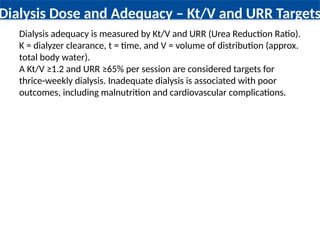
Dialysis Dose andAdequacy – Kt/V and URR Targets
Dialysis adequacy is measured by Kt/V and URR (Urea Reduction Ratio).
K = dialyzer clearance, t = time, and V = volume of distribution (approx.
total body water).
A Kt/V ≥1.2 and URR ≥65% per session are considered targets for
thrice-weekly dialysis. Inadequate dialysis is associated with poor
outcomes, including malnutrition and cardiovascular complications.
10.
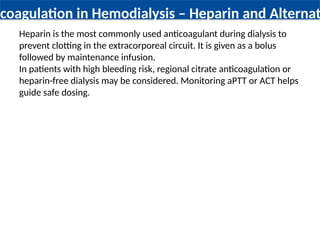
ticoagulation in Hemodialysis– Heparin and Alternati
Heparin is the most commonly used anticoagulant during dialysis to
prevent clotting in the extracorporeal circuit. It is given as a bolus
followed by maintenance infusion.
In patients with high bleeding risk, regional citrate anticoagulation or
heparin-free dialysis may be considered. Monitoring aPTT or ACT helps
guide safe dosing.
11.
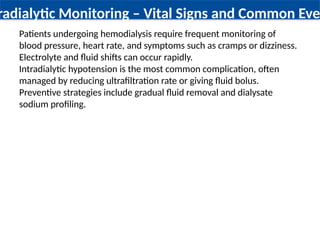
radialytic Monitoring –Vital Signs and Common Eve
Patients undergoing hemodialysis require frequent monitoring of
blood pressure, heart rate, and symptoms such as cramps or dizziness.
Electrolyte and fluid shifts can occur rapidly.
Intradialytic hypotension is the most common complication, often
managed by reducing ultrafiltration rate or giving fluid bolus.
Preventive strategies include gradual fluid removal and dialysate
sodium profiling.
12.
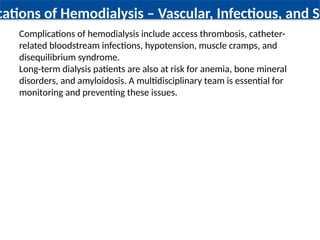
cations of Hemodialysis– Vascular, Infectious, and Sy
Complications of hemodialysis include access thrombosis, catheter-
related bloodstream infections, hypotension, muscle cramps, and
disequilibrium syndrome.
Long-term dialysis patients are also at risk for anemia, bone mineral
disorders, and amyloidosis. A multidisciplinary team is essential for
monitoring and preventing these issues.
13.
Peritoneal Dialysis –Overview and Comparison
Peritoneal dialysis uses the patient's peritoneal membrane as the
dialysis surface. Dialysate is instilled into the peritoneal cavity and
exchanged manually (CAPD) or automatically (APD).
It offers better lifestyle flexibility and preservation of residual kidney
function. However, it carries risks of peritonitis and is less effective for
very large patients or those with adhesions.
14.
nt Education andSupport – Empowering Dialysis Pati
Patient involvement is key to successful dialysis care. Education on
access care, dietary restrictions (e.g., low potassium, phosphorus),
fluid balance, and medication adherence improves outcomes.
Support groups and mental health counseling help address the
emotional and social challenges associated with chronic dialysis.
15.
d Conclusion –Integrating Risk Reduction and Renal
CKD is a major global health problem with diverse risk factors, many of
which are modifiable. Early identification and control of diabetes,
hypertension, and nephrotoxic exposure can prevent or delay
progression.
Hemodialysis is a complex but life-saving therapy requiring coordinated
care. As future physicians, understanding the biology, technique, and
human aspects of dialysis is crucial for managing renal patients
effectively.