Chimzi, Christin, Katherine & Ricky
EDAD 521
   Description of Society
   Higher education institutions
   Factors affecting Higher Education
   Significant changes
   Look at Student Affairs
   Populations effected
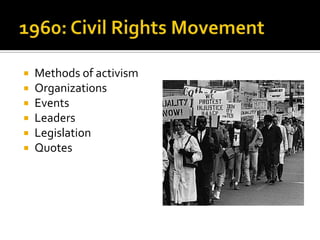
   Methods of activism
   Organizations
   Events
   Leaders
   Legislation
   Quotes
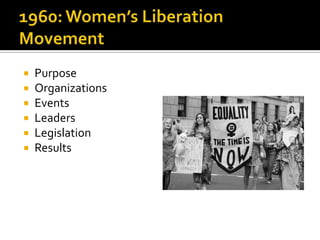
   Purpose
   Organizations
   Events
   Leaders
   Legislation
   Results
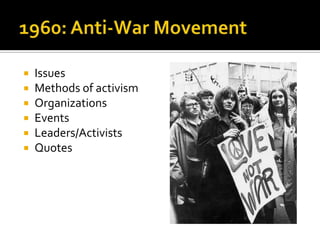
   Issues
   Methods of activism
   Organizations
   Events
   Leaders/Activists
   Quotes
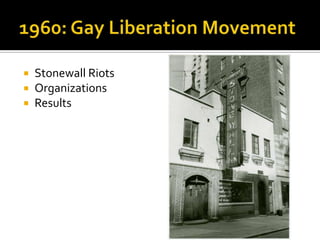
   Stonewall Riots
   Organizations
   Results
   Women’s Colleges
     1972 Coeducation becomes nearly Universal
     In 1960 there were over 200 Women’s Colleges
     Coeducational model was motivated by politics
     and finances, not by what is educationally and
     developmentally optimal for women
   Master Plan became               Cal State System: 1960- The
    international model for           23 California state-funded
    Higher Education                  schools became California
   Increase in Cal Grants            State Colleges through the
   Opened new Colleges and           this act
    Universities Across the State    In 1972 the word “colleges”
   Power moved from State            was dropped from the name
    Board of Ed to a newly            of this system
    created California State         Defined this system
    College Board of Trustees            Aimed at recruiting top 1/3rd of
   Set admissions guidelines for         Calif. High School students
    Ucs and CSC (CSU’s), and CC          Bachelor’s and Master’s
                                          degrees
                                         Minor research
                                         Primary responsibility for
                                          teaching credentials
UNIVERSITY OF CALIFORNIA          CALIFORNIA COMMUNITY
                                  COLLEGE SYSTEM:
   World Model of a                 Created 1967 also a result
    Multiversity                      of the Donahoe Higher
   Recruited top 12.5 % of           Education Act
    California High School           Catered to all HS grads
    Students                         50,000 attended in
   Campuses opened in San            California between 1960-
    Diego (1960), Irvine (1965)       1975
    and Santa Cruz (1965)
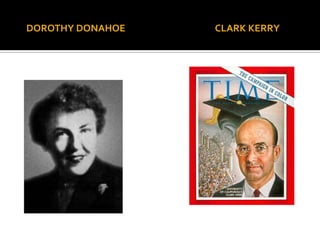
DOROTHY DONAHOE   CLARK KERRY
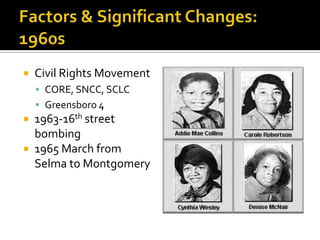
   Civil Rights Movement
     CORE, SNCC, SCLC
     Greensboro 4
 1963-16th street
  bombing
 1965 March from
  Selma to Montgomery
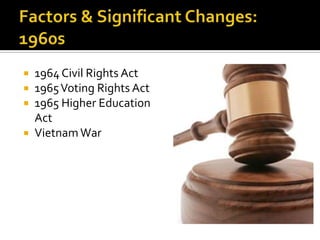
 1964 Civil Rights Act
 1965 Voting Rights Act
 1965 Higher Education
  Act
 Vietnam War
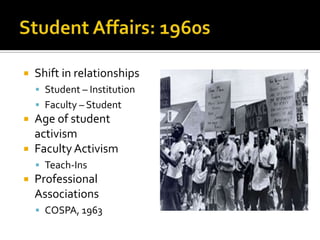
   Shift in relationships
     Student – Institution
     Faculty – Student
 Age of student
  activism
 Faculty Activism
     Teach-Ins
   Professional
    Associations
     COSPA, 1963
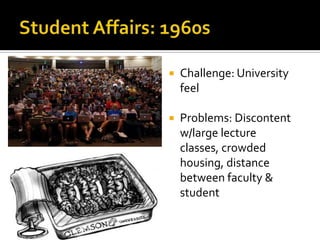
   Challenge: University
    feel

   Problems: Discontent
    w/large lecture
    classes, crowded
    housing, distance
    between faculty &
    student
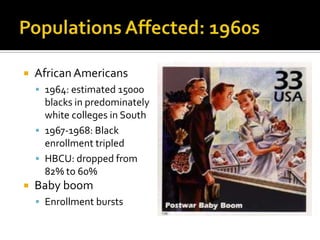
   African Americans
     1964: estimated 15000
      blacks in predominately
      white colleges in South
     1967-1968: Black
      enrollment tripled
     HBCU: dropped from
      82% to 60%
   Baby boom
     Enrollment bursts
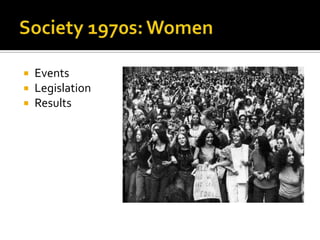
   Events
   Legislation
   Results
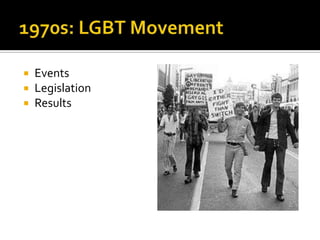
   Events
   Legislation
   Results
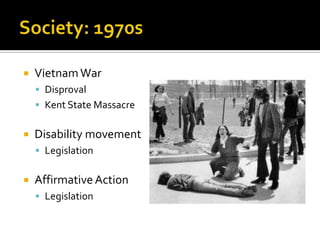
   Vietnam War
     Disproval
     Kent State Massacre


   Disability movement
     Legislation


   Affirmative Action
     Legislation
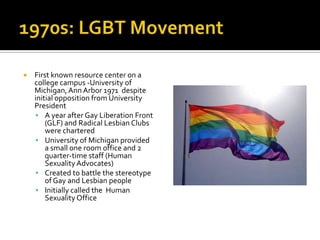
   First known resource center on a
    college campus -University of
    Michigan, Ann Arbor 1971 despite
    initial opposition from University
    President
     A year after Gay Liberation Front
        (GLF) and Radical Lesbian Clubs
        were chartered
     University of Michigan provided
        a small one room office and 2
        quarter-time staff (Human
        Sexuality Advocates)
     Created to battle the stereotype
        of Gay and Lesbian people
     Initially called the Human
        Sexuality Office
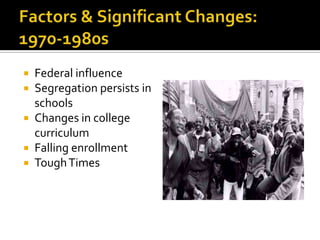
 Federal influence
 Segregation persists in
  schools
 Changes in college
  curriculum
 Falling enrollment
 Tough Times
   Consumer model
   Increase in Higher Ed  Increase SAP
   Student Affairs/Student Development
   CAS is developed
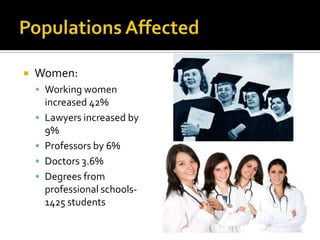
   Women:
     Working women
        increased 42%
       Lawyers increased by
        9%
       Professors by 6%
       Doctors 3.6%
       Degrees from
        professional schools-
        1425 students
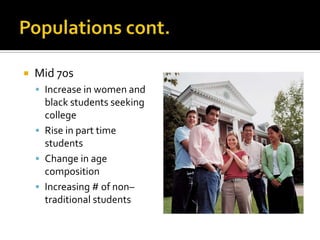
   Mid 70s
     Increase in women and
      black students seeking
      college
     Rise in part time
      students
     Change in age
      composition
     Increasing # of non–
      traditional students
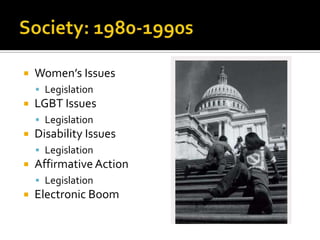
   Women’s Issues
     Legislation
   LGBT Issues
     Legislation
   Disability Issues
     Legislation
   Affirmative Action
     Legislation
   Electronic Boom
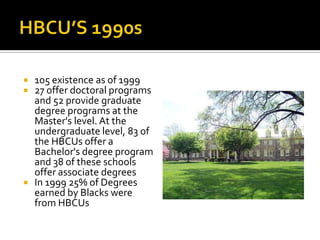
   105 existence as of 1999
   27 offer doctoral programs
    and 52 provide graduate
    degree programs at the
    Master's level. At the
    undergraduate level, 83 of
    the HBCUs offer a
    Bachelor's degree program
    and 38 of these schools
    offer associate degrees
   In 1999 25% of Degrees
    earned by Blacks were
    from HBCUs
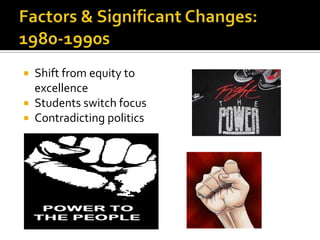
 Shift from equity to
  excellence
 Students switch focus
 Contradicting politics
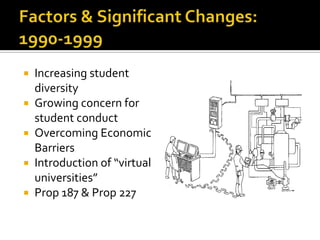
   Increasing student
    diversity
   Growing concern for
    student conduct
   Overcoming Economic
    Barriers
   Introduction of “virtual
    universities”
   Prop 187 & Prop 227
   Diversity of students
   1986: CAS Standards
    and Guidelines published
   NASPA/ACPA/AAHE
    studies:
     Student Learning
      Imperative
     Reasonable Expectations

   Increasing Appreciation
   Joint Services
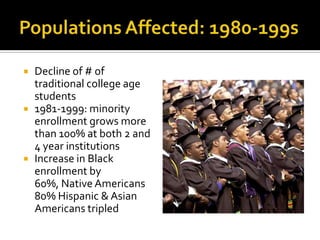
   Decline of # of
    traditional college age
    students
   1981-1999: minority
    enrollment grows more
    than 100% at both 2 and
    4 year institutions
   Increase in Black
    enrollment by
    60%, Native Americans
    80% Hispanic & Asian
    Americans tripled
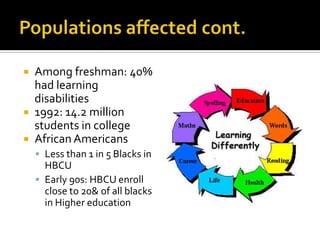
 Among freshman: 40%
  had learning
  disabilities
 1992: 14.2 million
  students in college
 African Americans
     Less than 1 in 5 Blacks in
      HBCU
     Early 90s: HBCU enroll
      close to 20& of all blacks
      in Higher education

Civil+rights+era+america+presentation

  • 1.
  • 2.
    Description of Society  Higher education institutions  Factors affecting Higher Education  Significant changes  Look at Student Affairs  Populations effected
  • 3.
    Methods of activism  Organizations  Events  Leaders  Legislation  Quotes
  • 4.
    Purpose  Organizations  Events  Leaders  Legislation  Results
  • 5.
    Issues  Methods of activism  Organizations  Events  Leaders/Activists  Quotes
  • 6.
    Stonewall Riots  Organizations  Results
  • 7.
    Women’s Colleges  1972 Coeducation becomes nearly Universal  In 1960 there were over 200 Women’s Colleges  Coeducational model was motivated by politics and finances, not by what is educationally and developmentally optimal for women
  • 8.
    Master Plan became  Cal State System: 1960- The international model for 23 California state-funded Higher Education schools became California  Increase in Cal Grants State Colleges through the  Opened new Colleges and this act Universities Across the State  In 1972 the word “colleges”  Power moved from State was dropped from the name Board of Ed to a newly of this system created California State  Defined this system College Board of Trustees  Aimed at recruiting top 1/3rd of  Set admissions guidelines for Calif. High School students Ucs and CSC (CSU’s), and CC  Bachelor’s and Master’s degrees  Minor research  Primary responsibility for teaching credentials
  • 9.
    UNIVERSITY OF CALIFORNIA CALIFORNIA COMMUNITY COLLEGE SYSTEM:  World Model of a  Created 1967 also a result Multiversity of the Donahoe Higher  Recruited top 12.5 % of Education Act California High School  Catered to all HS grads Students  50,000 attended in  Campuses opened in San California between 1960- Diego (1960), Irvine (1965) 1975 and Santa Cruz (1965)
  • 10.
    DOROTHY DONAHOE CLARK KERRY
  • 11.
    Civil Rights Movement  CORE, SNCC, SCLC  Greensboro 4  1963-16th street bombing  1965 March from Selma to Montgomery
  • 12.
     1964 CivilRights Act  1965 Voting Rights Act  1965 Higher Education Act  Vietnam War
  • 13.
    Shift in relationships  Student – Institution  Faculty – Student  Age of student activism  Faculty Activism  Teach-Ins  Professional Associations  COSPA, 1963
  • 14.
    Challenge: University feel  Problems: Discontent w/large lecture classes, crowded housing, distance between faculty & student
  • 15.
    African Americans  1964: estimated 15000 blacks in predominately white colleges in South  1967-1968: Black enrollment tripled  HBCU: dropped from 82% to 60%  Baby boom  Enrollment bursts
  • 16.
    Events  Legislation  Results
  • 17.
    Events  Legislation  Results
  • 18.
    Vietnam War  Disproval  Kent State Massacre  Disability movement  Legislation  Affirmative Action  Legislation
  • 19.
    First known resource center on a college campus -University of Michigan, Ann Arbor 1971 despite initial opposition from University President  A year after Gay Liberation Front (GLF) and Radical Lesbian Clubs were chartered  University of Michigan provided a small one room office and 2 quarter-time staff (Human Sexuality Advocates)  Created to battle the stereotype of Gay and Lesbian people  Initially called the Human Sexuality Office
  • 20.
     Federal influence Segregation persists in schools  Changes in college curriculum  Falling enrollment  Tough Times
  • 21.
    Consumer model  Increase in Higher Ed  Increase SAP  Student Affairs/Student Development  CAS is developed
  • 22.
    Women:  Working women increased 42%  Lawyers increased by 9%  Professors by 6%  Doctors 3.6%  Degrees from professional schools- 1425 students
  • 23.
    Mid 70s  Increase in women and black students seeking college  Rise in part time students  Change in age composition  Increasing # of non– traditional students
  • 24.
    Women’s Issues  Legislation  LGBT Issues  Legislation  Disability Issues  Legislation  Affirmative Action  Legislation  Electronic Boom
  • 25.
    105 existence as of 1999  27 offer doctoral programs and 52 provide graduate degree programs at the Master's level. At the undergraduate level, 83 of the HBCUs offer a Bachelor's degree program and 38 of these schools offer associate degrees  In 1999 25% of Degrees earned by Blacks were from HBCUs
  • 26.
     Shift fromequity to excellence  Students switch focus  Contradicting politics
  • 27.
    Increasing student diversity  Growing concern for student conduct  Overcoming Economic Barriers  Introduction of “virtual universities”  Prop 187 & Prop 227
  • 28.
    Diversity of students  1986: CAS Standards and Guidelines published  NASPA/ACPA/AAHE studies:  Student Learning Imperative  Reasonable Expectations  Increasing Appreciation  Joint Services
  • 29.
    Decline of # of traditional college age students  1981-1999: minority enrollment grows more than 100% at both 2 and 4 year institutions  Increase in Black enrollment by 60%, Native Americans 80% Hispanic & Asian Americans tripled
  • 30.
     Among freshman:40% had learning disabilities  1992: 14.2 million students in college  African Americans  Less than 1 in 5 Blacks in HBCU  Early 90s: HBCU enroll close to 20& of all blacks in Higher education