Structural Engineer

Who...?

MADE City Builder Academy
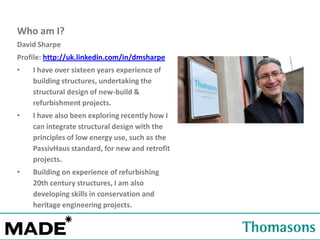
Who am I?
David Sharpe
Profile: http://uk.linkedin.com/in/dmsharpe
•

I have over sixteen years experience of
building structures, undertaking the
structural design of new-build &
refurbishment projects.

•

I have also been exploring recently how I
can integrate structural design with the
principles of low energy use, such as the
PassivHaus standard, for new and retrofit
projects.

•

Building on experience of refurbishing
20th century structures, I am also
developing skills in conservation and
heritage engineering projects.
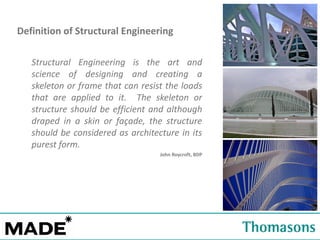
Definition of Structural Engineering
Structural Engineering is the art and
science of designing and creating a
skeleton or frame that can resist the loads
that are applied to it. The skeleton or
structure should be efficient and although
draped in a skin or façade, the structure
should be considered as architecture in its
purest form.
John Roycroft, BDP
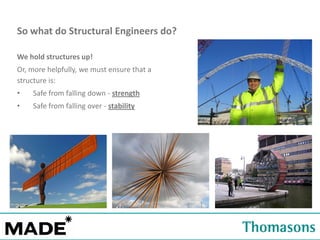
So what do Structural Engineers do?
We hold structures up!
Or, more helpfully, we must ensure that a
structure is:
•

Safe from falling down - strength

•

Safe from falling over - stability
So what do Structural Engineers do?
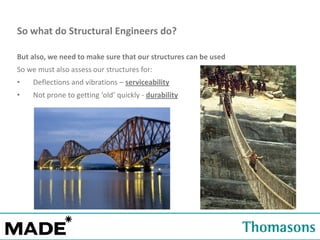
But also, we need to make sure that our structures can be used
So we must also assess our structures for:
•

Deflections and vibrations – serviceability

•

Not  prone  to  getting  ‘old’  quickly  - durability
So what do Structural Engineers do?
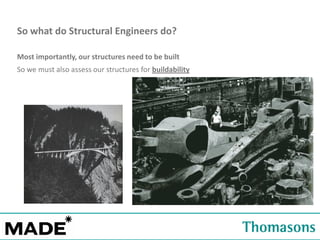
Most importantly, our structures need to be built
So we must also assess our structures for buildability
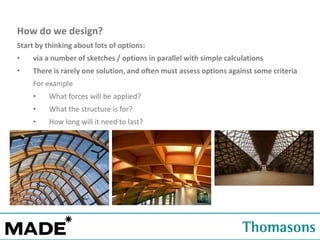
How do we design?
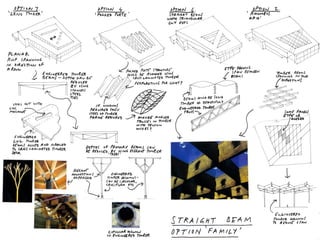
Start by thinking about lots of options:
•

via a number of sketches / options in parallel with simple calculations

•

There is rarely one solution, and often must assess options against some criteria
For example

•

What forces will be applied?

•

What the structure is for?

•

How long will it need to last?
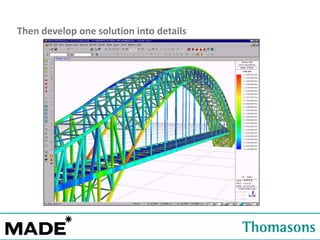
Then develop one solution into details
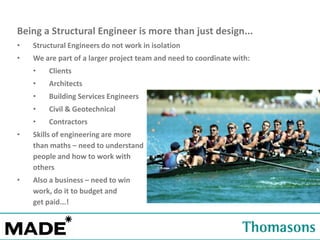
Being a Structural Engineer is more than just design...
•

Structural Engineers do not work in isolation

•

We are part of a larger project team and need to coordinate with:
•

Clients

•

Architects

•

Building Services Engineers

•

Civil & Geotechnical

•

Contractors

•

Skills of engineering are more
than maths – need to understand
people and how to work with
others

•

Also a business – need to win
work, do it to budget and
get paid...!
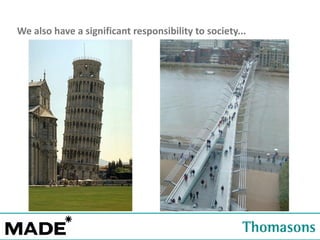
We also have a significant responsibility to society...
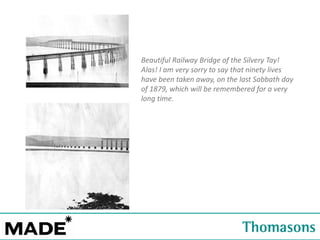
Beautiful Railway Bridge of the Silvery Tay!
Alas! I am very sorry to say that ninety lives
have been taken away, on the last Sabbath day
of 1879, which will be remembered for a very
long time.
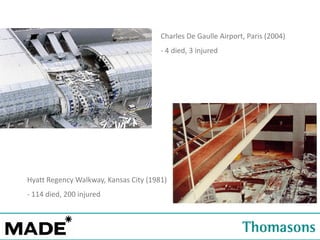
Charles De Gaulle Airport, Paris (2004)
- 4 died, 3 injured

Hyatt Regency Walkway, Kansas City (1981)
- 114 died, 200 injured
How did I get to be a Structural Engineer?
•

I started thinking about being involved in some form engineering around the
time I was selecting options for GCSEs.

•

In the run up to selecting which A-levels to take, I decided to focus on the built
environment, and went to chat to an architect and a civil/structural engineer. In
the end, I went for Civil Engineering, and selected my A-levels – Physics, Maths
& Geology – to suit the degree course requirements.

•

Then university – BEng (Hons) Civil Engineering – University of Liverpool

•

I decided to specialise in building structures, so decided to take a Masters degree
– MSc Structural Design, University College London

•

From there started working for design companies – known as consulting
engineers – starting with Arup in Cardiff in 1995.

•

Spent some time out on construction sites, to understand how things are built

•

Then went through route to become a Chartered Structural Engineer
What’s  on  my  desk  now?
•

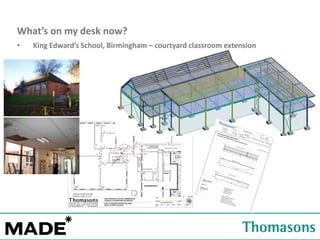
King  Edward’s  School,  Birmingham  – courtyard classroom extension
What’s  on  my  desk  now?
•

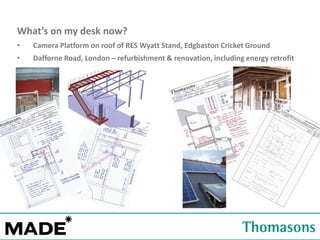
Camera Platform on roof of RES Wyatt Stand, Edgbaston Cricket Ground

•

Dafforne Road, London – refurbishment & renovation, including energy retrofit

Engineering- David Sharpe, City Builder Academy

  • 1.
  • 2.
    Who am I? DavidSharpe Profile: http://uk.linkedin.com/in/dmsharpe • I have over sixteen years experience of building structures, undertaking the structural design of new-build & refurbishment projects. • I have also been exploring recently how I can integrate structural design with the principles of low energy use, such as the PassivHaus standard, for new and retrofit projects. • Building on experience of refurbishing 20th century structures, I am also developing skills in conservation and heritage engineering projects.
  • 3.
    Definition of StructuralEngineering Structural Engineering is the art and science of designing and creating a skeleton or frame that can resist the loads that are applied to it. The skeleton or structure should be efficient and although draped in a skin or façade, the structure should be considered as architecture in its purest form. John Roycroft, BDP
  • 4.
    So what doStructural Engineers do? We hold structures up! Or, more helpfully, we must ensure that a structure is: • Safe from falling down - strength • Safe from falling over - stability
  • 5.
    So what doStructural Engineers do? But also, we need to make sure that our structures can be used So we must also assess our structures for: • Deflections and vibrations – serviceability • Not  prone  to  getting  ‘old’  quickly  - durability
  • 6.
    So what doStructural Engineers do? Most importantly, our structures need to be built So we must also assess our structures for buildability
  • 7.
    How do wedesign? Start by thinking about lots of options: • via a number of sketches / options in parallel with simple calculations • There is rarely one solution, and often must assess options against some criteria For example • What forces will be applied? • What the structure is for? • How long will it need to last?
  • 9.
    Then develop onesolution into details
  • 10.
    Being a StructuralEngineer is more than just design... • Structural Engineers do not work in isolation • We are part of a larger project team and need to coordinate with: • Clients • Architects • Building Services Engineers • Civil & Geotechnical • Contractors • Skills of engineering are more than maths – need to understand people and how to work with others • Also a business – need to win work, do it to budget and get paid...!
  • 11.
    We also havea significant responsibility to society...
  • 12.
    Beautiful Railway Bridgeof the Silvery Tay! Alas! I am very sorry to say that ninety lives have been taken away, on the last Sabbath day of 1879, which will be remembered for a very long time.
  • 13.
    Charles De GaulleAirport, Paris (2004) - 4 died, 3 injured Hyatt Regency Walkway, Kansas City (1981) - 114 died, 200 injured
  • 14.
    How did Iget to be a Structural Engineer? • I started thinking about being involved in some form engineering around the time I was selecting options for GCSEs. • In the run up to selecting which A-levels to take, I decided to focus on the built environment, and went to chat to an architect and a civil/structural engineer. In the end, I went for Civil Engineering, and selected my A-levels – Physics, Maths & Geology – to suit the degree course requirements. • Then university – BEng (Hons) Civil Engineering – University of Liverpool • I decided to specialise in building structures, so decided to take a Masters degree – MSc Structural Design, University College London • From there started working for design companies – known as consulting engineers – starting with Arup in Cardiff in 1995. • Spent some time out on construction sites, to understand how things are built • Then went through route to become a Chartered Structural Engineer
  • 15.
    What’s  on  my desk  now? • King  Edward’s  School,  Birmingham  – courtyard classroom extension
  • 16.
    What’s  on  my desk  now? • Camera Platform on roof of RES Wyatt Stand, Edgbaston Cricket Ground • Dafforne Road, London – refurbishment & renovation, including energy retrofit