Circulation. 2020;141:e705–e736. DOI: 10.1161/CIR.0000000000000749 March 31, 2020 e705
Barry A. Franklin, PhD,
FAHA, Chair
Paul D. Thompson, MD,
FAHA, Vice-Chair
Salah S. Al-Zaiti, RN, NP,
PhD, FAHA
Christine M. Albert, MD,
MPH
Marie-France Hivert, MD,
MMSC
Benjamin D. Levine, MD
Felipe Lobelo, MD, PhD,
FAHA
Kushal Madan, PhD, FAHA
Anjail Z. Sharrief, MD,
MPH
Thijs M.H. Eijsvogels, PhD
On behalf of the American
Heart Association
Physical Activity
Committee of the
Council on Lifestyle and
Cardiometabolic
Health; Council on
Cardiovascular and
Stroke Nursing; Council
on Clinical Cardiology;
and Stroke Council
© 2020 American Heart Association, Inc.
AHA SCIENTIFIC STATEMENT
Exercise-Related Acute Cardiovascular Events and Potential
Deleterious Adaptations Following Long-Term Exercise
Training: Placing the Risks Into Perspective–An Update
A Scientific Statement From the American Heart Association
Endorsed by the American College of Sports Medicine and American Association of Cardiovascular
and Pulmonary Rehabilitation
Circulation
https://www.ahajournals.org/journal/circ
ABSTRACT: Epidemiological and biological plausibility studies support a
cause-and-effect relationship between increased levels of physical activity
or cardiorespiratory fitness and reduced coronary heart disease events.
These data, plus the well-documented anti-aging effects of exercise, have
likely contributed to the escalating numbers of adults who have embraced
the notion that “more exercise is better.” As a result, worldwide
participation in endurance training, competitive long distance endurance
events, and high-intensity interval training has increased markedly since
the previous American Heart Association statement on exercise risk. On
the other hand, vigorous physical activity, particularly when performed
by unfit individuals, can acutely increase the risk of sudden cardiac death
and acute myocardial infarction in susceptible people. Recent studies have
also shown that large exercise volumes and vigorous intensities are both
associated with potential cardiac maladaptations, including accelerated
coronary artery calcification, exercise-induced cardiac biomarker release,
myocardial fibrosis, and atrial fibrillation. The relationship between these
maladaptive responses and physical activity often forms a U- or reverse
J-shaped dose-response curve. This scientific statement discusses the
cardiovascular and health implications for moderate to vigorous physical
activity, as well as high-volume, high-intensity exercise regimens, based
on current understanding of the associated risks and benefits. The goal
is to provide healthcare professionals with updated information to advise
patients on appropriate preparticipation screening and the benefits and
risks of physical activity or physical exertion in varied environments and
during competitive events.
Key Words:  AHA Scientific Statements
◼ cardiorespiratory fitness ◼ exercise
◼ high-intensity interval training
◼ J-shaped curve ◼ physical exertion
◼ risk assessment ◼ risk of exercise
Downloadedfromhttp://ahajournals.orgbyonApril4,2020
Franklin et al Exercise-Related Acute Cardiovascular Events
March 31, 2020 Circulation. 2020;141:e705–e736. DOI: 10.1161/CIR.0000000000000749e706
CLINICALSTATEMENTS
ANDGUIDELINES
S
ubstantial epidemiological, clinical, and basic sci-
ence evidence suggests that regular physical ac-
tivity (PA), higher cardiorespiratory fitness (CRF),
or both, delay the development of atherosclerotic car-
diovascular disease (CVD) and reduce the incidence of
coronary heart disease (CHD) events.1–3
PA is defined as
any bodily movement resulting from the contraction of
skeletal muscle that increases energy expenditure above
the basal level. A systematic review and meta-analysis
of 33 PA studies (n=883 372 participants) reported risk
reductions of 30% to 50% for cardiovascular mortality
and 20% to 50% for all-cause mortality with increas-
ing volumes of PA.4
More recently, researchers from the
Nurses’ Health Study (n=78 865) and the Health Pro-
fessionals Follow-up Study (n=44 354) estimated the
impact of 5 lifestyle factors, including ≥30 min/d of
moderate to vigorous PA, on life expectancy in the US
population.5
During up to 34 years of follow-up, the
most physically active cohorts of men and women dem-
onstrated 7- to 8-year gains in life expectancy.
Exercise training, as a subcategory of PA, is defined as
any planned and structured intervention with the objec-
tive of improving or maintaining CRF or health, achiev-
ing athletic goals, or both. Aerobic capacity or CRF can
be directly measured during cardiopulmonary exercise
testing via gas-exchange measurements or estimated
from the attained treadmill speed, percent grade, and
duration (minutes) or the cycle ergometer workload,
expressed as kilogram meters per minute. After a 12-
week exercise-based cardiac rehabilitation program in a
cohort of 5600 patients with known CVD, each 1-met-
abolic equivalent (MET; 1 MET=3.5 mL O2
·kg−1
·min−1
)
improvement in estimated CRF (CRFe) was associated
with a 13% overall reduced risk of all-cause mortality
and, in the least fit patient cohort (5 MET capacity),
a 30% reduction in mortality.6
These risk reductions
compare favorably with the survival benefit conferred
by commonly prescribed cardioprotective medications,
including statins.7
In US veterans, the incidence of major
CVD events was 16% lower for every 1-MET increase
in CRFe. Compared with the least fit veterans, the risk
of CVD events was ≈70% lower for individuals in the
highest fitness category.8
A prospective cohort study
of 120 000 consecutive patients who underwent
maximal treadmill testing and 1.1 million person-years
of observation reported no upper limit for the protec-
tive effect of higher CRFe on all-cause mortality. Com-
pared with the lowest performers (25th percentile),
elite CRFe (97.7th percentile) was associated with an
80% reduction in mortality risk. Remarkably, the effect
of low CRFe on all-cause mortality was comparable to
or greater than that of traditional risk factors such as
smoking and diabetes mellitus for coronary artery dis-
ease (CAD).9
A study from the UK Biobank (n=502 635)
showed inverse associations between CRFe and CHD
(hazard ratio [HR], 0.51 [95% CI, 0.38–0.69]) and CRFe
and atrial fibrillation (AF; HR, 0.40 [95% CI, 0.30–0.55])
among individuals at high genetic risk for these diseas-
es.10
Others have reported that highly fit individuals, re-
gardless of their risk factor profile, have an ≈50% lower
30-year CVD mortality than their counterparts with low
fitness.11
Similarly, men with subclinical CAD (coronary
artery calcium [CAC] score ≥100) whose CRFe was ≥10
METs have an age-adjusted HR for CHD events of 0.26
(95% CI, 0.15–0.45) compared with men whose CRFe
is 10 METs.12
More recently, compared with the least
fit men, CVD events were shown to be progressively re-
duced with increasing fitness levels, and the effect was
more prominent in individuals with the highest levels
of CAC.13
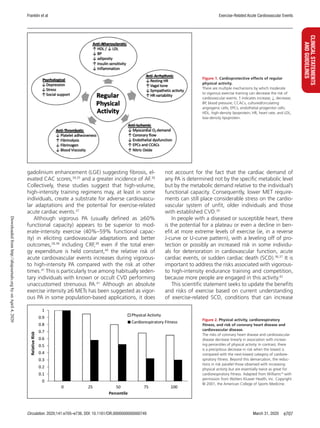
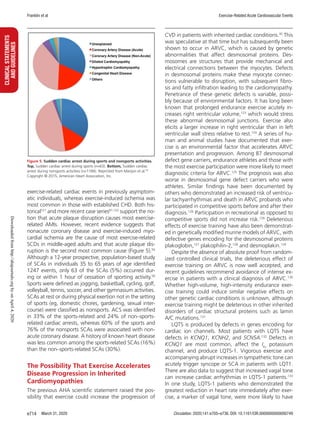
Collectively, these epidemiological analyses,
combined with evidence of biological plausibility (Fig-
ure 1),14,15
support a cause-and-effect relationship be-
tween increased levels of PA and CRF and reduced CVD
mortality16–18
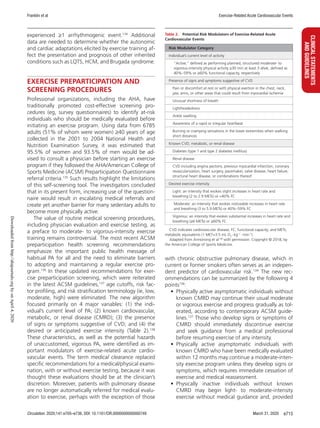
and suggest that being unfit is an indepen-
dent risk factor for CHD (Figure 2).1,19
Higher levels of PA or CRF (5 METs) before hospi-
talization for acute coronary syndromes (ACS) and sur-
gical procedures are associated with better short-term
outcomes,20,21
possibly because of exercise-induced
ischemic preconditioning.22
An investigation of 2172
patients hospitalized for ACS evaluated the effect of
preadmission PA on in-hospital and 1-month post-
discharge CVD health outcomes.23
Patients were cat-
egorized as physically inactive (reference category),
minimally active, and highly active. Multivariate analysis
revealed that compared with the inactive cohort, mini-
mal or high activity was associated with a 44% (95%
CI, 10%–68%) reduction of in-hospital mortality and
a 20% (95% CI, 1%–50%) lower risk of a CVD event
within the first month of hospital discharge.23
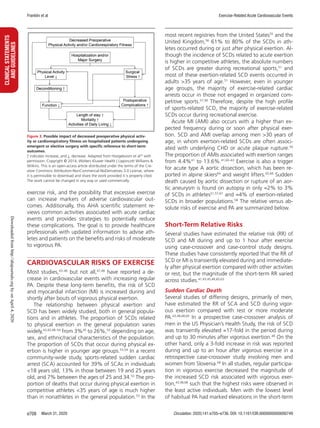
Compli-
cations after elective or emergent surgical procedures,
including bariatric surgery24
and coronary artery bypass
grafting,25
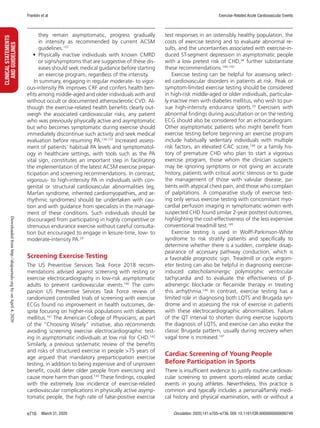
are also increased in those with reduced pre-
operative levels of PA or CRF (Figure 3).26
The favorable risk factor profiles and superior car-
diac performance of long-distance runners and the ob-
servation that vigorous PA and high levels of CRF are
associated with reduced use of diabetic, hypertensive,
and hypercholesterolemia medications27
suggest that
high-volume and high-intensity endurance training reg-
imens, including high-intensity interval training (HIIT),28
are cardioprotective in individuals with and without
CHD. These data have likely contributed to increasing
numbers of middle-aged and older adults concluding
that “more exercise is better.”29
As a result, worldwide
participation in half- and full-marathon races, triath-
lon events, and HIIT has increased markedly since the
American Heart Association’s (AHA’s) previous state-
ment on exercise risk.30
Nevertheless, prolonged exer-
cise increases cardiac biomarkers31–33
and postexercise
transient myocardial dysfunction, and endurance ath-
letes 35 years of age have increased myocardial late
Downloadedfromhttp://ahajournals.orgbyonApril4,2020
Franklin et al Exercise-Related Acute Cardiovascular Events
Circulation. 2020;141:e705–e736. DOI: 10.1161/CIR.0000000000000749 March 31, 2020 e707
CLINICALSTATEMENTS
ANDGUIDELINES
gadolinium enhancement (LGE) suggesting fibrosis, el-
evated CAC scores,34,35
and a greater incidence of AF.36
Collectively, these studies suggest that high-volume,
high-intensity training regimens may, at least in some
individuals, create a substrate for adverse cardiovascu-
lar adaptations and the potential for exercise-related
acute cardiac events.37
Although vigorous PA (usually defined as ≥60%
functional capacity) appears to be superior to mod-
erate-intensity exercise (40%–59% functional capac-
ity) in eliciting cardiovascular adaptations and better
outcomes,28,38
including CRF,39
even if the total ener-
gy expenditure is held constant,40
the relative risk of
acute cardiovascular events increases during vigorous-
to high-intensity PA compared with the risk at other
times.41
This is particularly true among habitually seden-
tary individuals with known or occult CVD performing
unaccustomed strenuous PA.41
Although an absolute
exercise intensity ≥6 METs has been suggested as vigor-
ous PA in some population-based applications, it does
not account for the fact that the cardiac demand of
any PA is determined not by the specific metabolic level
but by the metabolic demand relative to the individual’s
functional capacity. Consequently, lower MET require-
ments can still place considerable stress on the cardio-
vascular system of unfit, older individuals and those
with established CVD.30
In people with a diseased or susceptible heart, there
is the potential for a plateau or even a decline in ben-
efit at more extreme levels of exercise (ie, in a reverse
J-curve or U-curve pattern), with a leveling off of pro-
tection or possibly an increased risk in some individu-
als for deterioration in cardiovascular function, acute
cardiac events, or sudden cardiac death (SCD).36,37
It is
important to address the risks associated with vigorous-
to high-intensity endurance training and competition,
because more people are engaged in this activity.42
This scientific statement seeks to update the benefits
and risks of exercise based on current understanding
of exercise-related SCD, conditions that can increase
Figure 1. Cardioprotective effects of regular
physical activity.
There are multiple mechanisms by which moderate
to vigorous exercise training can decrease the risk of
cardiovascular events. ↑ indicates increase; ↓, decrease;
BP, blood pressure; CCACs, cultured/circulating
angiogenic cells; EPCs, endothelial progenitor cells;
HDL, high-density lipoprotein; HR, heart rate; and LDL,
low-density lipoprotein.
Figure 2. Physical activity, cardiorespiratory
fitness, and risk of coronary heart disease and
cardiovascular disease.
The risks of coronary heart disease and cardiovascular
disease decrease linearly in association with increas-
ing percentiles of physical activity. In contrast, there
is a precipitous decrease in risk when the lowest is
compared with the next-lowest category of cardiore-
spiratory fitness. Beyond this demarcation, the reduc-
tions in risk parallel those observed with increasing
physical activity but are essentially twice as great for
cardiorespiratory fitness. Adapted from Williams19
with
permission from Wolters Kluwer Health, Inc. Copyright
© 2001, the American College of Sports Medicine.
Downloadedfromhttp://ahajournals.orgbyonApril4,2020
Franklin et al Exercise-Related Acute Cardiovascular Events
March 31, 2020 Circulation. 2020;141:e705–e736. DOI: 10.1161/CIR.0000000000000749e708
CLINICALSTATEMENTS
ANDGUIDELINES
exercise risk, and the possibility that excessive exercise
can increase markers of adverse cardiovascular out-
comes. Additionally, this AHA scientific statement re-
views common activities associated with acute cardiac
events and provides strategies to potentially reduce
these complications. The goal is to provide healthcare
professionals with updated information to advise ath-
letes and patients on the benefits and risks of moderate
to vigorous PA.
CARDIOVASCULAR RISKS OF EXERCISE
Most studies,43–46
but not all,47,48
have reported a de-
crease in cardiovascular events with increasing regular
PA. Despite these long-term benefits, the risk of SCD
and myocardial infarction (MI) is increased during and
shortly after bouts of vigorous physical exertion.
The relationship between physical exertion and
SCD has been widely studied, both in general popula-
tions and in athletes. The proportion of SCDs related
to physical exertion in the general population varies
widely,43,45,48–54
from 3%45
to 26%,53
depending on age,
sex, and ethnic/racial characteristics of the population.
The proportion of SCDs that occur during physical ex-
ertion is higher in younger age groups.53,54
In a recent
community-wide study, sports-related sudden cardiac
arrest (SCA) accounted for 39% of SCAs in individuals
18 years old, 13% in those between 19 and 25 years
old, and 7% between the ages of 25 and 34.53
The pro-
portion of deaths that occur during physical exertion in
competitive athletes 35 years of age is much higher
than in nonathletes in the general population.53
In the
most recent registries from the United States55
and the
United Kingdom,56
61% to 80% of the SCDs in ath-
letes occurred during or just after physical exertion. Al-
though the incidence of SCDs related to acute exertion
is higher in competitive athletes, the absolute numbers
of SCDs are greater during recreational sports,51
and
most of these exertion-related SCD events occurred in
adults 35 years of age.51
However, even in younger
age groups, the majority of exercise-related cardiac
arrests occur in those not engaged in organized com-
petitive sports.57,58
Therefore, despite the high profile
of sports-related SCD, the majority of exercise-related
SCDs occur during recreational exercise.
Acute MI (AMI) also occurs with a higher than ex-
pected frequency during or soon after physical exer-
tion. SCD and AMI overlap among men 30 years of
age, in whom exertion-related SCDs are often associ-
ated with underlying CHD or acute plaque rupture.59
The proportion of AMIs associated with exertion ranges
from 4.4%41
to 13.6%.41,60–63
Exercise is also a trigger
for acute type A aortic dissection, which has been re-
ported in alpine skiers64
and weight lifters.65,66
Sudden
death caused by aortic dissection or rupture of an aor-
tic aneurysm is found on autopsy in only ≈2% to 3%
of SCDs in athletes51,57,67
and ≈4% of exertion-related
SCDs in broader populations.58
The relative versus ab-
solute risks of exercise and PA are summarized below.
Short-Term Relative Risks
Several studies have estimated the relative risk (RR) of
SCD and MI during and up to 1 hour after exercise
using case-crossover and case-control study designs.
These studies have consistently reported that the RR of
SCD or MI is transiently elevated during and immediate-
ly after physical exertion compared with other activities
or rest, but the magnitude of the short-term RR varied
across studies.41,43,45,48,60,63
Sudden Cardiac Death
Several studies of differing designs, primarily of men,
have estimated the RR of SCA and SCD during vigor-
ous exertion compared with rest or more moderate
PA.43,48,68,69
In a prospective case-crossover analysis of
men in the US Physician’s Health Study, the risk of SCD
was transiently elevated ≈17-fold in the period during
and up to 30 minutes after vigorous exertion.48
On the
other hand, only a 3-fold increase in risk was reported
during and up to an hour after vigorous exercise in a
retrospective case-crossover study involving men and
women from Slovenia.68
In all studies, regular participa-
tion in vigorous exercise decreased the magnitude of
the increased SCD risk associated with vigorous exer-
tion,43,48,68
such that the highest risks were observed in
the least active individuals. Men with the lowest level
of habitual PA had marked elevations in the short-term
Figure 3. Possible impact of decreased preoperative physical activ-
ity or cardiorespiratory fitness on hospitalized patients undergoing
emergent or elective surgery with specific reference to short-term
outcomes.
↑ indicates increase; and ↓, decrease. Adapted from Hoogeboom et al26
with
permission. Copyright © 2014, Wolters Kluwer Health | Lippincott Williams 
Wilkins. This is an open-access article distributed under the terms of the Cre-
ative Commons Attribution-NonCommercial-NoDerivatives 3.0 License, where
it is permissible to download and share the work provided it is properly cited.
The work cannot be changed in any way or used commercially.
Downloadedfromhttp://ahajournals.orgbyonApril4,2020
Franklin et al Exercise-Related Acute Cardiovascular Events
Circulation. 2020;141:e705–e736. DOI: 10.1161/CIR.0000000000000749 March 31, 2020 e709
CLINICALSTATEMENTS
ANDGUIDELINES
risk of SCD during vigorous exercise (RR=5068
to 7448
)
compared with those who exercised regularly (RR=268
to 1148
).43
However, in 2 of these studies, the risk of
SCD remained elevated during exertion even among
the most habitually active men.43,48
There are limited data regarding whether more mod-
erate levels of exercise might trigger SCD. One prospec-
tive case-crossover study among middle-aged nurses
reported the RR of SCD associated with combined expo-
sure to both moderate and vigorous levels of exertion.45
Because of the small number of exercise-associated
SCDs in women, the risk of moderate versus vigorous
exercise could not be analyzed separately. The RR of
SCD was modestly but significantly elevated during and
30 minutes after moderate and vigorous exercise, with
an estimated RR of 2.4 (95% CI, 1.2–4.6; P=0.01). This
transient increase in risk was again reduced by regular
exercise participation, with the highest risks observed
among women who reported 2 hours per week of
moderate to vigorous exertion (RR, 9.0 [95% CI, 3.3–
24.3]). In contrast to prior studies that examined vigor-
ous exercise in men,43,48
this transient elevation in risk
was no longer significant among the most habitually
active women. Women who reported participating in
moderate to vigorous exercise ≥2 hours per week had
an RR of 1.5 (95% CI, 0.61–3.61).
Myocardial Infarction
Several studies using differing designs have also dem-
onstrated significant 2- to 10-fold elevations in the like-
lihood of experiencing an AMI within 1 hour of par-
ticipating in vigorous exertion,41,60–63,70,71
with 1 study
demonstrating risk elevations persisting to 2 hours.62
When the available data from 7 studies (n=5503 pa-
tients) were combined using meta-analysis, the summa-
ry RR of MI associated with bouts of physical exertion
was 3.45 (95% CI, 2.33–5.13), with substantial be-
tween-study heterogeneity that was not explained by
study size or the year the study was conducted.72
Effect
sizes for the association of episodic PA did not appear
to change significantly over time. Again, as is the case
for SCD, the magnitude of association between PA as
a trigger of MI was greater in individuals with the low-
est habitual activity. In these 7 studies, estimates of the
RR associated with a bout of vigorous exertion in the
least habitually active individuals ranged from 4.571
to
10741
for MI. In comparison, RR estimates of MI in the
setting of exertion were much more modest (0.88–3.3)
in those with the highest levels of habitual PA.72
In a
meta-regression analysis, the RR of MI associated with
episodic PA was decreased by ≈45% for each additional
time per week a person habitually exercised.72
Since this meta-analysis was published in 2011, the
INTERHEART Study has reported results from a retro-
spective case-crossover design performed in the larg-
est population to date, including 12 461 patients with
first MI in 262 centers across 52 countries.63
Participa-
tion in heavy physical exertion was reported by 13.6%
of participants within the 1 hour before MI compared
with 9.1% at the same hour on a previous day (control
period). Compared with the control period, the adjust-
ed RR of AMI within 1 hour of physical exertion was
estimated to be 2.3 (95% CI, 2.0−2.7), correspond-
ing to a population attributable risk of 7.7% (95% CI,
6.3%−8.8%). Unlike prior studies, this study did not
demonstrate evidence of effect modification by base-
line PA level. However, the latter analysis only stratified
by overall participation in categories of PA by intensity
(sedentary, mild, moderate, or strenuous) and not by
frequency of participation.
Compared with vigorous exercise, the data on
whether moderate exercise also acutely elevates the
risk of MI are much more limited. One case-crossover
study within the Myocardial Infarction Registry in Augs-
burg, Germany, reported a modest increase in the risk
of MI within 2 hours of participation in moderate exer-
tion (METs=5; RR, 1.6 [95% CI, 1.2−2.1]).71
However,
a prior study from the same region in Germany found
no elevation in the risk of MI associated with moder-
ate physical exertion.60
Both studies demonstrated no
association between lighter levels of exertion and AMI.
Absolute Risks
Although there is a heightened RR of acute cardiac
events with unaccustomed vigorous PA, it is important
to recognize that the absolute risk of experiencing SCD
or MI during physical exertion is very small. For example,
in the Physicians’ Health Study, marked elevations in the
RR of SCD during and after a bout of vigorous physical
exertion translated into an absolute risk of only 1 SCD for
every 1.51 million episodes.48
This absolute risk is even
lower in middle-aged women, among whom 1 SCD oc-
curred for every 36.5 million person-hours of participa-
tion in moderate to vigorous exercise.45
Retrospective
multicenter data from fitness facilities also report low
absolute rates of adverse CVD events: 1 per 1 124 200
and 1 per 887 526 person-hours for nonfatal and fatal
cardiovascular events, respectively.73
In patients with es-
tablished heart disease in supervised cardiac rehabilita-
tion facilities, the absolute CVD event rate is higher (1
event per 58 000 patient-hours), but still low.74
Given that even the most avid exercisers do not
spend the majority of their time exercising, these low
absolute risks translate into extremely low incident rates
of exertion-related SCD in the general population. Re-
ported annual incidence rates of exertion-related SCD
in the population at large and across various subgroups
are shown in Table 1. Population-based estimates of the
frequency of exercise-related out-of-hospital cardiac ar-
rest and SCD range from 2.1 per 100 000 person-years
in the Netherlands,49
to 0.46 per 100 000 person-years
Downloadedfromhttp://ahajournals.orgbyonApril4,2020
Franklin et al Exercise-Related Acute Cardiovascular Events
March 31, 2020 Circulation. 2020;141:e705–e736. DOI: 10.1161/CIR.0000000000000749e710
CLINICALSTATEMENTS
ANDGUIDELINES
in France,51
and 0.31 per 100 000 person-years in Ja-
pan.75
In the Dutch study,49
survival after exercise-
related out-of-hospital cardiac arrest was better than
after non–exercise-related out-of-hospital cardiac arrest
(46.2% versus 17.2%). Although rates of exertion-re-
lated SCA are somewhat lower in Japan, the overall in-
cidence rate of exercise-related out-of-hospital cardiac
arrest increased from 0.18 to 0.43 per 100 000 person-
years from 2005 to 2012.75
A population-based study
in Oregon of adults 35 to 65 years of age found a simi-
lar estimate of sports-related SCA as in the Netherland’s
population (2.1 per 100 000 person-years).50
To place
these absolute rates of sports-related SCA into perspec-
tive, the absolute rate of SCA in other settings is much
higher because of the greater absolute time spent in
sedentary activities. In the Oregon and Japan studies,
the absolute incidence of nonsports SCA was estimated
to be 55.5 and 43.5 per 100 000 person-years, respec-
tively.50,75
Fewer estimates exist for exercise-associated
MI, but a Swedish population-based study suggested
that the absolute incidence of exercise-associated MI
was 0.75 per 100 000 person-years.70
Impact of Age and Sex on Exertion-
Related CVD Risk
Impact of Age
Few data are available as to whether age modifies the
RR of SCD during exertion; however, according to a
population-based study from Germany, older individu-
als had a higher RR of MI during and after exertion.71
In contrast, the larger INTERHEART study did not find
higher RRs of MI in older individuals.63
The absolute in-
cidence of exertion-related SCD and MI increases over
35 years of age,51,70
with the greatest numbers of exer-
tion-related SCDs reported between 40 and 64 years
of age.51
In the Netherlands, the incidence of exercise-
related SCA was 10-fold higher in individuals 35
years old (3.0 per 100 000 person-years) than among
those 35 years old (0.3 per 100 000 person-years).49
In
France, the absolute incidence of sports-associated SCD
increased with age in men but not women. The abso-
lute risk in men ranged from 0.4 per year per 100 000
in those 15 to 24 years of age to 17.5 per 100 000 in
those 55 to 64 years of age.76
Absolute Risks in Athletes
Although incidence rates of exertion-related SCD are
lower in younger age groups, rates of exercise-associ-
ated SCD or SCA are ≈4.5-fold higher in competitive
athletes than in recreational athletes of similar age (10–
35 years old).51
Highly fit competitive athletes spend a
significant proportion of time in both training and com-
petition, and the intensity of exercise is likely greater,
both of which could contribute to the higher incidence
of exercise-related acute cardiac events. In France, the
incidence rate was estimated at 0.9 per 100 000 per
year in young competitive athletes compared with 0.2
per 100 000 among young noncompetitive athletes.51
In series from the United States and the Veneto region
of Italy, estimates of sports-related SCD were slightly
lower at 0.61 per 100 000 person-years55
and 0.4 per
100 000 person-years,77
respectively. Although the inci-
dence rates of exertion-related SCD are proportionally
higher in competitive athletes, most exertion-related
SCDs in those 35 years of age occur in noncompeti-
tive sports participants, primarily because of the larger
size of the source population.57
Impact of Sex
The incidence of exertion-related SCD is much lower
in women than men. In multiple populations, the risk
of SCD in association with exercise is 15- to 20-fold
higher in men.49,50,76
This sex difference in exercise risk is
much more pronounced than the baseline 2- to 3-fold
higher overall incidence of SCD observed in men ver-
sus women in epidemiological studies not focusing on
exercise alone.49–51
The estimated incidence of sports-
related SCD in women ranges from 0.04 to 0.3 per
100 000 person-years compared with 0.5 to 5.8 per
100 000 person-years in men.49,76
The sex difference in
the incidence of sports-related SCD is most marked in
the 45- to 55-year-old age range, in which the RR for
women has been estimated to be only 3% (95% CI,
1.5%−7.5%) of that in similarly aged men.76
Sex differ-
ences in participation in vigorous athletic activity might
contribute to part of the lower incidence of exertion-
related SCD among women, but likely not all. Indeed,
rates of exertion-related SCD are higher among male
than female college athletes78
and adult athletes par-
ticipating in the same sporting activity.79,80
For example,
the incidence of SCA during full and half marathons
is higher in men than in women (0.9 versus 0.16 per
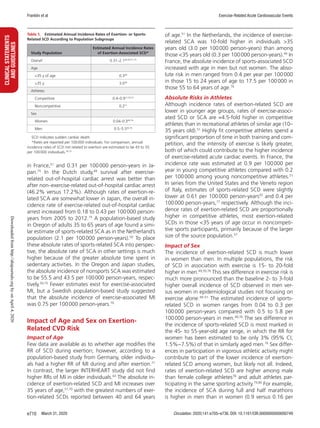
Table 1.  Estimated Annual Incidence Rates of Exertion- or Sports-
Related SCD According to Population Subgroups
Study Population
Estimated Annual Incidence Rates
of Exertion-Associated SCD*
Overall 0.31–2.149,50,51,75
Age
  35 y of age 0.349
  35 y 3.049
Athletes
 Competitive 0.4–0.951,55,57
 Noncompetitive 0.251
Sex
 Women 0.04–0.349,76
 Men 0.5–5.549,76
SCD indicates sudden cardiac death.
*Rates are reported per 100 000 individuals. For comparison, annual
incidence rates of SCD not related to exertion are estimated to be 43 to 55
per 100 000 individuals.50,75
Downloadedfromhttp://ahajournals.orgbyonApril4,2020
Franklin et al Exercise-Related Acute Cardiovascular Events
Circulation. 2020;141:e705–e736. DOI: 10.1161/CIR.0000000000000749 March 31, 2020 e711
CLINICALSTATEMENTS
ANDGUIDELINES
100 000 person-years, respectively).80
Cardiovascular
causes of death in athletes also vary by sex, with hyper-
trophic cardiomyopathy (HCM) more common in men
and coronary anomalies, arrhythmogenic right ventric-
ular cardiomyopathy (ARVC), and long-QT syndrome
(LQTS) predominating in women.67
The absolute incidence of exercise-associated AMI is
also slightly higher in men versus women, 0.046 ver-
sus 0.015 per 100 000 person-hours, respectively, but
the magnitude of the sex difference is smaller,61
and
the majority of studies have not found a sex differ-
ence in the RR of MI during physical exertion.41,70,71
A
study of 1048 patients with AMI referred for primary
angiography found that men had a higher RR of expe-
riencing AMI during physical exertion and that these
men were more likely to be classified as having very
low or low levels of habitual PA.61
Increasing amounts
of regular moderate PA have generally been associated
with decreased rates of CVD events in women,45,46,81
but a recent prospective study of 1 million women in
the United Kingdom raised the possibility that the re-
lationship might not be similar for vigorous exercise.82
In this study, women reporting daily strenuous PA were
at higher risk of CHD, cerebrovascular disease, and ve-
nous thromboembolism than women reporting strenu-
ous PA 2 to 3 times per week.82
Impact of Known CHD
Although CHD is responsible for a significant pro-
portion of sports-related SCD in adults,50
individuals
experiencing SCD during exercise are less likely to
have known heart disease than those who experience
SCD during other activities. In Oregon, only 15% of
those 35 to 65 years old who experienced SCA dur-
ing sports were known to have heart disease, com-
pared with 30% who experienced SCA during other
activities or at rest.50
In France, only 7% of women
had a history of heart disease or 1 cardiovascular risk
factor before their sports-related SCD.51
Similarly, the
majority of exercise-associated AMIs occur in patients
without a prior history of CHD or AMI.41,60
Although
the incidence of exercise-induced CVD events appears
to be somewhat higher in patients with established
CVD, paradoxically, the risk of AMI during exertion
has been reported to be higher in patients without
established angina or CHD in some41,60,71
but not all
studies.63
Overall, increasing habitual PA is not associ-
ated with elevated risks of AMI or stroke and appears
to confer lower total CVD and non-CVD mortality in
patients with stable CHD.83
Because epidemiological
studies indicate that low CRFe in middle age is the
strongest predictor of future heart failure with a pre-
served ejection fraction,84,85
exercise training could be
helpful in attenuating or reversing this condition by
preventing the associated increase in left ventricular
stiffness attributable to sedentary aging.86
EXERCISE-RELATED CERVICAL
ARTERIAL DISSECTION
Cervical artery dissection, which can occur in the ex-
tracranial carotid or vertebral arteries, is an important
cause of stroke in young patients87–91
and can result in
significant morbidity and mortality.87,92
The multicenter
Cervical Artery Dissection and Ischemic Stroke Patients
study group found that cervical trauma during sports
was more common in stroke patients with cervical artery
dissection than in age-, sex-, and country-matched con-
trol participants with stroke not associated with arterial
dissection.93
Although the available evidence supports an
association between sports, exercise, and cervical artery
dissection, few data are available regarding preventive
strategies for patients who participate in sporting activi-
ties. Nevertheless, clinicians should be aware of the po-
tential risk and presenting symptoms of exercise-related
cervical artery dissections so that patients can be referred
for appropriate diagnostic imaging and treatment.
COMMON ACTIVITIES ASSOCIATED
WITH ACUTE CARDIAC EVENTS
Few systematic studies have identified activities associat-
ed with a heightened RR of cardiac events. This is likely
because of the rarity of such events and the difficulty in
comparing activities with different and unknown partici-
pation rates, as well as different participant character-
istics. The cardiovascular stress of vigorous PA is deter-
mined by the individual’s CRF, because identical physical
tasks evoke lower cardiac demands in fit compared with
unfit subjects.30
Moreover, for individuals who already
exercise vigorously, the more frequently vigorous ex-
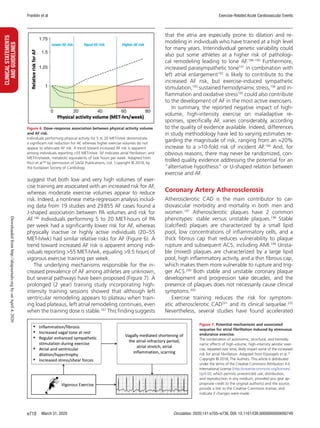
ercise is performed, the lower the RR of each exercise
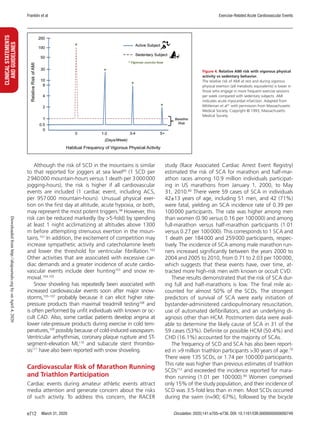
bout (Figure 4).41,94
Additional modulators of so-called
high-risk activities include superimposed physical, cogni-
tive, and environmental stresses, as well as competition,
all of which can accentuate the cardiorespiratory and
hemodynamic responses and thus heighten the risk of
exertion-related acute cardiovascular events.
Strenuous PA, especially when sudden, unaccus-
tomed, or involving high levels of anaerobic metabo-
lism, increases the risk for AMI and SCD. For example,
racquet sports,95
downhill skiing,96
marathon running,80
triathlon participation,79
and high-intensity sports activ-
ities (eg, basketball)97
may be associated with a greater
incidence of acute cardiovascular events than other
activities. For certain individuals (predominantly men),
mountaineering activities, including mountain hiking
and cross country or downhill skiing, are associated
with a heightened risk of SCD.98
At-risk individuals are
generally characterized by multiple risk factors (espe-
cially older age), and in particular, patients with heart
failure or prior MI with left ventricular dysfunction (ejec-
tion fraction 40%) are at greatest risk for SCD.99,100
Downloadedfromhttp://ahajournals.orgbyonApril4,2020
March 31, 2020 Circulation. 2020;141:e705–e736. DOI: 10.1161/CIR.0000000000000749e712
CLINICALSTATEMENTS
ANDGUIDELINES Franklin et al Exercise-Related Acute Cardiovascular Events
Although the risk of SCD in the mountains is similar
to that reported for joggers at sea level69
(1 SCD per
2 940 000 mountain-hours versus 1 death per 3 000 000
jogging-hours), the risk is higher if all cardiovascular
events are included (1 cardiac event, including ACS,
per 957 000 mountain-hours). Unusual physical exer-
tion on the first day at altitude, acute hypoxia, or both,
may represent the most potent triggers.98
However, this
risk can be reduced markedly (by 5-fold) by spending
at least 1 night acclimatizing at altitudes above 1300
m before attempting strenuous exertion in the moun-
tains.101
In addition, the excitement of competition may
increase sympathetic activity and catecholamine levels
and lower the threshold for ventricular fibrillation.102
Other activities that are associated with excessive car-
diac demands and a greater incidence of acute cardio-
vascular events include deer hunting103
and snow re-
moval.104,105
Snow shoveling has repeatedly been associated with
increased cardiovascular events soon after major snow-
storms,105–107
probably because it can elicit higher rate-
pressure products than maximal treadmill testing108
and
is often performed by unfit individuals with known or oc-
cult CAD. Also, some cardiac patients develop angina at
lower rate-pressure products during exercise in cold tem-
peratures,109
possibly because of cold-induced vasospasm.
Ventricular arrhythmias, coronary plaque rupture and ST-
segment–elevation MI,110
and subacute stent thrombo-
sis111
have also been reported with snow shoveling.
Cardiovascular Risk of Marathon Running
and Triathlon Participation
Cardiac events during amateur athletic events attract
media attention and generate concern about the risks
of such activity. To address this concern, the RACER
study (Race Associated Cardiac Arrest Event Registry)
estimated the risk of SCA for marathon and half-mar-
athon races among 10.9 million individuals participat-
ing in US marathons from January 1, 2000, to May
31, 2010.80
There were 59 cases of SCA in individuals
42±13 years of age, including 51 men, and 42 (71%)
were fatal, yielding an SCA incidence rate of 0.39 per
100 000 participants. The rate was higher among men
than women (0.90 versus 0.16 per 100 000) and among
full-marathon versus half-marathon participants (1.01
versus 0.27 per 100 000). This corresponds to 1 SCA and
1 death per 184 000 and 259 000 participants, respec-
tively. The incidence of SCA among male marathon run-
ners increased significantly between the years 2000 to
2004 and 2005 to 2010, from 0.71 to 2.03 per 100 000,
which suggests that these events have, over time, at-
tracted more high-risk men with known or occult CVD.
These results demonstrated that the risk of SCA dur-
ing full and half-marathons is low. The final mile ac-
counted for almost 50% of the SCDs. The strongest
predictors of survival of SCA were early initiation of
bystander-administered cardiopulmonary resuscitation,
use of automated defibrillators, and an underlying di-
agnosis other than HCM. Postmortem data were avail-
able to determine the likely cause of SCA in 31 of the
59 cases (53%). Definite or possible HCM (50.4%) and
CHD (16.1%) accounted for the majority of SCAs.
The frequency of SCD and SCA has also been report-
ed in 9 million triathlon participants 30 years of age.79
There were 135 SCDs, or 1.74 per 100 000 participants.
This rate was higher than previous estimates of triathlon
SCDs112
and exceeded the incidence reported for mara-
thon running (1.01 per 100 000).80
Women comprised
only 15% of the study population, and their incidence of
SCD was 3.5-fold less than in men. Most SCDs occurred
during the swim (n=90; 67%), followed by the bicycle
Figure 4. Relative AMI risk with vigorous physical
activity vs sedentary behavior.
The relative risk of AMI at rest and during vigorous
physical exertion (≥6 metabolic equivalents) is lower in
those who engage in more frequent exercise sessions
per week compared with sedentary subjects. AMI
indicates acute myocardial infarction. Adapted from
Mittleman et al41
with permission from Massachusetts
Medical Society. Copyright © 1993, Massachusetts
Medical Society.
Downloadedfromhttp://ahajournals.orgbyonApril4,2020
Franklin et al Exercise-Related Acute Cardiovascular Events
Circulation. 2020;141:e705–e736. DOI: 10.1161/CIR.0000000000000749 March 31, 2020 e713
CLINICALSTATEMENTS
ANDGUIDELINES
(n=22; 16%), run (n=15; 11%), and postrace (n=8; 6%)
periods. Race experience was known for 68 participants,
of whom 26 (38%) were competing in their first triath-
lon. Autopsies were performed on 61 victims, of whom
only 27 (44%) had relevant cardiovascular abnormalities,
including atherosclerotic CAD and cardiomyopathy.
These data suggest that SCA and SCD during mara-
thon running and triathlon participation are rare. Cli-
nicians should be aware of the risks associated with
underlying myocardial disease and atherosclerotic CAD
in patients contemplating such competition and of the
increased risk among first-time participants. The latter
suggests that inadequate preparation or poor training
contributed to the exertion-related fatalities.29,34
The
higher death rate during the swim portion of the tri-
athlon raises the possibility that factors associated with
swimming, such as increased central volume from im-
mersion,113
panic attacks leading to drowning,114
ad-
verse environmental conditions (eg, large waves or cool
temperatures), collisions among swimmers, and the
added challenges of water rescue could contribute to
the fatal events.79
Competitors at risk for cardiac events
should be encouraged to maintain their pace through-
out the race, because sprinting during the final miles
has been associated with a heightened risk of acute
cardiac events.115
Other race-related disorders, includ-
ing hyponatremia and hyperthermia, are uncommon
causes of competitor’s deaths.80
CHANGING CONCEPTS OF EXERCISE–
RELATED CARDIOVASCULAR EVENTS
Predominant Causes of Exercise-Related
SCD in the Young
The previous AHA statement noted that hereditary or
congenital cardiovascular abnormalities such as HCM
and coronary artery anomalies were the most common
causes of PA-related SCDs in young individuals 30 to
40 years old.30
Many studies, primarily from the United
States, identified HCM as the most common cause.
More recent studies have questioned this conclusion
and suggested that most cases of exercise-related SCD
in high school or collegiate athletes have no cause iden-
tifiable at autopsy and are classified as either a sudden
arrhythmic death56
or SCD with a structurally normal
heart (SNH).116
In a meta-analysis examining SCD in individuals 35
years of age that included 4605 subjects, HCM was
responsible for 10.3% of all deaths, whereas 26.7%
had SNHs.116
There were 608 athletes included in this
analysis of 34 studies published between 1990 and
2014; 13.6% of the deaths were attributed to HCM,
whereas 18.1% were attributed to SNH. Differences
in attributed causes appeared to depend on the geo-
graphic origin of the study. Among North American
athletes, 27.0% and 10.0% of the deaths were at-
tributed to HCM and SNH, respectively, whereas 5.7%
and 23.1% of the deaths in European athletes were at-
tributed to HCM and SNH. Genetic studies can identify
some of these victims with SNH. An investigation of all
SCDs in individuals 1 to 35 years of age in New Zealand
and Australia identified 490 total cases of SCD, 40%
of which were unexplained.117
Genetic testing in 113
cases with SNH identified a clinically definable genetic
mutation for conditions such as cardiomyopathy or car-
diac arrhythmia in 27% of the samples.
It remains difficult to determine with certainty the
prevalence of the causes and the incidence of exercise-
related SCD in the young. Individual studies, including
those examining a geographically defined population,
often include a small number of subjects because of the
rarity of exercise-related SCD. A prospectively collected
emergency services cardiac arrest database in Toronto,
Canada, identified SCAs during sports participation in
individuals 12 to 45 years of age from 2009 to 2014.118
There were only 16 SCAs during competition and 58
SCAs during noncompetitive athletic activity during
18.5 million hours of observation. This yields an annual
incidence in competitive athletes of only 0.76 SCA per
100 000 individuals, an estimate that can vary widely
with the addition or subtraction of only a few cases.
Consequently, the prevalence of any causative condition
and the incidence of SCD are highly variable depending
on the number of deaths. Even large meta-analyses can
be highly affected by the individual studies that com-
prise them. For example, some studies of SCD in ath-
letes included only deaths during PA,118
whereas others
included deaths both during PA and at other times.119
The reasons for the apparent change in the preva-
lence of conditions causing SCD between the previ-
ous30
and present document are probably multifacto-
rial. Case-collection bias in earlier studies is possible,
because the largest US studies originated from centers
with expertise in HCM management.120
Support for
this possibility comes from the observed difference in
causes of SCD between European and North American
studies.116
It is also possible that the wider apprecia-
tion of HCM as a cause of SCD has led to alterations
in medical management or to more effective screening
and restriction of vigorous sports participation in indi-
viduals with HCM.
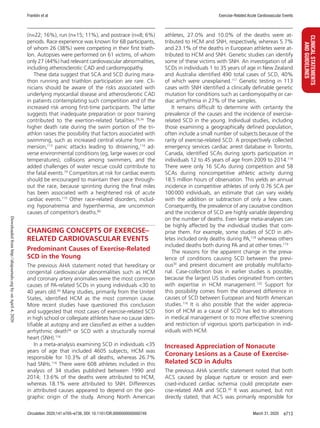
Increased Appreciation of Nonacute
Coronary Lesions as a Cause of Exercise-
Related SCD in Adults
The previous AHA scientific statement noted that both
ACS caused by plaque rupture or erosion and exer-
cised-induced cardiac ischemia could precipitate exer-
cise-related AMI and SCD.30
It was assumed, but not
directly stated, that ACS was primarily responsible for
Downloadedfromhttp://ahajournals.orgbyonApril4,2020
Franklin et al Exercise-Related Acute Cardiovascular Events
March 31, 2020 Circulation. 2020;141:e705–e736. DOI: 10.1161/CIR.0000000000000749e714
CLINICALSTATEMENTS
ANDGUIDELINES
exercise-related cardiac events in previously asymptom-
atic individuals, whereas exercise-induced ischemia was
most common in those with established CHD. Both his-
torical121
and more recent case series61,122
support the no-
tion that acute plaque disruption causes most exercise-
related AMIs. However, recent evidence suggests that
nonacute coronary disease and exercise-induced myo-
cardial ischemia are the cause of most exercise-related
SCDs in middle-aged adults and that acute plaque dis-
ruption is the second most common cause (Figure 5).50
Although a 12-year prospective, population-based study
of SCAs in individuals 35 to 65 years of age identified
1247 events, only 63 of the SCAs (5%) occurred dur-
ing or within 1 hour of cessation of sporting activity.50
Sports were defined as jogging, basketball, cycling, golf,
volleyball, tennis, soccer, and other gymnasium activities.
SCAs at rest or during physical exertion not in the setting
of sports (eg, domestic chores, gardening, sexual inter-
course) were classified as nonsports. ACS was identified
in 33% of the sports-related and 24% of non–sports-
related cardiac arrests, whereas 60% of the sports and
76% of the nonsports SCAs were associated with non-
acute coronary disease. A history of known heart disease
was less common among the sports-related SCAs (16%)
than the non–sports-related SCAs (30%).
The Possibility That Exercise Accelerates
Disease Progression in Inherited
Cardiomyopathies
The previous AHA scientific statement raised the pos-
sibility that exercise could increase the progression of
CVD in patients with inherited cardiac conditions.30
This
was speculative at that time but has subsequently been
shown to occur in ARVC, which is caused by genetic
abnormalities that affect desmosomal proteins. Des-
mosomes are structures that provide mechanical and
electrical connections between the myocytes. Defects
in desmosomal proteins make these myocyte connec-
tions vulnerable to disruption, with subsequent fibro-
sis and fatty infiltration leading to the cardiomyopathy.
Penetrance of these genetic defects is variable, possi-
bly because of environmental factors. It has long been
known that prolonged endurance exercise acutely in-
creases right ventricular volume,123
which would stress
these abnormal desmosomal junctions. Exercise also
elicits a larger increase in right ventricular than in left
ventricular wall stress relative to rest.124
A series of hu-
man and animal studies have documented that exer-
cise is an environmental factor that accelerates ARVC
presentation and progression. Among 87 desmosomal
defect gene carriers, endurance athletes and those with
the most exercise participation were more likely to meet
diagnostic criteria for ARVC.125
The prognosis was also
worse in desmosomal gene defect carriers who were
athletes. Similar findings have been documented by
others who demonstrated an increased risk of ventricu-
lar tachyarrhythmias and death in ARVC probands who
participated in competitive sports before and after their
diagnosis.126
Participation in recreational as opposed to
competitive sports did not increase risk.126
Deleterious
effects of exercise training have also been demonstrat-
ed in genetically modified murine models of ARVC, with
defective genes encoding for the desmosomal proteins
plakoglobin,127
plakophilin-2,128
and desmoplakin.129
Despite the absence of absolute proof from random-
ized controlled clinical trials, the deleterious effect of
exercise training on ARVC is now well accepted, and
recent guidelines recommend avoidance of intense ex-
ercise in patients with a clinical diagnosis of ARVC.130
Whether high-volume, high-intensity endurance exer-
cise training could induce similar negative effects on
other genetic cardiac conditions is unknown, although
exercise training might be deleterious in other inherited
disorders of cardiac structural proteins such as lamin
A/C mutations.131
LQTS is produced by defects in genes encoding for
cardiac ion channels. Most patients with LQTS have
defects in KCNQ1, KCNH2, and SCN5A.132
Defects in
KCNQ1 are most common, affect the IKs
potassium
channel, and produce LQTS-1. Vigorous exercise and
accompanying abrupt increases in sympathetic tone can
acutely trigger syncope or SCA in patients with LQT1.
There are also data to suggest that increased vagal tone
can increase cardiac arrhythmias in LQTS-1 patients.133
In one study, LQTS-1 patients who demonstrated the
greatest reduction in heart rate immediately after exer-
cise, a marker of vagal tone, were more likely to have
Figure 5. Sudden cardiac arrest during sports and nonsports activities.
Top, Sudden cardiac arrest during sports (n=63). Bottom, Sudden cardiac
arrest during nonsports activities (n=1184). Reprinted from Marijon et al.50
Copyright © 2015, American Heart Association, Inc.
Downloadedfromhttp://ahajournals.orgbyonApril4,2020
Franklin et al Exercise-Related Acute Cardiovascular Events
Circulation. 2020;141:e705–e736. DOI: 10.1161/CIR.0000000000000749 March 31, 2020 e715
CLINICALSTATEMENTS
ANDGUIDELINES
experienced ≥1 arrhythmogenic event.134
Additional
data are needed to determine whether the autonomic
and cardiac adaptations elicited by exercise training af-
fect the presentation and prognosis of other inherited
conditions such as LQTS, HCM, and Brugada syndrome.
EXERCISE PREPARTICIPATION AND
SCREENING PROCEDURES
Professional organizations, including the AHA, have
traditionally promoted cost-effective screening pro-
cedures (eg, survey questionnaires) to identify at-risk
individuals who should be medically evaluated before
initiating an exercise program. Using data from 6785
adults (51% of whom were women) ≥40 years of age
collected in the 2001 to 2004 National Health and
Nutrition Examination Survey, it was estimated that
95.5% of women and 93.5% of men would be ad-
vised to consult a physician before starting an exercise
program if they followed the AHA/American College of
Sports Medicine (ACSM) Preparticipation Questionnaire
referral criteria.135
Such results highlight the limitations
of this self-screening tool. The investigators concluded
that in its present form, increasing use of the question-
naire would result in escalating medical referrals and
create yet another barrier for many sedentary adults to
become more physically active.
The value of routine medical screening procedures,
including physician evaluation and exercise testing, as
a preface to moderate- to vigorous-intensity exercise
training remains controversial. The most recent ACSM
preparticipation health screening recommendations
emphasize the important public health message of
habitual PA for all and the need to eliminate barriers
to adopting and maintaining a regular exercise pro-
gram.136
In these updated recommendations for exer-
cise preparticipation screening, which were reiterated
in the latest ACSM guidelines,137
age cutoffs, risk fac-
tor profiling, and risk stratification terminology (ie, low,
moderate, high) were eliminated. The new algorithm
focused primarily on 4 major variables: (1) the indi-
vidual’s current level of PA; (2) known cardiovascular,
metabolic, or renal disease (CMRD); (3) the presence
of signs or symptoms suggestive of CVD; and (4) the
desired or anticipated exercise intensity (Table  2).138
These characteristics, as well as the potential hazards
of unaccustomed, vigorous PA, were identified as im-
portant modulators of exercise-related acute cardio-
vascular events. The term medical clearance replaced
specific recommendations for a medical/physical exami-
nation, with or without exercise testing, because it was
thought these evaluations should be at the clinician’s
discretion. Moreover, patients with pulmonary disease
are no longer automatically referred for medical evalu-
ation to exercise, perhaps with the exception of those
with chronic obstructive pulmonary disease, which in
current or former smokers often serves as an indepen-
dent predictor of cardiovascular risk.139
The new rec-
ommendations can be summarized by the following 4
points136
:
•	 Physically active asymptomatic individuals without
known CMRD may continue their usual moderate
or vigorous exercise and progress gradually as tol-
erated, according to contemporary ACSM guide-
lines.137
Those who develop signs or symptoms of
CMRD should immediately discontinue exercise
and seek guidance from a medical professional
before resuming exercise of any intensity.
•	Physically active asymptomatic individuals with
known CMRD who have been medically evaluated
within 12 months may continue a moderate-inten-
sity exercise program unless they develop signs or
symptoms, which requires immediate cessation of
exercise and medical reassessment.
•	Physically inactive individuals without known
CMRD may begin light- to moderate-intensity
exercise without medical guidance and, provided
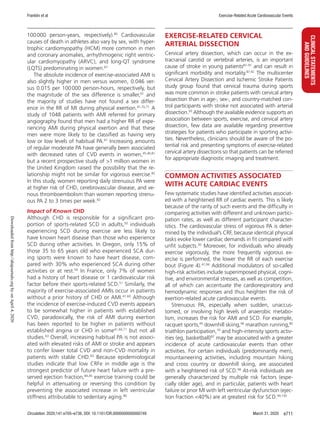
Table 2.  Potential Risk Modulators of Exercise-Related Acute
Cardiovascular Events
Risk Modulator Category
Individual’s current level of activity
  “Active,” defined as performing planned, structured moderate- to
vigorous-intensity physical activity ≥30 min at least 3 d/wk, defined as
40%–59% or ≥60% functional capacity, respectively
Presence of signs and symptoms suggestive of CVD
 Pain or discomfort at rest or with physical exertion in the chest, neck,
jaw, arms, or other areas that could result from myocardial ischemia
  Unusual shortness of breath
 Lightheadedness
  Ankle swelling
  Awareness of a rapid or irregular heartbeat
 Burning or cramping sensations in the lower extremities when walking
short distances
Known CVD, metabolic, or renal disease
  Diabetes (type 1 and type 2 diabetes mellitus)
  Renal disease
 CVD including angina pectoris, previous myocardial infarction, coronary
revascularization, heart surgery, pacemaker, valve disease, heart failure,
structural heart disease, or combinations thereof
Desired exercise intensity
 Light: an intensity that evokes slight increases in heart rate and
breathing (2 to 2.9 METs) or 40% FC
  Moderate: an intensity that evokes noticeable increases in heart rate
and breathing (3 to 5.9 METs) or 40%–59% FC
 Vigorous: an intensity that evokes substantial increases in heart rate and
breathing (≥6 METs) or ≥60% FC
CVD indicates cardiovascular disease; FC, functional capacity; and METs,
metabolic equivalents (1 MET=3.5 mL O2
·kg−1
·min−1
).
Adapted from Armstrong et al138
with permission. Copyright © 2018, by
the American College of Sports Medicine.
Downloadedfromhttp://ahajournals.orgbyonApril4,2020
Franklin et al Exercise-Related Acute Cardiovascular Events
March 31, 2020 Circulation. 2020;141:e705–e736. DOI: 10.1161/CIR.0000000000000749e716
CLINICALSTATEMENTS
ANDGUIDELINES
they remain asymptomatic, progress gradually
in intensity as recommended by current ACSM
guidelines.137
•	Physically inactive individuals with known CMRD
or signs/symptoms that are suggestive of these dis-
eases should seek medical guidance before starting
an exercise program, regardless of the intensity.
In summary, engaging in regular moderate- to vigor-
ous-intensity PA improves CRF and confers health ben-
efits among middle-aged and older individuals with and
without occult or documented atherosclerotic CVD. Al-
though the exercise-related health benefits clearly out-
weigh the associated cardiovascular risks, any patient
who was previously physically active and asymptomatic
but who becomes symptomatic during exercise should
immediately discontinue such activity and seek medical
evaluation before resuming PA.136,137
Increased assess-
ment of patients’ habitual PA levels and symptomatol-
ogy in healthcare settings, with tools such as the PA
vital sign, constitutes an important step in facilitating
the implementation of the latest ACSM exercise prepar-
ticipation and screening recommendations. In contrast,
vigorous- to high-intensity PA in individuals with con-
genital or structural cardiovascular abnormalities (eg,
Marfan syndrome, inherited cardiomyopathies, and ar-
rhythmic syndromes) should be undertaken with cau-
tion and with guidance from specialists in the manage-
ment of these conditions. Such individuals should be
discouraged from participating in highly competitive or
strenuous endurance exercise without careful consulta-
tion but encouraged to engage in leisure-time, low- to
moderate-intensity PA.29
Screening Exercise Testing
The US Preventive Services Task Force 2018 recom-
mendations advised against screening with resting or
exercise electrocardiography in low-risk asymptomatic
adults to prevent cardiovascular events.140
The com-
panion US Preventive Services Task Force review of
randomized controlled trials of screening with exercise
ECGs found no improvement in health outcomes, de-
spite focusing on higher-risk populations with diabetes
mellitus.141
The American College of Physicians, as part
of the “Choosing Wisely” initiative, also recommends
avoiding screening exercise electrocardiographic test-
ing in asymptomatic individuals at low risk for CHD.142
Similarly, a previous systematic review of the benefits
and risks of structured exercise in people 75 years of
age argued that mandatory preparticipation exercise
testing, in addition to being expensive and of unproven
benefit, could deter older people from exercising and
cause more harm than good.143
These findings, coupled
with the extremely low incidence of exercise-related
cardiovascular complications in physically active asymp-
tomatic people, the high rate of false-positive exercise
test responses in an ostensibly healthy population, the
costs of exercise testing and to evaluate abnormal re-
sults, and the uncertainties associated with exercise-in-
duced ST-segment depression in asymptomatic people
with a low pretest risk of CHD,94
further substantiate
these recommendations.140–142
Exercise testing can be helpful for assessing select-
ed cardiovascular disorders in patients at risk. Peak or
symptom-limited exercise testing should be considered
in high-risk middle-aged or older individuals, particular-
ly inactive men with diabetes mellitus, who wish to pur-
sue high-intensity endurance sports.29
Exercisers with
abnormal findings during auscultation or on the resting
ECG should also be considered for an echocardiogram.
Other asymptomatic patients who might benefit from
exercise testing before beginning an exercise program
include habitually sedentary individuals with multiple
risk factors, an elevated CAC score,144
or a family his-
tory of premature CHD who plan to start a vigorous
exercise program, those whom the clinician suspects
may be ignoring symptoms or not giving an accurate
history, patients with critical aortic stenosis or to guide
the management of those with valvular disease, pa-
tients with atypical chest pain, and those who complain
of palpitations. A comparative study of exercise test-
ing only versus exercise testing with concomitant myo-
cardial perfusion imaging in symptomatic women with
suspected CHD found similar 2-year posttest outcomes,
highlighting the cost-effectiveness of the less expensive
conventional treadmill test.145
Exercise testing is used in Wolff-Parkinson-White
syndrome to risk stratify patients and specifically to
determine whether there is a sudden, complete disap-
pearance of accessary pathway conduction, which is
a favorable prognostic sign. Treadmill or cycle ergom-
eter testing can also be helpful in diagnosing exercise-
induced catecholaminergic polymorphic ventricular
tachycardia and to evaluate the effectiveness of β-
adrenergic blockade or flecainide therapy in treating
this arrhythmia.146
In contrast, exercise testing has a
limited role in diagnosing both LQTS and Brugada syn-
drome and in assessing the risk of exercise in patients
with these electrocardiographic abnormalities. Failure
of the QT interval to shorten during exercise supports
the diagnosis of LQTS, and exercise can also evoke the
classic Brugada pattern, usually during recovery when
vagal tone is increased.147
Cardiac Screening of Young People
Before Participation in Sports
There is insufficient evidence to justify routine cardiovas-
cular screening to prevent sports-related acute cardiac
events in young athletes. Nevertheless, this practice is
common and typically includes a personal/family medi-
cal history and physical examination, with or without a
Downloadedfromhttp://ahajournals.orgbyonApril4,2020
Franklin et al Exercise-Related Acute Cardiovascular Events
Circulation. 2020;141:e705–e736. DOI: 10.1161/CIR.0000000000000749 March 31, 2020 e717
CLINICALSTATEMENTS
ANDGUIDELINES
12-lead resting ECG.49,51,118,148–151
Adding a resting ECG
to screening can enhance the detection of disorders as-
sociated with a heightened risk of SCD but increases
false-positive results, with costly follow-up noninvasive/
invasive studies and possible associated downstream psy-
chological harm.152
Consequently, a relevant AHA/Ameri-
can College of Cardiology scientific statement concluded
that the available data do not support a significant public
health benefit from using the 12-lead ECG as a universal
screening tool for athletes.153
This contrasts with recom-
mendations from the European Society of Cardiology.154
There are multiple issues with routine cardiovascular
screening in asymptomatic athletes. The true incidence
of sports-related SCA is unknown. This has been gener-
ally estimated at ≈1 per 200 000 annually,155
but studies
in accomplished athletes, including National Collegiate
Athletic Association basketball players119
and English
youth soccer players,156
have reported annualized rates
of 1 per 5200 and 1 per 14 794, respectively. It is also
not clear how truly asymptomatic athletes with a car-
diac condition should be managed. Others emphasize
that preparticipation screening of large groups of as-
ymptomatic athletes without known CVD will inevitably
result in many false-positive responses, unnecessarily
restricting PA among athletes who are free from CVD,
while simultaneously providing a false sense of security
to those with unremarkable findings.151
Other options are available to reduce exercise-re-
lated cardiac events. Coaches and athletes should be
educated about possible warning signs/symptoms (eg,
syncope, lightheadedness, perceived palpitations or ar-
rhythmias) that could be harbingers of acute cardiac
events. The Sudden Unexplained Death Study reported
that of 3775 SCAs in all age groups in the Portland,
OR, metropolitan area between 2002 and 2015, 186
(5%) occurred in the young (mean±SD age 25.9±6.8
years; 67% male), and the prevalence of warning signs
before SCA was 29%. Moreover, 26 of the 186 (14%)
were associated with sports as a trigger.53
Such symp-
toms mandate the immediate cessation of training/
competition and medical review. Regular emergency
drills, bystander cardiopulmonary resuscitation, and the
use of automated external defibrillators have increased
survival rates in the general157
and athletic158
popula-
tion. This writing group maintains that if cardiovascular
preparticipation screening is offered to young athletes,
it should be voluntary and conducted by highly expe-
rienced clinicians, but we recognize that the ability to
alter survival by removal from sports participation or by
other interventions has not been proven.156,159
CAN EXTREME EXERCISE HARM THE
HEART?
Long-term exercise training alters cardiac structure and
function. The athlete’s heart is characterized by (1)
enlargement of all cardiac chambers,160
(2) improve-
ment of cardiac function161
and compliance,162
and (3)
electrical remodeling, such as sinus bradycardia, sinus
arrhythmia, and first-degree atrioventricular block.163
These exercise training–induced adaptations are be-
lieved to be benign. Emerging evidence, however, sug-
gests that over time, high-volume, high-intensity exer-
cise training can induce cardiac maladaptations such as
an increased risk for AF, coronary artery calcification,
and myocardial fibrosis.164
Hence, there is debate as to
whether intensive exercise can be harmful to the heart,
especially in some individuals.165–167
Atrial Fibrillation
AF is characterized by chaotic electrical activity that re-
places normal sinus rhythm and eliminates the contri-
bution of atrial contraction to left ventricular filling. AF
is the most common arrhythmia in the general popula-
tion,168
and the risk of AF depends on subject charac-
teristics (age, race, height), health status (weight, blood
pressure, [para]sympathetic tone, diabetes mellitus, a
history of MI or heart failure), lifestyle factors (alcohol
use, smoking, PA), obstructive sleep apnea,169
and car-
diac characteristics (left atrial size and pressure).170,171
AF is associated with an increased risk for stroke,172
MI,173
heart failure,174
and a multitude of adverse clini-
cal consequences.175
The relation between exercise and incident AF is
complicated. Low levels of CRFe (6 METs) are asso-
ciated with a higher risk for AF, and individuals with
higher levels of CRFe (7.9±1.0 and 9.3±1.2 METs) have
a dose-dependent decrease in AF risk.176,177
Similarly, fit
AF patients have a lower risk for AF recurrences during
follow-up than their unfit counterparts.178
AF burden
and symptom severity decreased significantly in patients
with AF who increased their fitness during an exercise
training program versus those who failed to improve178
and among patients with AF randomized to aerobic in-
terval training in a small clinical trial.179
Although these
observations suggest that fitter individuals have the
lowest AF risk, there is substantial evidence that the
risk for AF is higher in athletes than in control subjects.
High-intensity exercise training180
and faster finishing
times181
were associated with an increase of AF in physi-
cally active older adults and long-distance cross-country
skiers, respectively. In the US Physician’s Health Study,
men who jogged 5 to 7 times per week had a 50%
higher risk of AF than men who did not exercise vigor-
ously, even after adjustment for multiple cardiovascular
risk factors.182
Three meta-analyses found that AF risk
was 2- to 10-fold higher in endurance athletes than in
control participants.170,183,184
Furthermore, long-term vol-
ume of vigorous endurance exercise (ie, ≥2000 hours
of training169
or ≥20 years of training185
) was strongly
associated with an increased risk for lone AF. These data
Downloadedfromhttp://ahajournals.orgbyonApril4,2020
Franklin et al Exercise-Related Acute Cardiovascular Events
March 31, 2020 Circulation. 2020;141:e705–e736. DOI: 10.1161/CIR.0000000000000749e718
CLINICALSTATEMENTS
ANDGUIDELINES
suggest that both low and very high volumes of exer-
cise training are associated with an increased risk for AF,
whereas moderate exercise volumes appear to reduce
risk. Indeed, a nonlinear meta-regression analysis includ-
ing data from 19 studies and 29 855 AF cases found a
J-shaped association between PA volumes and risk for
AF.186
Individuals performing 5 to 20 MET-hours of PA
per week had a significantly lower risk for AF, whereas
physically inactive or highly active individuals (20−55
MET-h/wk) had similar relative risks for AF (Figure 6). A
trend toward increased AF risk is apparent among indi-
viduals reporting 55 MET-h/wk, equaling 9.5 hours of
vigorous exercise training per week.
The underlying mechanisms responsible for the in-
creased prevalence of AF among athletes are unknown,
but several pathways have been proposed (Figure 7). A
prolonged (2 year) training study incorporating high-
intensity training sessions showed that although left
ventricular remodeling appears to plateau when train-
ing load plateaus, left atrial remodeling continues, even
when the training dose is stable.187
This finding suggests
that the atria are especially prone to dilation and re-
modeling in individuals who have trained at a high level
for many years. Interindividual genetic variability could
also put some athletes at a higher risk of pathologi-
cal remodeling leading to lone AF.188–190
Furthermore,
increased parasympathetic tone191
in combination with
left atrial enlargement192
is likely to contribute to the
increased AF risk, but exercise-induced sympathetic
stimulation,193
sustained hemodynamic stress,194
and in-
flammation and oxidative stress195
could also contribute
to the development of AF in the most active exercisers.
In summary, the reported negative impact of high-
volume, high-intensity exercise on maladaptive re-
sponses, specifically AF, varies considerably, according
to the quality of evidence available. Indeed, differences
in study methodology have led to varying estimates re-
garding the magnitude of risk, ranging from an ≈20%
increase to a 10-fold risk of incident AF.196
And, for
obvious reasons, there may never be randomized, con-
trolled quality evidence addressing the potential for an
“alternative hypothesis” or U-shaped relation between
exercise and AF.
Coronary Artery Atherosclerosis
Atherosclerotic CAD is the main contributor to car-
diovascular morbidity and mortality in both men and
women.197
Atherosclerotic plaques have 2 common
phenotypes: stable versus unstable plaques.198
Stable
(calcified) plaques are characterized by a small lipid
pool, low concentrations of inflammatory cells, and a
thick fibrous cap that reduces vulnerability to plaque
rupture and subsequent ACS, including AMI.199
Unsta-
ble (mixed) plaques are characterized by a large lipid
pool, high inflammatory activity, and a thin fibrous cap,
which makes them more vulnerable to rupture and trig-
ger ACS.200
Both stable and unstable coronary plaque
development and progression take decades, and the
presence of plaques does not necessarily cause clinical
symptoms.200
Exercise training reduces the risk for symptom-
atic atherosclerotic CAD201
and its clinical sequelae.202
Nevertheless, several studies have found accelerated
Figure 6. Dose–response association between physical activity volume
and AF risk.
Individuals performing physical activity for 5 to 20 MET-h/wk demonstrate
a significant risk reduction for AF, whereas higher exercise volumes do not
appear to attenuate AF risk. A trend toward increased AF risk is apparent
among individuals reporting 55 MET-h/wk. AF indicates atrial fibrillation; and
MET-hrs/week, metabolic equivalents of task hours per week. Adapted from
Ricci et al186
by permission of SAGE Publications, Ltd. Copyright © 2018, by
the European Society of Cardiology.
Figure 7. Potential mechanisms and associated
sequelae for atrial fibrillation induced by strenuous
endurance exercise.
The combination of autonomic, structural, and hemody-
namic effects of high-volume, high-intensity aerobic exer-
cise, repeated over time, likely impart some of the increased
risk for atrial fibrillation. Adapted from Eijsvogels et al.37
Copyright © 2018, The Authors. This article is distributed
under the terms of the Creative Commons Attribution 4.0
International License (http://creativecommons.org/licenses/
by/4.0/), which permits unrestricted use, distribution,
and reproduction in any medium, provided you give ap-
propriate credit to the original author(s) and the source,
provide a link to the Creative Commons license, and
indicate if changes were made.
Downloadedfromhttp://ahajournals.orgbyonApril4,2020
Franklin et al Exercise-Related Acute Cardiovascular Events
Circulation. 2020;141:e705–e736. DOI: 10.1161/CIR.0000000000000749 March 31, 2020 e719
CLINICALSTATEMENTS
ANDGUIDELINES
coronary artery atherosclerosis among veteran athletes.
Möhlenkamp et al203
were the first to demonstrate that
German marathon runners had a higher prevalence of
CAC scores ≥100 Agatston units compared with an
age- and risk factor–matched control group from the
general population (36% versus 22%, P=0.02). Aen-
gevaeren et al34
reported an increased CAC prevalence
across progressive tertiles of PA volumes, 43%, 50%,
and 68% (P=0.005), respectively, among Dutch male
amateur athletes. More importantly, the most active
athletes had a lower prevalence of unstable mixed
plaques (48% versus 69%; OR, 0.35 [95% CI, 0.15–
0.85]) and more often had only stable calcified plaques
(38% versus 16%; OR, 3.57 [95% CI, 1.28–9.97])
compared with the least active athletes.34
Merghani
et al35
reported similar findings in a cohort of British
male master endurance athletes and sedentary control
participants. The athletes had a higher prevalence of
atherosclerotic stable plaques with any degree of lumi-
nal stenosis compared with control participants (44.3%
versus 22.2%, P0.001). Athletes demonstrated pre-
dominantly stable calcified plaques (73% versus 31%,
P0.001) and fewer vulnerable mixed plaques (23%
versus 62%).35
These observations demonstrated an
increased prevalence of stable plaques among highly
active middle-aged endurance athletes.
Only 2 small studies (n=4635
and n=26204
) assessed
atherosclerotic characteristics among female athletes.
There were no differences in CAC and plaque preva-
lence between female athletes and control participants
in a British cohort.35
In contrast, among American
women undergoing computed tomography angiog-
raphy to evaluate CAD, athletes had lower coronary
plaque prevalence and calcific plaque volumes than
comparison women.204
Because the reference group
had a significantly higher prevalence of hypertension,
hyperlipidemia, smoking, and family history of CAD,
the decreased plaque prevalence in the athletes could
be more related to their low atherosclerotic risk profile
than their exercise behavior.
The clinical relevance of accelerated coronary ar-
tery atherosclerosis in athletes performing very high-
volume, high-intensity exercise is unknown. In clinical
populations, any CAC or plaque presence represents
a higher cardiovascular risk.205,206
On the other hand,
coronary artery size and dilating capacity are increased
among athletes compared with control subjects,207
which could offset the apparently negative adapta-
tion of a higher CAC. Elevated CAC scores in athletes
might also indicate increased cardiovascular risk, but
definite data to evaluate this hypothesis are lacking.208
Traditional CAC risk predictions might not be applicable
to athletes, because physically active individuals have
a lower risk for adverse cardiovascular outcomes than
less active individuals with similar CAC scores.209
The
hypothesis that athletes are at reduced risk despite their
higher CAC scores is supported by the observation that
the most active athletes had fewer unstable “mixed”
plaques and more stable “calcified” plaques.34,35
Mixed
plaques are associated with a high risk of cardiovascular
events, whereas calcified plaques are associated with a
lower risk.199
Very high volumes of exercise training can
therefore produce calcified stabilized plaques, similar to
the observation that statins can increase CAC scores
although they reduce atheroma volume and acute
cardiovascular events.13,210
In a large cohort of men
(n=21 758) with more than a decade of follow-up in the
Cooper Clinic Longitudinal study, adjusted risk of CAC
score ≥100 was greater among individuals with very
high levels of PA (n=432; ≥3000 MET-min/wk) com-
pared with those with lower activity levels. Neverthe-
less, their risk for all-cause and cardiovascular mortality
was not higher than that for those exercising at more
moderate levels, and it was lower than the least active
cohort with similar CAC scores. These findings refute
the notion that high-volume endurance activity (1 h/d)
increases mortality risk, regardless of CAC level.211
Several mechanisms have been proposed to explain
increased CAC after long-term, high-intensity exercise
training. Exercise-related changes in calcium metabo-
lism might contribute to the higher CAC score in ath-
letes. Vitamin D levels are lower in athletes,212
and low
vitamin D levels are associated with increased CAC in
the general population.213
In contrast, exercise acutely
increases parathyroid hormone,214
which is associated
with increased arterial calcification.215
Alternatively,
vigorous-intensity exercise can increase mechanical
stress on the coronary wall, causing disrupted flow pat-
terns,216
elevate blood pressure, and cause shear stress,
each of which is associated with accelerated athero-
sclerosis.217,218
Regular high-intensity exercise training
also transiently increases other nontraditional athero-
sclerotic risk factors, including oxidative free radicals,219
dicarbonyl stress,220
and systemic inflammation.221
Myocardial Fibrosis
Myocardial fibrosis is characterized by collagen infiltra-
tion in the myocardial extracellular matrix and can de-
velop after injury from myocardial ischemia (hypoxia),
inflammation, hypertensive overload, or combinations
thereof.222
It is associated with increased myocardial
stiffness,223
a higher incidence of ventricular arrhyth-
mias,224,225
and adverse cardiac outcomes.226
Myocardial
fibrosis is determined noninvasively using cardiac mag-
netic resonance imaging with gadolinium to determine
LGE, a marker for myocardial fibrosis. The development
of myocardial fibrosis generally occurs with cardiac re-
modeling secondary to diseases such as heart failure,
hypertension, and valvular dysfunction,227
but sev-
eral studies have found evidence of LGE in apparently
healthy athletes.228
The prevalence of LGE in endurance
Downloadedfromhttp://ahajournals.orgbyonApril4,2020
March 31, 2020 Circulation. 2020;141:e705–e736. DOI: 10.1161/CIR.0000000000000749e720
CLINICALSTATEMENTS
ANDGUIDELINES Franklin et al Exercise-Related Acute Cardiovascular Events
athletes has ranged from 0%229
to 50%.230
A system-
atic review of 19 studies reported LGE in 5.9% of the
509 athletes.228
Only 6 studies35,230–234
directly compared
LGE prevalence between athletes and control subjects
(Table 3). Five found a higher LGE prevalence in ath-
letes, and 1 study found no difference between athletes
and control subjects, but the prevalence of LGE varied
widely across studies, probably because of sample size
differences. Overall, competitive endurance athletes
had a substantially higher LGE prevalence than control
subjects performing PA at or below World Health Orga-
nization recommendations (12% versus 1.5%).
Several studies have attempted to identify factors as-
sociated with the presence of LGE. Long-term exercise
dose quantified as years of training230,235
and number
of completed foot races ≥42 km203,230
was consistently
found as a strong predictor for LGE, which suggests that
high-volume, high-intensity exercise training may in-
crease the risk of myocardial fibrosis. Alternatively, LGE
may also represent edema,236
inflammation,237
or myo-
cardial disarray238
rather than scar tissue. LGE in athletes
is often located where the right ventricle inserts into
the ventricular septum. Indeed, 48% of athletes with
LGE had LGE in the septum or right ventricular insertion
points.228
Short-term and prolonged exposure to high
cardiac strain can also cause edema-induced LGE.236
Vigorous exercise elicits a greater relative increase in
pulmonic than aortic systolic pressure, estimated as an
increase in wall stress of 125% versus 4% for the right
and left ventricles, respectively.124
This greater relative
increase in wall stress imposed on the thinner right
ventricular wall may contribute to edema and cardio-
myocyte damage in the septum and right ventricular
septal insertion points. An animal study found higher
levels of myocardial fibrosis in the right but not left ven-
tricle in rats running 60 min/d for 16 weeks compared
with sedentary controls.237
The amount of fibrosis was
time dependent and accompanied by myofiber disarray,
leukocyte infiltration, and expression of proinflamma-
tion factors (IL-1β [interleukin-1β] and MCP-1 [mono-
cyte chemoattractant protein-1]), which suggests that
exercise can induce deleterious remodeling.237
It is un-
known how these findings translate to humans, and
future studies are needed to determine the nature and
cause of LGE in athletes and whether edema-induced
LGE will regress, remain unchanged, or progress to scar
tissue over time.
There is little information about the clinical conse-
quences of LGE in athletes. Coronary revascularization
was more common in one study of athletes with versus
without LGE (25% versus 1%, P0.001) during 21±3
months of follow-up, but it is unclear how knowledge
of the fibrosis influenced clinical decisions.233
Also,
nonsustained ventricular arrhythmias, symptomatic
ventricular tachycardia, and progressive left ventricular
dysfunction were found in a case series of athletes with
subepicardial fibrosis.239
Although overall systolic and
diastolic cardiac function is usually normal in athletes
with LGE, one study found wall motion abnormalities
in myocardial segments with LGE.240
However, mas-
ters athletes have more compliant hearts and blood
vessels than matched healthy, sedentary individuals or
Table 3.  Overview of Studies Comparing Prevalence of LGE Between Male Athletes and Control Subjects
Study Athlete Cohort Control Group
LGE Prevalence
in Athletes,
n (%)
LGE Prevalence in
Control Subjects,
n (%)
Abdullah et al231
21 competitive master athletes (68 [66–70]
y of age), performing 6 or 7 exercise
sessions per week for 25 y
25 healthy seniors (69 [65–71] y of age)
performing 1 exercise session per week
for 25 y
0/21 (0) 0/25 (0)
Bohm et al232
33 competitive elite male master endurance
athletes (47±8 y of age) with a training
history of 29±8 y
33 individuals exercising ≤3 h/wk 1/33 (3) 0/33 (0)
Breuckmann et al233
102 marathon runners (57±6 y of age) with
a history of ≥5 marathons in ≤3 y
102 individuals (57±6 y of age) without
exceptional endurance sports activity
12/102 (12) 4/102 (4)
Merghani et al35
106 masters athletes (55±9 y of age) with a
training history 31±13 y
54 individuals (53±8 y of age) engaged
in habitual physical activity (ie, walking,
jogging, or swimming) according to WHO
recommendations (150 min/wk)
15/106 (14) 0/54 (0)
Tahir et al234
54 male competitive triathletes (44±10 y of
age), training 10 h/wk
29 female competitive triathletes (42±10 y
of age), training 10 h/wk
22 sedentary controls (40±12 y of age),
exercising ≤3 h/wk
14 sedentary controls (45±12 y of age),
exercising ≤3 h/wk
9/54 (17)
0/29 (0)
0/22 (0)
0/14 (0)
Wilson et al230
12 veteran endurance athletes (57±6 y of
age) with a training history of 43±6 y
20 sedentary controls (60±5 y of age) 6/12 (50) 0/20 (0)
Total 357 competitive endurance athletes 270 controls performing physical activity at
or below WHO recommendations*
43/357 (12.0) 4/270 (1.5)
LGE indicates late gadolinium enhancement; and WHO, World Health Organization.
*WHO recommendation: 150 minutes of moderate intensity physical activity, 75 minutes of vigorous, or an equivalent combination per week.
Downloadedfromhttp://ahajournals.orgbyonApril4,2020
Franklin et al Exercise-Related Acute Cardiovascular Events
Circulation. 2020;141:e705–e736. DOI: 10.1161/CIR.0000000000000749 March 31, 2020 e721
CLINICALSTATEMENTS
ANDGUIDELINES
individuals who perform lower amounts of regular exer-
cise.162,241
Because the clinical course and consequences
of LGE in endurance athletes are unclear, these athletes
require additional follow-up to determine the signifi-
cance of this finding.
Curvilinear Versus U-Shaped Associations
There is debate regarding the dose-response relation-
ship between the volume of PA or exercise training and
cardiovascular health outcomes. The prevailing dogma
suggests a curvilinear relationship between exercise vol-
ume and cardiovascular health risks (Figure 8A), which
indicates that individuals performing none to very low
volumes of exercise training have the highest risk for
adverse outcomes, whereas individuals who exercise
the most have the lowest risk. Epidemiological evidence
strongly supports this relationship.38,242,243
Wen et al38
found that 92 minutes per week of moderate- to vigor-
ous-intensity PA was associated with a 19% risk reduc-
tion for CVD mortality (HR, 0.81 [95% CI, 0.71−0.93])
and a 14% risk reduction for all-cause mortality (HR,
0.86 [95% CI, 0.81−0.91]). Larger exercise volumes
yielded greater health benefits, with a maximal risk
reduction of 45% for CVD mortality (HR, 0.55 [95%
CI, 0.46−0.66]) and 35% for all-cause mortality (HR,
0.65 [95% CI, 0.60−0.70]) in individuals performing
523 minutes of exercise per week. This exercise volume
equals 3.5 to 4 times the amount of PA recommended
in the 2018 Federal Physical Activity Guidelines,244
but
an increasing number of athletes are exceeding this ex-
ercise volume during their training. Arem et al242
investi-
gated the health benefits of a physically active lifestyle in
individuals performing up to 10 times the World Health
Organization–recommended exercise dose. Maximal
mortality risk reduction (HR, 0.61 [95% CI, 0.59−0.62])
occurred at an exercise volume equaling 3 to 5 times
the recommendations. Although the most active indi-
viduals (≥10 times the recommendations) had a lower
mortality risk (HR, 0.69 [95% CI, 0.59−0.78]) compared
with inactive control subjects, their risk reduction was
not as large as the group with optimal exercise volume.
Similar findings with large CIs for risk estimates among
the most active exercisers were observed in other stud-
ies38,82,242,243,245–247
(Table  4) and may be explained by
the relatively small sample sizes of the most active sub-
groups (typically 5% of the total cohort).
The observation that very high volumes of PA may
yield lower risk reductions than moderate- to high-
activity volumes resulted in the extreme exercise hy-
pothesis,37,248
which postulates a U-shaped relationship
between PA volumes and health outcomes (Figure 8B)
and is characterized by partial loss of exercise-induced
health benefits among the most active individuals.
However, only limited data are available to support this
hypothesis. Schnohr et al246
found an increased mor-
tality risk for strenuous versus light joggers (Table 4),
but there were few individuals in the most active group
(n=36) and only 2 deaths (no cause of death identi-
fied), resulting in an unusually large CI (0.48–8.14) and
discussion about its interpretation.249
Similarly, Lear et
al245
reported less mortality reduction from recreational
PA in the most active exercisers (Table 4), but this effect
disappeared when recreational and nonrecreational
physical activities were combined. Armstrong et al82
showed a higher risk ratio of cerebrovascular disease
Figure 8. Conceptual overview of dose-response association between physical activity volume and cardiovascular health outcomes.
Conceptual overview of dose-response association between physical activity volume and cardiovascular health outcomes in line with (A) the current dogma and
(B) an alternative hypothesis. There is currently no compelling evidence to reject the curvilinear association (A) between exercise volumes and cardiovascular health
outcomes, with atrial fibrillation as a possible exception. Adapted from Eijsvogels et al.37
Copyright © 2018, The Authors. This article is distributed under the terms
of the Creative Commons Attribution 4.0 International License (http://creativecommons.org/licenses/by/4.0/), which permits unrestricted use, distribution, and
reproduction in any medium, provided you give appropriate credit to the original author(s) and the source, provide a link to the Creative Commons license, and
indicate if changes were made.
Downloadedfromhttp://ahajournals.orgbyonApril4,2020
March 31, 2020 Circulation. 2020;141:e705–e736. DOI: 10.1161/CIR.0000000000000749e722
CLINICALSTATEMENTS
ANDGUIDELINES Franklin et al Exercise-Related Acute Cardiovascular Events
and venous thromboembolism in women performing
strenuous activities daily (RR, 0.96 [95% CI, 0.89−1.04]
and RR, 1.08 [95% CI, 0.99−1.17], respectively) com-
pared with women performing 2 to 3 sessions of stren-
uous activities per week (RR, 0.81 [95% CI, 0.78−0.84]
and RR, 0.83 [95% CI, 0.79−0.87], respectively). The
higher prevalence of smoking (25.6% versus 13.3%)
and lower socioeconomic status (20.1% versus 13.1%)
among daily strenuous exercisers compared with con-
ventional exercisers might explain this finding in part
and suggests that daily exercisers had a different life-
style than the typical endurance athlete. In aggregate,
there is currently no evidence to reject the curvilinear
association (Figure 8A) between exercise volumes and
cardiovascular health outcomes, with AF as a possible
exception.
The health benefits of long-term, high-volume,
high-intensity exercise training are supported by data
comparing life expectancy in elite athletes with con-
trol populations. Kettunen et al250
reported that endur-
ance athletes (n=437; HR, 0.70 [95% CI, 0.61−0.79])
and team sports athletes (n=1046; HR, 0.80 [95% CI,
0.72−0.89]) had a lower all-cause mortality rate than
control subjects (n=1712), whereas no difference was
found in life expectancy between power sports ath-
letes (n=941; HR, 0.93 [95% CI, 0.85−1.03]), includ-
ing power lifters, short-distance runners, and jumpers,
and control subjects, in part because of a high number
of non-natural causes of death (ie, suicide/homicide)
in the former. Similar data were found in a meta-
analysis of cohort studies among elite athletes. The
standardized mortality ratio was significantly lower in
elite athletes (n=42 807) for all-cause mortality (stan-
dardized mortality ratio, 0.67 [95% CI, 0.55−0.81]),
cardiovascular mortality (standardized mortality ratio,
0.73 [95% CI, 0.65−0.82]), and cancer mortality (stan-
dardized mortality ratio, 0.60 [95% CI, 0.38−0.94]).251
On average, elite athletes lived 3 to 6 years longer
than the general population.250,252,253
An important
limitation of these observational data is the inability
to differentiate cause and effect, because some traits
of elite athletes (eg, genetics, socioeconomic status,
other lifestyle habits) unrelated to PA can also affect
longevity. A Finnish study sought to minimize biologi-
cal and behavioral confounders by comparing life ex-
pectancy between Finnish elite athletes (n=900) and
their brothers (n=900).254
Elite athletes had a more ac-
tive lifestyle, smoked less, and lived ≈3 years longer
than their brothers. These data suggest that both exer-
cise training and a healthy lifestyle contributed to the
athletes’ increased longevity.
Strenuous Exercise in Cardiac Patients
Supervised exercise training and habitual PA are a class
1 recommendation for cardiac patients255–257
because
there is strong evidence that higher CRF258
and high-
er PA volumes259
are associated with a lower risk for
adverse outcomes. Some have suggested using HIIT
with cardiac patients,260
because HIIT elicits greater
increases in fitness than moderate-intensity continu-
ous training (MICT) in healthy young to middle-aged
adults.261
There are conflicting reports on the benefits
of HIIT versus MICT in cardiac rehabilitation. A me-
ta-analysis including CHD patients engaging in HIIT
(n=218) or MICT (n=254) found a 1.78 mL·kg−1
·min−1
(95% CI, 0.45–3.1 mL·kg−1
·min−1
) greater increase
in CRF with HIIT.262
Other meta-analyses including
Table 4.  All-Cause Mortality (Unshaded Columns) and Incident Cardiovascular Diseases (Shaded Columns) Between the Optimal and Most Active
Groups From Epidemiological Studies
Study
Arem et al242
Lear et al245
Lee et al243
Schnohr et al246
Wen et al38
Armstrong et al82
Maessen et al247
Sample size
  Total cohort 661 137 (100%) 130 843 (100%) 55 137 (100%) 1252 (100%) 416 175 (100%) 1 094 327 (100%) 12 440 (100%)
  Reference group 52 848 (8%) N/A* 42 121 (76%) 394 (31%) 226 493 (54%) 516 035 (47%) 417 (4%)
  Optimal group 124 446 (18.8%) 94 893 (72%) 2584 (5%) 570 (46%) 20 390 (5%)† 34 967 (3%) 2127 (19%)
  Most active group 4077 (0.6%) 3597 (3%) 2570 (5%) 36 (3%) 20 390 (5%)† 34 947 (3%) 2130 (19%)
Exercise type and volume MVPA Recreational PA Running time Jogging MVPA Strenuous activity MVPA
  Reference group 0 MET-h/wk N/A* 0 min/wk Nonjoggers 0 MET-h/wk 0 times/wk 0 MET-h/wk
  Optimal group 22.5–40 MET-h/wk 0–10 MET-h/wk 51–80 min/wk Light jogger 41±14 MET-h/wk† 4–6 times/wk 12.8–18.2 MET-h/wk
  Most active group ≥75 MET-h/wk ≥50 MET-h/wk ≥176 min/wk Strenuous jogger 41±14 MET-h/wk† 7 times/wk 29.5 MET-h/wk
Health risks HR (95% CI) HR (95% CI) HR (95% CI) HR (95% CI) HR (95% CI) RR (95% CI) OR (95% CI)
  Optimal group 0.61 (0.59−0.62) 0.89 (0.82–0.95) 0.67 (0.55–0.80) 0.22 (0.10−0.47) 0.65 (0.60−0.70)† 0.80 (0.76−0.85) 0.31 (0.20−0.48)
  Most active group 0.69 (0.59−0.78) 0.98 (0.91–1.06) 0.77 (0.63–0.92) 1.97 (0.48−8.14) 0.65 (0.60−0.70)† 0.89 (0.84−0.93) 0.43 (0.28−0.65)
HR indicates hazard ratio; MET, metabolic equivalents; MVPA, moderate to vigorous intensity physical activity; N/A, not applicable; PA, physical activity; OR, odds
ratio; and RR, relative risk.
*A cubic spline regression analyses was performed; thus, no dedicated reference group was created.
†The most active group was the optimal group in the study of Wen et al38
; thus, presented data are from the same subgroup.
Downloadedfromhttp://ahajournals.orgbyonApril4,2020
Franklin et al Exercise-Related Acute Cardiovascular Events
Circulation. 2020;141:e705–e736. DOI: 10.1161/CIR.0000000000000749 March 31, 2020 e723
CLINICALSTATEMENTS
ANDGUIDELINES
594 CHD patients263
and 411 patients with heart
failure and reduced ejection fraction264
found a 1.3
mL·kg−1
·min−1
(95% CI, 0.6–1.9 mL·kg−1
·min−1
) and
a 1.4 mL·kg−1
·min−1
(95% CI, 0.1–2.6 mL·kg−1
·min−1
)
greater increase in CRF with HIIT versus MICT for
both groups, respectively, but these effects disap-
peared after HIIT and MICT were matched for energy
expenditure.263,264
Furthermore, MICT was associated
with greater reductions in body mass (−0.48 kg [95%
CI, 0.15–0.81 kg]) and resting heart rate (−1.8 bpm
[95% CI, 0.71−2.89 bpm) compared with HIIT,261
and
there were no differences in quality of life outcomes
between the training modalities.263,264
These findings
suggest that the exercise-induced health benefits of
HIIT and MICT in cardiac patients are comparable.
A major concern in using HIIT in cardiac patients is
the increased risk for acute coronary events.265
Data
on the safety of HIIT in clinical populations are scarce.
A systematic review reported an adverse event rate of
8% using HIIT in patients with cardiometabolic diseas-
es.266
Adverse responses included vasovagal reaction,
nausea, ventricular bigeminy, atrial tachycardia, tran-
sient cerebral ischemia, and myocardial ischemia. An-
other study compared the cardiovascular event rates
during HIIT and MICT in 4846 coronary patients par-
ticipating in cardiac rehabilitation.267
The absolute risk
was low for HIIT (1 event per 23 182 patient-hours)
and MICT (1 event per 129 456 patient-hours) but
5.6 times higher in the HIIT group. Although HIIT is a
purported time-saving alternative to MICT, additional
long-term studies assessing the safety, compliance,
and morbidity and mortality after HIIT are needed be-
fore it can be widely adopted in patients with known
or suspected CAD, especially in unsupervised, non-
medical settings.268
Several studies have explored the effects of high-
intensity or high-volume PA on all-cause and cardio-
vascular mortality in cardiac patients outside of formal
cardiac rehabilitation programs. Williams and Thomp-
son269
reported a gradual risk reduction (−15% per
MET-h/d) of cardiovascular mortality in heart attack sur-
vivors (n=2377) running or walking up to 7.2 MET-h/d.
However, patients running ≥7.2 MET-h/d had a mortal-
ity risk similar to inactive patients (HR, 0.88 [95% CI,
0.45−1.58]). Other studies have also reported a partial
loss of the health benefits of PA among the most ac-
tive cardiac patients. Keteyian et al270
found the larg-
est risk reduction for major adverse cardiovascular
outcomes among patients with heart failure (n=959)
exercising 3 to 5 MET-h/wk (−37%), but no risk re-
duction in patients performing ≥7 MET-h/wk. Wan-
namethee et al271
reported a lower mortality risk for
patients with CHD (n=772) performing light (RR, 0.42
[95% CI, 0.25−0.71]) or moderate (RR, 0.47 [95% CI,
0.24−0.92]) activities but a nonsignificant reduction in
events in patients performing vigorous activities (RR,
0.63 [95% CI, 0.39−1.03]). Mons et al272
demonstrated
that patients with CHD (n=1038) who performed vig-
orous exercise 2 to 4 times weekly had the lowest all-
cause mortality (7.6 per 1000 person-years), but that
patients performing either no exercise (HR, 3.81 [95%
CI, 2.17−6.70]) or 7 sessions/week (HR, 1.77 [95%
CI, 0.90−3.47]) had an increased mortality risk. These
findings suggest a U-shaped relationship between exer-
cise volumes and health outcomes in cardiac patients;
however, other studies suggest a curvilinear relation-
ship. Stewart et al83
demonstrated a graded risk reduc-
tion for all-cause mortality with increasing PA volumes
among a large sample of CHD patients (n=15 486). The
largest risk reductions were observed in patients per-
forming any vigorous-intensity PA, irrespective of the
PA volume. Similarly, Moholdt et al273
found the lowest
mortality risk in the most active (≥4 sessions/wk) CHD
patients (n=3504; HR, 0.77 [95% CI, 0.66−0.89]). The
conflicting outcomes on the association between high-
intensity, high-volume PA and all-cause and cardiovas-
cular mortality warrant further exploration. Neverthe-
less, all studies demonstrated that inactive patients
have the highest mortality risk. Such results emphasize
the importance of regular PA for cardiac patients, ideal-
ly via traditional medically supervised center- or home-
based cardiac rehabilitation programs,274
as well as the
importance of prescribing exercise volumes according
to current AHA/American College of Cardiology recom-
mendations (Table 5).
Population Attributable Risk of Excessive
Exercise/PA
The population attributable fraction is the proportion
(fraction) of all cases in the population that can be at-
tributed to an exposure, whereas the population at-
tributable risk is the proportion of the incidence of a
disease-related event in the population (exposed and
unexposed) that is attributable to exposure. Nawrot et
al278
identified studies of specific triggers of nonfatal MI,
including vigorous physical exertion (≥6 METs; 6 reports,
n=5208), to calculate the corresponding population at-
tributable fractions. Physical exertion was associated
with increased odds of AMI (OR, 4.25 [95% CI, 3.17–
5.68]), with a population attributable fraction of 6.16%
(95% CI, 4.20%–8.64%). In INTERHEART (n=12 461), a
case-control study of first AMI in 52 countries, investi-
gators used a case-crossover approach to estimate ORs
for AMI occurring within 1 hour of triggers.63
Popula-
tion attributable risk was calculated from the propor-
tion of participants with exposure to physical exertion in
the case and control periods. Any PA in the case period
was associated with an OR of 2.31 (99% CI, 1.96–2.72),
with a population attributable risk of 7.7% (99% CI,
6.3%–8.8%). However, moderate to strenuous exercise
was associated with a population attributable risk of
Downloadedfromhttp://ahajournals.orgbyonApril4,2020
March 31, 2020 Circulation. 2020;141:e705–e736. DOI: 10.1161/CIR.0000000000000749e724
CLINICALSTATEMENTS
ANDGUIDELINES Franklin et al Exercise-Related Acute Cardiovascular Events
14.3% (99% CI, 9.9%–18.7%). Nevertheless, it remains
unclear whether and at which level there is a threshold
dose to classify “excessive exercise/PA.” Also, the cutoff
of such a threshold dose is likely to be dependent on the
outcome and may vary accordingly for coronary artery
atherosclerosis, myocardial fibrosis, and AF. For these
reasons, and because participation rates for endurance
events such as half- and full-marathon running, triath-
lon, and long-distance cycling have skyrocketed over the
past 2 decades, population risk estimates for excessive
exercise/PA are likely to be tenuous, at best.
RECOMMENDING PRUDENT EXERCISE
PROGRAMS
Inactive patients with and without CVD should be en-
couraged to develop gradually progressive exercise
Table 5.  Physical Activity and Exercise Recommendations for Cardiac Patient Populations
Recommendations for Cardiac Patient Populations
Class of
Recommendation Level of Evidence
Chronic heart failure257
Exercise training (or regular physical activity) is recommended as safe and effective for patients with heart
failure who are able to participate, to improve functional status.
I A
Cardiac rehabilitation can be useful in clinically stable patients with heart failure to increase functional
capacity, exercise tolerance, and health-related quality of life and decrease mortality.
IIa B
Congenital heart disease275
Clinicians should assess activity levels at regular intervals and counsel patients with congenital heart disease
about the types and intensity of exercise appropriate to their clinical status.
I C
Cardiopulmonary exercise testing can be useful to guide activity recommendations for patients with
congenital heart disease.
IIa C
Cardiac rehabilitation can be useful to increase exercise capacity in patients with congenital heart disease. IIa B
Coronary and other atherosclerotic vascular disease276
For all patients, the clinician should encourage 30 to 60 min of moderate-intensity aerobic activity, such
as brisk walking, at least 5 d and preferably 7 d per week, supplemented by an increase in daily lifestyle
activities (eg, walking breaks at work, gardening, household work) to improve cardiorespiratory fitness and
move patients out of the least fit, least active high-risk cohort (bottom 20%).
I B
For all patients, risk assessment with a physical activity history and/or an exercise test is recommended to
guide prognosis and prescription.
I B
The clinician should counsel patients to report and be evaluated for symptoms related to exercise. I C
It is reasonable for the clinician to recommend complementary resistance training at least 2 d per week. IIa C
Non-STEMI255
All eligible patients with non–ST-segment–elevation acute coronary syndromes should be referred to a
comprehensive cardiovascular rehabilitation program either before hospital discharge or during the first
outpatient visit.
I B
STEMI256
Exercise-based cardiac rehabilitation/secondary prevention programs are recommended for patients with
STEMI.
I B
A clear, detailed, and evidence-based plan of care that promotes medication adherence, timely follow-up
with the healthcare team, appropriate dietary and physical activities, and compliance with interventions for
secondary prevention should be provided to patients with STEMI.
I C
Stable angina277
Physical activity of 30 to 60 min, 7 d per week (minimum 5 d per week) is recommended. All patients should
be encouraged to obtain 30 to 60 min of moderate-intensity aerobic activity, such as brisk walking, on most,
preferably all, days of the week, supplemented by an increase in daily activities (such as walking breaks at
work, gardening, or household work).
I B
The patient’s risk should be assessed with a physical activity history. Where appropriate, an exercise test is
useful to guide the exercise prescription.
I B
Medically supervised programs (cardiac rehabilitation) are recommended for at-risk patients (eg, recent acute
coronary syndrome, revascularization, or heart failure).
I B
Expanding physical activity to include resistance training on 2 d per week may be reasonable. IIb C
Classification of recommendations: Class I: Conditions for which there is evidence, general agreement, or both that a given procedure or treatment is useful and
effective. Class II: Conditions for which there is conflicting evidence, a divergence of opinion, or both about the usefulness/efficacy of a procedure or treatment.
Class IIa: Weight of evidence/opinion is in favor of usefulness/efficacy. Class IIb: Usefulness/efficacy is less well established by evidence/opinion. Levels of evidence:
Level of Evidence A: Data derived from multiple randomized clinical trials. Level of Evidence B: Data derived from a single randomized trial or nonrandomized
studies. Level of Evidence C: Consensus opinion of experts. STEMI indicates ST-segment–elevation myocardial infarction.
Downloadedfromhttp://ahajournals.orgbyonApril4,2020
Franklin et al Exercise-Related Acute Cardiovascular Events
Circulation. 2020;141:e705–e736. DOI: 10.1161/CIR.0000000000000749 March 31, 2020 e725
CLINICALSTATEMENTS
ANDGUIDELINES
regimens. Because the least active, least fit individu-
als are at greatest risk for exercise-related acute car-
diac events, novice exercisers should follow a gradual
increase in exercise intensity to increase CRF without
greatly increasing their cardiovascular risk by starting
with vigorous exercise (Figure  4).41,94
Although most
cardiac patients initiate exercise-based rehabilitation
programs at ≈2 to 3 METs, uptitration of training in-
tensities over time is often suboptimal, especially when
direct early outpatient medical supervision and continu-
ous electrocardiographic monitoring have ceased.279
Such patients should be counseled to gradually increase
walking speed or grade over time to a moderate inten-
sity (40%–59% functional capacity or 3.0–5.9 METs),
provided they remain asymptomatic136
This approach is
prudent because these intensities are below the vigor-
ous PA level (≥60% functional capacity or ≥6 METs) that
is commonly associated with the triggering of exercise-
related acute cardiovascular events.41
Patients should be counseled to include a warm-
up and cool-down period during exercise training
sessions to reduce the likelihood of inducing cardiac
ischemia with sudden, intense physical effort280,281
and
to avoid the decrease in central blood volume that can
occur with abrupt cessation of PA. Previously inac-
tive patients with or without known CVD should also
be advised to avoid unaccustomed, vigorous physical
exertion and highly strenuous activities (eg, racquet
sports,95
snow removal106
), to recognize potential
exertion-related warning signs and symptoms (eg,
chest pain or pressure, lightheadedness, palpitations
or arrhythmias) that require cessation of exercise and
medical evaluation, and to adapt the exercise to the
environment. Because exercise in hot, humid environ-
ments requires an increased heart rate response to
handle the associated thermal load,282
patients should
be advised to reduce the intensity of exercise under
hot, humid conditions. Increased altitude reduces
oxygen availability and further augments the cardio-
respiratory and hemodynamic responses to a given
submaximal work rate, thereby increasing cardiac de-
mands. Accordingly, individuals exercising at altitudes
of 1500 m should limit the intensity of their exercise
until acclimated.101,137,283
Patients with CVD who are
interested in participating in competitive sports should
be evaluated and advised in accordance with the AHA/
American College of Cardiology eligibility and disqual-
ification recommendations for competitive athletes
with cardiovascular abnormalities.284–286
Prophylactic Use of Cardioprotective
Medications Before Exercise
Although some authors have suggested that individu-
als at risk for CAD may benefit from taking aspirin
or β-blockers shortly before competitive exercise,287–289
there are no definitive data that these medications
prevent exercise-related acute cardiac events. The
rationale for low-dose, uncoated aspirin to reduce
the elevated, transient risk for exertion-related ath-
erothrombosis is based on aspirin’s ability to inhibit
epinephrine-induced platelet aggregation, the obser-
vation that distance runners often show elevated in-
flammatory and hemostatic markers during races,290–292
the finding that aspirin discontinuation is associated
with an increase in acute cardiovascular events,293
and
the fact that aspirin use would preemptively provide
athletes with the only medication with a class 1A rec-
ommendation for prehospital administration to treat
ACS.287,288
Nevertheless, in the TIMI II study (Throm-
bolysis in Myocardial Infarction phase II), aspirin use
did not significantly reduce the likelihood of AMI dur-
ing physical exertion.289
Similarly, in the Myocardial In-
farction Onset Study, aspirin use did not alter the RR
of triggering AMI by heavy physical exertion.41
In the
RACER study, Kim et al80
also concluded that taking
aspirin before endurance running events would have
limited efficacy, because acute plaque rupture and
thrombosis were not found in any of the 5 runners
who were discovered to have died with CHD.
Taking short-acting β-blockers before strenuous ex-
ercise has also been suggested,294
despite their potential
to reduce exercise tolerance.295–297
Tofler et al294
report-
ed that peak and average heart rates during standard-
ized bouts of physical exertion were significantly lower
30 minutes after ingestion of a β-blocker and aspirin
than during a control period. Similarly, Kokkinos et al298
concluded that β-blocker therapy could protect against
excessive and repetitive elevations in blood pressure
in hypertensive patients engaged in vigorous activities
such as basketball, tennis, and racquetball. Analysis of
the TIMI II database suggested that β-blockers provide
the most compelling evidence for protection against
physical exertion.289
In contrast, the Myocardial Infarc-
tion Onset Study found that β-blockers did not signifi-
cantly reduce the likelihood of AMI with heavy physical
exertion, although the RR was slightly lower in users
(RR, 4.2 [95% CI, 1.8–9.9]) than nonusers (RR, 6.2
[95% CI, 4.7–8.2]).41
Collectively, these data and more recent reports63
suggest there is insufficient evidence to recommend the
routine use of either aspirin or β-blockers before strenu-
ous PA or sports participation. Decisions to recommend
these prophylactic agents requires assessment of the in-
dividual patient’s risk and a discussion with the patient
of potential risks and benefits.
CONCLUSIONS AND PERSPECTIVES
There is abundant evidence that the amount of ha-
bitual PA and the level of CRF are inversely related to
the risk of cardiovascular morbidity and mortality.299
Downloadedfromhttp://ahajournals.orgbyonApril4,2020
Franklin et al Exercise-Related Acute Cardiovascular Events
March 31, 2020 Circulation. 2020;141:e705–e736. DOI: 10.1161/CIR.0000000000000749e726
CLINICALSTATEMENTS
ANDGUIDELINES
Cardiovascular risk is reduced 30% and 64% in the
most active and fit individuals (Figure 2), respectively,19
and elite CRF is associated with an 80% reduction
in all-cause mortality.9
Life expectancy at 50 years of
age is 7 to 8 years greater in the most physically ac-
tive individuals.5
The benefits of exercise are not lim-
ited to healthy individuals, because regular PA reduces
recurrent events in patients with diagnosed CVD.2,300
Lower event rates and higher survival rates have been
reported in more active and more fit patients under-
going elective or emergent surgery24,25
or hospitalized
for ACS.23
Vigorous-intensity exercise appears to pro-
vide greater health benefits for primary and secondary
prevention than moderate-intensity exercise at a similar
volume.38,40
Hence, the number of individuals perform-
ing high-volume, high-intensity exercise training has
increased appreciably in recent decades, and partici-
pation rates have skyrocketed for endurance exercise
events such as half and full running marathons, triath-
lons, and long-distance cycling.42
In this statement, we
discussed the immediate and long-term risks of exercise
in healthy and diseased populations.
Exercise is known to acutely, albeit transiently, increase
the RR for SCD and MI. Risks appear to be highest in
men unaccustomed to exercise, with substantially lower
risks in regular exercisers and women. When expressed
as an absolute risk, acute events are very rare, with only
0.31 to 2.1 SCDs per 100 000 person-years.49,75
The
most common cause of exercise-related SCD in middle-
aged and older adults is atherosclerotic CAD. The most
common cause in young individuals is controversial, but
recent studies suggest that SCD with an SNH, and not
HCM, could be the most common cause.116
Long-term exercise training induces cardiac remod-
eling, and limited evidence suggests that this may be
maladaptive in some very active athletes. A J-shaped
association is present between PA volumes and risk
for AF.186
Coronary artery atherosclerosis may be more
prevalent in middle-aged athletes than in inactive in-
dividuals,35
with the highest plaque prevalence in the
most active athletes.34
Calcified plaques, presumably
more stable plaques, were more frequent in the most
active athletes, but this finding is not associated with
increased cardiovascular events.211
Collectively, these
data suggest that athletes with CAC are at higher risk
for mortality and acute cardiac events than athletes
without CAC; however, the risk for adverse cardiovas-
cular outcomes is lower in physically active people than
their inactive counterparts with the same CAC score.
Myocardial fibrosis also appears to be more common in
adult competitive athletes, and long-term exercise dose
is the best predictor for LGE on cardiac magnetic reso-
nance imaging.228
Relative to cardiovascular outcomes,
the clinical significance of accelerated coronary athero-
sclerosis and the presence of myocardial fibrosis in pre-
sumably healthy athletes requires additional study.
Most epidemiological studies report a decline in health
risks with increasing PA volumes, with a plateauing of the
reduction at the highest exercise volumes, although some
have suggested that the relationship is U-shaped, with an
increase in risk at the highest exercise volumes. Longevity
data argue against the U-shaped relationship. Elite endur-
ance athletes, for example, live 3 to 6 years longer than
the general population.250–253
A large prospective cohort
study also observed no upper limit for the reduced risk
of all-cause mortality with increasing CRF.9
These find-
ings might not be applicable to cardiac patients, because
high-intensity, high-volume PA may increase all-cause
mortality among these patients.164,269–272
Also, exercise is
known to accelerate disease development and severity in
patients with ARVC, and possibly with lamin A/C muta-
tions, but it is unclear whether exercise training can accel-
erate genotype to phenotype expression in other genetic
cardiac diseases such as HCM and LQTS.
Despite such caveats, the benefits associated with
long-term exercise training outweigh the risks for the
majority of the population. Physical inactivity and sed-
entary behavior are a worldwide concern.3
Interven-
tions are needed to increase population levels of PA.
To promote and maintain health, moderate-intensity
aerobic (endurance) PA for a minimum of 30 minutes
on 5 days each week, or vigorous-intensity aerobic PA
for a minimum of 20 minutes on 3 days each week, or
combinations thereof, is recommended.301
Ostensibly
healthy, inactive individuals starting to exercise should
begin slowly, generally with a walking program, and
increase the intensity and duration of exercise as their
tolerance permits. Patients with CVD seeking to greatly
increase their PA intensity or volume should be evalu-
ated and advised in accordance with AHA/American
College of Cardiology and related guidelines.284–286
Recommendations for exercise testing and prescrip-
tion in those with concomitant AF have been published
recently.302
‍ARTICLE INFORMATION
The American Heart Association makes every effort to avoid any actual or po-
tential conflicts of interest that may arise as a result of an outside relationship or
a personal, professional, or business interest of a member of the writing panel.
Specifically, all members of the writing group are required to complete and
submit a Disclosure Questionnaire showing all such relationships that might be
perceived as real or potential conflicts of interest.
This statement was approved by the American Heart Association Science
Advisory and Coordinating Committee on October 7, 2019, and the American
Heart Association Executive Committee on October 22, 2019. A copy of the
document is available at https://professional.heart.org/statements by using ei-
ther “Search for Guidelines  Statements” or the “Browse by Topic” area. To
purchase additional reprints, call 215-356-2721 or email Meredith.Edelman@
wolterskluwer.com.
The American Heart Association requests that this document be cited as
follows: Franklin BA, Thompson PD, Al-Zaiti SS, Albert CM, Hivert M-F, Levine
BD, Lobelo F, Madan K, Sharrief AZ, Eijsvogels TMH; on behalf of the American
Heart Association Physical Activity Committee of the Council on Lifestyle and
Cardiometabolic Health; Council on Cardiovascular and Stroke Nursing; Coun-
cil on Clinical Cardiology; and Stroke Council. Exercise-related acute cardiovas-
cular events and potential deleterious adaptations following long-term exercise
Downloadedfromhttp://ahajournals.orgbyonApril4,2020
Franklin et al Exercise-Related Acute Cardiovascular Events
Circulation. 2020;141:e705–e736. DOI: 10.1161/CIR.0000000000000749 March 31, 2020 e727
CLINICALSTATEMENTS
ANDGUIDELINES
training: placing the risks into perspective–an update: a scientific statement
from the American Heart Association. Circulation. 2020;141:e705–e736. doi:
10.1161/CIR.0000000000000749.
The expert peer review of AHA-commissioned documents (eg, scientific
statements, clinical practice guidelines, systematic reviews) is conducted by the
AHA Office of Science Operations. For more on AHA statements and guidelines
development, visit https://professional.heart.org/statements. Select the “Guide-
lines  Statements” drop-down menu, then click “Publication Development.”
Permissions: Multiple copies, modification, alteration, enhancement, and/or
distribution of this document are not permitted without the express permission
of the American Heart Association. Instructions for obtaining permission are
located at https://www.heart.org/permissions. A link to the “Copyright Permis-
sions Request Form” appears in the second paragraph (https://www.heart.org/
en/about-us/statements-and-policies/copyright-request-form).
Acknowledgments
The authors would like to thank Brenda White for her assistance with the prep-
aration, formatting, and serial revisions of this scientific statement, laboriously
checking the placement and accuracy of our citations.
Reviewer Disclosures
Reviewer Employment Research Grant
Other
Research
Support
Speakers’
Bureau/
Honoraria
Expert
Witness
Ownership
Interest
Consultant/
Advisory
Board Other
Gary J. Balady Boston Medical
Center
None None None None None None None
Kevin P. Davy Virginia Polytechnic
Institute and State
University
None None None None None None None
Leonard A. Kaminsky Ball State University AHA (Cardiorespiratory
Fitness and Morbidity
and Mortality)*
None None None None None None
Peter Kokkinos Veterans Affairs
Medical Center
None None None None None None None
This table represents the relationships of reviewers that may be perceived as actual or reasonably perceived conflicts of interest as reported on the Disclosure
Questionnaire, which all reviewers are required to complete and submit. A relationship is considered to be “significant” if (a) the person receives $10 000 or more
during any 12-month period, or 5% or more of the person’s gross income; or (b) the person owns 5% or more of the voting stock or share of the entity, or owns
$10 000 or more of the fair market value of the entity. A relationship is considered to be “modest” if it is less than “significant” under the preceding definition.
*Modest.
Writing Group Disclosures
Writing Group
Member Employment
Research
Grant
Other
Research
Support
Speakers’
Bureau/
Honoraria
Expert
Witness
Ownership
Interest
Consultant/
Advisory
Board Other
Barry A. Franklin William Beaumont Hospital None None None None None None None
Paul D. Thompson Hartford Hospital None None None None None None None
Salah S. Al-Zaiti University of Pittsburgh None None None None None None None
Christine M. Albert Cedars-Sinai Medical Center and
Smidt Heart Institute
None None None None None None None
Thijs M.H. Eijsvogels Radboud University Medical Center
, Netherlands
None None None None None None None
Marie-France Hivert Harvard Medical School and
Harvard Pilgrim Health Care
Institute
None None None None None None None
Benjamin D. Levine University of Texas Southwestern
Medical Center, Texas Health
Presbyterian Hospital, Dallas
Institute for Exercise and
Environmental Medicine
None None None None None None None
Felipe Lobelo Emory University Rollins School of
Public Health
None None None None None None None
Kushal Madan Sir Ganga Ram Hospital, India None None None None None None None
Anjail Z. Sharrief University of Texas Medical School
at Houston
None None None None None None None
This table represents the relationships of writing group members that may be perceived as actual or reasonably perceived conflicts of interest as reported on
the Disclosure Questionnaire, which all members of the writing group are required to complete and submit. A relationship is considered to be “significant” if
(a) the person receives $10 000 or more during any 12-month period, or 5% or more of the person’s gross income; or (b) the person owns 5% or more of the
voting stock or share of the entity, or owns $10 000 or more of the fair market value of the entity. A relationship is considered to be “modest” if it is less than
“significant” under the preceding definition.
Disclosures
Downloadedfromhttp://ahajournals.orgbyonApril4,2020
Franklin et al Exercise-Related Acute Cardiovascular Events
March 31, 2020 Circulation. 2020;141:e705–e736. DOI: 10.1161/CIR.0000000000000749e728
CLINICALSTATEMENTS
ANDGUIDELINES
REFERENCES
	1.	Myers J, Prakash M, Froelicher V, Do D, Partington S, Atwood JE. Exercise
capacity and mortality among men referred for exercise testing. N Engl J
Med. 2002;346:793–801. doi: 10.1056/NEJMoa011858
	 2.	 Thompson PD, Buchner D, Pina IL, Balady GJ, Williams MA, Marcus BH,
Berra K, Blair SN, Costa F, Franklin B, et al; on behalf of the American
Heart Association Council on Clinical Cardiology Subcommittee on Exer-
cise, Rehabilitation, and Prevention; American Heart Association Council
on Nutrition, Physical Activity, and Metabolism Subcommittee on Physical
Activity. Exercise and physical activity in the prevention and treatment of
atherosclerotic cardiovascular disease: a statement from the Council on
Clinical Cardiology (Subcommittee on Exercise, Rehabilitation, and Pre-
vention) and the Council on Nutrition, Physical Activity, and Metabolism
(Subcommittee on Physical Activity). Circulation. 2003;107:3109–3116.
doi: 10.1161/01.CIR.0000075572.40158.77
	3.	Lee IM, Shiroma EJ, Lobelo F, Puska P, Blair SN,
Katzmarzyk PT; Lancet Physical Activity Series Working Group. Effect of
physical inactivity on major non-communicable diseases worldwide: an
analysis of burden of disease and life expectancy. Lancet. 2012;380:219–
229. doi: 10.1016/S0140-6736(12)61031-9
	 4.	Nocon M, Hiemann T, Müller-Riemenschneider F, Thalau F, Roll S,
Willich SN. Association of physical activity with all-cause and cardiovascu-
lar mortality: a systematic review and meta-analysis. Eur J Cardiovasc Prev
Rehabil. 2008;15:239–246. doi: 10.1097/HJR.0b013e3282f55e09
	5.	Li Y, Pan A, Wang DD, Liu X, Dhana K, Franco OH,
Kaptoge S, Di Angelantonio E, Stampfer M, Willett WC, et al. Impact of
healthy lifestyle factors on life expectancies in the US population. Circula-
tion. 2018;138:345–355. doi: 10.1161/CIRCULATIONAHA.117.032047
	 6.	 Martin BJ, Arena R, Haykowsky M, Hauer T, Austford LD, Knudtson M,
Aggarwal S, Stone JA; APPROACH Investigators. Cardiovascular fitness
and mortality after contemporary cardiac rehabilitation. Mayo Clin Proc.
2013;88:455–463. doi: 10.1016/j.mayocp.2013.02.013
	 7.	 Boden WE, Franklin BA, Wenger NK. Physical activity and structured exer-
cise for patients with stable ischemic heart disease. JAMA. 2013;309:143–
144. doi: 10.1001/jama.2012.128367
	 8.	Kokkinos PF, Faselis C, Myers J, Narayan P, Sui X, Zhang J, Lavie CJ,
Moore H, Karasik P, Fletcher R. Cardiorespiratory fitness and incidence of
major adverse cardiovascular events in US veterans: a cohort study. Mayo
Clin Proc. 2017;92:39–48. doi: 10.1016/j.mayocp.2016.09.013
	 9.	 Mandsager K, Harb S, Cremer P, Phelan D, Nissen SE, Jaber W. Association
of cardiorespiratory fitness with long-term mortality among adults under-
going exercise treadmill testing. JAMA Netw Open. 2018;1:e183605. doi:
10.1001/jamanetworkopen.2018.3605
	10.	 Tikkanen E, Gustafsson S, Ingelsson E. Associations of fitness, physical ac-
tivity, strength, and genetic risk with cardiovascular disease: longitudinal
analyses in the UK Biobank study. Circulation. 2018;137:2583–2591. doi:
10.1161/CIRCULATIONAHA.117.032432
	11.	 Wickramasinghe CD, Ayers CR, Das S, de Lemos JA, Willis BL, Berry JD.
Prediction of 30-year risk for cardiovascular mortality by fitness and risk
factor levels: the Cooper Center Longitudinal Study. Circ Cardiovasc Qual
Outcomes. 2014;7:597–602. doi: 10.1161/CIRCOUTCOMES.113.000531
	 12.	 LaMonteMJ,FitzgeraldSJ,LevineBD,ChurchTS,KampertJB,NichamanMZ,
Gibbons LW, Blair SN. Coronary artery calcium, exercise tolerance, and
CHD events in asymptomatic men. Atherosclerosis. 2006;189:157–162.
doi: 10.1016/j.atherosclerosis.2005.12.014
	13.	Radford NB, DeFina LF, Leonard D, Barlow CE, Willis BL, Gibbons LW,
Gilchrist SC, Khera A, Levine BD. Cardiorespiratory fitness, coronary artery
calcium, and cardiovascular disease events in a cohort of generally healthy
middle-agemen:resultsfromtheCooperCenterLongitudinalStudy.Circula-
tion. 2018;137:1888–1895. doi: 10.1161/CIRCULATIONAHA.117.032708
	14.	 Joyner MJ, Green DJ. Exercise protects the cardiovascular system: effects
beyond traditional risk factors. J Physiol. 2009;587(pt 23):5551–5558.
doi: 10.1113/jphysiol.2009.179432
	15.	 Quindry JC, Franklin BA. Cardioprotective exercise and pharmacologic in-
terventions as complementary antidotes to cardiovascular disease. Exerc
Sport Sci Rev. 2018;46:5–17. doi: 10.1249/JES.0000000000000134
	16.	Blair SN, Kohl HW 3rd, Barlow CE, Paffenbarger RS Jr, Gibbons LW,
Macera CA. Changes in physical fitness and all-cause mortality: a pro-
spective study of healthy and unhealthy men. JAMA. 1995;273:1093–
1098.
	17.	 Kokkinos P, Myers J, Faselis C, Panagiotakos DB, Doumas M, Pittaras A,
Manolis A, Kokkinos JP, Karasik P, Greenberg M, et al. Exercise capac-
ity and mortality in older men: a 20-year follow-up study. Circulation.
2010;122:790–797. doi: 10.1161/CIRCULATIONAHA.110.938852
	18.	 Kodama S, Saito K, Tanaka S, Maki M, Yachi Y, Asumi M, Sugawara A,
Totsuka K, Shimano H, Ohashi Y, et al. Cardiorespiratory fitness as a quan-
titative predictor of all-cause mortality and cardiovascular events in
healthy men and women: a meta-analysis. JAMA. 2009;301:2024–2035.
doi: 10.1001/jama.2009.681
	19.	Williams PT. Physical fitness and activity as separate heart disease risk
factors: a meta-analysis. Med Sci Sports Exerc. 2001;33:754–761. doi:
10.1097/00005768-200105000-00012
	20.	 Ross R, Blair SN, Arena R, Church TS, Després JP, Franklin BA, Haskell WL,
Kaminsky LA, Levine BD, Lavie CJ, et al; on behalf of the American Heart
Association Physical Activity Committee of the Council on Lifestyle and
Cardiometabolic Health; Council on Clinical Cardiology; Council on Epi-
demiology and Prevention; Council on Cardiovascular and Stroke Nurs-
ing; Council on Functional Genomics and Translational Biology; Stroke
Council. Importance of assessing cardiorespiratory fitness in clinical prac-
tice: a case for fitness as a clinical vital sign: a scientific statement from
the American Heart Association. Circulation. 2016;134:e653–e699. doi:
10.1161/CIR.0000000000000461
	21.	 Kaminsky LA, Arena R, Beckie TM, Brubaker PH, Church TS, Forman DE,
Franklin BA, Gulati M, Lavie CJ, Myers J, et al; on behalf of the American
Heart Association Advocacy Coordinating Committee, Council on Clinical
Cardiology, and Council on Nutrition, Physical Activity and Metabolism. The
importance of cardiorespiratory fitness in the United States: the need for a
national registry: a policy statement from the American Heart Association.
Circulation. 2013;127:652–662. doi: 10.1161/CIR.0b013e31827ee100
	22.	 Thijssen DHJ, Redington A, George KP, Hopman MTE, Jones H. Association
of exercise preconditioning with immediate cardioprotection: a review.
JAMA Cardiol. 2018;3:169–176. doi: 10.1001/jamacardio.2017.4495
	23.	Pitsavos C, Kavouras SA, Panagiotakos DB, Arapi S, Anastasiou CA,
Zombolos S, Stravopodis P, Mantas Y, Kogias Y, Antonoulas A, et al; GREECS
Study Investigators. Physical activity status and acute coronary syndromes
survival: the GREECS (Greek Study of Acute Coronary Syndromes) study. J
Am Coll Cardiol. 2008;51:2034–2039. doi: 10.1016/j.jacc.2008.01.053
	24.	McCullough PA, Gallagher MJ, Dejong AT, Sandberg KR, Trivax JE,
AlexanderD,KasturiG,JafriSM,KrauseKR,ChengelisDL,MoyJ,FranklinBA.
Cardiorespiratory fitness and short-term complications after bariatric sur-
gery. Chest. 2006;130:517–525. doi: 10.1378/chest.130.2.517
	25.	 Smith JL, Verrill TA, Boura JA, Sakwa MP, Shannon FL, Franklin BA. Effect
of cardiorespiratory fitness on short-term morbidity and mortality after
coronary artery bypass grafting. Am J Cardiol. 2013;112:1104–1109. doi:
10.1016/j.amjcard.2013.05.057
	26.	 Hoogeboom TJ, Dronkers JJ, Hulzebos EH, van Meeteren NL. Merits of
exercise therapy before and after major surgery. Curr Opin Anaesthesiol.
2014;27:161–166. doi: 10.1097/ACO.0000000000000062
	27.	Williams PT, Franklin B. Vigorous exercise and diabetic, hyperten-
sive, and hypercholesterolemia medication use. Med Sci Sports Exerc.
2007;39:1933–1941. doi: 10.1249/mss.0b013e318145b337
	28.	 Wisløff U, Støylen A, Loennechen JP, Bruvold M, Rognmo Ø, Haram PM,
Tjønna AE, Helgerud J, Slørdahl SA, Lee SJ, et al. Superior cardiovascular
effect of aerobic interval training versus moderate continuous training in
heart failure patients: a randomized study. Circulation. 2007;115:3086–
3094. doi: 10.1161/CIRCULATIONAHA.106.675041
	29.	Sanchis-Gomar F, Santos-Lozano A, Garatachea N, Pareja-Galeano H,
Fiuza-Luces C, Joyner MJ, Lucia A. My patient wants to perform strenuous
endurance exercise: what’s the right advice? Int J Cardiol. 2015;197:248–
253. doi: 10.1016/j.ijcard.2015.06.014
	30.	 Thompson PD, Franklin BA, Balady GJ, Blair SN, Corrado D, Estes NA 3rd,
Fulton JE, Gordon NF, Haskell WL, Link MS, et al; on behalf of the American
Heart Association Council on Nutrition, Physical Activity, and Metabolism;
American Heart Association Council on Clinical Cardiology; American Col-
lege of Sports Medicine. Exercise and acute cardiovascular events placing
the risks into perspective: a scientific statement from the American Heart
Association Council on Nutrition, Physical Activity, and Metabolism and
the Council on Clinical Cardiology. Circulation. 2007;115:2358–2368.
doi: 10.1161/CIRCULATIONAHA.107.181485
	31.	 Aengevaeren VL, Van Kimmenade RRJ, Hopman MTE, Royen NV, Snider JV,
Januzzi JL, George KP, Eijsvogels TMH. Exercise-induced changes in solu-
ble ST2 concentrations in marathon runners. Med Sci Sports Exerc. 2018
Oct 18. doi: 10.1249/MSS.0000000000001806
	32.	Aengevaeren VL, Hopman MTE, Thijssen DHJ, van Kimmenade RR,
de Boer MJ, Eijsvogels TMH. Endurance exercise-induced changes in BNP
concentrations in cardiovascular patients versus healthy controls. Int J Car-
diol. 2017;227:430–435. doi: 10.1016/j.ijcard.2016.11.016
	33.	 Shave R, Baggish A, George K, Wood M, Scharhag J, Whyte G, Gaze D,
Thompson PD. Exercise-induced cardiac troponin elevation: evidence,
Downloadedfromhttp://ahajournals.orgbyonApril4,2020
Franklin et al Exercise-Related Acute Cardiovascular Events
Circulation. 2020;141:e705–e736. DOI: 10.1161/CIR.0000000000000749 March 31, 2020 e729
CLINICALSTATEMENTS
ANDGUIDELINES
mechanisms, and implications. J Am Coll Cardiol. 2010;56:169–176. doi:
10.1016/j.jacc.2010.03.037
	34.	 Aengevaeren VL, Mosterd A, Braber TL, Prakken NHJ, Doevendans PA,
Grobbee DE, Thompson PD, Eijsvogels TMH, Velthuis BK. Relationship be-
tween lifelong exercise volume and coronary atherosclerosis in athletes. Circu-
lation. 2017;136:138–148. doi: 10.1161/CIRCULATIONAHA.117.027834
	35.	Merghani A, Maestrini V, Rosmini S, Cox AT, Dhutia H,
Bastiaenan R, David S, Yeo TJ, Narain R, Malhotra A, et al. Prevalence
of subclinical coronary artery disease in masters endurance athletes with
a low atherosclerotic risk profile. Circulation. 2017;136:126–137. doi:
10.1161/CIRCULATIONAHA.116.026964
	36.	 O’Keefe JH, Franklin B, Lavie CJ. Exercising for health and longevity vs
peak performance: different regimens for different goals. Mayo Clin Proc.
2014;89:1171–1175. doi: 10.1016/j.mayocp.2014.07.007
	37.	 Eijsvogels TMH, Thompson PD, Franklin BA. The “extreme exercise hypoth-
esis”: recent findings and cardiovascular health implications. Curr Treat
Options Cardiovasc Med. 2018;20:84. doi: 10.1007/s11936-018-0674-3
	38.	 Wen CP, Wai JP, Tsai MK, Yang YC, Cheng TY, Lee MC, Chan HT, Tsao CK,
Tsai SP, Wu X. Minimum amount of physical activity for reduced mor-
tality and extended life expectancy: a prospective cohort study. Lancet.
2011;378:1244–1253. doi: 10.1016/S0140-6736(11)60749-6
	39.	Swain DP. Moderate or vigorous intensity exercise: which is bet-
ter for improving aerobic fitness? Prev Cardiol. 2005;8:55–58. doi:
10.1111/j.1520-037x.2005.02791.x
	40.	Swain DP, Franklin BA. Comparison of cardioprotective benefits of
vigorous versus moderate intensity aerobic exercise. Am J Cardiol.
2006;97:141–147. doi: 10.1016/j.amjcard.2005.07.130
	 41.	 Mittleman MA, Maclure M, Tofler GH, Sherwood JB, Goldberg RJ, Muller JE;
Determinants of Myocardial Infarction Onset Study Investigators. Trigger-
ing of acute myocardial infarction by heavy physical exertion: protection
against triggering by regular exertion. N Engl J Med. 1993;329:1677–
1683. doi: 10.1056/NEJM199312023292301
	42.	Franklin BA, Billecke S. Putting the benefits and risks of aerobic ex-
ercise in perspective. Curr Sports Med Rep. 2012;11:201–208. doi:
10.1249/JSR.0b013e31825dabd4
	43.	 Siscovick DS, Weiss NS, Fletcher RH, Lasky T. The incidence of primary
cardiac arrest during vigorous exercise. N Engl J Med. 1984;311:874–877.
doi: 10.1056/NEJM198410043111402
	44.	Lemaitre RN, Siscovick DS, Raghunathan TE, Weinmann S, Arbogast P,
Lin DY. Leisure-time physical activity and the risk of primary cardiac arrest.
Arch Intern Med. 1999;159:686–690. doi: 10.1001/archinte.159.7.686
	45.	Whang W, Manson JE, Hu FB, Chae CU, Rexrode KM,
Willett WC, Stampfer MJ, Albert CM. Physical exertion, exercise, and
sudden cardiac death in women. JAMA. 2006;295:1399–1403. doi:
10.1001/jama.295.12.1399
	 46.	 Manson JE, Greenland P, LaCroix AZ, Stefanick ML, Mouton CP, Oberman A,
Perri MG, Sheps DS, Pettinger MB, Siscovick DS. Walking compared with
vigorous exercise for the prevention of cardiovascular events in women. N
Engl J Med. 2002;347:716–725. doi: 10.1056/NEJMoa021067
	47.	 Kannel WB. Exercise and sudden death. JAMA. 1982;248:3143–3144.
	48.	 Albert CM, Mittleman MA, Chae CU, Lee IM, Hennekens CH, Manson JE.
Triggering of sudden death from cardiac causes by vigorous exertion. N
Engl J Med. 2000;343:1355–1361. doi: 10.1056/NEJM200011093431902
	49.	 Berdowski J, de Beus MF, Blom M, Bardai A, Bots ML, Doevendans PA,
Grobbee DE, Tan HL, Tijssen JG, Koster RW, et al. Exercise-related out-of-
hospital cardiac arrest in the general population: incidence and prognosis.
Eur Heart J. 2013;34:3616–3623. doi: 10.1093/eurheartj/eht401
	50.	Marijon E, Uy-Evanado A, Reinier K, Teodorescu C, Narayanan K,
Jouven X, Gunson K, Jui J, Chugh SS. Sudden cardiac arrest during
sports activity in middle age. Circulation. 2015;131:1384–1391. doi:
10.1161/CIRCULATIONAHA.114.011988
	51.	Marijon E, Tafflet M, Celermajer DS, Dumas F, Perier MC, Mustafic H,
Toussaint JF, Desnos M, Rieu M, Benameur N, et al. Sports-related sud-
den death in the general population. Circulation. 2011;124:672–681. doi:
10.1161/CIRCULATIONAHA.110.008979
	52.	Toukola T, Junttila MJ, Holmström LTA, Haukilahti MA, Tikkanen JT,
Terho H, Kenttä TV, Aro AL, Anttonen O, Kerola T, et al. Fragmented QRS
complex as a predictor of exercise-related sudden cardiac death. J Cardio-
vasc Electrophysiol. 2018;29:55–60. doi: 10.1111/jce.13341
	53.	Jayaraman R, Reinier K, Nair S, Aro AL, Uy-Evanado A, Rusinaru C,
Stecker EC, Gunson K, Jui J, Chugh SS. Risk factors of sudden cardiac death
in the young: multiple-year community-wide assessment. Circulation.
2018;137:1561–1570. doi: 10.1161/CIRCULATIONAHA.117.031262
	54.	 Pilmer CM, Porter B, Kirsh JA, Hicks AL, Gledhill N, Jamnik V, Faught BE,
Hildebrandt D, McCartney N, Gow RM, et al. Scope and nature of sudden
cardiac death before age 40 in Ontario: a report from the cardiac death
advisory committee of the office of the chief coroner. Heart Rhythm.
2013;10:517–523. doi: 10.1016/j.hrthm.2012.12.003
	55.	Maron BJ, Doerer JJ, Haas TS, Tierney DM, Mueller FO. Sudden
deaths in young competitive athletes: analysis of 1866 deaths in the
United States, 1980-2006. Circulation. 2009;119:1085–1092. doi:
10.1161/CIRCULATIONAHA.108.804617
	56.	 Finocchiaro G, Papadakis M, Robertus JL, Dhutia H, Steriotis AK, Tome M,
Mellor G, Merghani A, Malhotra A, Behr E, et al. Etiology of sudden death
in sports: insights from a United Kingdom regional registry. J Am Coll Car-
diol. 2016;67:2108–2115. doi: 10.1016/j.jacc.2016.02.062
	57.	Maron BJ, Haas TS, Duncanson ER, Garberich RF, Baker AM,
Mackey-Bojack S. Comparison of the frequency of sudden cardiovascu-
lar deaths in young competitive athletes versus nonathletes: should we
really screen only athletes? Am J Cardiol. 2016;117:1339–1341. doi:
10.1016/j.amjcard.2016.01.026
	58.	Asatryan B, Vital C, Kellerhals C, Medeiros-Domingo A, Gräni C,
Trachsel LD, Schmied CM, Saguner AM, Eser P, Herzig D, et al. Sports-
related sudden cardiac deaths in the young population of Switzerland.
PLoS One. 2017;12:e0174434. doi: 10.1371/journal.pone.0174434
	59.	 Burke AP, Farb A, Malcom GT, Liang Y, Smialek JE, Virmani R. Plaque rup-
ture and sudden death related to exertion in men with coronary artery
disease. JAMA. 1999;281:921–926. doi: 10.1001/jama.281.10.921
	60.	 Willich SN, Lewis M, Löwel H, Arntz HR, Schubert F, Schröder R; Triggers
and Mechanisms of Myocardial Infarction Study Group. Physical exertion
as a trigger of acute myocardial infarction. N Engl J Med. 1993;329:1684–
1690. doi: 10.1056/NEJM199312023292302
	61.	Giri S, Thompson PD, Kiernan FJ, Clive J, Fram DB, Mitchel JF,
Hirst JA, McKay RG, Waters DD. Clinical and angiographic characteris-
tics of exertion-related acute myocardial infarction [published correction
appears in JAMA. 1999;282:2124]. JAMA. 1999;282:1731–1736. doi:
10.1001/jama.282.18.1731
	62.	 Baylin A, Hernandez-Diaz S, Siles X, Kabagambe EK, Campos H. Triggers
of nonfatal myocardial infarction in Costa Rica: heavy physical exertion,
sexual activity, and infection. Ann Epidemiol. 2007;17:112–118. doi:
10.1016/j.annepidem.2006.05.004
	63.	Smyth A, O’Donnell M, Lamelas P, Teo K, Rangarajan S,
Yusuf S; on behalf of the INTERHEART Investigators. Physical activity
and anger or emotional upset as triggers of acute myocardial infarc-
tion: the INTERHEART study. Circulation. 2016;134:1059–1067. doi:
10.1161/CIRCULATIONAHA.116.023142
	64.	Schachner T, Fischler N, Dumfarth J, Bonaros N, Krapf C,
Schobersberger W, Grimm M. Aortic dissection type A in alpine skiers.
Biomed Res Int. 2013;2013:192459. doi: 10.1155/2013/192459
	65.	Hatzaras I, Tranquilli M, Coady M, Barrett PM, Bible J, Elefteriades JA.
Weight lifting and aortic dissection: more evidence for a connection. Car-
diology. 2007;107:103–106. doi: 10.1159/000094530
	66.	Elefteriades JA, Hatzaras I, Tranquilli MA, Elefteriades AJ, Stout R,
Shaw RK, Silverman D, Barash P. Weight lifting and rupture of silent aortic
aneurysms. JAMA. 2003;290:2803. doi: 10.1001/jama.290.21.2803
	67.	 Maron BJ, Haas TS, Ahluwalia A, Murphy CJ, Garberich RF. Demographics
and epidemiology of sudden deaths in young competitive athletes: from
the United States National Registry. Am J Med. 2016;129:1170–1177.
doi: 10.1016/j.amjmed.2016.02.031
	68.	 Selb Semerl J, Kenda MF. Out of hospital sudden cardiac death among
physically active and inactive married persons younger than 65 years in
Slovenia. J Clin Basic Cardiol. 2003;6:63−67.
	69.	Thompson PD, Funk EJ, Carleton RA, Sturner WQ. Incidence of death
during jogging in Rhode Island from 1975 through 1980. JAMA.
1982;247:2535–2538.
	70.	 Hallqvist J, Möller J, Ahlbom A, Diderichsen F, Reuterwall C, de Faire U.
Does heavy physical exertion trigger myocardial infarction? A case-cross-
over analysis nested in a population-based case-referent study. Am J Epi-
demiol. 2000;151:459–467. doi: 10.1093/oxfordjournals.aje.a010231
	71.	von Klot S, Mittleman MA, Dockery DW, Heier M, Meisinger C,
Hörmann A, Wichmann HE, Peters A. Intensity of physical exertion and
triggering of myocardial infarction: a case-crossover study. Eur Heart J.
2008;29:1881–1888. doi: 10.1093/eurheartj/ehn235
	72.	 Dahabreh IJ, Paulus JK. Association of episodic physical and sexual activ-
ity with triggering of acute cardiac events: systematic review and meta-
analysis. JAMA. 2011;305:1225–1233. doi: 10.1001/jama.2011.336
	73.	Goodman JM, Burr JF, Banks L, Thomas SG. The acute risks of ex-
ercise in apparently healthy adults and relevance for prevention
of cardiovascular events. Can J Cardiol. 2016;32:523–532. doi:
10.1016/j.cjca.2016.01.019
Downloadedfromhttp://ahajournals.orgbyonApril4,2020
Franklin et al Exercise-Related Acute Cardiovascular Events
March 31, 2020 Circulation. 2020;141:e705–e736. DOI: 10.1161/CIR.0000000000000749e730
CLINICALSTATEMENTS
ANDGUIDELINES
	74.	Franklin BA, Bonzheim K, Gordon S, Timmis GC. Safety of medically
supervised outpatient cardiac rehabilitation exercise therapy: a 16-year
follow-up. Chest. 1998;114:902–906. doi: 10.1378/chest.114.3.902
	75.	Kiyohara K, Nishiyama C, Kiguchi T, Nishiuchi T, Hayashi Y,
Iwami T, Kitamura T. Exercise-related out-of-hospital cardiac arrest among
the general population in the era of public-access defibrillation: a popu-
lation-based observation in Japan. J Am Heart Assoc. 2017;6:e005786.
doi:10.1161/JAHA.117.005786.
	76.	Marijon E, Bougouin W, Celermajer DS, Périer MC, Dumas F,
Benameur N, Karam N, Lamhaut L, Tafflet M, Mustafic H, et al. Charac-
teristics and outcomes of sudden cardiac arrest during sports in wom-
en. Circ Arrhythm Electrophysiol. 2013;6:1185–1191. doi: 10.1161/
CIRCEP.113.000651
	77.	 Corrado D, Basso C, Pavei A, Michieli P, Schiavon M, Thiene G. Trends in
sudden cardiovascular death in young competitive athletes after implemen-
tation of a preparticipation screening program. JAMA. 2006;296:1593–
1601. doi: 10.1001/jama.296.13.1593
	78.	 Maron BJ, Haas TS, Murphy CJ, Ahluwalia A, Rutten-Ramos S. Incidence
and causes of sudden death in U.S. college athletes. J Am Coll Cardiol.
2014;63:1636–1643. doi: 10.1016/j.jacc.2014.01.041
	79.	Harris KM, Creswell LL, Haas TS, Thomas T, Tung M, Isaacson E,
Garberich RF, Maron BJ. Death and cardiac arrest in U.S. triathlon partici-
pants, 1985 to 2016: a case series. Ann Intern Med. 2017;167:529–535.
doi: 10.7326/M17-0847
	80.	 Kim JH, Malhotra R, Chiampas G, d’Hemecourt P, Troyanos C, Cianca J,
Smith RN, Wang TJ, Roberts WO, Thompson PD, et al; Race Associated
Cardiac Arrest Event Registry (RACER) Study Group. Cardiac arrest dur-
ing long-distance running races. N Engl J Med. 2012;366:130–140. doi:
10.1056/NEJMoa1106468
	81.	Manson JE, Hu FB, Rich-Edwards JW, Colditz GA, Stampfer MJ,
Willett WC, Speizer FE, Hennekens CH. A prospective study of walk-
ing as compared with vigorous exercise in the prevention of coronary
heart disease in women. N Engl J Med. 1999;341:650–658. doi:
10.1056/NEJM199908263410904
	82.	 Armstrong ME, Green J, Reeves GK, Beral V, Cairns BJ; on behalf of the
Million Women Study Collaborators. Frequent physical activity may not re-
duce vascular disease risk as much as moderate activity: large prospective
study of women in the United Kingdom. Circulation. 2015;131:721–729.
doi: 10.1161/CIRCULATIONAHA.114.010296
	83.	Stewart RAH, Held C, Hadziosmanovic N, Armstrong PW, Cannon CP,
Granger CB, Hagström E, Hochman JS, Koenig W, Lonn E, et al; STA-
BILITY Investigators. Physical activity and mortality in patients with stable
coronary heart disease. J Am Coll Cardiol. 2017;70:1689–1700. doi:
10.1016/j.jacc.2017.08.017
	84.	Pandey A, Allen NB, Ayers C, Reis JP, Moreira HT, Sidney S, Rana JS,
Jacobs DR Jr, Chow LS, de Lemos JA, et al. Fitness in young adulthood and
long-term cardiac structure and function: the CARDIA study. JACC Heart
Fail. 2017;5:347–355. doi: 10.1016/j.jchf.2016.11.014
	85.	Pandey A, Cornwell WK 3rd, Willis B, Neeland IJ, Gao A, Leonard D,
DeFina L, Berry JD. Body mass index and cardiorespiratory fitness in mid-
life and risk of heart failure hospitalization in older age: findings from the
Cooper Center Longitudinal Study. JACC Heart Fail. 2017;5:367–374. doi:
10.1016/j.jchf.2016.12.021
	86.	Howden EJ, Sarma S, Lawley JS, Opondo M, Cornwell W, Stoller D,
Urey MA, Adams-Huet B, Levine BD. Reversing the cardiac effects of
sedentary aging in middle age: a randomized controlled trial: implica-
tions for heart failure prevention. Circulation. 2018;137:1549–1560. doi:
10.1161/CIRCULATIONAHA.117.030617
	87.	 Béjot Y, Daubail B, Debette S, Durier J, Giroud M. Incidence and outcome
of cerebrovascular events related to cervical artery dissection: the Dijon
Stroke Registry. Int J Stroke. 2014;9:879–882. doi: 10.1111/ijs.12154
	88.	 Lee VH, Brown RD Jr, Mandrekar JN, Mokri B. Incidence and outcome
of cervical artery dissection: a population-based study. Neurology.
2006;67:1809–1812. doi: 10.1212/01.wnl.0000244486.30455.71
	89.	 Leys D, Debette S, Lucas C, Leclerc X. Cervical artery dissections. Handb
Clin Neurol. 2009;93:751–765. doi: 10.1016/S0072-9752(08)93037-2
	90.	 Putaala J, Metso AJ, Metso TM, Konkola N, Kraemer Y, Haapaniemi E,
Kaste M, Tatlisumak T. Analysis of 1008 consecutive patients aged 15
to 49 with first-ever ischemic stroke: the Helsinki Young Stroke Registry.
Stroke. 2009;40:1195–1203. doi: 10.1161/STROKEAHA.108.529883
	91.	 Robertson JJ, Koyfman A. Cervical artery dissections: a review. J Emerg
Med. 2016;51:508–518. doi: 10.1016/j.jemermed.2015.10.044
	92.	 Grond-Ginsbach C, Debette S. The association of connective tissue disor-
ders with cervical artery dissections. Curr Mol Med. 2009;9:210–214. doi:
10.2174/156652409787581547
	 93.	 Engelter ST, Grond-Ginsbach C, Metso TM, Metso AJ, Kloss M, Debette S,
Leys D, Grau A, Dallongeville J, Bodenant M, et al; Cervical Artery Dis-
section and Ischemic Stroke Patients Study Group. Cervical artery dissec-
tion: trauma and other potential mechanical trigger events. Neurology.
2013;80:1950–1957. doi: 10.1212/WNL.0b013e318293e2eb
	 94.	Franklin BA. Preventing exercise-related cardiovascular events: is a medi-
cal examination more urgent for physical activity or inactivity? Circulation.
2014;129:1081–1084. doi: 10.1161/CIRCULATIONAHA.114.007641
	 95.	Northcote RJ, Flannigan C, Ballantyne D. Sudden death and vigor-
ous exercise: a study of 60 deaths associated with squash. Br Heart J.
1986;55:198–203. doi: 10.1136/hrt.55.2.198
	 96.	Burtscher M, Pachinger O, Mittleman MA, Ulmer H. Prior myocar-
dial infarction is the major risk factor associated with sudden cardiac
death during downhill skiing. Int J Sports Med. 2000;21:613–615. doi:
10.1055/s-2000-8481
	 97.	Link MS, Estes NA 3rd. Sudden cardiac death in the athlete: bridg-
ing the gaps between evidence, policy, and practice. Circulation.
2012;125:2511–2516. doi: 10.1161/CIRCULATIONAHA.111.023861
	 98.	Burtscher M. Risk and protective factors for sudden cardiac death dur-
ing leisure activities in the mountains: an update. Heart Lung Circ.
2017;26:757–762. doi: 10.1016/j.hlc.2017.01.010
	 99.	 Burtscher M, Philadelphy M, Likar R. Sudden cardiac death during moun-
tain hiking and downhill skiing. N Engl J Med. 1993;329:1738–1739.
doi: 10.1056/NEJM199312023292315
	100.	Ponchia A, Biasin R, Tempesta T, Thiene M, Volta SD. Cardiovascular
risk during physical activity in the mountains. J Cardiovasc Med (Hager-
stown). 2006;7:129–135. doi: 10.2459/01.JCM.0000203853.20762.bb
	101.	Lo MY, Daniels JD, Levine BD, Burtscher M. Sleeping altitude
and sudden cardiac death. Am Heart J. 2013;166:71–75. doi:
10.1016/j.ahj.2013.04.003
	102.	Lown B, Verrier RL, Rabinowitz SH. Neural and psychologic mechanisms
and the problem of sudden cardiac death. Am J Cardiol. 1977;39:890–
902. doi: 10.1016/s0002-9149(77)80044-1
	103.	 Haapaniemi S, Franklin BA, Wegner JH, Hamar S, Gordon S, Timmis GC,
O’Neill WW. Electrocardiographic responses to deer hunting activi-
ties in men with and without coronary artery disease. Am J Cardiol.
2007;100:175–179. doi: 10.1016/j.amjcard.2007.02.076
	104.	 Franklin BA, George P, Henry R, Gordon S, Timmis GC, O’Neill WW. Acute
myocardial infarction after manual or automated snow removal. Am J
Cardiol. 2001;87:1282–1283. doi: 10.1016/s0002-9149(01)01520-x
	105.	Chowdhury PS, Franklin BA, Boura JA, Dragovic LJ,
Kanluen S, Spitz W, Hodak J, O’Neill WW. Sudden cardiac death after
manual or automated snow removal. Am J Cardiol. 2003;92:833–835.
doi: 10.1016/s0002-9149(03)00894-4
	 106.	 Auger N, Potter BJ, Smargiassi A, Bilodeau-Bertrand M, Paris C, Kosatsky T.
Association between quantity and duration of snowfall and risk of myocar-
dial infarction. CMAJ. 2017;189:E235–E242. doi: 10.1503/cmaj.161064
	107.	Faich G, Rose R. Blizzard morbidity and mortality: Rhode Island, 1978.
Am J Public Health. 1979;69:1050–1052. doi: 10.2105/ajph.69.10.1050
	108.	Franklin BA, Hogan P, Bonzheim K, Bakalyar D, Terrien E,
Gordon S, Timmis GC. Cardiac demands of heavy snow shoveling. JAMA.
1995;273:880–882.
	109.	Juneau M, Johnstone M, Dempsey E, Waters DD. Exercise-induced myo-
cardial ischemia in a cold environment: effect of antianginal medications.
Circulation. 1989;79:1015–1020. doi: 10.1161/01.cir.79.5.1015
	110.	 Hammoudeh AJ, Haft JI. Coronary-plaque rupture in acute coronary syn-
dromes triggered by snow shoveling. N Engl J Med. 1996;335:2001. doi:
10.1056/NEJM199612263352617
	111.	Janardhanan R, Henry Z, Hur DJ, Lin CM, Lopez D,
Reagan PM, Rudnick SR, Koshko TJ, Keeley EC. The snow-shoveler’s ST
elevation myocardial infarction. Am J Cardiol. 2010;106:596–600. doi:
10.1016/j.amjcard.2010.03.075
	112.	 Harris KM, Henry JT, Rohman E, Haas TS, Maron BJ. Sudden death during
the triathlon. JAMA. 2010;303:1255–1257. doi: 10.1001/jama.2010.368
	113.	Kumar M, Thompson PD. A literature review of immersion pulmo-
nary edema. Phys Sportsmed. 2018:1–4. doi: 10.1080/00913847.
2018.1546104
	114.	Barwood MJ, Corbett J, Massey H, McMorris T, Tipton M,
Wagstaff CRD. Acute anxiety predicts components of the cold shock
response on cold water immersion: toward an integrated psychophysi-
ological model of acute cold water survival. Front Psychol. 2018;9:510.
doi: 10.3389/fpsyg.2018.00510
	115.	Redelmeier DA, Greenwald JA. Competing risks of mortality with
marathons: retrospective analysis. BMJ. 2007;335:1275–1277. doi:
10.1136/bmj.39384.551539.25
Downloadedfromhttp://ahajournals.orgbyonApril4,2020
Franklin et al Exercise-Related Acute Cardiovascular Events
Circulation. 2020;141:e705–e736. DOI: 10.1161/CIR.0000000000000749 March 31, 2020 e731
CLINICALSTATEMENTS
ANDGUIDELINES
	116.	 Ullal AJ, Abdelfattah RS, Ashley EA, Froelicher VF. Hypertrophic cardiomy-
opathy as a cause of sudden cardiac death in the young: a meta-analysis.
Am J Med. 2016;129:486–496.e2. doi: 10.1016/j.amjmed.2015.12.027
	117.	 Bagnall RD, Weintraub RG, Ingles J, Duflou J, Yeates L, Lam L, Davis AM,
Thompson T, Connell V, Wallace J, et al. A prospective study of sud-
den cardiac death among children and young adults. N Engl J Med.
2016;374:2441–2452. doi: 10.1056/NEJMoa1510687
	118.	Landry CH, Allan KS, Connelly KA, Cunningham K, Morrison LJ,
Dorian P; Rescu Investigators. Sudden cardiac arrest during participa-
tion in competitive sports. N Engl J Med. 2017;377:1943–1953. doi:
10.1056/NEJMoa1615710
	119.	 Harmon KG, Asif IM, Maleszewski JJ, Owens DS, Prutkin JM, Salerno JC,
Zigman ML, Ellenbogen R, Rao AL, Ackerman MJ, et al. Incidence, cause,
and comparative frequency of sudden cardiac death in National Col-
legiate Athletic Association athletes: a decade in review. Circulation.
2015;132:10–19. doi: 10.1161/CIRCULATIONAHA.115.015431
	120.	 Maron BJ. Clinical course and management of hypertrophic cardiomyop-
athy. N Engl J Med. 2018;379:655–668. doi: 10.1056/NEJMra1710575
	121.	 Black A, Black MM, Gensini G. Exertion and acute coronary artery injury.
Angiology. 1975;26:759–783. doi: 10.1177/000331977502601101
	122.	Albano AJ, Thompson PD, Kapur NK. Acute coronary thrombosis in
Boston marathon runners. N Engl J Med. 2012;366:184–185. doi:
10.1056/NEJMc1111015
	123.	Douglas PS, O’Toole ML, Hiller WD, Reichek N. Different effects of
prolonged exercise on the right and left ventricles. J Am Coll Cardiol.
1990;15:64–69. doi: 10.1016/0735-1097(90)90176-p
	124.	La Gerche A, Heidbüchel H, Burns AT, Mooney DJ, Taylor AJ,
Pfluger HB, Inder WJ, Macisaac AI, Prior DL. Disproportionate exercise
load and remodeling of the athlete’s right ventricle. Med Sci Sports Exerc.
2011;43:974–981. doi: 10.1249/MSS.0b013e31820607a3
	125.	James CA, Bhonsale A, Tichnell C, Murray B, Russell SD, Tandri H,
Tedford RJ, Judge DP, Calkins H. Exercise increases age-related pene-
trance and arrhythmic risk in arrhythmogenic right ventricular dysplasia/
cardiomyopathy-associated desmosomal mutation carriers. J Am Coll
Cardiol. 2013;62:1290–1297. doi: 10.1016/j.jacc.2013.06.033
	 126.	 RuwaldAC,MarcusF,EstesNA3rd,LinkM,McNittS,PolonskyB,CalkinsH,
Towbin JA, Moss AJ, Zareba W. Association of competitive and recreation-
al sport participation with cardiac events in patients with arrhythmogenic
right ventricular cardiomyopathy: results from the North American mul-
tidisciplinary study of arrhythmogenic right ventricular cardiomyopathy.
Eur Heart J. 2015;36:1735–1743. doi: 10.1093/eurheartj/ehv110
	127.	 Kirchhof P, Fabritz L, Zwiener M, Witt H, Schäfers M, Zellerhoff S, Paul M,
Athai T, Hiller KH, Baba HA, et al. Age- and training-dependent develop-
ment of arrhythmogenic right ventricular cardiomyopathy in heterozy-
gous plakoglobin-deficient mice. Circulation. 2006;114:1799–1806. doi:
10.1161/CIRCULATIONAHA.106.624502
	128.	 Cruz FM, Sanz-Rosa D, Roche-Molina M, García-Prieto J, García-Ruiz JM,
Pizarro G, Jiménez-Borreguero LJ, Torres M, Bernad A, Ruíz-Cabello J,
et al. Exercise triggers ARVC phenotype in mice expressing a disease-
causing mutated version of human plakophilin-2. J Am Coll Cardiol.
2015;65:1438–1450. doi: 10.1016/j.jacc.2015.01.045
	129.	Martherus R, Jain R, Takagi K, Mendsaikhan U, Turdi S, Osinska H,
James JF, Kramer K, Purevjav E, Towbin JA. Accelerated cardiac remodel-
ing in desmoplakin transgenic mice in response to endurance exercise is
associated with perturbed Wnt/β-catenin signaling. Am J Physiol Heart
Circ Physiol. 2016;310:H174–H187. doi: 10.1152/ajpheart.00295.2015
	130.	Al-Khatib SM, Stevenson WG, Ackerman MJ, Bryant WJ, Callans DJ,
Curtis AB, Deal BJ, Dickfeld T, Field ME, Fonarow GC, et al. 2017 AHA/
ACC/HRS guideline for management of patients with ventricular ar-
rhythmias and the prevention of sudden cardiac death: a report of the
American College of Cardiology Foundation/American Heart Association
Task Force on Clinical Practice Guidelines and the Heart Rhythm Society
[published correction appears in Circulation. 2018;138:e419–e420]. Cir-
culation. 2018;138:e272–e391. doi: 10.1161/CIR.0000000000000549
	131.	Pasotti M, Klersy C, Pilotto A, Marziliano N, Rapezzi C, Serio A,
Mannarino S, Gambarin F, Favalli V, Grasso M, et al. Long-term outcome
and risk stratification in dilated cardiolaminopathies. J Am Coll Cardiol.
2008;52:1250–1260. doi: 10.1016/j.jacc.2008.06.044
	132.	 Schwartz PJ, Crotti L, Insolia R. Long-QT syndrome: from genetics to man-
agement [published correction appears in Circ Arrhythm Electrophysiol.
2012;5:e119–e120]. Circ Arrhythm Electrophysiol. 2012;5:868–877. doi:
10.1161/CIRCEP.111.962019
	133.	Schwartz PJ, Vanoli E, Crotti L, Spazzolini C, Ferrandi C, Goosen A,
Hedley P, Heradien M, Bacchini S, Turco A, et al. Neural control of heart
rate is an arrhythmia risk modifier in long QT syndrome. J Am Coll Car-
diol. 2008;51:920–929. doi: 10.1016/j.jacc.2007.09.069
	134.	Crotti L, Spazzolini C, Porretta AP, Dagradi F, Taravelli E, Petracci B,
Vicentini A, Pedrazzini M, La Rovere MT, Vanoli E, et al. Vagal reflexes fol-
lowing an exercise stress test: a simple clinical tool for gene-specific risk
stratification in the long QT syndrome. J Am Coll Cardiol. 2012;60:2515–
2524. doi: 10.1016/j.jacc.2012.08.1009
	135.	Whitfield GP, Pettee Gabriel KK, Rahbar MH, Kohl HW 3rd. Application
of the American Heart Association/American College of Sports Medicine
Adult Preparticipation Screening Checklist to a nationally representative
sample of US adults aged ≥40 years from the National Health and Nu-
trition Examination Survey 2001 to 2004. Circulation. 2014;129:1113–
1120. doi: 10.1161/CIRCULATIONAHA.113.004160
	136.	Riebe D, Franklin BA, Thompson PD, Garber CE, Whitfield GP, Magal M,
Pescatello LS. Updating ACSM’s recommendations for exercise prepartici-
pation health screening [published correction appears in Med Sci Sports
Exerc. 2016;48:579]. Med Sci Sports Exerc. 2015;47:2473–2479. doi:
10.1249/MSS.0000000000000664
	137.	Riebe D, Ehrman JK, Liguori G, Magal M, eds. ACSM’s Guidelines for
Exercise Testing and Prescription. 10th ed. Philadelphia, PA: Lippincott
Williams  Wilkins; 2017.
	138.	Armstrong M, Paternostro-Bayles M, Conroy MB, Franklin BA,
Richardson C, Kriska A. Preparticipation screening prior to physical ac-
tivity in community lifestyle interventions. Transl J Am Coll Sports Med.
2018;3:176–180. doi: 10.1249/TJX.0000000000000073
	139.	de Barros e Silva PG, Califf RM, Sun JL, McMurray JJ, Holman R,
Haffner S, Thomas L, Lopes RD. Chronic obstructive pulmonary disease
and cardiovascular risk: insights from the NAVIGATOR trial. Int J Cardiol.
2014;176:1126–1128.
	140.	Curry SJ, Krist AH, Owens DK, Barry MJ, Caughey AB, Davidson KW,
Doubeni CA, Epling JW Jr, Kemper AR, Kubik M, et al; US Preventive
Services Task Force. Screening for cardiovascular disease risk with electro-
cardiography: US Preventive Services Task Force recommendation state-
ment. JAMA. 2018;319:2308–2314. doi: 10.1001/jama.2018.6848
	141.	Jonas DE, Reddy S, Middleton JC, Barclay C, Green J, Baker C,
Asher GN. Screening for cardiovascular disease risk with resting or ex-
ercise electrocardiography: evidence report and systematic review for
the US Preventive Services Task Force. JAMA. 2018;319:2315–2328. doi:
10.1001/jama.2018.6897
	142.	American College of Physicians. Choosing wisely initiative. http://www.
choosingwisely.org/. Accessed March 1, 2019.
	143.	Gill TM, DiPietro L, Krumholz HM. Role of exercise stress testing and
safety monitoring for older persons starting an exercise program. JAMA.
2000;284:342–349. doi: 10.1001/jama.284.3.342
	144.	Nasir K, Rubin J, Blaha MJ, Shaw LJ, Blankstein R, Rivera JJ, Khan AN,
Berman D, Raggi P, Callister T, et al. Interplay of coronary artery calcifica-
tion and traditional risk factors for the prediction of all-cause mortality
in asymptomatic individuals. Circ Cardiovasc Imaging. 2012;5:467–473.
doi: 10.1161/CIRCIMAGING.111.964528
	145.	Shaw LJ, Mieres JH, Hendel RH, Boden WE, Gulati M, Veledar E,
Hachamovitch R, Arrighi JA, Merz CN, Gibbons RJ, et al; for the WOMEN
Trial Investigators. Comparative effectiveness of exercise electrocardi-
ography with or without myocardial perfusion single photon emission
computed tomography in women with suspected coronary artery dis-
ease: results from the What Is the Optimal Method for Ischemia Evalu-
ation in Women (WOMEN) trial. Circulation. 2011;124:1239–1249. doi:
10.1161/CIRCULATIONAHA.111.029660
	146.	Kannankeril PJ, Moore JP, Cerrone M, Priori SG, Kertesz NJ, Ro PS,
Batra AS, Kaufman ES, Fairbrother DL, Saarel EV, et al. Efficacy of fle-
cainide in the treatment of catecholaminergic polymorphic ventricular
tachycardia: a randomized clinical trial. JAMA Cardiol. 2017;2:759–766.
doi: 10.1001/jamacardio.2017.1320
	147.	Mascia G, Hernandez-Ojeda J, Solimene F, Brugada R, Brugada J. Bru-
gada syndrome and exercise practice: current knowledge, shortcomings
and open questions [published correction appears in Int J Sports Med.
2017;38:e2]. Int J Sports Med. 2017;38:e2. doi: 10.1055/s-0043-120577
	148.	Steinvil A, Chundadze T, Zeltser D, Rogowski O, Halkin A, Galily Y,
Perluk H, Viskin S. Mandatory electrocardiographic screening of athletes
to reduce their risk for sudden death: proven fact or wishful thinking? J
Am Coll Cardiol. 2011;57:1291–1296. doi: 10.1016/j.jacc.2010.10.037
	149.	 Maron BJ, Levine BD, Washington RL, Baggish AL, Kovacs RJ, Maron MS;
on behalf of the American Heart Association Electrocardiography and
Arrhythmias Committee of the Council on Clinical Cardiology, Council
on Cardiovascular Disease in the Young, Council on Cardiovascular and
Downloadedfromhttp://ahajournals.orgbyonApril4,2020
Franklin et al Exercise-Related Acute Cardiovascular Events
March 31, 2020 Circulation. 2020;141:e705–e736. DOI: 10.1161/CIR.0000000000000749e732
CLINICALSTATEMENTS
ANDGUIDELINES
Stroke Nursing, Council on Functional Genomics and Translational Bi-
ology, and the American College of Cardiology. Eligibility and disquali-
fication recommendations for competitive athletes with cardiovascular
abnormalities: Task Force 2: preparticipation screening for cardiovascular
disease in competitive athletes: a scientific statement from the Ameri-
can Heart Association and American College of Cardiology. Circulation.
2015;132:e267–e272. doi: 10.1161/CIR.0000000000000238
	150.	Van Brabandt H, Desomer A, Gerkens S, Neyt M. Harms and benefits
of screening young people to prevent sudden cardiac death. BMJ.
2016;353:i1156. doi: 10.1136/bmj.i1156
	151.	Mosterd A. Pre-participation screening of asymptomatic athletes:
“Don’t do stupid stuff.” Neth Heart J. 2018;26:123–126. doi:
10.1007/s12471-018-1075-7
	152.	Drezner JA, O’Connor FG, Harmon KG, Fields KB, Asplund CA, Asif IM,
Price DE, Dimeff RJ, Bernhardt DT, Roberts WO. AMSSM position state-
ment on cardiovascular preparticipation screening in athletes: current
evidence, knowledge gaps, recommendations and future directions. Br
J Sports Med. 2017;51:153–167. doi: 10.1136/bjsports-2016-096781
	153.	Maron BJ, Friedman RA, Kligfield P, Levine BD, Viskin S, Chaitman BR,
Okin PM, Saul JP, Salberg L, Van Hare GF, et al; on behalf of the Ameri-
can Heart Association Council on Clinical Cardiology, Advocacy Coor-
dinating Committee, Council on Cardiovascular Disease in the Young,
Council on Cardiovascular Surgery and Anesthesia, Council on Epide-
miology and Prevention, Council on Functional Genomics and Trans-
lational Biology, Council on Quality of Care and Outcomes Research,
and American College of Cardiology. Assessment of the 12-lead ECG
as a screening test for detection of cardiovascular disease in healthy
general populations of young people (12–25 years of age): a scien-
tific statement from the American Heart Association and the Ameri-
can College of Cardiology. Circulation. 2014;130:1303–1334. doi:
10.1161/CIR.0000000000000025
	154.	 Mont L, Pelliccia A, Sharma S, Biffi A, Borjesson M, Brugada Terradellas J,
Carré F, Guasch E, Heidbuchel H, et al. Pre-participation cardiovascular
evaluation for athletic participants to prevent sudden death: position
paper from the EHRA and the EACPR, branches of the ESC. Endorsed
by APHRS, HRS, and SOLAECE. Eur J Prev Cardiol. 2017;24:41–69. doi:
10.1177/2047487316676042
	155.	Lawless CE. Minnesota high school athletes 1993–2012: evidence that
American screening strategies and sideline preparedness are associ-
ated with very low rates of sudden cardiac deaths. J Am Coll Cardiol.
2013;62:1302–1303. doi: 10.1016/j.jacc.2013.06.036
	156.	Malhotra A, Dhutia H, Finocchiaro G, Gati S, Beasley I, Clift P, Cowie C,
Kenny A, Mayet J, Oxborough D, et al. Outcomes of cardiac screening
in adolescent soccer players. N Engl J Med. 2018;379:524–534. doi:
10.1056/NEJMoa1714719
	 157.	 BlomMT,BeesemsSG,HommaPC,ZijlstraJA,HullemanM,vanHoeijenDA,
Bardai A, Tijssen JG, Tan HL, Koster RW. Improved survival after out-of-
hospital cardiac arrest and use of automated external defibrillators [pub-
lished correction appears in Circulation. 2014;130:e436]. Circulation.
2014;130:1868–1875. doi: 10.1161/CIRCULATIONAHA.114.010905
	158.	 Kinoshi T, Tanaka S, Sagisaka R, Hara T, Shirakawa T, Sone E, Takahashi H,
Sakurai M, Maki A, Takyu H, et al. Mobile automated external defibril-
lator response system during road races. N Engl J Med. 2018;379:488–
489. doi: 10.1056/NEJMc1803218
	159.	Sharma S, Merghani A, Gati S. Cardiac screening of young athletes pri-
or to participation in sports: difficulties in detecting the fatally flawed
among the fabulously fit. JAMA Intern Med. 2015;175:125–127. doi:
10.1001/jamainternmed.2014.6023
	160.	Pluim BM, Zwinderman AH, van der Laarse A, van der Wall EE. The ath-
lete’s heart: a meta-analysis of cardiac structure and function. Circula-
tion. 2000;101:336–344. doi: 10.1161/01.cir.101.3.336
	161.	Utomi V, Oxborough D, Whyte GP, Somauroo J, Sharma S, Shave R,
Atkinson G, George K. Systematic review and meta-analysis of training
mode, imaging modality and body size influences on the morphology
and function of the male athlete’s heart. Heart. 2013;99:1727–1733.
doi: 10.1136/heartjnl-2012-303465
	162.	Bhella PS, Hastings JL, Fujimoto N, Shibata S, Carrick-Ranson G,
Palmer MD, Boyd KN, Adams-Huet B, Levine BD. Impact of lifelong ex-
ercise “dose” on left ventricular compliance and distensibility. J Am Coll
Cardiol. 2014;64:1257–1266. doi: 10.1016/j.jacc.2014.03.062
	163.	Sharma S, Drezner JA, Baggish A, Papadakis M, Wilson MG, Prutkin JM,
La Gerche A, Ackerman MJ, Borjesson M, Salerno JC, et al. International
recommendations for electrocardiographic interpretation in athletes. J
Am Coll Cardiol. 2017;69:1057–1075. doi: 10.1016/j.jacc.2017.01.015
	164.	Eijsvogels TM, Molossi S, Lee DC, Emery MS, Thompson PD. Exercise at
the extremes: the amount of exercise to reduce cardiovascular events. J
Am Coll Cardiol. 2016;67:316–329. doi: 10.1016/j.jacc.2015.11.034
	165.	Eijsvogels TM, Fernandez AB, Thompson PD. Are there deleterious
cardiac effects of acute and chronic endurance exercise? Physiol Rev.
2016;96:99–125. doi: 10.1152/physrev.00029.2014
	 166.	 Levine BD. Can intensive exercise harm the heart? The benefits of competi-
tive endurance training for cardiovascular structure and function. Circula-
tion. 2014;130:987–991. doi: 10.1161/CIRCULATIONAHA.114.008142
	167.	La Gerche A, Heidbuchel H. Can intensive exercise harm the heart? You
can get too much of a good thing. Circulation. 2014;130:992–1002. doi:
10.1161/CIRCULATIONAHA.114.008141
	168.	Miyasaka Y, Barnes ME, Gersh BJ, Cha SS, Bailey KR, Abhayaratna WP,
Seward JB, Tsang TS. Secular trends in incidence of atrial fibrillation
in Olmsted County, Minnesota, 1980 to 2000, and implications on
the projections for future prevalence [published correction appears
in Circulation. 2006;114:e498]. Circulation. 2006;114:119–125. doi:
10.1161/CIRCULATIONAHA.105.595140
	169.	Calvo N, Ramos P, Montserrat S, Guasch E, Coll-Vinent B, Domenech M,
Bisbal F, Hevia S, Vidorreta S, Borras R, et al. Emerging risk factors and
the dose-response relationship between physical activity and lone atrial
fibrillation: a prospective case-control study. Europace. 2016;18:57–63.
doi: 10.1093/europace/euv216
	170.	Sorokin AV, Araujo CG, Zweibel S, Thompson PD. Atrial fibrillation in
endurance-trained athletes. Br J Sports Med. 2011;45:185–188. doi:
10.1136/bjsm.2009.057885
	171.	Alonso A, Krijthe BP, Aspelund T, Stepas KA, Pencina MJ, Moser CB,
Sinner MF, Sotoodehnia N, Fontes JD, Janssens AC, et al. Simple risk
model predicts incidence of atrial fibrillation in a racially and geographi-
cally diverse population: the CHARGE-AF consortium. J Am Heart Assoc.
2013;2:e000102. doi: 10.1161/JAHA.112.000102
	172.	Reiffel JA. Atrial fibrillation and stroke: epidemiology. Am J Med.
2014;127:e15–e16. doi: 10.1016/j.amjmed.2013.06.002
	 173.	 Ruddox V, Sandven I, Munkhaugen J, Skattebu J, Edvardsen T, Otterstad JE.
Atrial fibrillation and the risk for myocardial infarction, all-cause mortal-
ity and heart failure: a systematic review and meta-analysis. Eur J Prev
Cardiol. 2017;24:1555–1566. doi: 10.1177/2047487317715769
	174.	Chatterjee NA, Chae CU, Kim E, Moorthy MV, Conen D, Sandhu RK,
Cook NR, Lee IM, Albert CM. Modifiable risk factors for incident heart
failure in atrial fibrillation. JACC Heart Fail. 2017;5:552–560. doi:
10.1016/j.jchf.2017.04.004
	175.	Odutayo A, Wong CX, Hsiao AJ, Hopewell S, Altman DG, Emdin CA.
Atrial fibrillation and risks of cardiovascular disease, renal disease, and
death: systematic review and meta-analysis. BMJ. 2016;354:i4482. doi:
10.1136/bmj.i4482
	176.	Qureshi WT, Alirhayim Z, Blaha MJ, Juraschek SP, Keteyian SJ,
Brawner CA, Al-Mallah MH. Cardiorespiratory fitness and risk of incident
atrial fibrillation: results from the Henry Ford Exercise Testing (FIT) Project.
Circulation. 2015;131:1827–1834. doi: 10.1161/CIRCULATIONAHA.
114.014833
	177.	 Faselis C, Kokkinos P, Tsimploulis A, Pittaras A, Myers J, Lavie CJ, Kyritsi F,
Lovic D, Karasik P, Moore H. Exercise capacity and atrial fibrillation risk
in veterans: a cohort study. Mayo Clin Proc. 2016;91:558–566. doi:
10.1016/j.mayocp.2016.03.002
	178.	 Pathak RK, Elliott A, Middeldorp ME, Meredith M, Mehta AB, Mahajan R,
Hendriks JM, Twomey D, Kalman JM, Abhayaratna WP, et al. Impact
of CARDIOrespiratory FITness on arrhythmia recurrence in obese indi-
viduals with atrial fibrillation: the CARDIO-FIT study. J Am Coll Cardiol.
2015;66:985–996. doi: 10.1016/j.jacc.2015.06.488
	179.	Malmo V, Nes BM, Amundsen BH, Tjonna AE, Stoylen A, Rossvoll O,
Wisloff U, Loennechen JP. Aerobic interval training reduces the burden
of atrial fibrillation in the short term: a randomized trial. Circulation.
2016;133:466–473. doi: 10.1161/CIRCULATIONAHA.115.018220
	180.	Mozaffarian D, Furberg CD, Psaty BM, Siscovick D. Physical ac-
tivity and incidence of atrial fibrillation in older adults: the Car-
diovascular Health Study. Circulation. 2008;118:800–807. doi:
10.1161/CIRCULATIONAHA.108.785626
	181.	Andersen K, Farahmand B, Ahlbom A, Held C, Ljunghall S,
Michaëlsson K, Sundström J. Risk of arrhythmias in 52 755 long-distance
cross-country skiers: a cohort study. Eur Heart J. 2013;34:3624–3631.
doi: 10.1093/eurheartj/eht188
	182.	Aizer A, Gaziano JM, Cook NR, Manson JE, Buring JE, Albert CM. Re-
lation of vigorous exercise to risk of atrial fibrillation. Am J Cardiol.
2009;103:1572–1577. doi: 10.1016/j.amjcard.2009.01.374
Downloadedfromhttp://ahajournals.orgbyonApril4,2020
Franklin et al Exercise-Related Acute Cardiovascular Events
Circulation. 2020;141:e705–e736. DOI: 10.1161/CIR.0000000000000749 March 31, 2020 e733
CLINICALSTATEMENTS
ANDGUIDELINES
	183.	Abdulla J, Nielsen JR. Is the risk of atrial fibrillation higher in athletes
than in the general population? A systematic review and meta-analysis.
Europace. 2009;11:1156–1159. doi: 10.1093/europace/eup197
	184.	Mont L, Elosua R, Brugada J. Endurance sport practice as a risk factor
for atrial fibrillation and atrial flutter. Europace. 2009;11:11–17. doi:
10.1093/europace/eun289
	185.	Myrstad M, Nystad W, Graff-Iversen S, Thelle DS, Stigum H,
Aarønæs M, Ranhoff AH. Effect of years of endurance exercise on risk of
atrial fibrillation and atrial flutter. Am J Cardiol. 2014;114:1229–1233.
doi: 10.1016/j.amjcard.2014.07.047
	186.	 Ricci C, Gervasi F, Gaeta M, Smuts CM, Schutte AE, Leitzmann MF. Physi-
cal activity volume in relation to risk of atrial fibrillation: a non-linear
meta-regression analysis. Eur J Prev Cardiol. 2018;25:857–866. doi:
10.1177/2047487318768026
	187.	McNamara DA, Aiad N, Howden E, Hieda M, Link MS, Palmer D,
Samels M, Everding B, Ng J, Adams-Huet B, et al. Left atrial electrome-
chanical remodeling following 2 years of high-intensity exercise training
in sedentary middle-aged adults. Circulation. 2019;139:1507–1516. doi:
10.1161/CIRCULATIONAHA.118.037615
	188.	Flannery MD, Kalman JM, Sanders P, La Gerche A. State of the art re-
view: atrial fibrillation in athletes. Heart Lung Circ. 2017;26:983–989.
doi: 10.1016/j.hic.2017.05.132
	189.	Campuzano O, Perez-Serra A, Iglesias A, Brugada R. Genetic basis of atrial
fibrillation. Genes Dis. 2016;3:257–262. doi: 10.1016/j.gendis.2016.09.003
	190.	Otway R, Vandenberg JI, Guo G, Varghese A, Castro ML, Liu J, Zhao J,
Bursill JA, Wyse KR, Crotty H, et al. Stretch-sensitive KCNQ1 mutation:
a link between genetic and environmental factors in the pathogen-
esis of atrial fibrillation? J Am Coll Cardiol. 2007;49:578–586. doi:
10.1016/j.jacc.2006.09.044
	191.	Mills JD, Moore GE, Thompson PD. The athlete’s heart. Clin Sports Med.
1997;16:725–737. doi: 10.1016/s0278-5919(05)70050-8
	192.	Pelliccia A, Maron BJ, Di Paolo FM, Biffi A, Quattrini FM, Pisicchio C,
Roselli A, Caselli S, Culasso F. Prevalence and clinical significance of left
atrial remodeling in competitive athletes. J Am Coll Cardiol. 2005;46:690–
696. doi: 10.1016/j.jacc.2005.04.052
	193.	Elosua R, Arquer A, Mont L, Sambola A, Molina L, García-Morán E,
Brugada J, Marrugat J. Sport practice and the risk of lone atrial fi-
brillation: a case-control study [published correction appears in
Int J Cardiol. 2007;123:74]. Int J Cardiol. 2006;108:332–337. doi:
10.1016/j.ijcard.2005.05.020
	194.	La Gerche A, Claessen G. Increased flow, dam walls, and upstream
pressure: the physiological challenges and atrial consequences of in-
tense exercise. JACC Cardiovasc Imaging. 2016;9:1389–1391. doi:
10.1016/j.jcmg.2016.06.008
	195.	Swanson DR. Atrial fibrillation in athletes: implicit literature-based con-
nections suggest that overtraining and subsequent inflammation may be
a contributory mechanism. Med Hypotheses. 2006;66:1085–1092. doi:
10.1016/j.mehy.2006.01.006
	196.	 Elliott AD, Linz D, Verdicchio CV, Sanders P. Exercise and atrial fibrillation:
prevention or causation? Heart Lung Circ. 2018;27:1078–1085. doi:
10.1016/j.hlc.2018.04.296
	197.	Wong ND. Epidemiological studies of CHD and the evolution of
preventive cardiology. Nat Rev Cardiol. 2014;11:276–289. doi:
10.1038/nrcardio.2014.26
	198.	Finn AV, Nakano M, Narula J, Kolodgie FD, Virmani R. Concept of vul-
nerable/unstable plaque. Arterioscler Thromb Vasc Biol. 2010;30:1282–
1292. doi: 10.1161/ATVBAHA.108.179739
	199.	 Hou ZH, Lu B, Gao Y, Jiang SL, Wang Y, Li W, Budoff MJ. Prognostic value
of coronary CT angiography and calcium score for major adverse cardiac
events in outpatients. JACC Cardiovasc Imaging. 2012;5:990–999. doi:
10.1016/j.jcmg.2012.06.006
	200.	Libby P. Mechanisms of acute coronary syndromes and their im-
plications for therapy. N Engl J Med. 2013;368:2004–2013. doi:
10.1056/NEJMra1216063
	201.	Sattelmair J, Pertman J, Ding EL, Kohl HW 3rd, Haskell W, Lee IM.
Dose response between physical activity and risk of coronary heart dis-
ease: a meta-analysis. Circulation. 2011;124:789–795. doi: 10.1161/
CIRCULATIONAHA.110.010710
	 202.	 Mora S, Cook N, Buring JE, Ridker PM, Lee IM. Physical activity and reduced
riskofcardiovascularevents:potentialmediatingmechanisms.Circulation.
2007;116:2110–2118. doi: 10.1161/CIRCULATIONAHA.107.729939
	203.	Möhlenkamp S, Lehmann N, Breuckmann F, Bröcker-Preuss M,
Nassenstein K, Halle M, Budde T, Mann K, Barkhausen J, Heusch G, et al;
Marathon Study Investigators; Heinz Nixdorf Recall Study Investigators.
Running: the risk of coronary events: prevalence and prognostic rel-
evance of coronary atherosclerosis in marathon runners. Eur Heart J.
2008;29:1903–1910. doi: 10.1093/eurheartj/ehn163
	204.	Roberts WO, Schwartz RS, Kraus SM, Schwartz JG, Peichel G,
Garberich RF, Lesser JR, Oesterle SN, Wickstrom KK, Knickelbine T, et
al. Long-term marathon running is associated with low coronary plaque
formation in women. Med Sci Sports Exerc. 2017;49:641–645. doi:
10.1249/MSS.0000000000001154
	205.	 Detrano R, Guerci AD, Carr JJ, Bild DE, Burke G, Folsom AR, Liu K, Shea S,
Szklo M, Bluemke DA, et al. Coronary calcium as a predictor of coronary
events in four racial or ethnic groups. N Engl J Med. 2008;358:1336–
1345. doi: 10.1056/NEJMoa072100
	206.	Budoff MJ, Shaw LJ, Liu ST, Weinstein SR, Mosler TP, Tseng PH,
Flores FR, Callister TQ, Raggi P, Berman DS. Long-term prognosis
associated with coronary calcification: observations from a registry
of 25,253 patients. J Am Coll Cardiol. 2007;49:1860–1870. doi:
10.1016/j.jacc.2006.10.079
	207.	Haskell WL, Sims C, Myll J, Bortz WM, St Goar FG, Alderman EL. Coro-
nary artery size and dilating capacity in ultradistance runners. Circulation.
1993;87:1076–1082. doi: 10.1161/01.cir.87.4.1076
	208.	Baggish AL, Levine BD. Coronary artery calcification among endur-
ance athletes: “hearts of stone.” Circulation. 2017;136:149–151. doi:
10.1161/CIRCULATIONAHA.117.028750
	209.	 Arnson Y, Rozanski A, Gransar H, Hayes SW, Friedman JD, Thomson LEJ,
Berman DS. Impact of exercise on the relationship between CAC scores
and all-cause mortality. JACC Cardiovasc Imaging. 2017;10:1461–1468.
doi: 10.1016/j.jcmg.2016.12.030
	210.	Puri R, Nicholls SJ, Shao M, Kataoka Y, Uno K, Kapadia SR, Tuzcu EM,
Nissen SE. Impact of statins on serial coronary calcification during ather-
oma progression and regression. J Am Coll Cardiol. 2015;65:1273–1282.
doi: 10.1016/j.jacc.2015.01.036
	211.	DeFina LF, Radford NB, Barlow CE, Willis BL, Leonard D, Haskell WL,
Farrell SW, Pavlovic A, Abel K, Berry JD, et al. Association of all-cause and
cardiovascular mortality with high levels of physical activity and concur-
rent coronary artery calcification. JAMA Cardiol. 2019;4:174–181. doi:
10.1001/jamacardio.2018.4628
	212.	Farrokhyar F, Tabasinejad R, Dao D, Peterson D, Ayeni OR,
Hadioonzadeh R, Bhandari M. Prevalence of vitamin D inadequacy in ath-
letes: a systematic-review and meta-analysis. Sports Med. 2015;45:365–
378. doi: 10.1007/s40279-014-0267-6
	213.	Watson KE, Abrolat ML, Malone LL, Hoeg JM, Doherty T,
Detrano R, Demer LL. Active serum vitamin D levels are inversely corre-
lated with coronary calcification. Circulation. 1997;96:1755–1760. doi:
10.1161/01.cir.96.6.1755
	214.	Bouassida A, Latiri I, Bouassida S, Zalleg D, Zaouali M, Feki Y, Gharbi N,
Zbidi A, Tabka Z. Parathyroid hormone and physical exercise: a brief re-
view. J Sports Sci Med. 2006;5:367–374.
	215.	Hagström E, Michaëlsson K, Melhus H, Hansen T, Ahlström H,
Johansson L, Ingelsson E, Sundström J, Lind L, Arnlöv J. Plasma-parathy-
roid hormone is associated with subclinical and clinical atherosclerotic
disease in 2 community-based cohorts. Arterioscler Thromb Vasc Biol.
2014;34:1567–1573. doi: 10.1161./ATVBAHA.113.303062
	216.	Ding Z, Zhu H, Friedman MH. Coronary artery dynamics in vivo. Ann
Biomed Eng. 2002;30:419–429. doi: 10.1114/1.1467925
	217.	Chiu JJ, Chien S. Effects of disturbed flow on vascular endothe-
lium: pathophysiological basis and clinical perspectives. Physiol Rev.
2011;91:327–387. doi: 10.1152/physrev.00047.2009
	218.	Kronmal RA, McClelland RL, Detrano R, Shea S, Lima JA, Cushman M,
Bild DE, Burke GL. Risk factors for the progression of coronary artery
calcification in asymptomatic subjects: results from the Multi-Ethnic
Study of Atherosclerosis (MESA). Circulation. 2007;115:2722–2730. doi:
10.1161/CIRCULATIONAHA.106.674143
	219.	 Kojda G, Hambrecht R. Molecular mechanisms of vascular adaptations to
exercise: physical activity as an effective antioxidant therapy? Cardiovasc
Res. 2005;67:187–197. doi: 10.1016/j.cardiores.2005.04.032
	220.	Maessen MFH, Schalkwijk CG, Verheggen RJHM, Aengevaeren VL,
Hopman MTE, Eijsvogels TMH. A comparison of dicarbonyl stress
and advanced glycation endproducts in lifelong endurance ath-
letes vs. sedentary controls. J Sci Med Sport. 2017;20:921–926. doi:
10.1016/j.jsams.2017.03.011
	221.	Suzuki K, Nakaji S, Yamada M, Liu Q, Kurakake S, Okamura N,
Kumae T, Umeda T, Sugawara K. Impact of a competitive marathon race
on systemic cytokine and neutrophil responses. Med Sci Sports Exerc.
2003;35:348–355. doi: 10.1249/01.MSS.0000048861.57899.04
Downloadedfromhttp://ahajournals.orgbyonApril4,2020
Franklin et al Exercise-Related Acute Cardiovascular Events
March 31, 2020 Circulation. 2020;141:e705–e736. DOI: 10.1161/CIR.0000000000000749e734
CLINICALSTATEMENTS
ANDGUIDELINES
	222.	Zannad F, Radauceanu A. Effect of MR blockade on collagen formation
and cardiovascular disease with a specific emphasis on heart failure.
Heart Fail Rev. 2005;10:71–78. doi: 10.1007/s10741-005-2351-3
	223.	Sugihara N, Genda A, Shimizu M, Suematsu T, Kita Y, Minamoto M,
Kawagoshi H, Umeda K, Chin S, Takeda R. Diastolic dysfunction and its
relation to myocardial fibrosis in essential hypertension [in Japanese]. J
Cardiol. 1988;18:353–361.
	224.	Díez J. Mechanisms of cardiac fibrosis in hypertension. J Clin Hypertens
(Greenwich). 2007;9:546–550. doi: 10.1111/j.1524-6175.2007.06626.x
	225.	McLenachan JM, Dargie HJ. Ventricular arrhythmias in hypertensive
left ventricular hypertrophy: relationship to coronary artery disease,
left ventricular dysfunction, and myocardial fibrosis. Am J Hypertens.
1990;3:735–740. doi: 10.1093/ajh/3.10.735
	226.	Kwong RY, Sattar H, Wu H, Vorobiof G, Gandla V, Steel K, Siu S,
Brown KA. Incidence and prognostic implication of unrecognized myo-
cardial scar characterized by cardiac magnetic resonance in diabetic
patients without clinical evidence of myocardial infarction. Circulation.
2008;118:1011–1020. doi: 10.1161/CIRCULATIONAHA.107.727826
	227.	 Hill JA, Olson EN. Cardiac plasticity. N Engl J Med. 2008;358:1370–1380.
doi: 10.1056/NEJMra072139
	 228.	 vandeSchoorFR,AengevaerenVL,HopmanMT,OxboroughDL,GeorgeKP,
Thompson PD, Eijsvogels TM. Myocardial fibrosis in athletes. Mayo Clin
Proc. 2016;91:1617–1631. doi: 10.1016/j.mayocp.2016.07.012
	229.	 Hanssen H, Keithahn A, Hertel G, Drexel V, Stern H, Schuster T, Lorang D,
Beer AJ, Schmidt-Trucksäss A, Nickel T, et al. Magnetic resonance imag-
ing of myocardial injury and ventricular torsion after marathon running.
Clin Sci (Lond). 2011;120:143–152. doi: 10.1042/CS20100206
	230.	 Wilson M, O’Hanlon R, Prasad S, Deighan A, Macmillan P, Oxborough D,
Godfrey R, Smith G, Maceira A, Sharma S, et al. Diverse patterns of
myocardial fibrosis in lifelong, veteran endurance athletes. J Appl Physiol
(1985). 2011;110:1622–1626. doi: 10.1152/japplphysiol.01280.2010
	231.	Abdullah SM, Barkley KW, Bhella PS, Hastings JL, Matulevicius S,
Fujimoto N, Shibata S, Carrick-Ranson G, Palmer MD, Gandhi N, et
al. Lifelong physical activity regardless of dose is not associated with
myocardial fibrosis. Circ Cardiovasc Imaging. 2016;9:e005511. doi:
10.1161/CIRCIMAGING.116.005511
	232.	Bohm P, Schneider G, Linneweber L, Rentzsch A, Krämer N,
Abdul-Khaliq H, Kindermann W, Meyer T, Scharhag J. Right and left
ventricular function and mass in male elite master athletes: a controlled
contrast-enhanced cardiovascular magnetic resonance study. Circulation.
2016;133:1927–1935. doi: 10.1161/CIRCULATIONAHA.115.020975
	233.	Breuckmann F, Möhlenkamp S, Nassenstein K, Lehmann N, Ladd S,
Schmermund A, Sievers B, Schlosser T, Jöckel KH, Heusch G, et al. Myo-
cardial late gadolinium enhancement: prevalence, pattern, and prog-
nostic relevance in marathon runners. Radiology. 2009;251:50–57. doi:
10.1148/radiol.2511081118
	234.	Tahir E, Starekova J, Muellerleile K, von Stritzky A, Münch J,
Avanesov M, Weinrich JM, Stehning C, Bohnen S, Radunski UK, et al.
Myocardial fibrosis in competitive triathletes detected by contrast-en-
hanced CMR correlates with exercise-induced hypertension and com-
petition history. JACC Cardiovasc Imaging. 2018;11:1260–1270. doi:
10.1016/j.jcmg.2017.09.016
	235.	La Gerche A, Burns AT, Mooney DJ, Inder WJ, Taylor AJ, Bogaert J,
Macisaac AI, Heidbüchel H, Prior DL. Exercise-induced right ventricular
dysfunction and structural remodelling in endurance athletes. Eur Heart
J. 2012;33:998–1006. doi: 10.1093/eurheartj/ehr397
	236.	Sato T, Tsujino I, Ohira H, Oyama-Manabe N, Ito YM, Noguchi T,
Yamada A, Ikeda D, Watanabe T, Nishimura M. Paradoxical interventricu-
lar septal motion as a major determinant of late gadolinium enhance-
ment in ventricular insertion points in pulmonary hypertension. PLoS
One. 2013;8:e66724. doi: 10.1371/journal.pone.0066724
	237.	Rao Z, Wang S, Bunner WP, Chang Y, Shi R. Exercise induced right ven-
tricular fibrosis is associated with myocardial damage and inflammation.
Korean Circ J. 2018;48:1014–1024. doi: 10.4070/kcj.2018.0084
	238.	Bradlow WM, Assomull R, Kilner PJ, Gibbs JS, Sheppard MN,
Mohiaddin RH. Understanding late gadolinium enhancement in pul-
monary hypertension. Circ Cardiovasc Imaging. 2010;3:501–503. doi:
10.1161/CIRCIMAGING.109.919779
	239.	 Schnell F, Claessen G, La Gerche A, Bogaert J, Lentz PA, Claus P, Mabo P,
Carré F, Heidbuchel H. Subepicardial delayed gadolinium enhancement
in asymptomatic athletes: let sleeping dogs lie? Br J Sports Med.
2016;50:111–117. doi: 10.1136/bjsports-2014-094546
	240.	Eijsvogels TMH, Oxborough DL, O’Hanlon R, Sharma S, Prasad S,
Whyte G, George KP, Wilson MG. Global and regional cardiac function
in lifelong endurance athletes with and without myocardial fibrosis. Eur J
Sport Sci. 2017;17:1297–1303. doi: 10.1080/17461391.2017.1373864
	241.	Arbab-Zadeh A, Dijk E, Prasad A, Fu Q, Torres P, Zhang R,
Thomas JD, Palmer D, Levine BD. Effect of aging and physical activity
on left ventricular compliance. Circulation. 2004;110:1799–1805. doi:
10.1161/01.CIR.0000142863.71285.74
	242.	Arem H, Moore SC, Patel A, Hartge P, Berrington de Gonzalez A,
Visvanathan K, Campbell PT, Freedman M, Weiderpass E, Adami HO, et
al. Leisure time physical activity and mortality: a detailed pooled analysis
of the dose-response relationship. JAMA Intern Med. 2015;175:959–
967. doi: 10.1001/jamainternmed.2015.0533
	243.	Lee DC, Pate RR, Lavie CJ, Sui X, Church TS, Blair SN. Leisure-time run-
ning reduces all-cause and cardiovascular mortality risk. J Am Coll Car-
diol. 2014;64:472–481. doi: 10.1016/j.jacc.2014.04.058
	244.	Piercy KL, Troiano RP, Ballard RM, Carlson SA, Fulton JE, Galuska DA,
George SM, Olson RD. The Physical Activity Guidelines for Americans.
JAMA. 2018;320:2020–2028. doi: 10.1001/jama.2018.14854
	245.	Lear SA, Hu W, Rangarajan S, Gasevic D, Leong D, Iqbal R, Casanova A,
Swaminathan S, Anjana RM, Kumar R, et al. The effect of physical activ-
ity on mortality and cardiovascular disease in 130 000 people from 17
high-income, middle-income, and low-income countries: the PURE study.
Lancet. 2017;390:2643–2654. doi: 10.1016/S0140-6736(17)31634-3
	246.	Schnohr P, O’Keefe JH, Marott JL, Lange P, Jensen GB. Dose of jogging
and long-term mortality: the Copenhagen City Heart Study. J Am Coll
Cardiol. 2015;65:411–419. doi: 10.1016/j.jacc.2014.11.023
	247.	Maessen MF, Verbeek AL, Bakker EA, Thompson PD, Hopman MT,
Eijsvogels TM. Lifelong exercise patterns and cardiovascular health. Mayo
Clin Proc. 2016;91:745–754. doi: 10.1016/j.mayocp.2016.02.028
	248.	Eijsvogels TM, Thompson PD. Exercise is medicine: at any dose? JAMA.
2015;314:1915–1916. doi: 10.1001/jama.2015.10858
	249.	Maessen MFH, Hopman MTE, Verbeek ALM, Eijsvogels TMH. Dose of
jogging: mortality versus longevity. J Am Coll Cardiol. 2015;65:2672–
2673. doi: 10.1016/j.jacc.2015.02.080
	250.	 Kettunen JA, Kujala UM, Kaprio J, Bäckmand H, Peltonen M, Eriksson JG,
Sarna S. All-cause and disease-specific mortality among male, former elite
athletes: an average 50-year follow-up. Br J Sports Med. 2015;49:893–
897. doi: 10.1136/bjsports-2013-093347
	251.	Garatachea N, Santos-Lozano A, Sanchis-Gomar F, Fiuza-Luces C,
Pareja-Galeano H, Emanuele E, Lucia A. Elite athletes live longer than
the general population: a meta-analysis. Mayo Clin Proc. 2014;89:1195–
1200. doi: 10.1016/j.mayocp.2014.06.004
	252.	Clarke PM, Walter SJ, Hayen A, Mallon WJ, Heijmans J, Studdert DM.
Survival of the fittest: retrospective cohort study of the longevity of Olym-
pic medallists in the modern era. Br J Sports Med. 2015;49:898–902. doi:
10.1136/bjsports-2015-e8308rep
	253.	Marijon E, Tafflet M, Antero-Jacquemin J, El Helou N, Berthelot G,
Celermajer DS, Bougouin W, Combes N, Hermine O, Empana JP, et al.
Mortality of French participants in the Tour de France (1947-2012). Eur
Heart J. 2013;34:3145–3150. doi: 10.1093/eurheartj/eht347
	254.	Kontro TK, Sarna S, Kaprio J, Kujala UM. Mortality and health-related
habits in 900 Finnish former elite athletes and their brothers. Br J Sports
Med. 2018;52:89–95. doi: 10.1136/bjsports-2017-098206
	255.	Amsterdam EA, Wenger NK, Brindis RG, Casey DE Jr, Ganiats TG,
Holmes DR Jr, Jaffe AS, Jneid H, Kelly RF, Kontos MC, et al. 2014 AHA/
ACC guideline for the management of patients with non–ST-eleva-
tion acute coronary syndromes: executive summary: a report of the
American College of Cardiology/American Heart Association Task
Force on Practice Guidelines [published correction appears in Circula-
tion. 2014;130:e431–e432]. Circulation. 2014;130:2354–2394. doi:
10.1161/CIR.0000000000000133
	256.	O’Gara PT, Kushner FG, Ascheim DD, Casey DE Jr, Chung MK,
de Lemos JA, Ettinger SM, Fang JC, Fesmire FM, Franklin BA, et al. 2013
ACCF/AHA guideline for the management of ST-elevation myocardial
infarction: a report of the American College of Cardiology Foundation/
American Heart Association Task Force on Practice Guidelines. Circula-
tion. 2013;127:e362–e425. doi: 10.1161/CIR.0b013e3182742cf6
	257.	Yancy CW, Jessup M, Bozkurt B, Butler J, Casey DE Jr, Drazner MH,
Fonarow GC, Geraci SA, Horwich T, Januzzi JL, et al. 2013 ACCF/AHA
guideline for the management of heart failure: executive summary:
a report of the American College of Cardiology Foundation/Ameri-
can Heart Association Task Force on practice guidelines. Circulation.
2013;128:1810–1852. doi: 10.1161/CIR.0b013e31829e8807
	258.	Keteyian SJ, Patel M, Kraus WE, Brawner CA, McConnell TR,
Piña IL, Leifer ES, Fleg JL, Blackburn G, Fonarow GC, et al; HF-ACTION
Downloadedfromhttp://ahajournals.orgbyonApril4,2020
Franklin et al Exercise-Related Acute Cardiovascular Events
Circulation. 2020;141:e705–e736. DOI: 10.1161/CIR.0000000000000749 March 31, 2020 e735
CLINICALSTATEMENTS
ANDGUIDELINES
Investigators. Variables measured during cardiopulmonary exercise test-
ing as predictors of mortality in chronic systolic heart failure. J Am Coll
Cardiol. 2016;67:780–789. doi: 10.1016/j.jacc.2015.11.050
	259.	Moholdt T, Lavie CJ, Nauman J. Sustained physical activity, not weight
loss, associated with improved survival in coronary heart disease [pub-
lished correction appears in J Am Coll Cardiol. 2018;71:1499]. J Am Coll
Cardiol. 2018;71:1094–1101. doi: 10.1016/j.jacc.2018.01.011
	260.	Gayda M, Ribeiro PA, Juneau M, Nigam A. Comparison of different
forms of exercise training in patients with cardiac disease: where does
high-intensity interval training fit? Can J Cardiol. 2016;32:485–494. doi:
10.1016/j.cjca.2016.01.017
	261.	Milanović Z, Sporiš G, Weston M. Effectiveness of high-intensity interval
training (HIT) and continuous endurance training for VO2max
improve-
ments: a systematic review and meta-analysis of controlled trials. Sports
Med. 2015;45:1469–1481. doi: 10.1007/s40279-015-0365-0
	262.	Liou K, Ho S, Fildes J, Ooi SY. High intensity interval versus moderate
intensity continuous training in patients with coronary artery disease: a
meta-analysis of physiological and clinical parameters. Heart Lung Circ.
2016;25:166–174. doi: 10.1016/j.hlc.2015.06.828
	263.	Gomes-Neto M, Durães AR, Reis HFCD, Neves VR, Martinez BP,
Carvalho VO. High-intensity interval training versus moderate-intensity
continuous training on exercise capacity and quality of life in patients
with coronary artery disease: a systematic review and meta-analysis. Eur
J Prev Cardiol. 2017;24:1696–1707. doi: 10.1177/2047487317728370
	264.	Gomes Neto M, Durães AR, Conceição LSR, Saquetto MB,
Ellingsen Ø, Carvalho VO. High intensity interval training versus mod-
erate intensity continuous training on exercise capacity and quality of
life in patients with heart failure with reduced ejection fraction: a sys-
tematic review and meta-analysis. Int J Cardiol. 2018;261:134–141. doi:
10.1016/j.ijcard.2018.02.076
	265.	Cobb LA, Weaver WD. Exercise: a risk for sudden death in patients
with coronary heart disease. J Am Coll Cardiol. 1986;7:215–219. doi:
10.1016/s0735-1097(86)80284-4
	266.	Levinger I, Shaw CS, Stepto NK, Cassar S, McAinch AJ, Cheetham C,
Maiorana AJ. What doesn’t kill you makes you fitter: a systematic re-
view of high-intensity interval exercise for patients with cardiovascular
and metabolic diseases. Clin Med Insights Cardiol. 2015;9:53–63. doi:
10.4137/CMC.S26230
	267.	 Rognmo Ø, Moholdt T, Bakken H, Hole T, Mølstad P, Myhr NE, Grimsmo J,
Wisløff U. Cardiovascular risk of high- versus moderate-intensity aerobic
exercise in coronary heart disease patients. Circulation. 2012;126:1436–
1440. doi: 10.1161/CIRCULATIONAHA.112.123117
	268.	Quindry JC, Franklin BA, Chapman M, Humphrey R,
Mathis S. Benefits and risks of high-intensity interval training in patients
with coronary artery disease. Am J Cardiol. 2019;123:1370–1377. doi:
10.1016/j.amjcard.2019.01.008
	269.	 Williams PT, Thompson PD. Increased cardiovascular disease mortality as-
sociated with excessive exercise in heart attack survivors. Mayo Clin Proc.
2014;89:1187–1194. doi: 10.1016/j.mayocp.2014.05.006
	270.	Keteyian SJ, Leifer ES, Houston-Miller N, Kraus WE, Brawner CA,
O’Connor CM, Whellan DJ, Cooper LS, Fleg JL, Kitzman DW, et al; HF-
ACTION Investigators. Relation between volume of exercise and clinical
outcomes in patients with heart failure. J Am Coll Cardiol. 2012;60:1899–
1905. doi: 10.1016/j.jacc.2012.08.958
	271.	Wannamethee SG, Shaper AG, Walker M. Physical activity and mortal-
ity in older men with diagnosed coronary heart disease. Circulation.
2000;102:1358–1363. doi: 10.1161/01.cir.102.12.1358
	272.	Mons U, Hahmann H, Brenner H. A reverse J-shaped association of lei-
sure time physical activity with prognosis in patients with stable coronary
heart disease: evidence from a large cohort with repeated measurements.
Heart. 2014;100:1043–1049. doi: 10.1136/heartjnl-2013-305242
	273.	 Moholdt T, Wisløff U, Nilsen TI, Slørdahl SA. Physical activity and mortal-
ity in men and women with coronary heart disease: a prospective popu-
lation-based cohort study in Norway (the HUNT study). Eur J Cardiovasc
Prev Rehabil. 2008;15:639–645. doi: 10.1097/HJR.0b013e3283101671
	274.	Thomas RJ, Beatty AL, Beckie TM, Brewer LC, Brown TM, Forman DE,
Franklin BA, Keteyian SJ, Kitzman DW, Regensteiner JG, et al. Home-
based cardiac rehabilitation: a scientific statement from the American As-
sociation of Cardiovascular and Pulmonary Rehabilitation, the American
Heart Association, and the American College of Cardiology. Circulation.
2019;140:e69–e89. doi: 10.1161/CIR.0000000000000663
	275.	 Stout KK, Daniels CJ, Aboulhosn JA, Bozkurt B, Broberg CS, Colman JM,
Crumb SR, Dearani JA, Fuller S, Gurvitz M, et al. 2018 AHA/ACC guide-
line for the management of adults with congenital heart disease:
executive summary: a report of the American College of Cardiology/
American Heart Association Task Force on Clinical Practice Guidelines
[published correction appears in Circulation. 2019;139:e831–e832]. Cir-
culation. 2019;139:e637–e697. doi: 10.1161/CIR.0000000000000602
	276.	 Smith SC Jr, Benjamin EJ, Bonow RO, Braun LT, Creager MA, Franklin BA,
Gibbons RJ, Grundy SM, Hiratzka LF, Jones DW, et al; on behalf of the
World Heart Federation and the Preventive Cardiovascular Nurses Asso-
ciation. AHA/ACCF secondary prevention and risk reduction therapy for
patients with coronary and other atherosclerotic vascular disease: 2011
update: a guideline from the American Heart Association and Ameri-
can College of Cardiology Foundation [published correction appears in
Circulation. 2015;131:e408]. Circulation. 2011;124:2458–2473. doi:
10.1161/CIR.0b013e318235eb4d
	277.	Fraker TD Jr, Fihn SD, Gibbons RJ, Abrams J, Chatterjee K, Daley J,
Deedwania PC, Douglas JS, Ferguson TB Jr, Fihn SD, et al; on behalf
of the 2002 Chronic Stable Angina Writing Committee. 2007 Chronic
angina focused update of the ACC/AHA 2002 guidelines for the man-
agement of patients with chronic stable angina: a report of the American
College of Cardiology/American Heart Association Task Force on Practice
Guidelines Writing Group to Develop the Focused Update of the 2002
guidelines for the management of patients with chronic stable angina
[published correction appears in Circulation. 2007;116:e558]. Circulation.
2007;116:2762–2772. doi: 10.1161/CIRCULATIONAHA.107.187930
	278.	Nawrot TS, Perez L, Künzli N, Munters E, Nemery B. Public health impor-
tance of triggers of myocardial infarction: a comparative risk assessment.
Lancet. 2011;377:732–740. doi: 10.1016/S0140-6736(10)62296-9
	279.	Squires RW, Kaminsky LA, Porcari JP, Ruff JE, Savage PD, Williams MA.
Progression of exercise training in early outpatient cardiac rehabilitation:
an official statement from the American Association of Cardiovascular
and Pulmonary Rehabilitation. J Cardiopulm Rehabil Prev. 2018;38:139–
146. doi: 10.1097/HCR.0000000000000337
	280.	Barnard RJ, MacAlpin R, Kattus AA, Buckberg GD. Ischemic response
to sudden strenuous exercise in healthy men. Circulation. 1973;48:936–
942. doi: 10.1161/01.cir.48.5.936
	281.	Barnard RJ, Gardner GW, Diaco NV, MacAlpin RN, Kattus AA. Car-
diovascular responses to sudden strenuous exercise: heart rate,
blood pressure, and ECG. J Appl Physiol. 1973;34:833–837. doi:
10.1152/jappl.1973.34.6.833
	282.	Pandolf KB, Cafarelli E, Noble BJ, Metz KF. Hyperthermia: effect on exer-
cise prescription. Arch Phys Med Rehabil. 1975;56:524–526.
	283.	Levine BD, Zuckerman JH, deFilippi CR. Effect of high-altitude expo-
sure in the elderly: the Tenth Mountain Division study. Circulation.
1997;96:1224–1232. doi: 10.1161/01.cir.96.4.1224
	284.	Maron BJ, Zipes DP, Kovacs RJ; on behalf of the American Heart Asso-
ciation Electrocardiography and Arrhythmias Committee of the Council
on Clinical Cardiology, Council on Cardiovascular Disease in the Young,
Council on Cardiovascular and Stroke Nursing, Council on Functional
Genomics and Translational Biology, and the American College of Car-
diology. Eligibility and disqualification recommendations for competi-
tive athletes with cardiovascular abnormalities: preamble, principles,
and general considerations: a scientific statement from the American
Heart Association and American College of Cardiology. Circulation.
2015;132:e256–e261. doi: 10.1161/CIR.0000000000000236
	285.	Levine BD. Going high with heart disease: the effect of high altitude
exposure in older individuals and patients with coronary artery disease.
High Alt Med Biol. 2015;16:89–96. doi: 10.1089/ham.2015.0043
	286.	Parati G, Agostoni P, Basnyat B, Bilo G, Brugger H, Coca A, Festi L,
Giardini G, Lironcurti A, Luks AM, et al. Clinical recommendations for
high altitude exposure of individuals with pre-existing cardiovascular
conditions: a joint statement by the European Society of Cardiology,
the Council on Hypertension of the European Society of Cardiology, the
European Society of Hypertension, the International Society of Moun-
tain Medicine, the Italian Society of Hypertension and the Italian So-
ciety of Mountain Medicine. Eur Heart J. 2018;39:1546–1554. doi:
10.1093/eurheartj/ehx720
	287.	Siegel AJ. Pheidippides redux: reducing risk for acute cardiac events
during marathon running. Am J Med. 2012;125:630–635. doi:
10.1016/j.amjmed.2011.11.008
	288.	Siegel AJ, Noakes TD. Can pre-race aspirin prevent sudden cardiac
death during marathons? Br J Sports Med. 2017;51:1579–1581. doi:
10.1136/bjsports-2016-096917
	289.	Tofler GH, Muller JE, Stone PH, Forman S, Solomon RE, Knatterud GL,
Braunwald E. Modifiers of timing and possible triggers of acute myo-
cardial infarction in the Thrombolysis in Myocardial Infarction Phase II
Downloadedfromhttp://ahajournals.orgbyonApril4,2020
Franklin et al Exercise-Related Acute Cardiovascular Events
March 31, 2020 Circulation. 2020;141:e705–e736. DOI: 10.1161/CIR.0000000000000749e736
CLINICALSTATEMENTS
ANDGUIDELINES
(TIMI II) Study Group. J Am Coll Cardiol. 1992;20:1049–1055. doi:
10.1016/0735-1097(92)90356-r
	290.	Siegel AJ, Stec JJ, Lipinska I, Van Cott EM, Lewandrowski KB,
Ridker PM, Tofler GH. Effect of marathon running on inflammatory
and hemostatic markers. Am J Cardiol. 2001;88:918–920, A9. doi:
10.1016/s0002-9149(01)01909-9
	291.	Huskens D, Roest M, Remijn JA, Konings J, Kremers RM, Bloemen S,
Schurgers E, Selmeczi A, Kelchtermans H, van Meel R, et al. Strenuous
exercise induces a hyperreactive rebalanced haemostatic state that is
more pronounced in men. Thromb Haemost. 2016;115:1109–1119. doi:
10.1160/TH15-10-0821
	292.	Veltmeijer MTW, Eijsvogels TMH, Barteling W, Verbeek-Knobbe K,
van Heerde WL, Hopman MTE. The impact of exercise-induced core
body temperature elevations on coagulation responses. J Sci Med Sport.
2017;20:202–207. doi: 10.1016/j.jsams.2016.01.007
	293.	Sundström J, Hedberg J, Thuresson M, Aarskog P, Johannesen KM,
Oldgren J. Low-dose aspirin discontinuation and risk of cardiovascular
events: a Swedish nationwide, population-based cohort study. Circulation.
2017;136:1183–1192. doi: 10.1161/CIRCULATIONAHA.117.028321
	294.	Tofler GH, Spinaze M, Shaw E, Buckley T. Therapy for triggered acute
risk prevention in subjects at increased cardiovascular risk. Am J Cardiol.
2013;111:1755–1758. doi: 10.1016/j.amjcard.2013.02.030
	295.	Folgering H, van Bussel M. Maximal exercise power after a single dose
of metoprolol and of slow-release metoprolol. Eur J Clin Pharmacol.
1980;18:225–229. doi: 10.1007/bf00563003
	296.	Wilmore JH, Freund BJ, Joyner MJ, Hetrick GA, Hartzell AA, Strother RT,
Ewy GA, Faris WE. Acute response to submaximal and maximal exercise
consequent to beta-adrenergic blockade: implications for the prescrip-
tion of exercise. Am J Cardiol. 1985;55:135D–141D.
	297.	Anderson RL, Wilmore JH, Joyner MJ, Freund BJ, Hartzell AA, Todd CA,
Ewy GA. Effects of cardioselective and nonselective beta-adrenergic
blockade on the performance of highly trained runners. Am J Cardiol.
1985;55:149D–154D. doi: 10.1016/0002-9149(85)91072-0
	298.	Kokkinos P, Chrysohoou C, Panagiotakos D, Narayan P, Greenberg M,
Singh S. Beta-blockade mitigates exercise blood pressure in hyper-
tensive male patients. J Am Coll Cardiol. 2006;47:794–798. doi:
10.1016/j.jacc.2005.09.057
	299.	Thompson PD, Eijsvogels TMH. New physical activity guidelines: a call
to activity for clinicians and patients. JAMA. 2018;320:1983–1984. doi:
10.1001/jama.2018.16070
	300.	Leon AS, Franklin BA, Costa F, Balady GJ, Berra KA, Stewart KJ,
Thompson PD, Williams MA, Lauer MS. Cardiac rehabilitation and sec-
ondary prevention of coronary heart disease: an American Heart As-
sociation scientific statement from the Council on Clinical Cardiology
(Subcommittee on Exercise, Cardiac Rehabilitation, and Prevention) and
the Council on Nutrition, Physical Activity, and Metabolism (Subcommit-
tee on Physical Activity), in collaboration with the American association
of Cardiovascular and Pulmonary Rehabilitation [published correction ap-
pears in Circulation. 2005;111:1717]. Circulation. 2005;111:369–376.
doi: 10.1161/01.CIR.0000151788.08740.5C
	301.	 Haskell WL, Lee IM, Pate RR, Powell KE, Blair SN, Franklin BA, Macera CA,
Heath GW, Thompson PD, Bauman A. Physical activity and public health:
updated recommendation for adults from the American College of
Sports Medicine and the American Heart Association. Circulation.
2007;116:1081–1093. doi: 10.1161/CIRCULATIONAHA.107.185649
	302.	Keteyian SJ, Ehrman JK, Fuller B, Pack QR. Exercise testing and exercise
rehabilitation for patients with atrial fibrillation. J Cardiopulm Rehabil
Prev. 2019;39:65–72. doi: 10.1097/HCR.0000000000000423
Downloadedfromhttp://ahajournals.orgbyonApril4,2020

Circulation

  • 1.
    Circulation. 2020;141:e705–e736. DOI:10.1161/CIR.0000000000000749 March 31, 2020 e705 Barry A. Franklin, PhD, FAHA, Chair Paul D. Thompson, MD, FAHA, Vice-Chair Salah S. Al-Zaiti, RN, NP, PhD, FAHA Christine M. Albert, MD, MPH Marie-France Hivert, MD, MMSC Benjamin D. Levine, MD Felipe Lobelo, MD, PhD, FAHA Kushal Madan, PhD, FAHA Anjail Z. Sharrief, MD, MPH Thijs M.H. Eijsvogels, PhD On behalf of the American Heart Association Physical Activity Committee of the Council on Lifestyle and Cardiometabolic Health; Council on Cardiovascular and Stroke Nursing; Council on Clinical Cardiology; and Stroke Council © 2020 American Heart Association, Inc. AHA SCIENTIFIC STATEMENT Exercise-Related Acute Cardiovascular Events and Potential Deleterious Adaptations Following Long-Term Exercise Training: Placing the Risks Into Perspective–An Update A Scientific Statement From the American Heart Association Endorsed by the American College of Sports Medicine and American Association of Cardiovascular and Pulmonary Rehabilitation Circulation https://www.ahajournals.org/journal/circ ABSTRACT: Epidemiological and biological plausibility studies support a cause-and-effect relationship between increased levels of physical activity or cardiorespiratory fitness and reduced coronary heart disease events. These data, plus the well-documented anti-aging effects of exercise, have likely contributed to the escalating numbers of adults who have embraced the notion that “more exercise is better.” As a result, worldwide participation in endurance training, competitive long distance endurance events, and high-intensity interval training has increased markedly since the previous American Heart Association statement on exercise risk. On the other hand, vigorous physical activity, particularly when performed by unfit individuals, can acutely increase the risk of sudden cardiac death and acute myocardial infarction in susceptible people. Recent studies have also shown that large exercise volumes and vigorous intensities are both associated with potential cardiac maladaptations, including accelerated coronary artery calcification, exercise-induced cardiac biomarker release, myocardial fibrosis, and atrial fibrillation. The relationship between these maladaptive responses and physical activity often forms a U- or reverse J-shaped dose-response curve. This scientific statement discusses the cardiovascular and health implications for moderate to vigorous physical activity, as well as high-volume, high-intensity exercise regimens, based on current understanding of the associated risks and benefits. The goal is to provide healthcare professionals with updated information to advise patients on appropriate preparticipation screening and the benefits and risks of physical activity or physical exertion in varied environments and during competitive events. Key Words:  AHA Scientific Statements ◼ cardiorespiratory fitness ◼ exercise ◼ high-intensity interval training ◼ J-shaped curve ◼ physical exertion ◼ risk assessment ◼ risk of exercise Downloadedfromhttp://ahajournals.orgbyonApril4,2020
  • 2.
    Franklin et alExercise-Related Acute Cardiovascular Events March 31, 2020 Circulation. 2020;141:e705–e736. DOI: 10.1161/CIR.0000000000000749e706 CLINICALSTATEMENTS ANDGUIDELINES S ubstantial epidemiological, clinical, and basic sci- ence evidence suggests that regular physical ac- tivity (PA), higher cardiorespiratory fitness (CRF), or both, delay the development of atherosclerotic car- diovascular disease (CVD) and reduce the incidence of coronary heart disease (CHD) events.1–3 PA is defined as any bodily movement resulting from the contraction of skeletal muscle that increases energy expenditure above the basal level. A systematic review and meta-analysis of 33 PA studies (n=883 372 participants) reported risk reductions of 30% to 50% for cardiovascular mortality and 20% to 50% for all-cause mortality with increas- ing volumes of PA.4 More recently, researchers from the Nurses’ Health Study (n=78 865) and the Health Pro- fessionals Follow-up Study (n=44 354) estimated the impact of 5 lifestyle factors, including ≥30 min/d of moderate to vigorous PA, on life expectancy in the US population.5 During up to 34 years of follow-up, the most physically active cohorts of men and women dem- onstrated 7- to 8-year gains in life expectancy. Exercise training, as a subcategory of PA, is defined as any planned and structured intervention with the objec- tive of improving or maintaining CRF or health, achiev- ing athletic goals, or both. Aerobic capacity or CRF can be directly measured during cardiopulmonary exercise testing via gas-exchange measurements or estimated from the attained treadmill speed, percent grade, and duration (minutes) or the cycle ergometer workload, expressed as kilogram meters per minute. After a 12- week exercise-based cardiac rehabilitation program in a cohort of 5600 patients with known CVD, each 1-met- abolic equivalent (MET; 1 MET=3.5 mL O2 ·kg−1 ·min−1 ) improvement in estimated CRF (CRFe) was associated with a 13% overall reduced risk of all-cause mortality and, in the least fit patient cohort (5 MET capacity), a 30% reduction in mortality.6 These risk reductions compare favorably with the survival benefit conferred by commonly prescribed cardioprotective medications, including statins.7 In US veterans, the incidence of major CVD events was 16% lower for every 1-MET increase in CRFe. Compared with the least fit veterans, the risk of CVD events was ≈70% lower for individuals in the highest fitness category.8 A prospective cohort study of 120 000 consecutive patients who underwent maximal treadmill testing and 1.1 million person-years of observation reported no upper limit for the protec- tive effect of higher CRFe on all-cause mortality. Com- pared with the lowest performers (25th percentile), elite CRFe (97.7th percentile) was associated with an 80% reduction in mortality risk. Remarkably, the effect of low CRFe on all-cause mortality was comparable to or greater than that of traditional risk factors such as smoking and diabetes mellitus for coronary artery dis- ease (CAD).9 A study from the UK Biobank (n=502 635) showed inverse associations between CRFe and CHD (hazard ratio [HR], 0.51 [95% CI, 0.38–0.69]) and CRFe and atrial fibrillation (AF; HR, 0.40 [95% CI, 0.30–0.55]) among individuals at high genetic risk for these diseas- es.10 Others have reported that highly fit individuals, re- gardless of their risk factor profile, have an ≈50% lower 30-year CVD mortality than their counterparts with low fitness.11 Similarly, men with subclinical CAD (coronary artery calcium [CAC] score ≥100) whose CRFe was ≥10 METs have an age-adjusted HR for CHD events of 0.26 (95% CI, 0.15–0.45) compared with men whose CRFe is 10 METs.12 More recently, compared with the least fit men, CVD events were shown to be progressively re- duced with increasing fitness levels, and the effect was more prominent in individuals with the highest levels of CAC.13 Collectively, these epidemiological analyses, combined with evidence of biological plausibility (Fig- ure 1),14,15 support a cause-and-effect relationship be- tween increased levels of PA and CRF and reduced CVD mortality16–18 and suggest that being unfit is an indepen- dent risk factor for CHD (Figure 2).1,19 Higher levels of PA or CRF (5 METs) before hospi- talization for acute coronary syndromes (ACS) and sur- gical procedures are associated with better short-term outcomes,20,21 possibly because of exercise-induced ischemic preconditioning.22 An investigation of 2172 patients hospitalized for ACS evaluated the effect of preadmission PA on in-hospital and 1-month post- discharge CVD health outcomes.23 Patients were cat- egorized as physically inactive (reference category), minimally active, and highly active. Multivariate analysis revealed that compared with the inactive cohort, mini- mal or high activity was associated with a 44% (95% CI, 10%–68%) reduction of in-hospital mortality and a 20% (95% CI, 1%–50%) lower risk of a CVD event within the first month of hospital discharge.23 Compli- cations after elective or emergent surgical procedures, including bariatric surgery24 and coronary artery bypass grafting,25 are also increased in those with reduced pre- operative levels of PA or CRF (Figure 3).26 The favorable risk factor profiles and superior car- diac performance of long-distance runners and the ob- servation that vigorous PA and high levels of CRF are associated with reduced use of diabetic, hypertensive, and hypercholesterolemia medications27 suggest that high-volume and high-intensity endurance training reg- imens, including high-intensity interval training (HIIT),28 are cardioprotective in individuals with and without CHD. These data have likely contributed to increasing numbers of middle-aged and older adults concluding that “more exercise is better.”29 As a result, worldwide participation in half- and full-marathon races, triath- lon events, and HIIT has increased markedly since the American Heart Association’s (AHA’s) previous state- ment on exercise risk.30 Nevertheless, prolonged exer- cise increases cardiac biomarkers31–33 and postexercise transient myocardial dysfunction, and endurance ath- letes 35 years of age have increased myocardial late Downloadedfromhttp://ahajournals.orgbyonApril4,2020
  • 3.
    Franklin et alExercise-Related Acute Cardiovascular Events Circulation. 2020;141:e705–e736. DOI: 10.1161/CIR.0000000000000749 March 31, 2020 e707 CLINICALSTATEMENTS ANDGUIDELINES gadolinium enhancement (LGE) suggesting fibrosis, el- evated CAC scores,34,35 and a greater incidence of AF.36 Collectively, these studies suggest that high-volume, high-intensity training regimens may, at least in some individuals, create a substrate for adverse cardiovascu- lar adaptations and the potential for exercise-related acute cardiac events.37 Although vigorous PA (usually defined as ≥60% functional capacity) appears to be superior to mod- erate-intensity exercise (40%–59% functional capac- ity) in eliciting cardiovascular adaptations and better outcomes,28,38 including CRF,39 even if the total ener- gy expenditure is held constant,40 the relative risk of acute cardiovascular events increases during vigorous- to high-intensity PA compared with the risk at other times.41 This is particularly true among habitually seden- tary individuals with known or occult CVD performing unaccustomed strenuous PA.41 Although an absolute exercise intensity ≥6 METs has been suggested as vigor- ous PA in some population-based applications, it does not account for the fact that the cardiac demand of any PA is determined not by the specific metabolic level but by the metabolic demand relative to the individual’s functional capacity. Consequently, lower MET require- ments can still place considerable stress on the cardio- vascular system of unfit, older individuals and those with established CVD.30 In people with a diseased or susceptible heart, there is the potential for a plateau or even a decline in ben- efit at more extreme levels of exercise (ie, in a reverse J-curve or U-curve pattern), with a leveling off of pro- tection or possibly an increased risk in some individu- als for deterioration in cardiovascular function, acute cardiac events, or sudden cardiac death (SCD).36,37 It is important to address the risks associated with vigorous- to high-intensity endurance training and competition, because more people are engaged in this activity.42 This scientific statement seeks to update the benefits and risks of exercise based on current understanding of exercise-related SCD, conditions that can increase Figure 1. Cardioprotective effects of regular physical activity. There are multiple mechanisms by which moderate to vigorous exercise training can decrease the risk of cardiovascular events. ↑ indicates increase; ↓, decrease; BP, blood pressure; CCACs, cultured/circulating angiogenic cells; EPCs, endothelial progenitor cells; HDL, high-density lipoprotein; HR, heart rate; and LDL, low-density lipoprotein. Figure 2. Physical activity, cardiorespiratory fitness, and risk of coronary heart disease and cardiovascular disease. The risks of coronary heart disease and cardiovascular disease decrease linearly in association with increas- ing percentiles of physical activity. In contrast, there is a precipitous decrease in risk when the lowest is compared with the next-lowest category of cardiore- spiratory fitness. Beyond this demarcation, the reduc- tions in risk parallel those observed with increasing physical activity but are essentially twice as great for cardiorespiratory fitness. Adapted from Williams19 with permission from Wolters Kluwer Health, Inc. Copyright © 2001, the American College of Sports Medicine. Downloadedfromhttp://ahajournals.orgbyonApril4,2020
  • 4.
    Franklin et alExercise-Related Acute Cardiovascular Events March 31, 2020 Circulation. 2020;141:e705–e736. DOI: 10.1161/CIR.0000000000000749e708 CLINICALSTATEMENTS ANDGUIDELINES exercise risk, and the possibility that excessive exercise can increase markers of adverse cardiovascular out- comes. Additionally, this AHA scientific statement re- views common activities associated with acute cardiac events and provides strategies to potentially reduce these complications. The goal is to provide healthcare professionals with updated information to advise ath- letes and patients on the benefits and risks of moderate to vigorous PA. CARDIOVASCULAR RISKS OF EXERCISE Most studies,43–46 but not all,47,48 have reported a de- crease in cardiovascular events with increasing regular PA. Despite these long-term benefits, the risk of SCD and myocardial infarction (MI) is increased during and shortly after bouts of vigorous physical exertion. The relationship between physical exertion and SCD has been widely studied, both in general popula- tions and in athletes. The proportion of SCDs related to physical exertion in the general population varies widely,43,45,48–54 from 3%45 to 26%,53 depending on age, sex, and ethnic/racial characteristics of the population. The proportion of SCDs that occur during physical ex- ertion is higher in younger age groups.53,54 In a recent community-wide study, sports-related sudden cardiac arrest (SCA) accounted for 39% of SCAs in individuals 18 years old, 13% in those between 19 and 25 years old, and 7% between the ages of 25 and 34.53 The pro- portion of deaths that occur during physical exertion in competitive athletes 35 years of age is much higher than in nonathletes in the general population.53 In the most recent registries from the United States55 and the United Kingdom,56 61% to 80% of the SCDs in ath- letes occurred during or just after physical exertion. Al- though the incidence of SCDs related to acute exertion is higher in competitive athletes, the absolute numbers of SCDs are greater during recreational sports,51 and most of these exertion-related SCD events occurred in adults 35 years of age.51 However, even in younger age groups, the majority of exercise-related cardiac arrests occur in those not engaged in organized com- petitive sports.57,58 Therefore, despite the high profile of sports-related SCD, the majority of exercise-related SCDs occur during recreational exercise. Acute MI (AMI) also occurs with a higher than ex- pected frequency during or soon after physical exer- tion. SCD and AMI overlap among men 30 years of age, in whom exertion-related SCDs are often associ- ated with underlying CHD or acute plaque rupture.59 The proportion of AMIs associated with exertion ranges from 4.4%41 to 13.6%.41,60–63 Exercise is also a trigger for acute type A aortic dissection, which has been re- ported in alpine skiers64 and weight lifters.65,66 Sudden death caused by aortic dissection or rupture of an aor- tic aneurysm is found on autopsy in only ≈2% to 3% of SCDs in athletes51,57,67 and ≈4% of exertion-related SCDs in broader populations.58 The relative versus ab- solute risks of exercise and PA are summarized below. Short-Term Relative Risks Several studies have estimated the relative risk (RR) of SCD and MI during and up to 1 hour after exercise using case-crossover and case-control study designs. These studies have consistently reported that the RR of SCD or MI is transiently elevated during and immediate- ly after physical exertion compared with other activities or rest, but the magnitude of the short-term RR varied across studies.41,43,45,48,60,63 Sudden Cardiac Death Several studies of differing designs, primarily of men, have estimated the RR of SCA and SCD during vigor- ous exertion compared with rest or more moderate PA.43,48,68,69 In a prospective case-crossover analysis of men in the US Physician’s Health Study, the risk of SCD was transiently elevated ≈17-fold in the period during and up to 30 minutes after vigorous exertion.48 On the other hand, only a 3-fold increase in risk was reported during and up to an hour after vigorous exercise in a retrospective case-crossover study involving men and women from Slovenia.68 In all studies, regular participa- tion in vigorous exercise decreased the magnitude of the increased SCD risk associated with vigorous exer- tion,43,48,68 such that the highest risks were observed in the least active individuals. Men with the lowest level of habitual PA had marked elevations in the short-term Figure 3. Possible impact of decreased preoperative physical activ- ity or cardiorespiratory fitness on hospitalized patients undergoing emergent or elective surgery with specific reference to short-term outcomes. ↑ indicates increase; and ↓, decrease. Adapted from Hoogeboom et al26 with permission. Copyright © 2014, Wolters Kluwer Health | Lippincott Williams Wilkins. This is an open-access article distributed under the terms of the Cre- ative Commons Attribution-NonCommercial-NoDerivatives 3.0 License, where it is permissible to download and share the work provided it is properly cited. The work cannot be changed in any way or used commercially. Downloadedfromhttp://ahajournals.orgbyonApril4,2020
  • 5.
    Franklin et alExercise-Related Acute Cardiovascular Events Circulation. 2020;141:e705–e736. DOI: 10.1161/CIR.0000000000000749 March 31, 2020 e709 CLINICALSTATEMENTS ANDGUIDELINES risk of SCD during vigorous exercise (RR=5068 to 7448 ) compared with those who exercised regularly (RR=268 to 1148 ).43 However, in 2 of these studies, the risk of SCD remained elevated during exertion even among the most habitually active men.43,48 There are limited data regarding whether more mod- erate levels of exercise might trigger SCD. One prospec- tive case-crossover study among middle-aged nurses reported the RR of SCD associated with combined expo- sure to both moderate and vigorous levels of exertion.45 Because of the small number of exercise-associated SCDs in women, the risk of moderate versus vigorous exercise could not be analyzed separately. The RR of SCD was modestly but significantly elevated during and 30 minutes after moderate and vigorous exercise, with an estimated RR of 2.4 (95% CI, 1.2–4.6; P=0.01). This transient increase in risk was again reduced by regular exercise participation, with the highest risks observed among women who reported 2 hours per week of moderate to vigorous exertion (RR, 9.0 [95% CI, 3.3– 24.3]). In contrast to prior studies that examined vigor- ous exercise in men,43,48 this transient elevation in risk was no longer significant among the most habitually active women. Women who reported participating in moderate to vigorous exercise ≥2 hours per week had an RR of 1.5 (95% CI, 0.61–3.61). Myocardial Infarction Several studies using differing designs have also dem- onstrated significant 2- to 10-fold elevations in the like- lihood of experiencing an AMI within 1 hour of par- ticipating in vigorous exertion,41,60–63,70,71 with 1 study demonstrating risk elevations persisting to 2 hours.62 When the available data from 7 studies (n=5503 pa- tients) were combined using meta-analysis, the summa- ry RR of MI associated with bouts of physical exertion was 3.45 (95% CI, 2.33–5.13), with substantial be- tween-study heterogeneity that was not explained by study size or the year the study was conducted.72 Effect sizes for the association of episodic PA did not appear to change significantly over time. Again, as is the case for SCD, the magnitude of association between PA as a trigger of MI was greater in individuals with the low- est habitual activity. In these 7 studies, estimates of the RR associated with a bout of vigorous exertion in the least habitually active individuals ranged from 4.571 to 10741 for MI. In comparison, RR estimates of MI in the setting of exertion were much more modest (0.88–3.3) in those with the highest levels of habitual PA.72 In a meta-regression analysis, the RR of MI associated with episodic PA was decreased by ≈45% for each additional time per week a person habitually exercised.72 Since this meta-analysis was published in 2011, the INTERHEART Study has reported results from a retro- spective case-crossover design performed in the larg- est population to date, including 12 461 patients with first MI in 262 centers across 52 countries.63 Participa- tion in heavy physical exertion was reported by 13.6% of participants within the 1 hour before MI compared with 9.1% at the same hour on a previous day (control period). Compared with the control period, the adjust- ed RR of AMI within 1 hour of physical exertion was estimated to be 2.3 (95% CI, 2.0−2.7), correspond- ing to a population attributable risk of 7.7% (95% CI, 6.3%−8.8%). Unlike prior studies, this study did not demonstrate evidence of effect modification by base- line PA level. However, the latter analysis only stratified by overall participation in categories of PA by intensity (sedentary, mild, moderate, or strenuous) and not by frequency of participation. Compared with vigorous exercise, the data on whether moderate exercise also acutely elevates the risk of MI are much more limited. One case-crossover study within the Myocardial Infarction Registry in Augs- burg, Germany, reported a modest increase in the risk of MI within 2 hours of participation in moderate exer- tion (METs=5; RR, 1.6 [95% CI, 1.2−2.1]).71 However, a prior study from the same region in Germany found no elevation in the risk of MI associated with moder- ate physical exertion.60 Both studies demonstrated no association between lighter levels of exertion and AMI. Absolute Risks Although there is a heightened RR of acute cardiac events with unaccustomed vigorous PA, it is important to recognize that the absolute risk of experiencing SCD or MI during physical exertion is very small. For example, in the Physicians’ Health Study, marked elevations in the RR of SCD during and after a bout of vigorous physical exertion translated into an absolute risk of only 1 SCD for every 1.51 million episodes.48 This absolute risk is even lower in middle-aged women, among whom 1 SCD oc- curred for every 36.5 million person-hours of participa- tion in moderate to vigorous exercise.45 Retrospective multicenter data from fitness facilities also report low absolute rates of adverse CVD events: 1 per 1 124 200 and 1 per 887 526 person-hours for nonfatal and fatal cardiovascular events, respectively.73 In patients with es- tablished heart disease in supervised cardiac rehabilita- tion facilities, the absolute CVD event rate is higher (1 event per 58 000 patient-hours), but still low.74 Given that even the most avid exercisers do not spend the majority of their time exercising, these low absolute risks translate into extremely low incident rates of exertion-related SCD in the general population. Re- ported annual incidence rates of exertion-related SCD in the population at large and across various subgroups are shown in Table 1. Population-based estimates of the frequency of exercise-related out-of-hospital cardiac ar- rest and SCD range from 2.1 per 100 000 person-years in the Netherlands,49 to 0.46 per 100 000 person-years Downloadedfromhttp://ahajournals.orgbyonApril4,2020
  • 6.
    Franklin et alExercise-Related Acute Cardiovascular Events March 31, 2020 Circulation. 2020;141:e705–e736. DOI: 10.1161/CIR.0000000000000749e710 CLINICALSTATEMENTS ANDGUIDELINES in France,51 and 0.31 per 100 000 person-years in Ja- pan.75 In the Dutch study,49 survival after exercise- related out-of-hospital cardiac arrest was better than after non–exercise-related out-of-hospital cardiac arrest (46.2% versus 17.2%). Although rates of exertion-re- lated SCA are somewhat lower in Japan, the overall in- cidence rate of exercise-related out-of-hospital cardiac arrest increased from 0.18 to 0.43 per 100 000 person- years from 2005 to 2012.75 A population-based study in Oregon of adults 35 to 65 years of age found a simi- lar estimate of sports-related SCA as in the Netherland’s population (2.1 per 100 000 person-years).50 To place these absolute rates of sports-related SCA into perspec- tive, the absolute rate of SCA in other settings is much higher because of the greater absolute time spent in sedentary activities. In the Oregon and Japan studies, the absolute incidence of nonsports SCA was estimated to be 55.5 and 43.5 per 100 000 person-years, respec- tively.50,75 Fewer estimates exist for exercise-associated MI, but a Swedish population-based study suggested that the absolute incidence of exercise-associated MI was 0.75 per 100 000 person-years.70 Impact of Age and Sex on Exertion- Related CVD Risk Impact of Age Few data are available as to whether age modifies the RR of SCD during exertion; however, according to a population-based study from Germany, older individu- als had a higher RR of MI during and after exertion.71 In contrast, the larger INTERHEART study did not find higher RRs of MI in older individuals.63 The absolute in- cidence of exertion-related SCD and MI increases over 35 years of age,51,70 with the greatest numbers of exer- tion-related SCDs reported between 40 and 64 years of age.51 In the Netherlands, the incidence of exercise- related SCA was 10-fold higher in individuals 35 years old (3.0 per 100 000 person-years) than among those 35 years old (0.3 per 100 000 person-years).49 In France, the absolute incidence of sports-associated SCD increased with age in men but not women. The abso- lute risk in men ranged from 0.4 per year per 100 000 in those 15 to 24 years of age to 17.5 per 100 000 in those 55 to 64 years of age.76 Absolute Risks in Athletes Although incidence rates of exertion-related SCD are lower in younger age groups, rates of exercise-associ- ated SCD or SCA are ≈4.5-fold higher in competitive athletes than in recreational athletes of similar age (10– 35 years old).51 Highly fit competitive athletes spend a significant proportion of time in both training and com- petition, and the intensity of exercise is likely greater, both of which could contribute to the higher incidence of exercise-related acute cardiac events. In France, the incidence rate was estimated at 0.9 per 100 000 per year in young competitive athletes compared with 0.2 per 100 000 among young noncompetitive athletes.51 In series from the United States and the Veneto region of Italy, estimates of sports-related SCD were slightly lower at 0.61 per 100 000 person-years55 and 0.4 per 100 000 person-years,77 respectively. Although the inci- dence rates of exertion-related SCD are proportionally higher in competitive athletes, most exertion-related SCDs in those 35 years of age occur in noncompeti- tive sports participants, primarily because of the larger size of the source population.57 Impact of Sex The incidence of exertion-related SCD is much lower in women than men. In multiple populations, the risk of SCD in association with exercise is 15- to 20-fold higher in men.49,50,76 This sex difference in exercise risk is much more pronounced than the baseline 2- to 3-fold higher overall incidence of SCD observed in men ver- sus women in epidemiological studies not focusing on exercise alone.49–51 The estimated incidence of sports- related SCD in women ranges from 0.04 to 0.3 per 100 000 person-years compared with 0.5 to 5.8 per 100 000 person-years in men.49,76 The sex difference in the incidence of sports-related SCD is most marked in the 45- to 55-year-old age range, in which the RR for women has been estimated to be only 3% (95% CI, 1.5%−7.5%) of that in similarly aged men.76 Sex differ- ences in participation in vigorous athletic activity might contribute to part of the lower incidence of exertion- related SCD among women, but likely not all. Indeed, rates of exertion-related SCD are higher among male than female college athletes78 and adult athletes par- ticipating in the same sporting activity.79,80 For example, the incidence of SCA during full and half marathons is higher in men than in women (0.9 versus 0.16 per Table 1.  Estimated Annual Incidence Rates of Exertion- or Sports- Related SCD According to Population Subgroups Study Population Estimated Annual Incidence Rates of Exertion-Associated SCD* Overall 0.31–2.149,50,51,75 Age   35 y of age 0.349   35 y 3.049 Athletes  Competitive 0.4–0.951,55,57  Noncompetitive 0.251 Sex  Women 0.04–0.349,76  Men 0.5–5.549,76 SCD indicates sudden cardiac death. *Rates are reported per 100 000 individuals. For comparison, annual incidence rates of SCD not related to exertion are estimated to be 43 to 55 per 100 000 individuals.50,75 Downloadedfromhttp://ahajournals.orgbyonApril4,2020
  • 7.
    Franklin et alExercise-Related Acute Cardiovascular Events Circulation. 2020;141:e705–e736. DOI: 10.1161/CIR.0000000000000749 March 31, 2020 e711 CLINICALSTATEMENTS ANDGUIDELINES 100 000 person-years, respectively).80 Cardiovascular causes of death in athletes also vary by sex, with hyper- trophic cardiomyopathy (HCM) more common in men and coronary anomalies, arrhythmogenic right ventric- ular cardiomyopathy (ARVC), and long-QT syndrome (LQTS) predominating in women.67 The absolute incidence of exercise-associated AMI is also slightly higher in men versus women, 0.046 ver- sus 0.015 per 100 000 person-hours, respectively, but the magnitude of the sex difference is smaller,61 and the majority of studies have not found a sex differ- ence in the RR of MI during physical exertion.41,70,71 A study of 1048 patients with AMI referred for primary angiography found that men had a higher RR of expe- riencing AMI during physical exertion and that these men were more likely to be classified as having very low or low levels of habitual PA.61 Increasing amounts of regular moderate PA have generally been associated with decreased rates of CVD events in women,45,46,81 but a recent prospective study of 1 million women in the United Kingdom raised the possibility that the re- lationship might not be similar for vigorous exercise.82 In this study, women reporting daily strenuous PA were at higher risk of CHD, cerebrovascular disease, and ve- nous thromboembolism than women reporting strenu- ous PA 2 to 3 times per week.82 Impact of Known CHD Although CHD is responsible for a significant pro- portion of sports-related SCD in adults,50 individuals experiencing SCD during exercise are less likely to have known heart disease than those who experience SCD during other activities. In Oregon, only 15% of those 35 to 65 years old who experienced SCA dur- ing sports were known to have heart disease, com- pared with 30% who experienced SCA during other activities or at rest.50 In France, only 7% of women had a history of heart disease or 1 cardiovascular risk factor before their sports-related SCD.51 Similarly, the majority of exercise-associated AMIs occur in patients without a prior history of CHD or AMI.41,60 Although the incidence of exercise-induced CVD events appears to be somewhat higher in patients with established CVD, paradoxically, the risk of AMI during exertion has been reported to be higher in patients without established angina or CHD in some41,60,71 but not all studies.63 Overall, increasing habitual PA is not associ- ated with elevated risks of AMI or stroke and appears to confer lower total CVD and non-CVD mortality in patients with stable CHD.83 Because epidemiological studies indicate that low CRFe in middle age is the strongest predictor of future heart failure with a pre- served ejection fraction,84,85 exercise training could be helpful in attenuating or reversing this condition by preventing the associated increase in left ventricular stiffness attributable to sedentary aging.86 EXERCISE-RELATED CERVICAL ARTERIAL DISSECTION Cervical artery dissection, which can occur in the ex- tracranial carotid or vertebral arteries, is an important cause of stroke in young patients87–91 and can result in significant morbidity and mortality.87,92 The multicenter Cervical Artery Dissection and Ischemic Stroke Patients study group found that cervical trauma during sports was more common in stroke patients with cervical artery dissection than in age-, sex-, and country-matched con- trol participants with stroke not associated with arterial dissection.93 Although the available evidence supports an association between sports, exercise, and cervical artery dissection, few data are available regarding preventive strategies for patients who participate in sporting activi- ties. Nevertheless, clinicians should be aware of the po- tential risk and presenting symptoms of exercise-related cervical artery dissections so that patients can be referred for appropriate diagnostic imaging and treatment. COMMON ACTIVITIES ASSOCIATED WITH ACUTE CARDIAC EVENTS Few systematic studies have identified activities associat- ed with a heightened RR of cardiac events. This is likely because of the rarity of such events and the difficulty in comparing activities with different and unknown partici- pation rates, as well as different participant character- istics. The cardiovascular stress of vigorous PA is deter- mined by the individual’s CRF, because identical physical tasks evoke lower cardiac demands in fit compared with unfit subjects.30 Moreover, for individuals who already exercise vigorously, the more frequently vigorous ex- ercise is performed, the lower the RR of each exercise bout (Figure 4).41,94 Additional modulators of so-called high-risk activities include superimposed physical, cogni- tive, and environmental stresses, as well as competition, all of which can accentuate the cardiorespiratory and hemodynamic responses and thus heighten the risk of exertion-related acute cardiovascular events. Strenuous PA, especially when sudden, unaccus- tomed, or involving high levels of anaerobic metabo- lism, increases the risk for AMI and SCD. For example, racquet sports,95 downhill skiing,96 marathon running,80 triathlon participation,79 and high-intensity sports activ- ities (eg, basketball)97 may be associated with a greater incidence of acute cardiovascular events than other activities. For certain individuals (predominantly men), mountaineering activities, including mountain hiking and cross country or downhill skiing, are associated with a heightened risk of SCD.98 At-risk individuals are generally characterized by multiple risk factors (espe- cially older age), and in particular, patients with heart failure or prior MI with left ventricular dysfunction (ejec- tion fraction 40%) are at greatest risk for SCD.99,100 Downloadedfromhttp://ahajournals.orgbyonApril4,2020
  • 8.
    March 31, 2020Circulation. 2020;141:e705–e736. DOI: 10.1161/CIR.0000000000000749e712 CLINICALSTATEMENTS ANDGUIDELINES Franklin et al Exercise-Related Acute Cardiovascular Events Although the risk of SCD in the mountains is similar to that reported for joggers at sea level69 (1 SCD per 2 940 000 mountain-hours versus 1 death per 3 000 000 jogging-hours), the risk is higher if all cardiovascular events are included (1 cardiac event, including ACS, per 957 000 mountain-hours). Unusual physical exer- tion on the first day at altitude, acute hypoxia, or both, may represent the most potent triggers.98 However, this risk can be reduced markedly (by 5-fold) by spending at least 1 night acclimatizing at altitudes above 1300 m before attempting strenuous exertion in the moun- tains.101 In addition, the excitement of competition may increase sympathetic activity and catecholamine levels and lower the threshold for ventricular fibrillation.102 Other activities that are associated with excessive car- diac demands and a greater incidence of acute cardio- vascular events include deer hunting103 and snow re- moval.104,105 Snow shoveling has repeatedly been associated with increased cardiovascular events soon after major snow- storms,105–107 probably because it can elicit higher rate- pressure products than maximal treadmill testing108 and is often performed by unfit individuals with known or oc- cult CAD. Also, some cardiac patients develop angina at lower rate-pressure products during exercise in cold tem- peratures,109 possibly because of cold-induced vasospasm. Ventricular arrhythmias, coronary plaque rupture and ST- segment–elevation MI,110 and subacute stent thrombo- sis111 have also been reported with snow shoveling. Cardiovascular Risk of Marathon Running and Triathlon Participation Cardiac events during amateur athletic events attract media attention and generate concern about the risks of such activity. To address this concern, the RACER study (Race Associated Cardiac Arrest Event Registry) estimated the risk of SCA for marathon and half-mar- athon races among 10.9 million individuals participat- ing in US marathons from January 1, 2000, to May 31, 2010.80 There were 59 cases of SCA in individuals 42±13 years of age, including 51 men, and 42 (71%) were fatal, yielding an SCA incidence rate of 0.39 per 100 000 participants. The rate was higher among men than women (0.90 versus 0.16 per 100 000) and among full-marathon versus half-marathon participants (1.01 versus 0.27 per 100 000). This corresponds to 1 SCA and 1 death per 184 000 and 259 000 participants, respec- tively. The incidence of SCA among male marathon run- ners increased significantly between the years 2000 to 2004 and 2005 to 2010, from 0.71 to 2.03 per 100 000, which suggests that these events have, over time, at- tracted more high-risk men with known or occult CVD. These results demonstrated that the risk of SCA dur- ing full and half-marathons is low. The final mile ac- counted for almost 50% of the SCDs. The strongest predictors of survival of SCA were early initiation of bystander-administered cardiopulmonary resuscitation, use of automated defibrillators, and an underlying di- agnosis other than HCM. Postmortem data were avail- able to determine the likely cause of SCA in 31 of the 59 cases (53%). Definite or possible HCM (50.4%) and CHD (16.1%) accounted for the majority of SCAs. The frequency of SCD and SCA has also been report- ed in 9 million triathlon participants 30 years of age.79 There were 135 SCDs, or 1.74 per 100 000 participants. This rate was higher than previous estimates of triathlon SCDs112 and exceeded the incidence reported for mara- thon running (1.01 per 100 000).80 Women comprised only 15% of the study population, and their incidence of SCD was 3.5-fold less than in men. Most SCDs occurred during the swim (n=90; 67%), followed by the bicycle Figure 4. Relative AMI risk with vigorous physical activity vs sedentary behavior. The relative risk of AMI at rest and during vigorous physical exertion (≥6 metabolic equivalents) is lower in those who engage in more frequent exercise sessions per week compared with sedentary subjects. AMI indicates acute myocardial infarction. Adapted from Mittleman et al41 with permission from Massachusetts Medical Society. Copyright © 1993, Massachusetts Medical Society. Downloadedfromhttp://ahajournals.orgbyonApril4,2020
  • 9.
    Franklin et alExercise-Related Acute Cardiovascular Events Circulation. 2020;141:e705–e736. DOI: 10.1161/CIR.0000000000000749 March 31, 2020 e713 CLINICALSTATEMENTS ANDGUIDELINES (n=22; 16%), run (n=15; 11%), and postrace (n=8; 6%) periods. Race experience was known for 68 participants, of whom 26 (38%) were competing in their first triath- lon. Autopsies were performed on 61 victims, of whom only 27 (44%) had relevant cardiovascular abnormalities, including atherosclerotic CAD and cardiomyopathy. These data suggest that SCA and SCD during mara- thon running and triathlon participation are rare. Cli- nicians should be aware of the risks associated with underlying myocardial disease and atherosclerotic CAD in patients contemplating such competition and of the increased risk among first-time participants. The latter suggests that inadequate preparation or poor training contributed to the exertion-related fatalities.29,34 The higher death rate during the swim portion of the tri- athlon raises the possibility that factors associated with swimming, such as increased central volume from im- mersion,113 panic attacks leading to drowning,114 ad- verse environmental conditions (eg, large waves or cool temperatures), collisions among swimmers, and the added challenges of water rescue could contribute to the fatal events.79 Competitors at risk for cardiac events should be encouraged to maintain their pace through- out the race, because sprinting during the final miles has been associated with a heightened risk of acute cardiac events.115 Other race-related disorders, includ- ing hyponatremia and hyperthermia, are uncommon causes of competitor’s deaths.80 CHANGING CONCEPTS OF EXERCISE– RELATED CARDIOVASCULAR EVENTS Predominant Causes of Exercise-Related SCD in the Young The previous AHA statement noted that hereditary or congenital cardiovascular abnormalities such as HCM and coronary artery anomalies were the most common causes of PA-related SCDs in young individuals 30 to 40 years old.30 Many studies, primarily from the United States, identified HCM as the most common cause. More recent studies have questioned this conclusion and suggested that most cases of exercise-related SCD in high school or collegiate athletes have no cause iden- tifiable at autopsy and are classified as either a sudden arrhythmic death56 or SCD with a structurally normal heart (SNH).116 In a meta-analysis examining SCD in individuals 35 years of age that included 4605 subjects, HCM was responsible for 10.3% of all deaths, whereas 26.7% had SNHs.116 There were 608 athletes included in this analysis of 34 studies published between 1990 and 2014; 13.6% of the deaths were attributed to HCM, whereas 18.1% were attributed to SNH. Differences in attributed causes appeared to depend on the geo- graphic origin of the study. Among North American athletes, 27.0% and 10.0% of the deaths were at- tributed to HCM and SNH, respectively, whereas 5.7% and 23.1% of the deaths in European athletes were at- tributed to HCM and SNH. Genetic studies can identify some of these victims with SNH. An investigation of all SCDs in individuals 1 to 35 years of age in New Zealand and Australia identified 490 total cases of SCD, 40% of which were unexplained.117 Genetic testing in 113 cases with SNH identified a clinically definable genetic mutation for conditions such as cardiomyopathy or car- diac arrhythmia in 27% of the samples. It remains difficult to determine with certainty the prevalence of the causes and the incidence of exercise- related SCD in the young. Individual studies, including those examining a geographically defined population, often include a small number of subjects because of the rarity of exercise-related SCD. A prospectively collected emergency services cardiac arrest database in Toronto, Canada, identified SCAs during sports participation in individuals 12 to 45 years of age from 2009 to 2014.118 There were only 16 SCAs during competition and 58 SCAs during noncompetitive athletic activity during 18.5 million hours of observation. This yields an annual incidence in competitive athletes of only 0.76 SCA per 100 000 individuals, an estimate that can vary widely with the addition or subtraction of only a few cases. Consequently, the prevalence of any causative condition and the incidence of SCD are highly variable depending on the number of deaths. Even large meta-analyses can be highly affected by the individual studies that com- prise them. For example, some studies of SCD in ath- letes included only deaths during PA,118 whereas others included deaths both during PA and at other times.119 The reasons for the apparent change in the preva- lence of conditions causing SCD between the previ- ous30 and present document are probably multifacto- rial. Case-collection bias in earlier studies is possible, because the largest US studies originated from centers with expertise in HCM management.120 Support for this possibility comes from the observed difference in causes of SCD between European and North American studies.116 It is also possible that the wider apprecia- tion of HCM as a cause of SCD has led to alterations in medical management or to more effective screening and restriction of vigorous sports participation in indi- viduals with HCM. Increased Appreciation of Nonacute Coronary Lesions as a Cause of Exercise- Related SCD in Adults The previous AHA scientific statement noted that both ACS caused by plaque rupture or erosion and exer- cised-induced cardiac ischemia could precipitate exer- cise-related AMI and SCD.30 It was assumed, but not directly stated, that ACS was primarily responsible for Downloadedfromhttp://ahajournals.orgbyonApril4,2020
  • 10.
    Franklin et alExercise-Related Acute Cardiovascular Events March 31, 2020 Circulation. 2020;141:e705–e736. DOI: 10.1161/CIR.0000000000000749e714 CLINICALSTATEMENTS ANDGUIDELINES exercise-related cardiac events in previously asymptom- atic individuals, whereas exercise-induced ischemia was most common in those with established CHD. Both his- torical121 and more recent case series61,122 support the no- tion that acute plaque disruption causes most exercise- related AMIs. However, recent evidence suggests that nonacute coronary disease and exercise-induced myo- cardial ischemia are the cause of most exercise-related SCDs in middle-aged adults and that acute plaque dis- ruption is the second most common cause (Figure 5).50 Although a 12-year prospective, population-based study of SCAs in individuals 35 to 65 years of age identified 1247 events, only 63 of the SCAs (5%) occurred dur- ing or within 1 hour of cessation of sporting activity.50 Sports were defined as jogging, basketball, cycling, golf, volleyball, tennis, soccer, and other gymnasium activities. SCAs at rest or during physical exertion not in the setting of sports (eg, domestic chores, gardening, sexual inter- course) were classified as nonsports. ACS was identified in 33% of the sports-related and 24% of non–sports- related cardiac arrests, whereas 60% of the sports and 76% of the nonsports SCAs were associated with non- acute coronary disease. A history of known heart disease was less common among the sports-related SCAs (16%) than the non–sports-related SCAs (30%). The Possibility That Exercise Accelerates Disease Progression in Inherited Cardiomyopathies The previous AHA scientific statement raised the pos- sibility that exercise could increase the progression of CVD in patients with inherited cardiac conditions.30 This was speculative at that time but has subsequently been shown to occur in ARVC, which is caused by genetic abnormalities that affect desmosomal proteins. Des- mosomes are structures that provide mechanical and electrical connections between the myocytes. Defects in desmosomal proteins make these myocyte connec- tions vulnerable to disruption, with subsequent fibro- sis and fatty infiltration leading to the cardiomyopathy. Penetrance of these genetic defects is variable, possi- bly because of environmental factors. It has long been known that prolonged endurance exercise acutely in- creases right ventricular volume,123 which would stress these abnormal desmosomal junctions. Exercise also elicits a larger increase in right ventricular than in left ventricular wall stress relative to rest.124 A series of hu- man and animal studies have documented that exer- cise is an environmental factor that accelerates ARVC presentation and progression. Among 87 desmosomal defect gene carriers, endurance athletes and those with the most exercise participation were more likely to meet diagnostic criteria for ARVC.125 The prognosis was also worse in desmosomal gene defect carriers who were athletes. Similar findings have been documented by others who demonstrated an increased risk of ventricu- lar tachyarrhythmias and death in ARVC probands who participated in competitive sports before and after their diagnosis.126 Participation in recreational as opposed to competitive sports did not increase risk.126 Deleterious effects of exercise training have also been demonstrat- ed in genetically modified murine models of ARVC, with defective genes encoding for the desmosomal proteins plakoglobin,127 plakophilin-2,128 and desmoplakin.129 Despite the absence of absolute proof from random- ized controlled clinical trials, the deleterious effect of exercise training on ARVC is now well accepted, and recent guidelines recommend avoidance of intense ex- ercise in patients with a clinical diagnosis of ARVC.130 Whether high-volume, high-intensity endurance exer- cise training could induce similar negative effects on other genetic cardiac conditions is unknown, although exercise training might be deleterious in other inherited disorders of cardiac structural proteins such as lamin A/C mutations.131 LQTS is produced by defects in genes encoding for cardiac ion channels. Most patients with LQTS have defects in KCNQ1, KCNH2, and SCN5A.132 Defects in KCNQ1 are most common, affect the IKs potassium channel, and produce LQTS-1. Vigorous exercise and accompanying abrupt increases in sympathetic tone can acutely trigger syncope or SCA in patients with LQT1. There are also data to suggest that increased vagal tone can increase cardiac arrhythmias in LQTS-1 patients.133 In one study, LQTS-1 patients who demonstrated the greatest reduction in heart rate immediately after exer- cise, a marker of vagal tone, were more likely to have Figure 5. Sudden cardiac arrest during sports and nonsports activities. Top, Sudden cardiac arrest during sports (n=63). Bottom, Sudden cardiac arrest during nonsports activities (n=1184). Reprinted from Marijon et al.50 Copyright © 2015, American Heart Association, Inc. Downloadedfromhttp://ahajournals.orgbyonApril4,2020
  • 11.
    Franklin et alExercise-Related Acute Cardiovascular Events Circulation. 2020;141:e705–e736. DOI: 10.1161/CIR.0000000000000749 March 31, 2020 e715 CLINICALSTATEMENTS ANDGUIDELINES experienced ≥1 arrhythmogenic event.134 Additional data are needed to determine whether the autonomic and cardiac adaptations elicited by exercise training af- fect the presentation and prognosis of other inherited conditions such as LQTS, HCM, and Brugada syndrome. EXERCISE PREPARTICIPATION AND SCREENING PROCEDURES Professional organizations, including the AHA, have traditionally promoted cost-effective screening pro- cedures (eg, survey questionnaires) to identify at-risk individuals who should be medically evaluated before initiating an exercise program. Using data from 6785 adults (51% of whom were women) ≥40 years of age collected in the 2001 to 2004 National Health and Nutrition Examination Survey, it was estimated that 95.5% of women and 93.5% of men would be ad- vised to consult a physician before starting an exercise program if they followed the AHA/American College of Sports Medicine (ACSM) Preparticipation Questionnaire referral criteria.135 Such results highlight the limitations of this self-screening tool. The investigators concluded that in its present form, increasing use of the question- naire would result in escalating medical referrals and create yet another barrier for many sedentary adults to become more physically active. The value of routine medical screening procedures, including physician evaluation and exercise testing, as a preface to moderate- to vigorous-intensity exercise training remains controversial. The most recent ACSM preparticipation health screening recommendations emphasize the important public health message of habitual PA for all and the need to eliminate barriers to adopting and maintaining a regular exercise pro- gram.136 In these updated recommendations for exer- cise preparticipation screening, which were reiterated in the latest ACSM guidelines,137 age cutoffs, risk fac- tor profiling, and risk stratification terminology (ie, low, moderate, high) were eliminated. The new algorithm focused primarily on 4 major variables: (1) the indi- vidual’s current level of PA; (2) known cardiovascular, metabolic, or renal disease (CMRD); (3) the presence of signs or symptoms suggestive of CVD; and (4) the desired or anticipated exercise intensity (Table  2).138 These characteristics, as well as the potential hazards of unaccustomed, vigorous PA, were identified as im- portant modulators of exercise-related acute cardio- vascular events. The term medical clearance replaced specific recommendations for a medical/physical exami- nation, with or without exercise testing, because it was thought these evaluations should be at the clinician’s discretion. Moreover, patients with pulmonary disease are no longer automatically referred for medical evalu- ation to exercise, perhaps with the exception of those with chronic obstructive pulmonary disease, which in current or former smokers often serves as an indepen- dent predictor of cardiovascular risk.139 The new rec- ommendations can be summarized by the following 4 points136 : • Physically active asymptomatic individuals without known CMRD may continue their usual moderate or vigorous exercise and progress gradually as tol- erated, according to contemporary ACSM guide- lines.137 Those who develop signs or symptoms of CMRD should immediately discontinue exercise and seek guidance from a medical professional before resuming exercise of any intensity. • Physically active asymptomatic individuals with known CMRD who have been medically evaluated within 12 months may continue a moderate-inten- sity exercise program unless they develop signs or symptoms, which requires immediate cessation of exercise and medical reassessment. • Physically inactive individuals without known CMRD may begin light- to moderate-intensity exercise without medical guidance and, provided Table 2.  Potential Risk Modulators of Exercise-Related Acute Cardiovascular Events Risk Modulator Category Individual’s current level of activity   “Active,” defined as performing planned, structured moderate- to vigorous-intensity physical activity ≥30 min at least 3 d/wk, defined as 40%–59% or ≥60% functional capacity, respectively Presence of signs and symptoms suggestive of CVD  Pain or discomfort at rest or with physical exertion in the chest, neck, jaw, arms, or other areas that could result from myocardial ischemia   Unusual shortness of breath  Lightheadedness   Ankle swelling   Awareness of a rapid or irregular heartbeat  Burning or cramping sensations in the lower extremities when walking short distances Known CVD, metabolic, or renal disease   Diabetes (type 1 and type 2 diabetes mellitus)   Renal disease  CVD including angina pectoris, previous myocardial infarction, coronary revascularization, heart surgery, pacemaker, valve disease, heart failure, structural heart disease, or combinations thereof Desired exercise intensity  Light: an intensity that evokes slight increases in heart rate and breathing (2 to 2.9 METs) or 40% FC   Moderate: an intensity that evokes noticeable increases in heart rate and breathing (3 to 5.9 METs) or 40%–59% FC  Vigorous: an intensity that evokes substantial increases in heart rate and breathing (≥6 METs) or ≥60% FC CVD indicates cardiovascular disease; FC, functional capacity; and METs, metabolic equivalents (1 MET=3.5 mL O2 ·kg−1 ·min−1 ). Adapted from Armstrong et al138 with permission. Copyright © 2018, by the American College of Sports Medicine. Downloadedfromhttp://ahajournals.orgbyonApril4,2020
  • 12.
    Franklin et alExercise-Related Acute Cardiovascular Events March 31, 2020 Circulation. 2020;141:e705–e736. DOI: 10.1161/CIR.0000000000000749e716 CLINICALSTATEMENTS ANDGUIDELINES they remain asymptomatic, progress gradually in intensity as recommended by current ACSM guidelines.137 • Physically inactive individuals with known CMRD or signs/symptoms that are suggestive of these dis- eases should seek medical guidance before starting an exercise program, regardless of the intensity. In summary, engaging in regular moderate- to vigor- ous-intensity PA improves CRF and confers health ben- efits among middle-aged and older individuals with and without occult or documented atherosclerotic CVD. Al- though the exercise-related health benefits clearly out- weigh the associated cardiovascular risks, any patient who was previously physically active and asymptomatic but who becomes symptomatic during exercise should immediately discontinue such activity and seek medical evaluation before resuming PA.136,137 Increased assess- ment of patients’ habitual PA levels and symptomatol- ogy in healthcare settings, with tools such as the PA vital sign, constitutes an important step in facilitating the implementation of the latest ACSM exercise prepar- ticipation and screening recommendations. In contrast, vigorous- to high-intensity PA in individuals with con- genital or structural cardiovascular abnormalities (eg, Marfan syndrome, inherited cardiomyopathies, and ar- rhythmic syndromes) should be undertaken with cau- tion and with guidance from specialists in the manage- ment of these conditions. Such individuals should be discouraged from participating in highly competitive or strenuous endurance exercise without careful consulta- tion but encouraged to engage in leisure-time, low- to moderate-intensity PA.29 Screening Exercise Testing The US Preventive Services Task Force 2018 recom- mendations advised against screening with resting or exercise electrocardiography in low-risk asymptomatic adults to prevent cardiovascular events.140 The com- panion US Preventive Services Task Force review of randomized controlled trials of screening with exercise ECGs found no improvement in health outcomes, de- spite focusing on higher-risk populations with diabetes mellitus.141 The American College of Physicians, as part of the “Choosing Wisely” initiative, also recommends avoiding screening exercise electrocardiographic test- ing in asymptomatic individuals at low risk for CHD.142 Similarly, a previous systematic review of the benefits and risks of structured exercise in people 75 years of age argued that mandatory preparticipation exercise testing, in addition to being expensive and of unproven benefit, could deter older people from exercising and cause more harm than good.143 These findings, coupled with the extremely low incidence of exercise-related cardiovascular complications in physically active asymp- tomatic people, the high rate of false-positive exercise test responses in an ostensibly healthy population, the costs of exercise testing and to evaluate abnormal re- sults, and the uncertainties associated with exercise-in- duced ST-segment depression in asymptomatic people with a low pretest risk of CHD,94 further substantiate these recommendations.140–142 Exercise testing can be helpful for assessing select- ed cardiovascular disorders in patients at risk. Peak or symptom-limited exercise testing should be considered in high-risk middle-aged or older individuals, particular- ly inactive men with diabetes mellitus, who wish to pur- sue high-intensity endurance sports.29 Exercisers with abnormal findings during auscultation or on the resting ECG should also be considered for an echocardiogram. Other asymptomatic patients who might benefit from exercise testing before beginning an exercise program include habitually sedentary individuals with multiple risk factors, an elevated CAC score,144 or a family his- tory of premature CHD who plan to start a vigorous exercise program, those whom the clinician suspects may be ignoring symptoms or not giving an accurate history, patients with critical aortic stenosis or to guide the management of those with valvular disease, pa- tients with atypical chest pain, and those who complain of palpitations. A comparative study of exercise test- ing only versus exercise testing with concomitant myo- cardial perfusion imaging in symptomatic women with suspected CHD found similar 2-year posttest outcomes, highlighting the cost-effectiveness of the less expensive conventional treadmill test.145 Exercise testing is used in Wolff-Parkinson-White syndrome to risk stratify patients and specifically to determine whether there is a sudden, complete disap- pearance of accessary pathway conduction, which is a favorable prognostic sign. Treadmill or cycle ergom- eter testing can also be helpful in diagnosing exercise- induced catecholaminergic polymorphic ventricular tachycardia and to evaluate the effectiveness of β- adrenergic blockade or flecainide therapy in treating this arrhythmia.146 In contrast, exercise testing has a limited role in diagnosing both LQTS and Brugada syn- drome and in assessing the risk of exercise in patients with these electrocardiographic abnormalities. Failure of the QT interval to shorten during exercise supports the diagnosis of LQTS, and exercise can also evoke the classic Brugada pattern, usually during recovery when vagal tone is increased.147 Cardiac Screening of Young People Before Participation in Sports There is insufficient evidence to justify routine cardiovas- cular screening to prevent sports-related acute cardiac events in young athletes. Nevertheless, this practice is common and typically includes a personal/family medi- cal history and physical examination, with or without a Downloadedfromhttp://ahajournals.orgbyonApril4,2020
  • 13.
    Franklin et alExercise-Related Acute Cardiovascular Events Circulation. 2020;141:e705–e736. DOI: 10.1161/CIR.0000000000000749 March 31, 2020 e717 CLINICALSTATEMENTS ANDGUIDELINES 12-lead resting ECG.49,51,118,148–151 Adding a resting ECG to screening can enhance the detection of disorders as- sociated with a heightened risk of SCD but increases false-positive results, with costly follow-up noninvasive/ invasive studies and possible associated downstream psy- chological harm.152 Consequently, a relevant AHA/Ameri- can College of Cardiology scientific statement concluded that the available data do not support a significant public health benefit from using the 12-lead ECG as a universal screening tool for athletes.153 This contrasts with recom- mendations from the European Society of Cardiology.154 There are multiple issues with routine cardiovascular screening in asymptomatic athletes. The true incidence of sports-related SCA is unknown. This has been gener- ally estimated at ≈1 per 200 000 annually,155 but studies in accomplished athletes, including National Collegiate Athletic Association basketball players119 and English youth soccer players,156 have reported annualized rates of 1 per 5200 and 1 per 14 794, respectively. It is also not clear how truly asymptomatic athletes with a car- diac condition should be managed. Others emphasize that preparticipation screening of large groups of as- ymptomatic athletes without known CVD will inevitably result in many false-positive responses, unnecessarily restricting PA among athletes who are free from CVD, while simultaneously providing a false sense of security to those with unremarkable findings.151 Other options are available to reduce exercise-re- lated cardiac events. Coaches and athletes should be educated about possible warning signs/symptoms (eg, syncope, lightheadedness, perceived palpitations or ar- rhythmias) that could be harbingers of acute cardiac events. The Sudden Unexplained Death Study reported that of 3775 SCAs in all age groups in the Portland, OR, metropolitan area between 2002 and 2015, 186 (5%) occurred in the young (mean±SD age 25.9±6.8 years; 67% male), and the prevalence of warning signs before SCA was 29%. Moreover, 26 of the 186 (14%) were associated with sports as a trigger.53 Such symp- toms mandate the immediate cessation of training/ competition and medical review. Regular emergency drills, bystander cardiopulmonary resuscitation, and the use of automated external defibrillators have increased survival rates in the general157 and athletic158 popula- tion. This writing group maintains that if cardiovascular preparticipation screening is offered to young athletes, it should be voluntary and conducted by highly expe- rienced clinicians, but we recognize that the ability to alter survival by removal from sports participation or by other interventions has not been proven.156,159 CAN EXTREME EXERCISE HARM THE HEART? Long-term exercise training alters cardiac structure and function. The athlete’s heart is characterized by (1) enlargement of all cardiac chambers,160 (2) improve- ment of cardiac function161 and compliance,162 and (3) electrical remodeling, such as sinus bradycardia, sinus arrhythmia, and first-degree atrioventricular block.163 These exercise training–induced adaptations are be- lieved to be benign. Emerging evidence, however, sug- gests that over time, high-volume, high-intensity exer- cise training can induce cardiac maladaptations such as an increased risk for AF, coronary artery calcification, and myocardial fibrosis.164 Hence, there is debate as to whether intensive exercise can be harmful to the heart, especially in some individuals.165–167 Atrial Fibrillation AF is characterized by chaotic electrical activity that re- places normal sinus rhythm and eliminates the contri- bution of atrial contraction to left ventricular filling. AF is the most common arrhythmia in the general popula- tion,168 and the risk of AF depends on subject charac- teristics (age, race, height), health status (weight, blood pressure, [para]sympathetic tone, diabetes mellitus, a history of MI or heart failure), lifestyle factors (alcohol use, smoking, PA), obstructive sleep apnea,169 and car- diac characteristics (left atrial size and pressure).170,171 AF is associated with an increased risk for stroke,172 MI,173 heart failure,174 and a multitude of adverse clini- cal consequences.175 The relation between exercise and incident AF is complicated. Low levels of CRFe (6 METs) are asso- ciated with a higher risk for AF, and individuals with higher levels of CRFe (7.9±1.0 and 9.3±1.2 METs) have a dose-dependent decrease in AF risk.176,177 Similarly, fit AF patients have a lower risk for AF recurrences during follow-up than their unfit counterparts.178 AF burden and symptom severity decreased significantly in patients with AF who increased their fitness during an exercise training program versus those who failed to improve178 and among patients with AF randomized to aerobic in- terval training in a small clinical trial.179 Although these observations suggest that fitter individuals have the lowest AF risk, there is substantial evidence that the risk for AF is higher in athletes than in control subjects. High-intensity exercise training180 and faster finishing times181 were associated with an increase of AF in physi- cally active older adults and long-distance cross-country skiers, respectively. In the US Physician’s Health Study, men who jogged 5 to 7 times per week had a 50% higher risk of AF than men who did not exercise vigor- ously, even after adjustment for multiple cardiovascular risk factors.182 Three meta-analyses found that AF risk was 2- to 10-fold higher in endurance athletes than in control participants.170,183,184 Furthermore, long-term vol- ume of vigorous endurance exercise (ie, ≥2000 hours of training169 or ≥20 years of training185 ) was strongly associated with an increased risk for lone AF. These data Downloadedfromhttp://ahajournals.orgbyonApril4,2020
  • 14.
    Franklin et alExercise-Related Acute Cardiovascular Events March 31, 2020 Circulation. 2020;141:e705–e736. DOI: 10.1161/CIR.0000000000000749e718 CLINICALSTATEMENTS ANDGUIDELINES suggest that both low and very high volumes of exer- cise training are associated with an increased risk for AF, whereas moderate exercise volumes appear to reduce risk. Indeed, a nonlinear meta-regression analysis includ- ing data from 19 studies and 29 855 AF cases found a J-shaped association between PA volumes and risk for AF.186 Individuals performing 5 to 20 MET-hours of PA per week had a significantly lower risk for AF, whereas physically inactive or highly active individuals (20−55 MET-h/wk) had similar relative risks for AF (Figure 6). A trend toward increased AF risk is apparent among indi- viduals reporting 55 MET-h/wk, equaling 9.5 hours of vigorous exercise training per week. The underlying mechanisms responsible for the in- creased prevalence of AF among athletes are unknown, but several pathways have been proposed (Figure 7). A prolonged (2 year) training study incorporating high- intensity training sessions showed that although left ventricular remodeling appears to plateau when train- ing load plateaus, left atrial remodeling continues, even when the training dose is stable.187 This finding suggests that the atria are especially prone to dilation and re- modeling in individuals who have trained at a high level for many years. Interindividual genetic variability could also put some athletes at a higher risk of pathologi- cal remodeling leading to lone AF.188–190 Furthermore, increased parasympathetic tone191 in combination with left atrial enlargement192 is likely to contribute to the increased AF risk, but exercise-induced sympathetic stimulation,193 sustained hemodynamic stress,194 and in- flammation and oxidative stress195 could also contribute to the development of AF in the most active exercisers. In summary, the reported negative impact of high- volume, high-intensity exercise on maladaptive re- sponses, specifically AF, varies considerably, according to the quality of evidence available. Indeed, differences in study methodology have led to varying estimates re- garding the magnitude of risk, ranging from an ≈20% increase to a 10-fold risk of incident AF.196 And, for obvious reasons, there may never be randomized, con- trolled quality evidence addressing the potential for an “alternative hypothesis” or U-shaped relation between exercise and AF. Coronary Artery Atherosclerosis Atherosclerotic CAD is the main contributor to car- diovascular morbidity and mortality in both men and women.197 Atherosclerotic plaques have 2 common phenotypes: stable versus unstable plaques.198 Stable (calcified) plaques are characterized by a small lipid pool, low concentrations of inflammatory cells, and a thick fibrous cap that reduces vulnerability to plaque rupture and subsequent ACS, including AMI.199 Unsta- ble (mixed) plaques are characterized by a large lipid pool, high inflammatory activity, and a thin fibrous cap, which makes them more vulnerable to rupture and trig- ger ACS.200 Both stable and unstable coronary plaque development and progression take decades, and the presence of plaques does not necessarily cause clinical symptoms.200 Exercise training reduces the risk for symptom- atic atherosclerotic CAD201 and its clinical sequelae.202 Nevertheless, several studies have found accelerated Figure 6. Dose–response association between physical activity volume and AF risk. Individuals performing physical activity for 5 to 20 MET-h/wk demonstrate a significant risk reduction for AF, whereas higher exercise volumes do not appear to attenuate AF risk. A trend toward increased AF risk is apparent among individuals reporting 55 MET-h/wk. AF indicates atrial fibrillation; and MET-hrs/week, metabolic equivalents of task hours per week. Adapted from Ricci et al186 by permission of SAGE Publications, Ltd. Copyright © 2018, by the European Society of Cardiology. Figure 7. Potential mechanisms and associated sequelae for atrial fibrillation induced by strenuous endurance exercise. The combination of autonomic, structural, and hemody- namic effects of high-volume, high-intensity aerobic exer- cise, repeated over time, likely impart some of the increased risk for atrial fibrillation. Adapted from Eijsvogels et al.37 Copyright © 2018, The Authors. This article is distributed under the terms of the Creative Commons Attribution 4.0 International License (http://creativecommons.org/licenses/ by/4.0/), which permits unrestricted use, distribution, and reproduction in any medium, provided you give ap- propriate credit to the original author(s) and the source, provide a link to the Creative Commons license, and indicate if changes were made. Downloadedfromhttp://ahajournals.orgbyonApril4,2020
  • 15.
    Franklin et alExercise-Related Acute Cardiovascular Events Circulation. 2020;141:e705–e736. DOI: 10.1161/CIR.0000000000000749 March 31, 2020 e719 CLINICALSTATEMENTS ANDGUIDELINES coronary artery atherosclerosis among veteran athletes. Möhlenkamp et al203 were the first to demonstrate that German marathon runners had a higher prevalence of CAC scores ≥100 Agatston units compared with an age- and risk factor–matched control group from the general population (36% versus 22%, P=0.02). Aen- gevaeren et al34 reported an increased CAC prevalence across progressive tertiles of PA volumes, 43%, 50%, and 68% (P=0.005), respectively, among Dutch male amateur athletes. More importantly, the most active athletes had a lower prevalence of unstable mixed plaques (48% versus 69%; OR, 0.35 [95% CI, 0.15– 0.85]) and more often had only stable calcified plaques (38% versus 16%; OR, 3.57 [95% CI, 1.28–9.97]) compared with the least active athletes.34 Merghani et al35 reported similar findings in a cohort of British male master endurance athletes and sedentary control participants. The athletes had a higher prevalence of atherosclerotic stable plaques with any degree of lumi- nal stenosis compared with control participants (44.3% versus 22.2%, P0.001). Athletes demonstrated pre- dominantly stable calcified plaques (73% versus 31%, P0.001) and fewer vulnerable mixed plaques (23% versus 62%).35 These observations demonstrated an increased prevalence of stable plaques among highly active middle-aged endurance athletes. Only 2 small studies (n=4635 and n=26204 ) assessed atherosclerotic characteristics among female athletes. There were no differences in CAC and plaque preva- lence between female athletes and control participants in a British cohort.35 In contrast, among American women undergoing computed tomography angiog- raphy to evaluate CAD, athletes had lower coronary plaque prevalence and calcific plaque volumes than comparison women.204 Because the reference group had a significantly higher prevalence of hypertension, hyperlipidemia, smoking, and family history of CAD, the decreased plaque prevalence in the athletes could be more related to their low atherosclerotic risk profile than their exercise behavior. The clinical relevance of accelerated coronary ar- tery atherosclerosis in athletes performing very high- volume, high-intensity exercise is unknown. In clinical populations, any CAC or plaque presence represents a higher cardiovascular risk.205,206 On the other hand, coronary artery size and dilating capacity are increased among athletes compared with control subjects,207 which could offset the apparently negative adapta- tion of a higher CAC. Elevated CAC scores in athletes might also indicate increased cardiovascular risk, but definite data to evaluate this hypothesis are lacking.208 Traditional CAC risk predictions might not be applicable to athletes, because physically active individuals have a lower risk for adverse cardiovascular outcomes than less active individuals with similar CAC scores.209 The hypothesis that athletes are at reduced risk despite their higher CAC scores is supported by the observation that the most active athletes had fewer unstable “mixed” plaques and more stable “calcified” plaques.34,35 Mixed plaques are associated with a high risk of cardiovascular events, whereas calcified plaques are associated with a lower risk.199 Very high volumes of exercise training can therefore produce calcified stabilized plaques, similar to the observation that statins can increase CAC scores although they reduce atheroma volume and acute cardiovascular events.13,210 In a large cohort of men (n=21 758) with more than a decade of follow-up in the Cooper Clinic Longitudinal study, adjusted risk of CAC score ≥100 was greater among individuals with very high levels of PA (n=432; ≥3000 MET-min/wk) com- pared with those with lower activity levels. Neverthe- less, their risk for all-cause and cardiovascular mortality was not higher than that for those exercising at more moderate levels, and it was lower than the least active cohort with similar CAC scores. These findings refute the notion that high-volume endurance activity (1 h/d) increases mortality risk, regardless of CAC level.211 Several mechanisms have been proposed to explain increased CAC after long-term, high-intensity exercise training. Exercise-related changes in calcium metabo- lism might contribute to the higher CAC score in ath- letes. Vitamin D levels are lower in athletes,212 and low vitamin D levels are associated with increased CAC in the general population.213 In contrast, exercise acutely increases parathyroid hormone,214 which is associated with increased arterial calcification.215 Alternatively, vigorous-intensity exercise can increase mechanical stress on the coronary wall, causing disrupted flow pat- terns,216 elevate blood pressure, and cause shear stress, each of which is associated with accelerated athero- sclerosis.217,218 Regular high-intensity exercise training also transiently increases other nontraditional athero- sclerotic risk factors, including oxidative free radicals,219 dicarbonyl stress,220 and systemic inflammation.221 Myocardial Fibrosis Myocardial fibrosis is characterized by collagen infiltra- tion in the myocardial extracellular matrix and can de- velop after injury from myocardial ischemia (hypoxia), inflammation, hypertensive overload, or combinations thereof.222 It is associated with increased myocardial stiffness,223 a higher incidence of ventricular arrhyth- mias,224,225 and adverse cardiac outcomes.226 Myocardial fibrosis is determined noninvasively using cardiac mag- netic resonance imaging with gadolinium to determine LGE, a marker for myocardial fibrosis. The development of myocardial fibrosis generally occurs with cardiac re- modeling secondary to diseases such as heart failure, hypertension, and valvular dysfunction,227 but sev- eral studies have found evidence of LGE in apparently healthy athletes.228 The prevalence of LGE in endurance Downloadedfromhttp://ahajournals.orgbyonApril4,2020
  • 16.
    March 31, 2020Circulation. 2020;141:e705–e736. DOI: 10.1161/CIR.0000000000000749e720 CLINICALSTATEMENTS ANDGUIDELINES Franklin et al Exercise-Related Acute Cardiovascular Events athletes has ranged from 0%229 to 50%.230 A system- atic review of 19 studies reported LGE in 5.9% of the 509 athletes.228 Only 6 studies35,230–234 directly compared LGE prevalence between athletes and control subjects (Table 3). Five found a higher LGE prevalence in ath- letes, and 1 study found no difference between athletes and control subjects, but the prevalence of LGE varied widely across studies, probably because of sample size differences. Overall, competitive endurance athletes had a substantially higher LGE prevalence than control subjects performing PA at or below World Health Orga- nization recommendations (12% versus 1.5%). Several studies have attempted to identify factors as- sociated with the presence of LGE. Long-term exercise dose quantified as years of training230,235 and number of completed foot races ≥42 km203,230 was consistently found as a strong predictor for LGE, which suggests that high-volume, high-intensity exercise training may in- crease the risk of myocardial fibrosis. Alternatively, LGE may also represent edema,236 inflammation,237 or myo- cardial disarray238 rather than scar tissue. LGE in athletes is often located where the right ventricle inserts into the ventricular septum. Indeed, 48% of athletes with LGE had LGE in the septum or right ventricular insertion points.228 Short-term and prolonged exposure to high cardiac strain can also cause edema-induced LGE.236 Vigorous exercise elicits a greater relative increase in pulmonic than aortic systolic pressure, estimated as an increase in wall stress of 125% versus 4% for the right and left ventricles, respectively.124 This greater relative increase in wall stress imposed on the thinner right ventricular wall may contribute to edema and cardio- myocyte damage in the septum and right ventricular septal insertion points. An animal study found higher levels of myocardial fibrosis in the right but not left ven- tricle in rats running 60 min/d for 16 weeks compared with sedentary controls.237 The amount of fibrosis was time dependent and accompanied by myofiber disarray, leukocyte infiltration, and expression of proinflamma- tion factors (IL-1β [interleukin-1β] and MCP-1 [mono- cyte chemoattractant protein-1]), which suggests that exercise can induce deleterious remodeling.237 It is un- known how these findings translate to humans, and future studies are needed to determine the nature and cause of LGE in athletes and whether edema-induced LGE will regress, remain unchanged, or progress to scar tissue over time. There is little information about the clinical conse- quences of LGE in athletes. Coronary revascularization was more common in one study of athletes with versus without LGE (25% versus 1%, P0.001) during 21±3 months of follow-up, but it is unclear how knowledge of the fibrosis influenced clinical decisions.233 Also, nonsustained ventricular arrhythmias, symptomatic ventricular tachycardia, and progressive left ventricular dysfunction were found in a case series of athletes with subepicardial fibrosis.239 Although overall systolic and diastolic cardiac function is usually normal in athletes with LGE, one study found wall motion abnormalities in myocardial segments with LGE.240 However, mas- ters athletes have more compliant hearts and blood vessels than matched healthy, sedentary individuals or Table 3.  Overview of Studies Comparing Prevalence of LGE Between Male Athletes and Control Subjects Study Athlete Cohort Control Group LGE Prevalence in Athletes, n (%) LGE Prevalence in Control Subjects, n (%) Abdullah et al231 21 competitive master athletes (68 [66–70] y of age), performing 6 or 7 exercise sessions per week for 25 y 25 healthy seniors (69 [65–71] y of age) performing 1 exercise session per week for 25 y 0/21 (0) 0/25 (0) Bohm et al232 33 competitive elite male master endurance athletes (47±8 y of age) with a training history of 29±8 y 33 individuals exercising ≤3 h/wk 1/33 (3) 0/33 (0) Breuckmann et al233 102 marathon runners (57±6 y of age) with a history of ≥5 marathons in ≤3 y 102 individuals (57±6 y of age) without exceptional endurance sports activity 12/102 (12) 4/102 (4) Merghani et al35 106 masters athletes (55±9 y of age) with a training history 31±13 y 54 individuals (53±8 y of age) engaged in habitual physical activity (ie, walking, jogging, or swimming) according to WHO recommendations (150 min/wk) 15/106 (14) 0/54 (0) Tahir et al234 54 male competitive triathletes (44±10 y of age), training 10 h/wk 29 female competitive triathletes (42±10 y of age), training 10 h/wk 22 sedentary controls (40±12 y of age), exercising ≤3 h/wk 14 sedentary controls (45±12 y of age), exercising ≤3 h/wk 9/54 (17) 0/29 (0) 0/22 (0) 0/14 (0) Wilson et al230 12 veteran endurance athletes (57±6 y of age) with a training history of 43±6 y 20 sedentary controls (60±5 y of age) 6/12 (50) 0/20 (0) Total 357 competitive endurance athletes 270 controls performing physical activity at or below WHO recommendations* 43/357 (12.0) 4/270 (1.5) LGE indicates late gadolinium enhancement; and WHO, World Health Organization. *WHO recommendation: 150 minutes of moderate intensity physical activity, 75 minutes of vigorous, or an equivalent combination per week. Downloadedfromhttp://ahajournals.orgbyonApril4,2020
  • 17.
    Franklin et alExercise-Related Acute Cardiovascular Events Circulation. 2020;141:e705–e736. DOI: 10.1161/CIR.0000000000000749 March 31, 2020 e721 CLINICALSTATEMENTS ANDGUIDELINES individuals who perform lower amounts of regular exer- cise.162,241 Because the clinical course and consequences of LGE in endurance athletes are unclear, these athletes require additional follow-up to determine the signifi- cance of this finding. Curvilinear Versus U-Shaped Associations There is debate regarding the dose-response relation- ship between the volume of PA or exercise training and cardiovascular health outcomes. The prevailing dogma suggests a curvilinear relationship between exercise vol- ume and cardiovascular health risks (Figure 8A), which indicates that individuals performing none to very low volumes of exercise training have the highest risk for adverse outcomes, whereas individuals who exercise the most have the lowest risk. Epidemiological evidence strongly supports this relationship.38,242,243 Wen et al38 found that 92 minutes per week of moderate- to vigor- ous-intensity PA was associated with a 19% risk reduc- tion for CVD mortality (HR, 0.81 [95% CI, 0.71−0.93]) and a 14% risk reduction for all-cause mortality (HR, 0.86 [95% CI, 0.81−0.91]). Larger exercise volumes yielded greater health benefits, with a maximal risk reduction of 45% for CVD mortality (HR, 0.55 [95% CI, 0.46−0.66]) and 35% for all-cause mortality (HR, 0.65 [95% CI, 0.60−0.70]) in individuals performing 523 minutes of exercise per week. This exercise volume equals 3.5 to 4 times the amount of PA recommended in the 2018 Federal Physical Activity Guidelines,244 but an increasing number of athletes are exceeding this ex- ercise volume during their training. Arem et al242 investi- gated the health benefits of a physically active lifestyle in individuals performing up to 10 times the World Health Organization–recommended exercise dose. Maximal mortality risk reduction (HR, 0.61 [95% CI, 0.59−0.62]) occurred at an exercise volume equaling 3 to 5 times the recommendations. Although the most active indi- viduals (≥10 times the recommendations) had a lower mortality risk (HR, 0.69 [95% CI, 0.59−0.78]) compared with inactive control subjects, their risk reduction was not as large as the group with optimal exercise volume. Similar findings with large CIs for risk estimates among the most active exercisers were observed in other stud- ies38,82,242,243,245–247 (Table  4) and may be explained by the relatively small sample sizes of the most active sub- groups (typically 5% of the total cohort). The observation that very high volumes of PA may yield lower risk reductions than moderate- to high- activity volumes resulted in the extreme exercise hy- pothesis,37,248 which postulates a U-shaped relationship between PA volumes and health outcomes (Figure 8B) and is characterized by partial loss of exercise-induced health benefits among the most active individuals. However, only limited data are available to support this hypothesis. Schnohr et al246 found an increased mor- tality risk for strenuous versus light joggers (Table 4), but there were few individuals in the most active group (n=36) and only 2 deaths (no cause of death identi- fied), resulting in an unusually large CI (0.48–8.14) and discussion about its interpretation.249 Similarly, Lear et al245 reported less mortality reduction from recreational PA in the most active exercisers (Table 4), but this effect disappeared when recreational and nonrecreational physical activities were combined. Armstrong et al82 showed a higher risk ratio of cerebrovascular disease Figure 8. Conceptual overview of dose-response association between physical activity volume and cardiovascular health outcomes. Conceptual overview of dose-response association between physical activity volume and cardiovascular health outcomes in line with (A) the current dogma and (B) an alternative hypothesis. There is currently no compelling evidence to reject the curvilinear association (A) between exercise volumes and cardiovascular health outcomes, with atrial fibrillation as a possible exception. Adapted from Eijsvogels et al.37 Copyright © 2018, The Authors. This article is distributed under the terms of the Creative Commons Attribution 4.0 International License (http://creativecommons.org/licenses/by/4.0/), which permits unrestricted use, distribution, and reproduction in any medium, provided you give appropriate credit to the original author(s) and the source, provide a link to the Creative Commons license, and indicate if changes were made. Downloadedfromhttp://ahajournals.orgbyonApril4,2020
  • 18.
    March 31, 2020Circulation. 2020;141:e705–e736. DOI: 10.1161/CIR.0000000000000749e722 CLINICALSTATEMENTS ANDGUIDELINES Franklin et al Exercise-Related Acute Cardiovascular Events and venous thromboembolism in women performing strenuous activities daily (RR, 0.96 [95% CI, 0.89−1.04] and RR, 1.08 [95% CI, 0.99−1.17], respectively) com- pared with women performing 2 to 3 sessions of stren- uous activities per week (RR, 0.81 [95% CI, 0.78−0.84] and RR, 0.83 [95% CI, 0.79−0.87], respectively). The higher prevalence of smoking (25.6% versus 13.3%) and lower socioeconomic status (20.1% versus 13.1%) among daily strenuous exercisers compared with con- ventional exercisers might explain this finding in part and suggests that daily exercisers had a different life- style than the typical endurance athlete. In aggregate, there is currently no evidence to reject the curvilinear association (Figure 8A) between exercise volumes and cardiovascular health outcomes, with AF as a possible exception. The health benefits of long-term, high-volume, high-intensity exercise training are supported by data comparing life expectancy in elite athletes with con- trol populations. Kettunen et al250 reported that endur- ance athletes (n=437; HR, 0.70 [95% CI, 0.61−0.79]) and team sports athletes (n=1046; HR, 0.80 [95% CI, 0.72−0.89]) had a lower all-cause mortality rate than control subjects (n=1712), whereas no difference was found in life expectancy between power sports ath- letes (n=941; HR, 0.93 [95% CI, 0.85−1.03]), includ- ing power lifters, short-distance runners, and jumpers, and control subjects, in part because of a high number of non-natural causes of death (ie, suicide/homicide) in the former. Similar data were found in a meta- analysis of cohort studies among elite athletes. The standardized mortality ratio was significantly lower in elite athletes (n=42 807) for all-cause mortality (stan- dardized mortality ratio, 0.67 [95% CI, 0.55−0.81]), cardiovascular mortality (standardized mortality ratio, 0.73 [95% CI, 0.65−0.82]), and cancer mortality (stan- dardized mortality ratio, 0.60 [95% CI, 0.38−0.94]).251 On average, elite athletes lived 3 to 6 years longer than the general population.250,252,253 An important limitation of these observational data is the inability to differentiate cause and effect, because some traits of elite athletes (eg, genetics, socioeconomic status, other lifestyle habits) unrelated to PA can also affect longevity. A Finnish study sought to minimize biologi- cal and behavioral confounders by comparing life ex- pectancy between Finnish elite athletes (n=900) and their brothers (n=900).254 Elite athletes had a more ac- tive lifestyle, smoked less, and lived ≈3 years longer than their brothers. These data suggest that both exer- cise training and a healthy lifestyle contributed to the athletes’ increased longevity. Strenuous Exercise in Cardiac Patients Supervised exercise training and habitual PA are a class 1 recommendation for cardiac patients255–257 because there is strong evidence that higher CRF258 and high- er PA volumes259 are associated with a lower risk for adverse outcomes. Some have suggested using HIIT with cardiac patients,260 because HIIT elicits greater increases in fitness than moderate-intensity continu- ous training (MICT) in healthy young to middle-aged adults.261 There are conflicting reports on the benefits of HIIT versus MICT in cardiac rehabilitation. A me- ta-analysis including CHD patients engaging in HIIT (n=218) or MICT (n=254) found a 1.78 mL·kg−1 ·min−1 (95% CI, 0.45–3.1 mL·kg−1 ·min−1 ) greater increase in CRF with HIIT.262 Other meta-analyses including Table 4.  All-Cause Mortality (Unshaded Columns) and Incident Cardiovascular Diseases (Shaded Columns) Between the Optimal and Most Active Groups From Epidemiological Studies Study Arem et al242 Lear et al245 Lee et al243 Schnohr et al246 Wen et al38 Armstrong et al82 Maessen et al247 Sample size   Total cohort 661 137 (100%) 130 843 (100%) 55 137 (100%) 1252 (100%) 416 175 (100%) 1 094 327 (100%) 12 440 (100%)   Reference group 52 848 (8%) N/A* 42 121 (76%) 394 (31%) 226 493 (54%) 516 035 (47%) 417 (4%)   Optimal group 124 446 (18.8%) 94 893 (72%) 2584 (5%) 570 (46%) 20 390 (5%)† 34 967 (3%) 2127 (19%)   Most active group 4077 (0.6%) 3597 (3%) 2570 (5%) 36 (3%) 20 390 (5%)† 34 947 (3%) 2130 (19%) Exercise type and volume MVPA Recreational PA Running time Jogging MVPA Strenuous activity MVPA   Reference group 0 MET-h/wk N/A* 0 min/wk Nonjoggers 0 MET-h/wk 0 times/wk 0 MET-h/wk   Optimal group 22.5–40 MET-h/wk 0–10 MET-h/wk 51–80 min/wk Light jogger 41±14 MET-h/wk† 4–6 times/wk 12.8–18.2 MET-h/wk   Most active group ≥75 MET-h/wk ≥50 MET-h/wk ≥176 min/wk Strenuous jogger 41±14 MET-h/wk† 7 times/wk 29.5 MET-h/wk Health risks HR (95% CI) HR (95% CI) HR (95% CI) HR (95% CI) HR (95% CI) RR (95% CI) OR (95% CI)   Optimal group 0.61 (0.59−0.62) 0.89 (0.82–0.95) 0.67 (0.55–0.80) 0.22 (0.10−0.47) 0.65 (0.60−0.70)† 0.80 (0.76−0.85) 0.31 (0.20−0.48)   Most active group 0.69 (0.59−0.78) 0.98 (0.91–1.06) 0.77 (0.63–0.92) 1.97 (0.48−8.14) 0.65 (0.60−0.70)† 0.89 (0.84−0.93) 0.43 (0.28−0.65) HR indicates hazard ratio; MET, metabolic equivalents; MVPA, moderate to vigorous intensity physical activity; N/A, not applicable; PA, physical activity; OR, odds ratio; and RR, relative risk. *A cubic spline regression analyses was performed; thus, no dedicated reference group was created. †The most active group was the optimal group in the study of Wen et al38 ; thus, presented data are from the same subgroup. Downloadedfromhttp://ahajournals.orgbyonApril4,2020
  • 19.
    Franklin et alExercise-Related Acute Cardiovascular Events Circulation. 2020;141:e705–e736. DOI: 10.1161/CIR.0000000000000749 March 31, 2020 e723 CLINICALSTATEMENTS ANDGUIDELINES 594 CHD patients263 and 411 patients with heart failure and reduced ejection fraction264 found a 1.3 mL·kg−1 ·min−1 (95% CI, 0.6–1.9 mL·kg−1 ·min−1 ) and a 1.4 mL·kg−1 ·min−1 (95% CI, 0.1–2.6 mL·kg−1 ·min−1 ) greater increase in CRF with HIIT versus MICT for both groups, respectively, but these effects disap- peared after HIIT and MICT were matched for energy expenditure.263,264 Furthermore, MICT was associated with greater reductions in body mass (−0.48 kg [95% CI, 0.15–0.81 kg]) and resting heart rate (−1.8 bpm [95% CI, 0.71−2.89 bpm) compared with HIIT,261 and there were no differences in quality of life outcomes between the training modalities.263,264 These findings suggest that the exercise-induced health benefits of HIIT and MICT in cardiac patients are comparable. A major concern in using HIIT in cardiac patients is the increased risk for acute coronary events.265 Data on the safety of HIIT in clinical populations are scarce. A systematic review reported an adverse event rate of 8% using HIIT in patients with cardiometabolic diseas- es.266 Adverse responses included vasovagal reaction, nausea, ventricular bigeminy, atrial tachycardia, tran- sient cerebral ischemia, and myocardial ischemia. An- other study compared the cardiovascular event rates during HIIT and MICT in 4846 coronary patients par- ticipating in cardiac rehabilitation.267 The absolute risk was low for HIIT (1 event per 23 182 patient-hours) and MICT (1 event per 129 456 patient-hours) but 5.6 times higher in the HIIT group. Although HIIT is a purported time-saving alternative to MICT, additional long-term studies assessing the safety, compliance, and morbidity and mortality after HIIT are needed be- fore it can be widely adopted in patients with known or suspected CAD, especially in unsupervised, non- medical settings.268 Several studies have explored the effects of high- intensity or high-volume PA on all-cause and cardio- vascular mortality in cardiac patients outside of formal cardiac rehabilitation programs. Williams and Thomp- son269 reported a gradual risk reduction (−15% per MET-h/d) of cardiovascular mortality in heart attack sur- vivors (n=2377) running or walking up to 7.2 MET-h/d. However, patients running ≥7.2 MET-h/d had a mortal- ity risk similar to inactive patients (HR, 0.88 [95% CI, 0.45−1.58]). Other studies have also reported a partial loss of the health benefits of PA among the most ac- tive cardiac patients. Keteyian et al270 found the larg- est risk reduction for major adverse cardiovascular outcomes among patients with heart failure (n=959) exercising 3 to 5 MET-h/wk (−37%), but no risk re- duction in patients performing ≥7 MET-h/wk. Wan- namethee et al271 reported a lower mortality risk for patients with CHD (n=772) performing light (RR, 0.42 [95% CI, 0.25−0.71]) or moderate (RR, 0.47 [95% CI, 0.24−0.92]) activities but a nonsignificant reduction in events in patients performing vigorous activities (RR, 0.63 [95% CI, 0.39−1.03]). Mons et al272 demonstrated that patients with CHD (n=1038) who performed vig- orous exercise 2 to 4 times weekly had the lowest all- cause mortality (7.6 per 1000 person-years), but that patients performing either no exercise (HR, 3.81 [95% CI, 2.17−6.70]) or 7 sessions/week (HR, 1.77 [95% CI, 0.90−3.47]) had an increased mortality risk. These findings suggest a U-shaped relationship between exer- cise volumes and health outcomes in cardiac patients; however, other studies suggest a curvilinear relation- ship. Stewart et al83 demonstrated a graded risk reduc- tion for all-cause mortality with increasing PA volumes among a large sample of CHD patients (n=15 486). The largest risk reductions were observed in patients per- forming any vigorous-intensity PA, irrespective of the PA volume. Similarly, Moholdt et al273 found the lowest mortality risk in the most active (≥4 sessions/wk) CHD patients (n=3504; HR, 0.77 [95% CI, 0.66−0.89]). The conflicting outcomes on the association between high- intensity, high-volume PA and all-cause and cardiovas- cular mortality warrant further exploration. Neverthe- less, all studies demonstrated that inactive patients have the highest mortality risk. Such results emphasize the importance of regular PA for cardiac patients, ideal- ly via traditional medically supervised center- or home- based cardiac rehabilitation programs,274 as well as the importance of prescribing exercise volumes according to current AHA/American College of Cardiology recom- mendations (Table 5). Population Attributable Risk of Excessive Exercise/PA The population attributable fraction is the proportion (fraction) of all cases in the population that can be at- tributed to an exposure, whereas the population at- tributable risk is the proportion of the incidence of a disease-related event in the population (exposed and unexposed) that is attributable to exposure. Nawrot et al278 identified studies of specific triggers of nonfatal MI, including vigorous physical exertion (≥6 METs; 6 reports, n=5208), to calculate the corresponding population at- tributable fractions. Physical exertion was associated with increased odds of AMI (OR, 4.25 [95% CI, 3.17– 5.68]), with a population attributable fraction of 6.16% (95% CI, 4.20%–8.64%). In INTERHEART (n=12 461), a case-control study of first AMI in 52 countries, investi- gators used a case-crossover approach to estimate ORs for AMI occurring within 1 hour of triggers.63 Popula- tion attributable risk was calculated from the propor- tion of participants with exposure to physical exertion in the case and control periods. Any PA in the case period was associated with an OR of 2.31 (99% CI, 1.96–2.72), with a population attributable risk of 7.7% (99% CI, 6.3%–8.8%). However, moderate to strenuous exercise was associated with a population attributable risk of Downloadedfromhttp://ahajournals.orgbyonApril4,2020
  • 20.
    March 31, 2020Circulation. 2020;141:e705–e736. DOI: 10.1161/CIR.0000000000000749e724 CLINICALSTATEMENTS ANDGUIDELINES Franklin et al Exercise-Related Acute Cardiovascular Events 14.3% (99% CI, 9.9%–18.7%). Nevertheless, it remains unclear whether and at which level there is a threshold dose to classify “excessive exercise/PA.” Also, the cutoff of such a threshold dose is likely to be dependent on the outcome and may vary accordingly for coronary artery atherosclerosis, myocardial fibrosis, and AF. For these reasons, and because participation rates for endurance events such as half- and full-marathon running, triath- lon, and long-distance cycling have skyrocketed over the past 2 decades, population risk estimates for excessive exercise/PA are likely to be tenuous, at best. RECOMMENDING PRUDENT EXERCISE PROGRAMS Inactive patients with and without CVD should be en- couraged to develop gradually progressive exercise Table 5.  Physical Activity and Exercise Recommendations for Cardiac Patient Populations Recommendations for Cardiac Patient Populations Class of Recommendation Level of Evidence Chronic heart failure257 Exercise training (or regular physical activity) is recommended as safe and effective for patients with heart failure who are able to participate, to improve functional status. I A Cardiac rehabilitation can be useful in clinically stable patients with heart failure to increase functional capacity, exercise tolerance, and health-related quality of life and decrease mortality. IIa B Congenital heart disease275 Clinicians should assess activity levels at regular intervals and counsel patients with congenital heart disease about the types and intensity of exercise appropriate to their clinical status. I C Cardiopulmonary exercise testing can be useful to guide activity recommendations for patients with congenital heart disease. IIa C Cardiac rehabilitation can be useful to increase exercise capacity in patients with congenital heart disease. IIa B Coronary and other atherosclerotic vascular disease276 For all patients, the clinician should encourage 30 to 60 min of moderate-intensity aerobic activity, such as brisk walking, at least 5 d and preferably 7 d per week, supplemented by an increase in daily lifestyle activities (eg, walking breaks at work, gardening, household work) to improve cardiorespiratory fitness and move patients out of the least fit, least active high-risk cohort (bottom 20%). I B For all patients, risk assessment with a physical activity history and/or an exercise test is recommended to guide prognosis and prescription. I B The clinician should counsel patients to report and be evaluated for symptoms related to exercise. I C It is reasonable for the clinician to recommend complementary resistance training at least 2 d per week. IIa C Non-STEMI255 All eligible patients with non–ST-segment–elevation acute coronary syndromes should be referred to a comprehensive cardiovascular rehabilitation program either before hospital discharge or during the first outpatient visit. I B STEMI256 Exercise-based cardiac rehabilitation/secondary prevention programs are recommended for patients with STEMI. I B A clear, detailed, and evidence-based plan of care that promotes medication adherence, timely follow-up with the healthcare team, appropriate dietary and physical activities, and compliance with interventions for secondary prevention should be provided to patients with STEMI. I C Stable angina277 Physical activity of 30 to 60 min, 7 d per week (minimum 5 d per week) is recommended. All patients should be encouraged to obtain 30 to 60 min of moderate-intensity aerobic activity, such as brisk walking, on most, preferably all, days of the week, supplemented by an increase in daily activities (such as walking breaks at work, gardening, or household work). I B The patient’s risk should be assessed with a physical activity history. Where appropriate, an exercise test is useful to guide the exercise prescription. I B Medically supervised programs (cardiac rehabilitation) are recommended for at-risk patients (eg, recent acute coronary syndrome, revascularization, or heart failure). I B Expanding physical activity to include resistance training on 2 d per week may be reasonable. IIb C Classification of recommendations: Class I: Conditions for which there is evidence, general agreement, or both that a given procedure or treatment is useful and effective. Class II: Conditions for which there is conflicting evidence, a divergence of opinion, or both about the usefulness/efficacy of a procedure or treatment. Class IIa: Weight of evidence/opinion is in favor of usefulness/efficacy. Class IIb: Usefulness/efficacy is less well established by evidence/opinion. Levels of evidence: Level of Evidence A: Data derived from multiple randomized clinical trials. Level of Evidence B: Data derived from a single randomized trial or nonrandomized studies. Level of Evidence C: Consensus opinion of experts. STEMI indicates ST-segment–elevation myocardial infarction. Downloadedfromhttp://ahajournals.orgbyonApril4,2020
  • 21.
    Franklin et alExercise-Related Acute Cardiovascular Events Circulation. 2020;141:e705–e736. DOI: 10.1161/CIR.0000000000000749 March 31, 2020 e725 CLINICALSTATEMENTS ANDGUIDELINES regimens. Because the least active, least fit individu- als are at greatest risk for exercise-related acute car- diac events, novice exercisers should follow a gradual increase in exercise intensity to increase CRF without greatly increasing their cardiovascular risk by starting with vigorous exercise (Figure  4).41,94 Although most cardiac patients initiate exercise-based rehabilitation programs at ≈2 to 3 METs, uptitration of training in- tensities over time is often suboptimal, especially when direct early outpatient medical supervision and continu- ous electrocardiographic monitoring have ceased.279 Such patients should be counseled to gradually increase walking speed or grade over time to a moderate inten- sity (40%–59% functional capacity or 3.0–5.9 METs), provided they remain asymptomatic136 This approach is prudent because these intensities are below the vigor- ous PA level (≥60% functional capacity or ≥6 METs) that is commonly associated with the triggering of exercise- related acute cardiovascular events.41 Patients should be counseled to include a warm- up and cool-down period during exercise training sessions to reduce the likelihood of inducing cardiac ischemia with sudden, intense physical effort280,281 and to avoid the decrease in central blood volume that can occur with abrupt cessation of PA. Previously inac- tive patients with or without known CVD should also be advised to avoid unaccustomed, vigorous physical exertion and highly strenuous activities (eg, racquet sports,95 snow removal106 ), to recognize potential exertion-related warning signs and symptoms (eg, chest pain or pressure, lightheadedness, palpitations or arrhythmias) that require cessation of exercise and medical evaluation, and to adapt the exercise to the environment. Because exercise in hot, humid environ- ments requires an increased heart rate response to handle the associated thermal load,282 patients should be advised to reduce the intensity of exercise under hot, humid conditions. Increased altitude reduces oxygen availability and further augments the cardio- respiratory and hemodynamic responses to a given submaximal work rate, thereby increasing cardiac de- mands. Accordingly, individuals exercising at altitudes of 1500 m should limit the intensity of their exercise until acclimated.101,137,283 Patients with CVD who are interested in participating in competitive sports should be evaluated and advised in accordance with the AHA/ American College of Cardiology eligibility and disqual- ification recommendations for competitive athletes with cardiovascular abnormalities.284–286 Prophylactic Use of Cardioprotective Medications Before Exercise Although some authors have suggested that individu- als at risk for CAD may benefit from taking aspirin or β-blockers shortly before competitive exercise,287–289 there are no definitive data that these medications prevent exercise-related acute cardiac events. The rationale for low-dose, uncoated aspirin to reduce the elevated, transient risk for exertion-related ath- erothrombosis is based on aspirin’s ability to inhibit epinephrine-induced platelet aggregation, the obser- vation that distance runners often show elevated in- flammatory and hemostatic markers during races,290–292 the finding that aspirin discontinuation is associated with an increase in acute cardiovascular events,293 and the fact that aspirin use would preemptively provide athletes with the only medication with a class 1A rec- ommendation for prehospital administration to treat ACS.287,288 Nevertheless, in the TIMI II study (Throm- bolysis in Myocardial Infarction phase II), aspirin use did not significantly reduce the likelihood of AMI dur- ing physical exertion.289 Similarly, in the Myocardial In- farction Onset Study, aspirin use did not alter the RR of triggering AMI by heavy physical exertion.41 In the RACER study, Kim et al80 also concluded that taking aspirin before endurance running events would have limited efficacy, because acute plaque rupture and thrombosis were not found in any of the 5 runners who were discovered to have died with CHD. Taking short-acting β-blockers before strenuous ex- ercise has also been suggested,294 despite their potential to reduce exercise tolerance.295–297 Tofler et al294 report- ed that peak and average heart rates during standard- ized bouts of physical exertion were significantly lower 30 minutes after ingestion of a β-blocker and aspirin than during a control period. Similarly, Kokkinos et al298 concluded that β-blocker therapy could protect against excessive and repetitive elevations in blood pressure in hypertensive patients engaged in vigorous activities such as basketball, tennis, and racquetball. Analysis of the TIMI II database suggested that β-blockers provide the most compelling evidence for protection against physical exertion.289 In contrast, the Myocardial Infarc- tion Onset Study found that β-blockers did not signifi- cantly reduce the likelihood of AMI with heavy physical exertion, although the RR was slightly lower in users (RR, 4.2 [95% CI, 1.8–9.9]) than nonusers (RR, 6.2 [95% CI, 4.7–8.2]).41 Collectively, these data and more recent reports63 suggest there is insufficient evidence to recommend the routine use of either aspirin or β-blockers before strenu- ous PA or sports participation. Decisions to recommend these prophylactic agents requires assessment of the in- dividual patient’s risk and a discussion with the patient of potential risks and benefits. CONCLUSIONS AND PERSPECTIVES There is abundant evidence that the amount of ha- bitual PA and the level of CRF are inversely related to the risk of cardiovascular morbidity and mortality.299 Downloadedfromhttp://ahajournals.orgbyonApril4,2020
  • 22.
    Franklin et alExercise-Related Acute Cardiovascular Events March 31, 2020 Circulation. 2020;141:e705–e736. DOI: 10.1161/CIR.0000000000000749e726 CLINICALSTATEMENTS ANDGUIDELINES Cardiovascular risk is reduced 30% and 64% in the most active and fit individuals (Figure 2), respectively,19 and elite CRF is associated with an 80% reduction in all-cause mortality.9 Life expectancy at 50 years of age is 7 to 8 years greater in the most physically ac- tive individuals.5 The benefits of exercise are not lim- ited to healthy individuals, because regular PA reduces recurrent events in patients with diagnosed CVD.2,300 Lower event rates and higher survival rates have been reported in more active and more fit patients under- going elective or emergent surgery24,25 or hospitalized for ACS.23 Vigorous-intensity exercise appears to pro- vide greater health benefits for primary and secondary prevention than moderate-intensity exercise at a similar volume.38,40 Hence, the number of individuals perform- ing high-volume, high-intensity exercise training has increased appreciably in recent decades, and partici- pation rates have skyrocketed for endurance exercise events such as half and full running marathons, triath- lons, and long-distance cycling.42 In this statement, we discussed the immediate and long-term risks of exercise in healthy and diseased populations. Exercise is known to acutely, albeit transiently, increase the RR for SCD and MI. Risks appear to be highest in men unaccustomed to exercise, with substantially lower risks in regular exercisers and women. When expressed as an absolute risk, acute events are very rare, with only 0.31 to 2.1 SCDs per 100 000 person-years.49,75 The most common cause of exercise-related SCD in middle- aged and older adults is atherosclerotic CAD. The most common cause in young individuals is controversial, but recent studies suggest that SCD with an SNH, and not HCM, could be the most common cause.116 Long-term exercise training induces cardiac remod- eling, and limited evidence suggests that this may be maladaptive in some very active athletes. A J-shaped association is present between PA volumes and risk for AF.186 Coronary artery atherosclerosis may be more prevalent in middle-aged athletes than in inactive in- dividuals,35 with the highest plaque prevalence in the most active athletes.34 Calcified plaques, presumably more stable plaques, were more frequent in the most active athletes, but this finding is not associated with increased cardiovascular events.211 Collectively, these data suggest that athletes with CAC are at higher risk for mortality and acute cardiac events than athletes without CAC; however, the risk for adverse cardiovas- cular outcomes is lower in physically active people than their inactive counterparts with the same CAC score. Myocardial fibrosis also appears to be more common in adult competitive athletes, and long-term exercise dose is the best predictor for LGE on cardiac magnetic reso- nance imaging.228 Relative to cardiovascular outcomes, the clinical significance of accelerated coronary athero- sclerosis and the presence of myocardial fibrosis in pre- sumably healthy athletes requires additional study. Most epidemiological studies report a decline in health risks with increasing PA volumes, with a plateauing of the reduction at the highest exercise volumes, although some have suggested that the relationship is U-shaped, with an increase in risk at the highest exercise volumes. Longevity data argue against the U-shaped relationship. Elite endur- ance athletes, for example, live 3 to 6 years longer than the general population.250–253 A large prospective cohort study also observed no upper limit for the reduced risk of all-cause mortality with increasing CRF.9 These find- ings might not be applicable to cardiac patients, because high-intensity, high-volume PA may increase all-cause mortality among these patients.164,269–272 Also, exercise is known to accelerate disease development and severity in patients with ARVC, and possibly with lamin A/C muta- tions, but it is unclear whether exercise training can accel- erate genotype to phenotype expression in other genetic cardiac diseases such as HCM and LQTS. Despite such caveats, the benefits associated with long-term exercise training outweigh the risks for the majority of the population. Physical inactivity and sed- entary behavior are a worldwide concern.3 Interven- tions are needed to increase population levels of PA. To promote and maintain health, moderate-intensity aerobic (endurance) PA for a minimum of 30 minutes on 5 days each week, or vigorous-intensity aerobic PA for a minimum of 20 minutes on 3 days each week, or combinations thereof, is recommended.301 Ostensibly healthy, inactive individuals starting to exercise should begin slowly, generally with a walking program, and increase the intensity and duration of exercise as their tolerance permits. Patients with CVD seeking to greatly increase their PA intensity or volume should be evalu- ated and advised in accordance with AHA/American College of Cardiology and related guidelines.284–286 Recommendations for exercise testing and prescrip- tion in those with concomitant AF have been published recently.302 ‍ARTICLE INFORMATION The American Heart Association makes every effort to avoid any actual or po- tential conflicts of interest that may arise as a result of an outside relationship or a personal, professional, or business interest of a member of the writing panel. Specifically, all members of the writing group are required to complete and submit a Disclosure Questionnaire showing all such relationships that might be perceived as real or potential conflicts of interest. This statement was approved by the American Heart Association Science Advisory and Coordinating Committee on October 7, 2019, and the American Heart Association Executive Committee on October 22, 2019. A copy of the document is available at https://professional.heart.org/statements by using ei- ther “Search for Guidelines Statements” or the “Browse by Topic” area. To purchase additional reprints, call 215-356-2721 or email Meredith.Edelman@ wolterskluwer.com. The American Heart Association requests that this document be cited as follows: Franklin BA, Thompson PD, Al-Zaiti SS, Albert CM, Hivert M-F, Levine BD, Lobelo F, Madan K, Sharrief AZ, Eijsvogels TMH; on behalf of the American Heart Association Physical Activity Committee of the Council on Lifestyle and Cardiometabolic Health; Council on Cardiovascular and Stroke Nursing; Coun- cil on Clinical Cardiology; and Stroke Council. Exercise-related acute cardiovas- cular events and potential deleterious adaptations following long-term exercise Downloadedfromhttp://ahajournals.orgbyonApril4,2020
  • 23.
    Franklin et alExercise-Related Acute Cardiovascular Events Circulation. 2020;141:e705–e736. DOI: 10.1161/CIR.0000000000000749 March 31, 2020 e727 CLINICALSTATEMENTS ANDGUIDELINES training: placing the risks into perspective–an update: a scientific statement from the American Heart Association. Circulation. 2020;141:e705–e736. doi: 10.1161/CIR.0000000000000749. The expert peer review of AHA-commissioned documents (eg, scientific statements, clinical practice guidelines, systematic reviews) is conducted by the AHA Office of Science Operations. For more on AHA statements and guidelines development, visit https://professional.heart.org/statements. Select the “Guide- lines Statements” drop-down menu, then click “Publication Development.” Permissions: Multiple copies, modification, alteration, enhancement, and/or distribution of this document are not permitted without the express permission of the American Heart Association. Instructions for obtaining permission are located at https://www.heart.org/permissions. A link to the “Copyright Permis- sions Request Form” appears in the second paragraph (https://www.heart.org/ en/about-us/statements-and-policies/copyright-request-form). Acknowledgments The authors would like to thank Brenda White for her assistance with the prep- aration, formatting, and serial revisions of this scientific statement, laboriously checking the placement and accuracy of our citations. Reviewer Disclosures Reviewer Employment Research Grant Other Research Support Speakers’ Bureau/ Honoraria Expert Witness Ownership Interest Consultant/ Advisory Board Other Gary J. Balady Boston Medical Center None None None None None None None Kevin P. Davy Virginia Polytechnic Institute and State University None None None None None None None Leonard A. Kaminsky Ball State University AHA (Cardiorespiratory Fitness and Morbidity and Mortality)* None None None None None None Peter Kokkinos Veterans Affairs Medical Center None None None None None None None This table represents the relationships of reviewers that may be perceived as actual or reasonably perceived conflicts of interest as reported on the Disclosure Questionnaire, which all reviewers are required to complete and submit. A relationship is considered to be “significant” if (a) the person receives $10 000 or more during any 12-month period, or 5% or more of the person’s gross income; or (b) the person owns 5% or more of the voting stock or share of the entity, or owns $10 000 or more of the fair market value of the entity. A relationship is considered to be “modest” if it is less than “significant” under the preceding definition. *Modest. Writing Group Disclosures Writing Group Member Employment Research Grant Other Research Support Speakers’ Bureau/ Honoraria Expert Witness Ownership Interest Consultant/ Advisory Board Other Barry A. Franklin William Beaumont Hospital None None None None None None None Paul D. Thompson Hartford Hospital None None None None None None None Salah S. Al-Zaiti University of Pittsburgh None None None None None None None Christine M. Albert Cedars-Sinai Medical Center and Smidt Heart Institute None None None None None None None Thijs M.H. Eijsvogels Radboud University Medical Center , Netherlands None None None None None None None Marie-France Hivert Harvard Medical School and Harvard Pilgrim Health Care Institute None None None None None None None Benjamin D. Levine University of Texas Southwestern Medical Center, Texas Health Presbyterian Hospital, Dallas Institute for Exercise and Environmental Medicine None None None None None None None Felipe Lobelo Emory University Rollins School of Public Health None None None None None None None Kushal Madan Sir Ganga Ram Hospital, India None None None None None None None Anjail Z. Sharrief University of Texas Medical School at Houston None None None None None None None This table represents the relationships of writing group members that may be perceived as actual or reasonably perceived conflicts of interest as reported on the Disclosure Questionnaire, which all members of the writing group are required to complete and submit. A relationship is considered to be “significant” if (a) the person receives $10 000 or more during any 12-month period, or 5% or more of the person’s gross income; or (b) the person owns 5% or more of the voting stock or share of the entity, or owns $10 000 or more of the fair market value of the entity. A relationship is considered to be “modest” if it is less than “significant” under the preceding definition. Disclosures Downloadedfromhttp://ahajournals.orgbyonApril4,2020
  • 24.
    Franklin et alExercise-Related Acute Cardiovascular Events March 31, 2020 Circulation. 2020;141:e705–e736. DOI: 10.1161/CIR.0000000000000749e728 CLINICALSTATEMENTS ANDGUIDELINES REFERENCES 1. Myers J, Prakash M, Froelicher V, Do D, Partington S, Atwood JE. Exercise capacity and mortality among men referred for exercise testing. N Engl J Med. 2002;346:793–801. doi: 10.1056/NEJMoa011858 2. Thompson PD, Buchner D, Pina IL, Balady GJ, Williams MA, Marcus BH, Berra K, Blair SN, Costa F, Franklin B, et al; on behalf of the American Heart Association Council on Clinical Cardiology Subcommittee on Exer- cise, Rehabilitation, and Prevention; American Heart Association Council on Nutrition, Physical Activity, and Metabolism Subcommittee on Physical Activity. Exercise and physical activity in the prevention and treatment of atherosclerotic cardiovascular disease: a statement from the Council on Clinical Cardiology (Subcommittee on Exercise, Rehabilitation, and Pre- vention) and the Council on Nutrition, Physical Activity, and Metabolism (Subcommittee on Physical Activity). Circulation. 2003;107:3109–3116. doi: 10.1161/01.CIR.0000075572.40158.77 3. Lee IM, Shiroma EJ, Lobelo F, Puska P, Blair SN, Katzmarzyk PT; Lancet Physical Activity Series Working Group. Effect of physical inactivity on major non-communicable diseases worldwide: an analysis of burden of disease and life expectancy. Lancet. 2012;380:219– 229. doi: 10.1016/S0140-6736(12)61031-9 4. Nocon M, Hiemann T, Müller-Riemenschneider F, Thalau F, Roll S, Willich SN. Association of physical activity with all-cause and cardiovascu- lar mortality: a systematic review and meta-analysis. Eur J Cardiovasc Prev Rehabil. 2008;15:239–246. doi: 10.1097/HJR.0b013e3282f55e09 5. Li Y, Pan A, Wang DD, Liu X, Dhana K, Franco OH, Kaptoge S, Di Angelantonio E, Stampfer M, Willett WC, et al. Impact of healthy lifestyle factors on life expectancies in the US population. Circula- tion. 2018;138:345–355. doi: 10.1161/CIRCULATIONAHA.117.032047 6. Martin BJ, Arena R, Haykowsky M, Hauer T, Austford LD, Knudtson M, Aggarwal S, Stone JA; APPROACH Investigators. Cardiovascular fitness and mortality after contemporary cardiac rehabilitation. Mayo Clin Proc. 2013;88:455–463. doi: 10.1016/j.mayocp.2013.02.013 7. Boden WE, Franklin BA, Wenger NK. Physical activity and structured exer- cise for patients with stable ischemic heart disease. JAMA. 2013;309:143– 144. doi: 10.1001/jama.2012.128367 8. Kokkinos PF, Faselis C, Myers J, Narayan P, Sui X, Zhang J, Lavie CJ, Moore H, Karasik P, Fletcher R. Cardiorespiratory fitness and incidence of major adverse cardiovascular events in US veterans: a cohort study. Mayo Clin Proc. 2017;92:39–48. doi: 10.1016/j.mayocp.2016.09.013 9. Mandsager K, Harb S, Cremer P, Phelan D, Nissen SE, Jaber W. Association of cardiorespiratory fitness with long-term mortality among adults under- going exercise treadmill testing. JAMA Netw Open. 2018;1:e183605. doi: 10.1001/jamanetworkopen.2018.3605 10. Tikkanen E, Gustafsson S, Ingelsson E. Associations of fitness, physical ac- tivity, strength, and genetic risk with cardiovascular disease: longitudinal analyses in the UK Biobank study. Circulation. 2018;137:2583–2591. doi: 10.1161/CIRCULATIONAHA.117.032432 11. Wickramasinghe CD, Ayers CR, Das S, de Lemos JA, Willis BL, Berry JD. Prediction of 30-year risk for cardiovascular mortality by fitness and risk factor levels: the Cooper Center Longitudinal Study. Circ Cardiovasc Qual Outcomes. 2014;7:597–602. doi: 10.1161/CIRCOUTCOMES.113.000531 12. LaMonteMJ,FitzgeraldSJ,LevineBD,ChurchTS,KampertJB,NichamanMZ, Gibbons LW, Blair SN. Coronary artery calcium, exercise tolerance, and CHD events in asymptomatic men. Atherosclerosis. 2006;189:157–162. doi: 10.1016/j.atherosclerosis.2005.12.014 13. Radford NB, DeFina LF, Leonard D, Barlow CE, Willis BL, Gibbons LW, Gilchrist SC, Khera A, Levine BD. Cardiorespiratory fitness, coronary artery calcium, and cardiovascular disease events in a cohort of generally healthy middle-agemen:resultsfromtheCooperCenterLongitudinalStudy.Circula- tion. 2018;137:1888–1895. doi: 10.1161/CIRCULATIONAHA.117.032708 14. Joyner MJ, Green DJ. Exercise protects the cardiovascular system: effects beyond traditional risk factors. J Physiol. 2009;587(pt 23):5551–5558. doi: 10.1113/jphysiol.2009.179432 15. Quindry JC, Franklin BA. Cardioprotective exercise and pharmacologic in- terventions as complementary antidotes to cardiovascular disease. Exerc Sport Sci Rev. 2018;46:5–17. doi: 10.1249/JES.0000000000000134 16. Blair SN, Kohl HW 3rd, Barlow CE, Paffenbarger RS Jr, Gibbons LW, Macera CA. Changes in physical fitness and all-cause mortality: a pro- spective study of healthy and unhealthy men. JAMA. 1995;273:1093– 1098. 17. Kokkinos P, Myers J, Faselis C, Panagiotakos DB, Doumas M, Pittaras A, Manolis A, Kokkinos JP, Karasik P, Greenberg M, et al. Exercise capac- ity and mortality in older men: a 20-year follow-up study. Circulation. 2010;122:790–797. doi: 10.1161/CIRCULATIONAHA.110.938852 18. Kodama S, Saito K, Tanaka S, Maki M, Yachi Y, Asumi M, Sugawara A, Totsuka K, Shimano H, Ohashi Y, et al. Cardiorespiratory fitness as a quan- titative predictor of all-cause mortality and cardiovascular events in healthy men and women: a meta-analysis. JAMA. 2009;301:2024–2035. doi: 10.1001/jama.2009.681 19. Williams PT. Physical fitness and activity as separate heart disease risk factors: a meta-analysis. Med Sci Sports Exerc. 2001;33:754–761. doi: 10.1097/00005768-200105000-00012 20. Ross R, Blair SN, Arena R, Church TS, Després JP, Franklin BA, Haskell WL, Kaminsky LA, Levine BD, Lavie CJ, et al; on behalf of the American Heart Association Physical Activity Committee of the Council on Lifestyle and Cardiometabolic Health; Council on Clinical Cardiology; Council on Epi- demiology and Prevention; Council on Cardiovascular and Stroke Nurs- ing; Council on Functional Genomics and Translational Biology; Stroke Council. Importance of assessing cardiorespiratory fitness in clinical prac- tice: a case for fitness as a clinical vital sign: a scientific statement from the American Heart Association. Circulation. 2016;134:e653–e699. doi: 10.1161/CIR.0000000000000461 21. Kaminsky LA, Arena R, Beckie TM, Brubaker PH, Church TS, Forman DE, Franklin BA, Gulati M, Lavie CJ, Myers J, et al; on behalf of the American Heart Association Advocacy Coordinating Committee, Council on Clinical Cardiology, and Council on Nutrition, Physical Activity and Metabolism. The importance of cardiorespiratory fitness in the United States: the need for a national registry: a policy statement from the American Heart Association. Circulation. 2013;127:652–662. doi: 10.1161/CIR.0b013e31827ee100 22. Thijssen DHJ, Redington A, George KP, Hopman MTE, Jones H. Association of exercise preconditioning with immediate cardioprotection: a review. JAMA Cardiol. 2018;3:169–176. doi: 10.1001/jamacardio.2017.4495 23. Pitsavos C, Kavouras SA, Panagiotakos DB, Arapi S, Anastasiou CA, Zombolos S, Stravopodis P, Mantas Y, Kogias Y, Antonoulas A, et al; GREECS Study Investigators. Physical activity status and acute coronary syndromes survival: the GREECS (Greek Study of Acute Coronary Syndromes) study. J Am Coll Cardiol. 2008;51:2034–2039. doi: 10.1016/j.jacc.2008.01.053 24. McCullough PA, Gallagher MJ, Dejong AT, Sandberg KR, Trivax JE, AlexanderD,KasturiG,JafriSM,KrauseKR,ChengelisDL,MoyJ,FranklinBA. Cardiorespiratory fitness and short-term complications after bariatric sur- gery. Chest. 2006;130:517–525. doi: 10.1378/chest.130.2.517 25. Smith JL, Verrill TA, Boura JA, Sakwa MP, Shannon FL, Franklin BA. Effect of cardiorespiratory fitness on short-term morbidity and mortality after coronary artery bypass grafting. Am J Cardiol. 2013;112:1104–1109. doi: 10.1016/j.amjcard.2013.05.057 26. Hoogeboom TJ, Dronkers JJ, Hulzebos EH, van Meeteren NL. Merits of exercise therapy before and after major surgery. Curr Opin Anaesthesiol. 2014;27:161–166. doi: 10.1097/ACO.0000000000000062 27. Williams PT, Franklin B. Vigorous exercise and diabetic, hyperten- sive, and hypercholesterolemia medication use. Med Sci Sports Exerc. 2007;39:1933–1941. doi: 10.1249/mss.0b013e318145b337 28. Wisløff U, Støylen A, Loennechen JP, Bruvold M, Rognmo Ø, Haram PM, Tjønna AE, Helgerud J, Slørdahl SA, Lee SJ, et al. Superior cardiovascular effect of aerobic interval training versus moderate continuous training in heart failure patients: a randomized study. Circulation. 2007;115:3086– 3094. doi: 10.1161/CIRCULATIONAHA.106.675041 29. Sanchis-Gomar F, Santos-Lozano A, Garatachea N, Pareja-Galeano H, Fiuza-Luces C, Joyner MJ, Lucia A. My patient wants to perform strenuous endurance exercise: what’s the right advice? Int J Cardiol. 2015;197:248– 253. doi: 10.1016/j.ijcard.2015.06.014 30. Thompson PD, Franklin BA, Balady GJ, Blair SN, Corrado D, Estes NA 3rd, Fulton JE, Gordon NF, Haskell WL, Link MS, et al; on behalf of the American Heart Association Council on Nutrition, Physical Activity, and Metabolism; American Heart Association Council on Clinical Cardiology; American Col- lege of Sports Medicine. Exercise and acute cardiovascular events placing the risks into perspective: a scientific statement from the American Heart Association Council on Nutrition, Physical Activity, and Metabolism and the Council on Clinical Cardiology. Circulation. 2007;115:2358–2368. doi: 10.1161/CIRCULATIONAHA.107.181485 31. Aengevaeren VL, Van Kimmenade RRJ, Hopman MTE, Royen NV, Snider JV, Januzzi JL, George KP, Eijsvogels TMH. Exercise-induced changes in solu- ble ST2 concentrations in marathon runners. Med Sci Sports Exerc. 2018 Oct 18. doi: 10.1249/MSS.0000000000001806 32. Aengevaeren VL, Hopman MTE, Thijssen DHJ, van Kimmenade RR, de Boer MJ, Eijsvogels TMH. Endurance exercise-induced changes in BNP concentrations in cardiovascular patients versus healthy controls. Int J Car- diol. 2017;227:430–435. doi: 10.1016/j.ijcard.2016.11.016 33. Shave R, Baggish A, George K, Wood M, Scharhag J, Whyte G, Gaze D, Thompson PD. Exercise-induced cardiac troponin elevation: evidence, Downloadedfromhttp://ahajournals.orgbyonApril4,2020
  • 25.
    Franklin et alExercise-Related Acute Cardiovascular Events Circulation. 2020;141:e705–e736. DOI: 10.1161/CIR.0000000000000749 March 31, 2020 e729 CLINICALSTATEMENTS ANDGUIDELINES mechanisms, and implications. J Am Coll Cardiol. 2010;56:169–176. doi: 10.1016/j.jacc.2010.03.037 34. Aengevaeren VL, Mosterd A, Braber TL, Prakken NHJ, Doevendans PA, Grobbee DE, Thompson PD, Eijsvogels TMH, Velthuis BK. Relationship be- tween lifelong exercise volume and coronary atherosclerosis in athletes. Circu- lation. 2017;136:138–148. doi: 10.1161/CIRCULATIONAHA.117.027834 35. Merghani A, Maestrini V, Rosmini S, Cox AT, Dhutia H, Bastiaenan R, David S, Yeo TJ, Narain R, Malhotra A, et al. Prevalence of subclinical coronary artery disease in masters endurance athletes with a low atherosclerotic risk profile. Circulation. 2017;136:126–137. doi: 10.1161/CIRCULATIONAHA.116.026964 36. O’Keefe JH, Franklin B, Lavie CJ. Exercising for health and longevity vs peak performance: different regimens for different goals. Mayo Clin Proc. 2014;89:1171–1175. doi: 10.1016/j.mayocp.2014.07.007 37. Eijsvogels TMH, Thompson PD, Franklin BA. The “extreme exercise hypoth- esis”: recent findings and cardiovascular health implications. Curr Treat Options Cardiovasc Med. 2018;20:84. doi: 10.1007/s11936-018-0674-3 38. Wen CP, Wai JP, Tsai MK, Yang YC, Cheng TY, Lee MC, Chan HT, Tsao CK, Tsai SP, Wu X. Minimum amount of physical activity for reduced mor- tality and extended life expectancy: a prospective cohort study. Lancet. 2011;378:1244–1253. doi: 10.1016/S0140-6736(11)60749-6 39. Swain DP. Moderate or vigorous intensity exercise: which is bet- ter for improving aerobic fitness? Prev Cardiol. 2005;8:55–58. doi: 10.1111/j.1520-037x.2005.02791.x 40. Swain DP, Franklin BA. Comparison of cardioprotective benefits of vigorous versus moderate intensity aerobic exercise. Am J Cardiol. 2006;97:141–147. doi: 10.1016/j.amjcard.2005.07.130 41. Mittleman MA, Maclure M, Tofler GH, Sherwood JB, Goldberg RJ, Muller JE; Determinants of Myocardial Infarction Onset Study Investigators. Trigger- ing of acute myocardial infarction by heavy physical exertion: protection against triggering by regular exertion. N Engl J Med. 1993;329:1677– 1683. doi: 10.1056/NEJM199312023292301 42. Franklin BA, Billecke S. Putting the benefits and risks of aerobic ex- ercise in perspective. Curr Sports Med Rep. 2012;11:201–208. doi: 10.1249/JSR.0b013e31825dabd4 43. Siscovick DS, Weiss NS, Fletcher RH, Lasky T. The incidence of primary cardiac arrest during vigorous exercise. N Engl J Med. 1984;311:874–877. doi: 10.1056/NEJM198410043111402 44. Lemaitre RN, Siscovick DS, Raghunathan TE, Weinmann S, Arbogast P, Lin DY. Leisure-time physical activity and the risk of primary cardiac arrest. Arch Intern Med. 1999;159:686–690. doi: 10.1001/archinte.159.7.686 45. Whang W, Manson JE, Hu FB, Chae CU, Rexrode KM, Willett WC, Stampfer MJ, Albert CM. Physical exertion, exercise, and sudden cardiac death in women. JAMA. 2006;295:1399–1403. doi: 10.1001/jama.295.12.1399 46. Manson JE, Greenland P, LaCroix AZ, Stefanick ML, Mouton CP, Oberman A, Perri MG, Sheps DS, Pettinger MB, Siscovick DS. Walking compared with vigorous exercise for the prevention of cardiovascular events in women. N Engl J Med. 2002;347:716–725. doi: 10.1056/NEJMoa021067 47. Kannel WB. Exercise and sudden death. JAMA. 1982;248:3143–3144. 48. Albert CM, Mittleman MA, Chae CU, Lee IM, Hennekens CH, Manson JE. Triggering of sudden death from cardiac causes by vigorous exertion. N Engl J Med. 2000;343:1355–1361. doi: 10.1056/NEJM200011093431902 49. Berdowski J, de Beus MF, Blom M, Bardai A, Bots ML, Doevendans PA, Grobbee DE, Tan HL, Tijssen JG, Koster RW, et al. Exercise-related out-of- hospital cardiac arrest in the general population: incidence and prognosis. Eur Heart J. 2013;34:3616–3623. doi: 10.1093/eurheartj/eht401 50. Marijon E, Uy-Evanado A, Reinier K, Teodorescu C, Narayanan K, Jouven X, Gunson K, Jui J, Chugh SS. Sudden cardiac arrest during sports activity in middle age. Circulation. 2015;131:1384–1391. doi: 10.1161/CIRCULATIONAHA.114.011988 51. Marijon E, Tafflet M, Celermajer DS, Dumas F, Perier MC, Mustafic H, Toussaint JF, Desnos M, Rieu M, Benameur N, et al. Sports-related sud- den death in the general population. Circulation. 2011;124:672–681. doi: 10.1161/CIRCULATIONAHA.110.008979 52. Toukola T, Junttila MJ, Holmström LTA, Haukilahti MA, Tikkanen JT, Terho H, Kenttä TV, Aro AL, Anttonen O, Kerola T, et al. Fragmented QRS complex as a predictor of exercise-related sudden cardiac death. J Cardio- vasc Electrophysiol. 2018;29:55–60. doi: 10.1111/jce.13341 53. Jayaraman R, Reinier K, Nair S, Aro AL, Uy-Evanado A, Rusinaru C, Stecker EC, Gunson K, Jui J, Chugh SS. Risk factors of sudden cardiac death in the young: multiple-year community-wide assessment. Circulation. 2018;137:1561–1570. doi: 10.1161/CIRCULATIONAHA.117.031262 54. Pilmer CM, Porter B, Kirsh JA, Hicks AL, Gledhill N, Jamnik V, Faught BE, Hildebrandt D, McCartney N, Gow RM, et al. Scope and nature of sudden cardiac death before age 40 in Ontario: a report from the cardiac death advisory committee of the office of the chief coroner. Heart Rhythm. 2013;10:517–523. doi: 10.1016/j.hrthm.2012.12.003 55. Maron BJ, Doerer JJ, Haas TS, Tierney DM, Mueller FO. Sudden deaths in young competitive athletes: analysis of 1866 deaths in the United States, 1980-2006. Circulation. 2009;119:1085–1092. doi: 10.1161/CIRCULATIONAHA.108.804617 56. Finocchiaro G, Papadakis M, Robertus JL, Dhutia H, Steriotis AK, Tome M, Mellor G, Merghani A, Malhotra A, Behr E, et al. Etiology of sudden death in sports: insights from a United Kingdom regional registry. J Am Coll Car- diol. 2016;67:2108–2115. doi: 10.1016/j.jacc.2016.02.062 57. Maron BJ, Haas TS, Duncanson ER, Garberich RF, Baker AM, Mackey-Bojack S. Comparison of the frequency of sudden cardiovascu- lar deaths in young competitive athletes versus nonathletes: should we really screen only athletes? Am J Cardiol. 2016;117:1339–1341. doi: 10.1016/j.amjcard.2016.01.026 58. Asatryan B, Vital C, Kellerhals C, Medeiros-Domingo A, Gräni C, Trachsel LD, Schmied CM, Saguner AM, Eser P, Herzig D, et al. Sports- related sudden cardiac deaths in the young population of Switzerland. PLoS One. 2017;12:e0174434. doi: 10.1371/journal.pone.0174434 59. Burke AP, Farb A, Malcom GT, Liang Y, Smialek JE, Virmani R. Plaque rup- ture and sudden death related to exertion in men with coronary artery disease. JAMA. 1999;281:921–926. doi: 10.1001/jama.281.10.921 60. Willich SN, Lewis M, Löwel H, Arntz HR, Schubert F, Schröder R; Triggers and Mechanisms of Myocardial Infarction Study Group. Physical exertion as a trigger of acute myocardial infarction. N Engl J Med. 1993;329:1684– 1690. doi: 10.1056/NEJM199312023292302 61. Giri S, Thompson PD, Kiernan FJ, Clive J, Fram DB, Mitchel JF, Hirst JA, McKay RG, Waters DD. Clinical and angiographic characteris- tics of exertion-related acute myocardial infarction [published correction appears in JAMA. 1999;282:2124]. JAMA. 1999;282:1731–1736. doi: 10.1001/jama.282.18.1731 62. Baylin A, Hernandez-Diaz S, Siles X, Kabagambe EK, Campos H. Triggers of nonfatal myocardial infarction in Costa Rica: heavy physical exertion, sexual activity, and infection. Ann Epidemiol. 2007;17:112–118. doi: 10.1016/j.annepidem.2006.05.004 63. Smyth A, O’Donnell M, Lamelas P, Teo K, Rangarajan S, Yusuf S; on behalf of the INTERHEART Investigators. Physical activity and anger or emotional upset as triggers of acute myocardial infarc- tion: the INTERHEART study. Circulation. 2016;134:1059–1067. doi: 10.1161/CIRCULATIONAHA.116.023142 64. Schachner T, Fischler N, Dumfarth J, Bonaros N, Krapf C, Schobersberger W, Grimm M. Aortic dissection type A in alpine skiers. Biomed Res Int. 2013;2013:192459. doi: 10.1155/2013/192459 65. Hatzaras I, Tranquilli M, Coady M, Barrett PM, Bible J, Elefteriades JA. Weight lifting and aortic dissection: more evidence for a connection. Car- diology. 2007;107:103–106. doi: 10.1159/000094530 66. Elefteriades JA, Hatzaras I, Tranquilli MA, Elefteriades AJ, Stout R, Shaw RK, Silverman D, Barash P. Weight lifting and rupture of silent aortic aneurysms. JAMA. 2003;290:2803. doi: 10.1001/jama.290.21.2803 67. Maron BJ, Haas TS, Ahluwalia A, Murphy CJ, Garberich RF. Demographics and epidemiology of sudden deaths in young competitive athletes: from the United States National Registry. Am J Med. 2016;129:1170–1177. doi: 10.1016/j.amjmed.2016.02.031 68. Selb Semerl J, Kenda MF. Out of hospital sudden cardiac death among physically active and inactive married persons younger than 65 years in Slovenia. J Clin Basic Cardiol. 2003;6:63−67. 69. Thompson PD, Funk EJ, Carleton RA, Sturner WQ. Incidence of death during jogging in Rhode Island from 1975 through 1980. JAMA. 1982;247:2535–2538. 70. Hallqvist J, Möller J, Ahlbom A, Diderichsen F, Reuterwall C, de Faire U. Does heavy physical exertion trigger myocardial infarction? A case-cross- over analysis nested in a population-based case-referent study. Am J Epi- demiol. 2000;151:459–467. doi: 10.1093/oxfordjournals.aje.a010231 71. von Klot S, Mittleman MA, Dockery DW, Heier M, Meisinger C, Hörmann A, Wichmann HE, Peters A. Intensity of physical exertion and triggering of myocardial infarction: a case-crossover study. Eur Heart J. 2008;29:1881–1888. doi: 10.1093/eurheartj/ehn235 72. Dahabreh IJ, Paulus JK. Association of episodic physical and sexual activ- ity with triggering of acute cardiac events: systematic review and meta- analysis. JAMA. 2011;305:1225–1233. doi: 10.1001/jama.2011.336 73. Goodman JM, Burr JF, Banks L, Thomas SG. The acute risks of ex- ercise in apparently healthy adults and relevance for prevention of cardiovascular events. Can J Cardiol. 2016;32:523–532. doi: 10.1016/j.cjca.2016.01.019 Downloadedfromhttp://ahajournals.orgbyonApril4,2020
  • 26.
    Franklin et alExercise-Related Acute Cardiovascular Events March 31, 2020 Circulation. 2020;141:e705–e736. DOI: 10.1161/CIR.0000000000000749e730 CLINICALSTATEMENTS ANDGUIDELINES 74. Franklin BA, Bonzheim K, Gordon S, Timmis GC. Safety of medically supervised outpatient cardiac rehabilitation exercise therapy: a 16-year follow-up. Chest. 1998;114:902–906. doi: 10.1378/chest.114.3.902 75. Kiyohara K, Nishiyama C, Kiguchi T, Nishiuchi T, Hayashi Y, Iwami T, Kitamura T. Exercise-related out-of-hospital cardiac arrest among the general population in the era of public-access defibrillation: a popu- lation-based observation in Japan. J Am Heart Assoc. 2017;6:e005786. doi:10.1161/JAHA.117.005786. 76. Marijon E, Bougouin W, Celermajer DS, Périer MC, Dumas F, Benameur N, Karam N, Lamhaut L, Tafflet M, Mustafic H, et al. Charac- teristics and outcomes of sudden cardiac arrest during sports in wom- en. Circ Arrhythm Electrophysiol. 2013;6:1185–1191. doi: 10.1161/ CIRCEP.113.000651 77. Corrado D, Basso C, Pavei A, Michieli P, Schiavon M, Thiene G. Trends in sudden cardiovascular death in young competitive athletes after implemen- tation of a preparticipation screening program. JAMA. 2006;296:1593– 1601. doi: 10.1001/jama.296.13.1593 78. Maron BJ, Haas TS, Murphy CJ, Ahluwalia A, Rutten-Ramos S. Incidence and causes of sudden death in U.S. college athletes. J Am Coll Cardiol. 2014;63:1636–1643. doi: 10.1016/j.jacc.2014.01.041 79. Harris KM, Creswell LL, Haas TS, Thomas T, Tung M, Isaacson E, Garberich RF, Maron BJ. Death and cardiac arrest in U.S. triathlon partici- pants, 1985 to 2016: a case series. Ann Intern Med. 2017;167:529–535. doi: 10.7326/M17-0847 80. Kim JH, Malhotra R, Chiampas G, d’Hemecourt P, Troyanos C, Cianca J, Smith RN, Wang TJ, Roberts WO, Thompson PD, et al; Race Associated Cardiac Arrest Event Registry (RACER) Study Group. Cardiac arrest dur- ing long-distance running races. N Engl J Med. 2012;366:130–140. doi: 10.1056/NEJMoa1106468 81. Manson JE, Hu FB, Rich-Edwards JW, Colditz GA, Stampfer MJ, Willett WC, Speizer FE, Hennekens CH. A prospective study of walk- ing as compared with vigorous exercise in the prevention of coronary heart disease in women. N Engl J Med. 1999;341:650–658. doi: 10.1056/NEJM199908263410904 82. Armstrong ME, Green J, Reeves GK, Beral V, Cairns BJ; on behalf of the Million Women Study Collaborators. Frequent physical activity may not re- duce vascular disease risk as much as moderate activity: large prospective study of women in the United Kingdom. Circulation. 2015;131:721–729. doi: 10.1161/CIRCULATIONAHA.114.010296 83. Stewart RAH, Held C, Hadziosmanovic N, Armstrong PW, Cannon CP, Granger CB, Hagström E, Hochman JS, Koenig W, Lonn E, et al; STA- BILITY Investigators. Physical activity and mortality in patients with stable coronary heart disease. J Am Coll Cardiol. 2017;70:1689–1700. doi: 10.1016/j.jacc.2017.08.017 84. Pandey A, Allen NB, Ayers C, Reis JP, Moreira HT, Sidney S, Rana JS, Jacobs DR Jr, Chow LS, de Lemos JA, et al. Fitness in young adulthood and long-term cardiac structure and function: the CARDIA study. JACC Heart Fail. 2017;5:347–355. doi: 10.1016/j.jchf.2016.11.014 85. Pandey A, Cornwell WK 3rd, Willis B, Neeland IJ, Gao A, Leonard D, DeFina L, Berry JD. Body mass index and cardiorespiratory fitness in mid- life and risk of heart failure hospitalization in older age: findings from the Cooper Center Longitudinal Study. JACC Heart Fail. 2017;5:367–374. doi: 10.1016/j.jchf.2016.12.021 86. Howden EJ, Sarma S, Lawley JS, Opondo M, Cornwell W, Stoller D, Urey MA, Adams-Huet B, Levine BD. Reversing the cardiac effects of sedentary aging in middle age: a randomized controlled trial: implica- tions for heart failure prevention. Circulation. 2018;137:1549–1560. doi: 10.1161/CIRCULATIONAHA.117.030617 87. Béjot Y, Daubail B, Debette S, Durier J, Giroud M. Incidence and outcome of cerebrovascular events related to cervical artery dissection: the Dijon Stroke Registry. Int J Stroke. 2014;9:879–882. doi: 10.1111/ijs.12154 88. Lee VH, Brown RD Jr, Mandrekar JN, Mokri B. Incidence and outcome of cervical artery dissection: a population-based study. Neurology. 2006;67:1809–1812. doi: 10.1212/01.wnl.0000244486.30455.71 89. Leys D, Debette S, Lucas C, Leclerc X. Cervical artery dissections. Handb Clin Neurol. 2009;93:751–765. doi: 10.1016/S0072-9752(08)93037-2 90. Putaala J, Metso AJ, Metso TM, Konkola N, Kraemer Y, Haapaniemi E, Kaste M, Tatlisumak T. Analysis of 1008 consecutive patients aged 15 to 49 with first-ever ischemic stroke: the Helsinki Young Stroke Registry. Stroke. 2009;40:1195–1203. doi: 10.1161/STROKEAHA.108.529883 91. Robertson JJ, Koyfman A. Cervical artery dissections: a review. J Emerg Med. 2016;51:508–518. doi: 10.1016/j.jemermed.2015.10.044 92. Grond-Ginsbach C, Debette S. The association of connective tissue disor- ders with cervical artery dissections. Curr Mol Med. 2009;9:210–214. doi: 10.2174/156652409787581547 93. Engelter ST, Grond-Ginsbach C, Metso TM, Metso AJ, Kloss M, Debette S, Leys D, Grau A, Dallongeville J, Bodenant M, et al; Cervical Artery Dis- section and Ischemic Stroke Patients Study Group. Cervical artery dissec- tion: trauma and other potential mechanical trigger events. Neurology. 2013;80:1950–1957. doi: 10.1212/WNL.0b013e318293e2eb 94. Franklin BA. Preventing exercise-related cardiovascular events: is a medi- cal examination more urgent for physical activity or inactivity? Circulation. 2014;129:1081–1084. doi: 10.1161/CIRCULATIONAHA.114.007641 95. Northcote RJ, Flannigan C, Ballantyne D. Sudden death and vigor- ous exercise: a study of 60 deaths associated with squash. Br Heart J. 1986;55:198–203. doi: 10.1136/hrt.55.2.198 96. Burtscher M, Pachinger O, Mittleman MA, Ulmer H. Prior myocar- dial infarction is the major risk factor associated with sudden cardiac death during downhill skiing. Int J Sports Med. 2000;21:613–615. doi: 10.1055/s-2000-8481 97. Link MS, Estes NA 3rd. Sudden cardiac death in the athlete: bridg- ing the gaps between evidence, policy, and practice. Circulation. 2012;125:2511–2516. doi: 10.1161/CIRCULATIONAHA.111.023861 98. Burtscher M. Risk and protective factors for sudden cardiac death dur- ing leisure activities in the mountains: an update. Heart Lung Circ. 2017;26:757–762. doi: 10.1016/j.hlc.2017.01.010 99. Burtscher M, Philadelphy M, Likar R. Sudden cardiac death during moun- tain hiking and downhill skiing. N Engl J Med. 1993;329:1738–1739. doi: 10.1056/NEJM199312023292315 100. Ponchia A, Biasin R, Tempesta T, Thiene M, Volta SD. Cardiovascular risk during physical activity in the mountains. J Cardiovasc Med (Hager- stown). 2006;7:129–135. doi: 10.2459/01.JCM.0000203853.20762.bb 101. Lo MY, Daniels JD, Levine BD, Burtscher M. Sleeping altitude and sudden cardiac death. Am Heart J. 2013;166:71–75. doi: 10.1016/j.ahj.2013.04.003 102. Lown B, Verrier RL, Rabinowitz SH. Neural and psychologic mechanisms and the problem of sudden cardiac death. Am J Cardiol. 1977;39:890– 902. doi: 10.1016/s0002-9149(77)80044-1 103. Haapaniemi S, Franklin BA, Wegner JH, Hamar S, Gordon S, Timmis GC, O’Neill WW. Electrocardiographic responses to deer hunting activi- ties in men with and without coronary artery disease. Am J Cardiol. 2007;100:175–179. doi: 10.1016/j.amjcard.2007.02.076 104. Franklin BA, George P, Henry R, Gordon S, Timmis GC, O’Neill WW. Acute myocardial infarction after manual or automated snow removal. Am J Cardiol. 2001;87:1282–1283. doi: 10.1016/s0002-9149(01)01520-x 105. Chowdhury PS, Franklin BA, Boura JA, Dragovic LJ, Kanluen S, Spitz W, Hodak J, O’Neill WW. Sudden cardiac death after manual or automated snow removal. Am J Cardiol. 2003;92:833–835. doi: 10.1016/s0002-9149(03)00894-4 106. Auger N, Potter BJ, Smargiassi A, Bilodeau-Bertrand M, Paris C, Kosatsky T. Association between quantity and duration of snowfall and risk of myocar- dial infarction. CMAJ. 2017;189:E235–E242. doi: 10.1503/cmaj.161064 107. Faich G, Rose R. Blizzard morbidity and mortality: Rhode Island, 1978. Am J Public Health. 1979;69:1050–1052. doi: 10.2105/ajph.69.10.1050 108. Franklin BA, Hogan P, Bonzheim K, Bakalyar D, Terrien E, Gordon S, Timmis GC. Cardiac demands of heavy snow shoveling. JAMA. 1995;273:880–882. 109. Juneau M, Johnstone M, Dempsey E, Waters DD. Exercise-induced myo- cardial ischemia in a cold environment: effect of antianginal medications. Circulation. 1989;79:1015–1020. doi: 10.1161/01.cir.79.5.1015 110. Hammoudeh AJ, Haft JI. Coronary-plaque rupture in acute coronary syn- dromes triggered by snow shoveling. N Engl J Med. 1996;335:2001. doi: 10.1056/NEJM199612263352617 111. Janardhanan R, Henry Z, Hur DJ, Lin CM, Lopez D, Reagan PM, Rudnick SR, Koshko TJ, Keeley EC. The snow-shoveler’s ST elevation myocardial infarction. Am J Cardiol. 2010;106:596–600. doi: 10.1016/j.amjcard.2010.03.075 112. Harris KM, Henry JT, Rohman E, Haas TS, Maron BJ. Sudden death during the triathlon. JAMA. 2010;303:1255–1257. doi: 10.1001/jama.2010.368 113. Kumar M, Thompson PD. A literature review of immersion pulmo- nary edema. Phys Sportsmed. 2018:1–4. doi: 10.1080/00913847. 2018.1546104 114. Barwood MJ, Corbett J, Massey H, McMorris T, Tipton M, Wagstaff CRD. Acute anxiety predicts components of the cold shock response on cold water immersion: toward an integrated psychophysi- ological model of acute cold water survival. Front Psychol. 2018;9:510. doi: 10.3389/fpsyg.2018.00510 115. Redelmeier DA, Greenwald JA. Competing risks of mortality with marathons: retrospective analysis. BMJ. 2007;335:1275–1277. doi: 10.1136/bmj.39384.551539.25 Downloadedfromhttp://ahajournals.orgbyonApril4,2020
  • 27.
    Franklin et alExercise-Related Acute Cardiovascular Events Circulation. 2020;141:e705–e736. DOI: 10.1161/CIR.0000000000000749 March 31, 2020 e731 CLINICALSTATEMENTS ANDGUIDELINES 116. Ullal AJ, Abdelfattah RS, Ashley EA, Froelicher VF. Hypertrophic cardiomy- opathy as a cause of sudden cardiac death in the young: a meta-analysis. Am J Med. 2016;129:486–496.e2. doi: 10.1016/j.amjmed.2015.12.027 117. Bagnall RD, Weintraub RG, Ingles J, Duflou J, Yeates L, Lam L, Davis AM, Thompson T, Connell V, Wallace J, et al. A prospective study of sud- den cardiac death among children and young adults. N Engl J Med. 2016;374:2441–2452. doi: 10.1056/NEJMoa1510687 118. Landry CH, Allan KS, Connelly KA, Cunningham K, Morrison LJ, Dorian P; Rescu Investigators. Sudden cardiac arrest during participa- tion in competitive sports. N Engl J Med. 2017;377:1943–1953. doi: 10.1056/NEJMoa1615710 119. Harmon KG, Asif IM, Maleszewski JJ, Owens DS, Prutkin JM, Salerno JC, Zigman ML, Ellenbogen R, Rao AL, Ackerman MJ, et al. Incidence, cause, and comparative frequency of sudden cardiac death in National Col- legiate Athletic Association athletes: a decade in review. Circulation. 2015;132:10–19. doi: 10.1161/CIRCULATIONAHA.115.015431 120. Maron BJ. Clinical course and management of hypertrophic cardiomyop- athy. N Engl J Med. 2018;379:655–668. doi: 10.1056/NEJMra1710575 121. Black A, Black MM, Gensini G. Exertion and acute coronary artery injury. Angiology. 1975;26:759–783. doi: 10.1177/000331977502601101 122. Albano AJ, Thompson PD, Kapur NK. Acute coronary thrombosis in Boston marathon runners. N Engl J Med. 2012;366:184–185. doi: 10.1056/NEJMc1111015 123. Douglas PS, O’Toole ML, Hiller WD, Reichek N. Different effects of prolonged exercise on the right and left ventricles. J Am Coll Cardiol. 1990;15:64–69. doi: 10.1016/0735-1097(90)90176-p 124. La Gerche A, Heidbüchel H, Burns AT, Mooney DJ, Taylor AJ, Pfluger HB, Inder WJ, Macisaac AI, Prior DL. Disproportionate exercise load and remodeling of the athlete’s right ventricle. Med Sci Sports Exerc. 2011;43:974–981. doi: 10.1249/MSS.0b013e31820607a3 125. James CA, Bhonsale A, Tichnell C, Murray B, Russell SD, Tandri H, Tedford RJ, Judge DP, Calkins H. Exercise increases age-related pene- trance and arrhythmic risk in arrhythmogenic right ventricular dysplasia/ cardiomyopathy-associated desmosomal mutation carriers. J Am Coll Cardiol. 2013;62:1290–1297. doi: 10.1016/j.jacc.2013.06.033 126. RuwaldAC,MarcusF,EstesNA3rd,LinkM,McNittS,PolonskyB,CalkinsH, Towbin JA, Moss AJ, Zareba W. Association of competitive and recreation- al sport participation with cardiac events in patients with arrhythmogenic right ventricular cardiomyopathy: results from the North American mul- tidisciplinary study of arrhythmogenic right ventricular cardiomyopathy. Eur Heart J. 2015;36:1735–1743. doi: 10.1093/eurheartj/ehv110 127. Kirchhof P, Fabritz L, Zwiener M, Witt H, Schäfers M, Zellerhoff S, Paul M, Athai T, Hiller KH, Baba HA, et al. Age- and training-dependent develop- ment of arrhythmogenic right ventricular cardiomyopathy in heterozy- gous plakoglobin-deficient mice. Circulation. 2006;114:1799–1806. doi: 10.1161/CIRCULATIONAHA.106.624502 128. Cruz FM, Sanz-Rosa D, Roche-Molina M, García-Prieto J, García-Ruiz JM, Pizarro G, Jiménez-Borreguero LJ, Torres M, Bernad A, Ruíz-Cabello J, et al. Exercise triggers ARVC phenotype in mice expressing a disease- causing mutated version of human plakophilin-2. J Am Coll Cardiol. 2015;65:1438–1450. doi: 10.1016/j.jacc.2015.01.045 129. Martherus R, Jain R, Takagi K, Mendsaikhan U, Turdi S, Osinska H, James JF, Kramer K, Purevjav E, Towbin JA. Accelerated cardiac remodel- ing in desmoplakin transgenic mice in response to endurance exercise is associated with perturbed Wnt/β-catenin signaling. Am J Physiol Heart Circ Physiol. 2016;310:H174–H187. doi: 10.1152/ajpheart.00295.2015 130. Al-Khatib SM, Stevenson WG, Ackerman MJ, Bryant WJ, Callans DJ, Curtis AB, Deal BJ, Dickfeld T, Field ME, Fonarow GC, et al. 2017 AHA/ ACC/HRS guideline for management of patients with ventricular ar- rhythmias and the prevention of sudden cardiac death: a report of the American College of Cardiology Foundation/American Heart Association Task Force on Clinical Practice Guidelines and the Heart Rhythm Society [published correction appears in Circulation. 2018;138:e419–e420]. Cir- culation. 2018;138:e272–e391. doi: 10.1161/CIR.0000000000000549 131. Pasotti M, Klersy C, Pilotto A, Marziliano N, Rapezzi C, Serio A, Mannarino S, Gambarin F, Favalli V, Grasso M, et al. Long-term outcome and risk stratification in dilated cardiolaminopathies. J Am Coll Cardiol. 2008;52:1250–1260. doi: 10.1016/j.jacc.2008.06.044 132. Schwartz PJ, Crotti L, Insolia R. Long-QT syndrome: from genetics to man- agement [published correction appears in Circ Arrhythm Electrophysiol. 2012;5:e119–e120]. Circ Arrhythm Electrophysiol. 2012;5:868–877. doi: 10.1161/CIRCEP.111.962019 133. Schwartz PJ, Vanoli E, Crotti L, Spazzolini C, Ferrandi C, Goosen A, Hedley P, Heradien M, Bacchini S, Turco A, et al. Neural control of heart rate is an arrhythmia risk modifier in long QT syndrome. J Am Coll Car- diol. 2008;51:920–929. doi: 10.1016/j.jacc.2007.09.069 134. Crotti L, Spazzolini C, Porretta AP, Dagradi F, Taravelli E, Petracci B, Vicentini A, Pedrazzini M, La Rovere MT, Vanoli E, et al. Vagal reflexes fol- lowing an exercise stress test: a simple clinical tool for gene-specific risk stratification in the long QT syndrome. J Am Coll Cardiol. 2012;60:2515– 2524. doi: 10.1016/j.jacc.2012.08.1009 135. Whitfield GP, Pettee Gabriel KK, Rahbar MH, Kohl HW 3rd. Application of the American Heart Association/American College of Sports Medicine Adult Preparticipation Screening Checklist to a nationally representative sample of US adults aged ≥40 years from the National Health and Nu- trition Examination Survey 2001 to 2004. Circulation. 2014;129:1113– 1120. doi: 10.1161/CIRCULATIONAHA.113.004160 136. Riebe D, Franklin BA, Thompson PD, Garber CE, Whitfield GP, Magal M, Pescatello LS. Updating ACSM’s recommendations for exercise prepartici- pation health screening [published correction appears in Med Sci Sports Exerc. 2016;48:579]. Med Sci Sports Exerc. 2015;47:2473–2479. doi: 10.1249/MSS.0000000000000664 137. Riebe D, Ehrman JK, Liguori G, Magal M, eds. ACSM’s Guidelines for Exercise Testing and Prescription. 10th ed. Philadelphia, PA: Lippincott Williams Wilkins; 2017. 138. Armstrong M, Paternostro-Bayles M, Conroy MB, Franklin BA, Richardson C, Kriska A. Preparticipation screening prior to physical ac- tivity in community lifestyle interventions. Transl J Am Coll Sports Med. 2018;3:176–180. doi: 10.1249/TJX.0000000000000073 139. de Barros e Silva PG, Califf RM, Sun JL, McMurray JJ, Holman R, Haffner S, Thomas L, Lopes RD. Chronic obstructive pulmonary disease and cardiovascular risk: insights from the NAVIGATOR trial. Int J Cardiol. 2014;176:1126–1128. 140. Curry SJ, Krist AH, Owens DK, Barry MJ, Caughey AB, Davidson KW, Doubeni CA, Epling JW Jr, Kemper AR, Kubik M, et al; US Preventive Services Task Force. Screening for cardiovascular disease risk with electro- cardiography: US Preventive Services Task Force recommendation state- ment. JAMA. 2018;319:2308–2314. doi: 10.1001/jama.2018.6848 141. Jonas DE, Reddy S, Middleton JC, Barclay C, Green J, Baker C, Asher GN. Screening for cardiovascular disease risk with resting or ex- ercise electrocardiography: evidence report and systematic review for the US Preventive Services Task Force. JAMA. 2018;319:2315–2328. doi: 10.1001/jama.2018.6897 142. American College of Physicians. Choosing wisely initiative. http://www. choosingwisely.org/. Accessed March 1, 2019. 143. Gill TM, DiPietro L, Krumholz HM. Role of exercise stress testing and safety monitoring for older persons starting an exercise program. JAMA. 2000;284:342–349. doi: 10.1001/jama.284.3.342 144. Nasir K, Rubin J, Blaha MJ, Shaw LJ, Blankstein R, Rivera JJ, Khan AN, Berman D, Raggi P, Callister T, et al. Interplay of coronary artery calcifica- tion and traditional risk factors for the prediction of all-cause mortality in asymptomatic individuals. Circ Cardiovasc Imaging. 2012;5:467–473. doi: 10.1161/CIRCIMAGING.111.964528 145. Shaw LJ, Mieres JH, Hendel RH, Boden WE, Gulati M, Veledar E, Hachamovitch R, Arrighi JA, Merz CN, Gibbons RJ, et al; for the WOMEN Trial Investigators. Comparative effectiveness of exercise electrocardi- ography with or without myocardial perfusion single photon emission computed tomography in women with suspected coronary artery dis- ease: results from the What Is the Optimal Method for Ischemia Evalu- ation in Women (WOMEN) trial. Circulation. 2011;124:1239–1249. doi: 10.1161/CIRCULATIONAHA.111.029660 146. Kannankeril PJ, Moore JP, Cerrone M, Priori SG, Kertesz NJ, Ro PS, Batra AS, Kaufman ES, Fairbrother DL, Saarel EV, et al. Efficacy of fle- cainide in the treatment of catecholaminergic polymorphic ventricular tachycardia: a randomized clinical trial. JAMA Cardiol. 2017;2:759–766. doi: 10.1001/jamacardio.2017.1320 147. Mascia G, Hernandez-Ojeda J, Solimene F, Brugada R, Brugada J. Bru- gada syndrome and exercise practice: current knowledge, shortcomings and open questions [published correction appears in Int J Sports Med. 2017;38:e2]. Int J Sports Med. 2017;38:e2. doi: 10.1055/s-0043-120577 148. Steinvil A, Chundadze T, Zeltser D, Rogowski O, Halkin A, Galily Y, Perluk H, Viskin S. Mandatory electrocardiographic screening of athletes to reduce their risk for sudden death: proven fact or wishful thinking? J Am Coll Cardiol. 2011;57:1291–1296. doi: 10.1016/j.jacc.2010.10.037 149. Maron BJ, Levine BD, Washington RL, Baggish AL, Kovacs RJ, Maron MS; on behalf of the American Heart Association Electrocardiography and Arrhythmias Committee of the Council on Clinical Cardiology, Council on Cardiovascular Disease in the Young, Council on Cardiovascular and Downloadedfromhttp://ahajournals.orgbyonApril4,2020
  • 28.
    Franklin et alExercise-Related Acute Cardiovascular Events March 31, 2020 Circulation. 2020;141:e705–e736. DOI: 10.1161/CIR.0000000000000749e732 CLINICALSTATEMENTS ANDGUIDELINES Stroke Nursing, Council on Functional Genomics and Translational Bi- ology, and the American College of Cardiology. Eligibility and disquali- fication recommendations for competitive athletes with cardiovascular abnormalities: Task Force 2: preparticipation screening for cardiovascular disease in competitive athletes: a scientific statement from the Ameri- can Heart Association and American College of Cardiology. Circulation. 2015;132:e267–e272. doi: 10.1161/CIR.0000000000000238 150. Van Brabandt H, Desomer A, Gerkens S, Neyt M. Harms and benefits of screening young people to prevent sudden cardiac death. BMJ. 2016;353:i1156. doi: 10.1136/bmj.i1156 151. Mosterd A. Pre-participation screening of asymptomatic athletes: “Don’t do stupid stuff.” Neth Heart J. 2018;26:123–126. doi: 10.1007/s12471-018-1075-7 152. Drezner JA, O’Connor FG, Harmon KG, Fields KB, Asplund CA, Asif IM, Price DE, Dimeff RJ, Bernhardt DT, Roberts WO. AMSSM position state- ment on cardiovascular preparticipation screening in athletes: current evidence, knowledge gaps, recommendations and future directions. Br J Sports Med. 2017;51:153–167. doi: 10.1136/bjsports-2016-096781 153. Maron BJ, Friedman RA, Kligfield P, Levine BD, Viskin S, Chaitman BR, Okin PM, Saul JP, Salberg L, Van Hare GF, et al; on behalf of the Ameri- can Heart Association Council on Clinical Cardiology, Advocacy Coor- dinating Committee, Council on Cardiovascular Disease in the Young, Council on Cardiovascular Surgery and Anesthesia, Council on Epide- miology and Prevention, Council on Functional Genomics and Trans- lational Biology, Council on Quality of Care and Outcomes Research, and American College of Cardiology. Assessment of the 12-lead ECG as a screening test for detection of cardiovascular disease in healthy general populations of young people (12–25 years of age): a scien- tific statement from the American Heart Association and the Ameri- can College of Cardiology. Circulation. 2014;130:1303–1334. doi: 10.1161/CIR.0000000000000025 154. Mont L, Pelliccia A, Sharma S, Biffi A, Borjesson M, Brugada Terradellas J, Carré F, Guasch E, Heidbuchel H, et al. Pre-participation cardiovascular evaluation for athletic participants to prevent sudden death: position paper from the EHRA and the EACPR, branches of the ESC. Endorsed by APHRS, HRS, and SOLAECE. Eur J Prev Cardiol. 2017;24:41–69. doi: 10.1177/2047487316676042 155. Lawless CE. Minnesota high school athletes 1993–2012: evidence that American screening strategies and sideline preparedness are associ- ated with very low rates of sudden cardiac deaths. J Am Coll Cardiol. 2013;62:1302–1303. doi: 10.1016/j.jacc.2013.06.036 156. Malhotra A, Dhutia H, Finocchiaro G, Gati S, Beasley I, Clift P, Cowie C, Kenny A, Mayet J, Oxborough D, et al. Outcomes of cardiac screening in adolescent soccer players. N Engl J Med. 2018;379:524–534. doi: 10.1056/NEJMoa1714719 157. BlomMT,BeesemsSG,HommaPC,ZijlstraJA,HullemanM,vanHoeijenDA, Bardai A, Tijssen JG, Tan HL, Koster RW. Improved survival after out-of- hospital cardiac arrest and use of automated external defibrillators [pub- lished correction appears in Circulation. 2014;130:e436]. Circulation. 2014;130:1868–1875. doi: 10.1161/CIRCULATIONAHA.114.010905 158. Kinoshi T, Tanaka S, Sagisaka R, Hara T, Shirakawa T, Sone E, Takahashi H, Sakurai M, Maki A, Takyu H, et al. Mobile automated external defibril- lator response system during road races. N Engl J Med. 2018;379:488– 489. doi: 10.1056/NEJMc1803218 159. Sharma S, Merghani A, Gati S. Cardiac screening of young athletes pri- or to participation in sports: difficulties in detecting the fatally flawed among the fabulously fit. JAMA Intern Med. 2015;175:125–127. doi: 10.1001/jamainternmed.2014.6023 160. Pluim BM, Zwinderman AH, van der Laarse A, van der Wall EE. The ath- lete’s heart: a meta-analysis of cardiac structure and function. Circula- tion. 2000;101:336–344. doi: 10.1161/01.cir.101.3.336 161. Utomi V, Oxborough D, Whyte GP, Somauroo J, Sharma S, Shave R, Atkinson G, George K. Systematic review and meta-analysis of training mode, imaging modality and body size influences on the morphology and function of the male athlete’s heart. Heart. 2013;99:1727–1733. doi: 10.1136/heartjnl-2012-303465 162. Bhella PS, Hastings JL, Fujimoto N, Shibata S, Carrick-Ranson G, Palmer MD, Boyd KN, Adams-Huet B, Levine BD. Impact of lifelong ex- ercise “dose” on left ventricular compliance and distensibility. J Am Coll Cardiol. 2014;64:1257–1266. doi: 10.1016/j.jacc.2014.03.062 163. Sharma S, Drezner JA, Baggish A, Papadakis M, Wilson MG, Prutkin JM, La Gerche A, Ackerman MJ, Borjesson M, Salerno JC, et al. International recommendations for electrocardiographic interpretation in athletes. J Am Coll Cardiol. 2017;69:1057–1075. doi: 10.1016/j.jacc.2017.01.015 164. Eijsvogels TM, Molossi S, Lee DC, Emery MS, Thompson PD. Exercise at the extremes: the amount of exercise to reduce cardiovascular events. J Am Coll Cardiol. 2016;67:316–329. doi: 10.1016/j.jacc.2015.11.034 165. Eijsvogels TM, Fernandez AB, Thompson PD. Are there deleterious cardiac effects of acute and chronic endurance exercise? Physiol Rev. 2016;96:99–125. doi: 10.1152/physrev.00029.2014 166. Levine BD. Can intensive exercise harm the heart? The benefits of competi- tive endurance training for cardiovascular structure and function. Circula- tion. 2014;130:987–991. doi: 10.1161/CIRCULATIONAHA.114.008142 167. La Gerche A, Heidbuchel H. Can intensive exercise harm the heart? You can get too much of a good thing. Circulation. 2014;130:992–1002. doi: 10.1161/CIRCULATIONAHA.114.008141 168. Miyasaka Y, Barnes ME, Gersh BJ, Cha SS, Bailey KR, Abhayaratna WP, Seward JB, Tsang TS. Secular trends in incidence of atrial fibrillation in Olmsted County, Minnesota, 1980 to 2000, and implications on the projections for future prevalence [published correction appears in Circulation. 2006;114:e498]. Circulation. 2006;114:119–125. doi: 10.1161/CIRCULATIONAHA.105.595140 169. Calvo N, Ramos P, Montserrat S, Guasch E, Coll-Vinent B, Domenech M, Bisbal F, Hevia S, Vidorreta S, Borras R, et al. Emerging risk factors and the dose-response relationship between physical activity and lone atrial fibrillation: a prospective case-control study. Europace. 2016;18:57–63. doi: 10.1093/europace/euv216 170. Sorokin AV, Araujo CG, Zweibel S, Thompson PD. Atrial fibrillation in endurance-trained athletes. Br J Sports Med. 2011;45:185–188. doi: 10.1136/bjsm.2009.057885 171. Alonso A, Krijthe BP, Aspelund T, Stepas KA, Pencina MJ, Moser CB, Sinner MF, Sotoodehnia N, Fontes JD, Janssens AC, et al. Simple risk model predicts incidence of atrial fibrillation in a racially and geographi- cally diverse population: the CHARGE-AF consortium. J Am Heart Assoc. 2013;2:e000102. doi: 10.1161/JAHA.112.000102 172. Reiffel JA. Atrial fibrillation and stroke: epidemiology. Am J Med. 2014;127:e15–e16. doi: 10.1016/j.amjmed.2013.06.002 173. Ruddox V, Sandven I, Munkhaugen J, Skattebu J, Edvardsen T, Otterstad JE. Atrial fibrillation and the risk for myocardial infarction, all-cause mortal- ity and heart failure: a systematic review and meta-analysis. Eur J Prev Cardiol. 2017;24:1555–1566. doi: 10.1177/2047487317715769 174. Chatterjee NA, Chae CU, Kim E, Moorthy MV, Conen D, Sandhu RK, Cook NR, Lee IM, Albert CM. Modifiable risk factors for incident heart failure in atrial fibrillation. JACC Heart Fail. 2017;5:552–560. doi: 10.1016/j.jchf.2017.04.004 175. Odutayo A, Wong CX, Hsiao AJ, Hopewell S, Altman DG, Emdin CA. Atrial fibrillation and risks of cardiovascular disease, renal disease, and death: systematic review and meta-analysis. BMJ. 2016;354:i4482. doi: 10.1136/bmj.i4482 176. Qureshi WT, Alirhayim Z, Blaha MJ, Juraschek SP, Keteyian SJ, Brawner CA, Al-Mallah MH. Cardiorespiratory fitness and risk of incident atrial fibrillation: results from the Henry Ford Exercise Testing (FIT) Project. Circulation. 2015;131:1827–1834. doi: 10.1161/CIRCULATIONAHA. 114.014833 177. Faselis C, Kokkinos P, Tsimploulis A, Pittaras A, Myers J, Lavie CJ, Kyritsi F, Lovic D, Karasik P, Moore H. Exercise capacity and atrial fibrillation risk in veterans: a cohort study. Mayo Clin Proc. 2016;91:558–566. doi: 10.1016/j.mayocp.2016.03.002 178. Pathak RK, Elliott A, Middeldorp ME, Meredith M, Mehta AB, Mahajan R, Hendriks JM, Twomey D, Kalman JM, Abhayaratna WP, et al. Impact of CARDIOrespiratory FITness on arrhythmia recurrence in obese indi- viduals with atrial fibrillation: the CARDIO-FIT study. J Am Coll Cardiol. 2015;66:985–996. doi: 10.1016/j.jacc.2015.06.488 179. Malmo V, Nes BM, Amundsen BH, Tjonna AE, Stoylen A, Rossvoll O, Wisloff U, Loennechen JP. Aerobic interval training reduces the burden of atrial fibrillation in the short term: a randomized trial. Circulation. 2016;133:466–473. doi: 10.1161/CIRCULATIONAHA.115.018220 180. Mozaffarian D, Furberg CD, Psaty BM, Siscovick D. Physical ac- tivity and incidence of atrial fibrillation in older adults: the Car- diovascular Health Study. Circulation. 2008;118:800–807. doi: 10.1161/CIRCULATIONAHA.108.785626 181. Andersen K, Farahmand B, Ahlbom A, Held C, Ljunghall S, Michaëlsson K, Sundström J. Risk of arrhythmias in 52 755 long-distance cross-country skiers: a cohort study. Eur Heart J. 2013;34:3624–3631. doi: 10.1093/eurheartj/eht188 182. Aizer A, Gaziano JM, Cook NR, Manson JE, Buring JE, Albert CM. Re- lation of vigorous exercise to risk of atrial fibrillation. Am J Cardiol. 2009;103:1572–1577. doi: 10.1016/j.amjcard.2009.01.374 Downloadedfromhttp://ahajournals.orgbyonApril4,2020
  • 29.
    Franklin et alExercise-Related Acute Cardiovascular Events Circulation. 2020;141:e705–e736. DOI: 10.1161/CIR.0000000000000749 March 31, 2020 e733 CLINICALSTATEMENTS ANDGUIDELINES 183. Abdulla J, Nielsen JR. Is the risk of atrial fibrillation higher in athletes than in the general population? A systematic review and meta-analysis. Europace. 2009;11:1156–1159. doi: 10.1093/europace/eup197 184. Mont L, Elosua R, Brugada J. Endurance sport practice as a risk factor for atrial fibrillation and atrial flutter. Europace. 2009;11:11–17. doi: 10.1093/europace/eun289 185. Myrstad M, Nystad W, Graff-Iversen S, Thelle DS, Stigum H, Aarønæs M, Ranhoff AH. Effect of years of endurance exercise on risk of atrial fibrillation and atrial flutter. Am J Cardiol. 2014;114:1229–1233. doi: 10.1016/j.amjcard.2014.07.047 186. Ricci C, Gervasi F, Gaeta M, Smuts CM, Schutte AE, Leitzmann MF. Physi- cal activity volume in relation to risk of atrial fibrillation: a non-linear meta-regression analysis. Eur J Prev Cardiol. 2018;25:857–866. doi: 10.1177/2047487318768026 187. McNamara DA, Aiad N, Howden E, Hieda M, Link MS, Palmer D, Samels M, Everding B, Ng J, Adams-Huet B, et al. Left atrial electrome- chanical remodeling following 2 years of high-intensity exercise training in sedentary middle-aged adults. Circulation. 2019;139:1507–1516. doi: 10.1161/CIRCULATIONAHA.118.037615 188. Flannery MD, Kalman JM, Sanders P, La Gerche A. State of the art re- view: atrial fibrillation in athletes. Heart Lung Circ. 2017;26:983–989. doi: 10.1016/j.hic.2017.05.132 189. Campuzano O, Perez-Serra A, Iglesias A, Brugada R. Genetic basis of atrial fibrillation. Genes Dis. 2016;3:257–262. doi: 10.1016/j.gendis.2016.09.003 190. Otway R, Vandenberg JI, Guo G, Varghese A, Castro ML, Liu J, Zhao J, Bursill JA, Wyse KR, Crotty H, et al. Stretch-sensitive KCNQ1 mutation: a link between genetic and environmental factors in the pathogen- esis of atrial fibrillation? J Am Coll Cardiol. 2007;49:578–586. doi: 10.1016/j.jacc.2006.09.044 191. Mills JD, Moore GE, Thompson PD. The athlete’s heart. Clin Sports Med. 1997;16:725–737. doi: 10.1016/s0278-5919(05)70050-8 192. Pelliccia A, Maron BJ, Di Paolo FM, Biffi A, Quattrini FM, Pisicchio C, Roselli A, Caselli S, Culasso F. Prevalence and clinical significance of left atrial remodeling in competitive athletes. J Am Coll Cardiol. 2005;46:690– 696. doi: 10.1016/j.jacc.2005.04.052 193. Elosua R, Arquer A, Mont L, Sambola A, Molina L, García-Morán E, Brugada J, Marrugat J. Sport practice and the risk of lone atrial fi- brillation: a case-control study [published correction appears in Int J Cardiol. 2007;123:74]. Int J Cardiol. 2006;108:332–337. doi: 10.1016/j.ijcard.2005.05.020 194. La Gerche A, Claessen G. Increased flow, dam walls, and upstream pressure: the physiological challenges and atrial consequences of in- tense exercise. JACC Cardiovasc Imaging. 2016;9:1389–1391. doi: 10.1016/j.jcmg.2016.06.008 195. Swanson DR. Atrial fibrillation in athletes: implicit literature-based con- nections suggest that overtraining and subsequent inflammation may be a contributory mechanism. Med Hypotheses. 2006;66:1085–1092. doi: 10.1016/j.mehy.2006.01.006 196. Elliott AD, Linz D, Verdicchio CV, Sanders P. Exercise and atrial fibrillation: prevention or causation? Heart Lung Circ. 2018;27:1078–1085. doi: 10.1016/j.hlc.2018.04.296 197. Wong ND. Epidemiological studies of CHD and the evolution of preventive cardiology. Nat Rev Cardiol. 2014;11:276–289. doi: 10.1038/nrcardio.2014.26 198. Finn AV, Nakano M, Narula J, Kolodgie FD, Virmani R. Concept of vul- nerable/unstable plaque. Arterioscler Thromb Vasc Biol. 2010;30:1282– 1292. doi: 10.1161/ATVBAHA.108.179739 199. Hou ZH, Lu B, Gao Y, Jiang SL, Wang Y, Li W, Budoff MJ. Prognostic value of coronary CT angiography and calcium score for major adverse cardiac events in outpatients. JACC Cardiovasc Imaging. 2012;5:990–999. doi: 10.1016/j.jcmg.2012.06.006 200. Libby P. Mechanisms of acute coronary syndromes and their im- plications for therapy. N Engl J Med. 2013;368:2004–2013. doi: 10.1056/NEJMra1216063 201. Sattelmair J, Pertman J, Ding EL, Kohl HW 3rd, Haskell W, Lee IM. Dose response between physical activity and risk of coronary heart dis- ease: a meta-analysis. Circulation. 2011;124:789–795. doi: 10.1161/ CIRCULATIONAHA.110.010710 202. Mora S, Cook N, Buring JE, Ridker PM, Lee IM. Physical activity and reduced riskofcardiovascularevents:potentialmediatingmechanisms.Circulation. 2007;116:2110–2118. doi: 10.1161/CIRCULATIONAHA.107.729939 203. Möhlenkamp S, Lehmann N, Breuckmann F, Bröcker-Preuss M, Nassenstein K, Halle M, Budde T, Mann K, Barkhausen J, Heusch G, et al; Marathon Study Investigators; Heinz Nixdorf Recall Study Investigators. Running: the risk of coronary events: prevalence and prognostic rel- evance of coronary atherosclerosis in marathon runners. Eur Heart J. 2008;29:1903–1910. doi: 10.1093/eurheartj/ehn163 204. Roberts WO, Schwartz RS, Kraus SM, Schwartz JG, Peichel G, Garberich RF, Lesser JR, Oesterle SN, Wickstrom KK, Knickelbine T, et al. Long-term marathon running is associated with low coronary plaque formation in women. Med Sci Sports Exerc. 2017;49:641–645. doi: 10.1249/MSS.0000000000001154 205. Detrano R, Guerci AD, Carr JJ, Bild DE, Burke G, Folsom AR, Liu K, Shea S, Szklo M, Bluemke DA, et al. Coronary calcium as a predictor of coronary events in four racial or ethnic groups. N Engl J Med. 2008;358:1336– 1345. doi: 10.1056/NEJMoa072100 206. Budoff MJ, Shaw LJ, Liu ST, Weinstein SR, Mosler TP, Tseng PH, Flores FR, Callister TQ, Raggi P, Berman DS. Long-term prognosis associated with coronary calcification: observations from a registry of 25,253 patients. J Am Coll Cardiol. 2007;49:1860–1870. doi: 10.1016/j.jacc.2006.10.079 207. Haskell WL, Sims C, Myll J, Bortz WM, St Goar FG, Alderman EL. Coro- nary artery size and dilating capacity in ultradistance runners. Circulation. 1993;87:1076–1082. doi: 10.1161/01.cir.87.4.1076 208. Baggish AL, Levine BD. Coronary artery calcification among endur- ance athletes: “hearts of stone.” Circulation. 2017;136:149–151. doi: 10.1161/CIRCULATIONAHA.117.028750 209. Arnson Y, Rozanski A, Gransar H, Hayes SW, Friedman JD, Thomson LEJ, Berman DS. Impact of exercise on the relationship between CAC scores and all-cause mortality. JACC Cardiovasc Imaging. 2017;10:1461–1468. doi: 10.1016/j.jcmg.2016.12.030 210. Puri R, Nicholls SJ, Shao M, Kataoka Y, Uno K, Kapadia SR, Tuzcu EM, Nissen SE. Impact of statins on serial coronary calcification during ather- oma progression and regression. J Am Coll Cardiol. 2015;65:1273–1282. doi: 10.1016/j.jacc.2015.01.036 211. DeFina LF, Radford NB, Barlow CE, Willis BL, Leonard D, Haskell WL, Farrell SW, Pavlovic A, Abel K, Berry JD, et al. Association of all-cause and cardiovascular mortality with high levels of physical activity and concur- rent coronary artery calcification. JAMA Cardiol. 2019;4:174–181. doi: 10.1001/jamacardio.2018.4628 212. Farrokhyar F, Tabasinejad R, Dao D, Peterson D, Ayeni OR, Hadioonzadeh R, Bhandari M. Prevalence of vitamin D inadequacy in ath- letes: a systematic-review and meta-analysis. Sports Med. 2015;45:365– 378. doi: 10.1007/s40279-014-0267-6 213. Watson KE, Abrolat ML, Malone LL, Hoeg JM, Doherty T, Detrano R, Demer LL. Active serum vitamin D levels are inversely corre- lated with coronary calcification. Circulation. 1997;96:1755–1760. doi: 10.1161/01.cir.96.6.1755 214. Bouassida A, Latiri I, Bouassida S, Zalleg D, Zaouali M, Feki Y, Gharbi N, Zbidi A, Tabka Z. Parathyroid hormone and physical exercise: a brief re- view. J Sports Sci Med. 2006;5:367–374. 215. Hagström E, Michaëlsson K, Melhus H, Hansen T, Ahlström H, Johansson L, Ingelsson E, Sundström J, Lind L, Arnlöv J. Plasma-parathy- roid hormone is associated with subclinical and clinical atherosclerotic disease in 2 community-based cohorts. Arterioscler Thromb Vasc Biol. 2014;34:1567–1573. doi: 10.1161./ATVBAHA.113.303062 216. Ding Z, Zhu H, Friedman MH. Coronary artery dynamics in vivo. Ann Biomed Eng. 2002;30:419–429. doi: 10.1114/1.1467925 217. Chiu JJ, Chien S. Effects of disturbed flow on vascular endothe- lium: pathophysiological basis and clinical perspectives. Physiol Rev. 2011;91:327–387. doi: 10.1152/physrev.00047.2009 218. Kronmal RA, McClelland RL, Detrano R, Shea S, Lima JA, Cushman M, Bild DE, Burke GL. Risk factors for the progression of coronary artery calcification in asymptomatic subjects: results from the Multi-Ethnic Study of Atherosclerosis (MESA). Circulation. 2007;115:2722–2730. doi: 10.1161/CIRCULATIONAHA.106.674143 219. Kojda G, Hambrecht R. Molecular mechanisms of vascular adaptations to exercise: physical activity as an effective antioxidant therapy? Cardiovasc Res. 2005;67:187–197. doi: 10.1016/j.cardiores.2005.04.032 220. Maessen MFH, Schalkwijk CG, Verheggen RJHM, Aengevaeren VL, Hopman MTE, Eijsvogels TMH. A comparison of dicarbonyl stress and advanced glycation endproducts in lifelong endurance ath- letes vs. sedentary controls. J Sci Med Sport. 2017;20:921–926. doi: 10.1016/j.jsams.2017.03.011 221. Suzuki K, Nakaji S, Yamada M, Liu Q, Kurakake S, Okamura N, Kumae T, Umeda T, Sugawara K. Impact of a competitive marathon race on systemic cytokine and neutrophil responses. Med Sci Sports Exerc. 2003;35:348–355. doi: 10.1249/01.MSS.0000048861.57899.04 Downloadedfromhttp://ahajournals.orgbyonApril4,2020
  • 30.
    Franklin et alExercise-Related Acute Cardiovascular Events March 31, 2020 Circulation. 2020;141:e705–e736. DOI: 10.1161/CIR.0000000000000749e734 CLINICALSTATEMENTS ANDGUIDELINES 222. Zannad F, Radauceanu A. Effect of MR blockade on collagen formation and cardiovascular disease with a specific emphasis on heart failure. Heart Fail Rev. 2005;10:71–78. doi: 10.1007/s10741-005-2351-3 223. Sugihara N, Genda A, Shimizu M, Suematsu T, Kita Y, Minamoto M, Kawagoshi H, Umeda K, Chin S, Takeda R. Diastolic dysfunction and its relation to myocardial fibrosis in essential hypertension [in Japanese]. J Cardiol. 1988;18:353–361. 224. Díez J. Mechanisms of cardiac fibrosis in hypertension. J Clin Hypertens (Greenwich). 2007;9:546–550. doi: 10.1111/j.1524-6175.2007.06626.x 225. McLenachan JM, Dargie HJ. Ventricular arrhythmias in hypertensive left ventricular hypertrophy: relationship to coronary artery disease, left ventricular dysfunction, and myocardial fibrosis. Am J Hypertens. 1990;3:735–740. doi: 10.1093/ajh/3.10.735 226. Kwong RY, Sattar H, Wu H, Vorobiof G, Gandla V, Steel K, Siu S, Brown KA. Incidence and prognostic implication of unrecognized myo- cardial scar characterized by cardiac magnetic resonance in diabetic patients without clinical evidence of myocardial infarction. Circulation. 2008;118:1011–1020. doi: 10.1161/CIRCULATIONAHA.107.727826 227. Hill JA, Olson EN. Cardiac plasticity. N Engl J Med. 2008;358:1370–1380. doi: 10.1056/NEJMra072139 228. vandeSchoorFR,AengevaerenVL,HopmanMT,OxboroughDL,GeorgeKP, Thompson PD, Eijsvogels TM. Myocardial fibrosis in athletes. Mayo Clin Proc. 2016;91:1617–1631. doi: 10.1016/j.mayocp.2016.07.012 229. Hanssen H, Keithahn A, Hertel G, Drexel V, Stern H, Schuster T, Lorang D, Beer AJ, Schmidt-Trucksäss A, Nickel T, et al. Magnetic resonance imag- ing of myocardial injury and ventricular torsion after marathon running. Clin Sci (Lond). 2011;120:143–152. doi: 10.1042/CS20100206 230. Wilson M, O’Hanlon R, Prasad S, Deighan A, Macmillan P, Oxborough D, Godfrey R, Smith G, Maceira A, Sharma S, et al. Diverse patterns of myocardial fibrosis in lifelong, veteran endurance athletes. J Appl Physiol (1985). 2011;110:1622–1626. doi: 10.1152/japplphysiol.01280.2010 231. Abdullah SM, Barkley KW, Bhella PS, Hastings JL, Matulevicius S, Fujimoto N, Shibata S, Carrick-Ranson G, Palmer MD, Gandhi N, et al. Lifelong physical activity regardless of dose is not associated with myocardial fibrosis. Circ Cardiovasc Imaging. 2016;9:e005511. doi: 10.1161/CIRCIMAGING.116.005511 232. Bohm P, Schneider G, Linneweber L, Rentzsch A, Krämer N, Abdul-Khaliq H, Kindermann W, Meyer T, Scharhag J. Right and left ventricular function and mass in male elite master athletes: a controlled contrast-enhanced cardiovascular magnetic resonance study. Circulation. 2016;133:1927–1935. doi: 10.1161/CIRCULATIONAHA.115.020975 233. Breuckmann F, Möhlenkamp S, Nassenstein K, Lehmann N, Ladd S, Schmermund A, Sievers B, Schlosser T, Jöckel KH, Heusch G, et al. Myo- cardial late gadolinium enhancement: prevalence, pattern, and prog- nostic relevance in marathon runners. Radiology. 2009;251:50–57. doi: 10.1148/radiol.2511081118 234. Tahir E, Starekova J, Muellerleile K, von Stritzky A, Münch J, Avanesov M, Weinrich JM, Stehning C, Bohnen S, Radunski UK, et al. Myocardial fibrosis in competitive triathletes detected by contrast-en- hanced CMR correlates with exercise-induced hypertension and com- petition history. JACC Cardiovasc Imaging. 2018;11:1260–1270. doi: 10.1016/j.jcmg.2017.09.016 235. La Gerche A, Burns AT, Mooney DJ, Inder WJ, Taylor AJ, Bogaert J, Macisaac AI, Heidbüchel H, Prior DL. Exercise-induced right ventricular dysfunction and structural remodelling in endurance athletes. Eur Heart J. 2012;33:998–1006. doi: 10.1093/eurheartj/ehr397 236. Sato T, Tsujino I, Ohira H, Oyama-Manabe N, Ito YM, Noguchi T, Yamada A, Ikeda D, Watanabe T, Nishimura M. Paradoxical interventricu- lar septal motion as a major determinant of late gadolinium enhance- ment in ventricular insertion points in pulmonary hypertension. PLoS One. 2013;8:e66724. doi: 10.1371/journal.pone.0066724 237. Rao Z, Wang S, Bunner WP, Chang Y, Shi R. Exercise induced right ven- tricular fibrosis is associated with myocardial damage and inflammation. Korean Circ J. 2018;48:1014–1024. doi: 10.4070/kcj.2018.0084 238. Bradlow WM, Assomull R, Kilner PJ, Gibbs JS, Sheppard MN, Mohiaddin RH. Understanding late gadolinium enhancement in pul- monary hypertension. Circ Cardiovasc Imaging. 2010;3:501–503. doi: 10.1161/CIRCIMAGING.109.919779 239. Schnell F, Claessen G, La Gerche A, Bogaert J, Lentz PA, Claus P, Mabo P, Carré F, Heidbuchel H. Subepicardial delayed gadolinium enhancement in asymptomatic athletes: let sleeping dogs lie? Br J Sports Med. 2016;50:111–117. doi: 10.1136/bjsports-2014-094546 240. Eijsvogels TMH, Oxborough DL, O’Hanlon R, Sharma S, Prasad S, Whyte G, George KP, Wilson MG. Global and regional cardiac function in lifelong endurance athletes with and without myocardial fibrosis. Eur J Sport Sci. 2017;17:1297–1303. doi: 10.1080/17461391.2017.1373864 241. Arbab-Zadeh A, Dijk E, Prasad A, Fu Q, Torres P, Zhang R, Thomas JD, Palmer D, Levine BD. Effect of aging and physical activity on left ventricular compliance. Circulation. 2004;110:1799–1805. doi: 10.1161/01.CIR.0000142863.71285.74 242. Arem H, Moore SC, Patel A, Hartge P, Berrington de Gonzalez A, Visvanathan K, Campbell PT, Freedman M, Weiderpass E, Adami HO, et al. Leisure time physical activity and mortality: a detailed pooled analysis of the dose-response relationship. JAMA Intern Med. 2015;175:959– 967. doi: 10.1001/jamainternmed.2015.0533 243. Lee DC, Pate RR, Lavie CJ, Sui X, Church TS, Blair SN. Leisure-time run- ning reduces all-cause and cardiovascular mortality risk. J Am Coll Car- diol. 2014;64:472–481. doi: 10.1016/j.jacc.2014.04.058 244. Piercy KL, Troiano RP, Ballard RM, Carlson SA, Fulton JE, Galuska DA, George SM, Olson RD. The Physical Activity Guidelines for Americans. JAMA. 2018;320:2020–2028. doi: 10.1001/jama.2018.14854 245. Lear SA, Hu W, Rangarajan S, Gasevic D, Leong D, Iqbal R, Casanova A, Swaminathan S, Anjana RM, Kumar R, et al. The effect of physical activ- ity on mortality and cardiovascular disease in 130 000 people from 17 high-income, middle-income, and low-income countries: the PURE study. Lancet. 2017;390:2643–2654. doi: 10.1016/S0140-6736(17)31634-3 246. Schnohr P, O’Keefe JH, Marott JL, Lange P, Jensen GB. Dose of jogging and long-term mortality: the Copenhagen City Heart Study. J Am Coll Cardiol. 2015;65:411–419. doi: 10.1016/j.jacc.2014.11.023 247. Maessen MF, Verbeek AL, Bakker EA, Thompson PD, Hopman MT, Eijsvogels TM. Lifelong exercise patterns and cardiovascular health. Mayo Clin Proc. 2016;91:745–754. doi: 10.1016/j.mayocp.2016.02.028 248. Eijsvogels TM, Thompson PD. Exercise is medicine: at any dose? JAMA. 2015;314:1915–1916. doi: 10.1001/jama.2015.10858 249. Maessen MFH, Hopman MTE, Verbeek ALM, Eijsvogels TMH. Dose of jogging: mortality versus longevity. J Am Coll Cardiol. 2015;65:2672– 2673. doi: 10.1016/j.jacc.2015.02.080 250. Kettunen JA, Kujala UM, Kaprio J, Bäckmand H, Peltonen M, Eriksson JG, Sarna S. All-cause and disease-specific mortality among male, former elite athletes: an average 50-year follow-up. Br J Sports Med. 2015;49:893– 897. doi: 10.1136/bjsports-2013-093347 251. Garatachea N, Santos-Lozano A, Sanchis-Gomar F, Fiuza-Luces C, Pareja-Galeano H, Emanuele E, Lucia A. Elite athletes live longer than the general population: a meta-analysis. Mayo Clin Proc. 2014;89:1195– 1200. doi: 10.1016/j.mayocp.2014.06.004 252. Clarke PM, Walter SJ, Hayen A, Mallon WJ, Heijmans J, Studdert DM. Survival of the fittest: retrospective cohort study of the longevity of Olym- pic medallists in the modern era. Br J Sports Med. 2015;49:898–902. doi: 10.1136/bjsports-2015-e8308rep 253. Marijon E, Tafflet M, Antero-Jacquemin J, El Helou N, Berthelot G, Celermajer DS, Bougouin W, Combes N, Hermine O, Empana JP, et al. Mortality of French participants in the Tour de France (1947-2012). Eur Heart J. 2013;34:3145–3150. doi: 10.1093/eurheartj/eht347 254. Kontro TK, Sarna S, Kaprio J, Kujala UM. Mortality and health-related habits in 900 Finnish former elite athletes and their brothers. Br J Sports Med. 2018;52:89–95. doi: 10.1136/bjsports-2017-098206 255. Amsterdam EA, Wenger NK, Brindis RG, Casey DE Jr, Ganiats TG, Holmes DR Jr, Jaffe AS, Jneid H, Kelly RF, Kontos MC, et al. 2014 AHA/ ACC guideline for the management of patients with non–ST-eleva- tion acute coronary syndromes: executive summary: a report of the American College of Cardiology/American Heart Association Task Force on Practice Guidelines [published correction appears in Circula- tion. 2014;130:e431–e432]. Circulation. 2014;130:2354–2394. doi: 10.1161/CIR.0000000000000133 256. O’Gara PT, Kushner FG, Ascheim DD, Casey DE Jr, Chung MK, de Lemos JA, Ettinger SM, Fang JC, Fesmire FM, Franklin BA, et al. 2013 ACCF/AHA guideline for the management of ST-elevation myocardial infarction: a report of the American College of Cardiology Foundation/ American Heart Association Task Force on Practice Guidelines. Circula- tion. 2013;127:e362–e425. doi: 10.1161/CIR.0b013e3182742cf6 257. Yancy CW, Jessup M, Bozkurt B, Butler J, Casey DE Jr, Drazner MH, Fonarow GC, Geraci SA, Horwich T, Januzzi JL, et al. 2013 ACCF/AHA guideline for the management of heart failure: executive summary: a report of the American College of Cardiology Foundation/Ameri- can Heart Association Task Force on practice guidelines. Circulation. 2013;128:1810–1852. doi: 10.1161/CIR.0b013e31829e8807 258. Keteyian SJ, Patel M, Kraus WE, Brawner CA, McConnell TR, Piña IL, Leifer ES, Fleg JL, Blackburn G, Fonarow GC, et al; HF-ACTION Downloadedfromhttp://ahajournals.orgbyonApril4,2020
  • 31.
    Franklin et alExercise-Related Acute Cardiovascular Events Circulation. 2020;141:e705–e736. DOI: 10.1161/CIR.0000000000000749 March 31, 2020 e735 CLINICALSTATEMENTS ANDGUIDELINES Investigators. Variables measured during cardiopulmonary exercise test- ing as predictors of mortality in chronic systolic heart failure. J Am Coll Cardiol. 2016;67:780–789. doi: 10.1016/j.jacc.2015.11.050 259. Moholdt T, Lavie CJ, Nauman J. Sustained physical activity, not weight loss, associated with improved survival in coronary heart disease [pub- lished correction appears in J Am Coll Cardiol. 2018;71:1499]. J Am Coll Cardiol. 2018;71:1094–1101. doi: 10.1016/j.jacc.2018.01.011 260. Gayda M, Ribeiro PA, Juneau M, Nigam A. Comparison of different forms of exercise training in patients with cardiac disease: where does high-intensity interval training fit? Can J Cardiol. 2016;32:485–494. doi: 10.1016/j.cjca.2016.01.017 261. Milanović Z, Sporiš G, Weston M. Effectiveness of high-intensity interval training (HIT) and continuous endurance training for VO2max improve- ments: a systematic review and meta-analysis of controlled trials. Sports Med. 2015;45:1469–1481. doi: 10.1007/s40279-015-0365-0 262. Liou K, Ho S, Fildes J, Ooi SY. High intensity interval versus moderate intensity continuous training in patients with coronary artery disease: a meta-analysis of physiological and clinical parameters. Heart Lung Circ. 2016;25:166–174. doi: 10.1016/j.hlc.2015.06.828 263. Gomes-Neto M, Durães AR, Reis HFCD, Neves VR, Martinez BP, Carvalho VO. High-intensity interval training versus moderate-intensity continuous training on exercise capacity and quality of life in patients with coronary artery disease: a systematic review and meta-analysis. Eur J Prev Cardiol. 2017;24:1696–1707. doi: 10.1177/2047487317728370 264. Gomes Neto M, Durães AR, Conceição LSR, Saquetto MB, Ellingsen Ø, Carvalho VO. High intensity interval training versus mod- erate intensity continuous training on exercise capacity and quality of life in patients with heart failure with reduced ejection fraction: a sys- tematic review and meta-analysis. Int J Cardiol. 2018;261:134–141. doi: 10.1016/j.ijcard.2018.02.076 265. Cobb LA, Weaver WD. Exercise: a risk for sudden death in patients with coronary heart disease. J Am Coll Cardiol. 1986;7:215–219. doi: 10.1016/s0735-1097(86)80284-4 266. Levinger I, Shaw CS, Stepto NK, Cassar S, McAinch AJ, Cheetham C, Maiorana AJ. What doesn’t kill you makes you fitter: a systematic re- view of high-intensity interval exercise for patients with cardiovascular and metabolic diseases. Clin Med Insights Cardiol. 2015;9:53–63. doi: 10.4137/CMC.S26230 267. Rognmo Ø, Moholdt T, Bakken H, Hole T, Mølstad P, Myhr NE, Grimsmo J, Wisløff U. Cardiovascular risk of high- versus moderate-intensity aerobic exercise in coronary heart disease patients. Circulation. 2012;126:1436– 1440. doi: 10.1161/CIRCULATIONAHA.112.123117 268. Quindry JC, Franklin BA, Chapman M, Humphrey R, Mathis S. Benefits and risks of high-intensity interval training in patients with coronary artery disease. Am J Cardiol. 2019;123:1370–1377. doi: 10.1016/j.amjcard.2019.01.008 269. Williams PT, Thompson PD. Increased cardiovascular disease mortality as- sociated with excessive exercise in heart attack survivors. Mayo Clin Proc. 2014;89:1187–1194. doi: 10.1016/j.mayocp.2014.05.006 270. Keteyian SJ, Leifer ES, Houston-Miller N, Kraus WE, Brawner CA, O’Connor CM, Whellan DJ, Cooper LS, Fleg JL, Kitzman DW, et al; HF- ACTION Investigators. Relation between volume of exercise and clinical outcomes in patients with heart failure. J Am Coll Cardiol. 2012;60:1899– 1905. doi: 10.1016/j.jacc.2012.08.958 271. Wannamethee SG, Shaper AG, Walker M. Physical activity and mortal- ity in older men with diagnosed coronary heart disease. Circulation. 2000;102:1358–1363. doi: 10.1161/01.cir.102.12.1358 272. Mons U, Hahmann H, Brenner H. A reverse J-shaped association of lei- sure time physical activity with prognosis in patients with stable coronary heart disease: evidence from a large cohort with repeated measurements. Heart. 2014;100:1043–1049. doi: 10.1136/heartjnl-2013-305242 273. Moholdt T, Wisløff U, Nilsen TI, Slørdahl SA. Physical activity and mortal- ity in men and women with coronary heart disease: a prospective popu- lation-based cohort study in Norway (the HUNT study). Eur J Cardiovasc Prev Rehabil. 2008;15:639–645. doi: 10.1097/HJR.0b013e3283101671 274. Thomas RJ, Beatty AL, Beckie TM, Brewer LC, Brown TM, Forman DE, Franklin BA, Keteyian SJ, Kitzman DW, Regensteiner JG, et al. Home- based cardiac rehabilitation: a scientific statement from the American As- sociation of Cardiovascular and Pulmonary Rehabilitation, the American Heart Association, and the American College of Cardiology. Circulation. 2019;140:e69–e89. doi: 10.1161/CIR.0000000000000663 275. Stout KK, Daniels CJ, Aboulhosn JA, Bozkurt B, Broberg CS, Colman JM, Crumb SR, Dearani JA, Fuller S, Gurvitz M, et al. 2018 AHA/ACC guide- line for the management of adults with congenital heart disease: executive summary: a report of the American College of Cardiology/ American Heart Association Task Force on Clinical Practice Guidelines [published correction appears in Circulation. 2019;139:e831–e832]. Cir- culation. 2019;139:e637–e697. doi: 10.1161/CIR.0000000000000602 276. Smith SC Jr, Benjamin EJ, Bonow RO, Braun LT, Creager MA, Franklin BA, Gibbons RJ, Grundy SM, Hiratzka LF, Jones DW, et al; on behalf of the World Heart Federation and the Preventive Cardiovascular Nurses Asso- ciation. AHA/ACCF secondary prevention and risk reduction therapy for patients with coronary and other atherosclerotic vascular disease: 2011 update: a guideline from the American Heart Association and Ameri- can College of Cardiology Foundation [published correction appears in Circulation. 2015;131:e408]. Circulation. 2011;124:2458–2473. doi: 10.1161/CIR.0b013e318235eb4d 277. Fraker TD Jr, Fihn SD, Gibbons RJ, Abrams J, Chatterjee K, Daley J, Deedwania PC, Douglas JS, Ferguson TB Jr, Fihn SD, et al; on behalf of the 2002 Chronic Stable Angina Writing Committee. 2007 Chronic angina focused update of the ACC/AHA 2002 guidelines for the man- agement of patients with chronic stable angina: a report of the American College of Cardiology/American Heart Association Task Force on Practice Guidelines Writing Group to Develop the Focused Update of the 2002 guidelines for the management of patients with chronic stable angina [published correction appears in Circulation. 2007;116:e558]. Circulation. 2007;116:2762–2772. doi: 10.1161/CIRCULATIONAHA.107.187930 278. Nawrot TS, Perez L, Künzli N, Munters E, Nemery B. Public health impor- tance of triggers of myocardial infarction: a comparative risk assessment. Lancet. 2011;377:732–740. doi: 10.1016/S0140-6736(10)62296-9 279. Squires RW, Kaminsky LA, Porcari JP, Ruff JE, Savage PD, Williams MA. Progression of exercise training in early outpatient cardiac rehabilitation: an official statement from the American Association of Cardiovascular and Pulmonary Rehabilitation. J Cardiopulm Rehabil Prev. 2018;38:139– 146. doi: 10.1097/HCR.0000000000000337 280. Barnard RJ, MacAlpin R, Kattus AA, Buckberg GD. Ischemic response to sudden strenuous exercise in healthy men. Circulation. 1973;48:936– 942. doi: 10.1161/01.cir.48.5.936 281. Barnard RJ, Gardner GW, Diaco NV, MacAlpin RN, Kattus AA. Car- diovascular responses to sudden strenuous exercise: heart rate, blood pressure, and ECG. J Appl Physiol. 1973;34:833–837. doi: 10.1152/jappl.1973.34.6.833 282. Pandolf KB, Cafarelli E, Noble BJ, Metz KF. Hyperthermia: effect on exer- cise prescription. Arch Phys Med Rehabil. 1975;56:524–526. 283. Levine BD, Zuckerman JH, deFilippi CR. Effect of high-altitude expo- sure in the elderly: the Tenth Mountain Division study. Circulation. 1997;96:1224–1232. doi: 10.1161/01.cir.96.4.1224 284. Maron BJ, Zipes DP, Kovacs RJ; on behalf of the American Heart Asso- ciation Electrocardiography and Arrhythmias Committee of the Council on Clinical Cardiology, Council on Cardiovascular Disease in the Young, Council on Cardiovascular and Stroke Nursing, Council on Functional Genomics and Translational Biology, and the American College of Car- diology. Eligibility and disqualification recommendations for competi- tive athletes with cardiovascular abnormalities: preamble, principles, and general considerations: a scientific statement from the American Heart Association and American College of Cardiology. Circulation. 2015;132:e256–e261. doi: 10.1161/CIR.0000000000000236 285. Levine BD. Going high with heart disease: the effect of high altitude exposure in older individuals and patients with coronary artery disease. High Alt Med Biol. 2015;16:89–96. doi: 10.1089/ham.2015.0043 286. Parati G, Agostoni P, Basnyat B, Bilo G, Brugger H, Coca A, Festi L, Giardini G, Lironcurti A, Luks AM, et al. Clinical recommendations for high altitude exposure of individuals with pre-existing cardiovascular conditions: a joint statement by the European Society of Cardiology, the Council on Hypertension of the European Society of Cardiology, the European Society of Hypertension, the International Society of Moun- tain Medicine, the Italian Society of Hypertension and the Italian So- ciety of Mountain Medicine. Eur Heart J. 2018;39:1546–1554. doi: 10.1093/eurheartj/ehx720 287. Siegel AJ. Pheidippides redux: reducing risk for acute cardiac events during marathon running. Am J Med. 2012;125:630–635. doi: 10.1016/j.amjmed.2011.11.008 288. Siegel AJ, Noakes TD. Can pre-race aspirin prevent sudden cardiac death during marathons? Br J Sports Med. 2017;51:1579–1581. doi: 10.1136/bjsports-2016-096917 289. Tofler GH, Muller JE, Stone PH, Forman S, Solomon RE, Knatterud GL, Braunwald E. Modifiers of timing and possible triggers of acute myo- cardial infarction in the Thrombolysis in Myocardial Infarction Phase II Downloadedfromhttp://ahajournals.orgbyonApril4,2020
  • 32.
    Franklin et alExercise-Related Acute Cardiovascular Events March 31, 2020 Circulation. 2020;141:e705–e736. DOI: 10.1161/CIR.0000000000000749e736 CLINICALSTATEMENTS ANDGUIDELINES (TIMI II) Study Group. J Am Coll Cardiol. 1992;20:1049–1055. doi: 10.1016/0735-1097(92)90356-r 290. Siegel AJ, Stec JJ, Lipinska I, Van Cott EM, Lewandrowski KB, Ridker PM, Tofler GH. Effect of marathon running on inflammatory and hemostatic markers. Am J Cardiol. 2001;88:918–920, A9. doi: 10.1016/s0002-9149(01)01909-9 291. Huskens D, Roest M, Remijn JA, Konings J, Kremers RM, Bloemen S, Schurgers E, Selmeczi A, Kelchtermans H, van Meel R, et al. Strenuous exercise induces a hyperreactive rebalanced haemostatic state that is more pronounced in men. Thromb Haemost. 2016;115:1109–1119. doi: 10.1160/TH15-10-0821 292. Veltmeijer MTW, Eijsvogels TMH, Barteling W, Verbeek-Knobbe K, van Heerde WL, Hopman MTE. The impact of exercise-induced core body temperature elevations on coagulation responses. J Sci Med Sport. 2017;20:202–207. doi: 10.1016/j.jsams.2016.01.007 293. Sundström J, Hedberg J, Thuresson M, Aarskog P, Johannesen KM, Oldgren J. Low-dose aspirin discontinuation and risk of cardiovascular events: a Swedish nationwide, population-based cohort study. Circulation. 2017;136:1183–1192. doi: 10.1161/CIRCULATIONAHA.117.028321 294. Tofler GH, Spinaze M, Shaw E, Buckley T. Therapy for triggered acute risk prevention in subjects at increased cardiovascular risk. Am J Cardiol. 2013;111:1755–1758. doi: 10.1016/j.amjcard.2013.02.030 295. Folgering H, van Bussel M. Maximal exercise power after a single dose of metoprolol and of slow-release metoprolol. Eur J Clin Pharmacol. 1980;18:225–229. doi: 10.1007/bf00563003 296. Wilmore JH, Freund BJ, Joyner MJ, Hetrick GA, Hartzell AA, Strother RT, Ewy GA, Faris WE. Acute response to submaximal and maximal exercise consequent to beta-adrenergic blockade: implications for the prescrip- tion of exercise. Am J Cardiol. 1985;55:135D–141D. 297. Anderson RL, Wilmore JH, Joyner MJ, Freund BJ, Hartzell AA, Todd CA, Ewy GA. Effects of cardioselective and nonselective beta-adrenergic blockade on the performance of highly trained runners. Am J Cardiol. 1985;55:149D–154D. doi: 10.1016/0002-9149(85)91072-0 298. Kokkinos P, Chrysohoou C, Panagiotakos D, Narayan P, Greenberg M, Singh S. Beta-blockade mitigates exercise blood pressure in hyper- tensive male patients. J Am Coll Cardiol. 2006;47:794–798. doi: 10.1016/j.jacc.2005.09.057 299. Thompson PD, Eijsvogels TMH. New physical activity guidelines: a call to activity for clinicians and patients. JAMA. 2018;320:1983–1984. doi: 10.1001/jama.2018.16070 300. Leon AS, Franklin BA, Costa F, Balady GJ, Berra KA, Stewart KJ, Thompson PD, Williams MA, Lauer MS. Cardiac rehabilitation and sec- ondary prevention of coronary heart disease: an American Heart As- sociation scientific statement from the Council on Clinical Cardiology (Subcommittee on Exercise, Cardiac Rehabilitation, and Prevention) and the Council on Nutrition, Physical Activity, and Metabolism (Subcommit- tee on Physical Activity), in collaboration with the American association of Cardiovascular and Pulmonary Rehabilitation [published correction ap- pears in Circulation. 2005;111:1717]. Circulation. 2005;111:369–376. doi: 10.1161/01.CIR.0000151788.08740.5C 301. Haskell WL, Lee IM, Pate RR, Powell KE, Blair SN, Franklin BA, Macera CA, Heath GW, Thompson PD, Bauman A. Physical activity and public health: updated recommendation for adults from the American College of Sports Medicine and the American Heart Association. Circulation. 2007;116:1081–1093. doi: 10.1161/CIRCULATIONAHA.107.185649 302. Keteyian SJ, Ehrman JK, Fuller B, Pack QR. Exercise testing and exercise rehabilitation for patients with atrial fibrillation. J Cardiopulm Rehabil Prev. 2019;39:65–72. doi: 10.1097/HCR.0000000000000423 Downloadedfromhttp://ahajournals.orgbyonApril4,2020