(46)
SINGLE CORRECT QUESTION
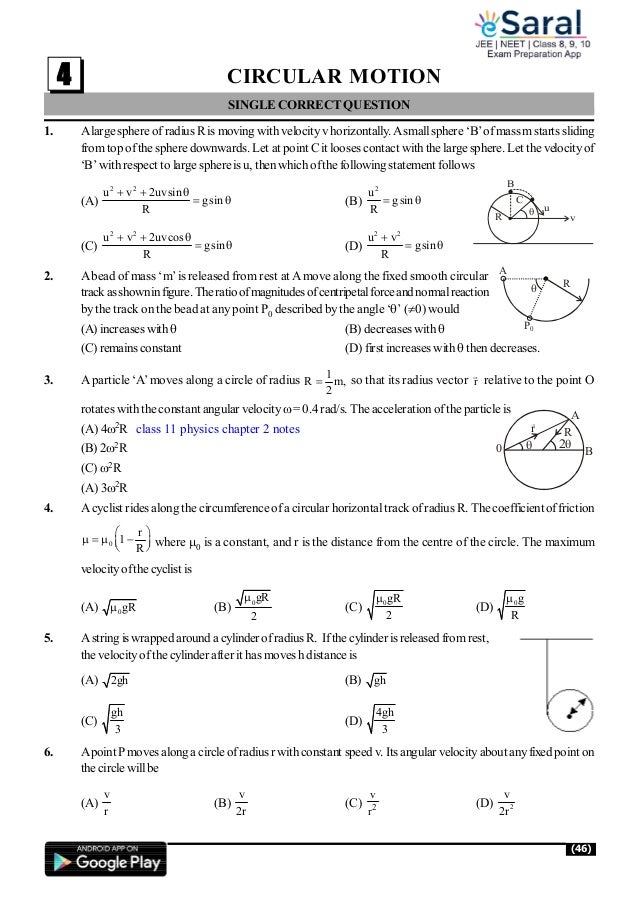
1. Alarge sphere ofradius R is moving withvelocityv horizontally.Asmallsphere ‘B’ofmassmstarts sliding
fromtopofthe sphere downwards. Let at point Cit looses contact withthe large sphere. Let the velocityof
‘B’ withrespect to large sphere is u, thenwhichofthefollowing statement follows
(A)
2 2
u v 2uvsin
gsin
R
  
  (B)
2
u
gsin
R
 

C
R
u
v
B
(C)
2 2
u v 2uvcos
gsin
R
  
  (D)
2 2
u v
gsin
R

 
2. Abead of mass ‘m’is released from rest atAmove along the fixed smooth circular
trackasshowninfigure.Theratioofmagnitudesofcentripetalforceandnormalreaction
bythe track on the bead at anypoint P0 described bythe angle ‘’ (0) would
(A) increaseswith (B) decreases with
R

P0
A
(C) remains constant (D) first increases with then decreases.
3. Aparticle ‘A’moves along a circle of radius 1
R m,
2
 so that its radius vector r

relative to the point O
rotates with theconstant angular velocity= 0.4rad/s. The acceleration ofthe particle is
(A) 42R
(B) 22R
(C) 2R
R
A
B
 
r

0
(A) 32R
4. A cyclist rides along the circumference ofa circular horizontaltrack ofradius R. Thecoefficientoffriction
0
r
1
R
 
   
 
  where 0 is a constant, and r is the distance from the centre of the circle. The maximum
velocityofthe cyclist is
(A) 0gR
 (B) 0gR
2

(C) 0gR
2

(D) 0g
R

5. Astring iswrapped around a cylinderofradius R. Ifthe cylinder isreleased fromrest,
the velocityofthe cylinder after it has moves hdistance is
(A) 2gh (B) gh
(C)
gh
3
(D)
4gh
3
6. Apoint Pmoves along a circleofradius r withconstant speed v. Itsangular velocityabout anyfixed point on
the circlewillbe
(A)
v
r
(B)
v
2r
(C) 2
r
v
(D) 2
v
2r
4 CIRCULAR MOTION
class 11 physics chapter 2 notes
(47)
7. Find the magnitudeand directionoftheforce acting on aparticle ofmass mduring its motioninthe xyplane
according to the law x = a sin t and y= b cos t, where a, b and are constants.
(A) m2 2 2
x y
 , radiallyinwards (B) m2 (x2 + y2), radiallyoutwards
(C) m(x+ y), tangentially (D) 2 2
x y
 radiallyinwards
8. Anathletecompletes one round ofa circular track ofradius R in40second. What will
be his displacement at the end of 2 minute 20 second
(A) Zero (B) 2 R
(C) 2R (D) 7R
9. In the aboveProblem, what is the ratio ofthe displacement to the distance, whenthe athlete has covered 3/
4 th ofthe circular track?
(A)
2 2
3
(B)
2
3
(C)
2
3
(D) None ofthese
10. Aparticle Pis moving ina circle ofradius ‘r’with a uniformspeed v. C is the centreofthe circle andAB is a
diameter. When passing through B the angular velocityofPabout Aand C are inthe ratio
(A) 1 : 1 (B) 1 : 2 (C) 2 : 1 (D) 4 : 1
11. Two beads Aand B of equal mass m are connected by a light inextensible cord. They are constrained to
move ona frictionless ring inverticalplane. The blocksare released fromrest as showninfigure.The tension
in the cord just after the release is
(A)
mg
4
(B) 2 mg
(C)
mg
2
(D)
mg
2
12. Aplastic circular disc ofradius Ris placed onathinoilfilm, spreadover a flat horizontalsurface. The torque
required to spinthe disc about its centralverticalaxis witha constant angular velocityis proportionalto
(A) R2 (B) R3 (C) R4 (D) R6
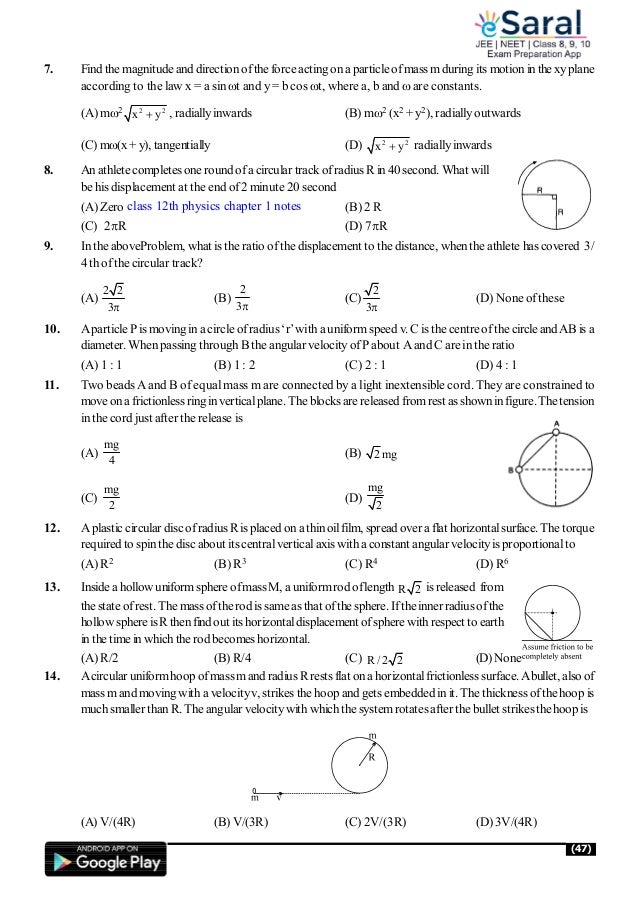
13. Inside a hollowuniformsphere ofmassM, a uniformrodoflength R 2 isreleased from
the state ofrest. The mass ofthe rod is sameas that ofthesphere. Ifthe innerradius ofthe
hollow sphereis Rthenfindout its horizontaldisplacement ofsphere withrespect to earth
in thetime in whichthe rod becomes horizontal.
(A) R/2 (B) R/4 (C) R / 2 2 (D)None
14. Acircular uniformhoop ofmassmand radius R rests flat onahorizontalfrictionless surface.Abullet, also of
mass mandmoving with a velocityv, strikes the hoopand gets embedded init. The thickness ofthehoop is
muchsmaller thanR. The angular velocitywith which the systemrotates after the bullet strikesthehoop is
(A) V/(4R) (B) V/(3R) (C) 2V/(3R) (D) 3V/(4R)
class 12th physics chapter 1 notes
(48)
15. Asolid uniformsphere isrolling without slipping onafrictionless surface,showninfigure witha translational
velocityvm/s. Ifit is to climb on theinclined surface thenvshould be:
(A) >
10
gh
7
(B) > 2gh (C) 2gh (D)
10
7
gh
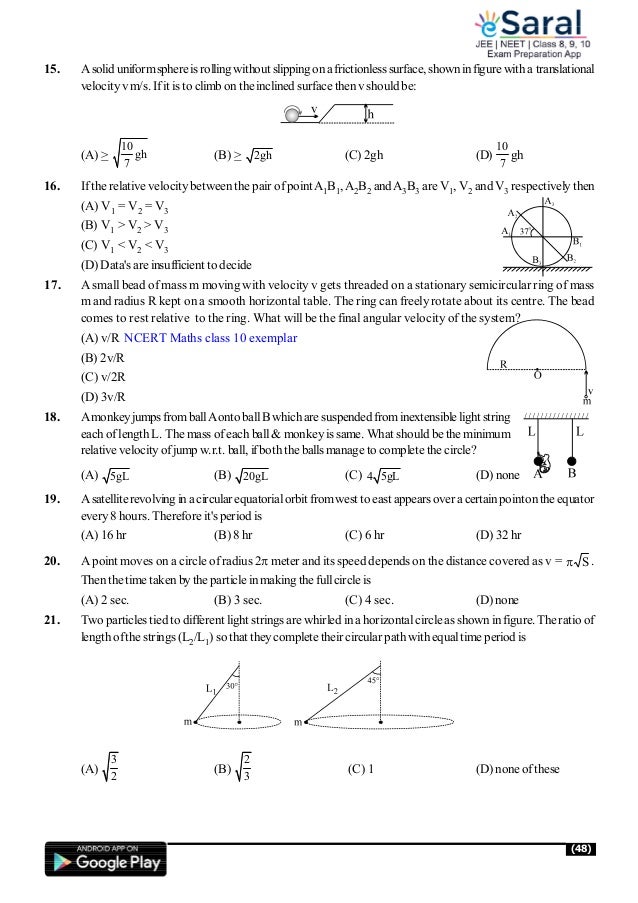
16. Ifthe relative velocitybetween the pair ofpointA1B1,A2B2 andA3B3 are V1, V2 and V3 respectivelythen
(A) V1 = V2 = V3
(B) V1 > V2 > V3
(C) V1 < V2 < V3
(D) Data's are insufficient to decide
17. A small bead of mass m moving with velocity v gets threaded on a stationary semicircular ring of mass
m and radius R kept on a smooth horizontal table. The ring can freelyrotate about its centre. The bead
comes to rest relative to the ring. What will be the final angular velocity of the system?
(A) v/R
(B) 2v/R
(C) v/2R
(D) 3v/R
18. Amonkeyjumps fromballAonto ballB whichare suspended frominextensiblelight string
each oflengthL. The mass ofeach ball& monkeyis same. What should be the minimum
relative velocityofjump w.r.t. ball, ifboththe balls manage to complete the circle?
(A) 5gL (B) 20gL (C) 4 5gL (D) none
19. Asatelliterevolving inacircularequatorialorbit fromwest to east appears overa certainpointonthe equator
every8 hours. Therefore it's period is
(A) 16 hr (B) 8 hr (C) 6 hr (D) 32 hr
20. A point moves on a circle ofradius 2 meter and its speed depends on the distance covered as v = S
 .
Thenthetime takenbythe particle in making the fullcircle is
(A) 2 sec. (B) 3 sec. (C) 4 sec. (D) none
21. Two particles tied to different light strings are whirled ina horizontalcircle as shown in figure.The ratio of
length ofthe strings (L2/L1) so that theycomplete theircircular pathwithequaltime period is
(A)
3
2
(B)
2
3
(C) 1 (D) noneofthese
NCERT Maths class 10 exemplar
(49)
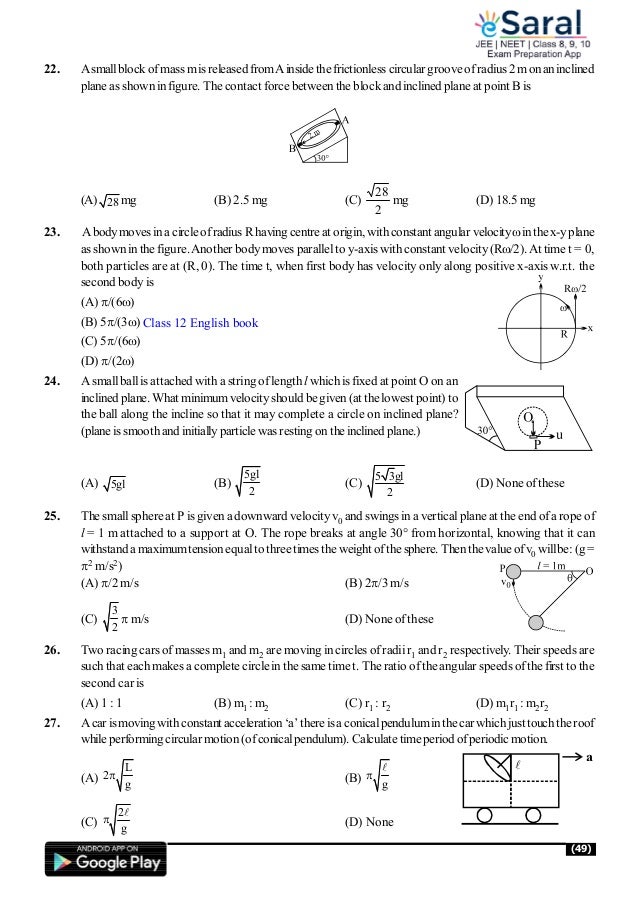
22. Asmallblockofmass misreleased fromAinsidethe frictionless circular grooveofradius 2 monaninclined
plane as shownin figure. The contact force betweenthe block and inclined plane at point B is
(A) 28 mg (B) 2.5 mg (C)
2
28
mg (D) 18.5 mg
23. Abodymoves ina circle ofradius R having centreat origin, withconstant angular velocityinthe x-yplane
as shown inthe figure.Another bodymoves parallelto y-axis withconstant velocity(R/2).At time t = 0,
both particles are at (R, 0). The time t, when first body has velocity only along positive x-axis w.r.t. the
second bodyis
(A) /(6
(B) 5/(3
(C) 5/(6
(D) /(2
24. A smallballis attached with a string of lengthl whichis fixed at point O on an
inclined plane. What minimumvelocityshould be given (at thelowest point) to
the ball along the incline so that it may complete a circle on inclined plane?
(plane issmoothand initiallyparticle was resting ontheinclined plane.)
(A) 5gl (B)
5gl
2
(C)
5 3gl
2
(D) None ofthese
25. The small sphere at P is given a downward velocityv0 and swings in a verticalplane at the end ofa rope of
l = 1 m attached to a support at O. The rope breaks at angle 30° from horizontal, knowing that it can
withstand a maximumtensionequalto threetimes the weight ofthe sphere. Thenthevalue ofv0 willbe: (g =
2 m/s2)
(A) /2 m/s (B) 2/3 m/s
(C)
3
2
 m/s (D) None ofthese
26. Two racing cars of masses m1 and m2 are moving in circles of radiir1 and r2 respectively. Their speeds are
such that eachmakes a complete circle in the same time t. The ratio ofthe angular speeds ofthe first to the
second car is
(A) 1 : 1 (B) m1 : m2 (C) r1 : r2 (D) m1r1 : m2r2
27. Acaris moving withconstant acceleration‘a’there isa conicalpenduluminthe car whichjust touchthe roof
while performingcircular motion(ofconicalpendulum). Calculate time periodofperiodic motion.
(A)
L
2
g
 (B) g


(C)
2
g


(D) None
a

Class 12 English book
(50)
28. Aparticledoesuniformcircular motionina horizontalplane. The radiusofthe circleis 20cm. Thecentripetal
force acting on the particle is 10 N. It's kinetic energyis
(A) 0.1 J (B) 0.2 J (C) 2.0 J (D) 1.0 J
29. AparticleismovinginacircleofradiusRinsuchawaythat atanyinstantthenormalandtangentialcomponents
ofits acceleration are equal. Ifits speed at t = 0 is 0
v the time taken to complete the first revolution is
(A)
0
R
v (B) 0
v
R
(C)
2
0
R
(1 e )
v
 
 (D)
2
0
R
(e )
v
 
.
30. A spool is being applied by a horizontal force F as shown in the figure. The spool is placed on rough
horizontalsurface. Thedirectionoffrictionalforce actingonspoolis
(A) Forward direction
(B) Zero if R = 2r and I = 2 mr2
(C) Backward direction ifR = r and   2
F
R
r

(D)Dataisinsufficient
31. The bar shown in the figure is made of a single piece of material. It is fixed at one end. It consists of two
segments ofequallength
2
L0
but different cross-sectionalareaAand 2A. What isthe change inlengthofthe
entire systemunder the action ofanaxialforce F. Consider the shape ofjoint to remain circular.
(A)
Ay
4
FL
3
(B)
Ay
8
FL
3
(C)
Ay
2
FL
3
(D) None of these
L/2 L/2
A
F
A=area of cross section
2A
32. A particle ofmass mand charge q is attached to a light rod oflength L. The rod can
rotate freelyinthe plane ofpaper about the other end, whichis hinged at P. The entire
assemblylies in a uniform electric field E also acting in the plane ofpaper as shown.
The rod isreleased fromrest whenit makesanangle withthe electric field direction.
Determine the speed ofthe particle whenthe rod is parallelto the electric field.
E
m,q
L

P
(A)
2
/
1
m
)
cos
1
(
qEL
2





 

(B)
2
/
1
m
)
sin
1
(
qEL
2





 

(C)
2
/
1
m
2
)
cos
1
(
qEL





 

(D) None ofthese
33. Alargeinsulatingthick sheet ofthickness2dcarries auniformcharge perunit volume.Aparticle ofmass m,
carrying a chargeq having a signopposite to that ofthe sheet, is releasedfromthe surface ofthesheet. The
sheet does not offer anymechanicalresistanceto the motion ofthe particle. Find the oscillation frequency
ofthe particle inside the sheet.
(A)  =

2
1
0
m
q


(B)  =

3
1
0
m
q


(C)  =

4
1
0
m
q


(D) None ofthese
34. Figure shows a radar screen, with the dots denoting respective positions of Indian SUKHOI.A, B, C and
PAKI F-16-E.Allare flying withconstant velocityinhorizontalplane. SUKHOI-Areports to ground control
that E is moving due north with velocity160 m/s. At same time SUKHOI-B reports that PAKI F-16-E is
moving dueeast at 120m/s. Throughwhat minimumangleSUKHOI-C (originallymovinginnortheast)turns
(51)
so that it is alligned indirection ofmotionofE.
(A) 8° clockwise
(B) 8°anticlockwise
(C) 16° clockwise
N
S
E
W
y
x
45°
B
C A
E
Radar Screen
Plane Direction
SUKHOI A East
SUKHOI B North
SUKHOI C North East
PAKI F-16 E Unknown direction
(D) 16° anticlockwise
35. A motor car is travelling at 60 m/s on a circular road ofradius 1200m. It increases its speed at the rate of4
m/s2
. The accelerationofthe car is (at initialtime)
(A) 3 m/s2
(B) 4 m/s2
(C) 5m/s2
(D) 6 m/s2
(E) 7m/s2
36. A particle ofmass mis attached to one end ofstring oflength whilethe other end is fixed to apoint height
h (h < ) above the smooth horizontaltable. The particle is made to revolve in a circle on the table so asto
make n revolutions per second. The value ofn ifthe particle is in contact with the table willbe-
(A)
h
g
2
1

(B)

g
2
1

(C)
h
2
g
2
1

(D) None ofthese
37. Aparticleis moving intheverticalplane. It isattached at one endofa string oflengthand whose other end is
fixed. The velocityat lowest point is u. The tensioninstring is T

and velocityofparticle is v

at anyposition.
Thenwhichofthe following quantitywillremains constant.
(A) Kinetic energy (B)GravitationalP.E. (C) T

·v

(D) T

×v

ASSERTIONAND REASON
38. Statement-1 :Aparticle moving at constant speedand constant magnitude ofradialacceleration must
beundergoinguniformcircularmotion.
Statement-2 : In uniformcircular motion speed cannot change as their is no tangentialacceleration.
(A) Statement-1 istrue, statement-2 istrueand statement-2 is correctexplanationfor statement-1.
(B) Statement-1istrue,statement-2istrueandstatement-2isNOT thecorrectexplanationforstatement-1.
(C) Statement-1 is true, statement-2 is false.
(D) Statement-1 isfalse, statement-2 is true.
39. Abhiand Johnare in a rotor at rest relative to wallto rotor.
Statement-1 : Centrifugalforce onAbhiinreference frame ofJohnmr2 radiallyonward as showninfigure.
Statement-2 :Angular velocityofAbhiwithrespect to Johnis same as angular velocityofAbhiwith respect
to axisofrotation.
(A) Statement-1 istrue, statement-2 is trueand statement-2 is correct explanationfor
statement-1.
(B)Statement-1istrue,statement-2istrueandstatement-2isNOTthecorrectexplanation
forstatement-1.
(C) Statement-1 is true, statement-2 is false. JOHN ABHI
r
(D) Statement-1 isfalse, statement-2 is true.
(52)
COMPREHENSION
Passage for Q. no. (40 to 41)
Achild isswinging a toyairplaneona string. The airplanemoving withconstant speeddescribes ahorizontal
(in X-Y plane) circle of radius 2 m and takes 2 s to complete one orbit. At t = 0, the airplane is directly
infront of the child and moving in the +Y direction. The child is facing in the positive X-direction. The
approximate plot ofX-components of
40. velocityoftheairplane as a functionoftime over onecomplete circle is
(A) (B)
(C) (D)
41. centripetalacceleration ofthe airplane as afunctionoftime over one complete circle is
(A) (B)
(C) (D)
Passage for Q. no. (42 to 43)
AuniformbarAB ofmass mand length Lis placedhorizontallyat rest ona smoothtable.
Another uniformbar PQ ofmass 2m but of same length L is moving horizontally with
velocityVon same table. Whenbar PQ reaches near barAB the end Pis attached to end
B and combined rod moves forward and also rotates.
42. The angularvelocityofcomposite rod willbe
(A)  =
4v
11L
(B) 
11v
4L
(C) 
8v
11L
(D)  =
v
L
43. The velocityofendAjust after the rod joined together
(A)
2
v
11
 (B)
2v
3
 (C)
28
v
33
 (D) noneofthese
(53)
Passage for Q. no. (44 to 46)
Two beads of mass 2m and m, connected by a rod of length  and of negligible mass are free to move
in a smooth vertical circular wire frame of radius  as shown. Initially the system is held in horizontal
position (Refer figure)

2m m
44. The velocity that should be given to mass 2m (when rod is in horizontalposition) in counter-clockwise
direction so that the rod just becomes vertical is :
(A)
5g
3

(B)
3 3 1
g
3
 

 
 
 (C)
3
g
2
 (D) None of these
45. If the rod is replaced by a massless string of length and the system is released when the string is
horizontalthen :
(A) Mass 2m will arrive earlier at the bottom.
(B) Mass m will arrive earlier at the bottom.
(C) Both the masses will arrive together but with different speeds.
(D) Both the masses will arrive together with same speeds.
46. The string is now replaced by a spring of spring constant k and natural length. Mass 2m is fixed at the
bottom ofthe frame. The mass m which has the other end ofthe spring attached to it is brought nearthe
mass 2mand released as shown in figure. The maximumangle  that the spring willsubstend at the centre
will be : (Take k = 10 N/m,  = 1 m, m = 1 kg and  = r)
2m m
fixed
attached
to spring
2m
m
fixed

(A) 60° (B) 30° (C) 90° (D) None of these
MULTIPLE CORRECTQUESTION
47. A car isofmass mmovingalong a circular trackofradius r witha speed which increases linearlywith time t
as v = kt, where k is a constant. Then
(A) the instantaneouspower delivered bythe centripetalforce is mk3t3/r.
(B) the power delivered bythe centripetalforce is zero.
(C) the instantaneouspower delivered bythe tangentialforce is mk2t.
(D) the power delivered bythe tangentialforce is zero.
48. Anobject followsa curved path. Thefollowing quantities mayremainconstant during the motion.
(A) speed (B) velocity
(C) acceleration (D) magnitudeofacceleration
(54)
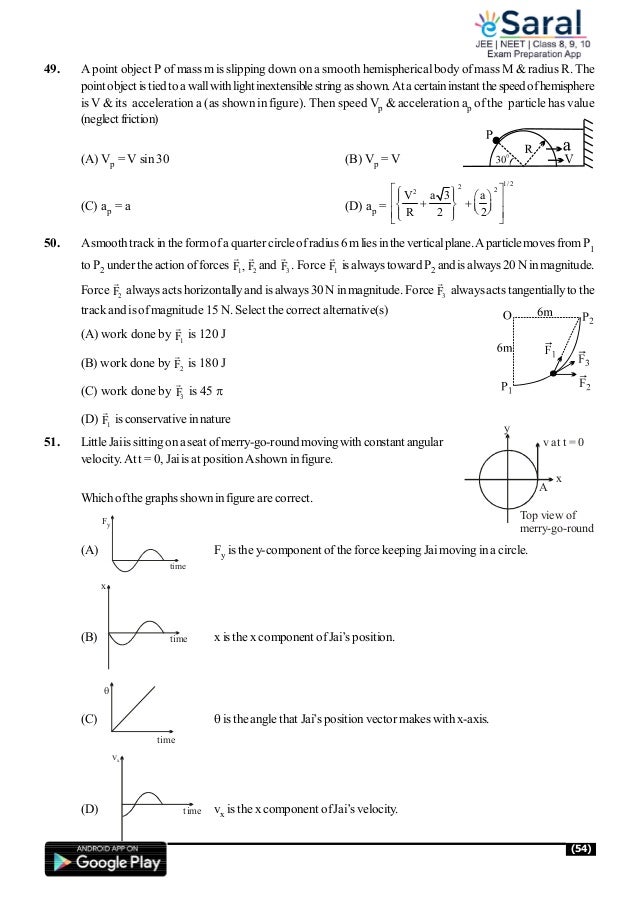
49. A point object P of mass mis slipping down ona smooth hemispherical bodyofmass M & radius R. The
point objectis tiedto awallwithlight inextensiblestring as shown.Ata certaininstant thespeedofhemisphere
is V & its acceleration a (as shown in figure). Then speed Vp & acceleration ap ofthe particle has value
(neglect friction)
(A) Vp = V sin 30 (B) Vp = V
(C) ap = a (D) ap =
1/ 2
2 2
2
V a 3 a
R 2 2
 
 
   
 
 
   
 
 
 
 
 
50. Asmoothtrack inthe formofa quarter circleofradius 6 mlies inthe verticalplane.AparticlemovesfromP1
to P2 under the action offorces 1 2
F , F
 
and 3
F

. Force 1
F

isalways toward P2 andis always 20 Ninmagnitude.
Force 2
F

always acts horizontallyand is always 30 Ninmagnitude. Force 3
F

alwaysacts tangentiallyto the
track and isofmagnitude 15 N. Select the correct alternative(s)
(A) work done by 1
F

is 120 J
(B) work done by 2
F

is 180 J
(C) work done by 3
F

is 45 
(D) 1
F

is conservative innature
51. Little Jaiis sitting onaseat ofmerry-go-roundmovingwithconstant angular
velocity.At t = 0, Jaiis at positionAshown in figure.
Top view of
merry-go-round
x
A
v at t = 0
y
Which ofthe graphs shown infigure are correct.
(A)
time
Fy
Fy is the y-component ofthe force keeping Jaimoving in a circle.
(B) time
x
x is the x component ofJai’s position.
(C)
time

 is theangle that Jai’s position vector makes withx-axis.
(D) time
vx
vx is the x component ofJai’s velocity.
(55)
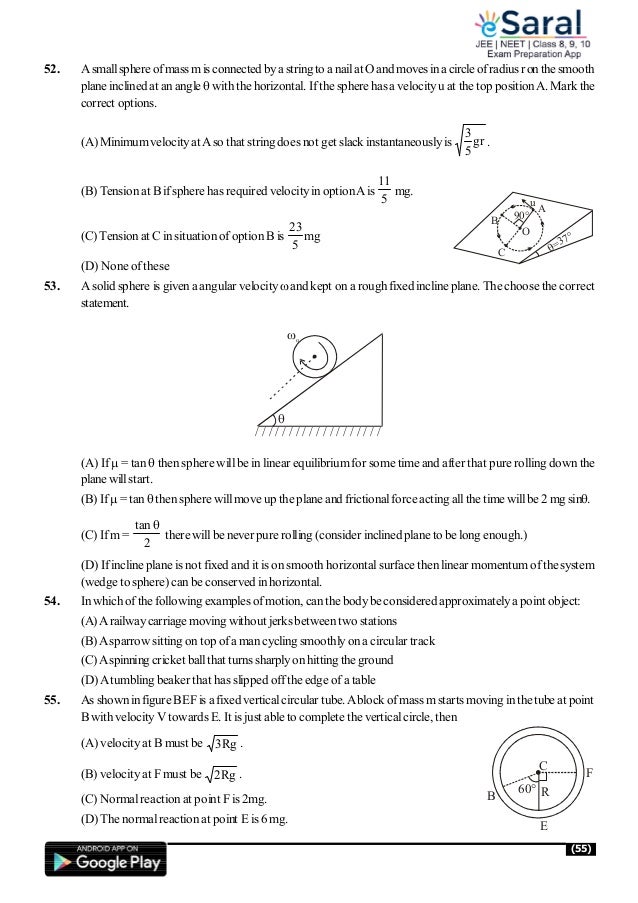
52. Asmallsphereofmass misconnected bya stringto a nailat Oand moves inacircle ofradius ronthesmooth
plane inclined at anangle  with the horizontal. Ifthe sphere has a velocityu at the top positionA. Mark the
correct options.
(A) MinimumvelocityatAso that string does not get slack instantaneouslyis gr
5
3
.
(B) Tensionat B ifsphere has required velocityinoptionAis
5
11
mg.
(C)Tensionat C in situation ofoptionB is
5
23
mg
C
B
A
O
90°
=37°
u
(D) None ofthese
53. A solid sphere is given aangular velocityand kept on a roughfixed incline plane. The choose the correct
statement.
/ / / / / / / / / / / / / / / / / / /

o
(A) If = tan  then sphere willbe in linear equilibriumfor some time and after that pure rolling down the
plane willstart.
(B) If = tan  thensphere willmove up the plane and frictionalforce acting allthe time willbe 2 mg sin.
(C) Ifm=
2
tan
there willbe never pure rolling (consider inclined plane to belong enough.)
(D) Ifincline plane is not fixed and it is on smooth horizontalsurface then linear momentum ofthesystem
(wedge to sphere) can be conserved in horizontal.
54. In whichofthe following examples ofmotion, canthe bodybe considered approximatelya point object:
(A)Arailwaycarriage moving without jerksbetweentwo stations
(B)Asparrow sitting on top ofa man cycling smoothlyona circular track
(C)Aspinning cricket ballthat turns sharplyon hittingthe ground
(D)Atumbling beaker that has slipped offthe edge ofa table
55. As showninfigure BEFis afixed verticalcircular tube.Ablock ofmass mstarts moving in the tube at point
B withvelocityV towards E. It is just able to complete the verticalcircle, then
(A) velocityat B must be Rg
3 .
(B) velocityat F must be Rg
2 .
C
R
F
E
60°
B
(C) Normalreaction at point Fis 2mg.
(D) The normalreaction at point E is 6 mg.
(56)
MATCH THE COLUMN
56. A narrow tube exists in a vertical plane. A small sphere is given a horizontal velocity u at its lowest
position (Refer diagram). Match the values of velocityu inColumn-I to the properties ofupward motion
indicated in Column-II.
Inner Surface
R
u
Outer Surface
Column-I Column-II
(A) u 2gR
 (p) Sphere is always in contact with inner
surface of tube during its upward motion.
(B) u 3gR
 (q) Sphere is always in contact with outer
surface of tube during its upward motion.
(C) u 4gR
 (r) Sphere is in contact with outer surface of
tube first then with inner surface during its
upward motion.
(D) u 5gR
 (s) Sphere is in contact with inner surface of
tube first then with outer surface during its
upward motion.
57. A particle ofmass ‘m’ moves ina circular path. The particle starts fromrest at t = 0. Speed ofthe particle
is given as v = kt2 where ‘k’ is a constant. Now match the following:
List-I List-II
(A).Accelerationofparticle at time ‘t’ (P) 2mk2t3
(B) Work done byresultant force from (Q)
2 3
1
mk t
2
t – 0 time ‘t’
(C) Instantaneouspower at time (R)
2
2
kt
kt 4
R
 
  
 
‘t’(dueto resultant force)
(D)Average power upto time ‘t’(due to (S)
2 4
1
mk t
2
resultant force)
(57)
SUBJECTIVE QUESTION
58. Prove that a motor car movingover a convex bridgeis lighter than the same car resting onthe samebridge.
59. Asmallblock ofmass 2minitiallyrests at thebottomofa circular, verticaltrack, which
has aradius ofR. Thecontact surface between the mass and the loopis frictionless.A
bullet ofmassmstrikestheblock horizontallywithinitialspeedv0 andremainembedded
intheblock as the blockand the bullet circlethe loop. Determine eachofthe following
in terms of m, v0, R and g.
(a) The speed ofthe masses immediatelyafter the impact.
(b) The minimuminitialspeed ofthe bullet ifthe block and the bullet are successfullyto executea complete
ride onthe loop.
60. A particle moves along a circle of constant radius with radial acceleration changing with time as ar = k tn
where k is constant and n > 1. How does the power developed by the net force on the particle vary with
time?
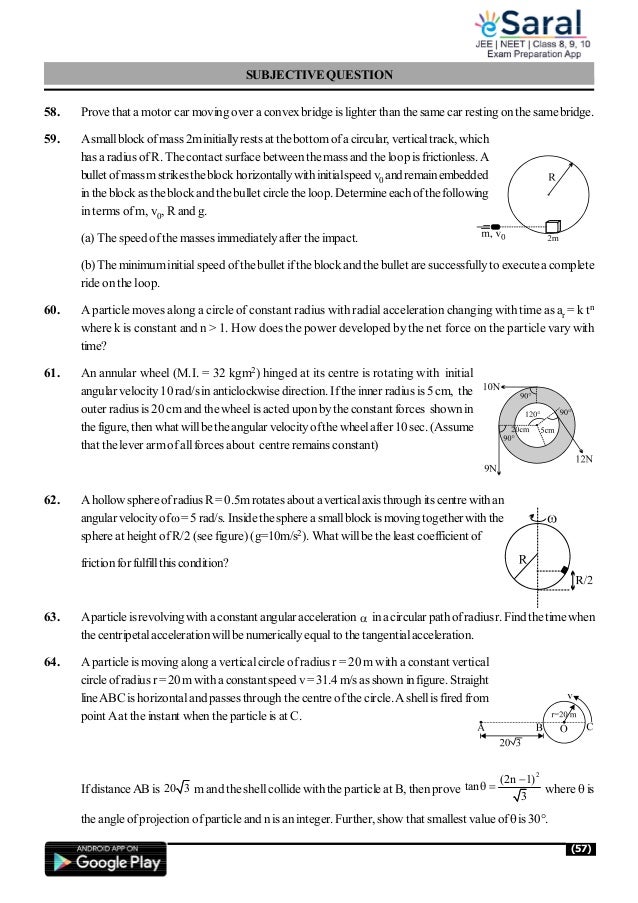
61. An annular wheel (M.I. = 32 kgm2) hinged at its centre is rotating with initial
angular velocity10 rad/s in anticlockwise direction. Ifthe inner radius is 5 cm, the
outer radius is 20 cmand thewheelis acted uponbythe constant forces shown in
the figure, thenwhat willbethe angularvelocityofthe wheelafter 10sec. (Assume
that thelever armofallforces about centre remains constant)
62. Ahollowsphereofradius R =0.5mrotates about averticalaxis throughitscentrewithan
angular velocityof=5 rad/s. Inside thesphere a smallblock is moving togetherwiththe
sphere at height ofR/2 (seefigure) (g=10m/s2). What willbe the least coefficient of
frictionforfulfillthiscondition?
63. Aparticle isrevolving witha constant angular acceleration  inacircular pathofradiusr. Findthetimewhen
the centripetalaccelerationwillbe numericallyequalto the tangentialacceleration.
64. A particle is moving along a verticalcircle ofradius r = 20 mwitha constant vertical
circle ofradius r = 20mwitha constant speed v=31.4m/s as showninfigure. Straight
lineABCis horizontaland passes through the centre ofthe circle.Ashellis fired from
pointAat the instant when the particle is at C.
IfdistanceAB is 20 3 mandthe shellcollide withthe particle at B, then prove
2
(2n 1)
tan
3

  where is
the angle ofprojection ofparticle and n is aninteger. Further, show that smallest value ofis 30°.
(58)
65. ArodoflengthRandmass Mis freeto rotate about ahorizontalaxispassing throughhingeP as showninthe
figure. First it is taken aside suchthat it becomes horizontaland thenreleased.
At the lowest point the rod hits the block B of mass m and stops. If
mass ofrod is 75 kg, find mass ofthe block if it just complete the
circle.
R
m2
P
m1
66. Two particlesAand B are movingina horizontalplaneanticlockwiseontwo different concentric circles with
different constant angular velocities 2and respectively. Find the relative velocityofB w.r.t.Aafter time
t = /. (Take  = 3rad/sec, r = 2m] (Both are moving in same sense)
2r
r
A B
X
Y
at t= 0
67. A flexible drive belt runs over a frictionless flywheel(seeFigure). The mass perunit length ofthe drive belt
is 1 kg/m, and the tension in the drive belt is 10N. The speed ofthe drive belt is 2m/s. The whole systemis
located on a horizontalplane. Find the normalforce (in N) exerted bythe belt on the flywheel.
T
T
v
SOLUTION [CIRCULAR MOTION]
(59)
1. (B) Centripetal acceleration is taken in frame of reference of
sphere because circular motion is in this frame
2. (C) Fcentripetal
= N - mg sin 
 N = Fcentripetal
+ mg sin 
2
mV
mgsin
R
  
From conservation of energy
mg R sin  =
1
2
mV2

2
mV
2 mg sin
R
 
3. (A) Suppose the body moves from A to B in time t. Then radius
vector describes the angle . Since the angle subtended at the
centre of the circle is twice that at the circumference. Hence the
angular velocity of the body is 2. Linear velocity = 2R
Acceleration
2 2 2
2
v 4R
4 R
R R

   
Put the values.
4. (B)
2
0
mv r
mg mg 1
r R
 
    
 
 
2
2
0
r
y v g r
R
 
   
 
 
For y to be maximum,
dy 2r
0 1
dr R
  
R
r
2

2
2
max 0 0
R R R
v g g
2 4R 4
 
    
 
 
0
max
gR
v
2


5. (D)
6. (B) Let O be the centre of circle and P the position of the point
at any time and Athe point about which angular velocity is to be
found.
N
O
P
T
A
Draw PN perpendicular to AP.
The velocity v at P is along PT,
the tangent at P.
Also if OAP = OPAs = ,
TPN =  and therefore the resolved part of v along PN = v cos
.

Resolved part of v along PN
Angular velocity about A
AP

vcos v
2rcos 2r

 

CIRCULAR MOTION SOLUTION
7. (A) Given x = a sin t
y = b cos t
Radius vector ˆ ˆ
r xi yj
 

, = a sin t î + b cos t ˆ
j
Velocity vector dr
v
dt


 ,
d ˆ ˆ
(a sin i b cos t j)
dt
   
= a cos t ˆ
i – b sin t ˆ
j
Acceleration vector
dv
a
dt



= –a2
sin t ˆ
i – b2
cos t ˆ
j
= – 2 (a sin t ˆ
i + b cos t ˆ
j , 2
r
 

Forces 2
F ma m r
    
  
The magnitude of force
2
F ( m r)
  

,
2 2 2 2
F m r m x y
    
The direction of force is radially inwards.
8. (B)
9. (A)
10. (B) Angular velocity of particle P about point A,
A
AB
T 2r
 
  
A
2r
r
v
B
C
P
Angular velocity of particle
P about point C,
c
BC
T r
 
  
Ratio
A
c
/ 2r 1
/ r 2
 
 
 
SOLUTION [CIRCULAR MOTION]
(60)
11. (D) Just after the release B moves downwards and A moves
horizontally leftwards with the same acceleration say a. Drawing
free body diagram of both A and B :
Tcos45 ma
or T 2ma ....(1)
 

 
mg Tcos45 ma
or mg ma ma
g
or a ... 2
2
  
 

Substituting this in (1) we get
mg
T
2

12. (C)
Consider an element of radius r and thickness dr.
Thickness of oil film is h.
 dA = 2r dr, v = r
 dF =
2
v 2
(dA) r dr
h h

 
 dT = (dF)r =
3
2
r dr
h

 T =
4
R
2h

or
4
T R

13. (B) x = displacement of rod w.r.t. sphere
R 2 R
2
2 2
 
y = displacement of sphere w.r.t. ground
My = M(x – y) 
x R
y
2 4
 
14. (B) LMC
mV = mV0 + m(V0 + R)  V = 2V0 + 2
AMC mVR = m(V0 + R)R + mR2
 V = V0 + 2 R
solving  = V/3 R
15. (A)
16. (A) So relative velocity in every case is of magnitude 2V
 V1 = V2 = V3 = 2V
17. (C) Pi
= mv  At final position, both the bead and ring are
rotating about axis through O and | to the plane.
Im
= mR2
, Iring
= mR2
 I = Im
+ Iring
= 2mR2
 Lfinal
= I = 2mR2
V'
R
 
 
 
= 2mRV'
 Pf
=
final
L
R
= 2mV'
Pf
= Pi
 2mV' = mV  V' =
V
2
=
V'
R
=
V
2R
18. (C)
19. (C)
20. (C) v =  S 
dv 1 dS
dt dt
2 S
 
= · S
2 S

 =
2
2

= a (tangential acceleration)
If required time is t, 2R =
2
1
at
2
solving we get t = 4 sec.
21. (A) Tsin = m2L sin
Tcos = mg
& hence, for constant ''
(angular speed), L 
1
cos

2 1
1 2
L cos
L cos


 =
3
· 2
2
=
3
2
22. (C) N – mgsin =
2
mv
R
2
1
mv2 = mgH 
2
mv
R
=
2mgH
R
= 2mg
 N =
mg
2
+ 2mg =
5mg
2
SOLUTION [CIRCULAR MOTION]
(61)
Contact force = mg
2
25 3
4 2
 
  
 
 
=
28
2
mg
23. (B) 1, g
R ˆ
V i
2



R cos =
R
2

 = 60º
Rotated = 360º – 60º
= 300º or
5
3

; t =
5
3


24. (B) for complete circular motion
Vmin = 5gL
here geff = g sin 30º =
g
2
 Vmin =
5
gL
2
25. (C)
2
1
mv mg
1 2
 = 3mg
v1 =
5
g
2
now
1
2
mV0
2 + mg
1
2
=
1
2
mV1
2
V0 =
3g
2
=
3
2

26. (A) 1 = 2 = 
 1 = 2 = 1
27.  a = g, eff
g g 2

45º
ma
equb.
mg
So geometry is like
T 
2
m
2
 
mg 2

45º
g 2

2
m
Tcos45
2

 

Tsin45 mg 2
 
2
m 2g 2g
1
2mg


      

 
2
T 2
2g g
   
 
28. (D)
2
mv
10
r
 
2
1 r
mv 10 1J
2 2
  
29. (C) 30. (B) 31. (A) 32. (A)
33. (A) 34. (B) 35. (C)
36. (A) Tcos = mg
h


Tsin = m2 sin
n =
1 g
2 h

37. (C) T · V 0

 
because T is always  to v.
Assertion and Reason
38. (B) 39. (C)
Passsage
40. (D) r = 2m
 =
2
2


= 1 rad/sec.
 = t
Vx = –Vsint
= –Vsin t
41. (B) ax = –
2
V
cos t
r
 = –
2
V
cost
r
42. (C)
cm
L 3L
2m m
2 2
y
3m
 
   
 
 =
5
6
L
From linear momentum conservation
(2m) V = (3m) Vcm
 Vcm =
2
3
V ..............(1)
From angular momentum conservation (about 0)
L
3
 
 
  2mV = Icmcm
=
2 2
2 2
cm
mL 2 L 2
m L 2m 2m L
12 3 12 3
 
   
   
 
   
   
 
 
cm =
8 V
11 L
43. (A) Velocity of A
A = cm – cm
7
L
6


SOLUTION [CIRCULAR MOTION]
(62)
=
2
3
 –
8
11 L

 
 
 
7
L
6
;
=
2 28
3 33
 

 
 
 

A =
2
11 


44. (B) The speeds given to 2m will also be possessed by m
 KE in horizontal position gets converted in PE in vertical
position.
1
2
2mv2
+
1
2
mv2
= change in PE in vertical position.
 PE = 2 mg [ cos 30° –  cos 60°] + mg [ cos 30° +
2

]
2 mg
3 3
mg
2 2 2 2
   
  
   
   
   
   
2m
m

3 1
mg [ 3 1] mg
2
 

   
 
 
 
=
3 1
mg 3 1
2 2
 
  
 
 
 
 =
3 3 1
mg
2 2
 

 
 
 

K.E. =
1
2
3mv2
= mg
3 3 1
2
 

 
 
 
 v =
3 3 1
g
2
 

 
 
 

45. (D) Both the masses will have same acceleration all the
time.
 Their velocities and distance covered will be same.
46. (A) Length of spring at maximum = 2 cos
 Extension is x = (2 cos – )
Now initial potential energy of the spring is converted into
final PE of spring and gravitational PE.

1
2
k2
=
1
2
k (2 cos – )2
+ mg ( – cos )
Putting values
1
2
× 10 × 12
=
1
2
× 10 (2 cos – 1)2
+ 10 (1 – cos )
5 = 5 (2 cos  – 1)2
+ 10 – 10 cos
2 cos
 
m
q
1 = (2 cos  – 1)2
+ 2 – 2 cos
2 cos  – 1 = (2 cos – 1)2
 cos =
1
2
  = 60°
Multiple Choice Questions
47. (B, C)
48. (A, C, D)
49. (B, D) Velocity of point object w.r.t. hemispherical body  
V'

will be same in magnitude to that of weight of hemispherical
body. Hence, for total velocity p
V

which is the resultant of V

& V'

we have Vp =  
2 2 2
V V 2V cos 120
  = V
acceleration of p = acc. of p w.r.t.
hemispherical body + acc. of hemispherical body
= t
'
p
a

+ n
'
p
a

+ a

where '
p
a

is acceleration of 'p' w.r.t. hemispherical body &
t
'
p
a

& n
'
p
a

the tangential & normal component in
corresponding circular motion.
Here t
'
p
a

= a
& n
'
p
a

=
2
p
V
R
Hence ap =  
2
2
2
0
P
V
acos30 a acos60
R
 
  
 
 
=
2 2
2
V a 3 a
R 2 2
   
 
   
   
 
50. (B, C, D) 2
F
w = F2  
2
OP = 30 · (6) = 180 J
3
F
w =
2
1
P
3
P
Along the path
F dx
 =
2 6
4
3
0
F dx

 = 15 · (3) = 45J
1
F
w =
2
1
P
11
P
F dx

1
F
w =
/ 2
0
20 cos Rd
4 2

 
 
 
 
 

1
F
w = 20 (–2) R ·
/ 2
0
sin
4 2

 
 
 

 
 
 
 
 
1
F
w = (–40) · 6 0 sin
4

 

 
 
SOLUTION [CIRCULAR MOTION]
(63)
1
F
w = 120 2 J
Work done by F1 is independent of path. So it is conservative in
nature
51. (A,C) 52. (A)
53. (A,D) 54. (A,B)
55. (A,B,C) 2
E
V = V2 + 2g(R – R cos 60°)
4gr = V2 + gR
V = 3gR
2
B
V = 2
E
V – 2gR = 2gR
N =
2
P
mV
R
= 2mg
NE mg =
2
E
mV
R
 NE = 5mg]
56. (A-q; B-r; C-r; D-q)
57. (A-r; B-s; C-p; D-q)
58. The motion of the motor car over a convex bridge AB is the
motion along the segment of a circle AB (Figure;
The centripetal force is provided by the difference of weight mg
of the car and the normal reaction R of the bridge.
mg – R =
2
mv
r
or R = mg –
2
mv
r
Clearly R < mg, i.e., the weight of the moving car is less than the
weight of the stationary car.
59. (a) v0/3, (b) 3 5gR
(a) Conserving momentum in horizontal direction
mv0 = (2m + m)v, v =
0
v
3
Collision is perfectly inelastic
(b) Now 3 m mass will move in the circle and 3 m mass requires
5Rg minimum velocity at bottom most point to execute the
loop so
V =
0
V
3
= 5Rg , then v0 = 3 5Rg
60. tn–1
Given radial acceleration
ar = ktn =
2
v
R
 v2 = Rktn  v = Rk tn/2

dv
dt
=
n
Rk
2
n
1
2
t
 

 
 
 Tangential force, Ft = m
dv
dt
= m
n
2 Rk
n
1
2
t
 

 
 
 Power developed = v
·
F


=  
r t t
F F ·v F v
 
  
= m
n
2 Rk
n
1
2
t
 

 
  ·  
n / 2
Rk t =
n 1
mnRk
t
2

 P  tn–1
61. net
19(0.2) – 12(0.05)
= 3.8 – 0.6
= 3.2 N mt = 32 
 = 0.1 rad/s2
 = 0
+ t
 = 10 + (0.1) (10)
= 11 rad/s
62. FBD of block (Ref. sphere)
here for  = 5 rad/s
mg sin60 > Fp
cos600
 block will have
tendency to move
down along inclined
 friction will be directed upward
x-axis Nsin60 – Ncos60 = m2
Rsin60
.............(1)
y-axis Ncos60 – Nsin60 = mg
.............(2)
From (1) and (2)
 =
3 3
23
63. Le the speed of the particle after time t from starting be v
 The centripetal acceleration
2
2
r
v
a r
r
   & the corresponding angular speed t


 .
 2 2 2
r
a r( t) r t
    ...(i)
We known that the tangential acceleration 
 r
at ...(ii)
Since, t
r a
a  (given)
 2 2
r t r
   
1
t 

64. As at the time of firing of the shell, the particle was at C and the
shell collides with it at B, therefore the number of the revolutions
completed by the particle is odd multiple of half i.e., (2n – 1)/2,
where n is an integer.
Let T be the time period of the particle, then
2 r 2 3.14 20
T 4second
v 31.4
  
  
If t be the time of the flight of the shell, then
t = time of [(2n – 1)/2] revolutions of the particle
SOLUTION [CIRCULAR MOTION]
(64)
(2n 1)
4 2(2n 1)
2

    second
for a projectile, the time of flight is given by
2usin
t
g


Hence,
2usin
2(2n 1)
g

  ...(i)
The range of the projectile is given by
2
u sin2
R
g


Hence,
2
u sin2
20 3
g

 ...(ii)
From equation (i) and (ii)
2
(2n 1)
tan
3

 
For  to be smallest, n = 1, so
2
(2n 1)
tan
3

 
65. (0015) Let the angular velocity of rod at the time of collision be
w
According to the law of conservation of energy
For the rod at the horizontal and vertical positions, we get
m2gR =
2
R
g
m
I
2
1 2
2


2
gR
m2
=
2
2
2
·
3
R
m
2
1
 =  =
R
g
3
Applying the law of conservation of angular momentum about
P
Let the angular speed of block about P after the collision be 0.
I = m1R20

3
R
m 2
2
= m1R20 0 =
R
g
3
m
3
m
1
2
Linear velocity of ball is
v0 = 0R  v0 = gR
3
m
3
m
1
2
For ball to complete the circle
v0 = gR
5 = gR
3
m
3
m
1
2

1
2
m
m
= 15 ]
66. (0024 )
A
2 r

2 r

v = 4 r
rel 
67. (0012)
T
T
N
2T – N = m2Rcm = µ × R ×
2
R
V






×

R
2
2T – N = 2µv2
N = 2T – 2µv2 = 2 × 10 – 2 × 1 × 4 = 12 N ]

Circular Motion JEE Advanced Important Questions

  • 1.
    (46) SINGLE CORRECT QUESTION 1.Alarge sphere ofradius R is moving withvelocityv horizontally.Asmallsphere ‘B’ofmassmstarts sliding fromtopofthe sphere downwards. Let at point Cit looses contact withthe large sphere. Let the velocityof ‘B’ withrespect to large sphere is u, thenwhichofthefollowing statement follows (A) 2 2 u v 2uvsin gsin R      (B) 2 u gsin R    C R u v B (C) 2 2 u v 2uvcos gsin R      (D) 2 2 u v gsin R    2. Abead of mass ‘m’is released from rest atAmove along the fixed smooth circular trackasshowninfigure.Theratioofmagnitudesofcentripetalforceandnormalreaction bythe track on the bead at anypoint P0 described bythe angle ‘’ (0) would (A) increaseswith (B) decreases with R  P0 A (C) remains constant (D) first increases with then decreases. 3. Aparticle ‘A’moves along a circle of radius 1 R m, 2  so that its radius vector r  relative to the point O rotates with theconstant angular velocity= 0.4rad/s. The acceleration ofthe particle is (A) 42R (B) 22R (C) 2R R A B   r  0 (A) 32R 4. A cyclist rides along the circumference ofa circular horizontaltrack ofradius R. Thecoefficientoffriction 0 r 1 R           where 0 is a constant, and r is the distance from the centre of the circle. The maximum velocityofthe cyclist is (A) 0gR  (B) 0gR 2  (C) 0gR 2  (D) 0g R  5. Astring iswrapped around a cylinderofradius R. Ifthe cylinder isreleased fromrest, the velocityofthe cylinder after it has moves hdistance is (A) 2gh (B) gh (C) gh 3 (D) 4gh 3 6. Apoint Pmoves along a circleofradius r withconstant speed v. Itsangular velocityabout anyfixed point on the circlewillbe (A) v r (B) v 2r (C) 2 r v (D) 2 v 2r 4 CIRCULAR MOTION class 11 physics chapter 2 notes
  • 2.
    (47) 7. Find themagnitudeand directionoftheforce acting on aparticle ofmass mduring its motioninthe xyplane according to the law x = a sin t and y= b cos t, where a, b and are constants. (A) m2 2 2 x y  , radiallyinwards (B) m2 (x2 + y2), radiallyoutwards (C) m(x+ y), tangentially (D) 2 2 x y  radiallyinwards 8. Anathletecompletes one round ofa circular track ofradius R in40second. What will be his displacement at the end of 2 minute 20 second (A) Zero (B) 2 R (C) 2R (D) 7R 9. In the aboveProblem, what is the ratio ofthe displacement to the distance, whenthe athlete has covered 3/ 4 th ofthe circular track? (A) 2 2 3 (B) 2 3 (C) 2 3 (D) None ofthese 10. Aparticle Pis moving ina circle ofradius ‘r’with a uniformspeed v. C is the centreofthe circle andAB is a diameter. When passing through B the angular velocityofPabout Aand C are inthe ratio (A) 1 : 1 (B) 1 : 2 (C) 2 : 1 (D) 4 : 1 11. Two beads Aand B of equal mass m are connected by a light inextensible cord. They are constrained to move ona frictionless ring inverticalplane. The blocksare released fromrest as showninfigure.The tension in the cord just after the release is (A) mg 4 (B) 2 mg (C) mg 2 (D) mg 2 12. Aplastic circular disc ofradius Ris placed onathinoilfilm, spreadover a flat horizontalsurface. The torque required to spinthe disc about its centralverticalaxis witha constant angular velocityis proportionalto (A) R2 (B) R3 (C) R4 (D) R6 13. Inside a hollowuniformsphere ofmassM, a uniformrodoflength R 2 isreleased from the state ofrest. The mass ofthe rod is sameas that ofthesphere. Ifthe innerradius ofthe hollow sphereis Rthenfindout its horizontaldisplacement ofsphere withrespect to earth in thetime in whichthe rod becomes horizontal. (A) R/2 (B) R/4 (C) R / 2 2 (D)None 14. Acircular uniformhoop ofmassmand radius R rests flat onahorizontalfrictionless surface.Abullet, also of mass mandmoving with a velocityv, strikes the hoopand gets embedded init. The thickness ofthehoop is muchsmaller thanR. The angular velocitywith which the systemrotates after the bullet strikesthehoop is (A) V/(4R) (B) V/(3R) (C) 2V/(3R) (D) 3V/(4R) class 12th physics chapter 1 notes
  • 3.
    (48) 15. Asolid uniformsphereisrolling without slipping onafrictionless surface,showninfigure witha translational velocityvm/s. Ifit is to climb on theinclined surface thenvshould be: (A) > 10 gh 7 (B) > 2gh (C) 2gh (D) 10 7 gh 16. Ifthe relative velocitybetween the pair ofpointA1B1,A2B2 andA3B3 are V1, V2 and V3 respectivelythen (A) V1 = V2 = V3 (B) V1 > V2 > V3 (C) V1 < V2 < V3 (D) Data's are insufficient to decide 17. A small bead of mass m moving with velocity v gets threaded on a stationary semicircular ring of mass m and radius R kept on a smooth horizontal table. The ring can freelyrotate about its centre. The bead comes to rest relative to the ring. What will be the final angular velocity of the system? (A) v/R (B) 2v/R (C) v/2R (D) 3v/R 18. Amonkeyjumps fromballAonto ballB whichare suspended frominextensiblelight string each oflengthL. The mass ofeach ball& monkeyis same. What should be the minimum relative velocityofjump w.r.t. ball, ifboththe balls manage to complete the circle? (A) 5gL (B) 20gL (C) 4 5gL (D) none 19. Asatelliterevolving inacircularequatorialorbit fromwest to east appears overa certainpointonthe equator every8 hours. Therefore it's period is (A) 16 hr (B) 8 hr (C) 6 hr (D) 32 hr 20. A point moves on a circle ofradius 2 meter and its speed depends on the distance covered as v = S  . Thenthetime takenbythe particle in making the fullcircle is (A) 2 sec. (B) 3 sec. (C) 4 sec. (D) none 21. Two particles tied to different light strings are whirled ina horizontalcircle as shown in figure.The ratio of length ofthe strings (L2/L1) so that theycomplete theircircular pathwithequaltime period is (A) 3 2 (B) 2 3 (C) 1 (D) noneofthese NCERT Maths class 10 exemplar
  • 4.
    (49) 22. Asmallblockofmass misreleasedfromAinsidethe frictionless circular grooveofradius 2 monaninclined plane as shownin figure. The contact force betweenthe block and inclined plane at point B is (A) 28 mg (B) 2.5 mg (C) 2 28 mg (D) 18.5 mg 23. Abodymoves ina circle ofradius R having centreat origin, withconstant angular velocityinthe x-yplane as shown inthe figure.Another bodymoves parallelto y-axis withconstant velocity(R/2).At time t = 0, both particles are at (R, 0). The time t, when first body has velocity only along positive x-axis w.r.t. the second bodyis (A) /(6 (B) 5/(3 (C) 5/(6 (D) /(2 24. A smallballis attached with a string of lengthl whichis fixed at point O on an inclined plane. What minimumvelocityshould be given (at thelowest point) to the ball along the incline so that it may complete a circle on inclined plane? (plane issmoothand initiallyparticle was resting ontheinclined plane.) (A) 5gl (B) 5gl 2 (C) 5 3gl 2 (D) None ofthese 25. The small sphere at P is given a downward velocityv0 and swings in a verticalplane at the end ofa rope of l = 1 m attached to a support at O. The rope breaks at angle 30° from horizontal, knowing that it can withstand a maximumtensionequalto threetimes the weight ofthe sphere. Thenthevalue ofv0 willbe: (g = 2 m/s2) (A) /2 m/s (B) 2/3 m/s (C) 3 2  m/s (D) None ofthese 26. Two racing cars of masses m1 and m2 are moving in circles of radiir1 and r2 respectively. Their speeds are such that eachmakes a complete circle in the same time t. The ratio ofthe angular speeds ofthe first to the second car is (A) 1 : 1 (B) m1 : m2 (C) r1 : r2 (D) m1r1 : m2r2 27. Acaris moving withconstant acceleration‘a’there isa conicalpenduluminthe car whichjust touchthe roof while performingcircular motion(ofconicalpendulum). Calculate time periodofperiodic motion. (A) L 2 g  (B) g   (C) 2 g   (D) None a  Class 12 English book
  • 5.
    (50) 28. Aparticledoesuniformcircular motioninahorizontalplane. The radiusofthe circleis 20cm. Thecentripetal force acting on the particle is 10 N. It's kinetic energyis (A) 0.1 J (B) 0.2 J (C) 2.0 J (D) 1.0 J 29. AparticleismovinginacircleofradiusRinsuchawaythat atanyinstantthenormalandtangentialcomponents ofits acceleration are equal. Ifits speed at t = 0 is 0 v the time taken to complete the first revolution is (A) 0 R v (B) 0 v R (C) 2 0 R (1 e ) v    (D) 2 0 R (e ) v   . 30. A spool is being applied by a horizontal force F as shown in the figure. The spool is placed on rough horizontalsurface. Thedirectionoffrictionalforce actingonspoolis (A) Forward direction (B) Zero if R = 2r and I = 2 mr2 (C) Backward direction ifR = r and   2 F R r  (D)Dataisinsufficient 31. The bar shown in the figure is made of a single piece of material. It is fixed at one end. It consists of two segments ofequallength 2 L0 but different cross-sectionalareaAand 2A. What isthe change inlengthofthe entire systemunder the action ofanaxialforce F. Consider the shape ofjoint to remain circular. (A) Ay 4 FL 3 (B) Ay 8 FL 3 (C) Ay 2 FL 3 (D) None of these L/2 L/2 A F A=area of cross section 2A 32. A particle ofmass mand charge q is attached to a light rod oflength L. The rod can rotate freelyinthe plane ofpaper about the other end, whichis hinged at P. The entire assemblylies in a uniform electric field E also acting in the plane ofpaper as shown. The rod isreleased fromrest whenit makesanangle withthe electric field direction. Determine the speed ofthe particle whenthe rod is parallelto the electric field. E m,q L  P (A) 2 / 1 m ) cos 1 ( qEL 2         (B) 2 / 1 m ) sin 1 ( qEL 2         (C) 2 / 1 m 2 ) cos 1 ( qEL         (D) None ofthese 33. Alargeinsulatingthick sheet ofthickness2dcarries auniformcharge perunit volume.Aparticle ofmass m, carrying a chargeq having a signopposite to that ofthe sheet, is releasedfromthe surface ofthesheet. The sheet does not offer anymechanicalresistanceto the motion ofthe particle. Find the oscillation frequency ofthe particle inside the sheet. (A)  =  2 1 0 m q   (B)  =  3 1 0 m q   (C)  =  4 1 0 m q   (D) None ofthese 34. Figure shows a radar screen, with the dots denoting respective positions of Indian SUKHOI.A, B, C and PAKI F-16-E.Allare flying withconstant velocityinhorizontalplane. SUKHOI-Areports to ground control that E is moving due north with velocity160 m/s. At same time SUKHOI-B reports that PAKI F-16-E is moving dueeast at 120m/s. Throughwhat minimumangleSUKHOI-C (originallymovinginnortheast)turns
  • 6.
    (51) so that itis alligned indirection ofmotionofE. (A) 8° clockwise (B) 8°anticlockwise (C) 16° clockwise N S E W y x 45° B C A E Radar Screen Plane Direction SUKHOI A East SUKHOI B North SUKHOI C North East PAKI F-16 E Unknown direction (D) 16° anticlockwise 35. A motor car is travelling at 60 m/s on a circular road ofradius 1200m. It increases its speed at the rate of4 m/s2 . The accelerationofthe car is (at initialtime) (A) 3 m/s2 (B) 4 m/s2 (C) 5m/s2 (D) 6 m/s2 (E) 7m/s2 36. A particle ofmass mis attached to one end ofstring oflength whilethe other end is fixed to apoint height h (h < ) above the smooth horizontaltable. The particle is made to revolve in a circle on the table so asto make n revolutions per second. The value ofn ifthe particle is in contact with the table willbe- (A) h g 2 1  (B)  g 2 1  (C) h 2 g 2 1  (D) None ofthese 37. Aparticleis moving intheverticalplane. It isattached at one endofa string oflengthand whose other end is fixed. The velocityat lowest point is u. The tensioninstring is T  and velocityofparticle is v  at anyposition. Thenwhichofthe following quantitywillremains constant. (A) Kinetic energy (B)GravitationalP.E. (C) T  ·v  (D) T  ×v  ASSERTIONAND REASON 38. Statement-1 :Aparticle moving at constant speedand constant magnitude ofradialacceleration must beundergoinguniformcircularmotion. Statement-2 : In uniformcircular motion speed cannot change as their is no tangentialacceleration. (A) Statement-1 istrue, statement-2 istrueand statement-2 is correctexplanationfor statement-1. (B) Statement-1istrue,statement-2istrueandstatement-2isNOT thecorrectexplanationforstatement-1. (C) Statement-1 is true, statement-2 is false. (D) Statement-1 isfalse, statement-2 is true. 39. Abhiand Johnare in a rotor at rest relative to wallto rotor. Statement-1 : Centrifugalforce onAbhiinreference frame ofJohnmr2 radiallyonward as showninfigure. Statement-2 :Angular velocityofAbhiwithrespect to Johnis same as angular velocityofAbhiwith respect to axisofrotation. (A) Statement-1 istrue, statement-2 is trueand statement-2 is correct explanationfor statement-1. (B)Statement-1istrue,statement-2istrueandstatement-2isNOTthecorrectexplanation forstatement-1. (C) Statement-1 is true, statement-2 is false. JOHN ABHI r (D) Statement-1 isfalse, statement-2 is true.
  • 7.
    (52) COMPREHENSION Passage for Q.no. (40 to 41) Achild isswinging a toyairplaneona string. The airplanemoving withconstant speeddescribes ahorizontal (in X-Y plane) circle of radius 2 m and takes 2 s to complete one orbit. At t = 0, the airplane is directly infront of the child and moving in the +Y direction. The child is facing in the positive X-direction. The approximate plot ofX-components of 40. velocityoftheairplane as a functionoftime over onecomplete circle is (A) (B) (C) (D) 41. centripetalacceleration ofthe airplane as afunctionoftime over one complete circle is (A) (B) (C) (D) Passage for Q. no. (42 to 43) AuniformbarAB ofmass mand length Lis placedhorizontallyat rest ona smoothtable. Another uniformbar PQ ofmass 2m but of same length L is moving horizontally with velocityVon same table. Whenbar PQ reaches near barAB the end Pis attached to end B and combined rod moves forward and also rotates. 42. The angularvelocityofcomposite rod willbe (A)  = 4v 11L (B)  11v 4L (C)  8v 11L (D)  = v L 43. The velocityofendAjust after the rod joined together (A) 2 v 11  (B) 2v 3  (C) 28 v 33  (D) noneofthese
  • 8.
    (53) Passage for Q.no. (44 to 46) Two beads of mass 2m and m, connected by a rod of length  and of negligible mass are free to move in a smooth vertical circular wire frame of radius  as shown. Initially the system is held in horizontal position (Refer figure)  2m m 44. The velocity that should be given to mass 2m (when rod is in horizontalposition) in counter-clockwise direction so that the rod just becomes vertical is : (A) 5g 3  (B) 3 3 1 g 3         (C) 3 g 2  (D) None of these 45. If the rod is replaced by a massless string of length and the system is released when the string is horizontalthen : (A) Mass 2m will arrive earlier at the bottom. (B) Mass m will arrive earlier at the bottom. (C) Both the masses will arrive together but with different speeds. (D) Both the masses will arrive together with same speeds. 46. The string is now replaced by a spring of spring constant k and natural length. Mass 2m is fixed at the bottom ofthe frame. The mass m which has the other end ofthe spring attached to it is brought nearthe mass 2mand released as shown in figure. The maximumangle  that the spring willsubstend at the centre will be : (Take k = 10 N/m,  = 1 m, m = 1 kg and  = r) 2m m fixed attached to spring 2m m fixed  (A) 60° (B) 30° (C) 90° (D) None of these MULTIPLE CORRECTQUESTION 47. A car isofmass mmovingalong a circular trackofradius r witha speed which increases linearlywith time t as v = kt, where k is a constant. Then (A) the instantaneouspower delivered bythe centripetalforce is mk3t3/r. (B) the power delivered bythe centripetalforce is zero. (C) the instantaneouspower delivered bythe tangentialforce is mk2t. (D) the power delivered bythe tangentialforce is zero. 48. Anobject followsa curved path. Thefollowing quantities mayremainconstant during the motion. (A) speed (B) velocity (C) acceleration (D) magnitudeofacceleration
  • 9.
    (54) 49. A pointobject P of mass mis slipping down ona smooth hemispherical bodyofmass M & radius R. The point objectis tiedto awallwithlight inextensiblestring as shown.Ata certaininstant thespeedofhemisphere is V & its acceleration a (as shown in figure). Then speed Vp & acceleration ap ofthe particle has value (neglect friction) (A) Vp = V sin 30 (B) Vp = V (C) ap = a (D) ap = 1/ 2 2 2 2 V a 3 a R 2 2                           50. Asmoothtrack inthe formofa quarter circleofradius 6 mlies inthe verticalplane.AparticlemovesfromP1 to P2 under the action offorces 1 2 F , F   and 3 F  . Force 1 F  isalways toward P2 andis always 20 Ninmagnitude. Force 2 F  always acts horizontallyand is always 30 Ninmagnitude. Force 3 F  alwaysacts tangentiallyto the track and isofmagnitude 15 N. Select the correct alternative(s) (A) work done by 1 F  is 120 J (B) work done by 2 F  is 180 J (C) work done by 3 F  is 45  (D) 1 F  is conservative innature 51. Little Jaiis sitting onaseat ofmerry-go-roundmovingwithconstant angular velocity.At t = 0, Jaiis at positionAshown in figure. Top view of merry-go-round x A v at t = 0 y Which ofthe graphs shown infigure are correct. (A) time Fy Fy is the y-component ofthe force keeping Jaimoving in a circle. (B) time x x is the x component ofJai’s position. (C) time   is theangle that Jai’s position vector makes withx-axis. (D) time vx vx is the x component ofJai’s velocity.
  • 10.
    (55) 52. Asmallsphereofmass misconnectedbya stringto a nailat Oand moves inacircle ofradius ronthesmooth plane inclined at anangle  with the horizontal. Ifthe sphere has a velocityu at the top positionA. Mark the correct options. (A) MinimumvelocityatAso that string does not get slack instantaneouslyis gr 5 3 . (B) Tensionat B ifsphere has required velocityinoptionAis 5 11 mg. (C)Tensionat C in situation ofoptionB is 5 23 mg C B A O 90° =37° u (D) None ofthese 53. A solid sphere is given aangular velocityand kept on a roughfixed incline plane. The choose the correct statement. / / / / / / / / / / / / / / / / / / /  o (A) If = tan  then sphere willbe in linear equilibriumfor some time and after that pure rolling down the plane willstart. (B) If = tan  thensphere willmove up the plane and frictionalforce acting allthe time willbe 2 mg sin. (C) Ifm= 2 tan there willbe never pure rolling (consider inclined plane to belong enough.) (D) Ifincline plane is not fixed and it is on smooth horizontalsurface then linear momentum ofthesystem (wedge to sphere) can be conserved in horizontal. 54. In whichofthe following examples ofmotion, canthe bodybe considered approximatelya point object: (A)Arailwaycarriage moving without jerksbetweentwo stations (B)Asparrow sitting on top ofa man cycling smoothlyona circular track (C)Aspinning cricket ballthat turns sharplyon hittingthe ground (D)Atumbling beaker that has slipped offthe edge ofa table 55. As showninfigure BEFis afixed verticalcircular tube.Ablock ofmass mstarts moving in the tube at point B withvelocityV towards E. It is just able to complete the verticalcircle, then (A) velocityat B must be Rg 3 . (B) velocityat F must be Rg 2 . C R F E 60° B (C) Normalreaction at point Fis 2mg. (D) The normalreaction at point E is 6 mg.
  • 11.
    (56) MATCH THE COLUMN 56.A narrow tube exists in a vertical plane. A small sphere is given a horizontal velocity u at its lowest position (Refer diagram). Match the values of velocityu inColumn-I to the properties ofupward motion indicated in Column-II. Inner Surface R u Outer Surface Column-I Column-II (A) u 2gR  (p) Sphere is always in contact with inner surface of tube during its upward motion. (B) u 3gR  (q) Sphere is always in contact with outer surface of tube during its upward motion. (C) u 4gR  (r) Sphere is in contact with outer surface of tube first then with inner surface during its upward motion. (D) u 5gR  (s) Sphere is in contact with inner surface of tube first then with outer surface during its upward motion. 57. A particle ofmass ‘m’ moves ina circular path. The particle starts fromrest at t = 0. Speed ofthe particle is given as v = kt2 where ‘k’ is a constant. Now match the following: List-I List-II (A).Accelerationofparticle at time ‘t’ (P) 2mk2t3 (B) Work done byresultant force from (Q) 2 3 1 mk t 2 t – 0 time ‘t’ (C) Instantaneouspower at time (R) 2 2 kt kt 4 R        ‘t’(dueto resultant force) (D)Average power upto time ‘t’(due to (S) 2 4 1 mk t 2 resultant force)
  • 12.
    (57) SUBJECTIVE QUESTION 58. Provethat a motor car movingover a convex bridgeis lighter than the same car resting onthe samebridge. 59. Asmallblock ofmass 2minitiallyrests at thebottomofa circular, verticaltrack, which has aradius ofR. Thecontact surface between the mass and the loopis frictionless.A bullet ofmassmstrikestheblock horizontallywithinitialspeedv0 andremainembedded intheblock as the blockand the bullet circlethe loop. Determine eachofthe following in terms of m, v0, R and g. (a) The speed ofthe masses immediatelyafter the impact. (b) The minimuminitialspeed ofthe bullet ifthe block and the bullet are successfullyto executea complete ride onthe loop. 60. A particle moves along a circle of constant radius with radial acceleration changing with time as ar = k tn where k is constant and n > 1. How does the power developed by the net force on the particle vary with time? 61. An annular wheel (M.I. = 32 kgm2) hinged at its centre is rotating with initial angular velocity10 rad/s in anticlockwise direction. Ifthe inner radius is 5 cm, the outer radius is 20 cmand thewheelis acted uponbythe constant forces shown in the figure, thenwhat willbethe angularvelocityofthe wheelafter 10sec. (Assume that thelever armofallforces about centre remains constant) 62. Ahollowsphereofradius R =0.5mrotates about averticalaxis throughitscentrewithan angular velocityof=5 rad/s. Inside thesphere a smallblock is moving togetherwiththe sphere at height ofR/2 (seefigure) (g=10m/s2). What willbe the least coefficient of frictionforfulfillthiscondition? 63. Aparticle isrevolving witha constant angular acceleration  inacircular pathofradiusr. Findthetimewhen the centripetalaccelerationwillbe numericallyequalto the tangentialacceleration. 64. A particle is moving along a verticalcircle ofradius r = 20 mwitha constant vertical circle ofradius r = 20mwitha constant speed v=31.4m/s as showninfigure. Straight lineABCis horizontaland passes through the centre ofthe circle.Ashellis fired from pointAat the instant when the particle is at C. IfdistanceAB is 20 3 mandthe shellcollide withthe particle at B, then prove 2 (2n 1) tan 3    where is the angle ofprojection ofparticle and n is aninteger. Further, show that smallest value ofis 30°.
  • 13.
    (58) 65. ArodoflengthRandmass Misfreeto rotate about ahorizontalaxispassing throughhingeP as showninthe figure. First it is taken aside suchthat it becomes horizontaland thenreleased. At the lowest point the rod hits the block B of mass m and stops. If mass ofrod is 75 kg, find mass ofthe block if it just complete the circle. R m2 P m1 66. Two particlesAand B are movingina horizontalplaneanticlockwiseontwo different concentric circles with different constant angular velocities 2and respectively. Find the relative velocityofB w.r.t.Aafter time t = /. (Take  = 3rad/sec, r = 2m] (Both are moving in same sense) 2r r A B X Y at t= 0 67. A flexible drive belt runs over a frictionless flywheel(seeFigure). The mass perunit length ofthe drive belt is 1 kg/m, and the tension in the drive belt is 10N. The speed ofthe drive belt is 2m/s. The whole systemis located on a horizontalplane. Find the normalforce (in N) exerted bythe belt on the flywheel. T T v
  • 14.
    SOLUTION [CIRCULAR MOTION] (59) 1.(B) Centripetal acceleration is taken in frame of reference of sphere because circular motion is in this frame 2. (C) Fcentripetal = N - mg sin   N = Fcentripetal + mg sin  2 mV mgsin R    From conservation of energy mg R sin  = 1 2 mV2  2 mV 2 mg sin R   3. (A) Suppose the body moves from A to B in time t. Then radius vector describes the angle . Since the angle subtended at the centre of the circle is twice that at the circumference. Hence the angular velocity of the body is 2. Linear velocity = 2R Acceleration 2 2 2 2 v 4R 4 R R R      Put the values. 4. (B) 2 0 mv r mg mg 1 r R            2 2 0 r y v g r R           For y to be maximum, dy 2r 0 1 dr R    R r 2  2 2 max 0 0 R R R v g g 2 4R 4            0 max gR v 2   5. (D) 6. (B) Let O be the centre of circle and P the position of the point at any time and Athe point about which angular velocity is to be found. N O P T A Draw PN perpendicular to AP. The velocity v at P is along PT, the tangent at P. Also if OAP = OPAs = , TPN =  and therefore the resolved part of v along PN = v cos .  Resolved part of v along PN Angular velocity about A AP  vcos v 2rcos 2r     CIRCULAR MOTION SOLUTION 7. (A) Given x = a sin t y = b cos t Radius vector ˆ ˆ r xi yj    , = a sin t î + b cos t ˆ j Velocity vector dr v dt    , d ˆ ˆ (a sin i b cos t j) dt     = a cos t ˆ i – b sin t ˆ j Acceleration vector dv a dt    = –a2 sin t ˆ i – b2 cos t ˆ j = – 2 (a sin t ˆ i + b cos t ˆ j , 2 r    Forces 2 F ma m r         The magnitude of force 2 F ( m r)     , 2 2 2 2 F m r m x y      The direction of force is radially inwards. 8. (B) 9. (A) 10. (B) Angular velocity of particle P about point A, A AB T 2r      A 2r r v B C P Angular velocity of particle P about point C, c BC T r      Ratio A c / 2r 1 / r 2      
  • 15.
    SOLUTION [CIRCULAR MOTION] (60) 11.(D) Just after the release B moves downwards and A moves horizontally leftwards with the same acceleration say a. Drawing free body diagram of both A and B : Tcos45 ma or T 2ma ....(1)      mg Tcos45 ma or mg ma ma g or a ... 2 2       Substituting this in (1) we get mg T 2  12. (C) Consider an element of radius r and thickness dr. Thickness of oil film is h.  dA = 2r dr, v = r  dF = 2 v 2 (dA) r dr h h     dT = (dF)r = 3 2 r dr h   T = 4 R 2h  or 4 T R  13. (B) x = displacement of rod w.r.t. sphere R 2 R 2 2 2   y = displacement of sphere w.r.t. ground My = M(x – y)  x R y 2 4   14. (B) LMC mV = mV0 + m(V0 + R)  V = 2V0 + 2 AMC mVR = m(V0 + R)R + mR2  V = V0 + 2 R solving  = V/3 R 15. (A) 16. (A) So relative velocity in every case is of magnitude 2V  V1 = V2 = V3 = 2V 17. (C) Pi = mv  At final position, both the bead and ring are rotating about axis through O and | to the plane. Im = mR2 , Iring = mR2  I = Im + Iring = 2mR2  Lfinal = I = 2mR2 V' R       = 2mRV'  Pf = final L R = 2mV' Pf = Pi  2mV' = mV  V' = V 2 = V' R = V 2R 18. (C) 19. (C) 20. (C) v =  S  dv 1 dS dt dt 2 S   = · S 2 S   = 2 2  = a (tangential acceleration) If required time is t, 2R = 2 1 at 2 solving we get t = 4 sec. 21. (A) Tsin = m2L sin Tcos = mg & hence, for constant '' (angular speed), L  1 cos  2 1 1 2 L cos L cos    = 3 · 2 2 = 3 2 22. (C) N – mgsin = 2 mv R 2 1 mv2 = mgH  2 mv R = 2mgH R = 2mg  N = mg 2 + 2mg = 5mg 2
  • 16.
    SOLUTION [CIRCULAR MOTION] (61) Contactforce = mg 2 25 3 4 2          = 28 2 mg 23. (B) 1, g R ˆ V i 2    R cos = R 2   = 60º Rotated = 360º – 60º = 300º or 5 3  ; t = 5 3   24. (B) for complete circular motion Vmin = 5gL here geff = g sin 30º = g 2  Vmin = 5 gL 2 25. (C) 2 1 mv mg 1 2  = 3mg v1 = 5 g 2 now 1 2 mV0 2 + mg 1 2 = 1 2 mV1 2 V0 = 3g 2 = 3 2  26. (A) 1 = 2 =   1 = 2 = 1 27.  a = g, eff g g 2  45º ma equb. mg So geometry is like T  2 m 2   mg 2  45º g 2  2 m Tcos45 2     Tsin45 mg 2   2 m 2g 2g 1 2mg             2 T 2 2g g       28. (D) 2 mv 10 r   2 1 r mv 10 1J 2 2    29. (C) 30. (B) 31. (A) 32. (A) 33. (A) 34. (B) 35. (C) 36. (A) Tcos = mg h   Tsin = m2 sin n = 1 g 2 h  37. (C) T · V 0    because T is always  to v. Assertion and Reason 38. (B) 39. (C) Passsage 40. (D) r = 2m  = 2 2   = 1 rad/sec.  = t Vx = –Vsint = –Vsin t 41. (B) ax = – 2 V cos t r  = – 2 V cost r 42. (C) cm L 3L 2m m 2 2 y 3m          = 5 6 L From linear momentum conservation (2m) V = (3m) Vcm  Vcm = 2 3 V ..............(1) From angular momentum conservation (about 0) L 3       2mV = Icmcm = 2 2 2 2 cm mL 2 L 2 m L 2m 2m L 12 3 12 3                         cm = 8 V 11 L 43. (A) Velocity of A A = cm – cm 7 L 6  
  • 17.
    SOLUTION [CIRCULAR MOTION] (62) = 2 3 – 8 11 L        7 L 6 ; = 2 28 3 33           A = 2 11    44. (B) The speeds given to 2m will also be possessed by m  KE in horizontal position gets converted in PE in vertical position. 1 2 2mv2 + 1 2 mv2 = change in PE in vertical position.  PE = 2 mg [ cos 30° –  cos 60°] + mg [ cos 30° + 2  ] 2 mg 3 3 mg 2 2 2 2                        2m m  3 1 mg [ 3 1] mg 2              = 3 1 mg 3 1 2 2             = 3 3 1 mg 2 2           K.E. = 1 2 3mv2 = mg 3 3 1 2           v = 3 3 1 g 2           45. (D) Both the masses will have same acceleration all the time.  Their velocities and distance covered will be same. 46. (A) Length of spring at maximum = 2 cos  Extension is x = (2 cos – ) Now initial potential energy of the spring is converted into final PE of spring and gravitational PE.  1 2 k2 = 1 2 k (2 cos – )2 + mg ( – cos ) Putting values 1 2 × 10 × 12 = 1 2 × 10 (2 cos – 1)2 + 10 (1 – cos ) 5 = 5 (2 cos  – 1)2 + 10 – 10 cos 2 cos   m q 1 = (2 cos  – 1)2 + 2 – 2 cos 2 cos  – 1 = (2 cos – 1)2  cos = 1 2   = 60° Multiple Choice Questions 47. (B, C) 48. (A, C, D) 49. (B, D) Velocity of point object w.r.t. hemispherical body   V'  will be same in magnitude to that of weight of hemispherical body. Hence, for total velocity p V  which is the resultant of V  & V'  we have Vp =   2 2 2 V V 2V cos 120   = V acceleration of p = acc. of p w.r.t. hemispherical body + acc. of hemispherical body = t ' p a  + n ' p a  + a  where ' p a  is acceleration of 'p' w.r.t. hemispherical body & t ' p a  & n ' p a  the tangential & normal component in corresponding circular motion. Here t ' p a  = a & n ' p a  = 2 p V R Hence ap =   2 2 2 0 P V acos30 a acos60 R          = 2 2 2 V a 3 a R 2 2                 50. (B, C, D) 2 F w = F2   2 OP = 30 · (6) = 180 J 3 F w = 2 1 P 3 P Along the path F dx  = 2 6 4 3 0 F dx   = 15 · (3) = 45J 1 F w = 2 1 P 11 P F dx  1 F w = / 2 0 20 cos Rd 4 2             1 F w = 20 (–2) R · / 2 0 sin 4 2                   1 F w = (–40) · 6 0 sin 4        
  • 18.
    SOLUTION [CIRCULAR MOTION] (63) 1 F w= 120 2 J Work done by F1 is independent of path. So it is conservative in nature 51. (A,C) 52. (A) 53. (A,D) 54. (A,B) 55. (A,B,C) 2 E V = V2 + 2g(R – R cos 60°) 4gr = V2 + gR V = 3gR 2 B V = 2 E V – 2gR = 2gR N = 2 P mV R = 2mg NE mg = 2 E mV R  NE = 5mg] 56. (A-q; B-r; C-r; D-q) 57. (A-r; B-s; C-p; D-q) 58. The motion of the motor car over a convex bridge AB is the motion along the segment of a circle AB (Figure; The centripetal force is provided by the difference of weight mg of the car and the normal reaction R of the bridge. mg – R = 2 mv r or R = mg – 2 mv r Clearly R < mg, i.e., the weight of the moving car is less than the weight of the stationary car. 59. (a) v0/3, (b) 3 5gR (a) Conserving momentum in horizontal direction mv0 = (2m + m)v, v = 0 v 3 Collision is perfectly inelastic (b) Now 3 m mass will move in the circle and 3 m mass requires 5Rg minimum velocity at bottom most point to execute the loop so V = 0 V 3 = 5Rg , then v0 = 3 5Rg 60. tn–1 Given radial acceleration ar = ktn = 2 v R  v2 = Rktn  v = Rk tn/2  dv dt = n Rk 2 n 1 2 t         Tangential force, Ft = m dv dt = m n 2 Rk n 1 2 t         Power developed = v · F   =   r t t F F ·v F v      = m n 2 Rk n 1 2 t        ·   n / 2 Rk t = n 1 mnRk t 2   P  tn–1 61. net 19(0.2) – 12(0.05) = 3.8 – 0.6 = 3.2 N mt = 32   = 0.1 rad/s2  = 0 + t  = 10 + (0.1) (10) = 11 rad/s 62. FBD of block (Ref. sphere) here for  = 5 rad/s mg sin60 > Fp cos600  block will have tendency to move down along inclined  friction will be directed upward x-axis Nsin60 – Ncos60 = m2 Rsin60 .............(1) y-axis Ncos60 – Nsin60 = mg .............(2) From (1) and (2)  = 3 3 23 63. Le the speed of the particle after time t from starting be v  The centripetal acceleration 2 2 r v a r r    & the corresponding angular speed t    .  2 2 2 r a r( t) r t     ...(i) We known that the tangential acceleration   r at ...(ii) Since, t r a a  (given)  2 2 r t r     1 t   64. As at the time of firing of the shell, the particle was at C and the shell collides with it at B, therefore the number of the revolutions completed by the particle is odd multiple of half i.e., (2n – 1)/2, where n is an integer. Let T be the time period of the particle, then 2 r 2 3.14 20 T 4second v 31.4       If t be the time of the flight of the shell, then t = time of [(2n – 1)/2] revolutions of the particle
  • 19.
    SOLUTION [CIRCULAR MOTION] (64) (2n1) 4 2(2n 1) 2      second for a projectile, the time of flight is given by 2usin t g   Hence, 2usin 2(2n 1) g    ...(i) The range of the projectile is given by 2 u sin2 R g   Hence, 2 u sin2 20 3 g   ...(ii) From equation (i) and (ii) 2 (2n 1) tan 3    For  to be smallest, n = 1, so 2 (2n 1) tan 3    65. (0015) Let the angular velocity of rod at the time of collision be w According to the law of conservation of energy For the rod at the horizontal and vertical positions, we get m2gR = 2 R g m I 2 1 2 2   2 gR m2 = 2 2 2 · 3 R m 2 1  =  = R g 3 Applying the law of conservation of angular momentum about P Let the angular speed of block about P after the collision be 0. I = m1R20  3 R m 2 2 = m1R20 0 = R g 3 m 3 m 1 2 Linear velocity of ball is v0 = 0R  v0 = gR 3 m 3 m 1 2 For ball to complete the circle v0 = gR 5 = gR 3 m 3 m 1 2  1 2 m m = 15 ] 66. (0024 ) A 2 r  2 r  v = 4 r rel  67. (0012) T T N 2T – N = m2Rcm = µ × R × 2 R V       ×  R 2 2T – N = 2µv2 N = 2T – 2µv2 = 2 × 10 – 2 × 1 × 4 = 12 N ]