CONSTRUCTION STATUTE:
CIPAA 2012 and ITS IMPLEMENTATION
YEO DOR EEN
YONG SING YEW
Construction Industry Payment and Adjudication Act 2012
An Act to recover payment which is due and haven’t paid for construction work
done or services rendered.
Enacted in Parliament on 22nd June 2012 and came into operation on 15th April
2014.
Divided into 7 parts.
Has 41 sections.
CIPAA is an Act of Parliament that makes adjudication compulsory via
statutory adjudication, hence, it does not allow parties to contract out of the
provisions of CIPAA and all construction contracts would be bound by this
statutory adjudication.
What is CIPAA?
Main
Objectives
of CIPAA
provide a cheaper and speedy dispute resolution
mechanism of adjudication in the construction
industry.
ensure and promote regular and prompt payment.
remove the conditional 'pay when paid' arrangement.
reduce the issue of cash flow shortage or non-payment
of progress payments which has always been a major
hindrance by obstructing the progress and completion
of many construction projects.
provides remedies for recovery of payment upon the
conclusion of adjudication.
a mandatory statutory process that does not require the
agreement of the parties’ to commence the process and
prevails over any contractual agreements to the
contrary between the parties. Statutory adjudication can
commenced at any time whether during or after the
project completion.
THE
ADJUDICATION
PROCESS
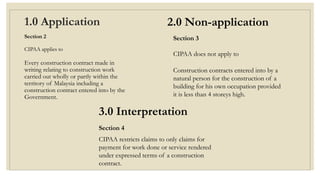
1.0 Application
Section 2
CIPAA applies to
Every construction contract made in
writing relating to construction work
carried out wholly or partly within the
territory of Malaysia including a
construction contract entered into by the
Government.
2.0 Non-application
Section 3
CIPAA does not apply to
Construction contracts entered into by a
natural person for the construction of a
building for his own occupation provided
it is less than 4 storeys high.
3.0 Interpretation
Section 4
CIPAA restricts claims to only claims for
payment for work done or service rendered
under expressed terms of a construction
contract.
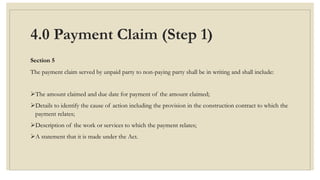
4.0 Payment Claim (Step 1)
Section 5
The payment claim served by unpaid party to non-paying party shall be in writing and shall include:
The amount claimed and due date for payment of the amount claimed;
Details to identify the cause of action including the provision in the construction contract to which the
payment relates;
Description of the work or services to which the payment relates;
A statement that it is made under the Act.
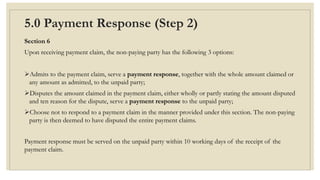
5.0 Payment Response (Step 2)
Section 6
Upon receiving payment claim, the non-paying party has the following 3 options:
Admits to the payment claim, serve a payment response, together with the whole amount claimed or
any amount as admitted, to the unpaid party;
Disputes the amount claimed in the payment claim, either wholly or partly stating the amount disputed
and ten reason for the dispute, serve a payment response to the unpaid party;
Choose not to respond to a payment claim in the manner provided under this section. The non-paying
party is then deemed to have disputed the entire payment claims.
Payment response must be served on the unpaid party within 10 working days of the receipt of the
payment claim.
6.0 Commencement of Adjudication (Step 3)
Section 7
CIPAA provides for an unpaid party to refer a dispute arising from a payment claim to adjudication. The right to refer a
dispute to adjudication can only be carried out after the expiry of the period to serve a payment response as specified.
Section 8
A Claimant may initiate adjudication proceedings by serving a written notice of adjudication on the Respondent (non-
paying party) stating the nature and description of the dispute and remedy sought together with any supporting documents.
Section 21
Once the Respondent has received the notice of adjudication, an adjudicator may be appointed in the following manner:
both parties in dispute agree on an adjudicator within 10 working days from the service of the notice of adjudication
by the Claimant;
both parties in dispute cannot agree on an adjudicator within 10 working days from the service of notice of
adjudication by the Claimant, either party can request the Director of the KLRCA to appoint an adjudicator;
both parties in dispute agree to request the Director of KLRCA to appoint an adjudicator.
7.0 Appointment of Adjudicator (Step 4)
When both parties agreed on an adjudicator, the claimant shall notify the adjudicator to be appointed
in writing and provide him with a copy of the notice of adjudication. The adjudicator shall indicate
his acceptance of his appointment within 10 working days from the date he was notified of his
appointment.
When the adjudicator is appointed by the Director of KLRCA, the Director shall appoint an
adjudicator within 5 working days and shall notify the parties and adjudicator in writing. The
adjudicator shall indicate his acceptance of his appointment within 10 working days from the
date he was notified of his appointment.
8.0 Submission of Adjudication Claim (Step 5)
Section 9
Claimant shall serve an Adjudication Claim within 10 working days from the date of receipt of
acceptance of the appointment from the adjudicator on the Respondent with a copy to the adjudicator.
The Adjudication Claim should contain the nature of the claim, description of the dispute and the
remedy sought together with any supporting document.
The Claimant shall also serve a copy of the Adjudication Claim on the Director of KLRCA within 7
working days after served it to the Respondent.
9.0 Adjudication Response (Step 6)
Section 10 of CIPAA
• Respondents serve on the Claimant
• To answer the adjudication claim and be accompanied by any supporting documents
• Within 10 working days from the date of receipt of the Adjudication Claim
• For government construction contract of RM20m or less, the time limit to serve a
Adjudication Response is within 30 days
• The Respondents shall provide a copy of the Adjudication Response to the adjudicator
• Respondents shall also serve a copy of the Adjudication Response on the KLRCA within
7 working days after serving a written Adjudication Response.
• If fails to serve any adjudication response, the claimant may proceed with the
adjudication
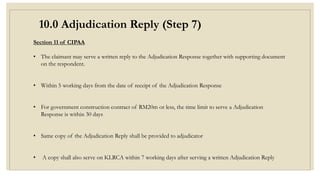
10.0 Adjudication Reply (Step 7)
Section 11 of CIPAA
• The claimant may serve a written reply to the Adjudication Response together with supporting document
on the respondent.
• Within 5 working days from the date of receipt of the Adjudication Response
• For government construction contract of RM20m or less, the time limit to serve a Adjudication
Response is within 30 days
• Same copy of the Adjudication Reply shall be provided to adjudicator
• A copy shall also serve on KLRCA within 7 working days after serving a written Adjudication Reply
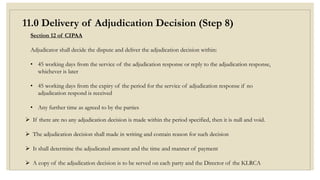
11.0 Delivery of Adjudication Decision (Step 8)
Section 12 of CIPAA
Adjudicator shall decide the dispute and deliver the adjudication decision within:
• 45 working days from the service of the adjudication response or reply to the adjudication response,
whichever is later
• 45 working days from the expiry of the period for the service of adjudication response if no
adjudication respond is received
• Any further time as agreed to by the parties
 If there are no any adjudication decision is made within the period specified, then it is null and void.
 The adjudication decision shall made in writing and contain reason for such decision
 It shall determine the adjudicated amount and the time and manner of payment
 A copy of the adjudication decision is to be served on each party and the Director of the KLRCA
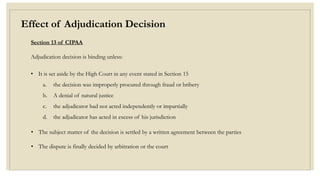
Effect of Adjudication Decision
Section 13 of CIPAA
Adjudication decision is binding unless:
• It is set aside by the High Court in any event stated in Section 15
a. the decision was improperly procured through fraud or bribery
b. A denial of natural justice
c. the adjudicator had not acted independently or impartially
d. the adjudicator has acted in excess of his jurisdiction
• The subject matter of the decision is settled by a written agreement between the parties
• The dispute is finally decided by arbitration or the court
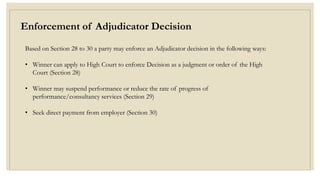
Enforcement of Adjudicator Decision
Based on Section 28 to 30 a party may enforce an Adjudicator decision in the following ways:
• Winner can apply to High Court to enforce Decision as a judgment or order of the High
Court (Section 28)
• Winner may suspend performance or reduce the rate of progress of
performance/consultancy services (Section 29)
• Seek direct payment from employer (Section 30)
Suspension or Reduction of the Rate of Progress of Performance
Section 29 of CIPAA
• Party that intending to suspend work or reduce rate of progress shall give written notice to the other party
• The party who exercise his rights to suspend or reduce the rate of progress
a. Is not in breach of contract
b. Is entitle to a fair and reasonable extension of time to complete his obligations under the contract
c. Entitle to recover any loss and expenses
d. Shall resume performance or the rate of progress within 10 working days after having paid by the
other party
Exemption Order 2014
Section 40 of CIPAA
The Minister of Works may, upon considering the recommendation of the KLRCA, to exempt:
a. Any person or class of persons
b. Any contract, matter or transaction or any class thereof,
from all or any of the provision of this act, subject to such terms and conditions as may be prescribed.
 Exemption Order 2014 also exempts two categories of Government construction contracts from the statutory
adjudication regime under the CIPAA.
1. First categories exempts 2 types of Government construction contracts in respect of construction works:
a. that is carried out urgently and without delay due to natural disaster, flood, landslide, ground subsidence, fire
and other emergency and unforeseen circumstances
b. that relates to national security or security related facilities
2. For second categories, it is only a partial exemption in that it gives the parties to Government construction
contracts with a contract sum of RM20 million or less, a longer period for service of certain documents, such as
the payment response, adjudication response and adjudication reply, than the time frames provided under the
CIPAA.
Q & A
1) What are the main objectives of CIPAA?
 To provide a cheaper and speedy dispute resolution.
 To ensure and promote regular and prompt payment.
 To remove the conditional 'pay when paid' arrangement.
 To reduce the issue of cash flow shortage or non-payment of progress payments.
 To provide remedies for recovery of payment upon the conclusion of adjudication.
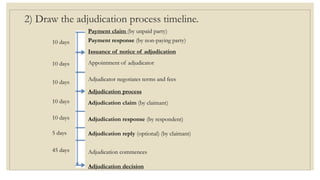
2) Draw the adjudication process timeline.
10 days
10 days
10 days
10 days
10 days
5 days
45 days
Payment claim (by unpaid party)
Payment response (by non-paying party)
Issuance of notice of adjudication
Appointment of adjudicator
Adjudicator negotiates terms and fees
Adjudication process
Adjudication claim (by claimant)
Adjudication response (by respondent)
Adjudication reply (optional) (by claimant)
Adjudication commences
Adjudication decision
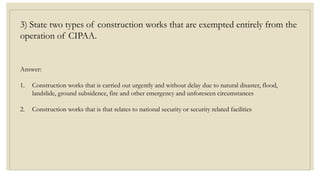
3) State two types of construction works that are exempted entirely from the
operation of CIPAA.
Answer:
1. Construction works that is carried out urgently and without delay due to natural disaster, flood,
landslide, ground subsidence, fire and other emergency and unforeseen circumstances
2. Construction works that is that relates to national security or security related facilities
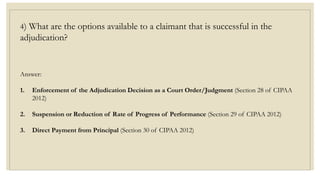
4) What are the options available to a claimant that is successful in the
adjudication?
Answer:
1. Enforcement of the Adjudication Decision as a Court Order/Judgment (Section 28 of CIPAA
2012)
2. Suspension or Reduction of Rate of Progress of Performance (Section 29 of CIPAA 2012)
3. Direct Payment from Principal (Section 30 of CIPAA 2012)

CIPAA presentation

  • 1.
    CONSTRUCTION STATUTE: CIPAA 2012and ITS IMPLEMENTATION YEO DOR EEN YONG SING YEW
  • 2.
    Construction Industry Paymentand Adjudication Act 2012 An Act to recover payment which is due and haven’t paid for construction work done or services rendered. Enacted in Parliament on 22nd June 2012 and came into operation on 15th April 2014. Divided into 7 parts. Has 41 sections. CIPAA is an Act of Parliament that makes adjudication compulsory via statutory adjudication, hence, it does not allow parties to contract out of the provisions of CIPAA and all construction contracts would be bound by this statutory adjudication. What is CIPAA?
  • 3.
    Main Objectives of CIPAA provide acheaper and speedy dispute resolution mechanism of adjudication in the construction industry. ensure and promote regular and prompt payment. remove the conditional 'pay when paid' arrangement. reduce the issue of cash flow shortage or non-payment of progress payments which has always been a major hindrance by obstructing the progress and completion of many construction projects. provides remedies for recovery of payment upon the conclusion of adjudication. a mandatory statutory process that does not require the agreement of the parties’ to commence the process and prevails over any contractual agreements to the contrary between the parties. Statutory adjudication can commenced at any time whether during or after the project completion.
  • 4.
  • 5.
    1.0 Application Section 2 CIPAAapplies to Every construction contract made in writing relating to construction work carried out wholly or partly within the territory of Malaysia including a construction contract entered into by the Government. 2.0 Non-application Section 3 CIPAA does not apply to Construction contracts entered into by a natural person for the construction of a building for his own occupation provided it is less than 4 storeys high. 3.0 Interpretation Section 4 CIPAA restricts claims to only claims for payment for work done or service rendered under expressed terms of a construction contract.
  • 6.
    4.0 Payment Claim(Step 1) Section 5 The payment claim served by unpaid party to non-paying party shall be in writing and shall include: The amount claimed and due date for payment of the amount claimed; Details to identify the cause of action including the provision in the construction contract to which the payment relates; Description of the work or services to which the payment relates; A statement that it is made under the Act.
  • 7.
    5.0 Payment Response(Step 2) Section 6 Upon receiving payment claim, the non-paying party has the following 3 options: Admits to the payment claim, serve a payment response, together with the whole amount claimed or any amount as admitted, to the unpaid party; Disputes the amount claimed in the payment claim, either wholly or partly stating the amount disputed and ten reason for the dispute, serve a payment response to the unpaid party; Choose not to respond to a payment claim in the manner provided under this section. The non-paying party is then deemed to have disputed the entire payment claims. Payment response must be served on the unpaid party within 10 working days of the receipt of the payment claim.
  • 8.
    6.0 Commencement ofAdjudication (Step 3) Section 7 CIPAA provides for an unpaid party to refer a dispute arising from a payment claim to adjudication. The right to refer a dispute to adjudication can only be carried out after the expiry of the period to serve a payment response as specified. Section 8 A Claimant may initiate adjudication proceedings by serving a written notice of adjudication on the Respondent (non- paying party) stating the nature and description of the dispute and remedy sought together with any supporting documents. Section 21 Once the Respondent has received the notice of adjudication, an adjudicator may be appointed in the following manner: both parties in dispute agree on an adjudicator within 10 working days from the service of the notice of adjudication by the Claimant; both parties in dispute cannot agree on an adjudicator within 10 working days from the service of notice of adjudication by the Claimant, either party can request the Director of the KLRCA to appoint an adjudicator; both parties in dispute agree to request the Director of KLRCA to appoint an adjudicator.
  • 9.
    7.0 Appointment ofAdjudicator (Step 4) When both parties agreed on an adjudicator, the claimant shall notify the adjudicator to be appointed in writing and provide him with a copy of the notice of adjudication. The adjudicator shall indicate his acceptance of his appointment within 10 working days from the date he was notified of his appointment. When the adjudicator is appointed by the Director of KLRCA, the Director shall appoint an adjudicator within 5 working days and shall notify the parties and adjudicator in writing. The adjudicator shall indicate his acceptance of his appointment within 10 working days from the date he was notified of his appointment.
  • 10.
    8.0 Submission ofAdjudication Claim (Step 5) Section 9 Claimant shall serve an Adjudication Claim within 10 working days from the date of receipt of acceptance of the appointment from the adjudicator on the Respondent with a copy to the adjudicator. The Adjudication Claim should contain the nature of the claim, description of the dispute and the remedy sought together with any supporting document. The Claimant shall also serve a copy of the Adjudication Claim on the Director of KLRCA within 7 working days after served it to the Respondent.
  • 11.
    9.0 Adjudication Response(Step 6) Section 10 of CIPAA • Respondents serve on the Claimant • To answer the adjudication claim and be accompanied by any supporting documents • Within 10 working days from the date of receipt of the Adjudication Claim • For government construction contract of RM20m or less, the time limit to serve a Adjudication Response is within 30 days • The Respondents shall provide a copy of the Adjudication Response to the adjudicator • Respondents shall also serve a copy of the Adjudication Response on the KLRCA within 7 working days after serving a written Adjudication Response. • If fails to serve any adjudication response, the claimant may proceed with the adjudication
  • 12.
    10.0 Adjudication Reply(Step 7) Section 11 of CIPAA • The claimant may serve a written reply to the Adjudication Response together with supporting document on the respondent. • Within 5 working days from the date of receipt of the Adjudication Response • For government construction contract of RM20m or less, the time limit to serve a Adjudication Response is within 30 days • Same copy of the Adjudication Reply shall be provided to adjudicator • A copy shall also serve on KLRCA within 7 working days after serving a written Adjudication Reply
  • 13.
    11.0 Delivery ofAdjudication Decision (Step 8) Section 12 of CIPAA Adjudicator shall decide the dispute and deliver the adjudication decision within: • 45 working days from the service of the adjudication response or reply to the adjudication response, whichever is later • 45 working days from the expiry of the period for the service of adjudication response if no adjudication respond is received • Any further time as agreed to by the parties  If there are no any adjudication decision is made within the period specified, then it is null and void.  The adjudication decision shall made in writing and contain reason for such decision  It shall determine the adjudicated amount and the time and manner of payment  A copy of the adjudication decision is to be served on each party and the Director of the KLRCA
  • 14.
    Effect of AdjudicationDecision Section 13 of CIPAA Adjudication decision is binding unless: • It is set aside by the High Court in any event stated in Section 15 a. the decision was improperly procured through fraud or bribery b. A denial of natural justice c. the adjudicator had not acted independently or impartially d. the adjudicator has acted in excess of his jurisdiction • The subject matter of the decision is settled by a written agreement between the parties • The dispute is finally decided by arbitration or the court
  • 15.
    Enforcement of AdjudicatorDecision Based on Section 28 to 30 a party may enforce an Adjudicator decision in the following ways: • Winner can apply to High Court to enforce Decision as a judgment or order of the High Court (Section 28) • Winner may suspend performance or reduce the rate of progress of performance/consultancy services (Section 29) • Seek direct payment from employer (Section 30)
  • 16.
    Suspension or Reductionof the Rate of Progress of Performance Section 29 of CIPAA • Party that intending to suspend work or reduce rate of progress shall give written notice to the other party • The party who exercise his rights to suspend or reduce the rate of progress a. Is not in breach of contract b. Is entitle to a fair and reasonable extension of time to complete his obligations under the contract c. Entitle to recover any loss and expenses d. Shall resume performance or the rate of progress within 10 working days after having paid by the other party
  • 17.
    Exemption Order 2014 Section40 of CIPAA The Minister of Works may, upon considering the recommendation of the KLRCA, to exempt: a. Any person or class of persons b. Any contract, matter or transaction or any class thereof, from all or any of the provision of this act, subject to such terms and conditions as may be prescribed.
  • 18.
     Exemption Order2014 also exempts two categories of Government construction contracts from the statutory adjudication regime under the CIPAA. 1. First categories exempts 2 types of Government construction contracts in respect of construction works: a. that is carried out urgently and without delay due to natural disaster, flood, landslide, ground subsidence, fire and other emergency and unforeseen circumstances b. that relates to national security or security related facilities 2. For second categories, it is only a partial exemption in that it gives the parties to Government construction contracts with a contract sum of RM20 million or less, a longer period for service of certain documents, such as the payment response, adjudication response and adjudication reply, than the time frames provided under the CIPAA.
  • 19.
  • 20.
    1) What arethe main objectives of CIPAA?  To provide a cheaper and speedy dispute resolution.  To ensure and promote regular and prompt payment.  To remove the conditional 'pay when paid' arrangement.  To reduce the issue of cash flow shortage or non-payment of progress payments.  To provide remedies for recovery of payment upon the conclusion of adjudication.
  • 21.
    2) Draw theadjudication process timeline. 10 days 10 days 10 days 10 days 10 days 5 days 45 days Payment claim (by unpaid party) Payment response (by non-paying party) Issuance of notice of adjudication Appointment of adjudicator Adjudicator negotiates terms and fees Adjudication process Adjudication claim (by claimant) Adjudication response (by respondent) Adjudication reply (optional) (by claimant) Adjudication commences Adjudication decision
  • 22.
    3) State twotypes of construction works that are exempted entirely from the operation of CIPAA. Answer: 1. Construction works that is carried out urgently and without delay due to natural disaster, flood, landslide, ground subsidence, fire and other emergency and unforeseen circumstances 2. Construction works that is that relates to national security or security related facilities
  • 23.
    4) What arethe options available to a claimant that is successful in the adjudication? Answer: 1. Enforcement of the Adjudication Decision as a Court Order/Judgment (Section 28 of CIPAA 2012) 2. Suspension or Reduction of Rate of Progress of Performance (Section 29 of CIPAA 2012) 3. Direct Payment from Principal (Section 30 of CIPAA 2012)