CIA Missile Launch Keener Math Pd 7
Team Members Jeremiah Good- Team Leader, Overseer.  Ty Snyder- Calculations. Rachel Grove- Designer. Mitch Grove-  Answer checker.
Process The first step we did was we found the distance from the earth to the moon. The next step was entering the day numbers and miles traveled into a graphing calculator for each missile, and then graphed this on the calculator. Next, we found the best fit line for each missile.
Then we graphed the best fit lines and found the point of intersection. We found the conclusion by knowing that the X variable in the point of intersection is the number of days it took for the missiles to collide. The Y variable is the mile mark as to where the two missiles collided. We were able to stop the nuclear missile before it reached the moon.
Graphs All graphs that were used were calculated using a graphing calculator, therefore all the graphs we made are stored to the calculator.
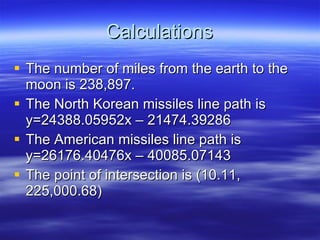
Calculations The number of miles from the earth to the moon is 238,897. The North Korean missiles line path is y=24388.05952x – 21474.39286 The American missiles line path is y=26176.40476x – 40085.07143 The point of intersection is (10.11, 225,000.68)
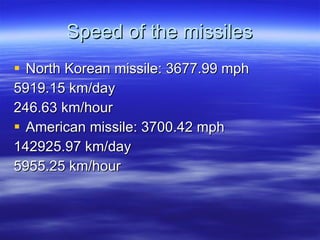
Speed of the missiles North Korean missile: 3677.99 mph 5919.15 km/day 246.63 km/hour American missile: 3700.42 mph 142925.97 km/day 5955.25 km/hour
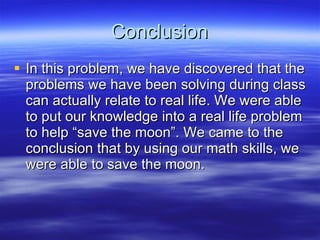
Conclusion In this problem, we have discovered that the problems we have been solving during class can actually relate to real life. We were able to put our knowledge into a real life problem to help “save the moon”. We came to the conclusion that by using our math skills, we were able to save the moon.
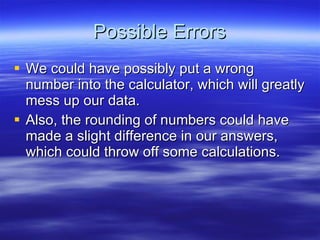
Possible Errors We could have possibly put a wrong number into the calculator, which will greatly mess up our data. Also, the rounding of numbers could have made a slight difference in our answers, which could throw off some calculations.

Cia Missile Launch

  • 1.
    CIA Missile LaunchKeener Math Pd 7
  • 2.
    Team Members JeremiahGood- Team Leader, Overseer. Ty Snyder- Calculations. Rachel Grove- Designer. Mitch Grove- Answer checker.
  • 3.
    Process The firststep we did was we found the distance from the earth to the moon. The next step was entering the day numbers and miles traveled into a graphing calculator for each missile, and then graphed this on the calculator. Next, we found the best fit line for each missile.
  • 4.
    Then we graphedthe best fit lines and found the point of intersection. We found the conclusion by knowing that the X variable in the point of intersection is the number of days it took for the missiles to collide. The Y variable is the mile mark as to where the two missiles collided. We were able to stop the nuclear missile before it reached the moon.
  • 5.
    Graphs All graphsthat were used were calculated using a graphing calculator, therefore all the graphs we made are stored to the calculator.
  • 6.
    Calculations The numberof miles from the earth to the moon is 238,897. The North Korean missiles line path is y=24388.05952x – 21474.39286 The American missiles line path is y=26176.40476x – 40085.07143 The point of intersection is (10.11, 225,000.68)
  • 7.
    Speed of themissiles North Korean missile: 3677.99 mph 5919.15 km/day 246.63 km/hour American missile: 3700.42 mph 142925.97 km/day 5955.25 km/hour
  • 8.
    Conclusion In thisproblem, we have discovered that the problems we have been solving during class can actually relate to real life. We were able to put our knowledge into a real life problem to help “save the moon”. We came to the conclusion that by using our math skills, we were able to save the moon.
  • 9.
    Possible Errors Wecould have possibly put a wrong number into the calculator, which will greatly mess up our data. Also, the rounding of numbers could have made a slight difference in our answers, which could throw off some calculations.